
Life, 1926-01-07 · page 26 of 40
Life — January 7, 1926 — page 26: what you’re looking at
What you’re looking at
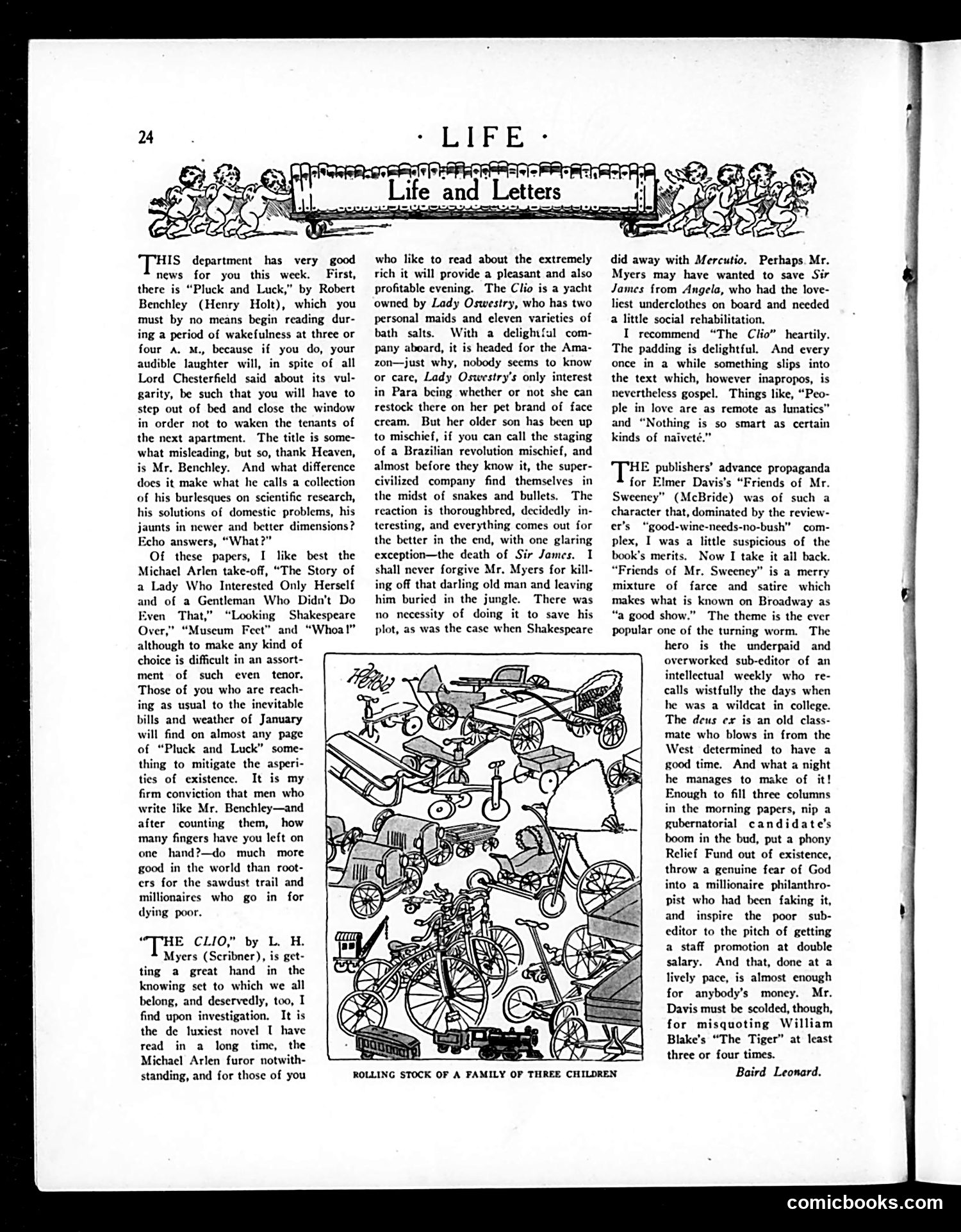
This is a **book review column** rather than political cartooning. The page discusses three novels: Robert Benchley's *Pluck and Luck*, L.H. Myers's *The Clio*, and Elmer Davis's *Friends of Mr. Sweeney*. The **central cartoon** illustrates "rolling stock of a family of three children"—a humorous drawing depicting the improbable array of wheeled toys and vehicles (bicycles, scooters, wagons, carriages) accumulated by one household. This visual joke complements the text's satirical tone about consumer excess and domestic absurdity. The reviews themselves are witty, employing satire to evaluate literature. The critic mocks the wealthy characters in *The Clio* (a yacht novel about the ultra-rich obsessed with trivial matters), and playfully critiques Benchley's scientific satires. The broader satirical point: Life magazine positions itself as arbiter of sophisticated, intelligent reading for its educated audience.
📄 Transcribed text from this page (OCR, searchable)
Machine-transcribed from the original scan — historical spelling and the odd misread are preserved.
THs department has very good news for you this week. First, there is “Pluck and Luck,” by Robert Benchley (Henry Holt), which you must by no means begin reading dur- ing a period of wakefulness at three or four a. M., because if you do, your audible laughter will, in spite of all Lord Chesterfield said about its vul- garity, be such that you will have to step out of bed and close the window in order not to waken the tenants of the next apartment. The title is some- what misleading, but so, thank Heaven, is Mr. Benchley. And what difference does it make what he calls a collection of his burlesques on scientific research, his solutions of domestic problems, his jaunts in newer and better dimensions? Echo answers, “What?” Of these papers, I like best the Michael Arlen take-off, “The Story of a Lady Who Interested Only Herself and of a Gentleman Who Didn't Do Even That,” “Looking Shakespeare Over,” “Museum Feet” and “Whoa!” although to make any kind of choice is difficult in an assort- ment of such even tenor, Those of you who are reach- ing as usual to the inevitable bills and weather of January will find on almost any page of “Pluck and Luck” some- thing to mitigate the asperi- ties of existence. It is my firm conviction that men who write like Mr. Benchley—and after counting them, how many fingers have you left on one hand?—do much more good in the world than root- ers for the sawdust trail and millionaires who go in for dying poor. , E CLIO,” by L. H. Myers (Scribner), is get- ting a great hand in the knowing set to which we all belong, and deservedly, too, I find upon investigation. It is the de luxiest novel [ have read in a long time, the Michael Arlen furor notwith- standing, and for those of you who like to read about the extremely rich it will provide a pleasant and also profitable evening. The Clio is a yacht owned by Lady Oswestry, who has two personal maids and eleven varieties of bath salts. With a delightful com- pany aboard, it is headed for the Ama- zon—just why, nobody seems to know or care, Lady Oswestry’s only interest in Para being whether or not she can restock there on her pet brand of face cream. But her older son has been up to mischief, if you can call the staging of a Brazilian revolution mischief, and almost before they know it, the super- civilized company find themselves in the midst of snakes and bullets, The reaction is thoroughbred, decidedly in- teresting, and everything comes out for the better in the end, with one glaring exception—the death of Sir James. 1 shall never forgive Mr. Myers for kill- ing off that darling old man and leaving him buried in the jungle. There was no necessity of doing it to save his plot, as was the case when Shakespeare ROLLING STOCK OF A FAMILY OP THREE CHILDREN did away with Mercutio. Perhaps. Mr. Myers may have wanted to save Sir James from Angela, who had the love- liest underclothes on board and needed a little social rehabilitation. I recommend “The Clio” heartily. The padding is delightful. And every once in a while something slips into the text which, however inapropos, is nevertheless gospel. Things like, “Peo- ple in love are as remote as lunatics” and “Nothing is so smart as certain kinds of naiveté.” THe publishers’ advance propaganda for Elmer Davis’s “Friends of Mr. Sweeney” (McBride) was of such a character that, dominated by the review- er’s “good-wine-needs-no-bush” com- plex, I was a little suspicious of the book's merits. Now I take it all back. “Friends of Mr. Sweeney” is a merry mixture of farce and satire which makes what is known on Broadway as “a good show.” The theme is the ever popular one of the turning worm. The hero is the underpaid and overworked sub-editor of an intellectual weekly who re- calls wistfully the days when he was a wildcat in college. The deus ex is an old class- mate who blows in from the West determined to have a good time. And what a night he manages to make of Enough to fill three columns in the morning papers, nip a gubernatorial candidate's boom in the bud, put a phony Relief Fund out of existence, throw a genuine fear of God into a millionaire philanthro- pist who had been faking it, and inspire the poor sub- editor to the pitch of getting a staff promotion at double salary. And that, done at a lively pace, is almost enough for anybody’s money. Mr. Davis must be scolded, though, for misquoting William Blake’s “The Tiger” at least three or four times. Baird Leonard. comicbooks.com