
A complete issue · 47 pages · 1925
Life — July 2, 1925
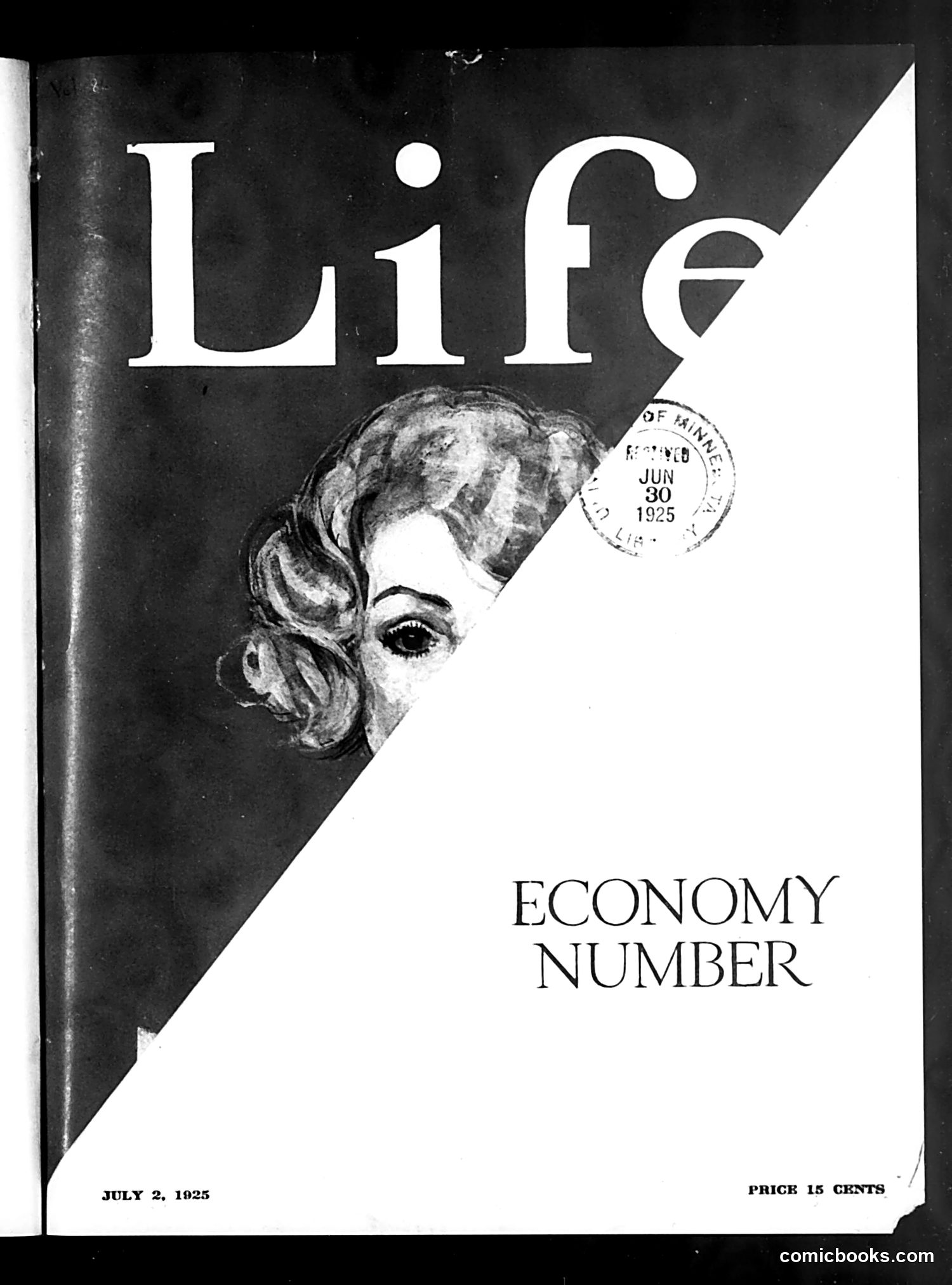
This is the cover of Life's "Economy Number" issue. The design features a woman's face peering around a diagonal white panel—a visual metaphor for economizing or "cutting corners." Her 1920s styling (bobbed hair, defined eye makeup) reflects the contemporary flapper aesthetic. The "Economy Number" designation suggests the issue contains articles addressing economic issues of the mid-1920s, likely during the post-World War I economic adjustment period. The woman's peek-around gesture cleverly illustrates the concept of thriftiness or budgeting—looking to save money by finding bargains or reducing expenses. The cover cost 15 cents and was received June 30, 1925.
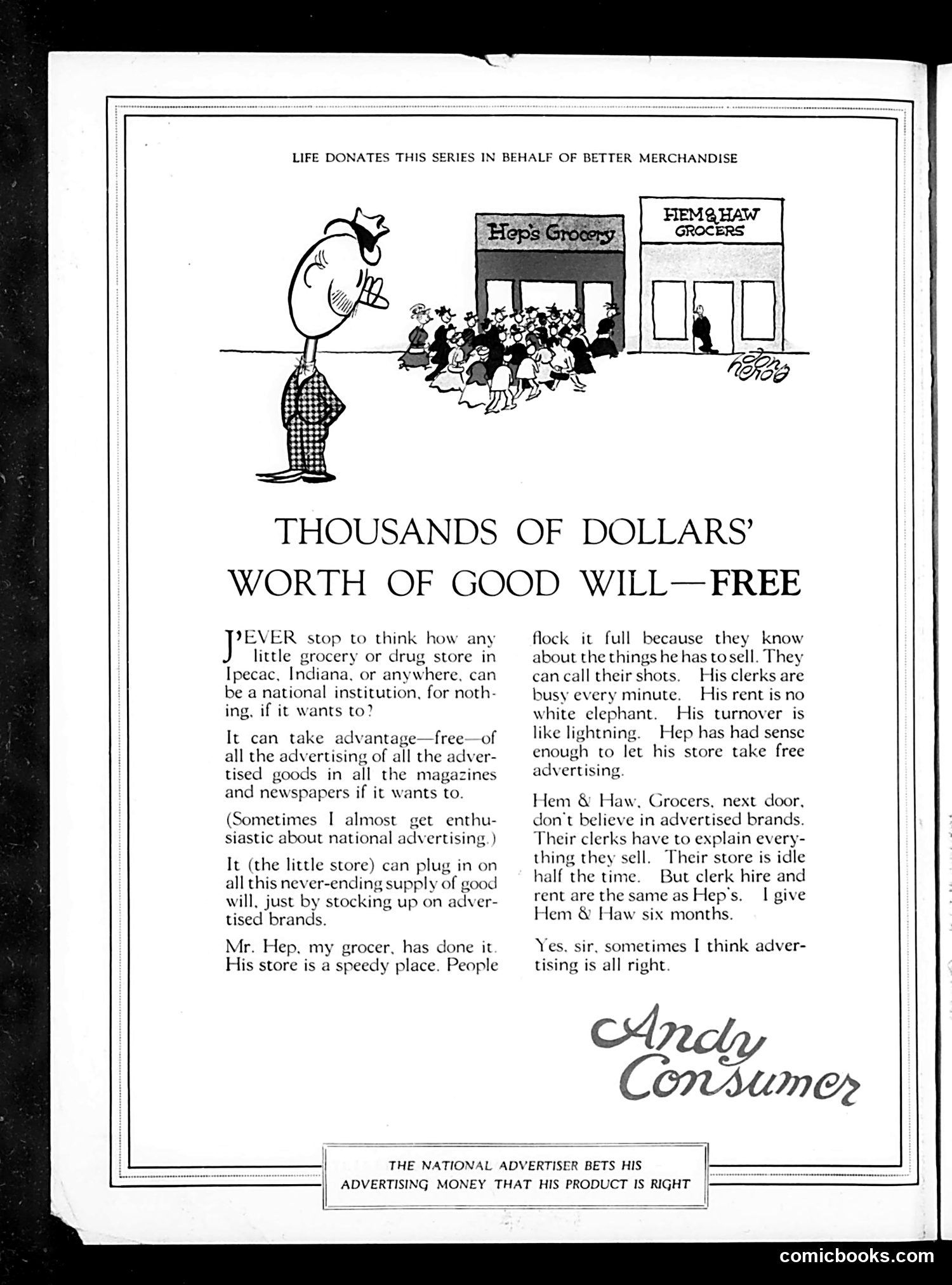
This is an advertisement disguised as editorial content, promoting better merchandise through national advertising. The cartoon contrasts two grocery stores: "Hep's Grocery" (crowded, successful) and "Hem & Haw Grocers" (nearly empty). The satire argues that Hep's thrives because he stocks advertised national brands customers recognize and trust, requiring minimal clerk effort. Hem & Haw's clerks must constantly explain products to skeptical customers who don't recognize unadvertised brands—a inefficient business model. The bylined "Andy Consumer" argues that while advertising seems wasteful, it actually benefits small retailers by creating customer demand for specific products, reducing sales friction. The message: national advertising generates "good will" worth thousands of dollars to local merchants who stock those brands. This reflects early 20th-century debates about modern marketing's economic value.
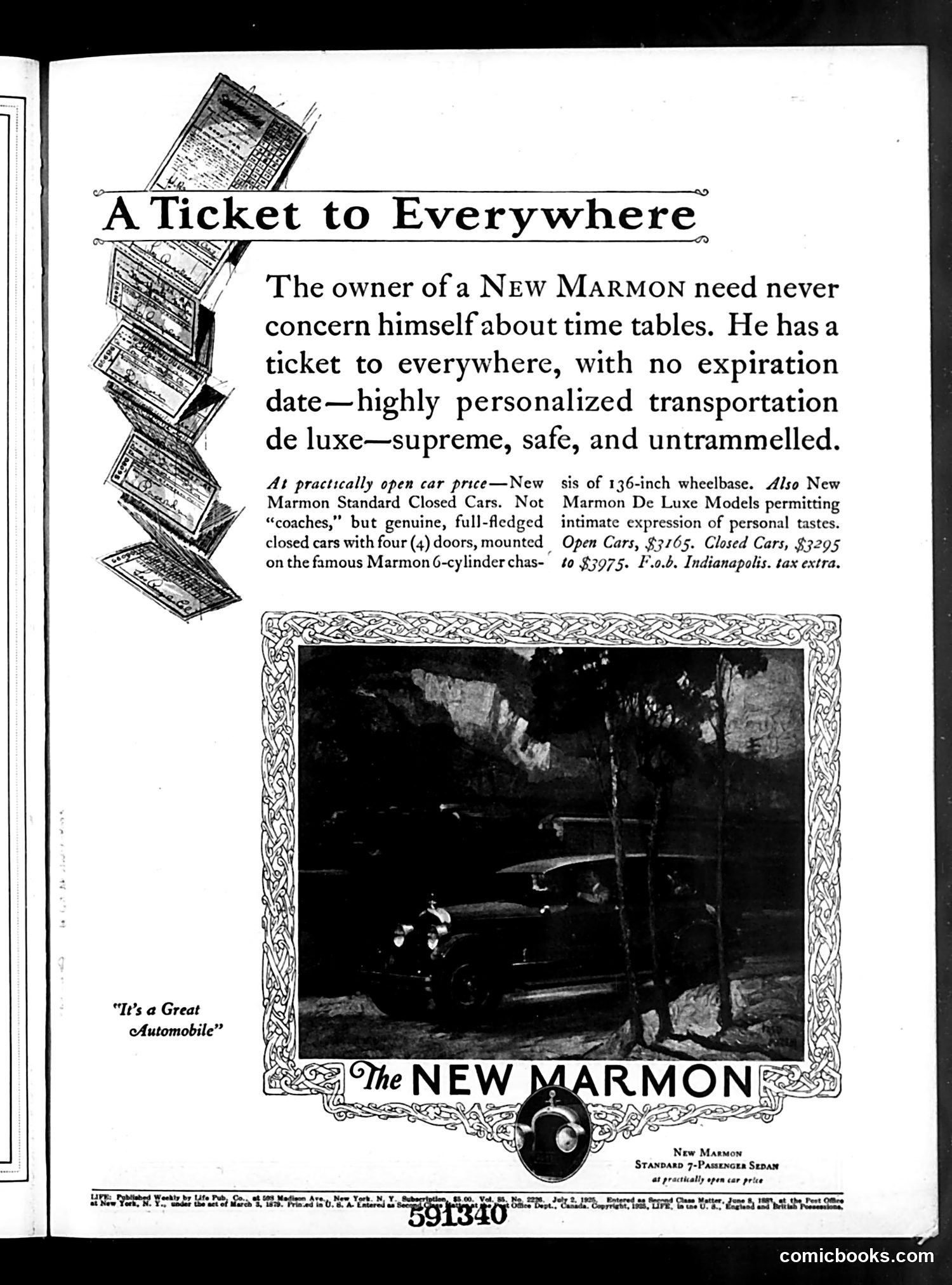
This is primarily a **Marmon automobile advertisement**, not political satire. The page uses the phrase "A Ticket to Everywhere" to market the New Marmon car as luxury transportation offering freedom and status. The visual metaphor stacks stylized tickets to suggest unlimited travel possibilities. The accompanying photograph shows an elegant automobile parked in a scenic setting, appealing to aspirational buyers. The advertisement emphasizes the car's prestigious features: a 6-cylinder engine, multiple body styles (open and closed cars), safety, and smooth operation. Pricing ranges from $2,165 to $3,295. The tagline "It's a Great Automobile" reinforces quality and desirability. This reflects the early automotive era when cars represented luxury and social advancement rather than basic transportation. The ad targets wealthy consumers seeking status symbols.
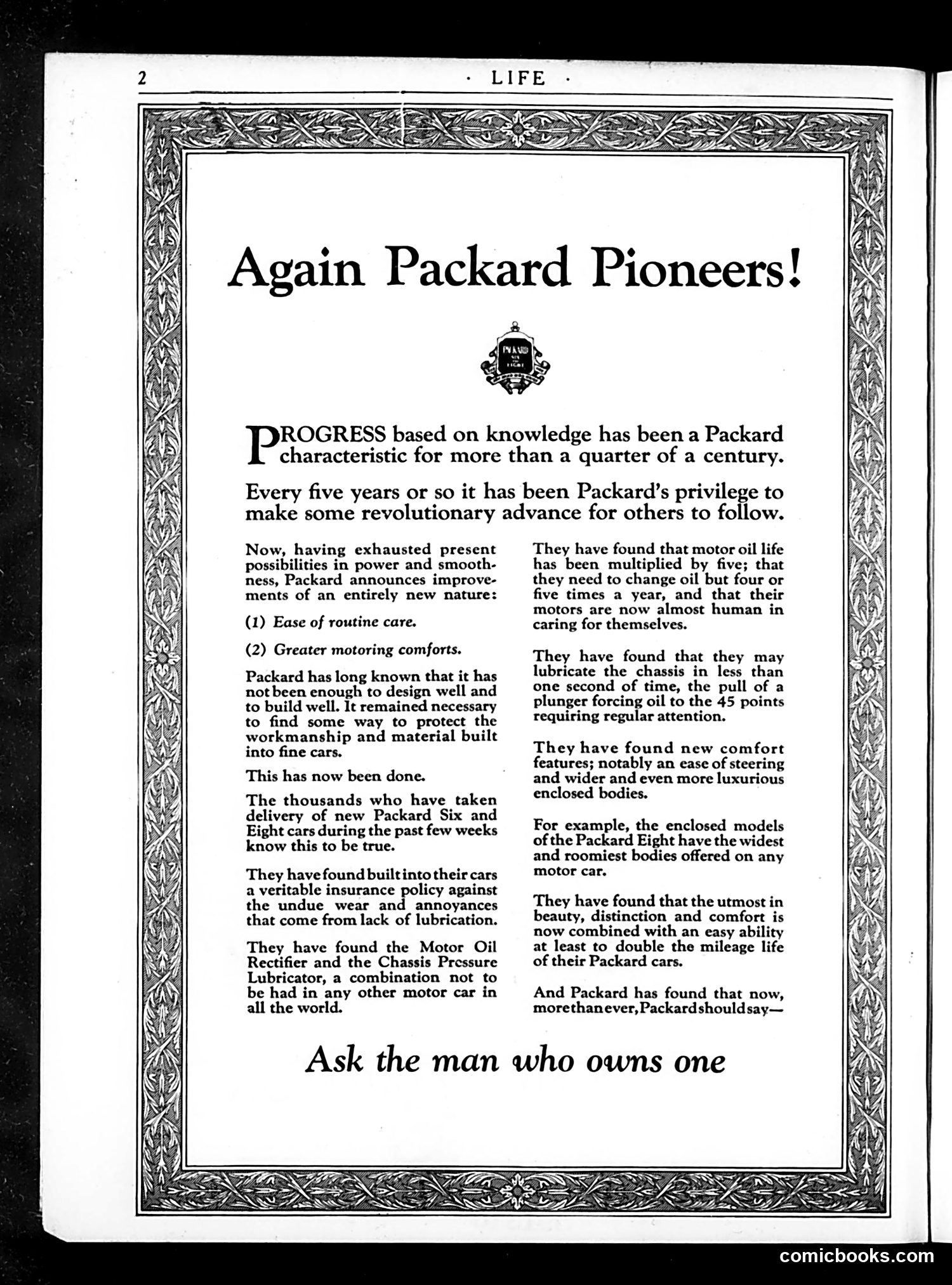
This is **not a satirical cartoon page**, but rather a **Packard automobile advertisement** from *Life* magazine. The page promotes Packard's latest innovations in motor cars, emphasizing: - **Technical advances**: improved lubrication systems, wider enclosed bodies, better steering - **Marketing angle**: "Progress based on knowledge" has been Packard's strategy for 25+ years - **Comfort features**: ease of maintenance, luxury enclosed models (particularly the Packard Eight) - **Call to action**: "Ask the man who owns one" The ornate border and formal layout reflect early 20th-century magazine design. This is straightforward product advertising targeting affluent consumers, not satirical commentary. The Packard brand positions itself as premium and innovation-driven rather than economy-focused.
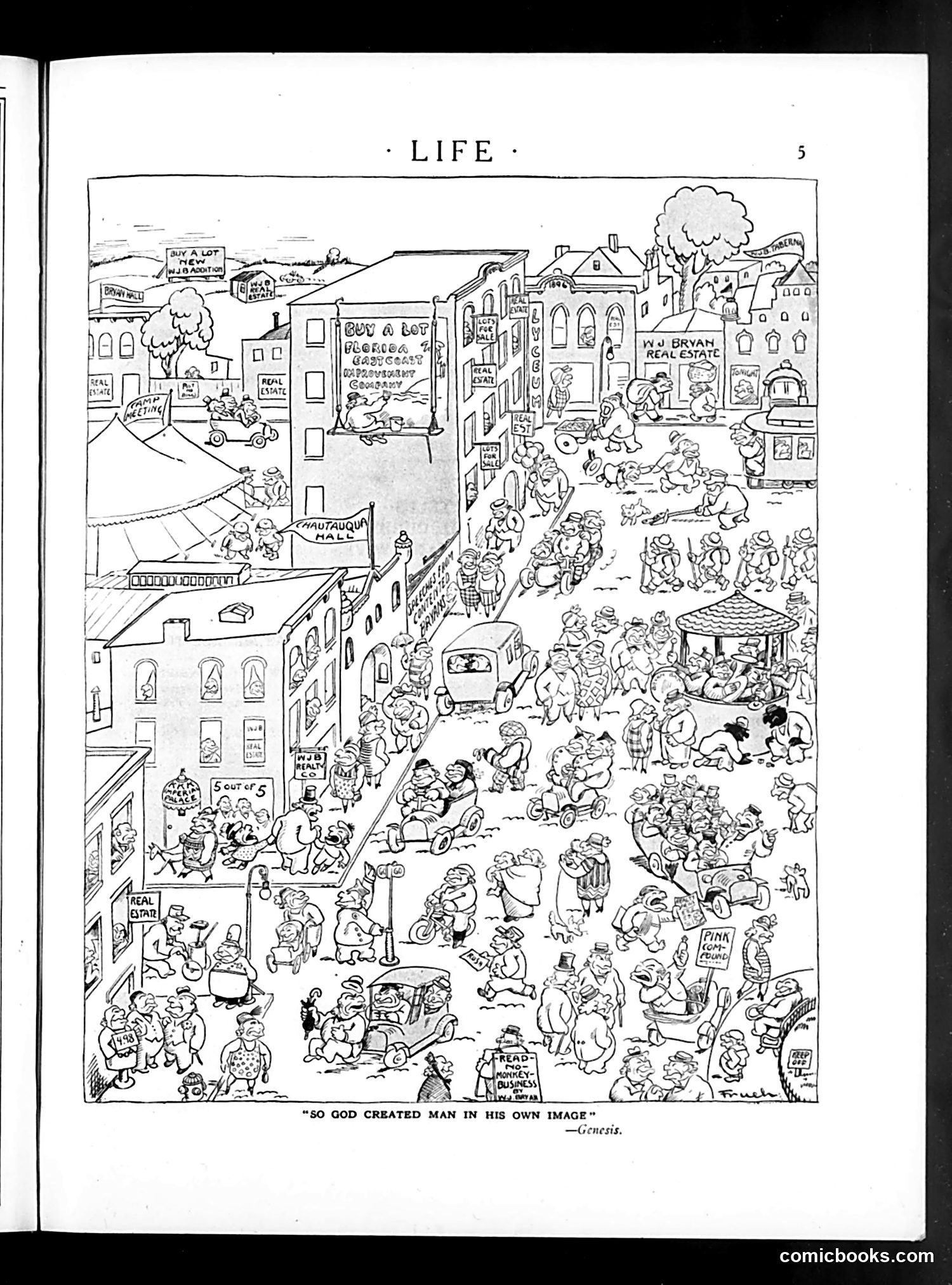
This is a satirical cartoon titled "So God Created Man in His Own Image" (Genesis quote). It depicts a crowded urban street scene filled with dozens of people engaged in various commercial and social activities—buying real estate, conducting business, shopping, playing, and socializing. The satire appears to critique American materialism and consumerism in the early 20th century. Visible signs reference real estate transactions, businesses, and commerce throughout the scene. The ironic biblical epigraph suggests the cartoon is commenting on how humans have shaped civilization according to their own (flawed) nature—emphasizing greed, acquisition, and commerce rather than spiritual values. The densely packed composition emphasizes how thoroughly commercial concerns dominate urban American life.
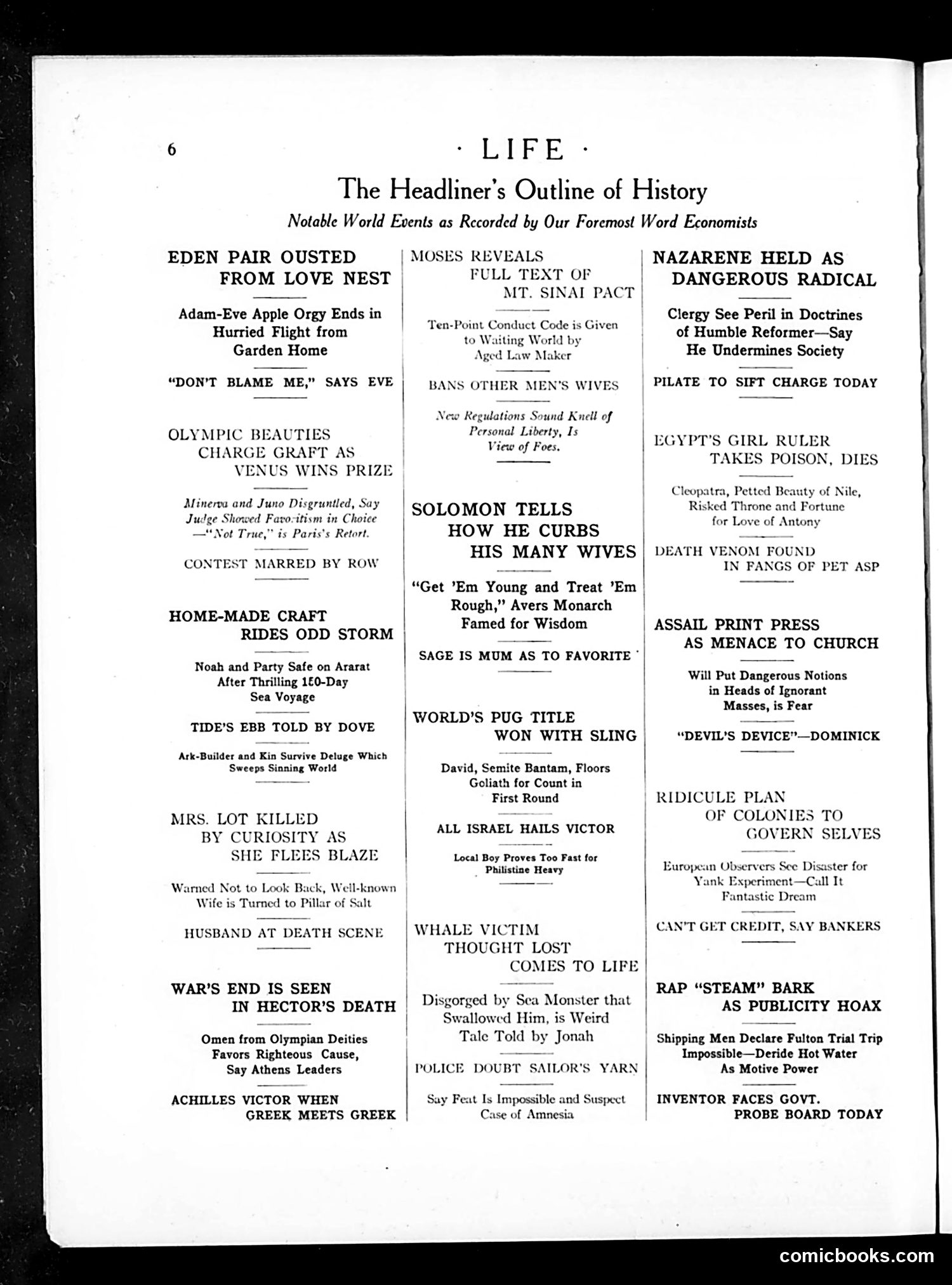
This is "The Headliner's Outline of History"—a satirical news summary using mock-biblical and historical headlines to mock contemporary events. The page parodies serious journalism by presenting current news in grandiose, absurd language. Examples of the satire: - **"Eden Pair Ousted from Love Nest"**: Mock-biblical coverage of a mundane relationship scandal - **"Solomon Tells How He Curbs His Many Wives"**: References the biblical king to mock modern marital advice - **"World's Pug Title Won with Sling"**: Absurdly compares a dog show to David versus Goliath - **"All Israel Hails Victor"**: Inflates trivial local news to epic historical significance The humor relies on juxtaposing ancient/biblical language against ordinary modern events, satirizing both sensationalist journalism and readers' appetite for overwrought news coverage. The format mocks how newspapers treated gossip and minor events as momentous historical occurrences.
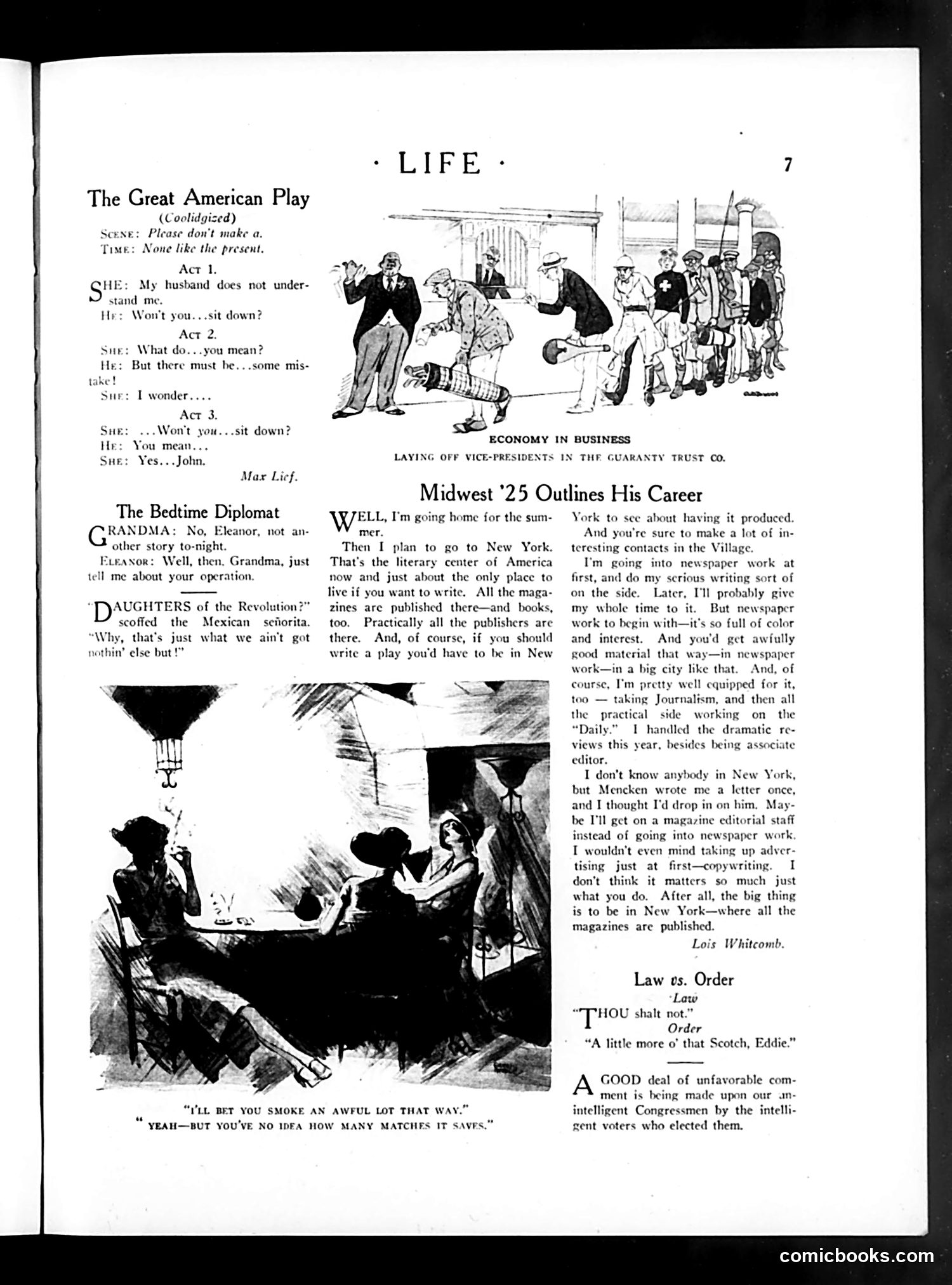
This page contains several satirical pieces typical of early 20th-century Life magazine: **"The Great American Play"** mocks marital incomprehension through a brief dramatic sketch where a husband and wife talk past each other. **"The Bedtime Diplomat"** depicts a grandmother and Eleanor (likely Eleanor Roosevelt, given the era) in dialogue about historical "Daughters of the Revolution"—satirizing upper-class women's patriotic societies. **"Economy in Business"** cartoon shows businessmen laying off vice-presidents, mocking corporate cost-cutting during economic uncertainty. **"Midwest '25 Outlines His Career"** profiles an aspiring writer's ambitions to work in New York publishing and journalism. **"Law vs. Order"** makes a brief political jab at congressmen, suggesting voters' criticism of elected officials. The overall tone reflects 1920s-era social satire on marriage, class pretension, business practices, and politics.

I can see this is a mostly black page from comicbooks.com with very faint imagery that's difficult to discern clearly. There appear to be some circular designs or emblems visible in the darker areas, and there's a white border on the right edge, but the content is too dark and degraded to make out specific figures, text, or satirical elements with confidence. Without being able to read the OCR text clearly or see distinct illustrations, I cannot reliably identify what political figures, social references, or jokes this page contains. This appears to be either a heavily aged/damaged scan, a back cover, or a page where the image quality prevents accurate analysis. To provide accurate historical context as you've requested, I would need a clearer image or more legible OCR text.
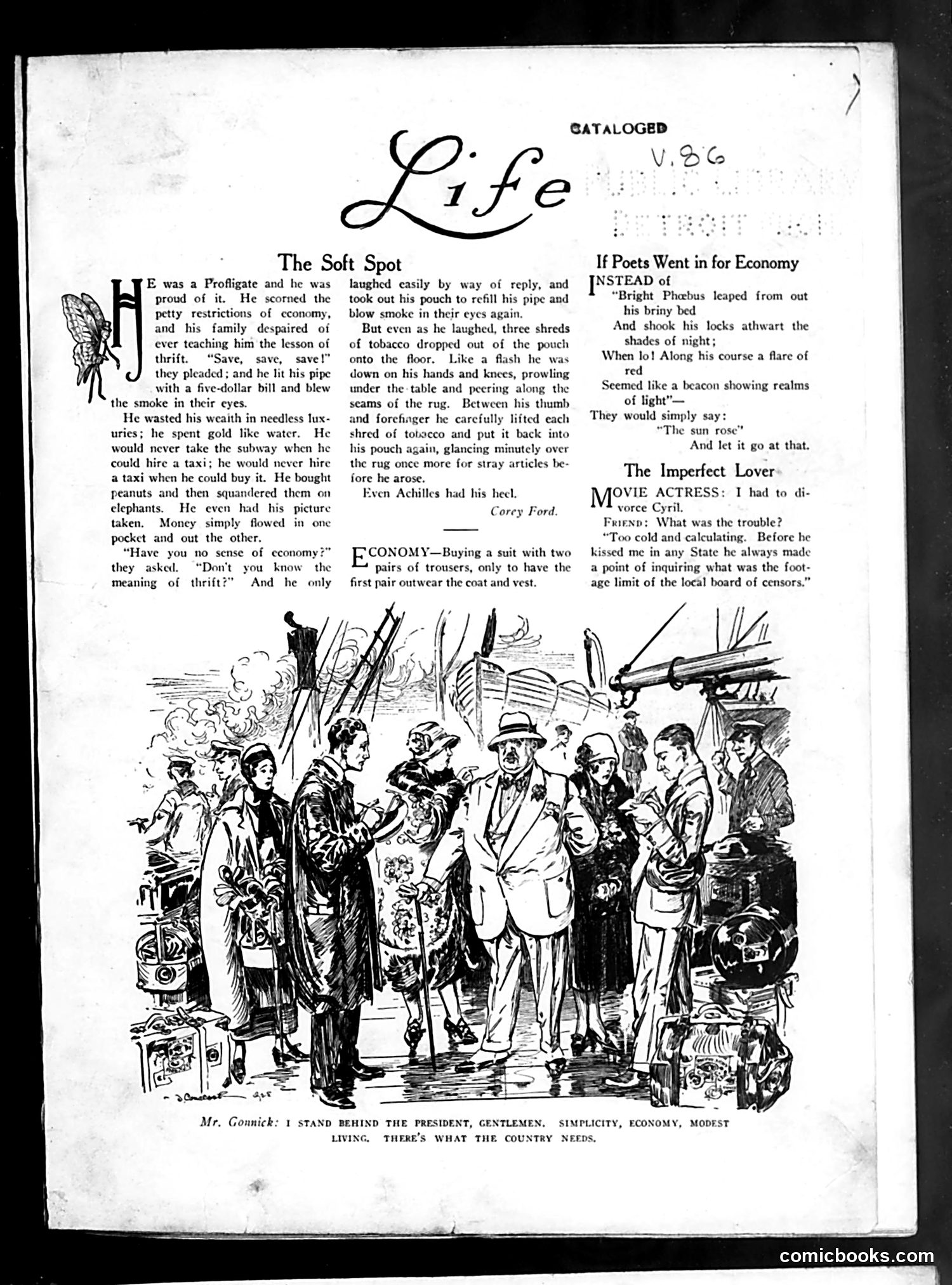
This page contains three separate satirical pieces mocking wastefulness and pretense. **"The Soft Spot"** ridicules a man claiming to practice economy while actually squandering money—he boasts of thrift but wastes wealth on luxuries (avoiding subways, buying expensive items, maintaining expensive hobbies like collecting elephant pictures). The joke: his professed values contradict his behavior. **"Economy"** satirizes false frugality in purchasing—buying a cheap suit where only the outer layers wear well, while hidden layers deteriorate quickly. It's false economy. **"The Imperfect Lover"** and **"If Poets Went in for Economy"** are brief humor pieces mocking romantic and poetic pretension. The illustrated scene at bottom (captioned about "Mr. Gonnick") appears to mock political hypocrisy regarding thrift and living simply—likely satirizing politicians preaching austerity while appearing surrounded by luxury and excess.
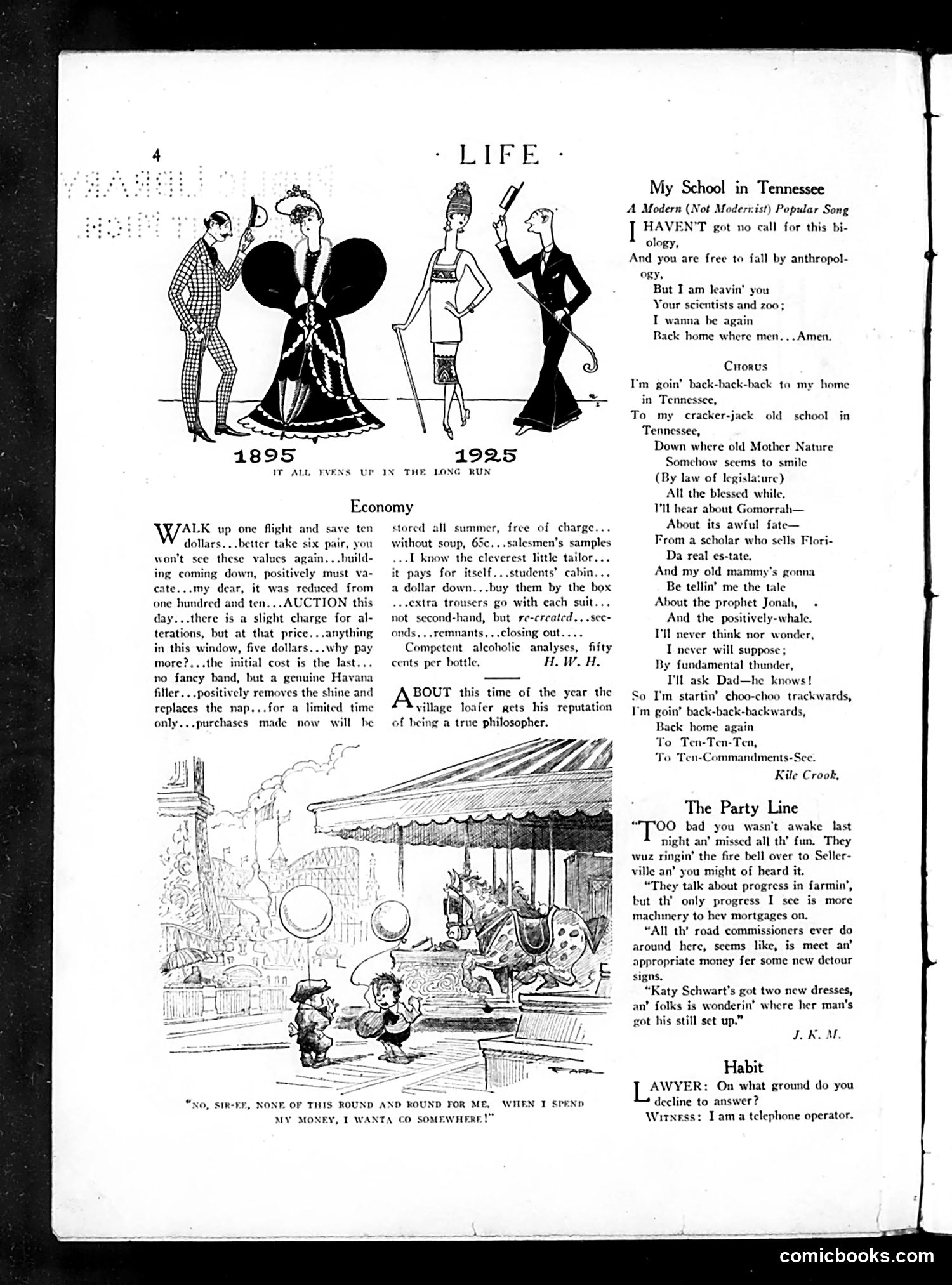
The top illustration contrasts fashion between 1895 and 1925—showing how dramatically women's clothing changed in thirty years. The 1895 figure wears a restrictive corset and bustle; the 1925 figure wears a loose, modern flapper dress. This satirizes the rapid social transformation of the Jazz Age. The main cartoon depicts a carnival or fair scene with the caption: "No, Sir-ee. None of this round and round for me. When I spend my money, I wanta go somewhere!" This mocks the frivolous consumer culture and spending habits of the 1920s—people wanting tangible goods rather than simple amusement. The page also includes social commentary through short pieces like "The Party Line" and "Habit," critiquing small-town gossip and modern behavior changes during this period of significant social upheaval.
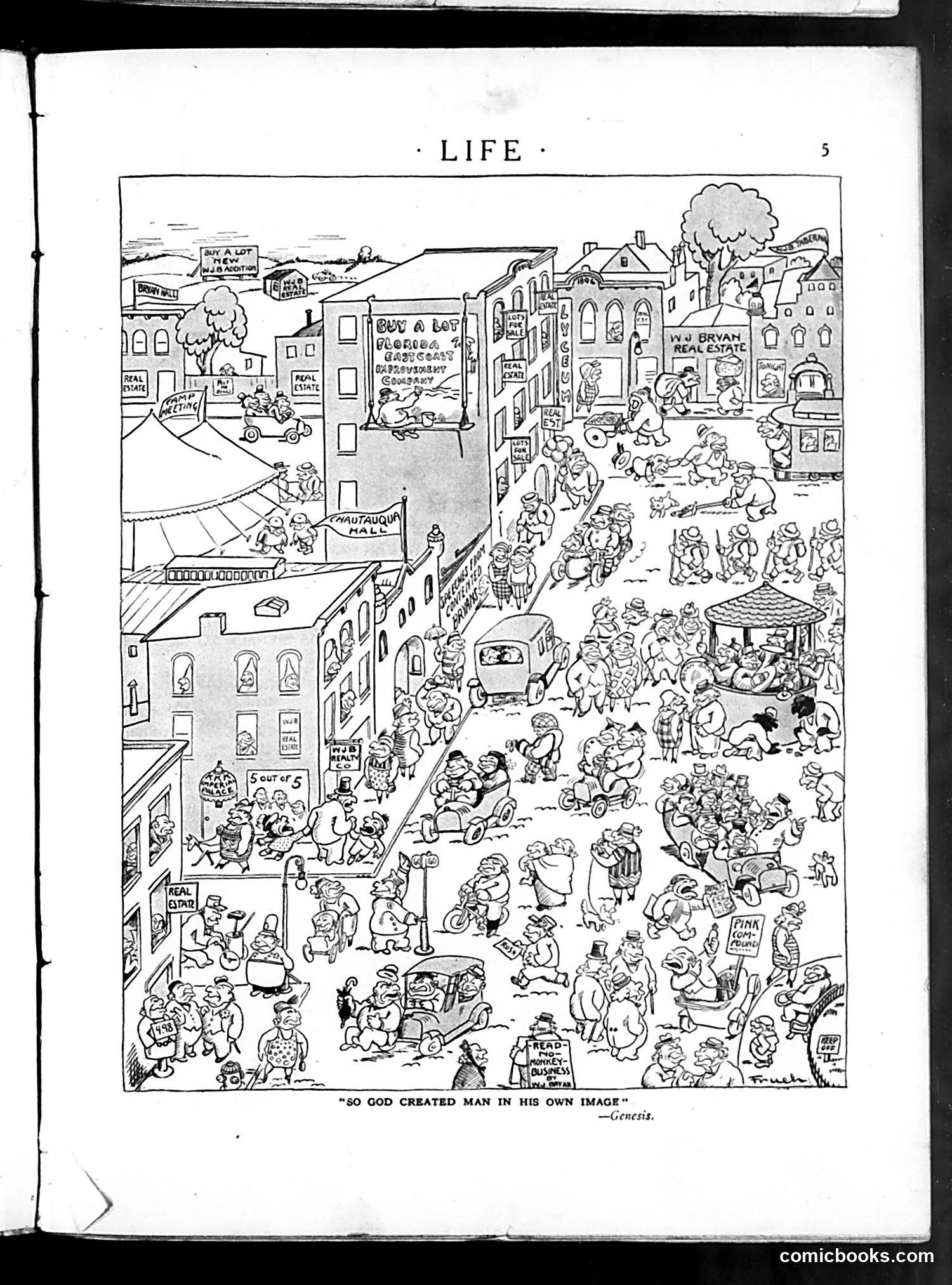
This is a bustling satirical scene depicting a crowded commercial street or marketplace. The cartoon shows numerous figures engaged in various activities—shopping, selling, socializing—amid buildings labeled with business names like "Buy a Lot," "Real Estate," and what appears to be commercial establishments. The epigraph quotes Genesis: "So God created man in his own image," creating ironic contrast between divine creation and the materialistic, mercenary chaos depicted below. The satire appears to critique commercial excess, consumerism, and the degradation of human values in pursuit of profit and real estate speculation. Various signs reference buying, selling, and financial transactions. The crowded, frenetic composition emphasizes the madness of unbridled commercialism and consumer culture. The work likely dates to Life's early satirical period, critiquing American capitalism and consumer society.
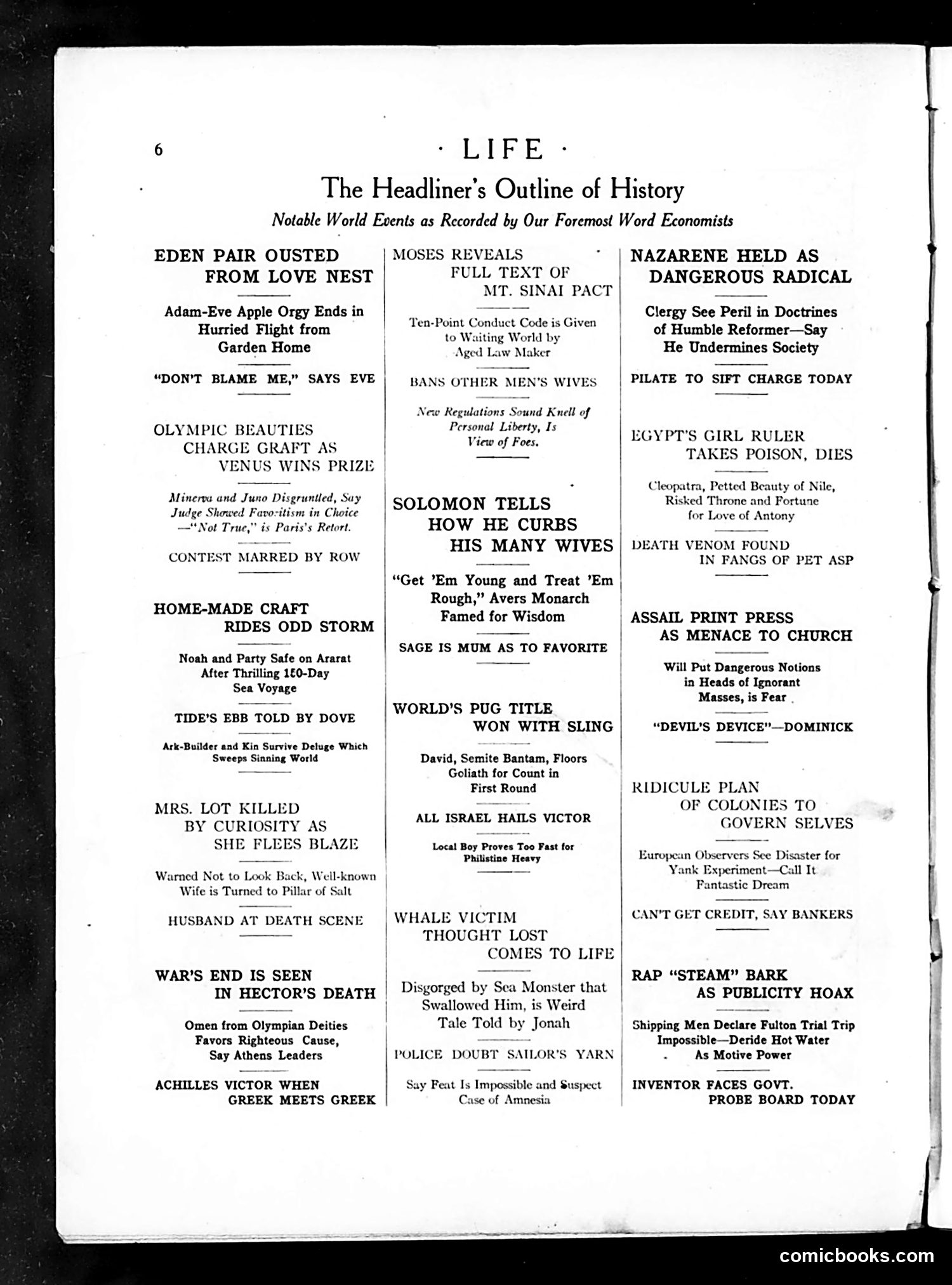
This is a satirical mock-newspaper headlines page parodying biblical and historical events with absurdist humor. The page presents fictionalized "news" about Adam and Eve, Moses, Solomon, Cleopatra, and other historical/biblical figures as if they were contemporary scandals. Examples include: "Eden Pair Ousted from Love Nest" (Adam-Eve); "Solomon Tells How He Curbs His Many Wives"; "Egypt's Girl Ruler Takes Poison, Dies" (Cleopatra). The satire works by treating ancient history as tabloid gossip—applying modern journalistic sensationalism and domestic drama conventions to revered historical figures. This mocks both contemporary sensationalist press and how we trivialize serious history into entertainment. The humor relies on incongruity between dignified historical subjects and cheap tabloid treatment.
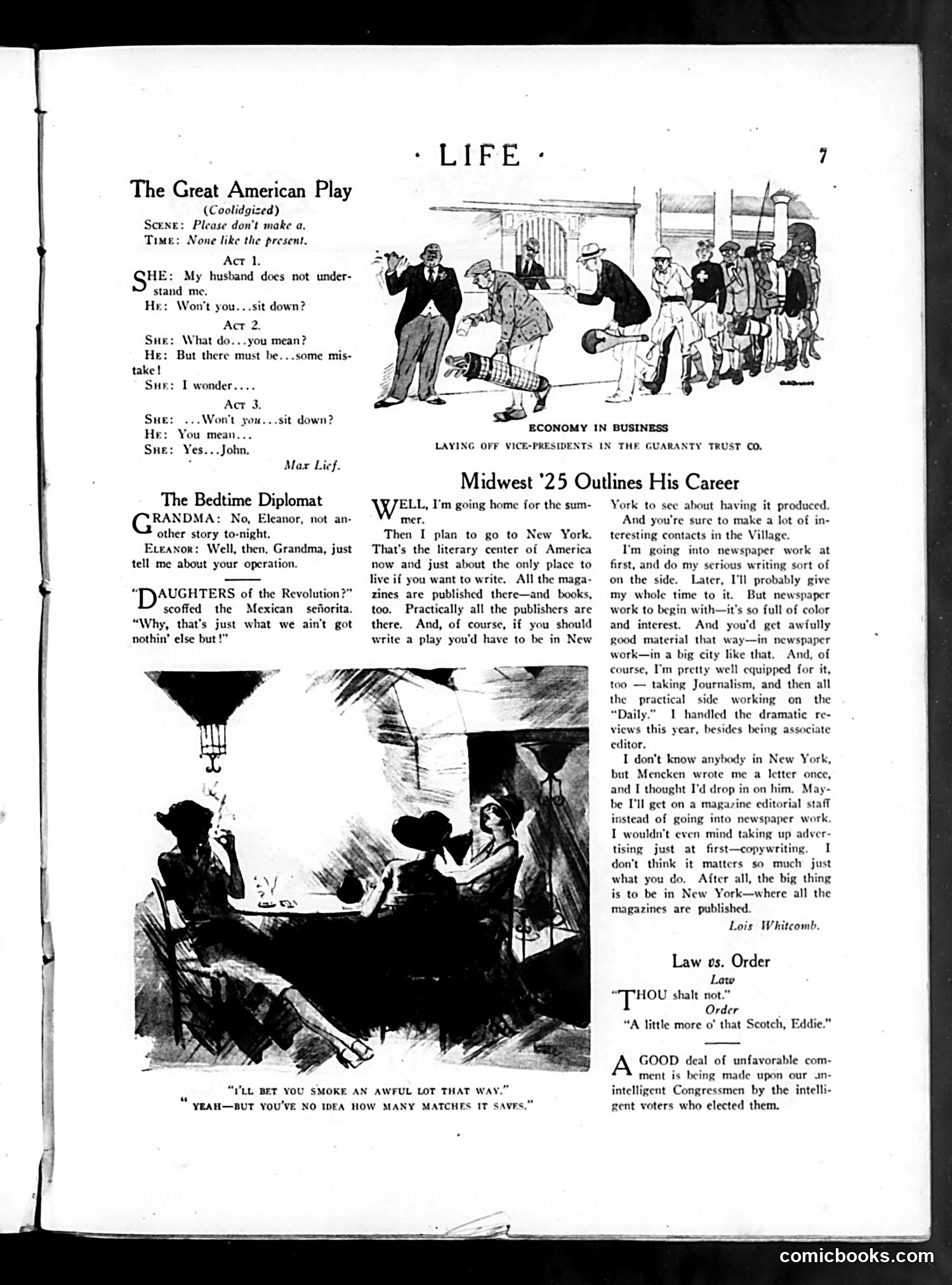
This page contains satirical sketches and short pieces typical of Life's humor content. **Top cartoon** ("Economy in Business"): Shows businessmen laying off vice-presidents at a "Guaranty Trust Co." — satirizing corporate cost-cutting during economic hardship, likely the 1920s recession period. **"The Bedtime Diplomat"** and **"The Great American Play"**: Brief comedic sketches mocking domestic arguments and theatrical pretension. **Lower illustration**: A dramatic sketch accompanying "The Bedtime Diplomat," showing figures in conversation, with dialogue about smoking. **"Midwest '25 Outlines His Career"**: A longer piece where someone named Lois Whitcomb describes ambitions to work in New York journalism and publishing. The page reflects 1920s concerns: economic instability, media careers, and marital comedy. No specific political figures are identifiable—the satire targets general social types and situations.
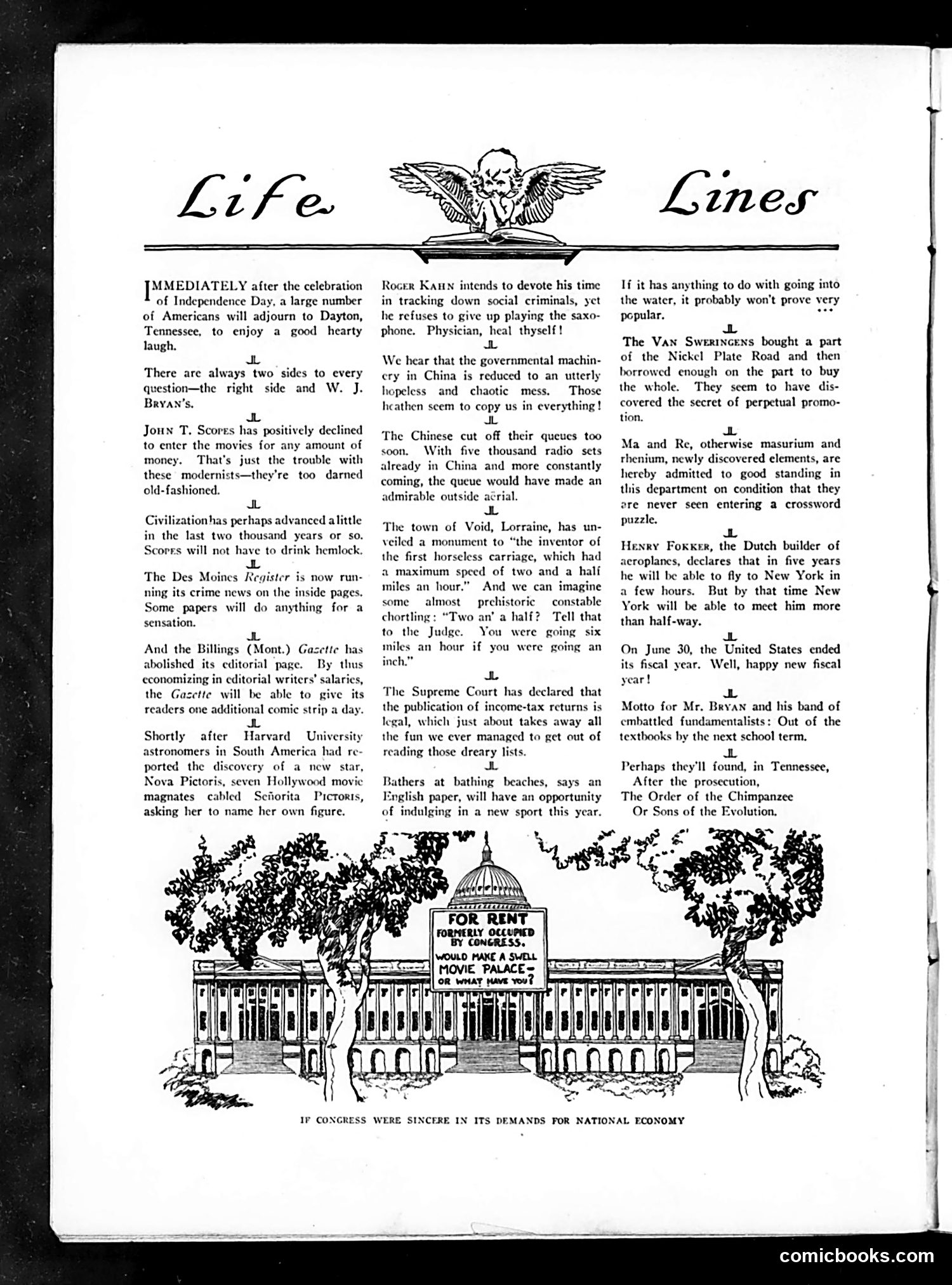
This is a satirical news commentary page from *Life* magazine. The main cartoon at bottom depicts the U.S. Capitol building with a "For Rent" sign, captioned "If Congress Were Sincere in Its Demands for National Economy." The satire suggests Congress demands fiscal responsibility from citizens while being wasteful itself—implying the building should be rented out if lawmakers truly practiced the economy they preach. The column above contains brief satirical items mocking various contemporary figures and institutions: Roger Kahn (saxophonist), W.J. Bryan's political inconsistency, John T. Scopes (the evolution trial defendant), Chinese governmental chaos, and Supreme Court tax policy. The humor relies on readers recognizing these public figures and current events from the 1920s era.
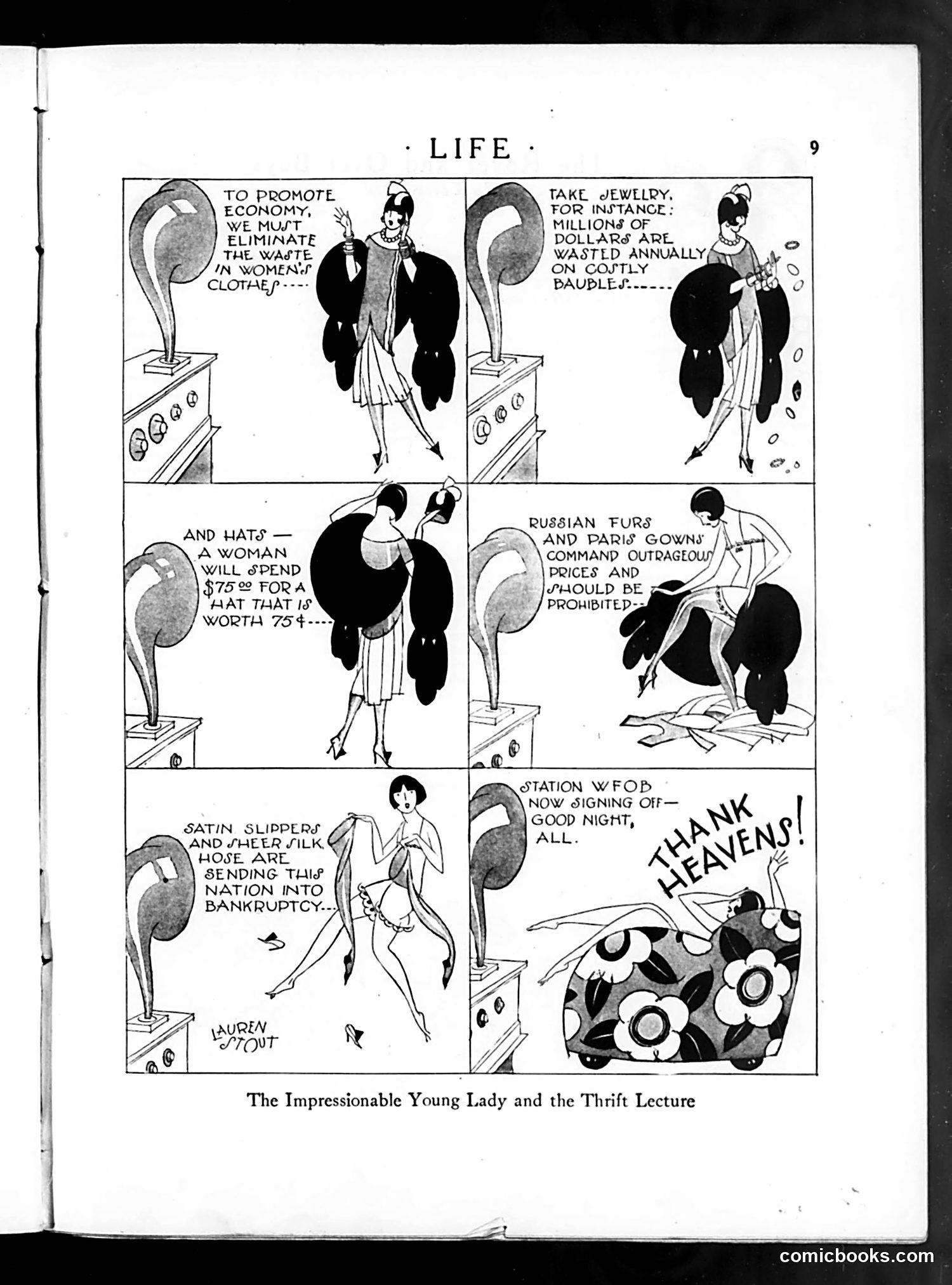
This comic satirizes the gap between stated economic principles and actual behavior. A lecturer promotes thrift by highlighting wasteful spending: millions wasted on jewelry, women spending $75 on hats worth 75¢, and expensive furs and Paris gowns. The "impressionable young lady" appears to absorb these lessons—until the final panel reveals her driving away in an expensive, flower-decorated automobile, exclaiming "Thank heavens!" The joke: despite hearing arguments against luxury consumption, she immediately indulges in precisely the kind of extravagant purchase the lecture condemned. The cartoon mocks both the ineffectiveness of moralizing about consumerism and the young woman's inability (or unwillingness) to resist temptation, reflecting 1920s anxieties about modern consumer culture and women's spending habits.
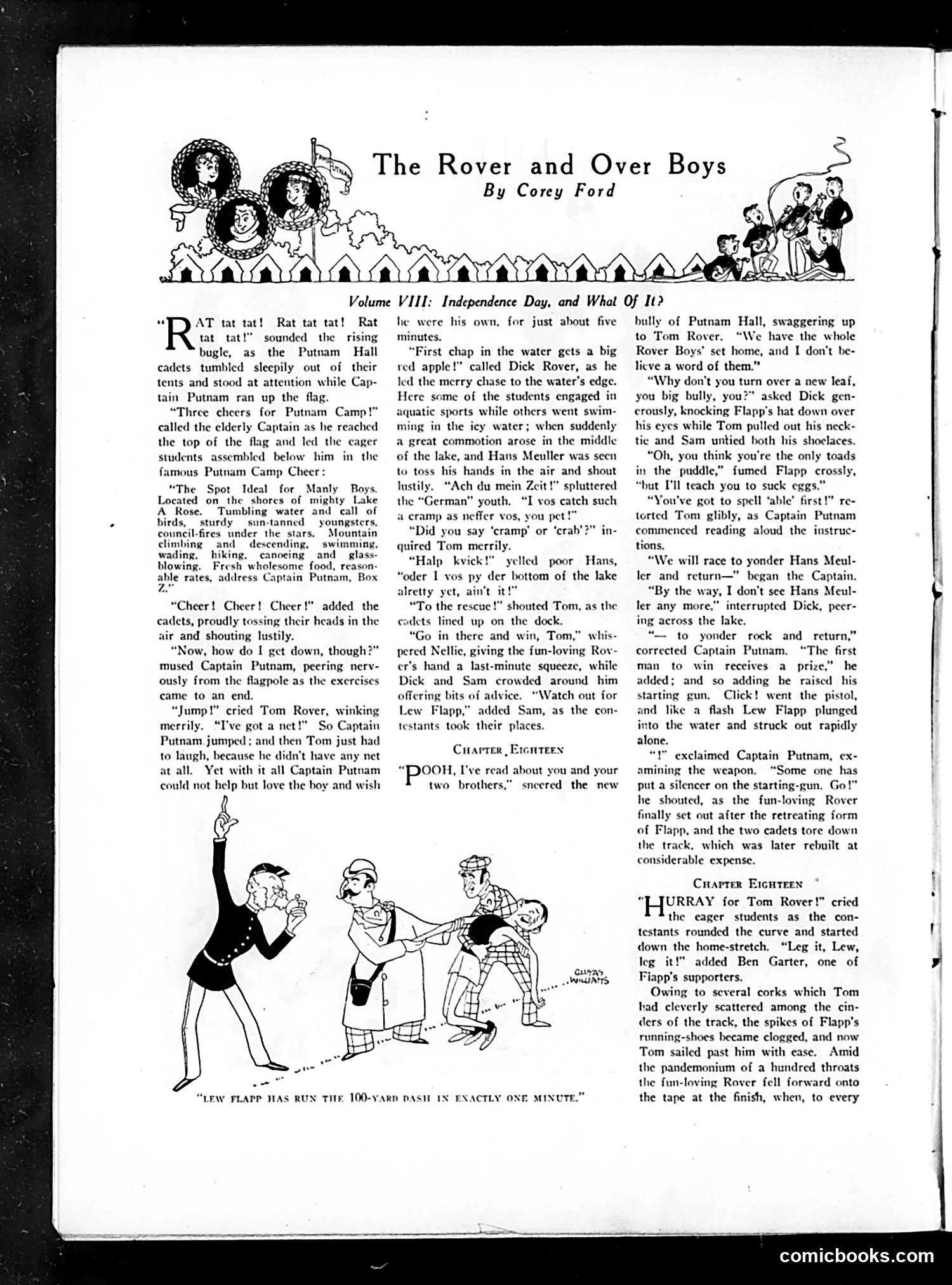
This page contains the eighth installment of a serialized humorous story about "Putnam Hall" cadets engaging in Independence Day athletics and pranks. The narrative describes cadets competing in aquatic sports, with characters named Tom Rover, Dick Rover, Hans Meuller, and others participating in races and stunts at a lake. The accompanying illustration shows figures engaged in what appears to be a physical altercation or competitive activity on a track. This is **not political satire**. Rather, it's a light comedic fiction piece featuring schoolboy adventures, typical of Life magazine's entertainment content during this era. The humor derives from youthful mischief and competitive antics rather than social or political commentary.
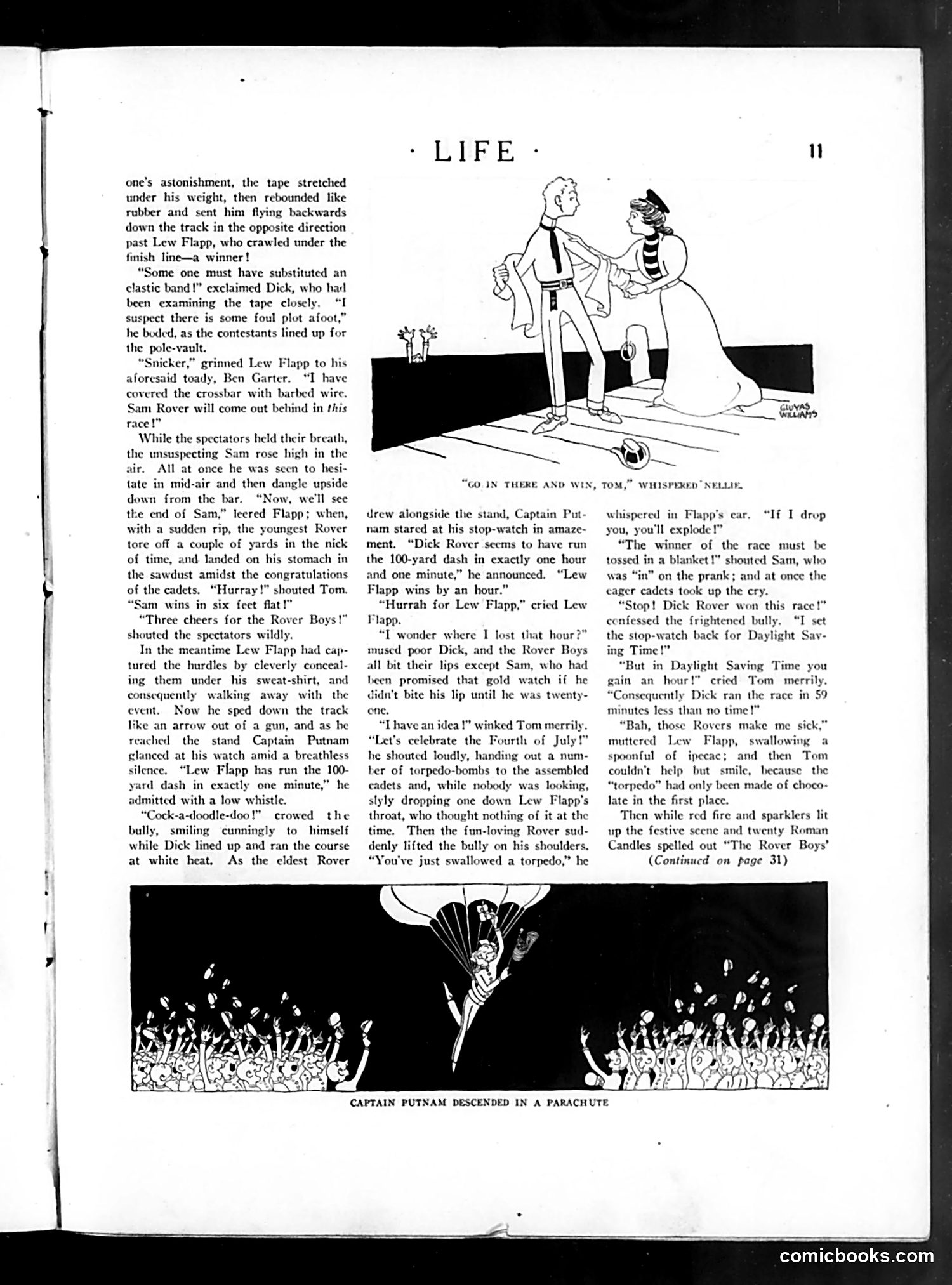
This page contains a fictional narrative about a competitive race involving characters named Lew Flapp, Sam Rover, Dick, Tom, and Captain Putnam. The story describes a dramatic competition—apparently a pole-vault or similar athletic event—where competitors attempt to break a record. The main cartoon at top shows a woman (Nellie) adjusting a man's clothing before competition. The bottom illustration depicts "Captain Putnam Descended in a Parachute," showing a figure descending by parachute above a crowd. **The satire appears to mock:** competitive sports enthusiasm, the tendency toward dramatic cheating accusations in competition, and possibly early aviation stunts (parachuting was still novel). The tone is lighthearted and comedic rather than politically pointed. Without publication date visible, precise historical context remains unclear.
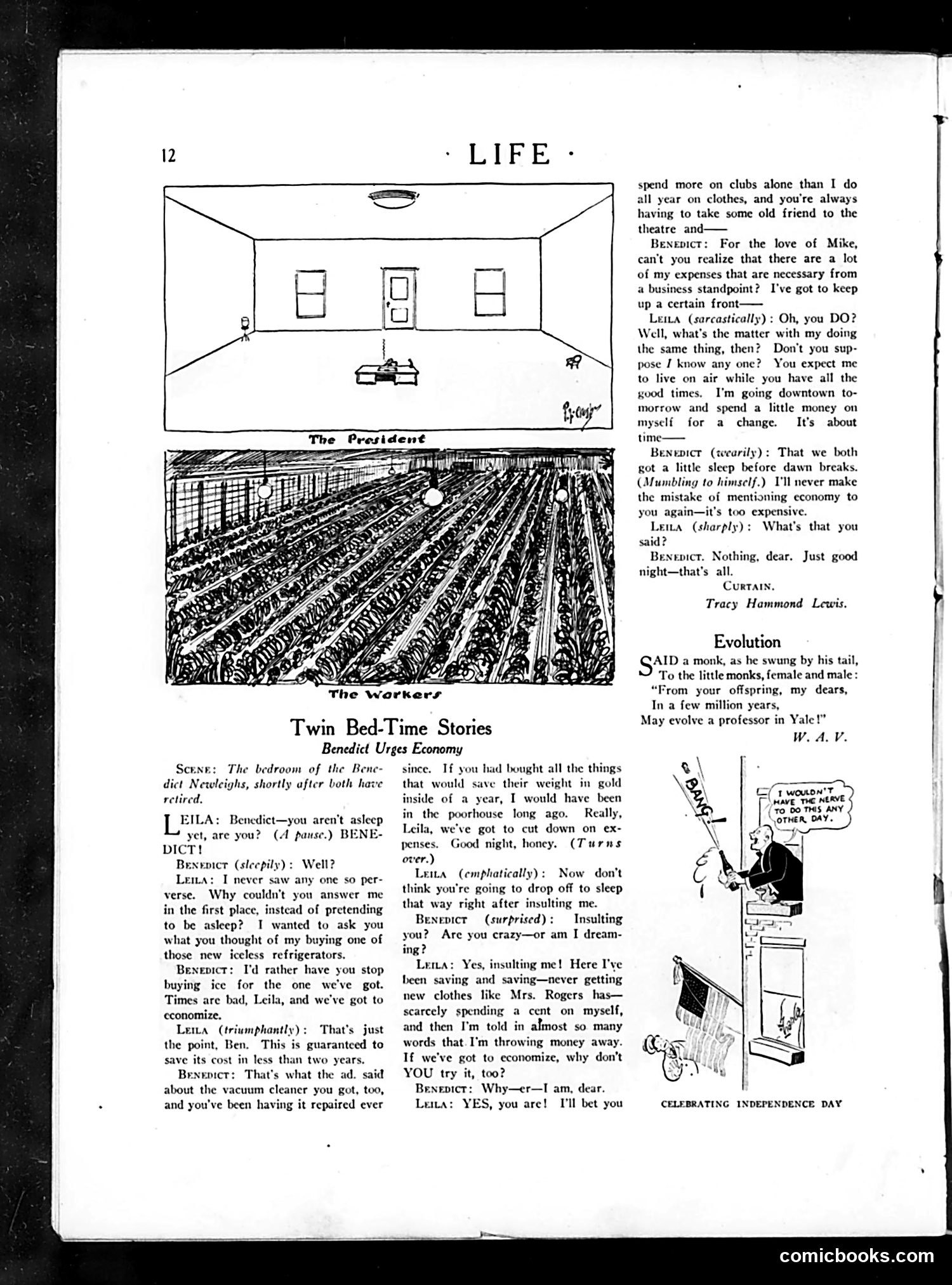
This marital comedy depicts post-WWI financial anxiety. Benedict wants his wife Leila to economize during "bad times," but she counters that his own expenses—clubs, entertaining business associates at theaters—exceed her clothing spending. The satire targets husbands' hypocrisy: they demand wives cut luxuries while protecting their own "necessary" expenditures as business essentials. Leila's threat to spend money on herself anyway represents growing female independence and consumer power. The dialogue captures 1920s domestic tension over budgeting and gender roles, with wives increasingly resistant to blanket belt-tightening while husbands maintained discretionary spending. The brief "Evolution" poem below is unrelated wordplay about monkeys evolving into Yale professors—lighthearted filler.
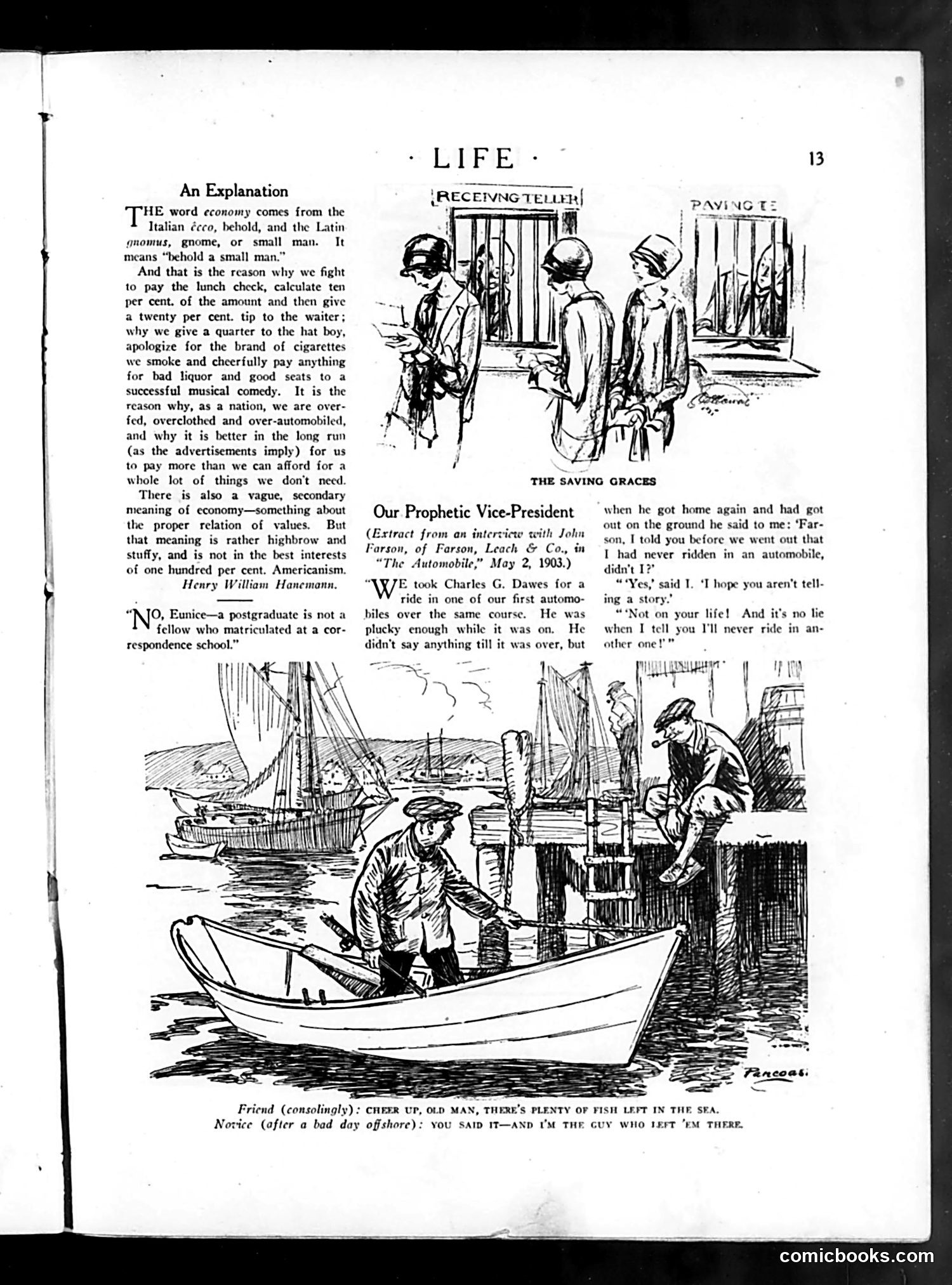
This page contains satirical commentary and cartoons typical of early 1900s Life magazine. **"An Explanation"** mocks American consumer culture, particularly the pressure to overspend on unnecessary items—tipping excessively, buying expensive theater tickets, and purchasing automobiles. The author argues Americans are "over-fed, overclothed and over-automobiled" despite claims of "economy." **"The Saving Graces"** shows two scenes: workers at a bank's receiving window and paying desk, and a fisherman's joke about depleted waters. **"Our Prophetic Vice-President"** references an anecdote about Charles G. Dawes (who became Vice President under Coolidge in 1921) taking an early automobile ride. The humor lies in Dawes' reluctance to repeat the experience, reflecting contemporary anxiety about automobiles as dangerous, unreliable novelties. The cartoon at bottom depicts two fishermen with a crude joke about fish depletion and responsibility—common working-class humor of the era.
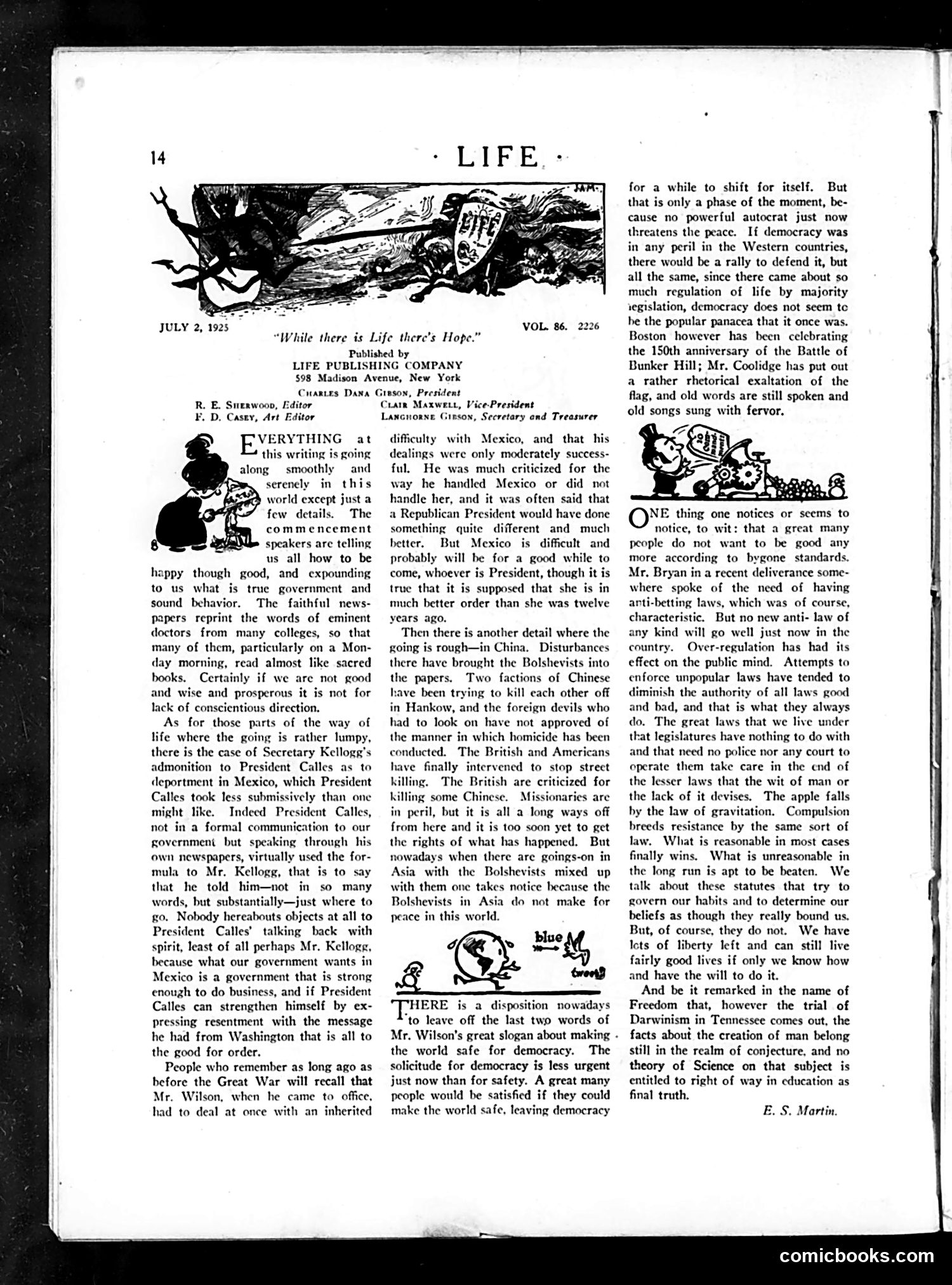
This editorial page addresses three foreign policy crises: **Mexico, China, and the broader tension between democracy and order**. **The Mexican situation** involves Secretary of State Kellogg's rebuke to Mexican President Calles, who publicly rejected American criticism through his newspapers. The author notes this is acceptable—stronger Mexican government serves American interests, even if defiant. **China's instability** stems from rival factions fighting in Hankow with Bolshevik involvement, threatening foreign nationals. British and American intervention is criticized but understood as necessary. **The larger theme**: Americans increasingly prioritize global "safety" over spreading "democracy"—Wilson's famous post-WWI slogan. The author observes that with no immediate autocratic threat, people would accept world stability even without democratic reform. This reflects 1920s disillusionment with idealistic interventionism, preferring order to ideological crusades. The cartoons (small illustrations accompanying the text) appear to satirize these priorities, though details are unclear in reproduction.
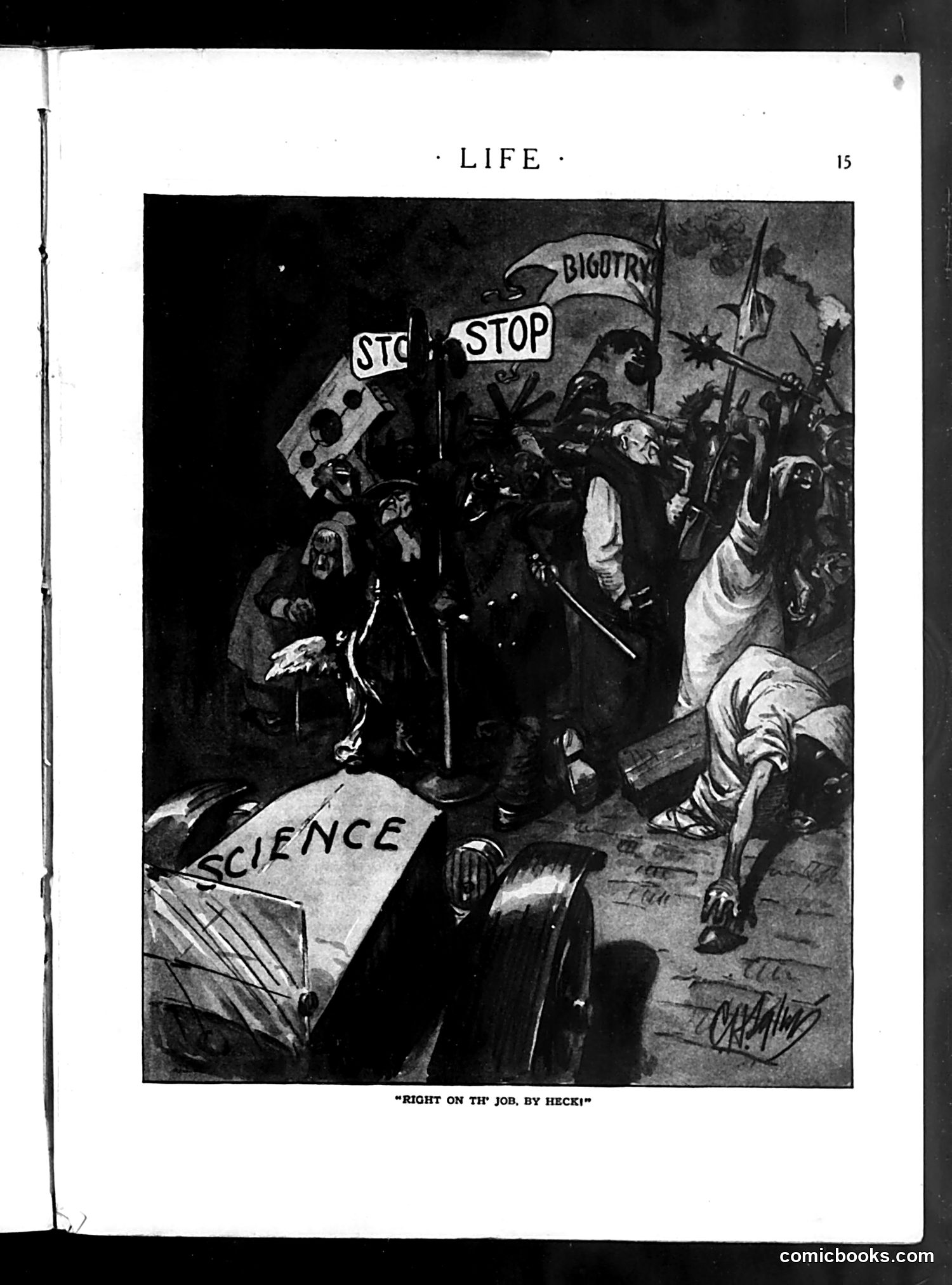
This political cartoon depicts a collision between two forces: "Science" (lying wounded or defeated on the ground) and "Bigotry" (a figure holding a "STOP" sign). Armed figures with weapons surround the scene, while a person on the right appears to be fleeing or protesting. The satire critiques how bigotry and anti-intellectual forces actively obstruct scientific progress. The "STOP" signs and violent imagery suggest organized resistance to scientific advancement, possibly referencing early 20th-century conflicts over evolution, medicine, or other scientific topics that faced religious or prejudicial opposition. The title's casual tone ("By Heck!") underscores the cartoon's ironic commentary—presenting destructive bigotry as earnest dedication to duty.
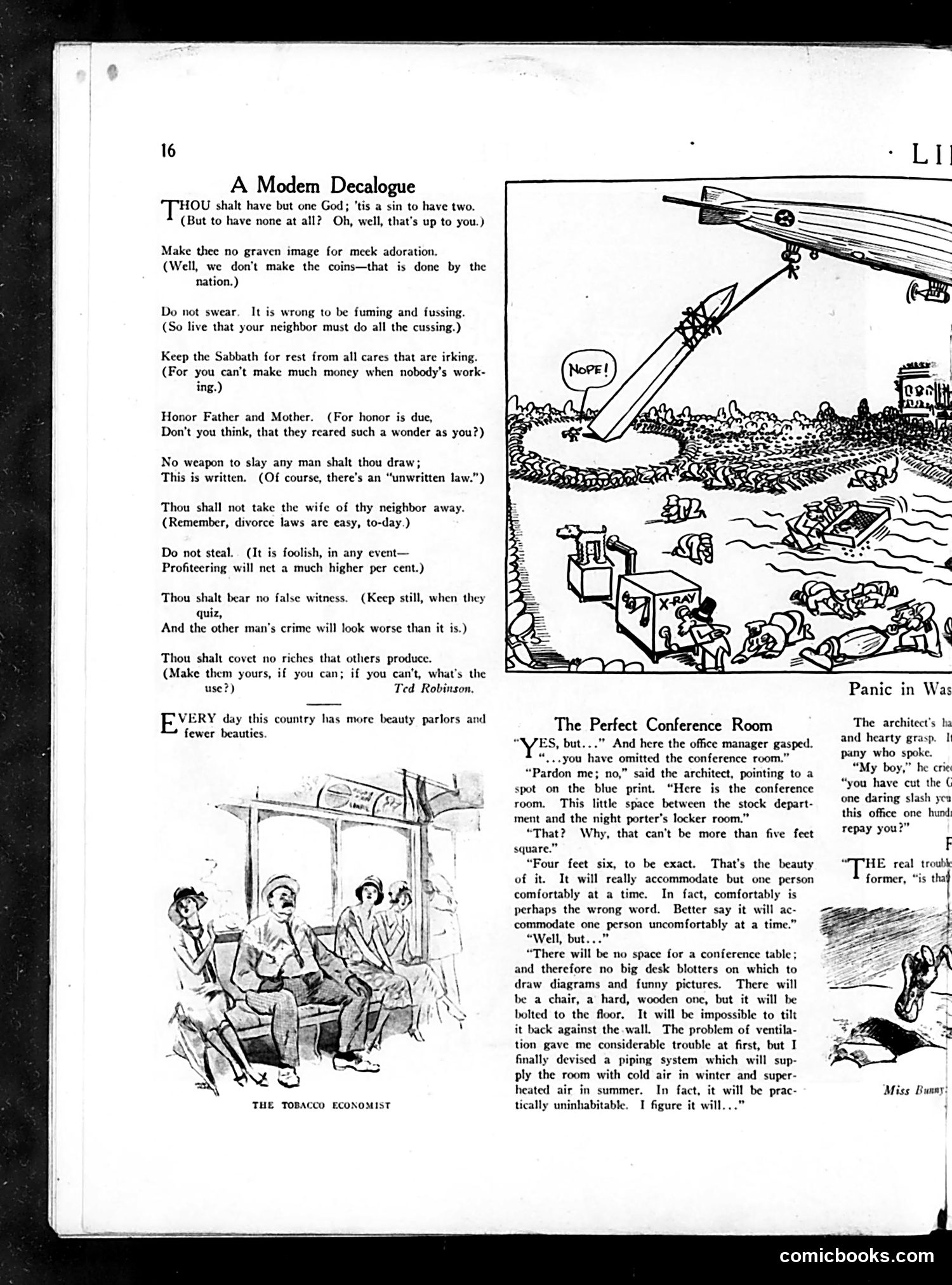
**"A Modern Decalogue"** (by Ted Robinson) is a satirical rewriting of the Ten Commandments that exposes hypocrisy in early 20th-century American society. Each commandment is followed by a parenthetical commentary revealing how people actually behave—contradicting the stated rule. Examples: "Honor Father and Mother" is undercut by suggesting they deserve honor merely for producing "such a wonder as you"; "Do not steal" is mocked by noting that profiteering yields "a much higher per cent." The satire targets moral relativism, greed, and the gap between professed values and actual behavior. **"The Perfect Conference Room"** is a separate satirical dialogue between an architect and office manager. The architect has designed an absurdly tiny, uncomfortable "conference room" (4'6" square, bolted furniture, uninhabitable ventilation). The joke mocks inefficient office design and corporate pretense—creating the appearance of facilities while providing no actual function. Both pieces exemplify *Life* magazine's social commentary on American capitalism and hypocrisy.
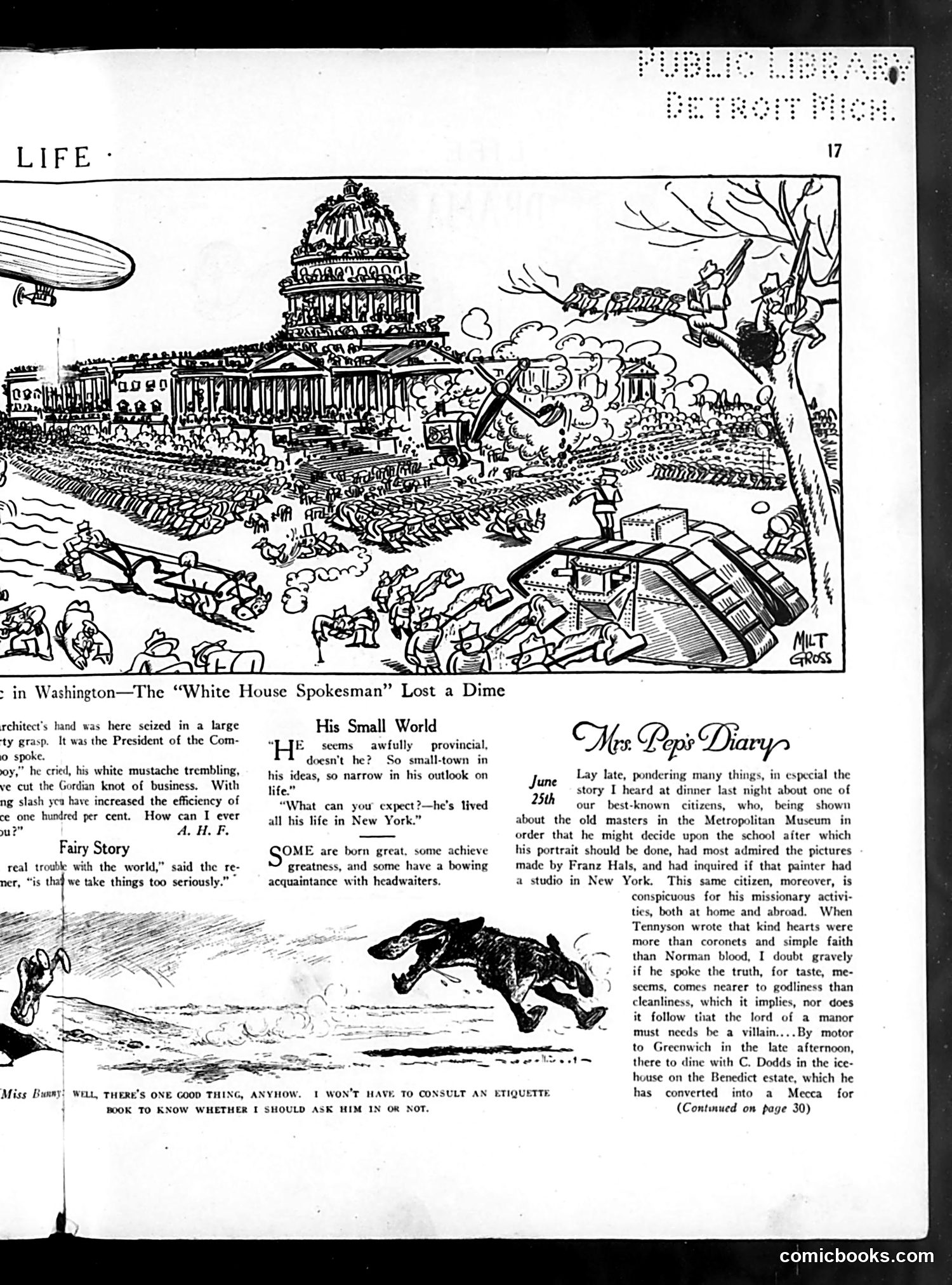
This page contains multiple satirical pieces mocking American provincialism and social pretension: **"His Small World"** (top dialogue) ridicules a narrow-minded businessman who, despite living in New York, lacks cosmopolitan sophistication. The joke: even NYC residence doesn't guarantee cultured perspective. **"Fairy Story"** (left, with dog illustration) appears to be a brief humorous sketch, though the text is partially obscured. **"Mrs. Poppy's Diary"** (right) satirizes a wealthy socialite's obliviousness. She describes a "best-known citizen" who admired paintings by Frans Hals (a Dutch master) and asked if the artist had a studio in New York—revealing ignorant provincialism despite his pretensions to refined taste and missionary work. **The cartoon** (bottom left) shows Miss Bunny relieved she won't need an etiquette book—satirizing anxious social-climbing and rigid formality concerns. The overarching theme: American wealth and status don't guarantee genuine culture or good manners; pretension and narrow-mindedness persist even among the supposedly sophisticated.
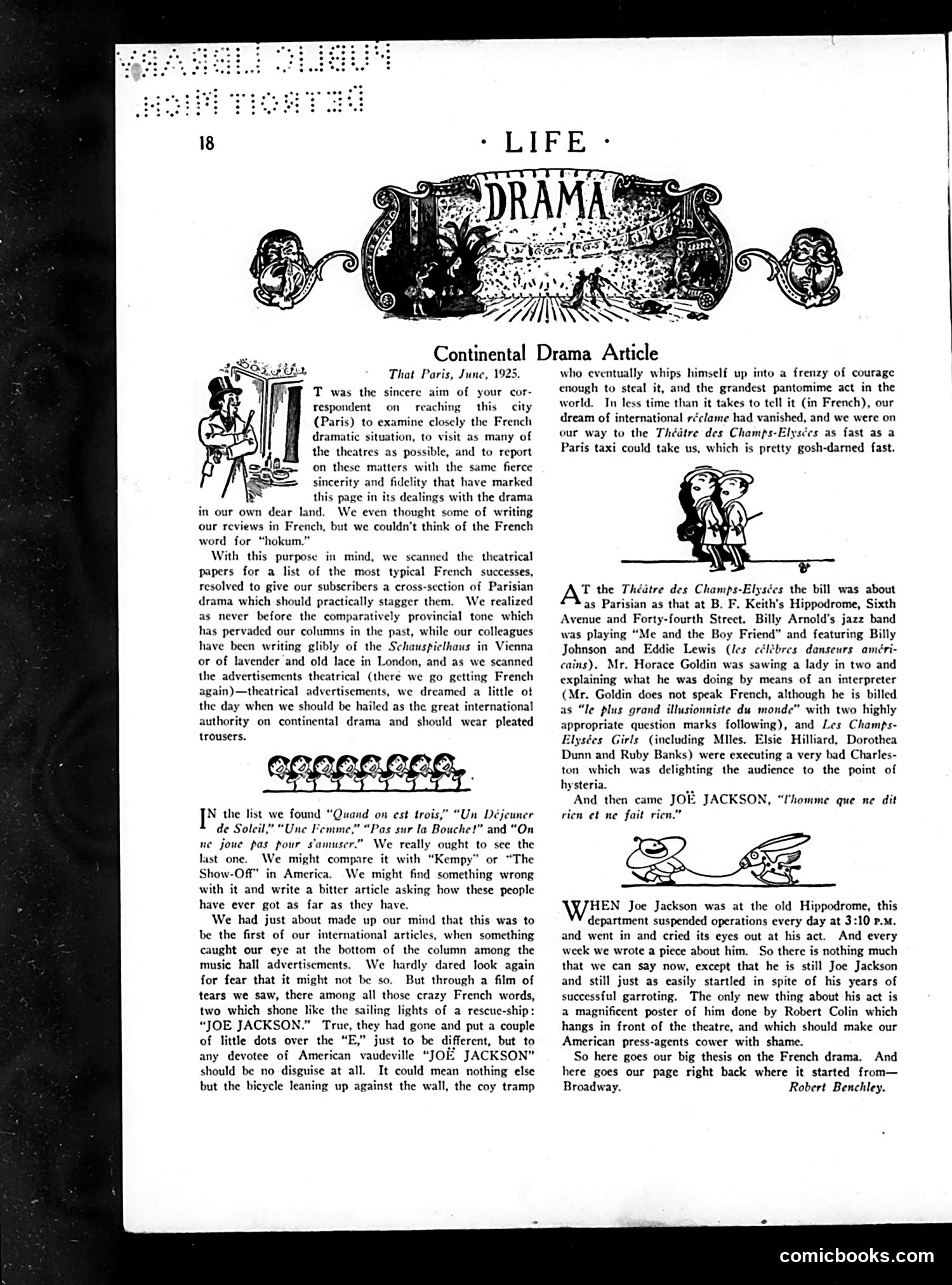
This 1925 *Life* magazine page satirizes American theatrical pretension and parochialism. The author, writing from Paris, initially aims to report on "serious" French drama with international sophistication—even considering writing in French (but can't think of the French word for "hokum," mocking their own provincialism). However, the joke centers on **Joe Jackson**, a famous American silent vaudeville performer known for a pantomime act involving a stolen bicycle. The author abandons all pretense of continental sophistication the moment he spots Jackson's name in a Parisian music hall advertisement, abandoning his "international articles" dream to rush to see this American performer. The satire targets American cultural insecurity: despite aspirations toward European refinement, Americans remain emotionally invested in homegrown entertainment. Jackson's presence in Paris becomes absurdly more relevant than actual French drama. The accompanying illustrations and jovial tone emphasize the humor of this collision between highbrow ambitions and lowbrow American entertainment nostalgia.
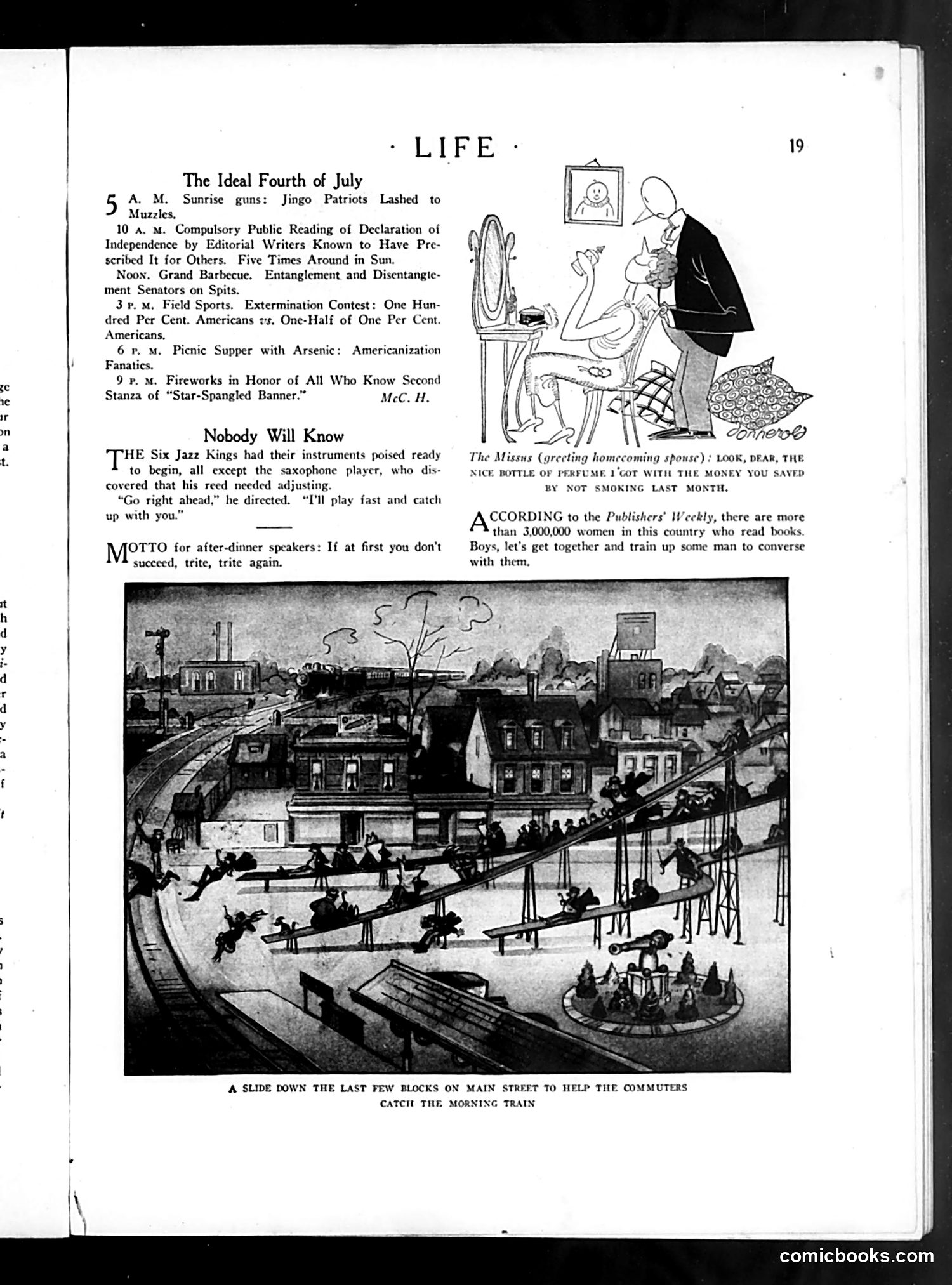
This is a satirical page from *Life* magazine featuring multiple short humor pieces mocking American society and holidays. **"The Ideal Fourth of July"** is a darkly comic schedule imagining an absurdly violent Independence Day. It satirizes nationalist fervor by suggesting patriots be "lashed to muzzles," senators roasted on spits, and "extermination contests" between different types of Americans—likely critiquing xenophobic "Americanization" movements popular in the early 20th century. **The cartoon below** depicts a fantastical futuristic town where residents use slides instead of walking to catch morning trains—satirizing American obsession with speed and convenience. **The smaller jokes** mock domestic life (a wife justifying perfume as a money-saving purchase) and gender attitudes (suggesting women readers are exotic creatures men need to be "trained" to converse with). The overall tone is cynical about American values: nationalism, materialism, and gender relations—typical of *Life*'s satirical approach to contemporary society.
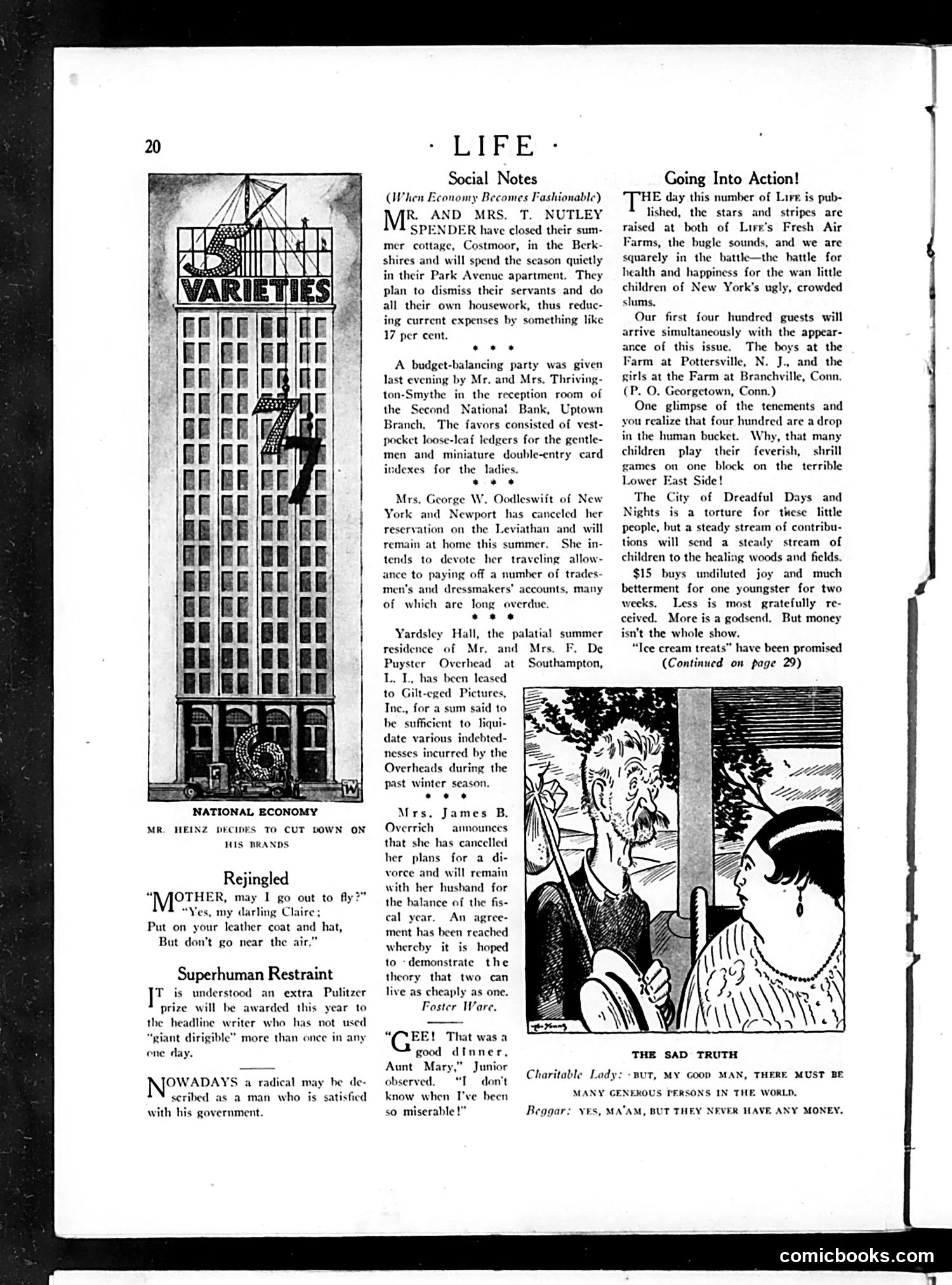
This page satirizes the economic hardships of the early 1920s (likely post-WWI recession) through multiple angles: **"Social Notes" section**: The satire mocks wealthy New Yorkers adopting economic austerity as fashion. Mrs. Nutley reduces household expenses by 17% by dismissing servants; the Thrivington-Smythes throw a "budget-balancing party" with ledger-themed party favors. Mrs. Oodleswit cancels her Leviathan reservation; Mrs. Overrich postpones her divorce to "live as cheaply as one." The joke: the ultra-wealthy treating genuine hardship as a trendy game. **Bottom cartoon titled "The Sad Truth"**: A beggar explains to a charitable lady the cruel irony of philanthropy during economic crisis—generous people have no money; those with money lack generosity. **Other items**: Brief quips about "Rejingled" motherhood (air safety concerns), restraint about dirigible headlines, and a definition of "radical" as someone satisfied with government—all reflecting 1920s anxieties. The overall message: economic crisis exposes both the obliviousness of the wealthy and the structural failure of charitable systems.
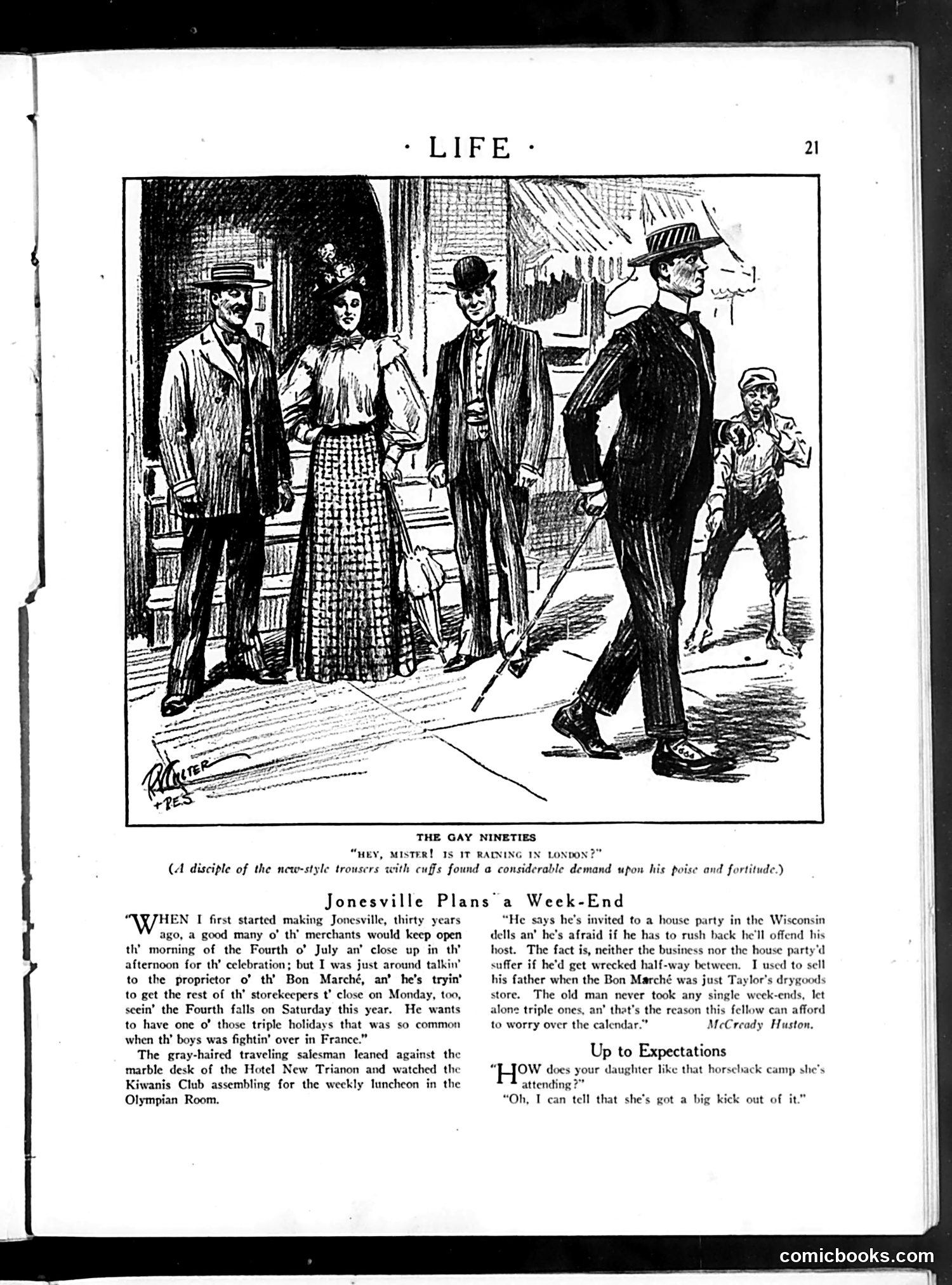
**"The Gay Nineties" cartoon** satirizes a fashion trend: men wearing trousers with cuffs (a new style at the time). The joke shows a man so concerned with maintaining the appearance of his fashionable cuffed trousers that when asked a simple question about London rain, he's anxiously worried the answer might require him to look down, potentially compromising his composure and the crisp presentation of his new pants. It's mocking vanity and men's self-consciousness about following fashion trends. **"Jonesville Plans a Week-End"** depicts generational change through a traveling salesman's observation: modern shop owners want three-day weekends for leisure (house parties), whereas the previous generation (their fathers) never took even single days off. The satire critiques how newfound prosperity and leisure attitudes are making younger businessmen prioritize pleasure over the work ethic their fathers embodied—a common post-WWI anxiety about changing American values. Both pieces reflect 1920s social commentary on modernization, fashion consciousness, and shifting work culture.
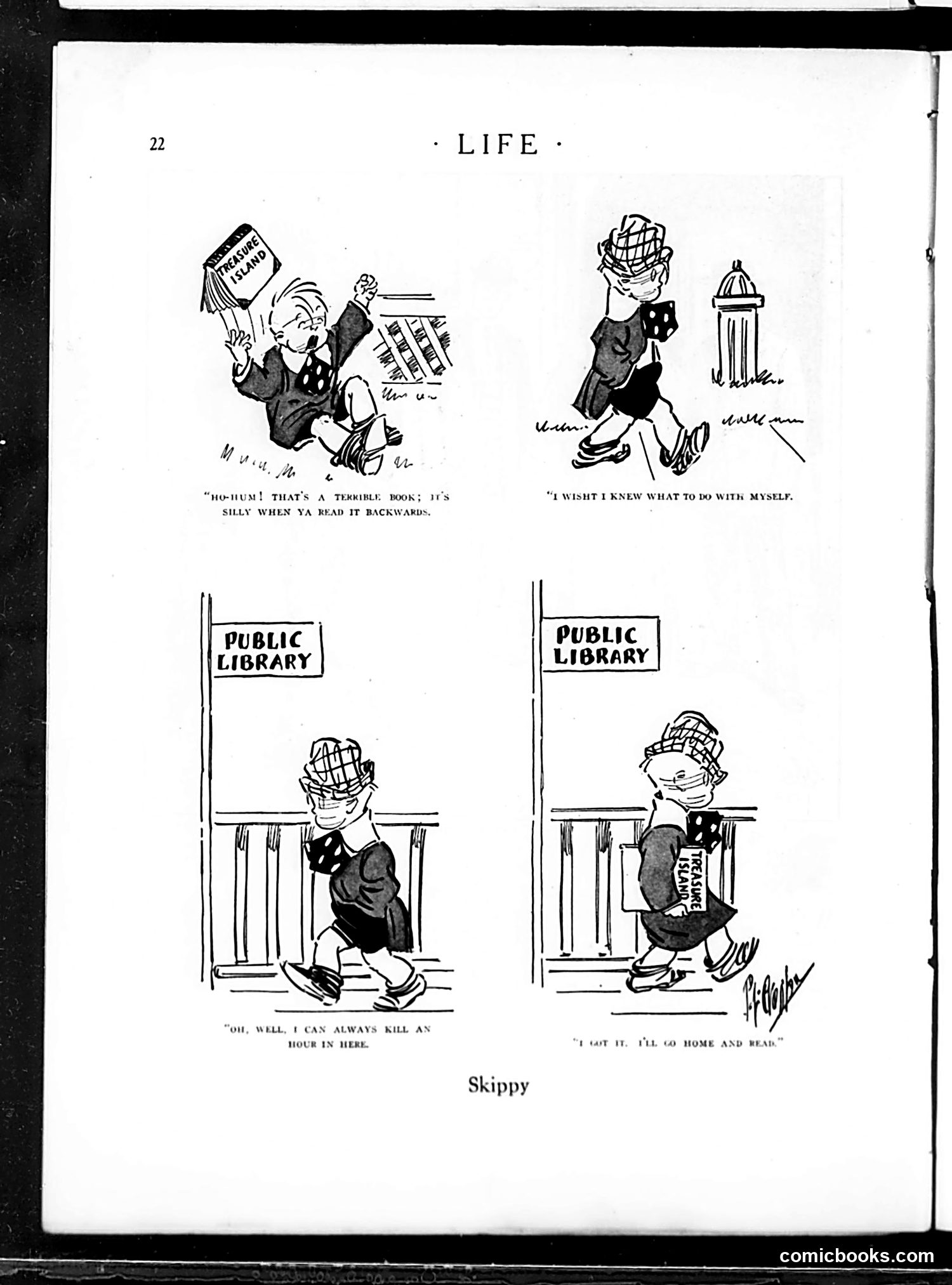
This is a four-panel "Skippy" comic strip satirizing how people use public libraries as time-killing refuges rather than for serious reading. The character Skippy, a mischievous boy, demonstrates this theme: **Panel 1-2:** Skippy critiques a book as "silly," suggesting casual, dismissive reading habits. **Panel 3:** At the library, he notes he can "kill an hour" there—using the library as mere entertainment/shelter rather than intellectual pursuit. **Panel 4:** He ironically decides to *leave* the library to read at home instead. The satire mocks both the laziness of patrons who browse aimlessly and the library's role as a social refuge. This reflects 1920s-30s attitudes about youth culture, reading standards, and public institutions. The humor relies on Skippy's childish logic revealing adult hypocrisy about libraries' stated educational mission versus actual use as casual hangouts.
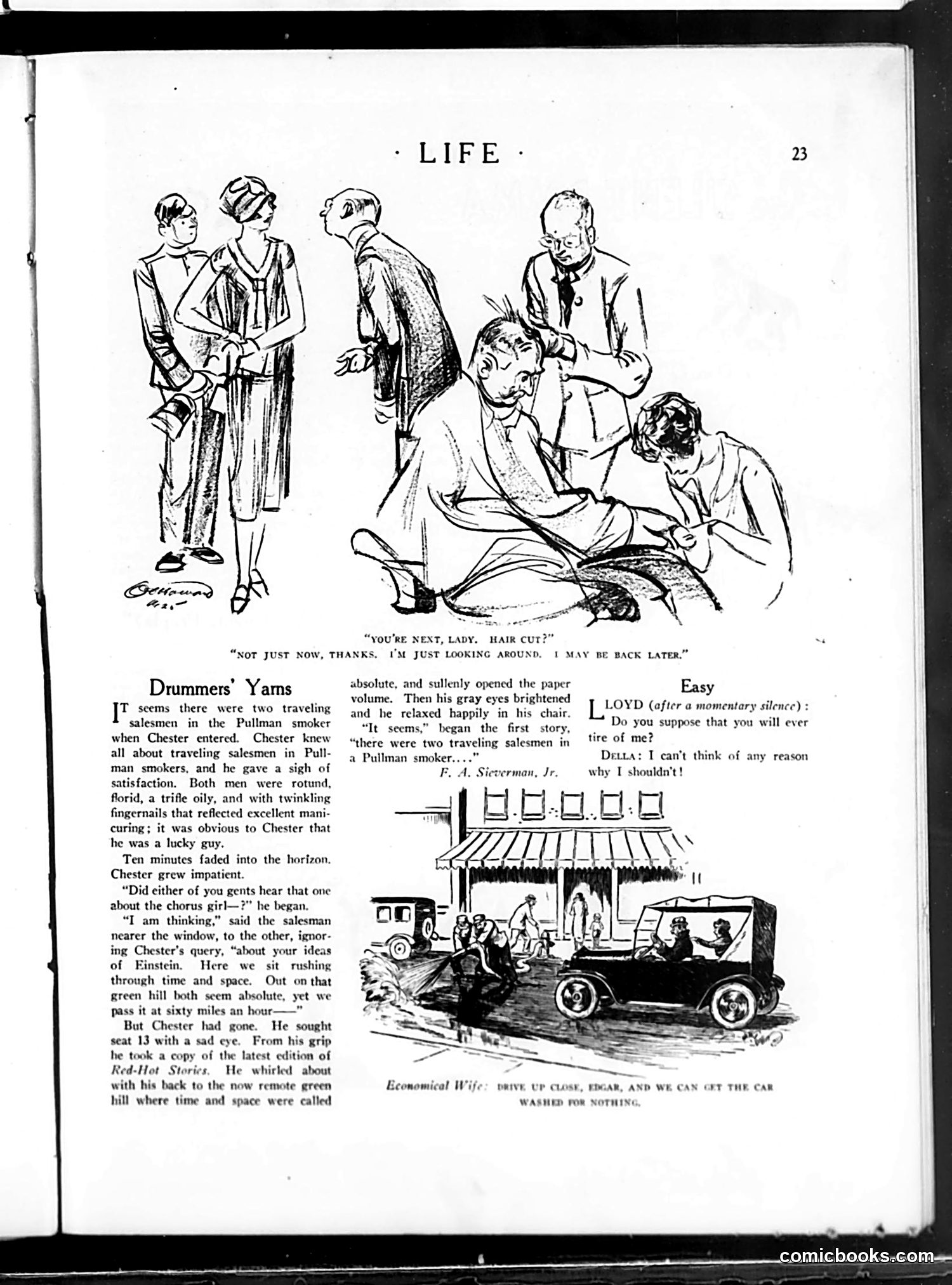
**"Drummers' Yarns"** satirizes traveling salesmen (door-to-door salesmen, called "drummers") as tedious storytellers. Chester enters a Pullman train car smoker expecting the stereotypical bawdy jokes salesmen were famous for. Instead, one salesman launches into pseudo-intellectual discussion of Einstein and relativity—attempting to seem cultured. Chester, disappointed and rejected, retreats to read *Red-Hot Stories* magazine. The joke: even when trying to escape salesmen's tired narratives, he finds the same story opening ("there were two traveling salesmen") in his reading material. The satire mocks both the salesmen's predictable humor and Chester's lowbrow alternative. **"Economical Wife"** (lower cartoon) is a domestic gag: A wife suggests driving up close to a car wash so they can get their vehicle cleaned "for nothing"—implying they'll get sprayed for free without paying. It's gentle satire of frugality or marital penny-pinching.
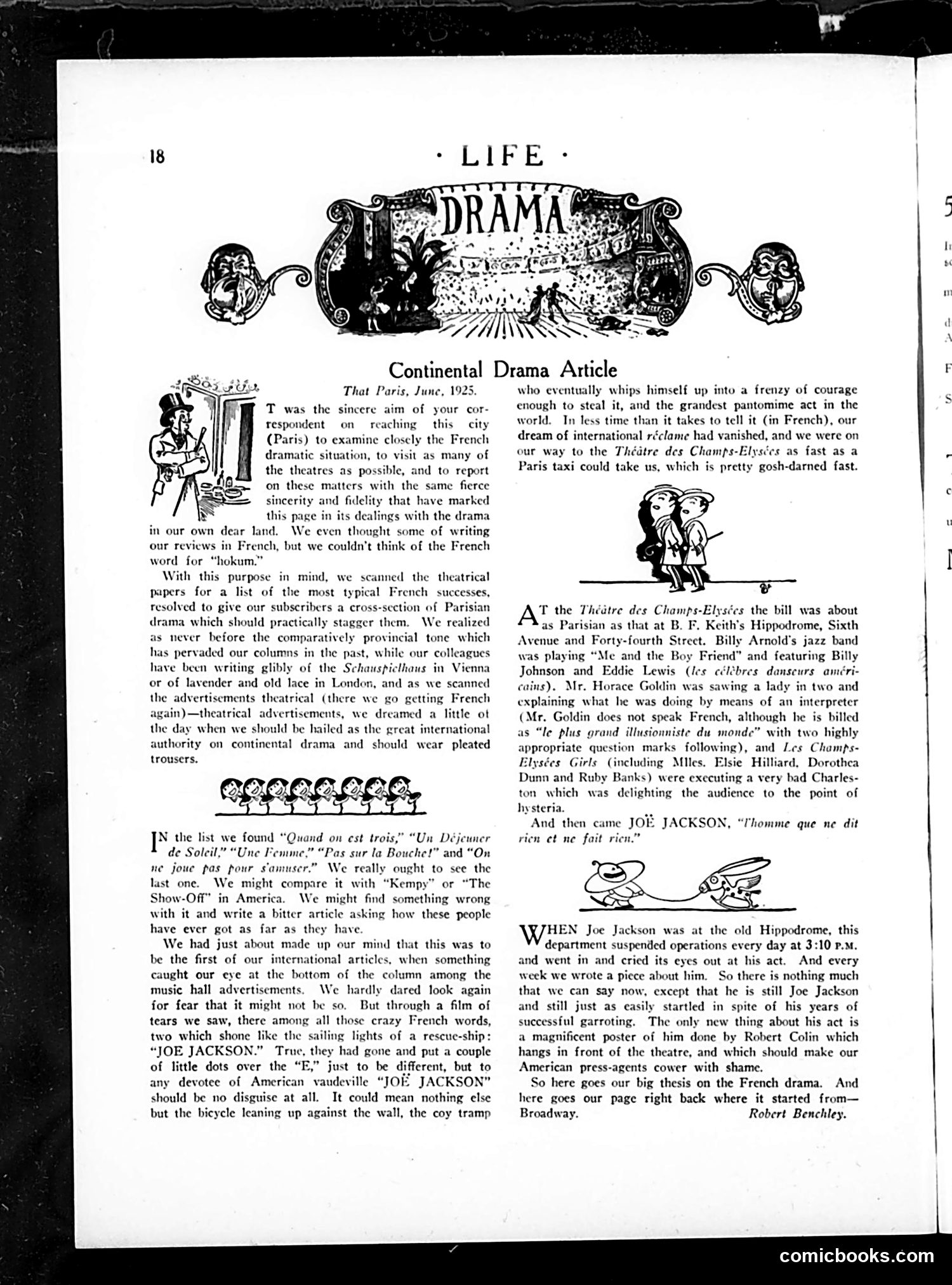
This 1925 article satirizes American cultural pretensions while celebrating American vaudeville's superiority. The author mocks Life's tendency to cover European theater breathlessly, noting they initially planned to review French plays with utmost seriousness. However, they discovered Joe Jackson—a famous silent pantomime comedian known for his bicycle-stealing routine—performing in Paris under the billing "JOE JACKSON" (with French diacritical marks). The joke: Joe Jackson's American vaudeville act was so superior and memorable that it instantly overshadowed the magazine's grand plans to become an "international authority on continental drama." The author abandons their pretentious European theater ambitions, realizing that American popular entertainment—specifically Jackson's wordless physical comedy—represents the true grandeur of performance art. The satire targets both American cultural anxiety about European sophistication and genuine pride in homegrown entertainment talent.
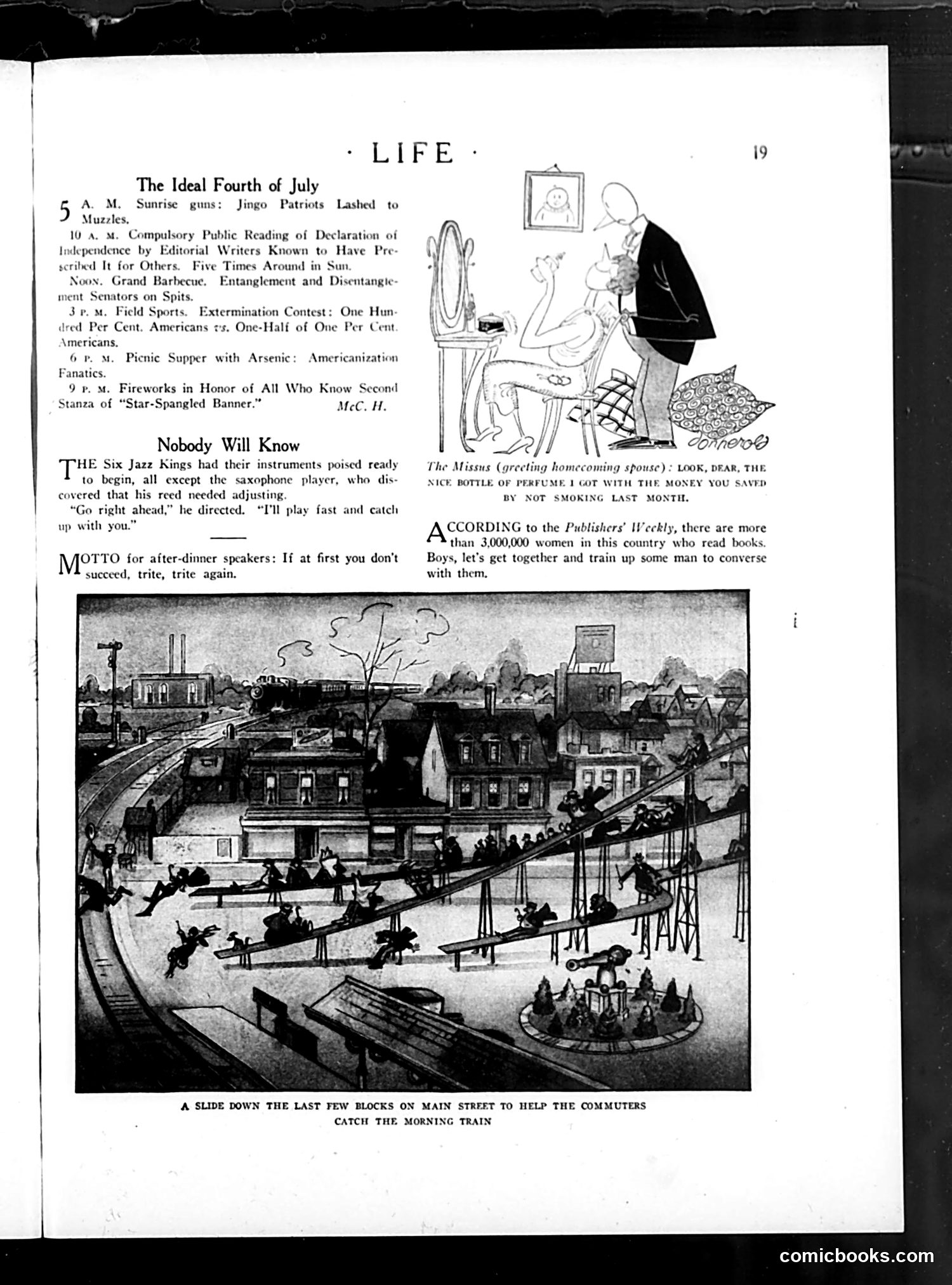
This page from Life satirizes American patriotism and social conventions through multiple jokes: **"The Ideal Fourth of July"** mocks jingoistic nationalism by describing an absurdly violent Independence Day—patriots "lashed to muzzles," an "extermination contest" between "100% Americans" vs. those only "half" American, and picnic food "with arsenic." The satire critiques excessive patriotism and nativist attitudes toward immigrants. **The jazz band anecdote** is a simple comedic sketch about a saxophonist's confidence. **The illustration** shows futuristic urban recreation—slides replacing stairs for commuters, depicting modern American efficiency culture. **The perfume joke** uses domestic irony: a wife buys luxury goods with money supposedly saved from her husband quitting smoking, mocking both consumerism and marital dynamics. **The closing text** sarcastically suggests men need "training" to converse with the 3+ million female readers, poking fun at gender relations and intellectual gaps. Overall, the page blends patriotic satire, domestic humor, and social commentary typical of Life's satirical approach.
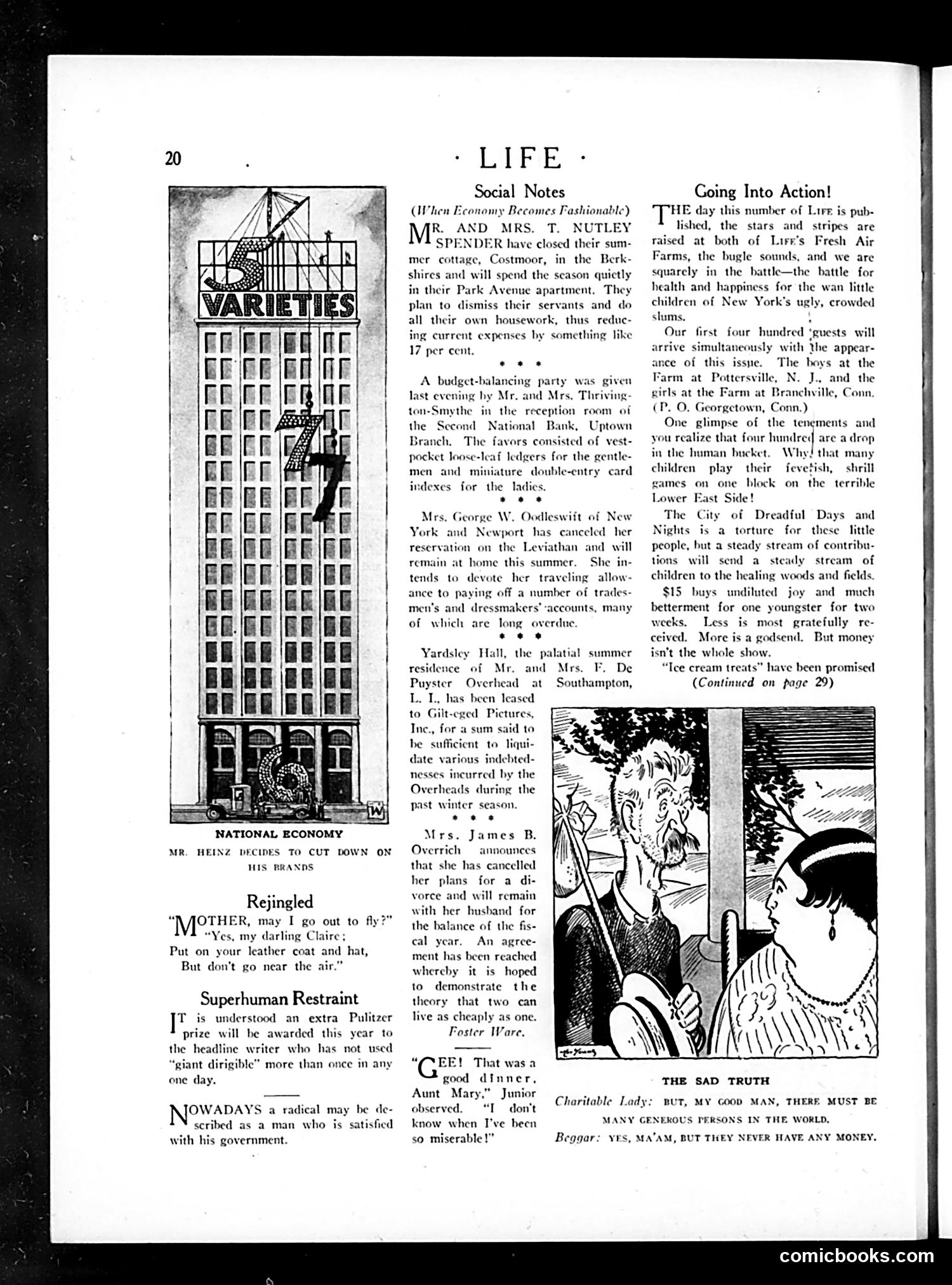
This page satirizes the economic hardships of the 1920s-early 1930s through multiple angles: **Social Notes Section**: Mocks wealthy New York society's sudden embrace of frugality. The wealthy Nutleys dismiss servants to save "17 per cent," and Mrs. Overrich cancels her divorce to economize—suggesting economic anxiety has penetrated even the privileged classes. The satire lies in portraying these minor sacrifices as genuine hardship. **"The Sad Truth" Cartoon**: Shows a wealthy woman ("Charitable Lady") telling a beggar that "generous persons" exist—yet he counters that generous people "never have any money." This darkly comic commentary suggests wealth and charity are disconnected; the rich may be sympathetic but lack liquidity to help. **"Going Into Action!"**: Appeals for Fresh Air Fund donations ($15 per child) for slum children, contrasting sharply with the society pages' trivial economies. This juxtaposition highlights real poverty amid the wealthy's performative belt-tightening. The overall message: economic crisis has touched everyone, but sympathy without resources helps no one.
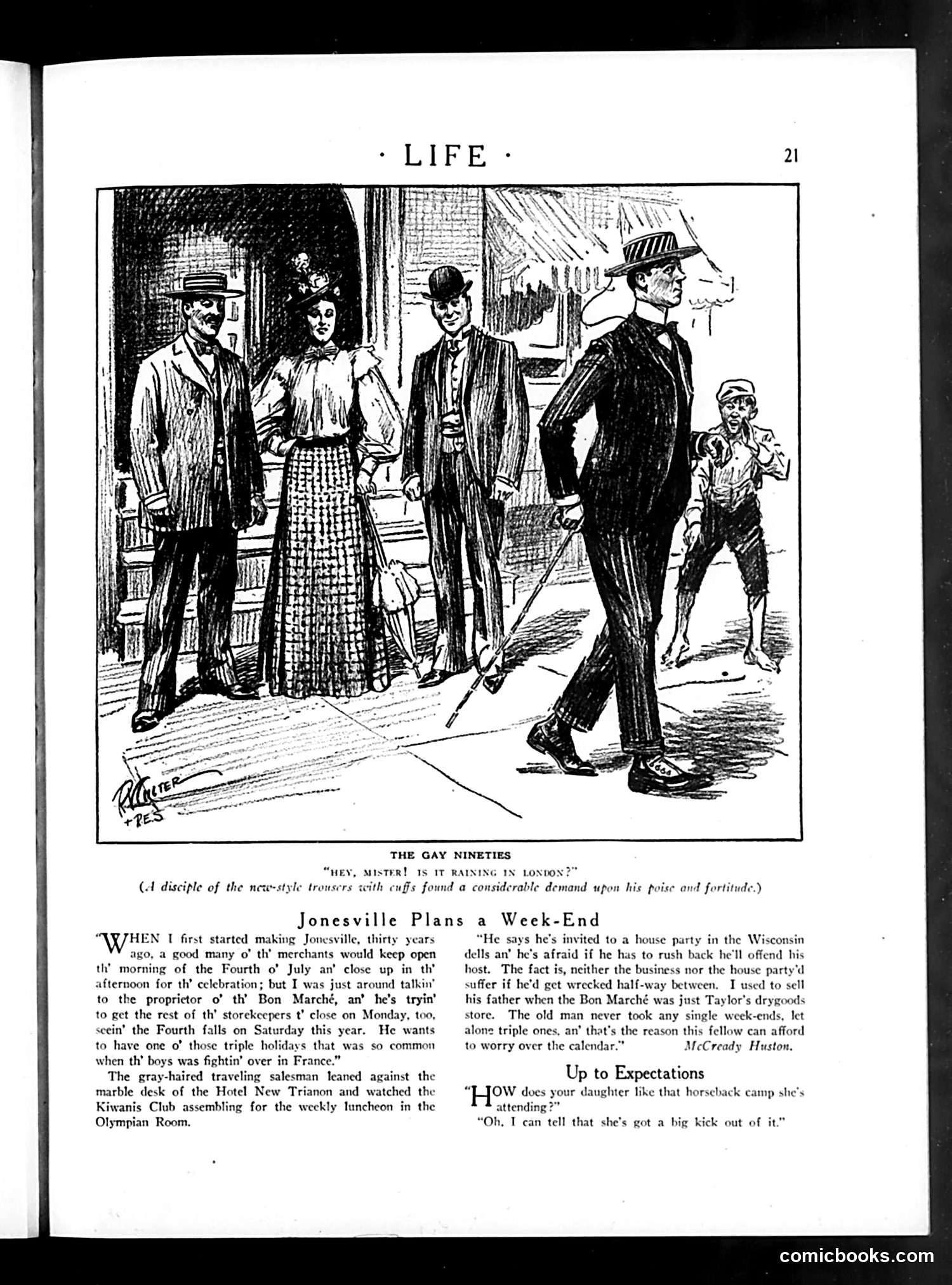
**The Top Cartoon ("The Gay Nineties"):** This satirizes the 1890s fashion trend of trouser cuffs. A well-dressed man asks another about London rain while gesturing downward—the joke being that the new cuffed trousers collect water and mud, requiring careful balance and composure to maintain one's dignity in wet conditions. It's gentle mockery of a passing fashion fad. **The Text Stories:** These are nostalgic anecdotes about small-town American life (Jonesville). The first contrasts old-fashioned merchants who never took time off with modern businessmen seeking extended holidays for pleasure trips—lampooning how leisure and work-life balance have changed. The second is a simple pun: "big kick" meaning both enthusiasm and literal horseback riding. The page reflects Life magazine's satirical approach to contemporary social changes—new fashion, shifting work ethics, and American leisure culture.
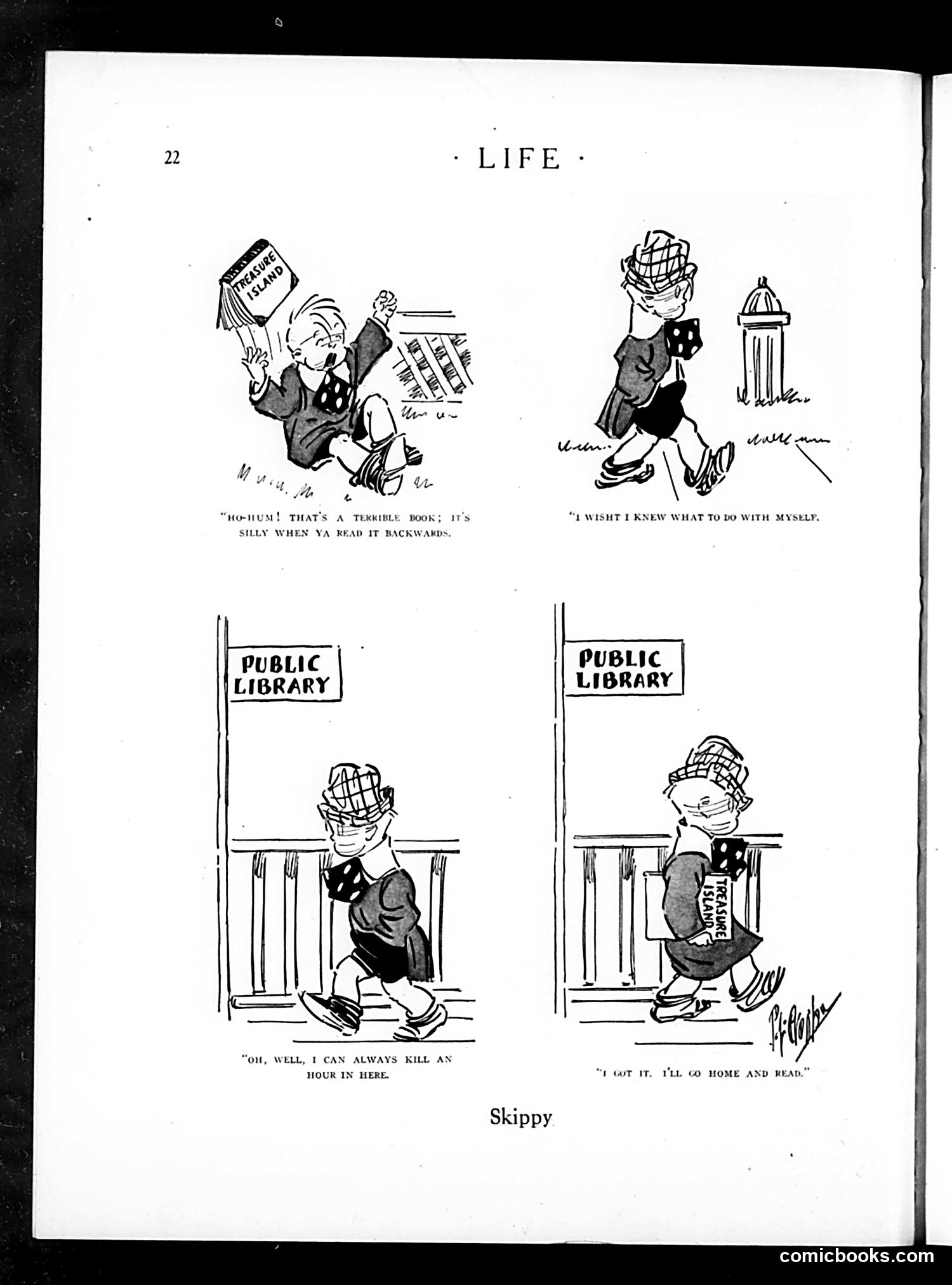
This is a four-panel comic strip featuring "Skippy," a mischievous child character. The satire targets children's boredom and literacy attitudes in early 20th-century America. **The joke:** Skippy encounters a "terrible book" that reads silly backwards, then wanders aimlessly. He discovers the public library as a place to "kill an hour"—initially framing reading as time-wasting rather than enrichment. The punchline subverts this: he ultimately decides to go home and read anyway, suggesting that even reluctant children find reading appealing once engaged. The strip gently mocks both children's resistance to reading and the era's concerns about youth idleness. It also reflects period attitudes about public libraries as accessible refuges for entertainment, not just serious scholarship. Skippy's character—a working-class street kid in shabby clothes and newsboy cap—represents the common urban child of the era.
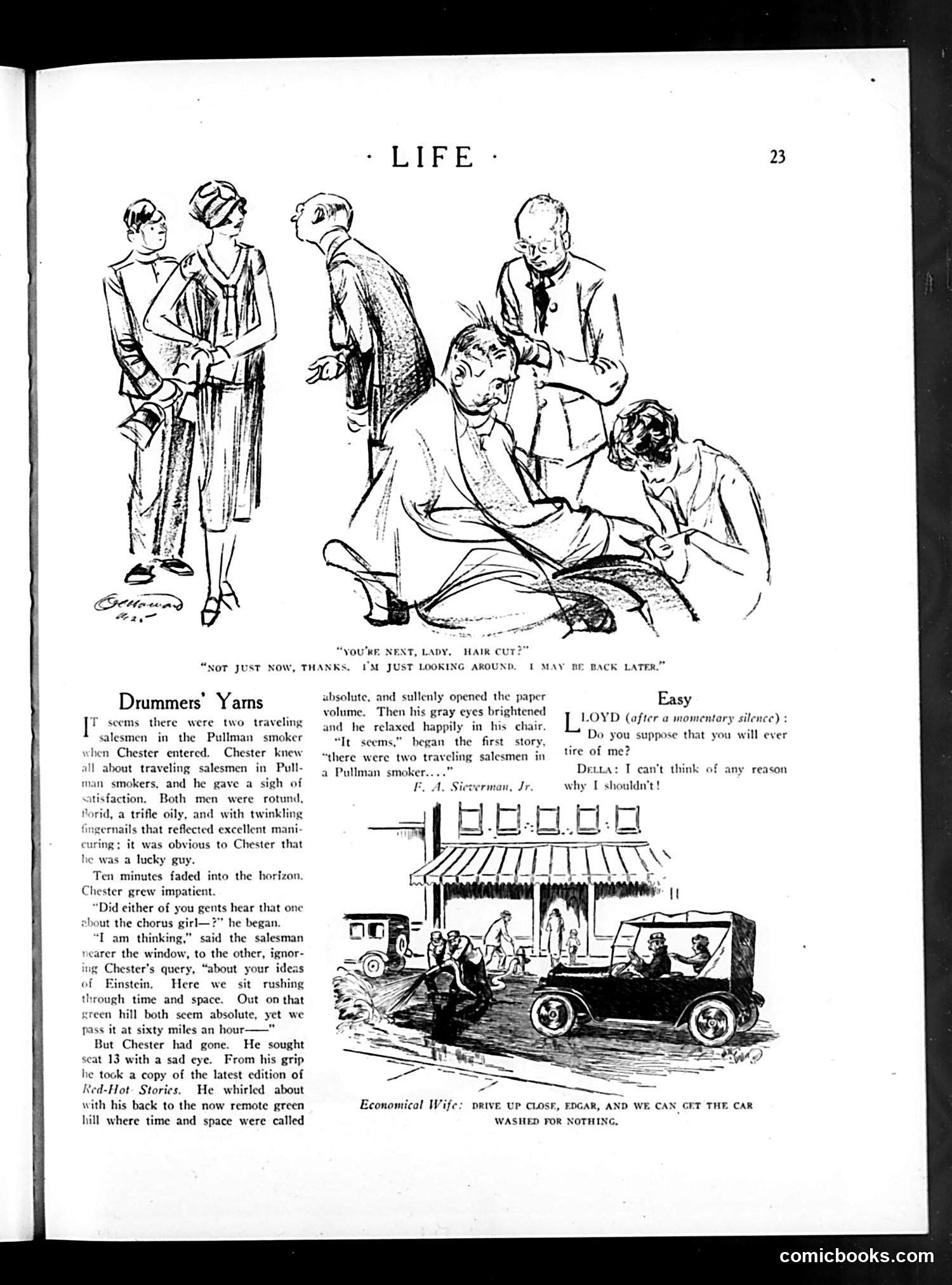
This page contains three separate satirical pieces typical of 1920s humor: **"Drummers' Yarns"** mocks traveling salesmen ("drummers"—salespeople) and their tired repertoire. Chester attempts to tell a predictable joke about a chorus girl, but is rebuffed by a salesman spouting pseudo-intellectual philosophy about Einstein and relativity. The joke's irony: Chester retreats to *Red-Hot Stories* magazine, which begins with the same "two traveling salesmen" opening—suggesting all such stories are derivative clichés. The cartoon at top depicts a barbershop scene with the caption joke about a woman's hesitation during a haircut, playing on anxiety about salon decisions. **"Easy"** is a brief domestic dialogue where Della confidently states she'll never tire of her husband, presenting conventional marriage sentiment. **"Economical Wife"** offers visual satire: a wife suggests driving close to a muddy construction site so the car gets free washing—trading dignity for pennies, satirizing women's penny-pinching domestic economies during economically austere times. All three pieces reflect period gender roles and commercial culture through gentle mockery.
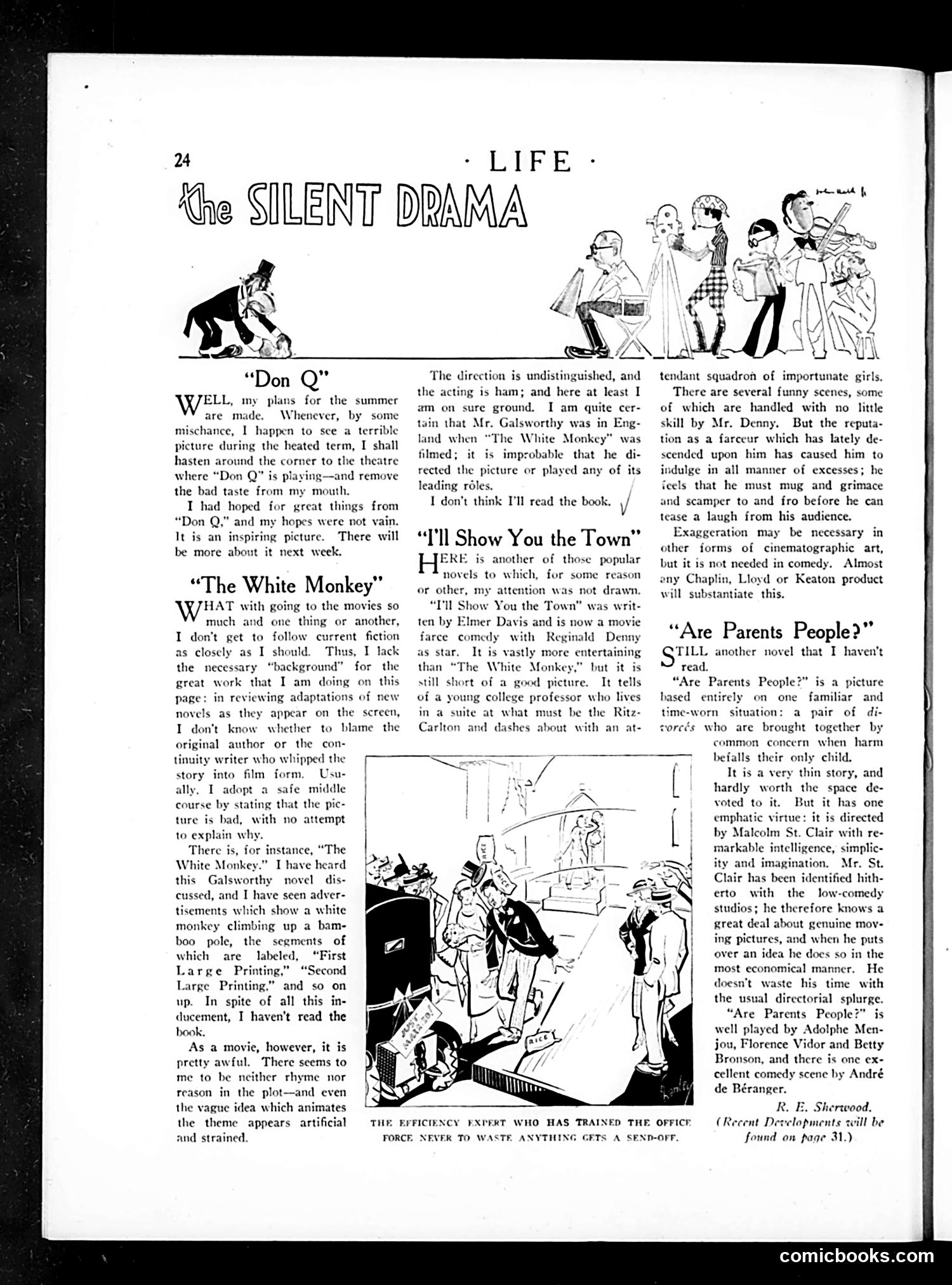
This page contains film criticism from Life's "Silent Drama" column, reviewing four movies (all silent films, as indicated by the title). The critic dismisses *The White Monkey* (adapted from Galsworthy's novel) as poorly directed with ham acting, admitting he hasn't read the source material. *I'll Show You the Town*, a comedy starring Reginald Denny about a college professor at the Ritz-Carlton surrounded by women, is deemed entertaining but marred by Denny's excessive mugging—the critic argues exaggeration isn't necessary in comedy, citing Chaplin and Keaton as counterexamples. *Are Parents People?* is critiqued as a thin, familiar divorce-plot story, redeemed only by director Malcolm St. Clair's intelligent, economical direction. The cartoon illustrates an "efficiency expert" training office staff never to waste anything—likely satirizing contemporary business culture's obsession with efficiency movements, a major cultural trend in the 1920s.
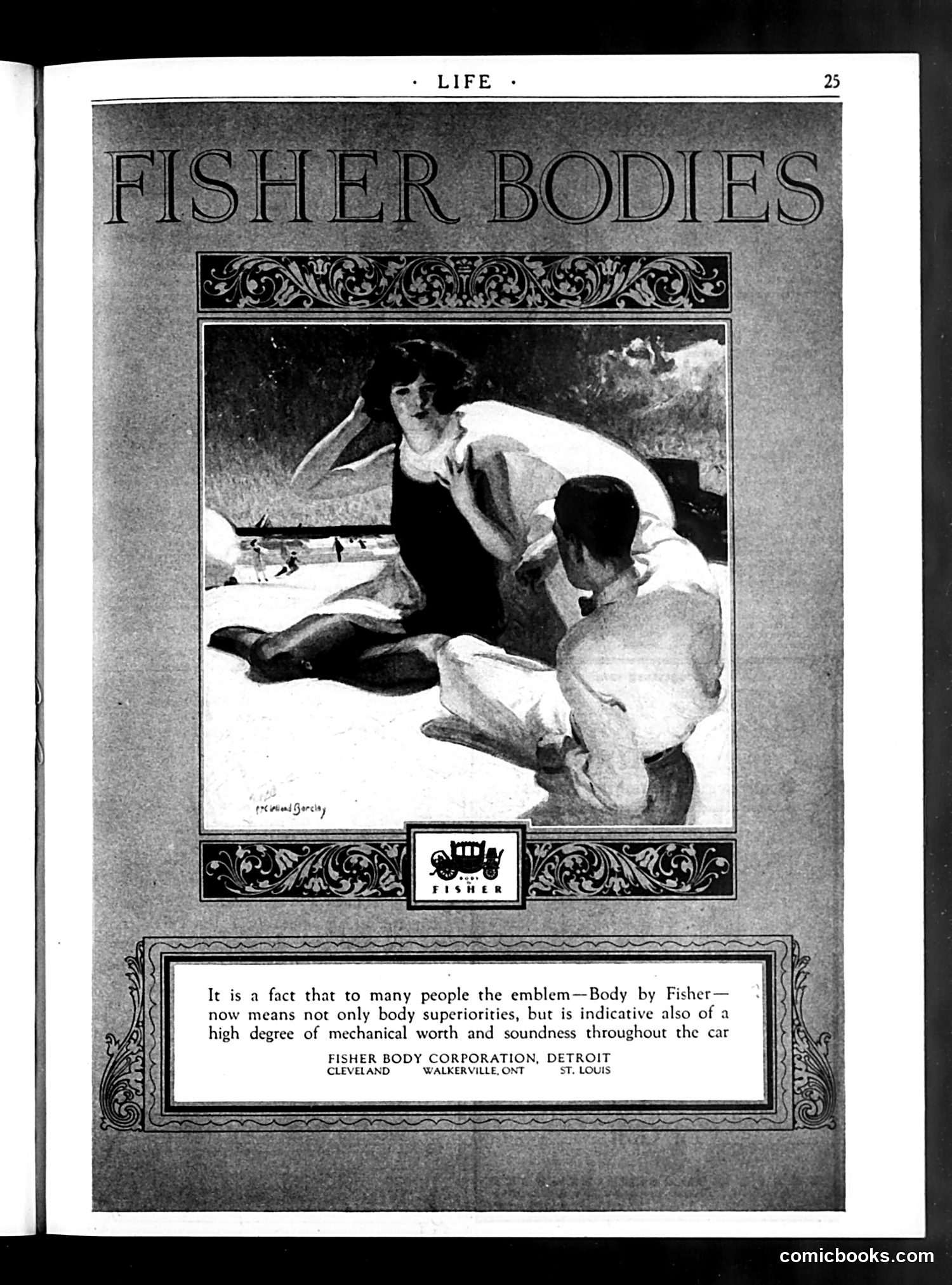
This is a **Fisher Body Corporation advertisement**, not satire or political commentary. The page shows two people examining an automobile body, illustrating Fisher Body's brand messaging. The text claims that "Body by Fisher" has become synonymous not just with superior car bodies, but with overall mechanical quality and reliability. Fisher Body Corporation was a major American auto body manufacturer (headquartered in Detroit) that supplied bodies to various automobile makers. The ad's point is straightforward: the Fisher brand name had achieved such reputation that consumers associated it with excellence beyond just the body itself—suggesting trustworthiness in the entire vehicle's construction and durability. The ornamental borders and formal layout are typical of early 20th-century magazine advertising design.
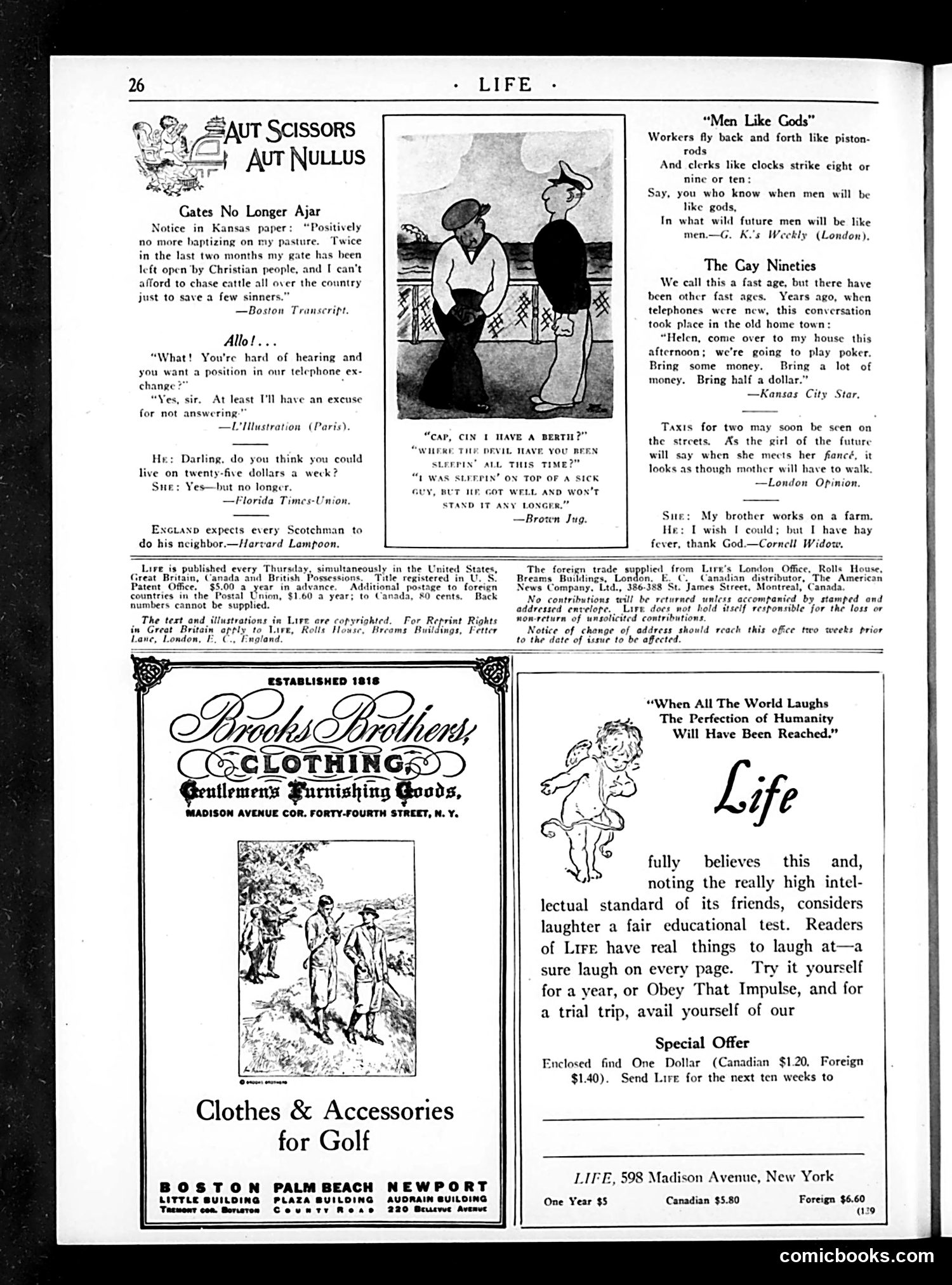
This page from *Life* magazine contains several short humorous items typical of early 20th-century American satire: **"Gates No Longer Ajar"** mocks overzealous Christian evangelism—a Kansas farmer complains that baptizing neighbors keep leaving his gates open, letting cattle escape. The joke: saving souls costs him money. **The telephone exchange joke** plays on deaf applicants being hired because they have a built-in excuse for not answering calls. **"Cap, Cin I Have a Berth?"** depicts a vagrant complaining he can't sleep on sick men anymore because they recover and won't tolerate it—dark humor about poverty and homelessness. Other brief items satirize modern dating economics, Scottish stinginess, and telephone-era social changes. The page is primarily **advertising and promotional content** for *Life* magazine itself, emphasizing humor as intellectual entertainment. The Brooks Brothers ad and subscription offer dominate the layout, making this largely a commercial page rather than substantive editorial content.
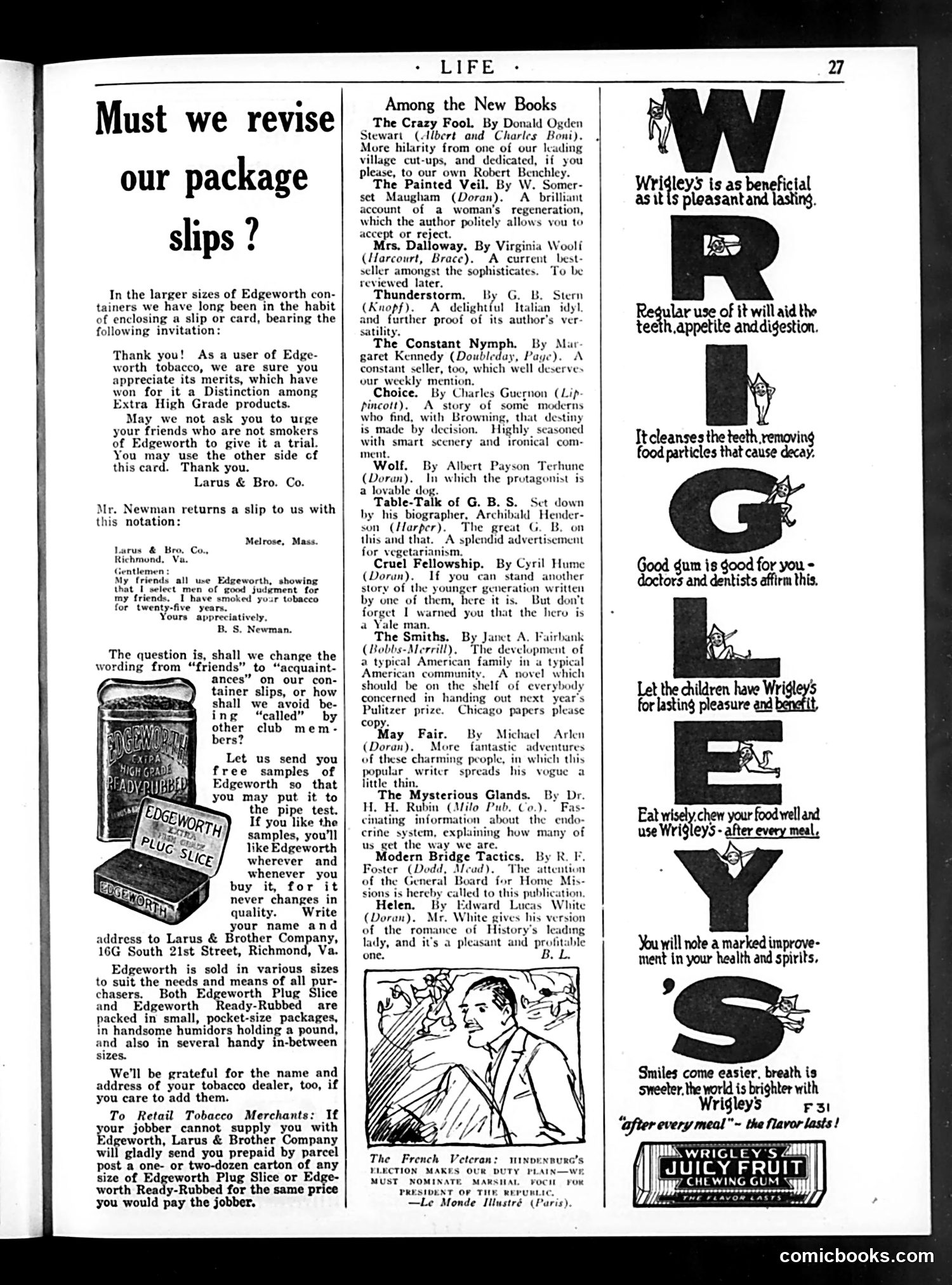
This page combines a tobacco advertisement with book reviews and chewing gum ads. The main feature is an Edgeworth tobacco company inquiry: should they revise their package inserts? The company included cards asking customers to recommend Edgeworth to non-smoking "friends." One customer, B.S. Newman, humorously returned the card noting his friends *already* smoke Edgeworth—so he'd selected men of good judgment. The company now debates whether to change "friends" to "acquaintances" to avoid social embarrassment among club members. The satire targets American class anxieties of the 1920s: the humor lies in the awkwardness of admitting your social circle all shares the same brand loyalty, implying either excellent taste or predictable conformity. The right side contains Wrigley's chewing gum advertisements, promoting dental and digestive benefits—typical early-20th-century patent-medicine style marketing claims.
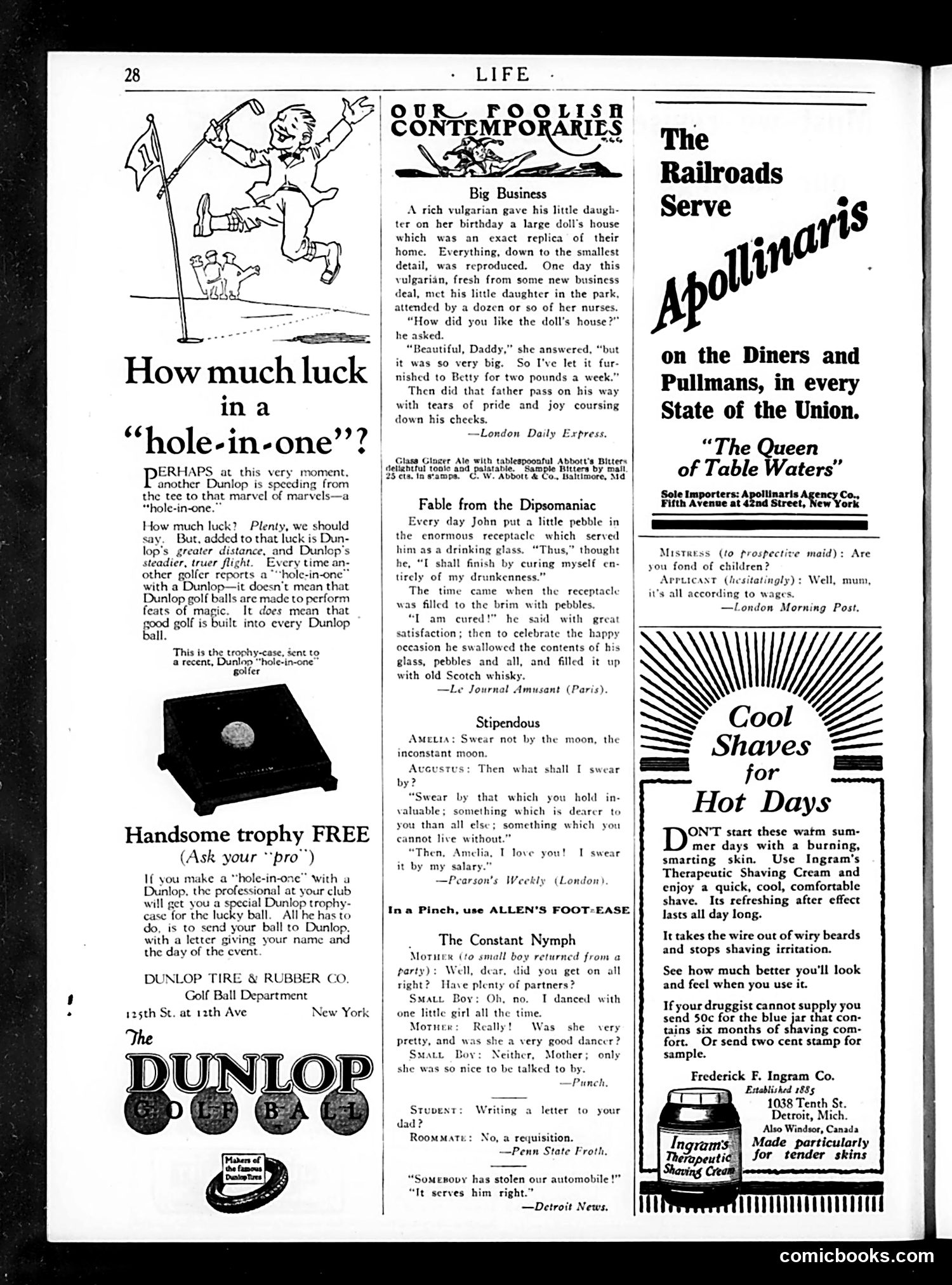
This Life magazine page combines satirical humor with period advertising. The main cartoon depicts a wealthy businessman's daughter who receives an elaborate dollhouse replica of her family home. The joke: rather than playing with it, she rents it out to a friend for two pounds weekly—satirizing both child precocity and the business mentality of the "rich vulgarian" father. The humor relies on ironic role-reversal: the child adopts her father's capitalist mindset, treating the luxury gift as investment property. Other brief humor pieces mock alcoholism ("Dipsomaniac" fable), romantic sentimentality (man swearing by his salary instead of love), and social pretense. These reflect common early-20th-century satirical targets. The advertisements—for Dunlop golf balls, shaving cream, and Apollinaris water—target affluent male readers, reinforcing the magazine's audience.
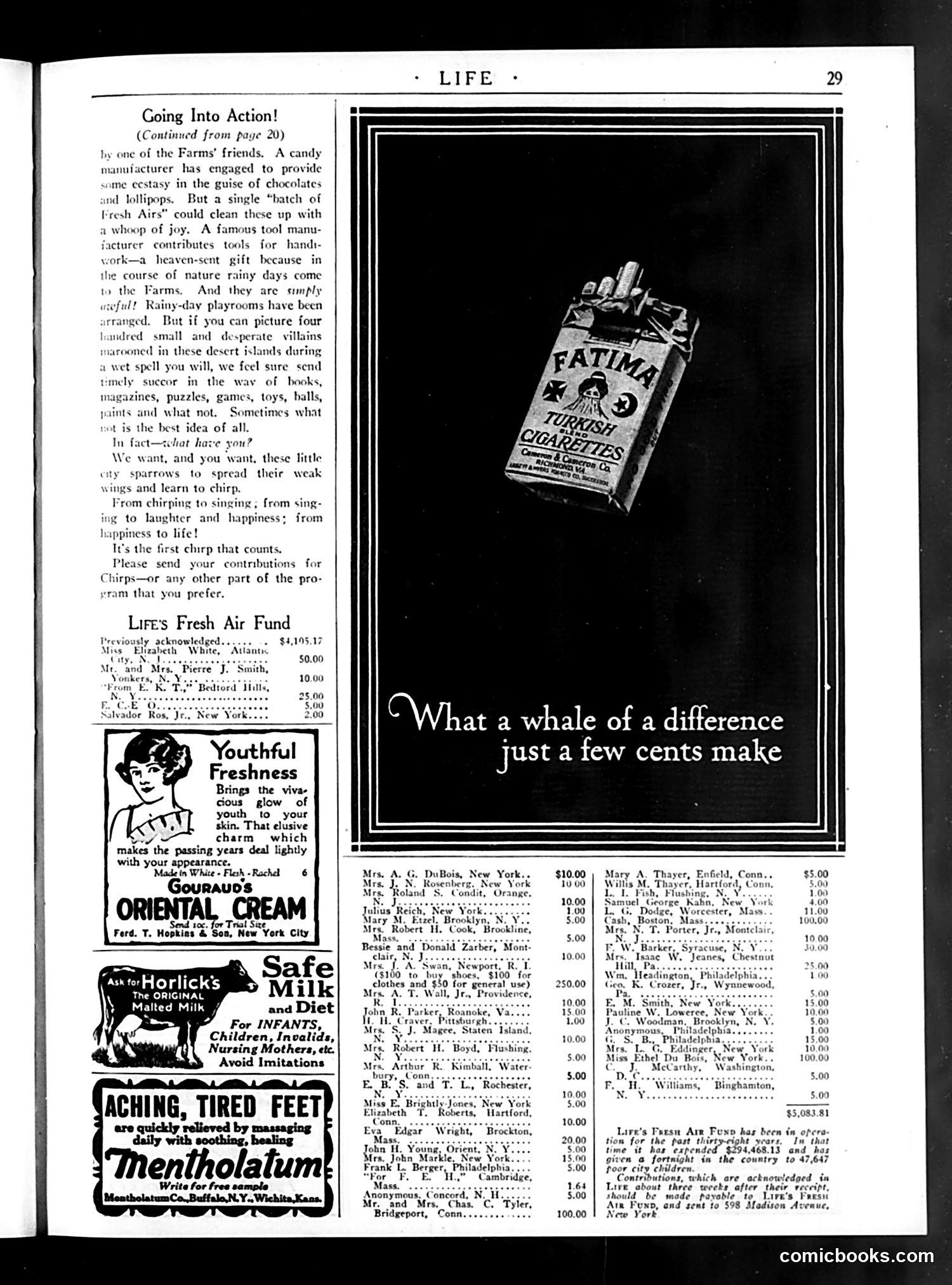
This page primarily documents **Life's Fresh Air Fund**, a charitable program providing urban children with rural respite. The main content is a fundraising appeal listing donors and their contributions. The **central image** advertises Fatima Turkish Cigarettes with the tagline "What a whale of a difference just a few cents make"—a commercial pitch suggesting small monetary amounts yield significant results, which ironically mirrors the Fresh Air Fund's messaging about modest donations helping underprivileged children. The surrounding **advertisements** (Oriental Cream, Horlick's Malted Milk, Mentholatum) are typical period products. The "Youthful Freshness" cream ad uses similar language about minor expenditures producing major beauty benefits. **Context for modern readers**: This reflects early 20th-century Progressive Era charity work targeting poor urban youth, offering them outdoor experiences. The juxtaposition of cigarette advertising alongside children's welfare appeals reflects different advertising standards of that era—tobacco ads appeared freely in family magazines.
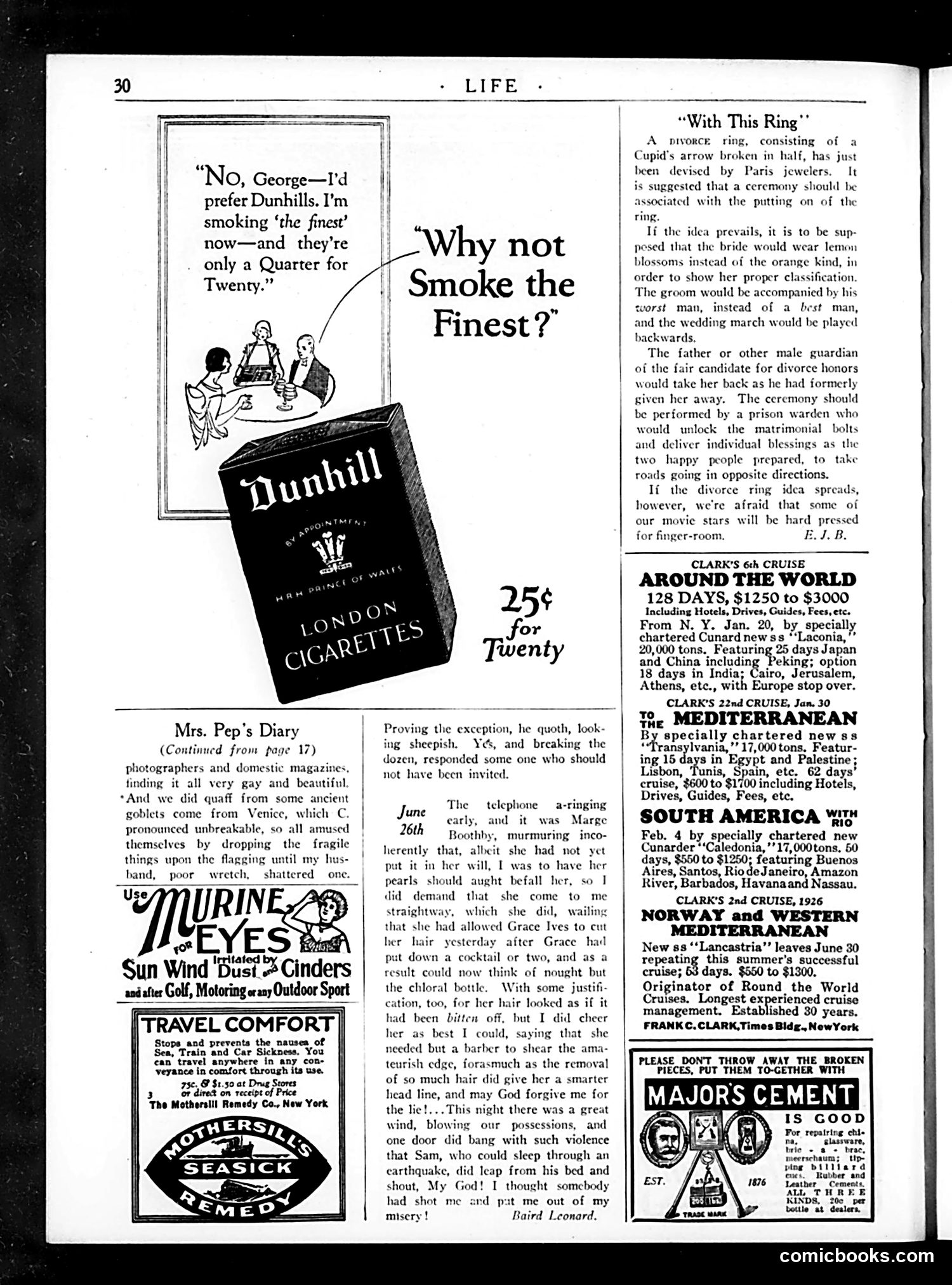
This page contains a **cigarette advertisement** disguised as editorial content. The main cartoon shows a man rejecting expensive cigars ("Dunhills") in favor of Dunhill cigarettes at 25 cents per pack, with the tagline "Why not Smoke the Finest?"—a pitch that cheaper cigarettes offer equivalent quality to luxury alternatives. The satire appears to target the absurdity of marketing claims: the ad conflates "finest" quality with low price, inverting typical luxury-good logic. The cartoon's conversational tone between "George" and another figure makes the sales pitch seem like peer recommendation rather than advertising. The page also includes "Mrs. Pep's Diary," a humor column about domestic life; various travel cruises; and patent medicine ads (Travel Comfort for seasickness, Mothers' Remedy). These reflect 1920s-era magazine conventions mixing editorial, humor, and commercial content without clear separation—a practice modern readers would recognize as problematic blurring of advertising and journalism.
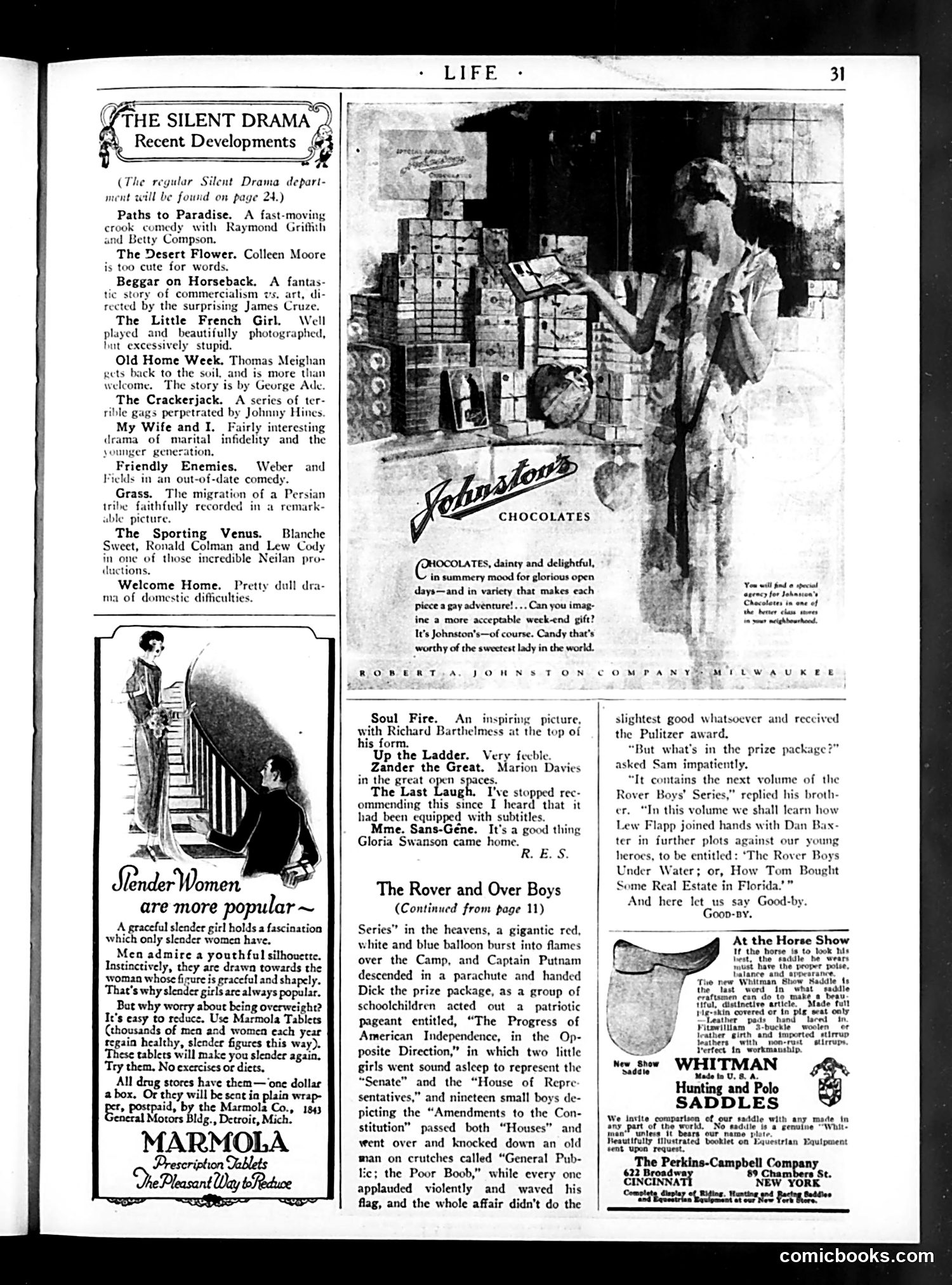
This page is primarily a **film review column** from Life magazine's entertainment section, covering silent movies of the era (likely early 1920s). The reviews are brief, witty critiques of various films—some praising performances (Colleen Moore, Richard Barthelmess), others mocking plots as "excessively stupid" or "feeble." The satirical edge appears in **"The Rover and Over Boys"** continuation piece, which mocks juvenile adventure fiction through absurdist humor: schoolchildren perform a patriotic pageant where senators "go sound asleep," constitutional amendments are depicted knocking down an elderly "General Public," and the whole meaningless spectacle "received the Pulitzer award"—obvious satire of how frivolous entertainment wins serious recognition. The advertisements (Marmola weight-loss tablets, Johnston's chocolates, Whitman saddles) reflect period consumer culture. The "Slender Women" ad promoting weight reduction reflects 1920s beauty standards. The cartoonish illustration of a woman on stairs reinforces the magazine's visual humor typical of this era's satirical publications.
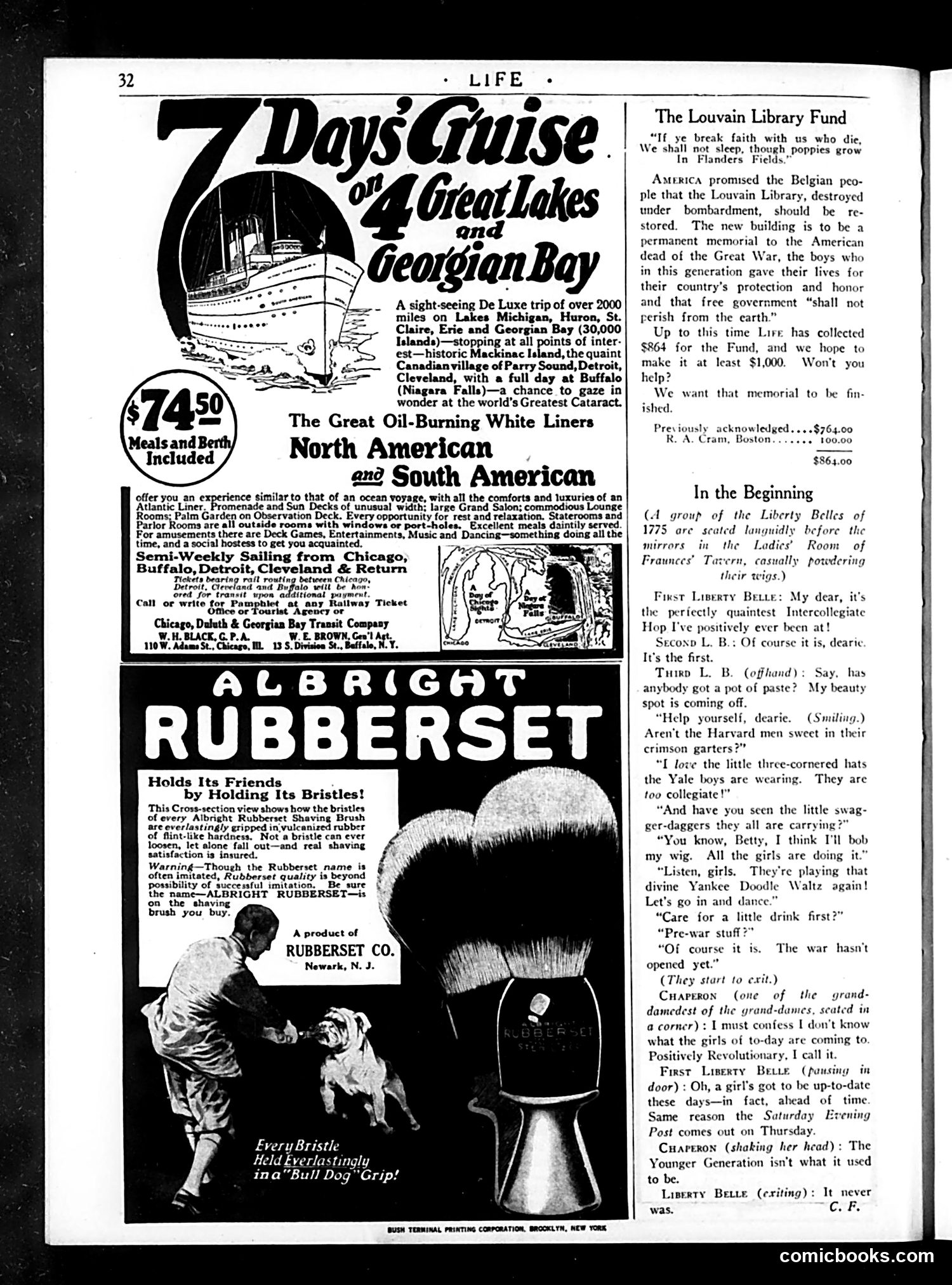
This Life magazine page combines advertisements with satirical content. The main advertisements promote a Great Lakes cruise ($74.50) and an Albright Rubberset shaving brush—typical 1920s luxury marketing. The satirical piece, "In the Beginning," imagines Liberty Belles from 1775 at Fraunces' Tavern (a Revolutionary War-era New York establishment) gossiping about modern 1920s fashions and behaviors. The joke mocks contemporary women by having colonial-era women discuss "bobbing" wigs, swagger daggers, and collegiate fashion—suggesting that modern women's fashions and attitudes, presented as revolutionary, actually echo eighteenth-century vanity. The Louvain Library appeal references a genuine post-WWI reconstruction fund for a Belgian library destroyed in German bombardment, framing it as an American memorial to fallen soldiers. This combines patriotic duty with fundraising.
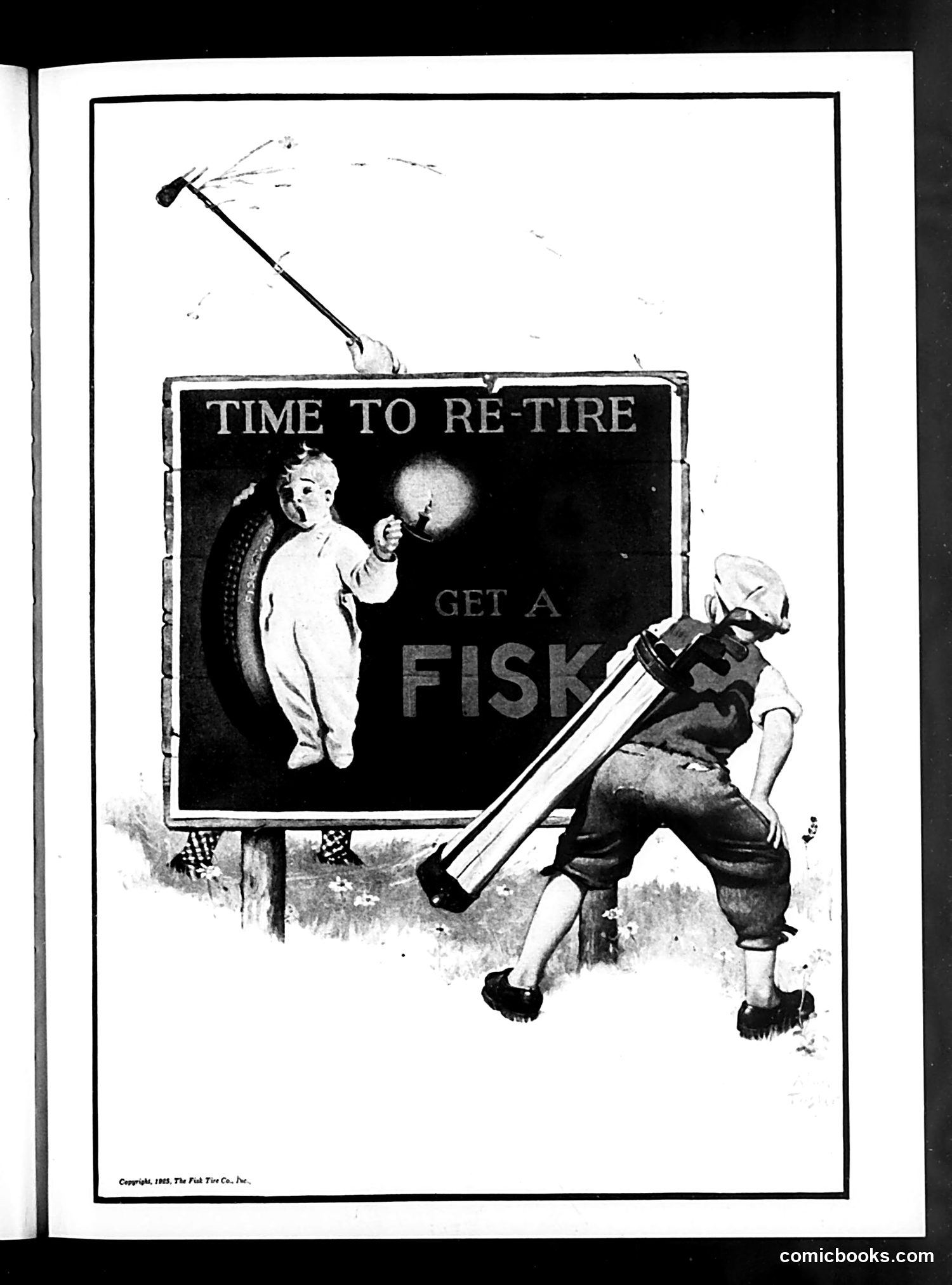
This is a 1925 Fisk Tire Company advertisement disguised as satirical commentary. The image depicts two children—one hammering a nail into a billboard, another operating what appears to be a cannon or blower—attacking a roadside advertisement. The ad's message plays on the era's frustration with ubiquitous roadside advertising. The headline "TIME TO RE-TIRE / GET A FISK" makes a pun: "re-tire" suggests both replacing worn tires and being "tired of" (annoyed by) billboards. The joke targets billboard clutter itself while advertising Fisk tires, using children as mischievous agents destroying ads. This reflects 1920s growing public annoyance with commercial signage proliferating across the American landscape—the ad cleverly monetizes that frustration to promote tire replacement.
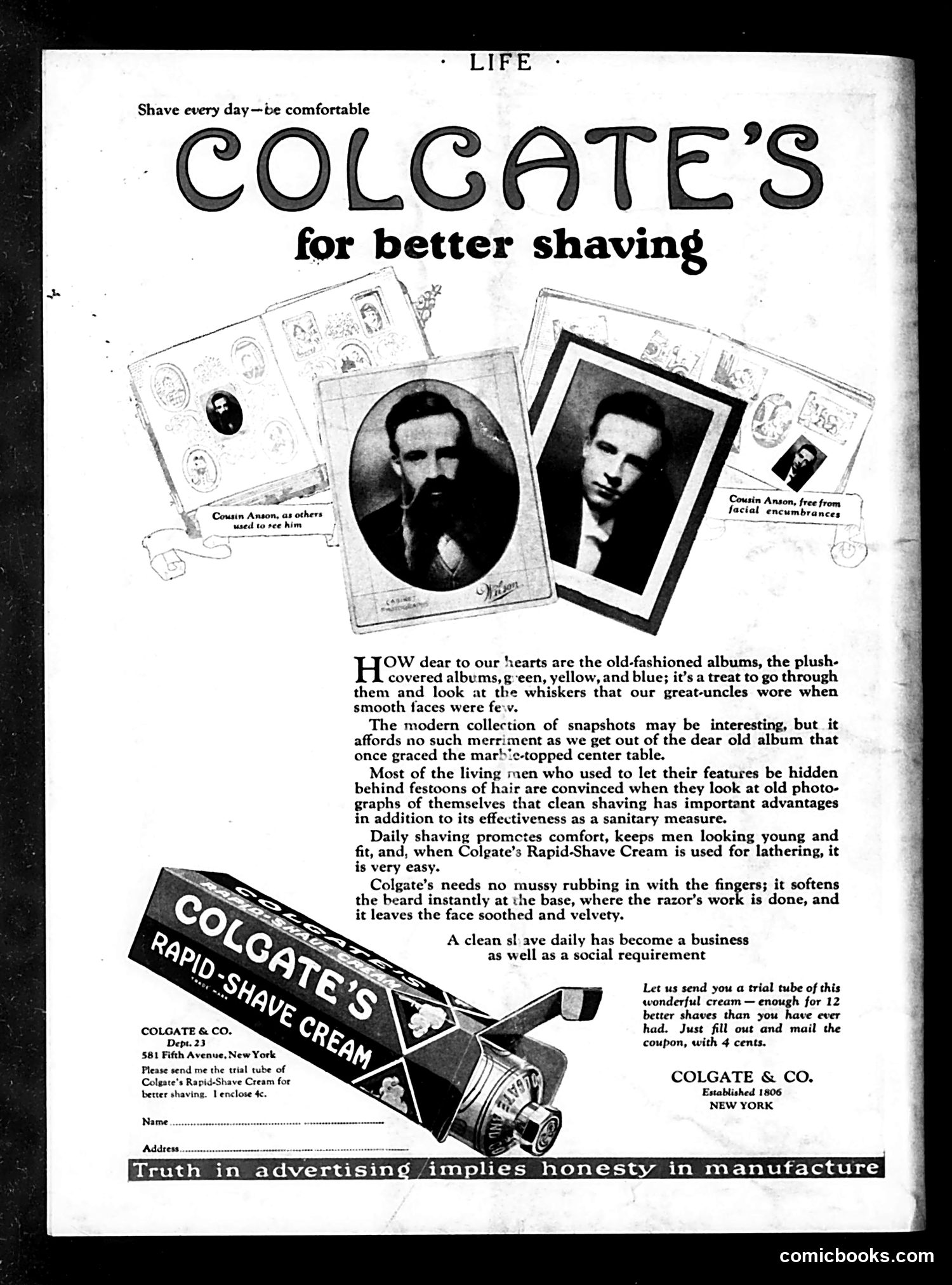
This is primarily a **Colgate's shaving cream advertisement**, not political satire. The page uses humor to promote daily shaving by contrasting old and modern grooming standards. The two portrait photographs labeled "Cousin Anson" show the same man with and without facial hair—a before-and-after demonstrating how outdated full beards appear. The accompanying text nostalgically references old photograph albums filled with hirsute ancestors, suggesting that contemporary readers find those heavily-bearded looks ridiculous by modern standards. The advertisement's central message: clean-shaven faces are now the social and business norm, and Colgate's cream makes daily shaving easy and comfortable. The copy appeals to masculine vanity (looking "young and fit") and social conformity. The bottom tagline—"Truth in advertising implies honesty in manufacture"—was standard corporate messaging of the era, not satirical commentary.

I can see this is a page from Life magazine, but the image quality is extremely poor—mostly black with only faint, indecipherable shapes visible on the right side. There appear to be some circular forms that might be illustrations or caricatures, but I cannot make out specific details, text, figures, or their identities with any confidence. The OCR text only contains a website reference ("comicbooks.com") and a page number ("8"), providing no contextual information about the page's content, date, or subject matter. Without clearer visibility of the actual cartoon(s), illustrations, or readable text, I cannot responsibly identify specific figures, political references, or explain the satire or joke. I'd need a higher-quality image scan to provide accurate analysis.