
Life, 1925-07-02 · page 24 of 47
Life — July 2, 1925 — page 24: what you’re looking at
What you’re looking at
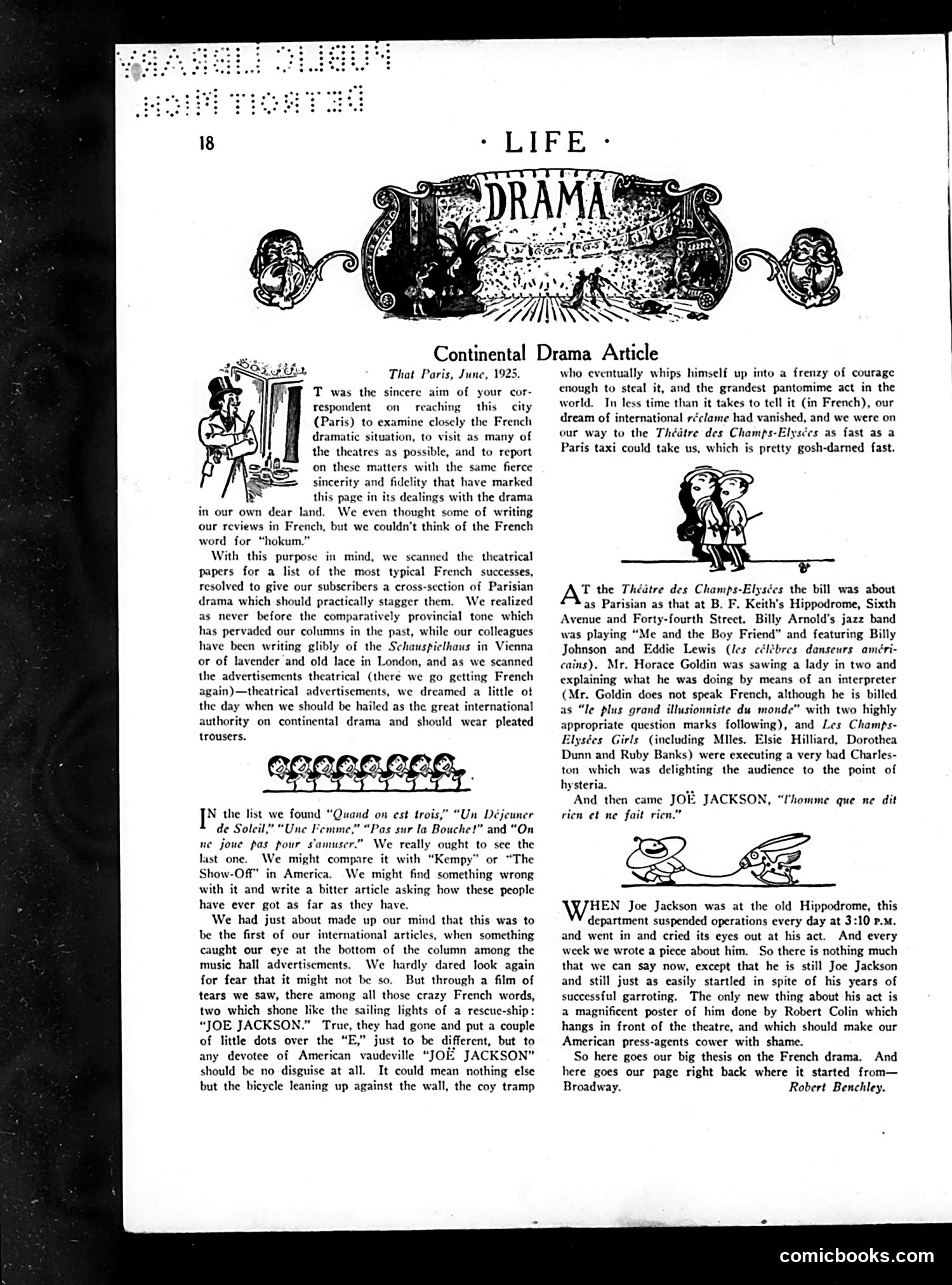
This 1925 *Life* magazine page satirizes American theatrical pretension and parochialism. The author, writing from Paris, initially aims to report on "serious" French drama with international sophistication—even considering writing in French (but can't think of the French word for "hokum," mocking their own provincialism). However, the joke centers on **Joe Jackson**, a famous American silent vaudeville performer known for a pantomime act involving a stolen bicycle. The author abandons all pretense of continental sophistication the moment he spots Jackson's name in a Parisian music hall advertisement, abandoning his "international articles" dream to rush to see this American performer. The satire targets American cultural insecurity: despite aspirations toward European refinement, Americans remain emotionally invested in homegrown entertainment. Jackson's presence in Paris becomes absurdly more relevant than actual French drama. The accompanying illustrations and jovial tone emphasize the humor of this collision between highbrow ambitions and lowbrow American entertainment nostalgia.
📄 Transcribed text from this page (OCR, searchable)
Machine-transcribed from the original scan — historical spelling and the odd misread are preserved.
That Paris, June, 1925. T was the sincere aim of your cor- respondent on reaching this city (Paris) to examine closely the French dramatic situation, to visit as many of the theatres as possible, and to report on these matters with the same fierce sincerity and fidelity that have marked this page in its dealings with the drama in our own dear land. We even thought some of writing our reviews in French, but we couldn't think of the French word for “hokum.” With this purpose in mind, we scanned the theatrical papers for a list of the most typical French successes, resolved to give our subscribers a cross-section of Parisian drama which should practically stagger them. We realized as never before the comparatively provincial tone which has pervaded our columns in the past, while our colleagues have been writing glibly of the Schauspiclhaus in Vienna or of lavender and old lace in London, and as we scanned the advertisements theatrical (there we go getting French again)—theatrical advertisements, we dreamed a little ot the day when we should be hailed as the great international authority on continental drama and should wear pleated ORR EE IX the list we found “Quand on est trois,” “Un Déjeuner de Soleil,” “Une Femme,” “Pas sur la Bouche!” and “On ne joue pas pour s'amuser.” We really ought to see the last one. We might compare it with “Kempy” or “The Show-Off” in America. We might find something wrong with it and write a bitter article asking how these people have ever got as far as they have. We had just about made up our mind that this was to be the first of our international articles, when something caught our eye at the bottom of the column among the music hall advertisements. We hardly dared look again for fear that it might not be so. But through a film of tears we saw, there among all those crazy French words, two which shone like the sailing lights of a rescue-ship: “JOE JACKSON.” True, they had gone and put a couple of little dots over the “E,” just to be different, but to any devotee of American vaudeville “JOE JACKSON” should be no disguise at all. It could mean nothing else but the bicycle leaning up against the wall, the coy tramp Continental Drama Article who eventually whips himself up into a frenzy of courage cnough to steal it, and the grandest pantomime act in the world. In less time than it takes to tell it (in French), our dream of international réclame had vanished, and we were on our way to the Thédtre des Champs-Ely: Paris taxi could take us, which is pretty gosh-darned fast. At the Thédtre des Champs-Elysées the bill was about as Parisian as that at B. F. Keith's Hippodrome, Sixth Avenue and Forty-fourth Street. Billy Arnold’s jazz band was playing “Me and the Boy Friend” and featuring Billy Johnson and Eddie Lewis (les célébres danseurs améri- cains). Mr. Horace Goldin was sawing a lady in two and explaining what he was doing by means of an interpreter (Mr. Goldin does not speak French, although he is billed as “le plus grand illusionniste du monde” with two highly appropriate question marks following), and Les Champs- Elysécs Girls (including Milles. Elsie Hilliard, Dorothea Dunn and Ruby Banks) were executing a very bad Charles- ton which was delighting the audience to the point of hysteria. And then came JOE JACKSON, “l'homme que ne dit rien et ne fait ricn.” WHEN Joe Jackson was at the old Hippodrome, this department suspended operations every day at 3:10 p.m. and went in and cried its eyes out at his act. And every week we wrote a piece about him. So there is nothing much that we can say now, except that he is still Joe Jackson and still just as easily startled in spite of his years of successful garroting. The only new thing about his act is a magnificent poster of him done by Robert Colin which hangs in front of the theatre, and which should make our American press-agents cower with shame. So here goes our big thesis on the French drama. And here goes our page right back where it started from— Broadway. Robert Benchley. comicbooks.com