
Life, 1925-07-02 · page 19 of 47
Life — July 2, 1925 — page 19: what you’re looking at
What you’re looking at
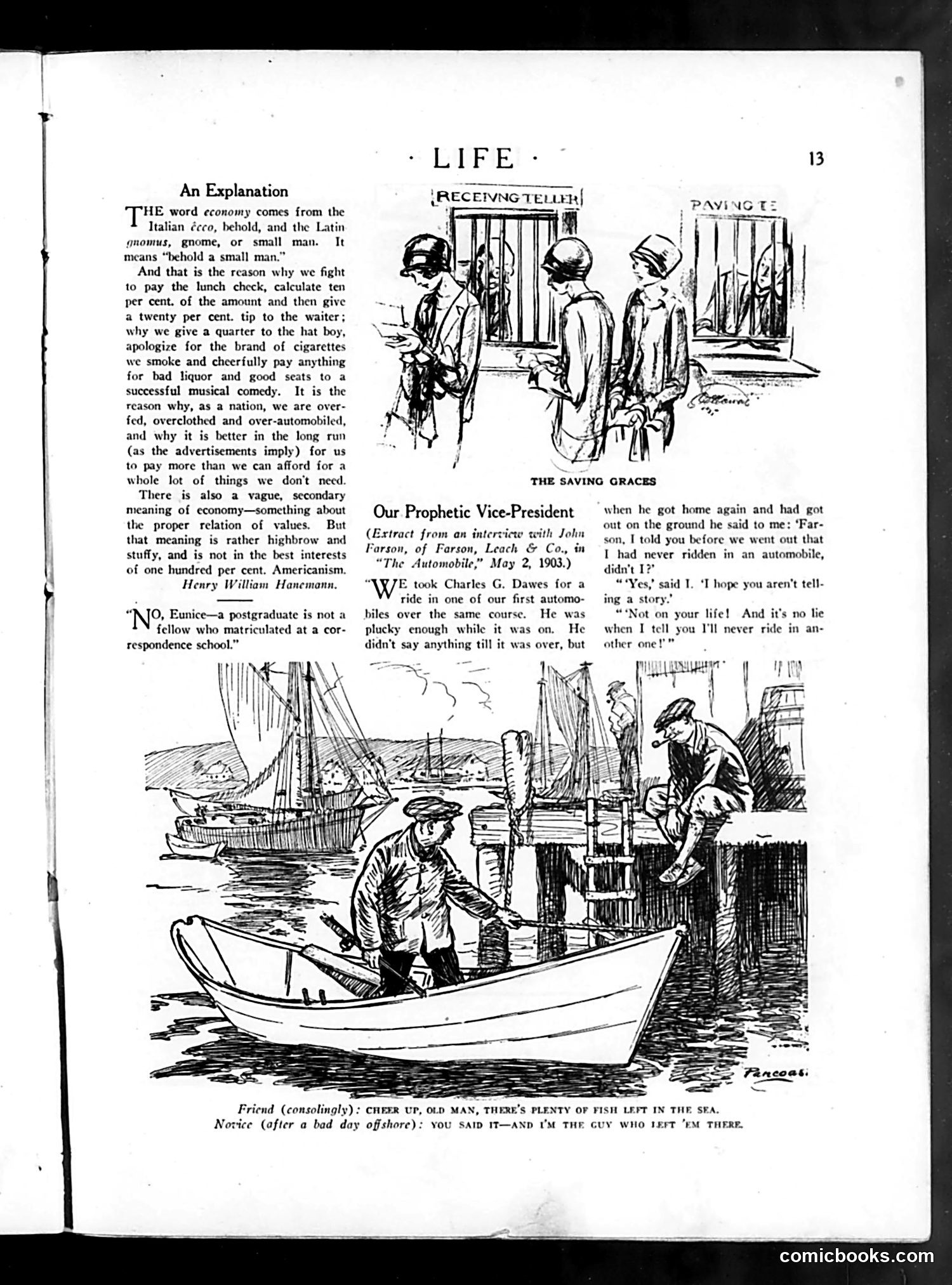
This page contains satirical commentary and cartoons typical of early 1900s Life magazine. **"An Explanation"** mocks American consumer culture, particularly the pressure to overspend on unnecessary items—tipping excessively, buying expensive theater tickets, and purchasing automobiles. The author argues Americans are "over-fed, overclothed and over-automobiled" despite claims of "economy." **"The Saving Graces"** shows two scenes: workers at a bank's receiving window and paying desk, and a fisherman's joke about depleted waters. **"Our Prophetic Vice-President"** references an anecdote about Charles G. Dawes (who became Vice President under Coolidge in 1921) taking an early automobile ride. The humor lies in Dawes' reluctance to repeat the experience, reflecting contemporary anxiety about automobiles as dangerous, unreliable novelties. The cartoon at bottom depicts two fishermen with a crude joke about fish depletion and responsibility—common working-class humor of the era.
📄 Transcribed text from this page (OCR, searchable)
Machine-transcribed from the original scan — historical spelling and the odd misread are preserved.
An Explanation THe word economy comes from the Italian éeco, behold, and the Latin gnomus, gnome, or small man. It means “behold a small man.” And that is the reason why we fight to pay the lunch check, calculate ten per cent. of the amount and then give a twenty per cent. tip to the waiter; why we give a quarter to the hat boy, apologize for the brand of cigarettes we smoke and cheerfully pay anything for bad liquor and good seats to a successful musical comedy. It is the reason why, as a nation, we are over- fed, overclothed and over-automobiled, and why it is better in the long run (as the advertisements imply) for us to pay more than we can afford for a whole lot of things we don't need. There is also a vague, secondary meaning of economy—something about the proper relation of values. But that meaning is rather highbrow and stuffy, and is not in the best interests of one hundred per cent. Americanism. Henry William Hanemann. “N°: Eunice—a postgraduate is not a fellow who matriculated at a cor- respondence school.” “LIFE! - \RECE EIVNGT ELLER| PAVING TE THE SAVING GRACES Our Prophetic Vice-President (Extract from an interview with John Farson, of Farson, Leach & Co., in “The Automobile,” May 2, 1903.) “ E took Charles G, Dawes for a ride in one of our first automo- biles over the same course. He was plucky enough while it was on. He didn’t say anything till it was over, but Friend (consolingly) : CHEER UP, OLD MAN, THERE'S PLENTY OF FISH LEFT IN THE SEA. Novice (after a bad day offshore): you SAID IT—AND UM THR GUY WHO DEFT ‘EM THERE, when he got home again and had got out on the ground he said to me: ‘Far- son, I told you before we went out that I had never ridden in an automobile, didn’t 1?° “Yes, said I. ‘I hope you aren't tell- ing a story.’ “‘Not on your life! And it’s no lie when I tell you I'll never ride in an- other one!" comicbooks.com