
Life, 1925-07-02 · page 20 of 47
Life — July 2, 1925 — page 20: what you’re looking at
What you’re looking at
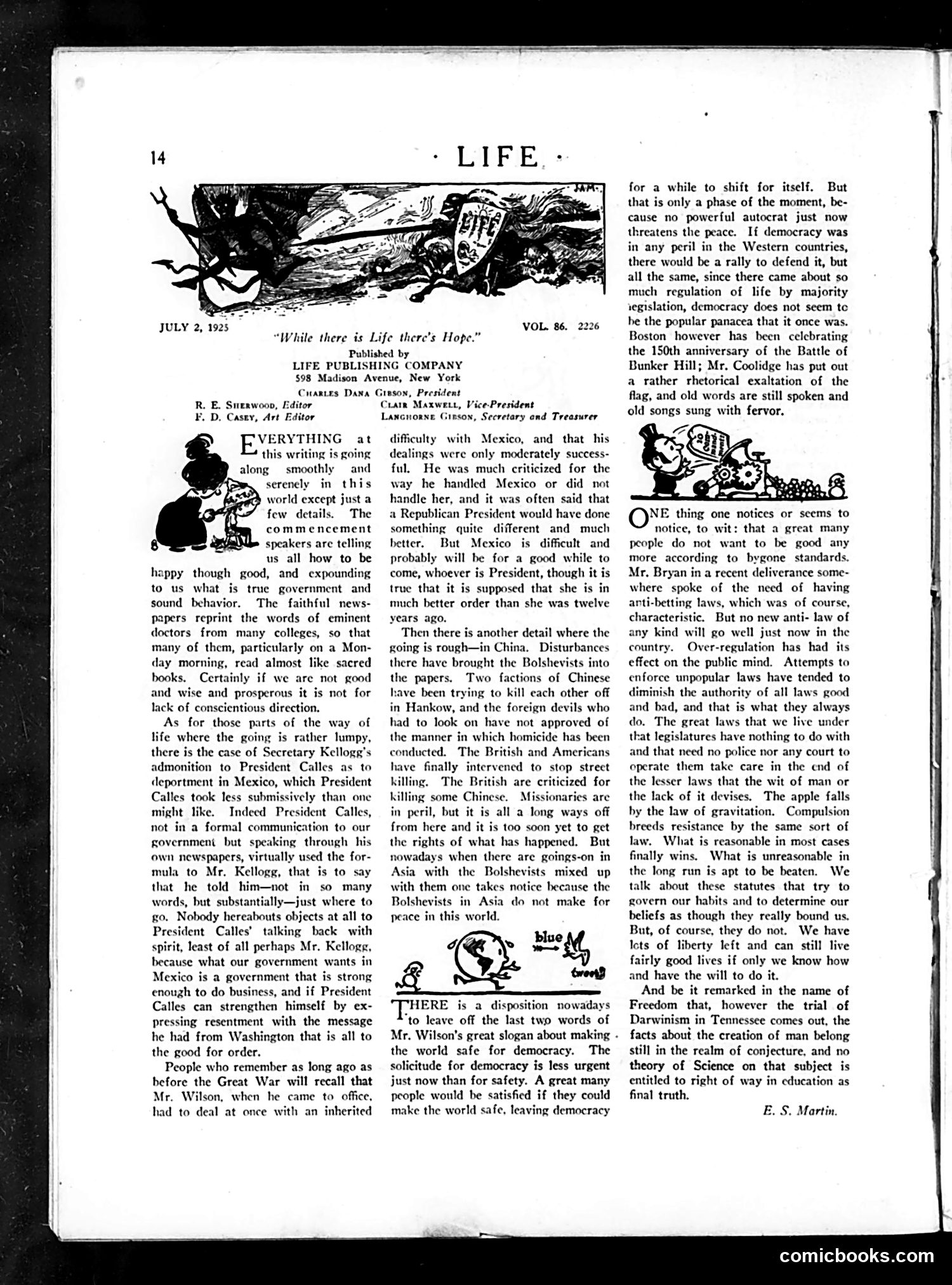
This editorial page addresses three foreign policy crises: **Mexico, China, and the broader tension between democracy and order**. **The Mexican situation** involves Secretary of State Kellogg's rebuke to Mexican President Calles, who publicly rejected American criticism through his newspapers. The author notes this is acceptable—stronger Mexican government serves American interests, even if defiant. **China's instability** stems from rival factions fighting in Hankow with Bolshevik involvement, threatening foreign nationals. British and American intervention is criticized but understood as necessary. **The larger theme**: Americans increasingly prioritize global "safety" over spreading "democracy"—Wilson's famous post-WWI slogan. The author observes that with no immediate autocratic threat, people would accept world stability even without democratic reform. This reflects 1920s disillusionment with idealistic interventionism, preferring order to ideological crusades. The cartoons (small illustrations accompanying the text) appear to satirize these priorities, though details are unclear in reproduction.
📄 Transcribed text from this page (OCR, searchable)
Machine-transcribed from the original scan — historical spelling and the odd misread are preserved.
JULY 2, 1925 VOL. 86. 2226 “While there is Life there’s Hope.” Published by LIFE PUBLISHING COMPANY $98 Madison Avenue, New York Cuartes Dana R. E. Sneawoon, Editor F, D, Casnry, Art Editor VERYTHING at this writing is going along smoothly and serenely in this world except just a few details. The commencement speakers are telling us all how to be happy though good, and expounding to us what is true government and sound behavior. The faithful news- papers reprint the words of eminent doctors from many colleges, so that many of them, particularly on a Mon- day morning, read almost like sacred books. Certainly if we are not good and wise and prosperous it is not for lack of conscientious direction, As for those parts of the way of life where the going is rather lumpy, there is the case of Secretary Kellogg's admonition to President Calles as to deportment in Mexico, which President Calles took less submissively than one might like. Indeed President Calles, not in a formal communication to our government but speaking through his own newspapers, virtually used the for- mula to Mr. Kellogg, that is to say that he told him—not in so many words, but substantially—just where to go. Nobody hereabouts objects at all to President Calles’ talking back with spirit, least of all perhaps Mr. Kellogg, because what our government wants in Mexico is a government that is strong enough to do business, and if President Calles can strengthen himself by ex- pressing resentment with the message he had from Washington that is all to the good for order. People who remember as long ago as before the Great War will recall that Mr. Wilson, when he came to office, had to deal at once with an inherited son, President Crate Maxwett, Vice-President Lancnoane Girson, Secretary ond Treasurer difficulty with Mexico, and that his dealings were only moderately success- ful. He was much criticized for the way he handled Mexico or did not handle her, and it was often said that a Republican President would have done something quite different and much better. But Mexico is difficult and probably will be for a good while to come, whoever is President, though it is true that it is supposed that she is in much better order than she was twelve years ago. Then there is another detail where the going is rough—in China. Disturbances there have brought the Bolshevists into the papers. Two factions of Chinese have been trying to kill each other off in Hankow, and the foreign devils who had to look on have not approved of the manner in which homicide has been conducted. The British and Americans have finally intervened to s killing. The British are er killing some Chinese. Missionaries are in peril, but it is all a long ways off from here and it is too soon yet to get the rights of what has happened. But nowadays when there are goings-on in Asia with the Bolshevists mixed up with them one takes notice because the Bolshevists in Asia do not make for peace in this world. 4 r = trond HERE is a disposition nowadays “to leave off the last two words of Mr. Wilson's great slogan about making - the world safe for democracy. The solicitude for democracy is less urgent just now than for safety. A great many people would be satisfied if they could make the world safe, leaving democracy for a while to shift for itself. But that is only a phase of the moment, be- cause no powerful autocrat just now threatens the peace. If democracy was in any peril in the Western countries, there would be a rally to defend it, but all the same, since there came about so much regulation of life by majority vegislation, democracy does not seem to be the popular panacea that it once was. Boston however has been celebrating the 150th anniversary of the Battle of Bunker Hill; Mr. Coolidge has put out a rather rhetorical exaltation of the flag, and old words are still spoken and old songs sung with fervor. NE thing one notices or seems to notice, to wit: that a great many people do not want to be good any more according to bygone standards. Mr. Bryan in a recent deliverance some- where spoke of the need of having anti-betting laws, which was of course, characteristic. But no new anti- law of any kind will go well just now in the country. Over-regulation has had its effect on the public mind. Attempts to enforce unpopular laws have tended to diminish the authority of all laws good and bad, and that is what they always do. The great laws that we live under that legislatures have nothing to do with and that need no police nor any court to operate them take care in the end of the lesser laws that the wit of man or the lack of it devises. The apple falls by the law of gravitation. Compulsion breeds resistance by the same sort of law. What is reasonable in most cases finally wins. What is unreasonable in the long run is apt to be beaten. We talk about these statutes that try to govern our habits and to determine our beliefs as though they really bound us. But, of course, they do not. We have lets of liberty left and can still live fairly good lives if only we know how and have the will to do it. And be it remarked in the name of Freedom that, however the trial of Darwinism in Tennessee comes out, the facts about the creation of man belong still in the realm of conjecture, and no theory of Science on that subject is entitled to right of way in cducation as final truth. E. S. Martin. comicbooks.com