
Life, 1925-07-02 · page 7 of 47
Life — July 2, 1925 — page 7: what you’re looking at
What you’re looking at
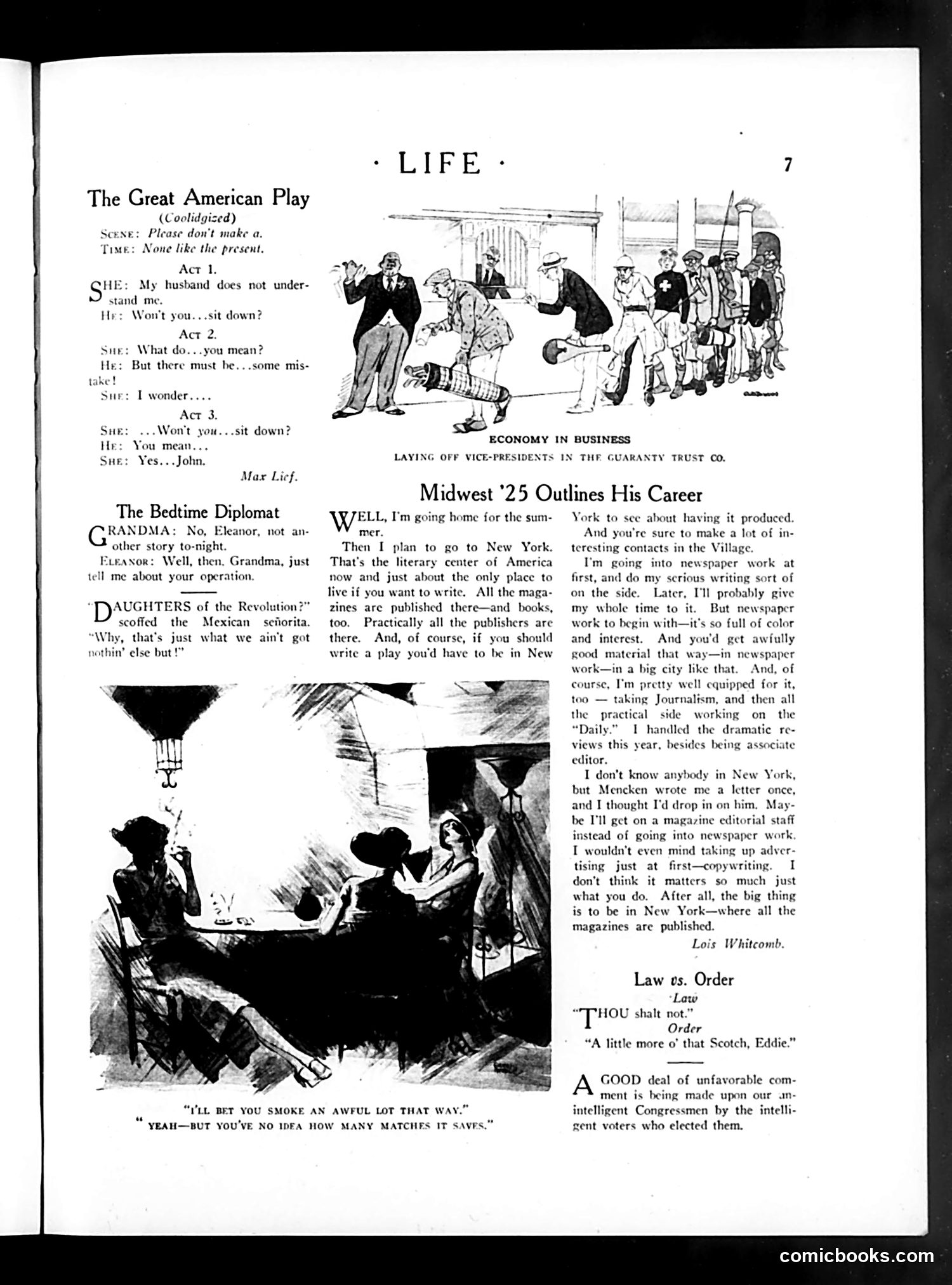
This page contains several satirical pieces typical of early 20th-century Life magazine: **"The Great American Play"** mocks marital incomprehension through a brief dramatic sketch where a husband and wife talk past each other. **"The Bedtime Diplomat"** depicts a grandmother and Eleanor (likely Eleanor Roosevelt, given the era) in dialogue about historical "Daughters of the Revolution"—satirizing upper-class women's patriotic societies. **"Economy in Business"** cartoon shows businessmen laying off vice-presidents, mocking corporate cost-cutting during economic uncertainty. **"Midwest '25 Outlines His Career"** profiles an aspiring writer's ambitions to work in New York publishing and journalism. **"Law vs. Order"** makes a brief political jab at congressmen, suggesting voters' criticism of elected officials. The overall tone reflects 1920s-era social satire on marriage, class pretension, business practices, and politics.
📄 Transcribed text from this page (OCR, searchable)
Machine-transcribed from the original scan — historical spelling and the odd misread are preserved.
The Great American Play (Coolidgized) Please don't make a. None like the present. Scene: Time: Act 1. HE: My husband does not under- stand m He: Won't you...sit down? Act 2. : What do...you mean? But there must be...some mis- : L wonder... Act 3. .. Won't you...sit down? You mean... Yes...John, Max Lief. The Bedtime Diplomat RANDMA: No, Eleanor, not an- other story to-night. Exteanor: Well, then, Grandma, just tell me about your operation. UGHTERS of the Revolution?” scoffed the Mexican sciiorita. “Why, that’s just what we ain't got nothin’ else but !" ECONOMY IN BUSINESS LAYING OFF VICE-PRESIDENTS IN THR GUARANTY TRUST CO. Midwest °25 Outlines His Career W ELL, I'm going home for the sum- mer. Then [ plan to go to New York. That's the literary center of America now and just about the only place to live if you want to write. All the maga- zines are published there—and books, too. Practically all the publishers are there. And, of course, if you should write a play you'd have to be in New VLL BET YOU SMOKE AN AWFUL LOT THAT WAY.” " . ” YEAH—BUT YOU'VE NO IDFA HOW MANY MATCHES IT SAVFS. York to sce about having it produced. And you're sure to make a lot of in- teresting contacts in the Village. I'm going into newspaper work at first, and do my scrious writing sort of on the side. Later, I'll probably give my whole time to it. But newspaper work to begin with—it's so full of color and interest. And you'd get awfully good material that way—in newspaper work—in a big city like that. And, of course, I'm pretty well equipped for it, too — taking Journalism, and then all the practical working on the “Daily.” I handled the dramatic re- views this year, besides being associate editor. I don't know anybody in New York, but Mencken wrote me a letter once, and I thought I'd drop in on him. May- be I'll get on a magazine editorial instead of going into newspaper work I wouldn't even mind taking up adver- tising just at first—copywriting. I don't think it matters so much just what you do. After all, the big thing is to be in New York—where all the magazines are published. Lois Whitcomb. side Law vs. Order Law wp HOU shalt not.” Order “A little more o' that Scotch, Eddie.” GOOD deal of unfavorable com- ment is being made upon our an- intelligent Congressmen by the intelli- gent voters who elected them. comicbooks.com