
A complete issue · 43 pages · 1925
Life — June 18, 1925
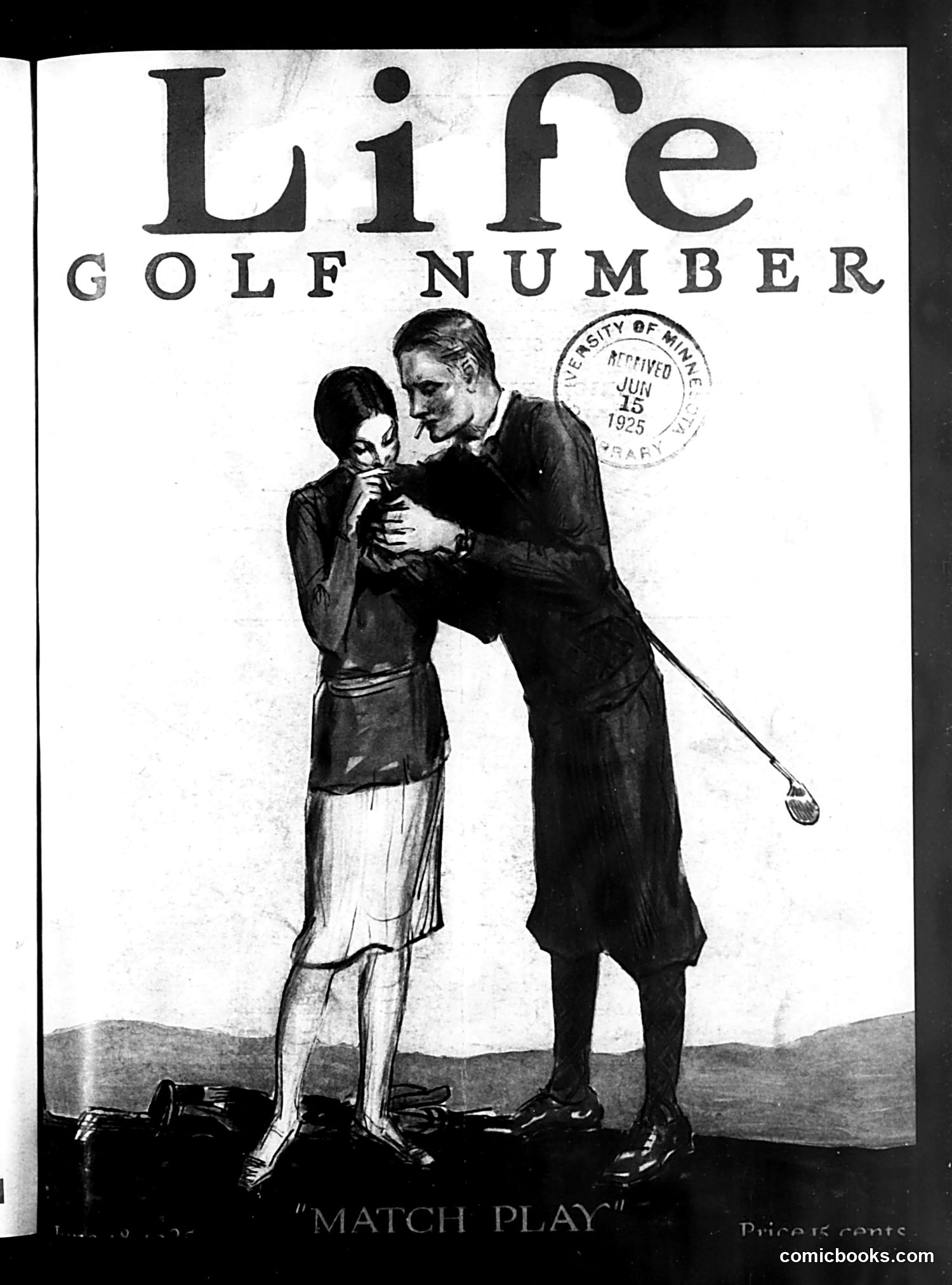
This is a 1925 *Life* magazine cover depicting a romantic/flirtatious scene between a man and woman on a golf course. The title "Match Play" is a golf pun—a match play tournament is a common golf competition format, but here it's used to suggest romantic "matching" or pairing. The image satirizes the 1920s "modern woman" and changing social customs. The woman's short skirt, bobbed hair, and direct interaction with the man reflect Jazz Age anxieties about female liberation and evolving dating conventions. The golf setting underscores women's increasing participation in recreational activities previously dominated by men. The library stamp dates it June 15, 1925, placing it during peak "Roaring Twenties" cultural upheaval.
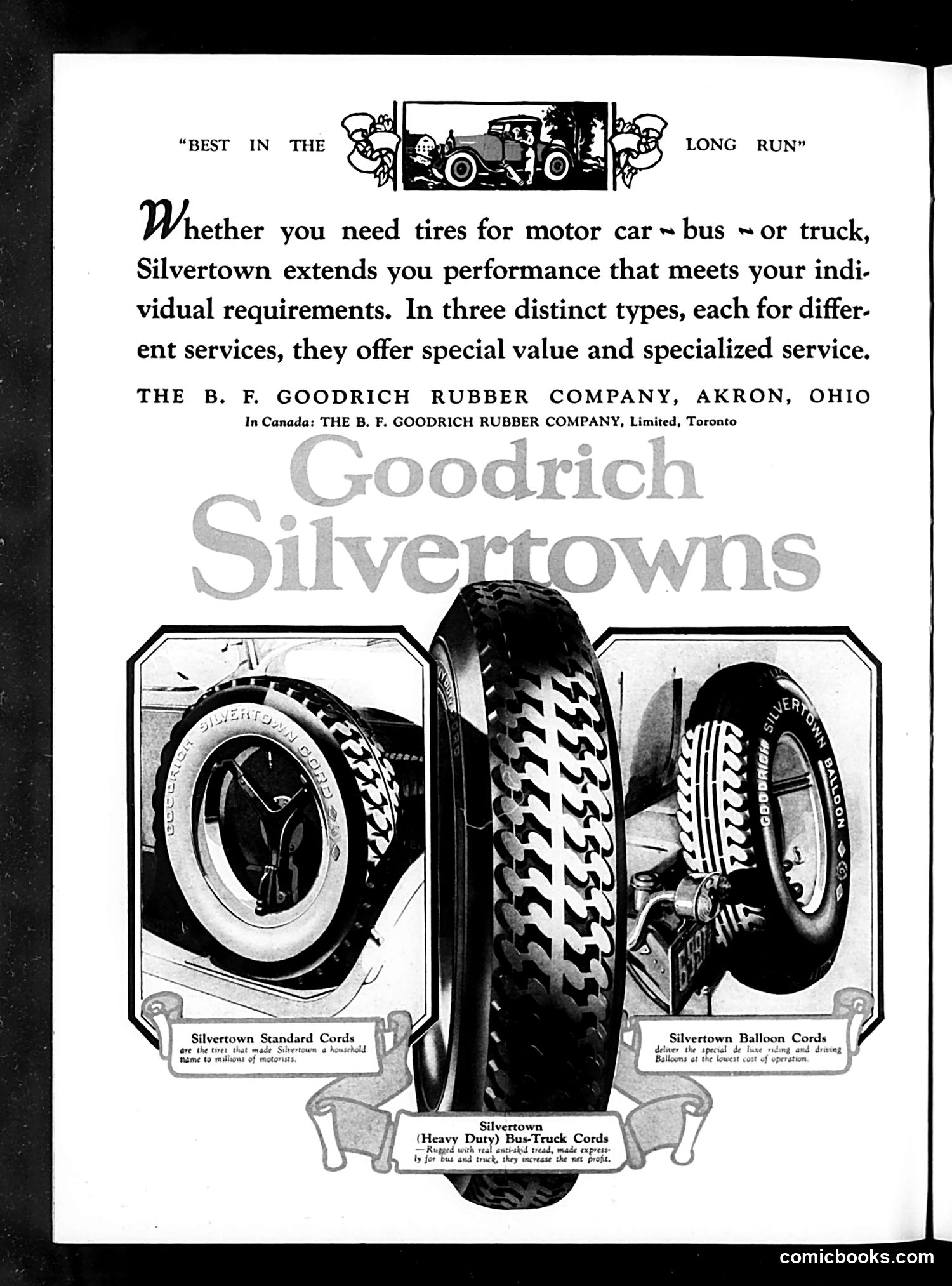
This is **not a cartoon or satire page**—it's a **straightforward advertisement** for Goodrich Silvertown tires, manufactured by The B.F. Goodrich Rubber Company. The page promotes three tire types designed for different vehicles: motor cars, buses, and trucks. The imagery shows three distinct tire models with their tread patterns visible. The tagline "Best in the Long Run" emphasizes durability and reliability. The decorative elements (cherubs, vintage car illustration at top) are typical 1920s-30s advertising aesthetics. There's no political commentary, caricature, or satire present—this is period product marketing aimed at commercial and consumer vehicle owners, highlighting specialized tire options for different transportation needs.
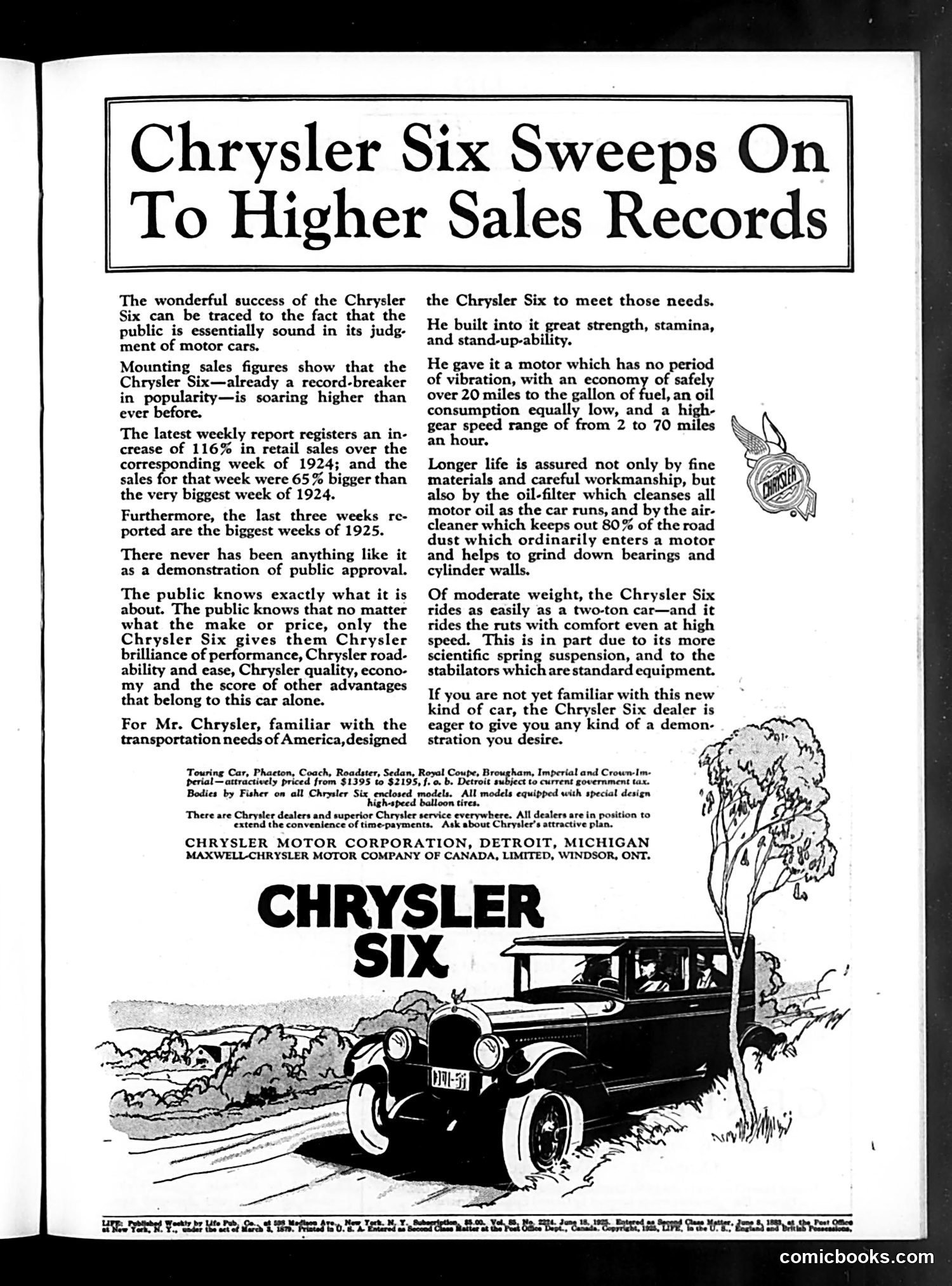
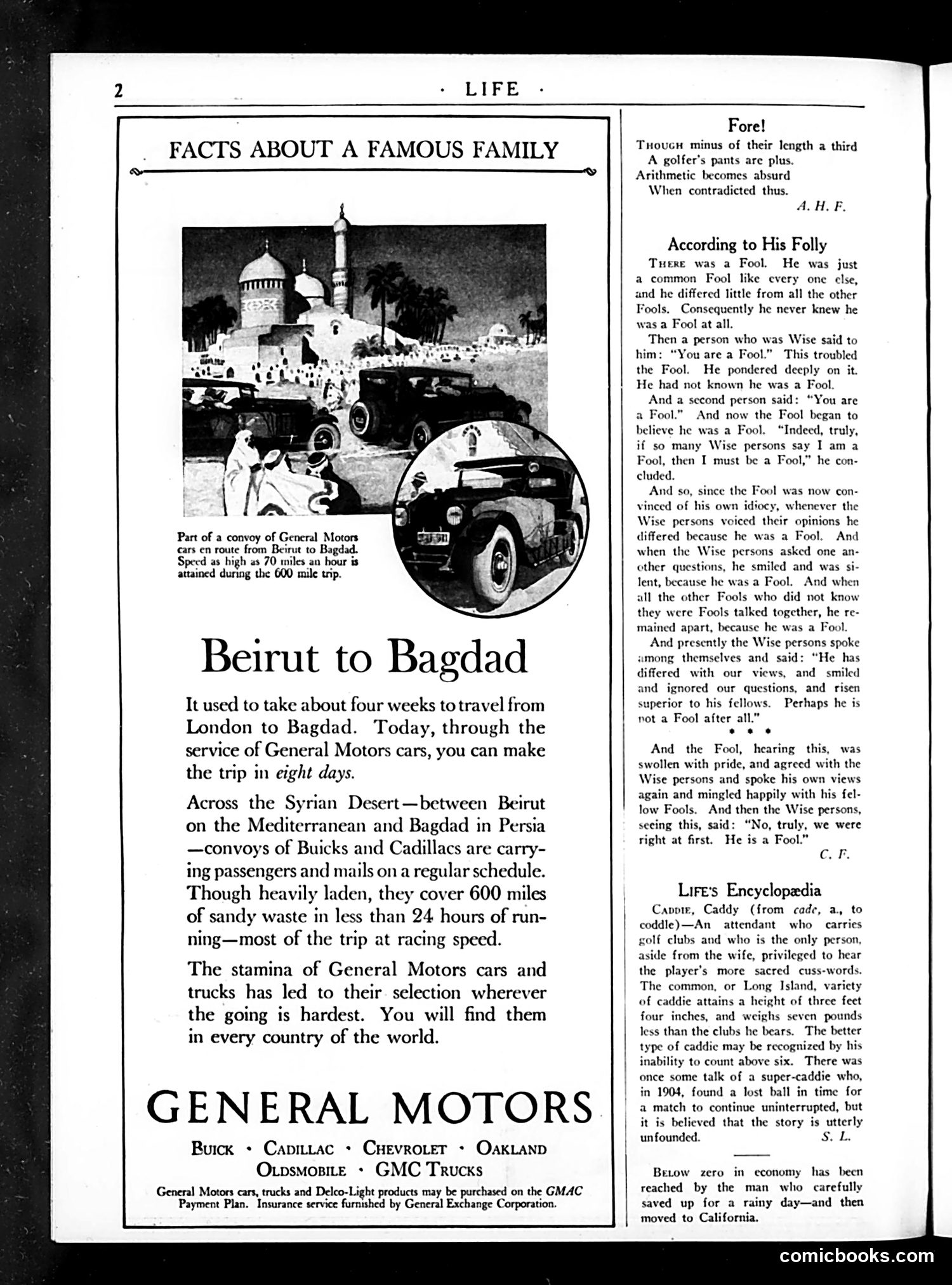
This page is primarily **advertising for General Motors**, featuring a promotional article about an auto convoy traveling from Beirut to Baghdad. The photo shows luxury cars (Buicks and Cadillacs) crossing the Syrian Desert at high speed—a feat meant to demonstrate American automotive superiority and reliability across difficult terrain. The accompanying text emphasizes that General Motors vehicles are chosen "wherever the going is hardest" and can be "found in every country of the world," positioning American cars as globally dominant technology. The right column contains unrelated satirical content ("According to His Folly"), a philosophical piece about foolishness—separate from the automotive promotion. This reflects 1920s-era American industrial confidence and advertising's growing sophistication in magazines like *Life*.
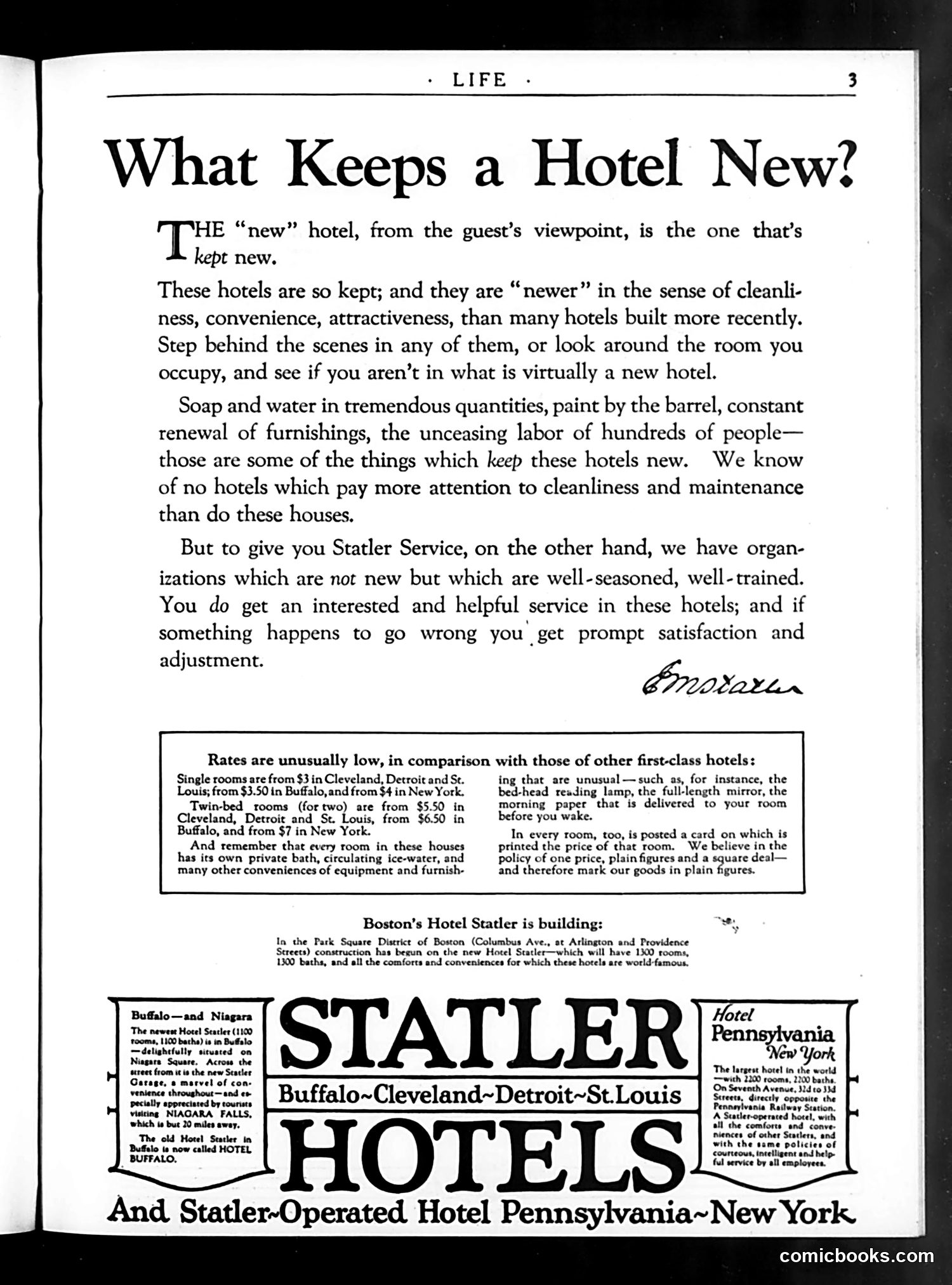
This page is **primarily advertising**, not satirical content. It's a promotional piece for Statler Hotels, a chain operating in Buffalo, Cleveland, Detroit, and St. Louis, with a new Pennsylvania location opening in New York. The article "What Keeps a Hotel New?" argues that cleanliness and maintenance matter more than construction date. The signed commentary (appears to be from hotel management) contrasts well-maintained older hotels favorably against newer properties lacking proper service standards. The advertisements highlight Statler's competitive rates and amenities—ice water, mirrors, delivered newspapers—positioning these as desirable features. This reflects early 20th-century hotel competition standards. **This is commercial messaging, not satire or political commentary.**
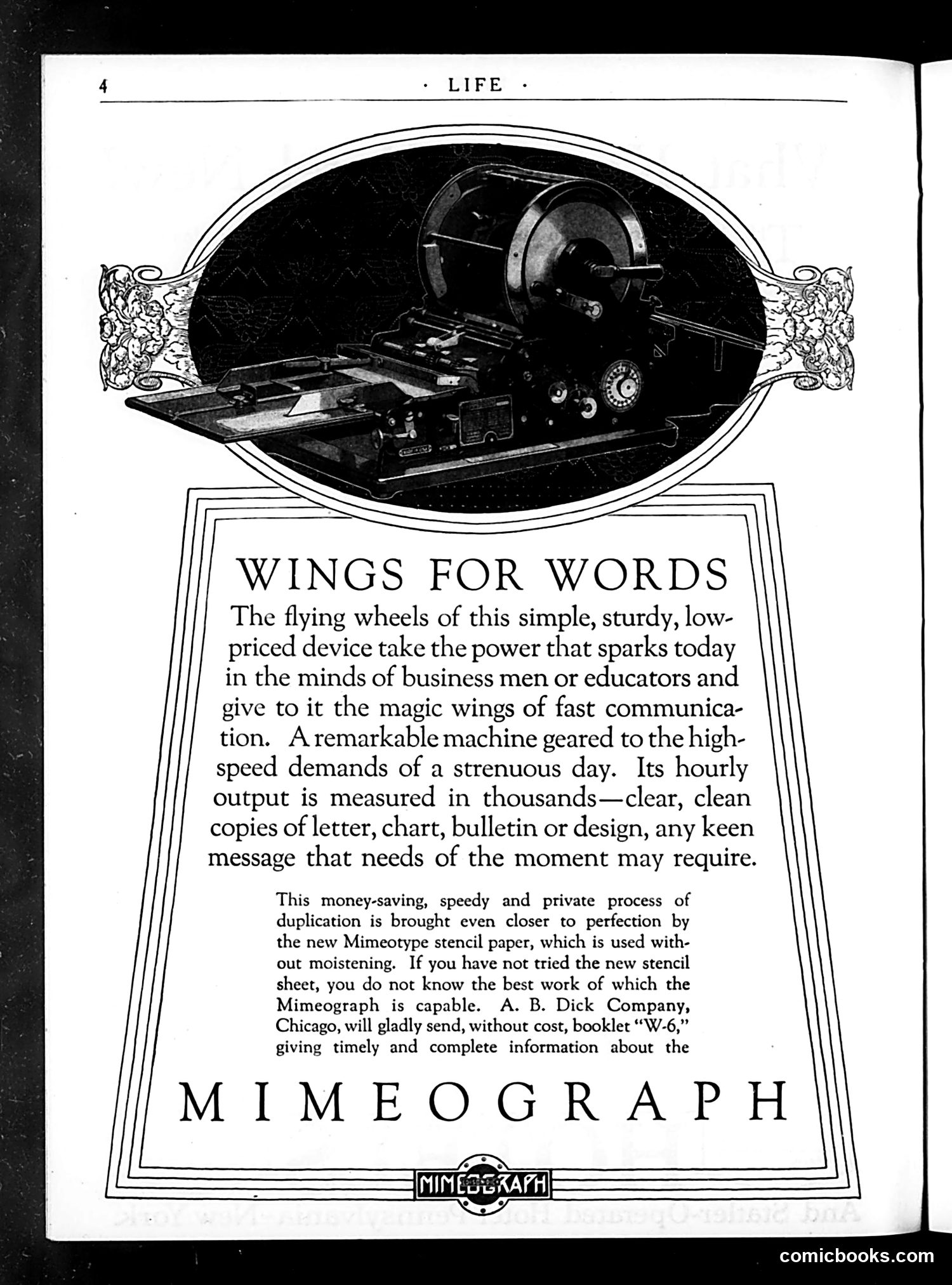
This page is primarily **advertising, not satire or political cartoon**. It's a commercial advertisement for the Mimeograph machine by A.B. Dick Company of Chicago. The ad's title, "Wings for Words," uses metaphorical language to market the mimeograph as a rapid duplicating device. The image shows the mechanical equipment. The text emphasizes the machine's speed, reliability, and cost-effectiveness for business use—claiming it can produce "thousands" of clear copies hourly for "letters, charts, bulletins or designs." The ad specifically promotes new Mimeotype stencil paper as an improvement. There are no political figures or social satire present. This is straightforward early 20th-century business-to-business advertising highlighting office technology for efficient workplace communication.
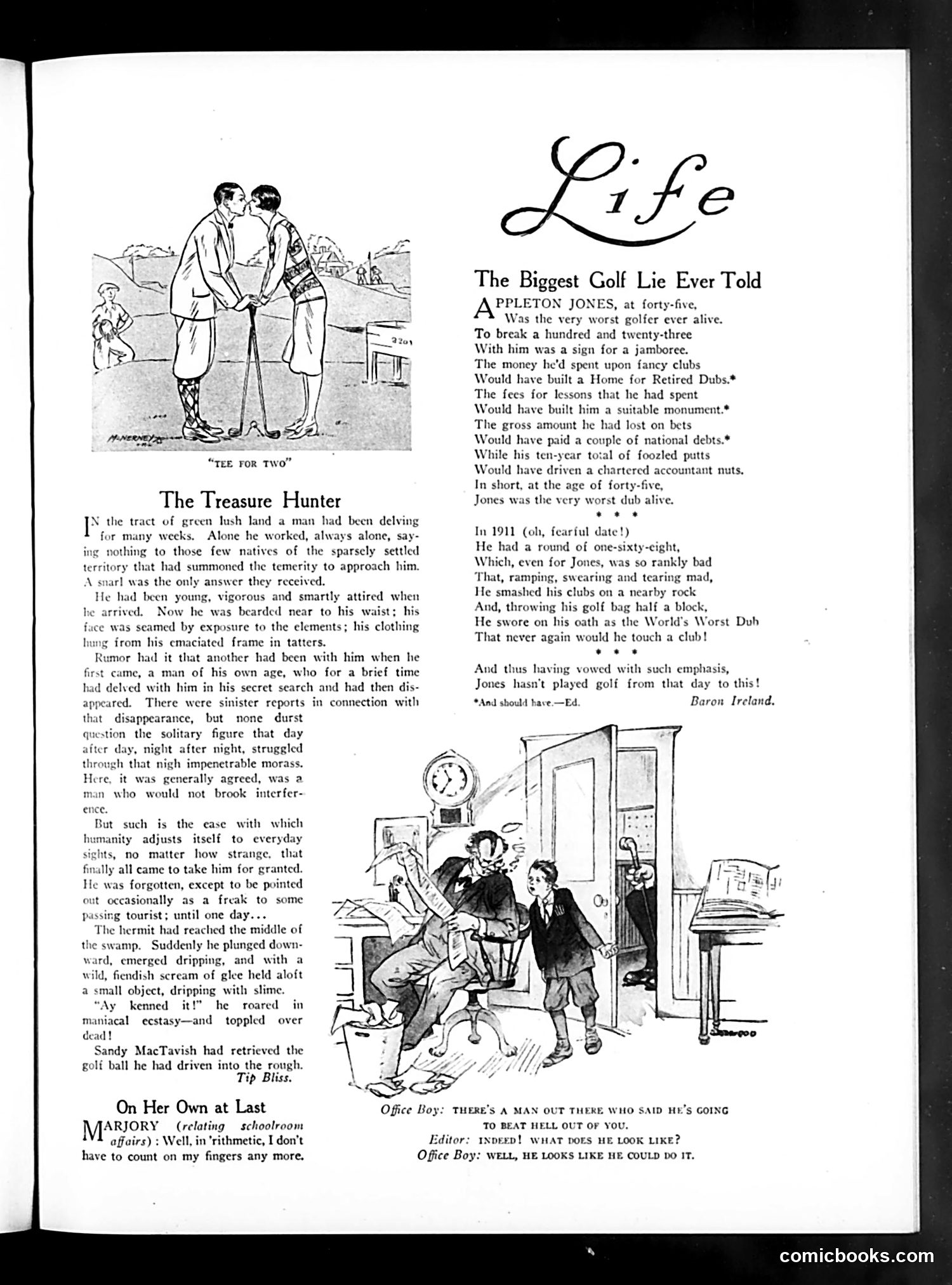
This page from *Life* magazine contains three humorous pieces: **"The Biggest Golf Lie Ever Told"** mocks Appleton Jones, described as "the very worst golfer ever alive." The satire catalogs his financial losses from golf obsession—expensive clubs, lessons, lost bets—totaling ruinous debts. The 1911 anecdote describes Jones's dramatic tantrum: smashing clubs on rocks and swearing never to play again. The joke is that despite this emphatic vow, "Jones hasn't played golf from that day to this!"—suggesting golfers' addiction makes their reform vows laughably hollow. **"The Treasure Hunter"** presents a hermit emerging from swampland, presumably after years of isolation. The narrative emphasizes his transformation through nature exposure and solitude. **"On Her Own at Last"** shows Marjory, a schoolteacher, proudly announcing she no longer needs to count on her fingers for arithmetic—a joke about newfound competence or independence. The cartoons reflect early 20th-century American humor about obsessions, social roles, and personal achievement.
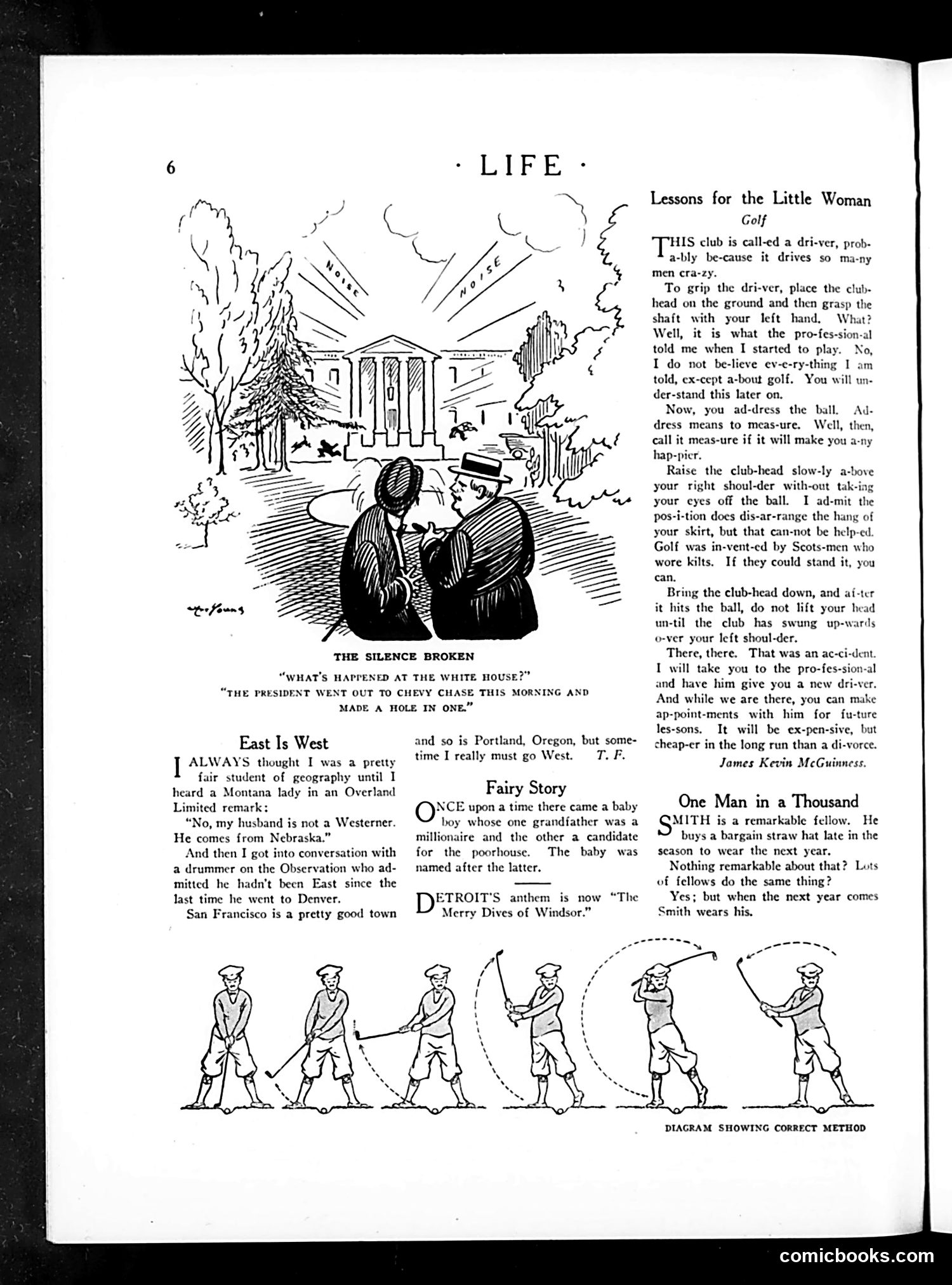
**Main Cartoon: "The Silence Broken"** The illustration shows two women on a golf course with the caption "'What's happened at the White House?' 'The President went out to play golf this morning and made a hole in one.'" This is political satire mocking a sitting president's golf habits, suggesting he's absent from his duties. The joke's cruelty implies the president is incompetent—the only thing he does well is golf. **Other Content:** The page includes golf instruction ("Lessons for the Little Woman"), short humor pieces ("East Is West," "Fairy Story," "One Man in a Thousand"), and a technical diagram showing proper golf swing technique. Without a visible date or president's name, the specific target remains unclear, though presidential golf-playing was a recurring satirical subject in early 20th-century Life magazine.
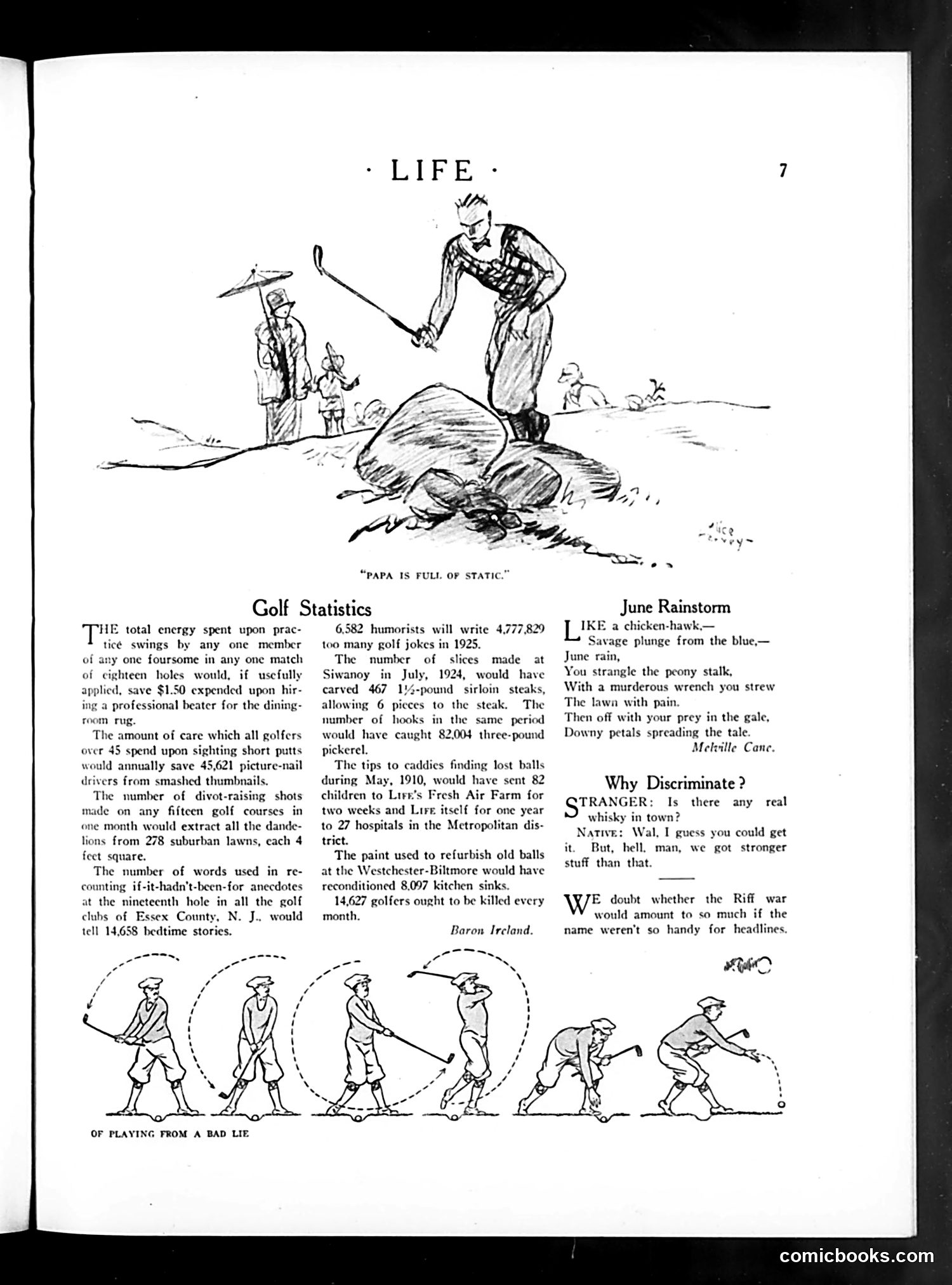
This Life magazine page (page 7) contains humorous content about golf and social issues circa 1925. The top cartoon shows a man beating a large rock with a golf club while a woman and child watch, captioned "Papa is full of static"—satirizing golf's frustration and its effect on family life. The "Golf Statistics" section humorously lists absurd calculations (e.g., golfers' swing energy could heat dinners, lost-ball tips, statistics about killed golfers), mocking the era's obsession with quantifying everything through statistics. The bottom strip illustrates six sequential golf poses demonstrating "playing from a bad lie"—showing increasingly contorted positions as a golfer attempts shots from difficult terrain. The other sections—"June Rainstorm" (poetry) and "Why Discriminate?" (brief commentary on whisky quality)—are unrelated filler content typical of Life's satirical magazine format.
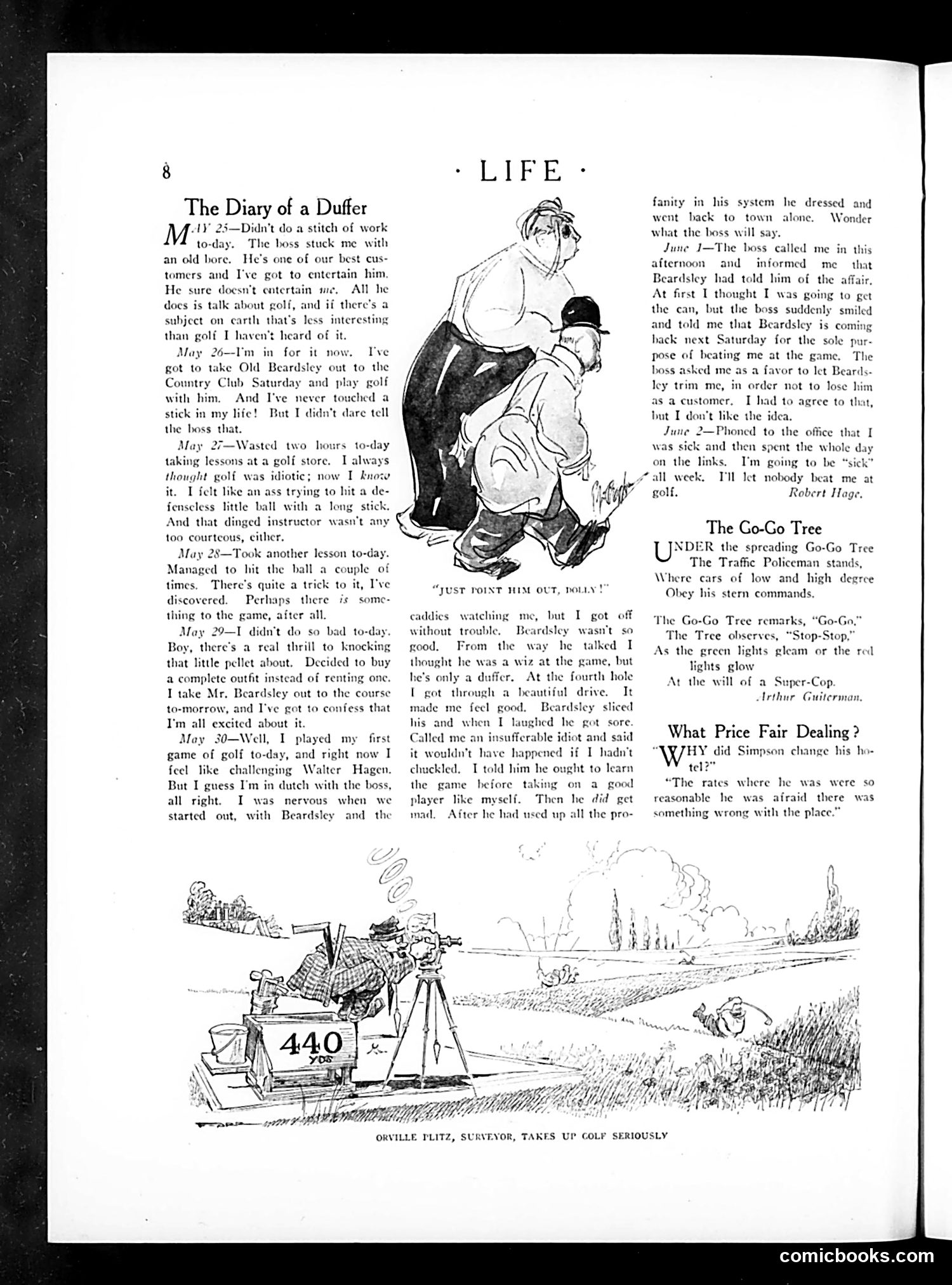
This page contains two satirical pieces about golf, a leisure activity associated with the American upper class. **"The Diary of a Duffer"** mocks an incompetent golfer through dated diary entries (May 25-30). The protagonist is a poor player who complains about his boss and makes excuses, ultimately being humiliated while golfing with his employer "Beardsley." The humor targets amateur golfers' self-deception and social anxiety around the sport. **"The Go-Go Tree"** is a short poem satirizing traffic policemen ("the Traffic Policeman stands") and their authority over motorists. The reference to a "Super-Cop" suggests criticism of overzealous law enforcement. Both pieces use gentle satire to critique leisure activities and social hierarchies of early 20th-century America.
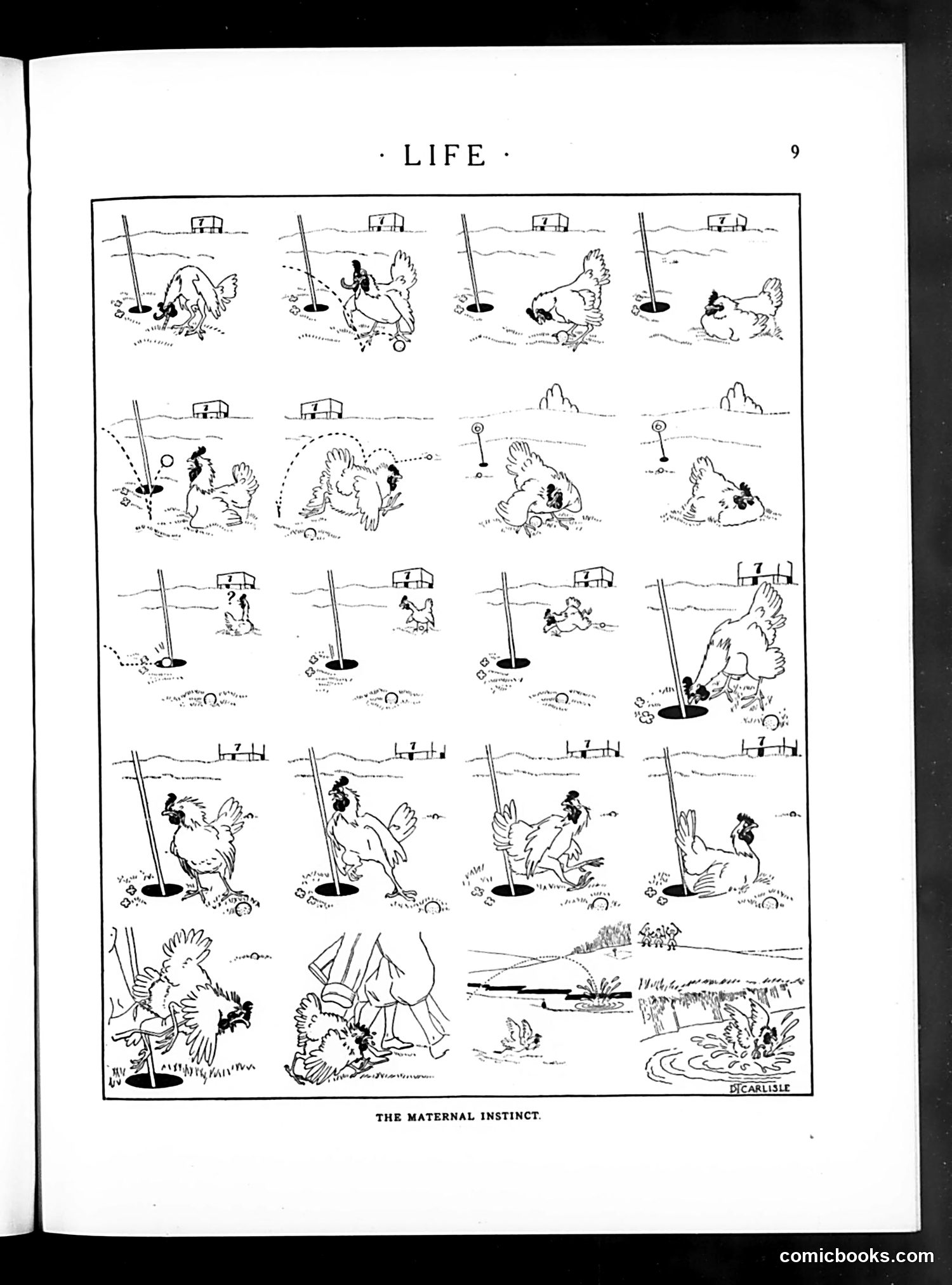
This comic strip depicts a hen and her chicks at a golf course, showing the mother bird protecting her offspring from the hazards of the game. The sequence progresses from the hen discovering a golf hole, through various attempts to shield her chicks from flying golf balls and approaching golfers, culminating in her herding them away to safety near water. The humor relies on anthropomorphizing the hen's "maternal instinct"—treating her protective behavior toward genuine dangers (golf balls, clubs, human interference) as a relatable parental concern. The joke works by elevating animal behavior to mirror human parental vigilance, with the golf course serving as an absurdly dangerous environment for a barnyard family. The satire gently mocks both protective parenthood and the intrusive nature of recreational golf.
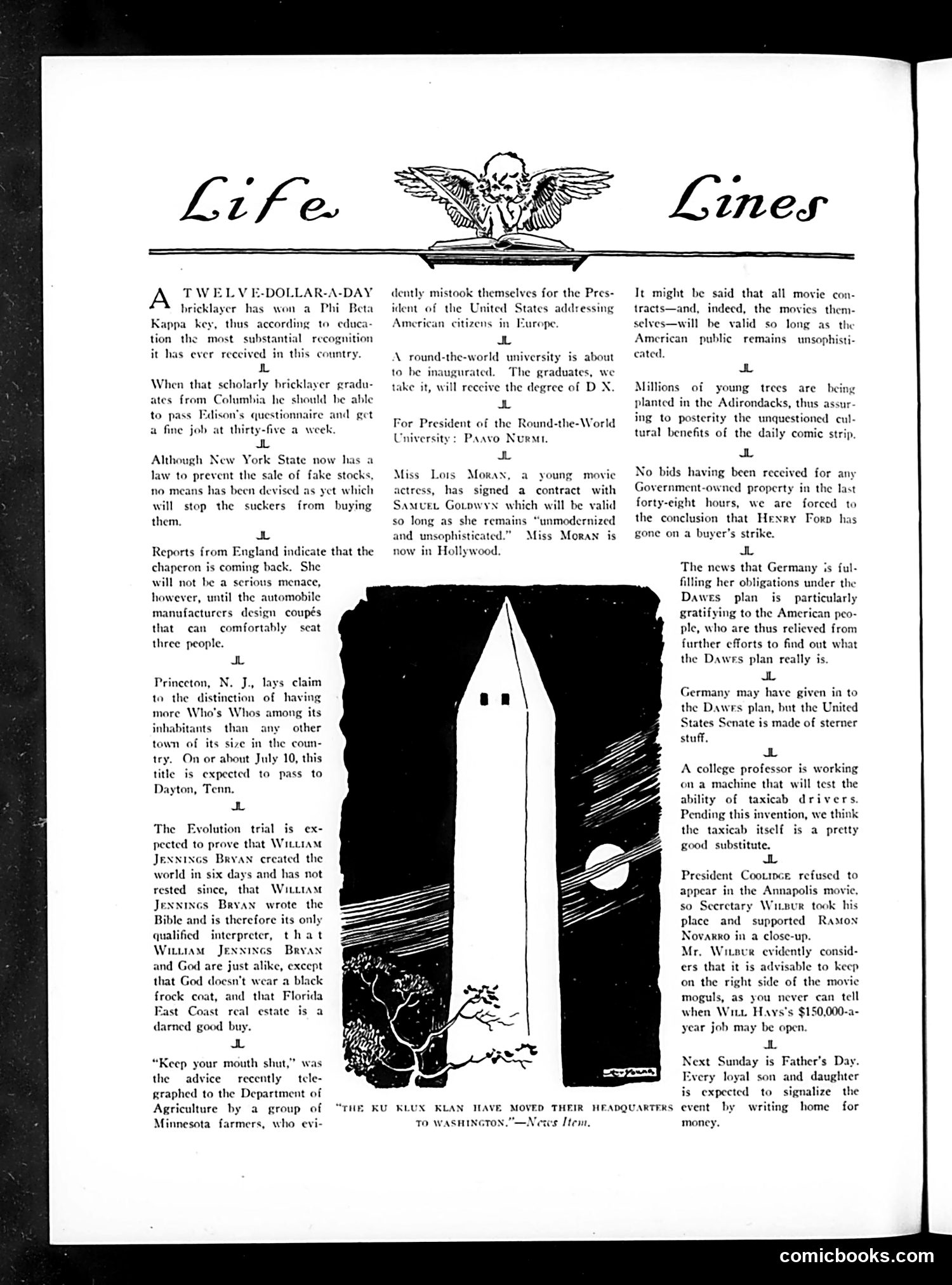
The main cartoon depicts a **KKK headquarters building** (identified by the caption: "THE KU KLUX KLAN HAVE MOVED THEIR HEADQUARTERS TO WASHINGTON") being relocated to the nation's capital. The image shows a white-robed figure and the characteristic pointed hood structure. This is political satire **criticizing the KKK's influence in U.S. government**, suggesting the organization had effectively moved into positions of political power in Washington, D.C. The surrounding "Life Lines" column contains various social commentary items, including references to President Coolidge, movie contracts, and other contemporary 1920s issues. This reflects a period when the KKK experienced significant resurgence and claimed mainstream political influence, making the joke about their "headquarters" being in Washington a biting critique of institutional racism in American government.
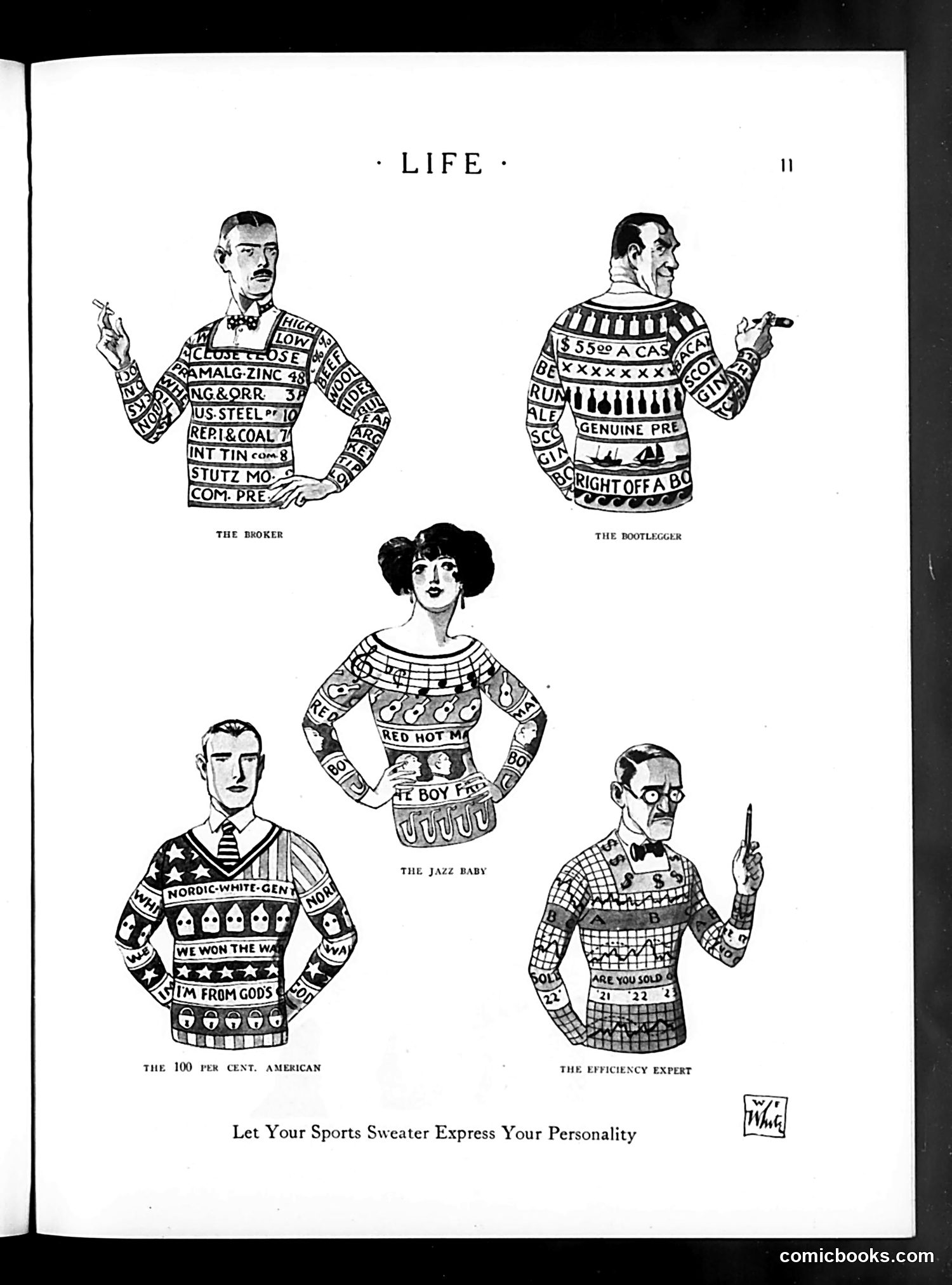
This satirical illustration depicts five stereotyped character types of the 1920s era, each wearing a sweater emblazoned with text expressing their personality or values. The figures are labeled "The Broker," "The Bootlegger," "The Jazz Baby," "The 100 Per Cent American," and "The Efficiency Expert." Each sweater displays slogans and symbols reflecting contemporary concerns: stock market trading, Prohibition-era smuggling, jazz culture, patriotic nationalism, and industrial productivity metrics. The tagline "Let Your Sports Sweater Express Your Personality" suggests that consumer goods reveal one's social identity and values. The satire mocks 1920s American society by reducing diverse personalities to easily recognizable commercial stereotypes—implying that identity itself had become commodified during this era of mass consumption and cultural standardization.
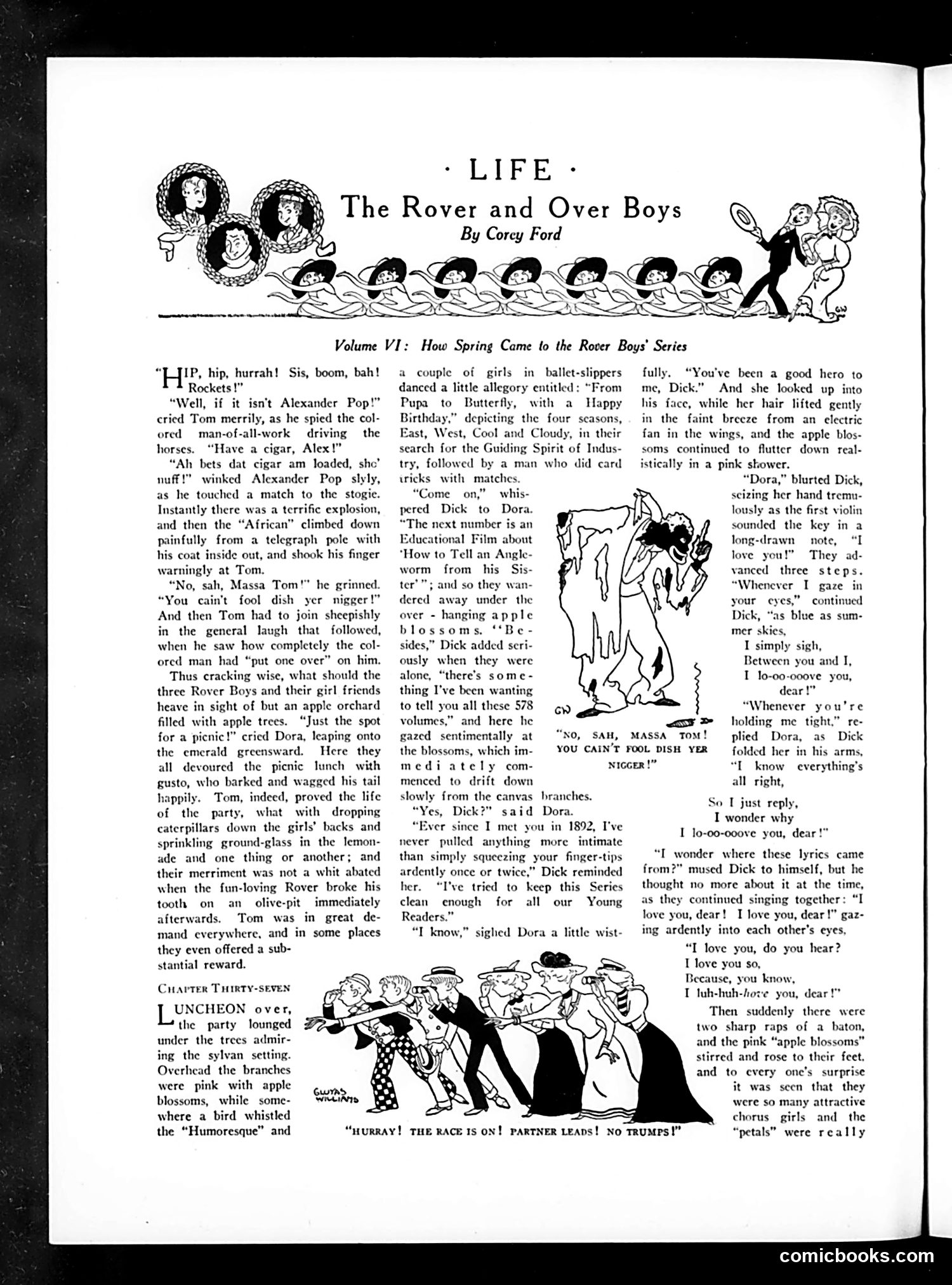
This is a humorous story about children's picnic hijinks, not political satire. The narrative describes "Rover Boys" (an allusion to the popular *Rover Boys* adventure series) and their girlfriend companions enjoying an outdoor meal under apple blossoms. The humor derives from slapstick chaos: an explosion from a telegraph pole, a dog eating the lunch, children singing sentimental songs, and ultimately a baton striking a balloon that startles everyone awake. The illustrated vignettes show children dancing, racing, and generally causing commotion. The satire targets overly sentimental children's literature and pastoral romance, mocking the gap between idealized storybook adventures and messy reality. There's no identified political commentary—just gentle mockery of genteel youth culture.
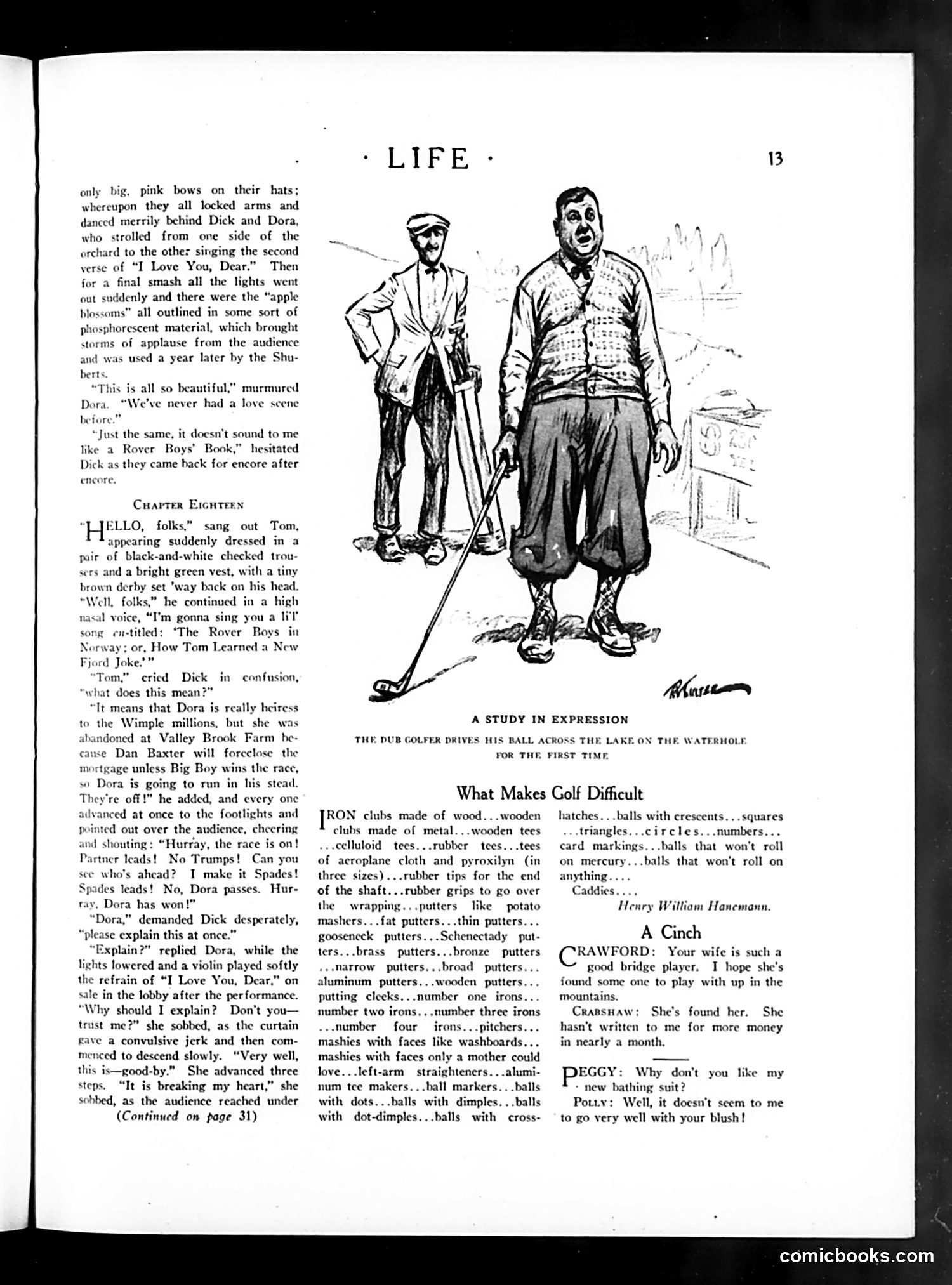
This page contains a serialized story ("Chapter Eighteen") featuring characters named Tom, Dick, and Dora, centered on a plot involving the "Wimple millions" and a foreclosed mortgage on "Valley Brook Farm." The narrative appears to be a melodramatic romance with financial stakes. The illustration labeled "A Study in Expression" depicts two men—one in formal attire with a cane, the other in casual clothing—apparently engaged in golf. This illustrates the story's subplot. Below are three brief humor items ("What Makes Golf Difficult," "A Cinch," and "Peggy") offering period-appropriate jokes about golf equipment, marriage, and courtship—typical early 20th-century Life magazine comedy targeting middle-class readers familiar with golf culture and romantic conventions.
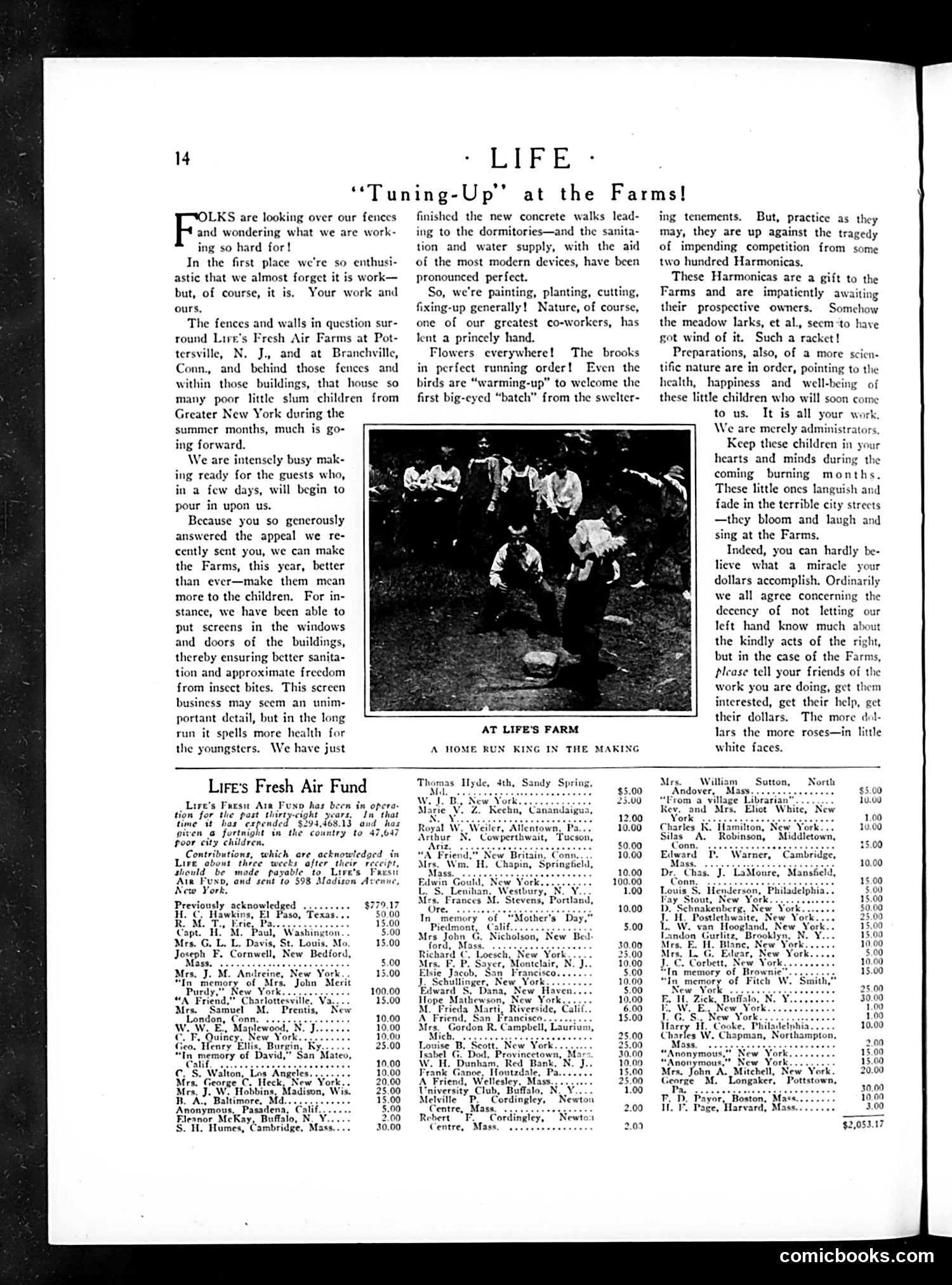
This page combines an article about Life's Fresh Air Farms with a fundraising appeal. The farms provided summer retreats for poor children from New York City and surrounding areas. The article describes improvements—concrete walks, dormitories, sanitation upgrades—made to welcome "the first big-eyed 'batch' from the swelters" (tenement districts). The photograph shows children at the farm. The appeal emphasizes the farms' work building health and character in urban children, framing it as charity work. The bulk of the page lists donors to "Life's Fresh Air Fund," documenting contributions ranging from small amounts to several hundred dollars. This reflects Progressive Era concerns about urban poverty and child welfare.
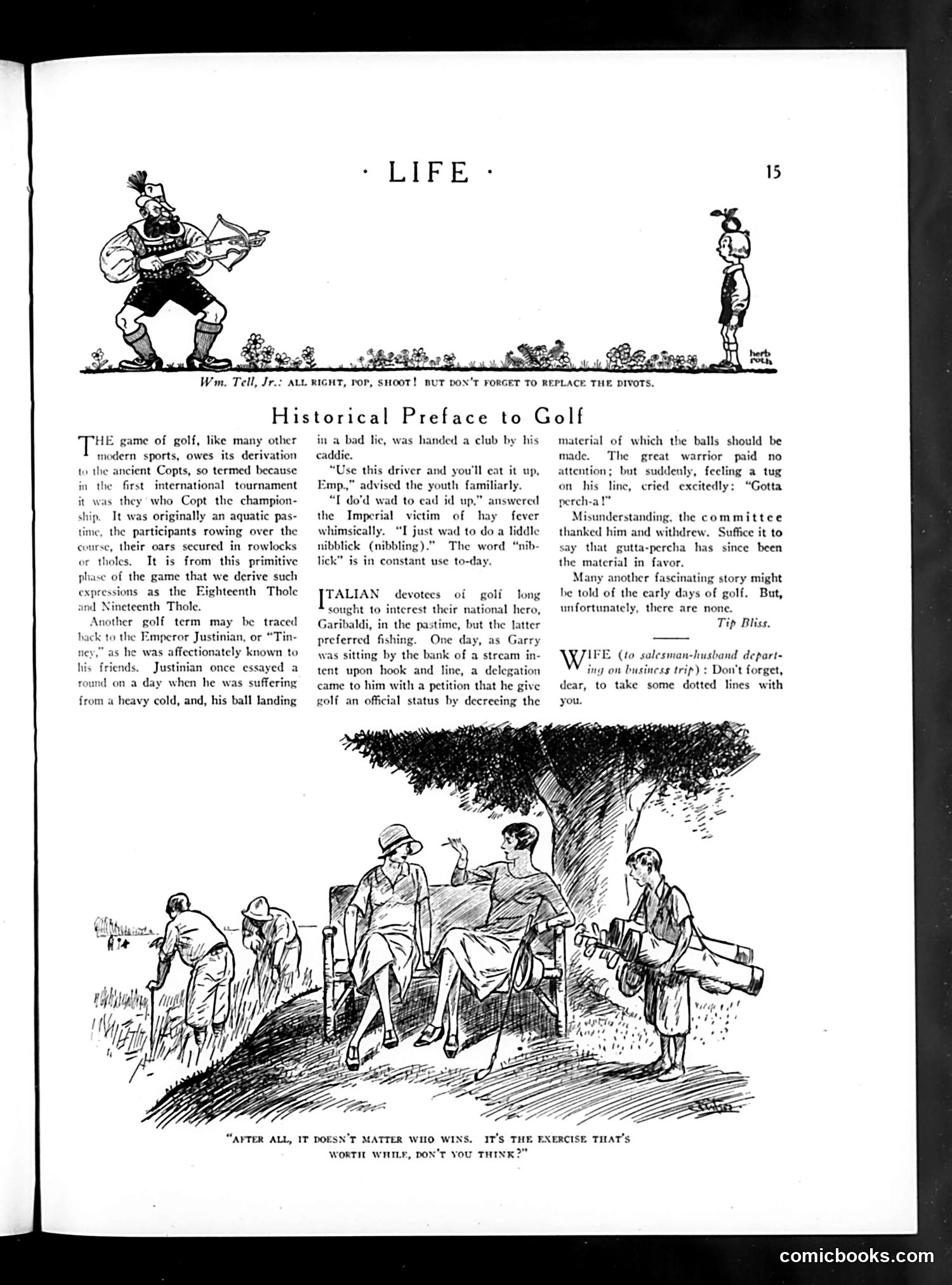
This page presents a "Historical Preface to Golf" discussing the game's origins. The top cartoon shows a man in military dress addressing a young golfer, with text referencing "Wm. Tell, Jr." and pivots—an apparent joke about William Tell and golf club pivots. The main text traces golf's etymology to ancient Cots and mentions Italian general Garibaldi's supposed connection to the sport through a humorous anecdote about fishing. The lower illustration depicts gentlemen relaxing under a tree during a golf outing, with the caption: "After all, it doesn't matter who wins. It's the exercise that's worth while, don't you think?"—a satirical commentary on upper-class leisure activities and the social pretense that competition matters less than the activity itself.
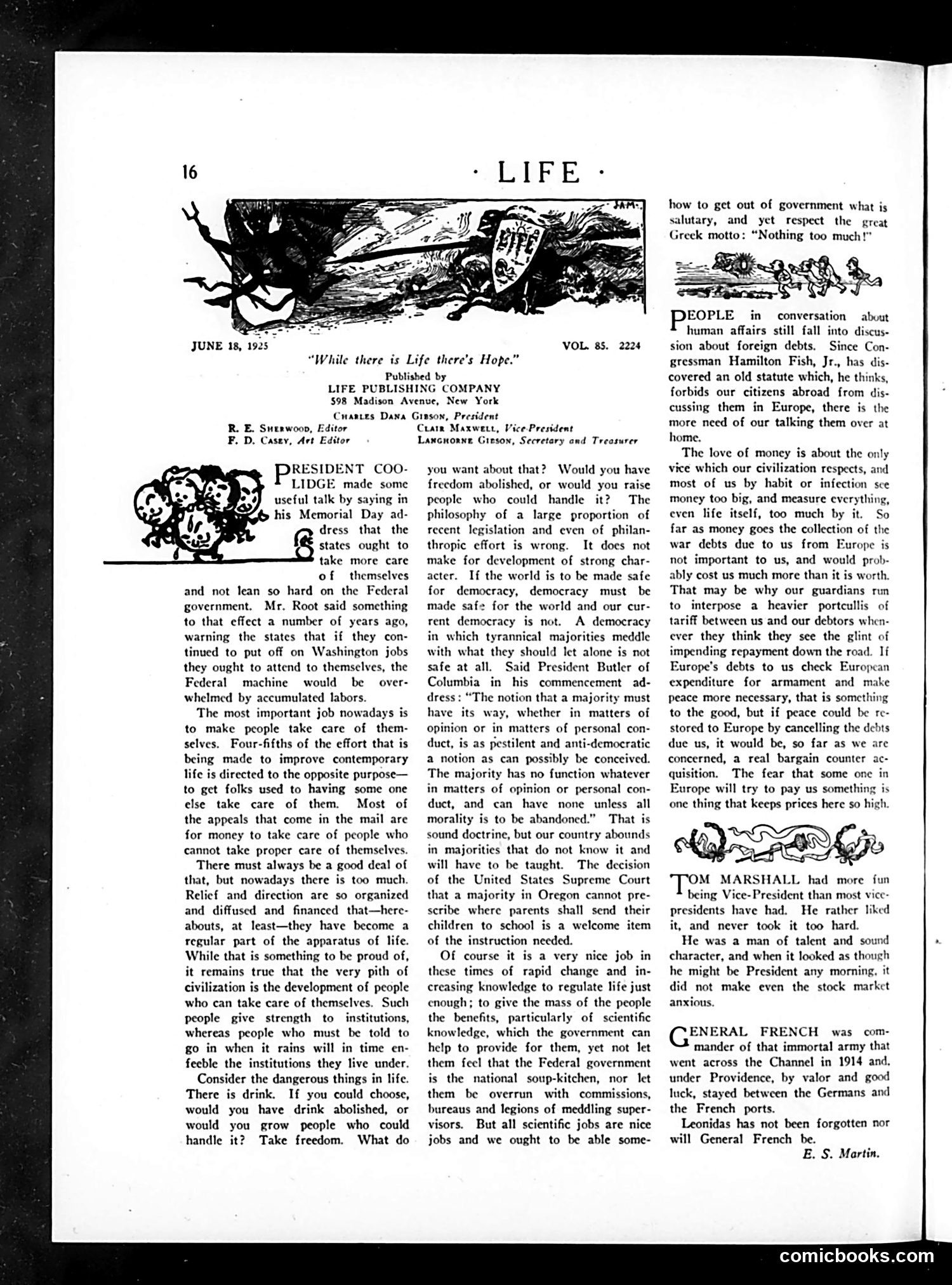
The main editorial by the magazine's leadership attacks the growing expansion of government relief and social programs. The argument: Americans are becoming too dependent on government assistance rather than developing self-reliance and strong character. President Coolidge is referenced approvingly for his Memorial Day address urging states to reduce federal dependence. The editor invokes the anti-majoritarian philosophy of Columbia University President Nicholas Murray Butler, celebrating the Supreme Court's recent Oregon decision striking down compulsory public schooling laws. The satire targets progressive reformers and philanthropic organizations whose "appeals" for charity money the magazine views as weakening American independence. The core conservative argument: civilization depends on people managing their own affairs, not on institutional safety nets or government "meddling." This reflects 1920s conservative ideology opposing the expansion of government social welfare—a debate that remains politically relevant today, though the specific reference to Oregon school attendance laws now appears historically distant.
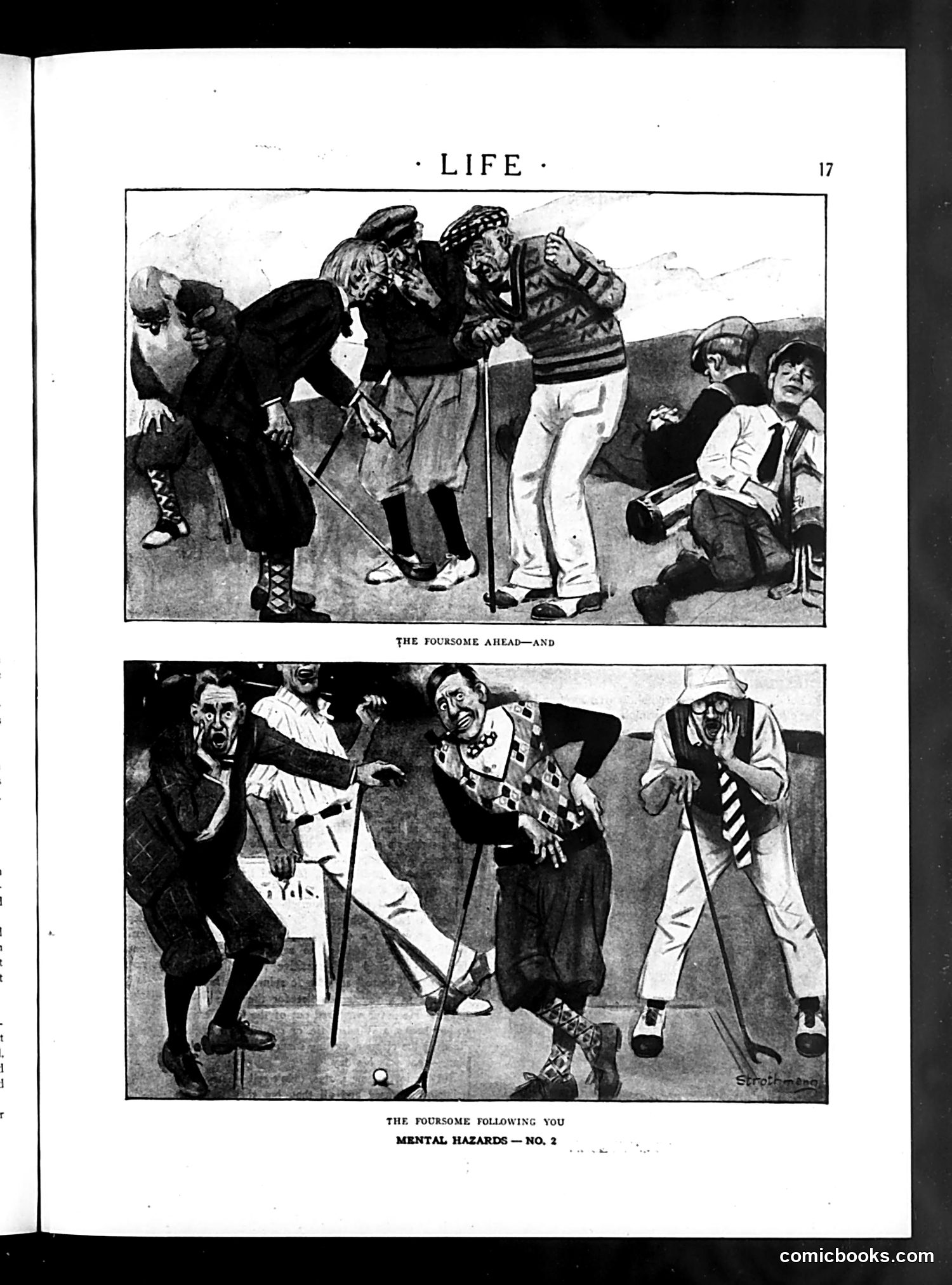
This is a satirical cartoon sequence about golf, specifically depicting "Mental Hazards" for golfers. The page shows two scenes: **Top panel**: A foursome of golfers being watched by spectators, including what appear to be children observing from the sidelines. **Bottom panel**: The same golfers in various states of distress or poor form during play, with exaggerated facial expressions suggesting frustration and poor performance. The satire targets golf's psychological challenges—how golfers' concentration and composure deteriorate under observation and pressure. The caricatured faces and dramatic poses humorously illustrate the mental game of golf. This appears to be part of a series ("No. 2"), likely exploring different hazards golfers face beyond physical course obstacles. The humor relies on recognizing golf culture's well-known psychological difficulties.
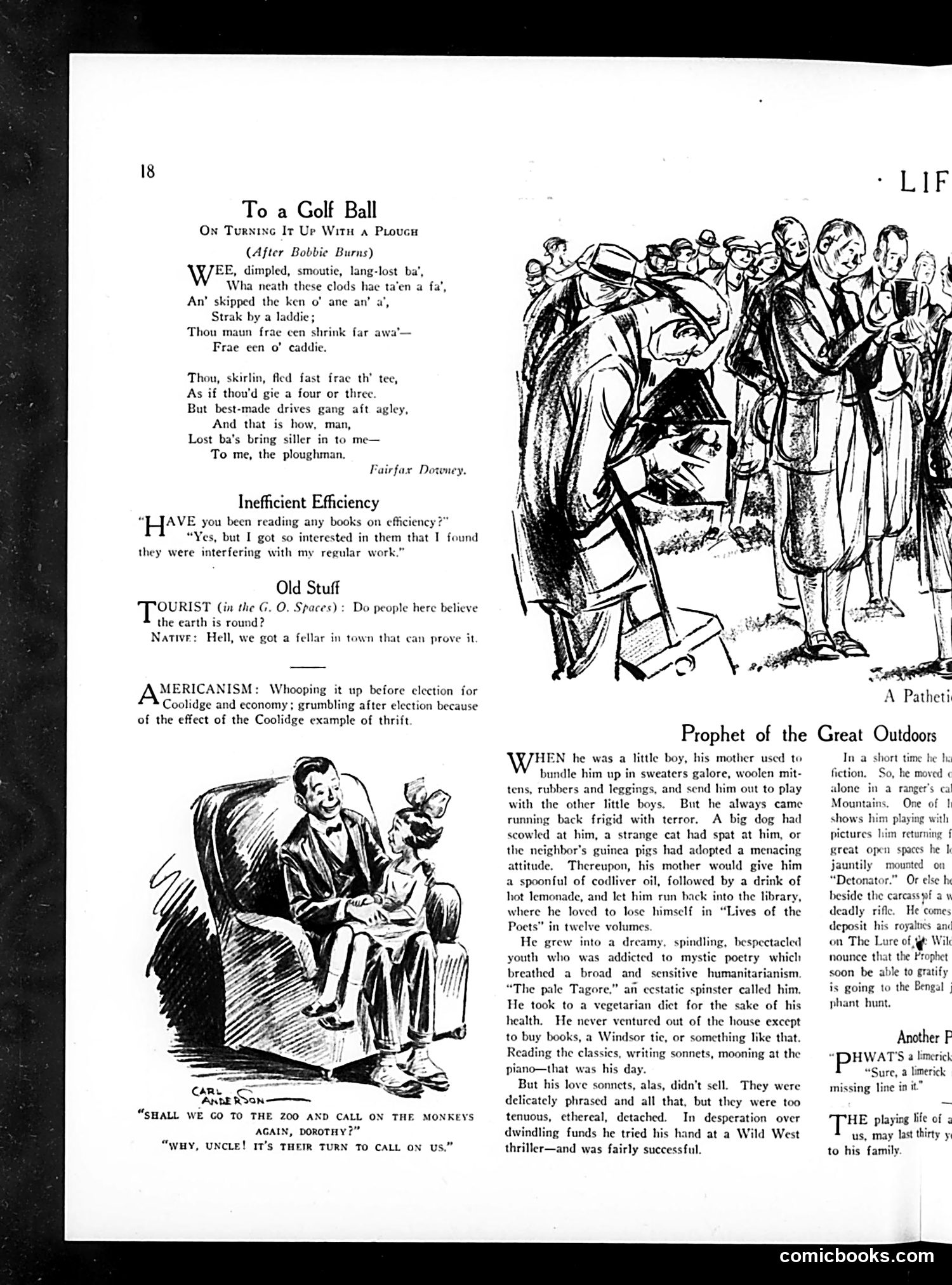
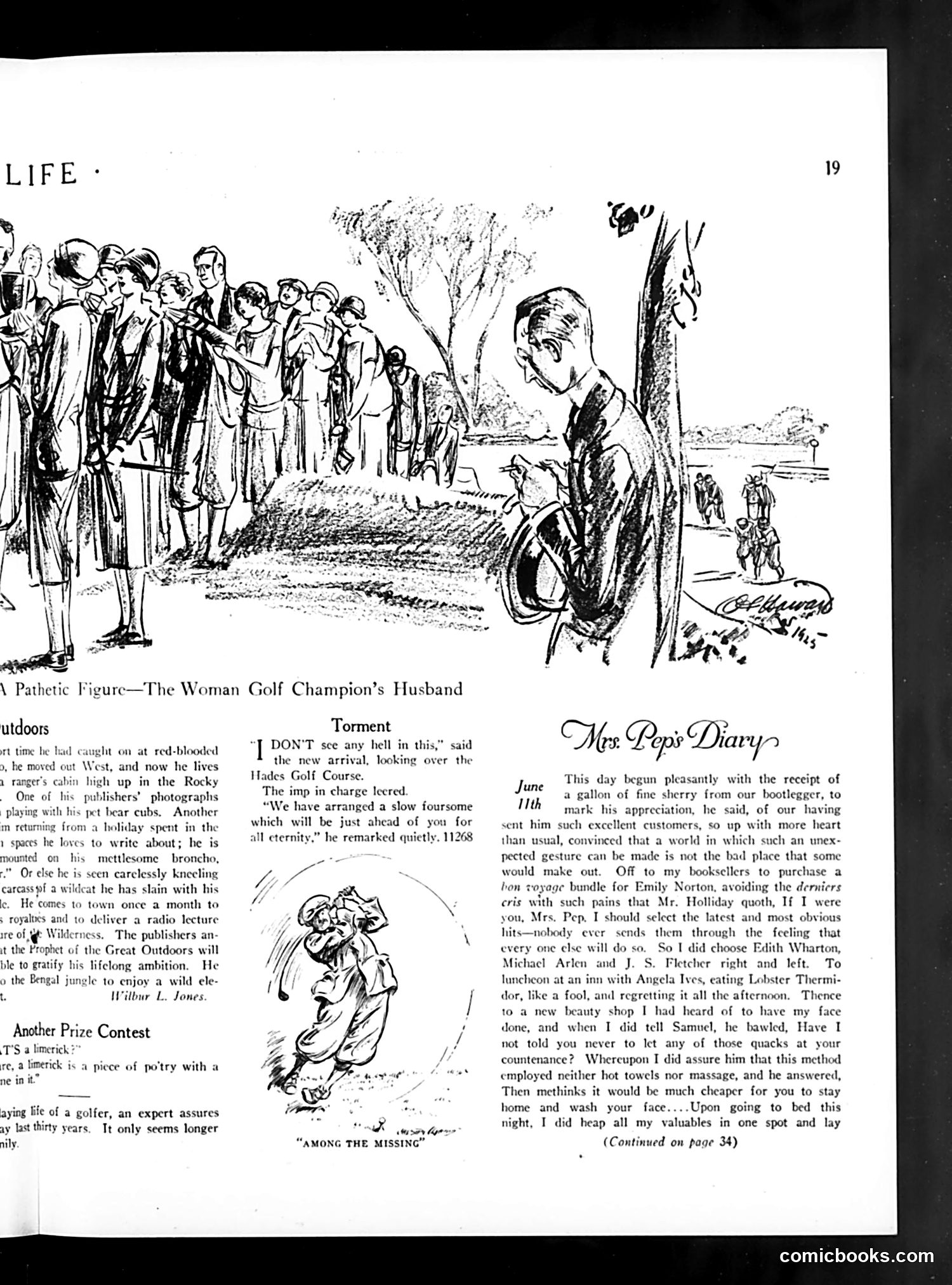
This page from *Life* magazine contains several satirical pieces mocking American culture and behavior circa the 1920s. **"To a Golf Ball"** is a humorous poem (styled after Robert Burns) about a lost golf ball—the joke being that a poor farmer/caddie profits from collecting lost balls, presenting the golfer's frustration as his gain. **"Inefficient Efficiency"** satirizes the era's obsession with "efficiency" literature and management books—the irony being someone becomes so absorbed reading *about* efficiency that it ruins their actual work productivity. **"Americanism"** mocks American political behavior: citizens enthusiastically support Coolidge and "economy" before elections, then hypocritically complain about the economic effects of his thrift policies afterward. **The monkey cartoon** jokes that uncle and niece should visit the zoo "to call on the monkeys"—implying humans and monkeys are essentially equivalent, a subtle evolutionary jab. **"Prophet of the Great Outdoors"** satirizes a sheltered, bookish intellectual who writes successful Wild West fiction despite never experiencing outdoor adventure, then moves to the wilderness to authenticate his image—exposing pretentious posturing among writers.
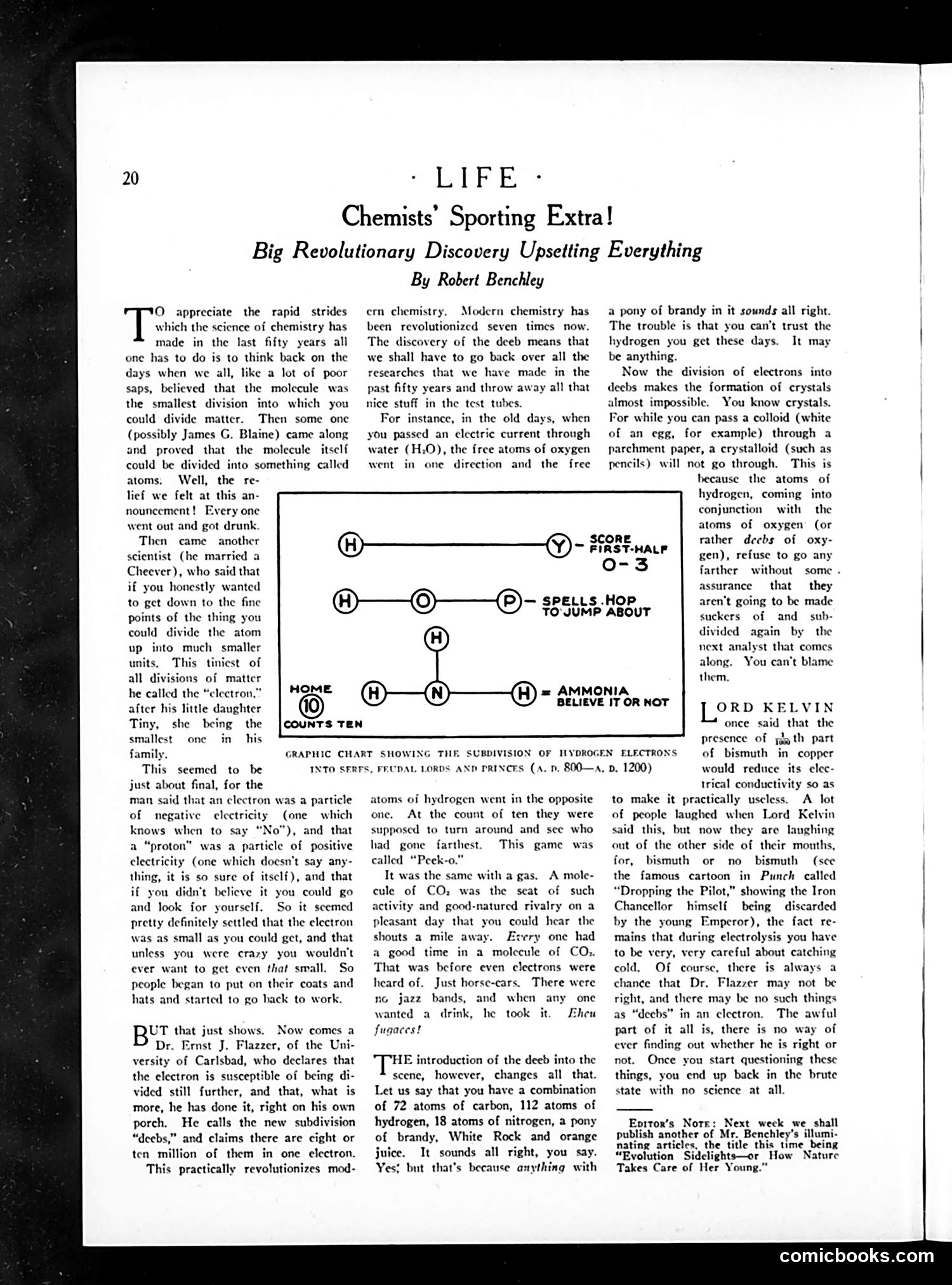
This is a satirical essay by Robert Benchley mocking the rapid succession of scientific discoveries in chemistry. The humor rests on the idea that scientists keep subdividing matter into smaller and smaller units—molecules, atoms, electrons, and now the newly invented "deebs"—each discovery supposedly "revolutionizing" chemistry and rendering previous research obsolete. The joke targets both scientific hubris and the public's gullible acceptance of each new theory. Benchley invents a fictional Dr. Ernst J. Flazzer who claims to have discovered "deebs" (even smaller than electrons) in his porch laboratory. The accompanying diagram humorously presents these discoveries as a "graphic chart" with chemical notation. The satire suggests that scientists keep moving the goalposts, making confident pronouncements about nature's fundamental building blocks only to be contradicted shortly after. By the 1920s (Life's era), this pattern of constant scientific revision was already well-established enough to merit mockery from a humor magazine.
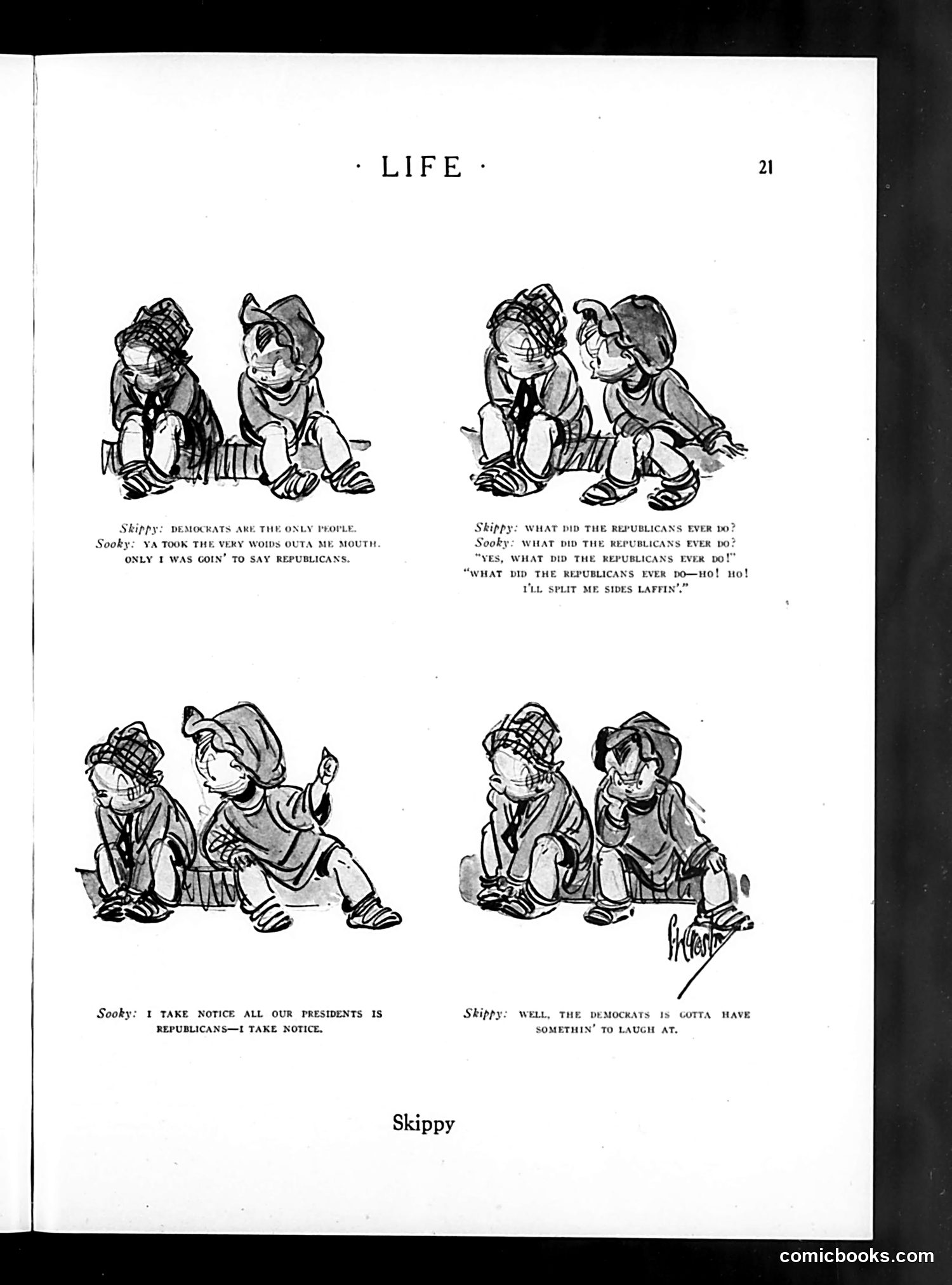
This comic strips satirizes American political partisanship through child characters Skippy and Sooky. The joke hinges on hypocrisy: Skippy claims Democrats are "the only people," then immediately switches to attacking Republicans when Sooky echoes his sentiment. The satire deepens when Sooky points out that virtually all U.S. presidents have been Republicans, yet Skippy dismisses this fact. Skippy's final quip—that Democrats "gotta have somethin' to laugh at"—suggests Republicans provided easy targets for ridicule regardless of actual accomplishments. The strip mocks partisan voters who criticize the opposing party without coherent reasoning, using children's dialectical speech patterns to emphasize the absurdity of political tribalism. The humor relies on readers recognizing this partisan behavior in contemporary politics.
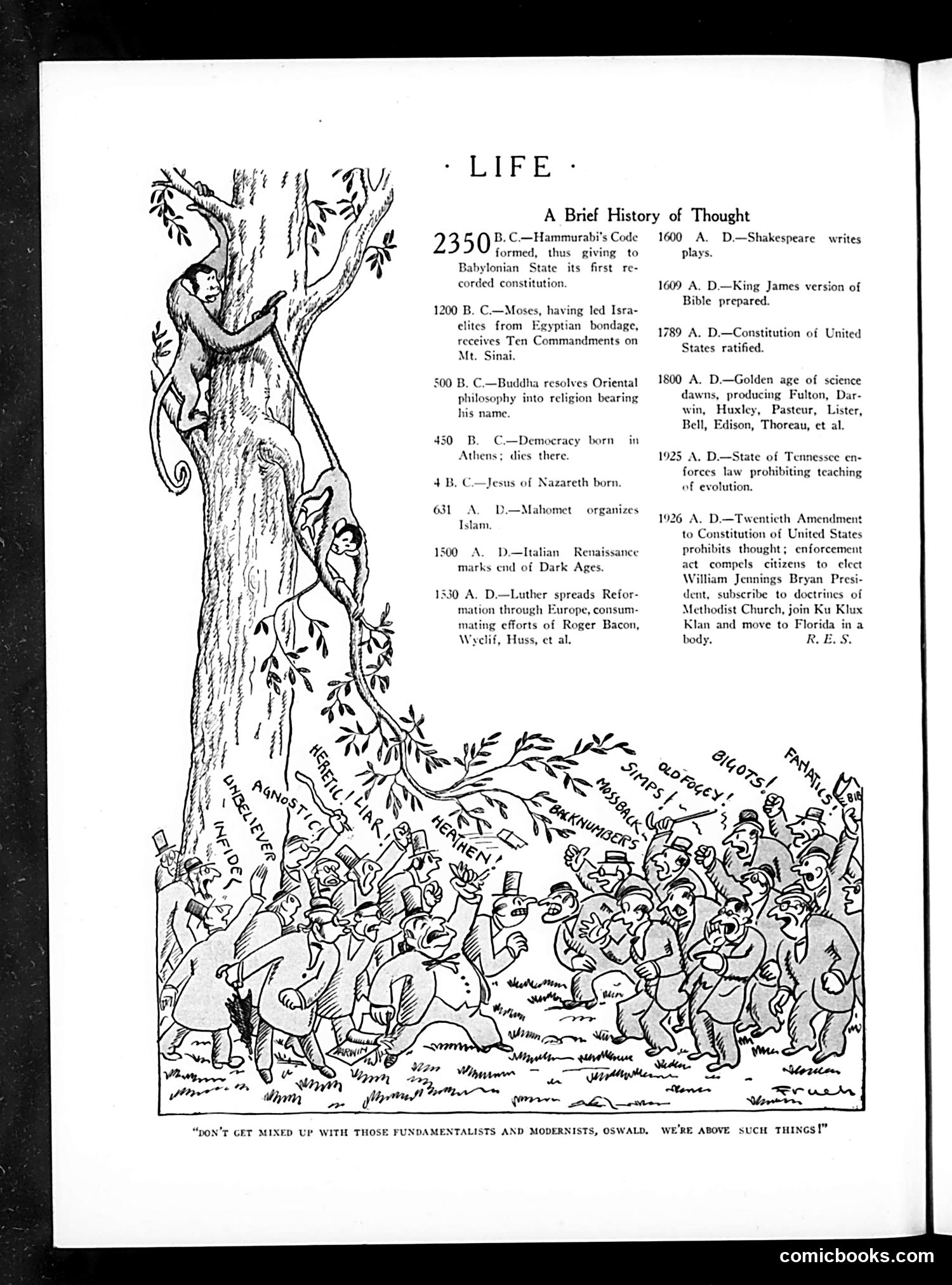
This page satirizes the **Scopes Trial era (1925-1926)** clash between religious fundamentalism and scientific modernism in America. The timeline mockingly presents human intellectual progress—from Hammurabi's Code through Darwin and Edison—before culminating in a brutal joke: Tennessee's 1925 evolution-teaching ban, followed by a fictional 1926 prediction that the "Twentieth Amendment prohibits thought" and forces citizens to elect William Jennings Bryan president, join the Ku Klux Klan, and relocate to Florida. The cartoon below depicts a tree crowded with figures engaged in heated debate, labeled with various intellectual positions. The caption—where two characters claim superiority to "fundamentalists and modernists"—satirizes how both sides of the evolution debate claimed intellectual high ground while the public brawled below. **The message**: Life mocks anti-evolution legislation as fundamentally anti-intellectual, portraying it as regression from centuries of human progress.
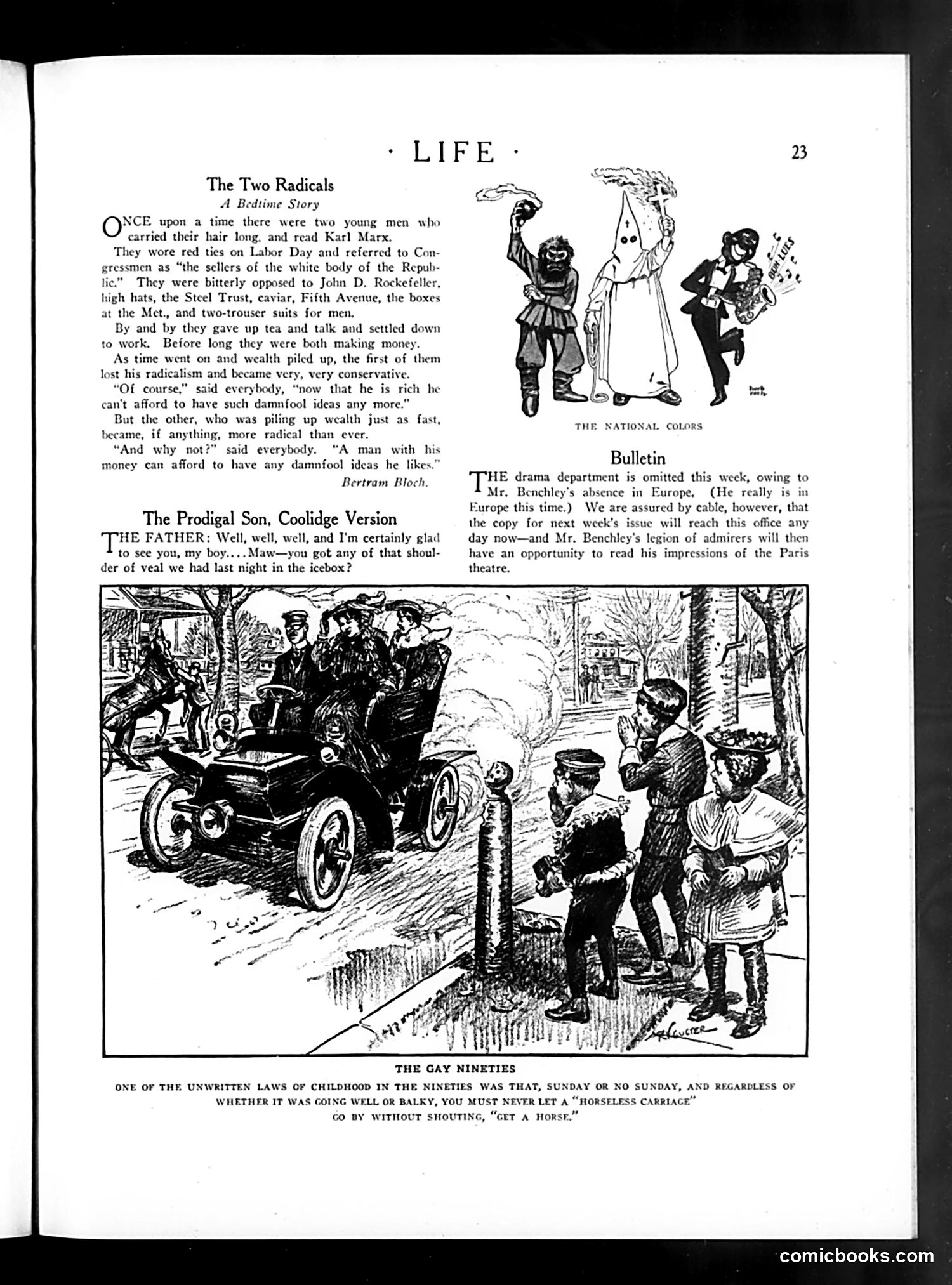
**"The Two Radicals"** mocks ideological consistency. Two young radicals—long-haired Marx readers who despised Rockefeller, the Steel Trust, and wealth—both became rich. One abandoned his radical beliefs once wealthy (the expected outcome). The other grew *more* radical despite accumulating the same wealth. The joke exposes hypocrisy: society excuses abandoning principles for money but finds a wealthy radical inexplicably committed to his stated beliefs—suggesting radical ideology is merely affectation, not genuine conviction. **"The Prodigal Son, Coolidge Version"** is a brief, untranslated dialogue fragment likely referencing President Calvin Coolidge through the biblical parable of the prodigal son returning home. **"The Gay Nineties"** illustration shows children shouting at a horseless carriage (early automobile), reflecting genuine 1890s childhood behavior—the novelty of automobiles inspired children to demand drivers "get a horse," treating cars as curiosities destined to fail.
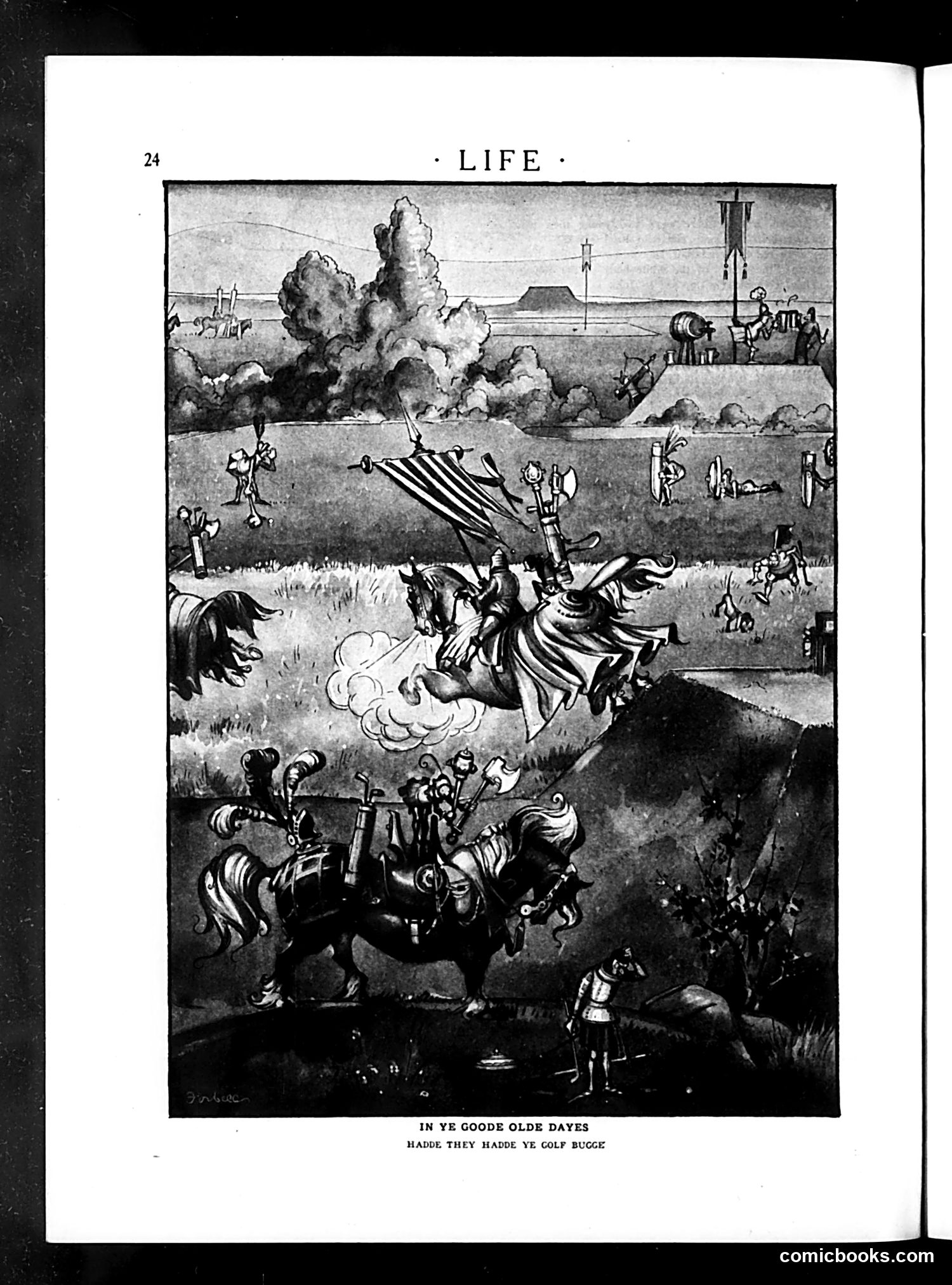
This is a satirical illustration contrasting medieval times with the modern era. The caption uses faux-archaic language ("In ye goode olde dayes / Hadde they hadde ye golf bugge") to joke that golf buggies are a modern invention, not ancient. The image shows a layered scene: the top depicts medieval warfare with cannons and soldiers; the middle shows pastoral countryside; the bottom features elaborately dressed nobles on horseback in what appears to be a hunting or recreational scene, styled to evoke medieval pageantry. The satire suggests that wealthy people have always sought leisure activities and status symbols—whether medieval hunts or modern golf carts—indicating that human nature and class-based recreation are timeless, not new inventions of contemporary society.
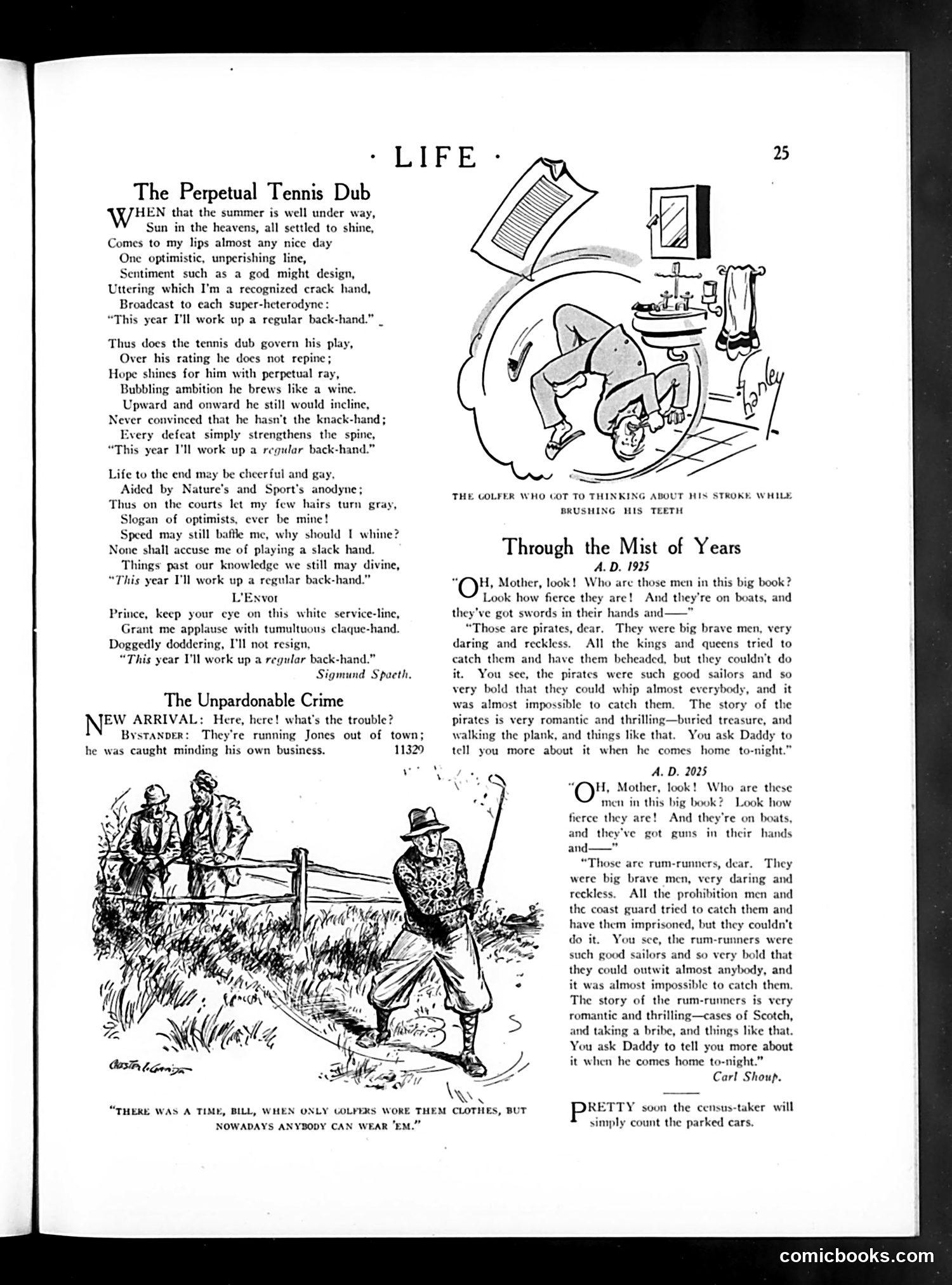
This page contains three distinct satirical pieces: **"The Perpetual Tennis Dub"** (poem): Mocks amateur tennis players who eternally promise themselves they'll improve their backhand, never accepting their mediocrity. The repetition satirizes self-deluding optimism. **"The Unpardonable Crime"**: A brief joke about a man being run out of town for "minding his own business"—satirizing small-town conformity and intolerance of individuality. **"Through the Mist of Years"**: The sharpest satire here. It contrasts 1925 with a imagined 2025, where a mother explains "rum-runners" to her child exactly as pirates were once explained—as romantic, daring outlaws. This directly mocks Prohibition enforcement, suggesting alcohol smugglers are becoming folk heroes equivalent to historical pirates. The parallel implies Prohibition is creating a new criminal class society romanticizes. **"The Golfer" cartoon**: Shows a man distracted mid-thought while brushing teeth—simple domestic humor about overthinking golf technique.
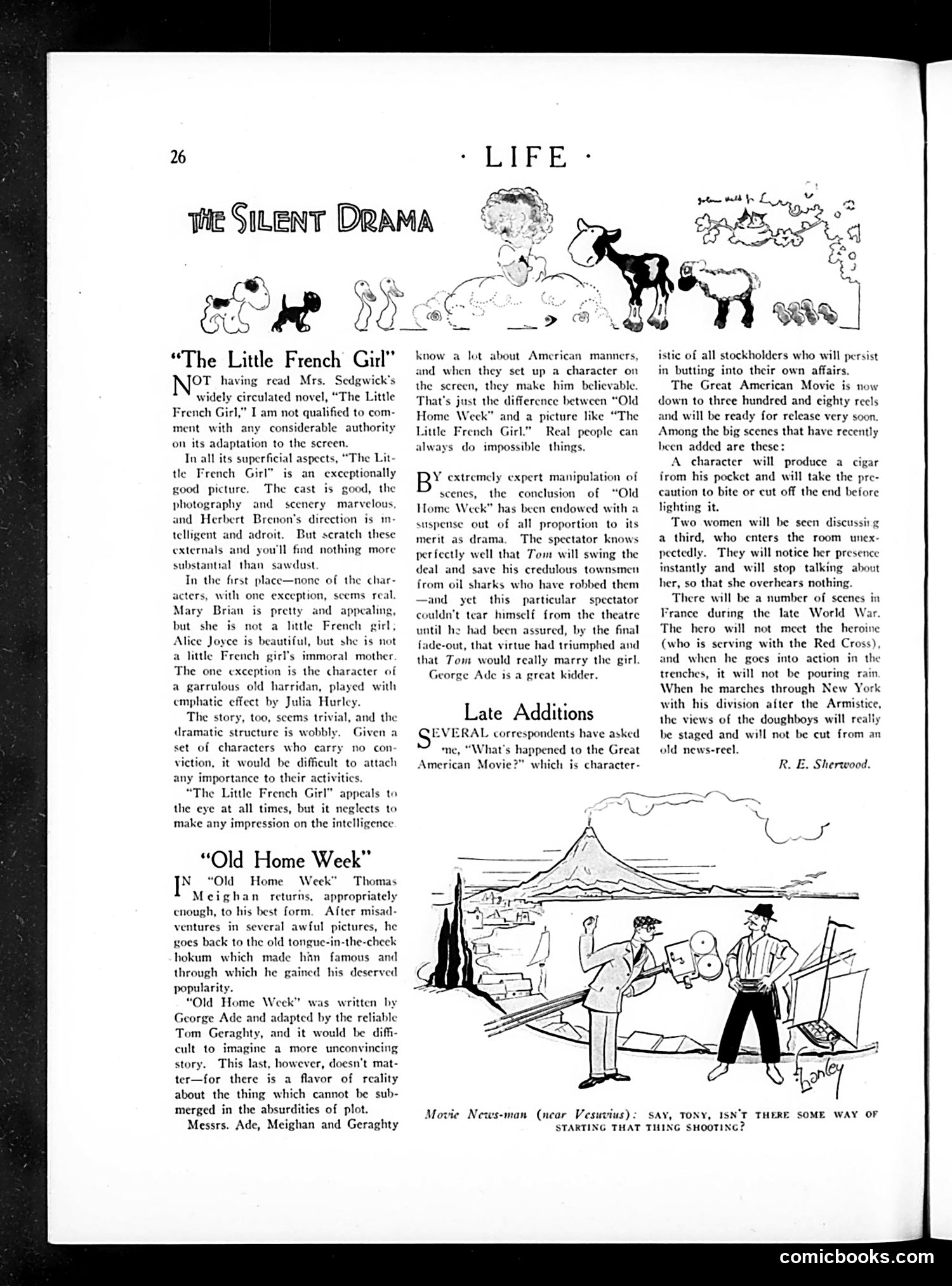
This Life magazine page (page 26) reviews three films. The main cartoon satirizes Hollywood's formulaic approach to movies. A "Movie News-man" near a volcano asks about starting "that thing shooting"—mocking how filmmakers mechanically produce scenes without creativity or logic. The page critiques "The Little French Girl" for being visually polished but dramatically hollow ("nothing more substantial than sawdust"), while praising "Old Home Week" because its writer George Ade and star Thomas Meighan understand authentic American character and behavior—real people can make even implausible plots work. The "Late Additions" section mockingly lists trivial scenes being added to Hollywood's bloated "Great American Movie"—a 380-reel film (absurdly long). The satire suggests Hollywood is manufacturing standardized, predictable content rather than creating meaningful cinema. The tone criticizes the industry's formulaic, audience-manipulation tactics during the silent film era.
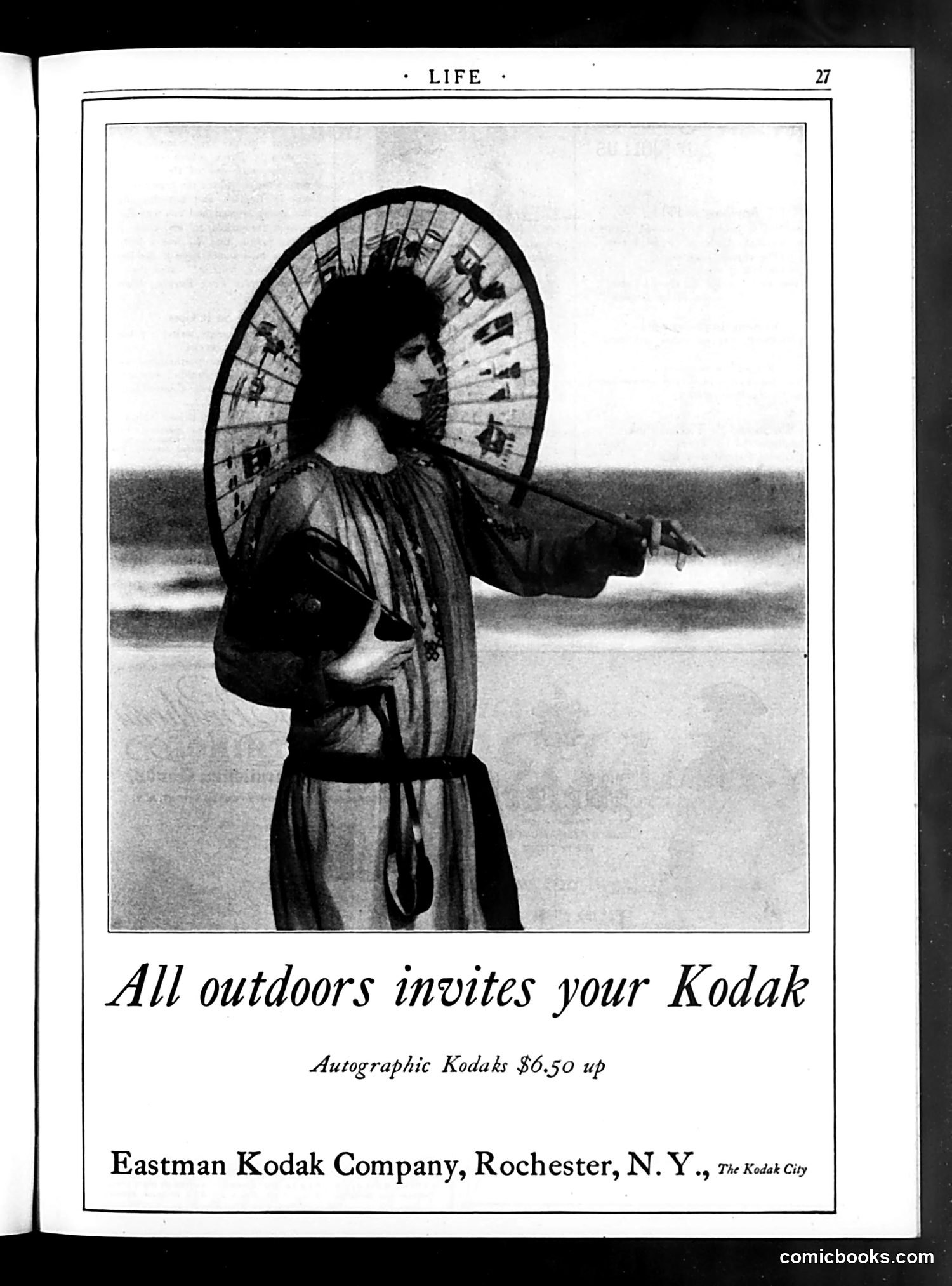
This is a **Kodak camera advertisement**, not political satire. The page features a woman in profile wearing an elaborate decorative parasol, posed outdoors near water. The image exemplifies early 20th-century leisure aesthetics—a fashionable woman enjoying nature, which Kodak positions as the perfect moment to capture with a camera. The ad's appeal targets affluent consumers by suggesting that outdoor activities and travel naturally invite photography. The "Autographic Kodaks $6.50 up" pricing indicates these were consumer cameras for the middle-to-upper classes. The composition itself demonstrates Kodak's marketing strategy: beautiful outdoor scenes and attractive subjects make compelling arguments for camera ownership. This represents how advertising used lifestyle imagery to drive consumer purchases during the early camera era.
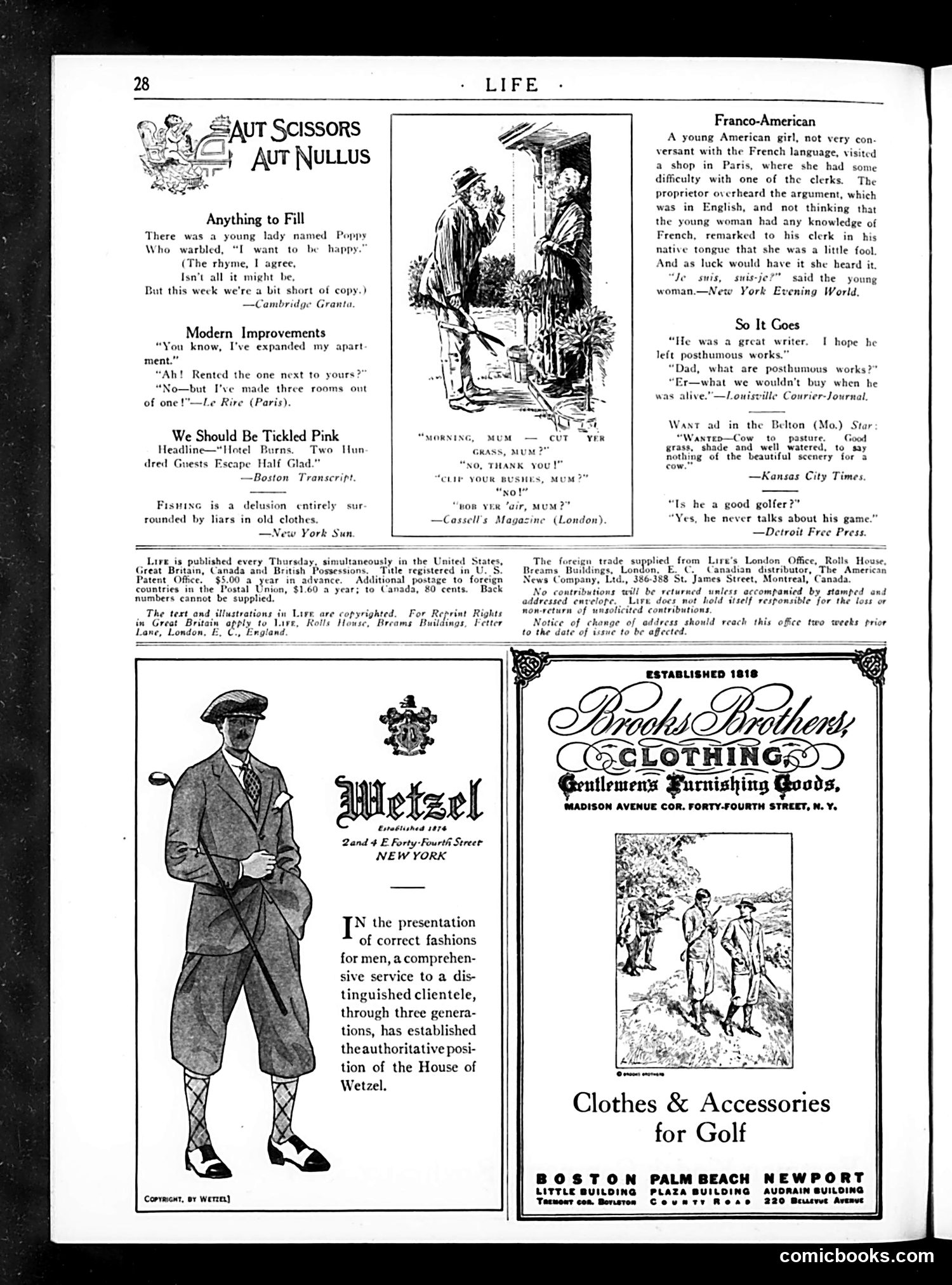
This page is primarily **humor and advertisements** from Life magazine's satirical section. The main cartoon depicts a domestic scene with a mother and child, captioned with British dialogue ("Morning, Mum—cut yer grass, Mum?"). The joke relies on wordplay and the child's misunderstanding of grown-up conversation—typical early 20th-century family humor. The surrounding text contains brief jokes reprinted from other publications, including: - A Franco-American cultural joke about language barriers and misunderstanding - Observations about fishing, hotel fires, and golf etiquette The page also includes advertisements for men's clothing (Wetzel, Brooks Brothers) and golf wear—typical of Life's format mixing humor with upscale retail advertising. The content reflects period attitudes: light domestic comedy, casual xenophobia in the "Franco-American" bit, and affluent leisure pursuits. Nothing here suggests political satire; it's entertainment and commerce aimed at educated, middle-to-upper-class readers.
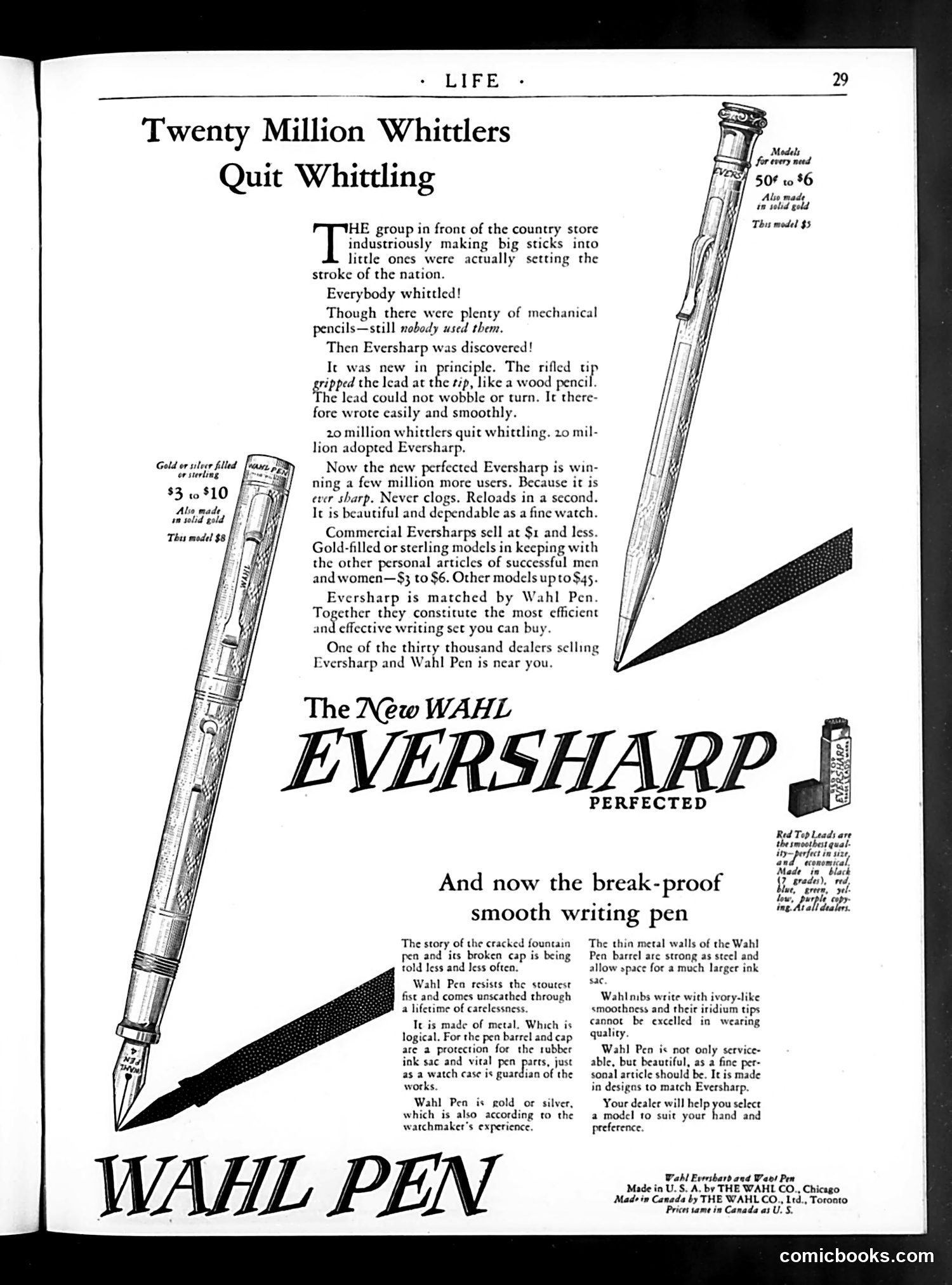
This is primarily a **product advertisement**, not political satire. The page promotes two writing instruments: the Eversharp mechanical pencil and the Wahl Pen. The opening section uses humorous exaggeration rather than political commentary. It jokes that Americans were so obsessed with whittling (shaving wood) that this casual activity represented "the stroke of the nation." The satire is mild and commercial: even though mechanical pencils existed, nobody used them until Eversharp appeared, whereupon "20 million whittlers quit whittling." The advertisement emphasizes that Eversharp's rifled tip prevented wobbling—a genuine mechanical innovation presented as revolutionary. The copy positions both products as luxury goods matching personal success, with prices ranging from $1 to $45 (substantial for the era). There are no political figures, caricatures, or social commentary. This is straightforward early-20th-century advertising using gentle humor to sell writing instruments as marks of sophistication.
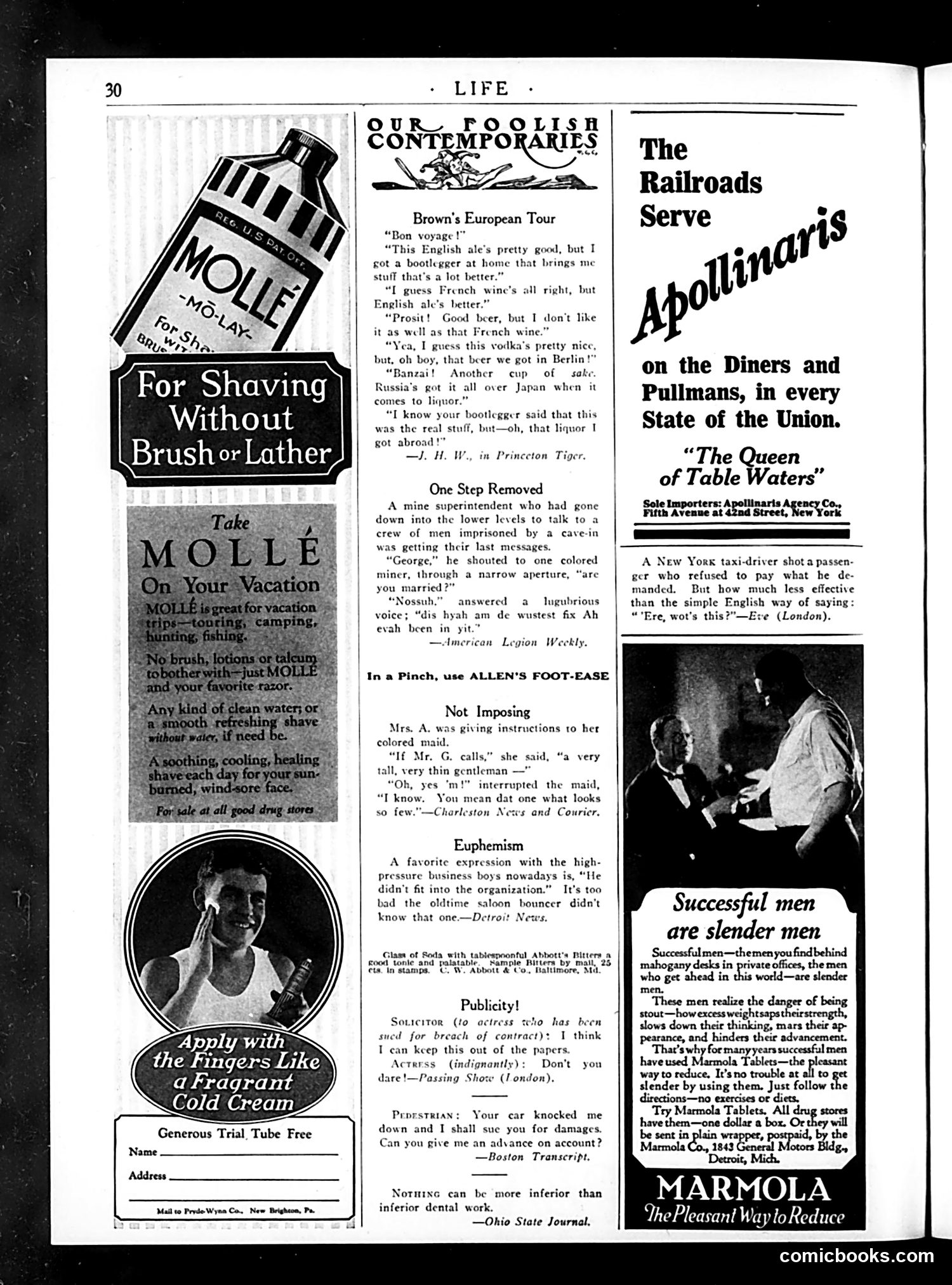
This page features a satirical cartoon strip mocking American attitudes toward alcohol following Prohibition's repeal. The joke presents travelers returning from Europe, each praising their home country's liquor while simultaneously disparaging it—a bootlegger's homemade whiskey beats English ale; French wine beats English ale; Berlin beer beats vodka, and so on. The satire targets American hypocrisy and the era's bootlegging culture. Despite traveling abroad to experience supposedly superior European beverages, the characters ultimately prefer illegal American homemade liquor, suggesting Americans smugly believe their contraband surpasses legitimate foreign imports. The accompanying humor pieces use similar formulaic joke structures common to 1920s-30s magazines: brief one-liners about class differences, racial stereotypes (the mine worker and maid sections), and business jargon. The page's advertisements (Marmola diet pills, Abbott's Bitters) reflect contemporary consumer culture.
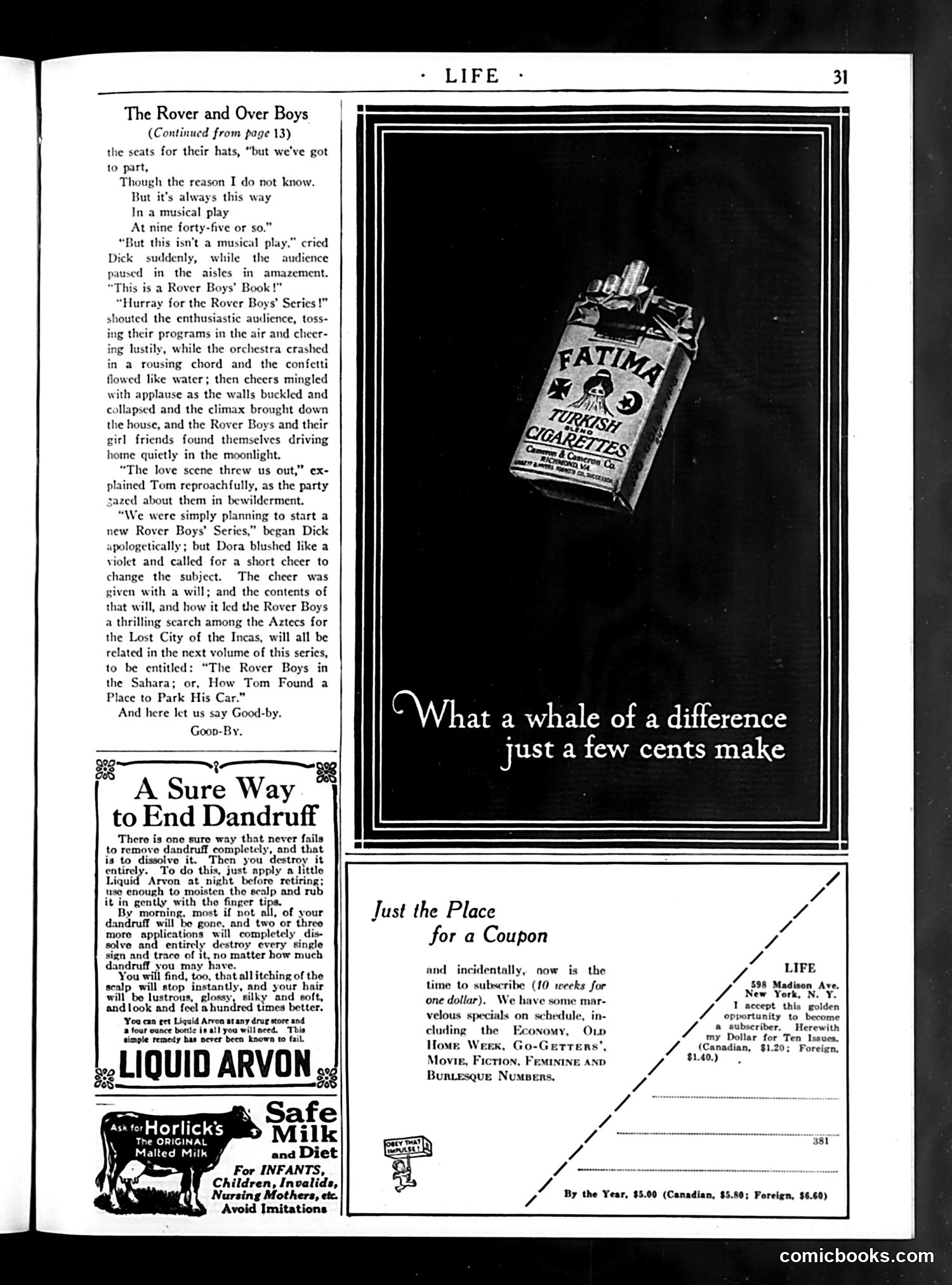
This is a humorous parody of the *Rover Boys* series, immensely popular adventure novels for young readers in the early 1900s. The joke mocks how formulaic these books were: the text describes characters accidentally stumbling into a theatrical production of their own story, complete with mandatory romantic subplot ("the love scene") and climactic action that always concludes at exactly "nine forty-five." The satire peaks when Dick protests this isn't a musical play—it's a *Rover Boys* book—prompting the audience to cheer wildly. The humor lies in exposing the series' predictable structure: love interest, dramatic exit, promise of the next installment (here: "The Rover Boys in the Sahara; or, How Tom Found a Place to Park His Car"), repeat. The "Place to Park His Car" reference is a modern touch, gently mocking how these supposedly timeless adventure tales were already becoming dated as automobiles proliferated.
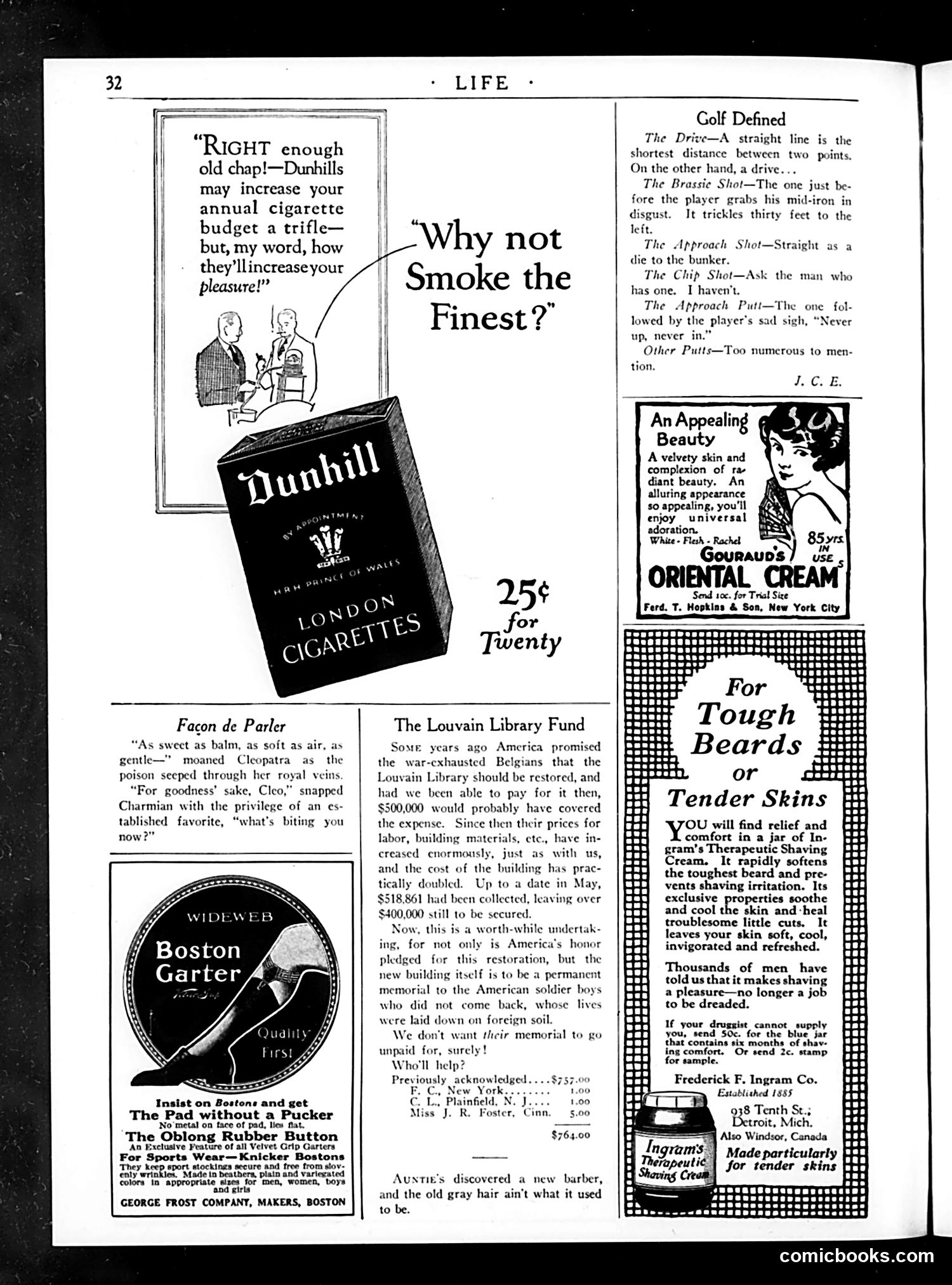
This page is primarily **advertisements** with minimal editorial content. The main cartoon depicts two gentlemen in conversation, where one persuades the other to buy Dunhill cigarettes from London by arguing they'll increase pleasure despite the cost. It's a straightforward product endorsement using humor and class appeal—the "old chap" phrasing and British cigarette brand suggest sophistication. The page also includes a "Golf Defined" humor column that satirizes golfers' self-delusion about their skill, using golfing terminology to mock common player failures (drives that don't go straight, chips that land in bunkers, missed putts). A substantial article discusses fundraising for the **Louvain Library restoration in Belgium**—a post-WWI reconstruction effort America had pledged to support. The text notes costs have doubled and appeals for additional donations as a memorial to American soldiers. The remaining content consists of period advertisements for garters, shaving cream, and beauty products—typical 1920s consumer goods marketing with health and appearance appeals.
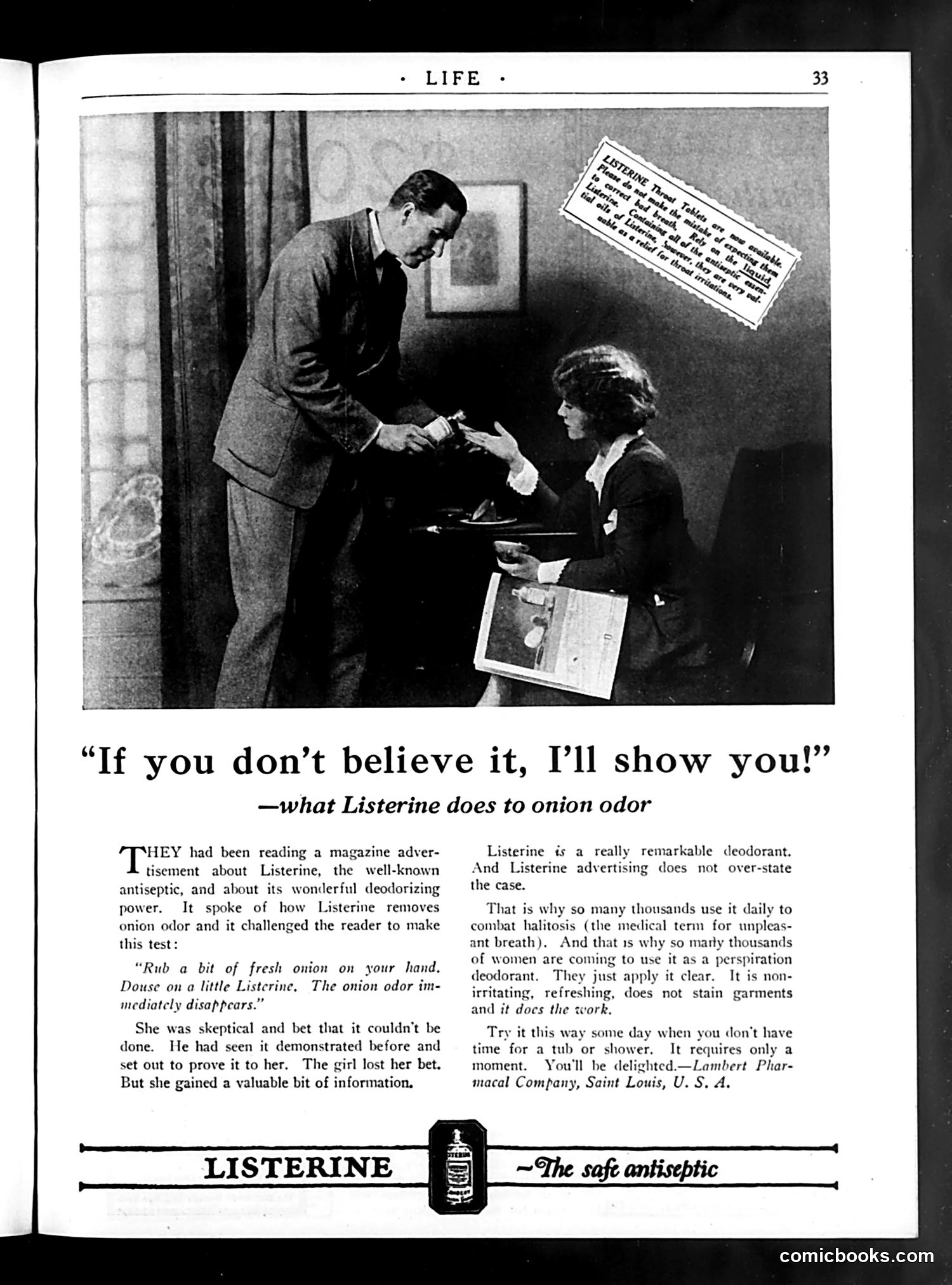
This is a **Listerine antiseptic advertisement**, not political satire. The page depicts a domestic scene where a man demonstrates the product's deodorizing claims to a skeptical woman by rubbing onion on his hand, applying Listerine, and showing the odor disappears. The "joke" centers on proving an exaggerated advertising claim—the man had read a magazine ad claiming Listerine removes onion odor and wagered he could demonstrate it. The woman is skeptical but loses the bet, gaining "valuable information." The advertisement then pivots to Listerine's primary use: combating "halitosis" (bad breath) and as a perspiration deodorant. It emphasizes the product is "non-irritating," "refreshing," and requires only a moment to apply—appealing to busy people without time for bathing. This reflects early 20th-century marketing strategies that created social anxiety around personal hygiene to sell products.
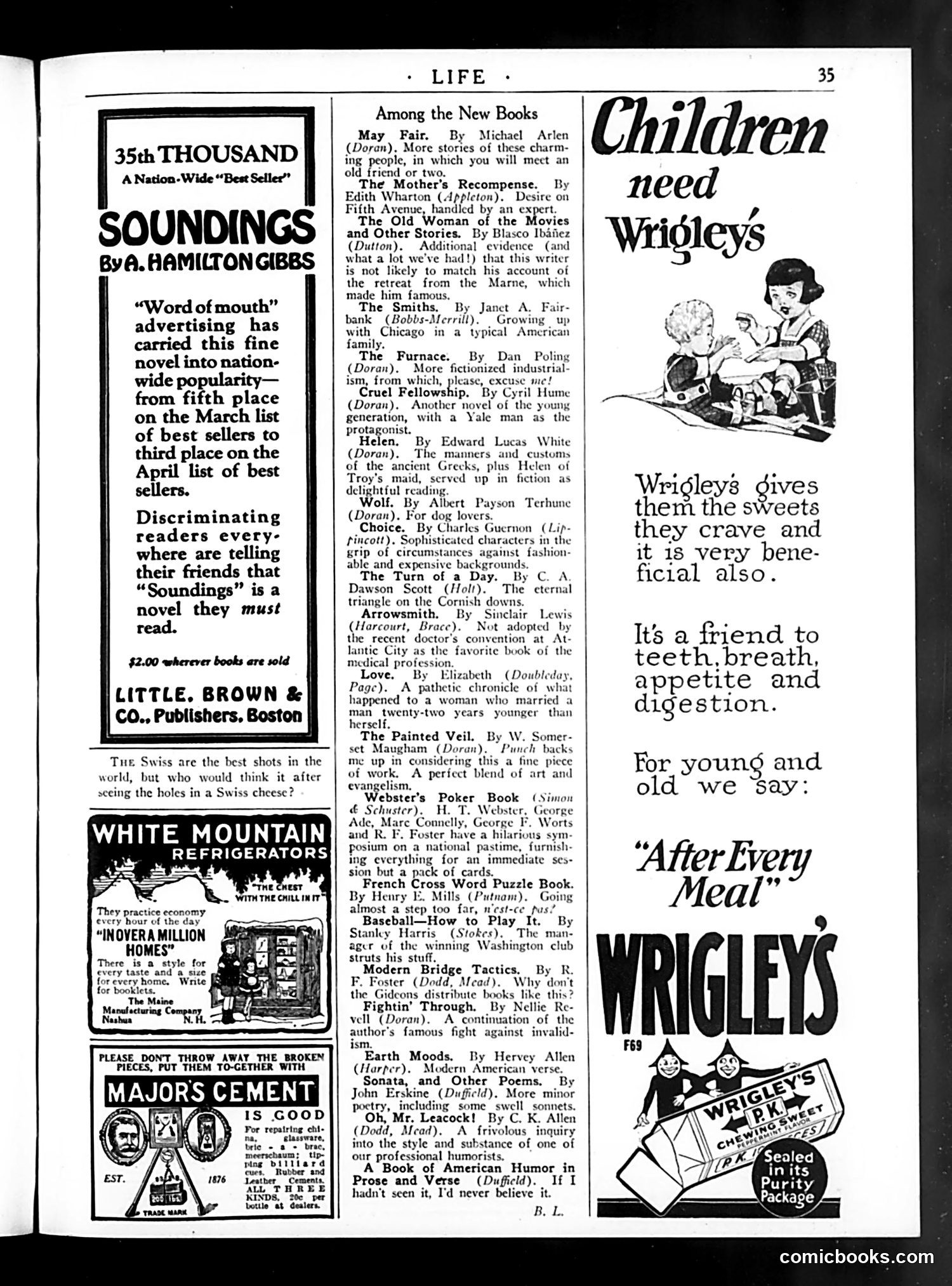
This page is primarily **advertising and book reviews**, not political satire. The main content consists of: 1. **Book advertisements and reviews** listing 1920s publications (by Edith Wharton, Sinclair Lewis, W. Somerset Maugham, etc.) 2. **Product advertisements** for refrigerators, cement, and chewing gum—typical commercial fare 3. **One mild joke** about Swiss cheese (the holes), which is generic humor unrelated to current events 4. The prominent **Wrigley's gum advertisement** features children, emphasizing the product's benefit to digestion and dental health There are **no political cartoons, caricatures, or satirical commentary** visible on this page. The humor is limited to wordplay and advertising slogans. This appears to be a standard 1920s magazine section mixing book promotions with consumer product ads—representative of Life's evolution from pure satire toward mainstream publication status.
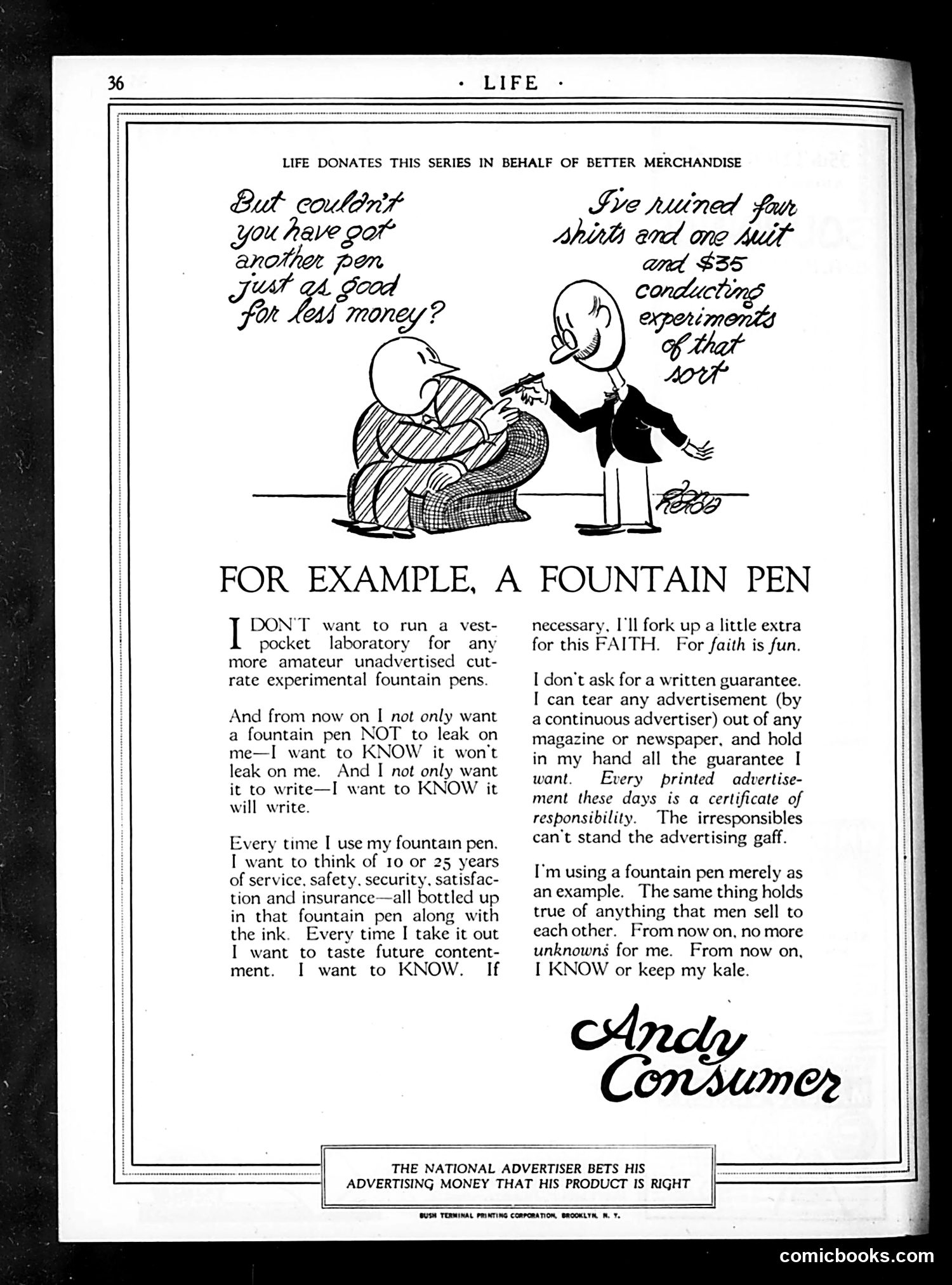
This is a satirical advertisement/editorial hybrid from *Life* magazine promoting consumer responsibility and corporate accountability. The cartoon depicts a skeptical consumer confronting a manufacturer about cheap imitation products. The central argument, attributed to "Andy Consumer," argues that consumers should demand quality goods with proven track records rather than untested bargains. The fountain pen serves as the example—a common consumer good prone to failure. The satire's point: manufacturers who advertise nationally are implicitly guaranteeing their products work, since their reputation and advertising budget are at stake. A printed advertisement functions as a "certificate of responsibility." Unknown brands and cheap knockoffs lack this accountability. This reflects early-20th-century consumer culture anxieties—fountain pens frequently leaked and malfunctioned. The piece advocates for branded, advertised products as safer choices than unproven alternatives, positioning national advertising itself as a consumer protection mechanism.

I can see this is a mostly blank or very dark page from what appears to be a Life magazine issue, with minimal visible content. The only clearly legible text is "comicbooks.com" in the lower right corner, which is a modern website watermark added during digitization. The page itself is too dark and degraded to discern any cartoon illustrations, text, or satirical content that would have been originally printed. Without visible figures, captions, or readable OCR text providing political or social context, I cannot identify specific references, caricatures, or the intended satire. This appears to be a damaged or poorly scanned archival page that doesn't contain recoverable content for analysis.

I can see this is a very dark, low-contrast black and white page from what appears to be a historical publication. The image quality is severely degraded—the content is almost entirely illegible to me. While there is text visible at the bottom reading "comicbooks.com," I cannot reliably make out the main cartoon, caricatures, or OCR'd text that would allow me to identify the political or social references, the figures depicted, or the satirical point being made. To provide accurate historical analysis as requested, I would need a clearer or higher-contrast version of this page. I cannot responsibly speculate about content I cannot clearly see.
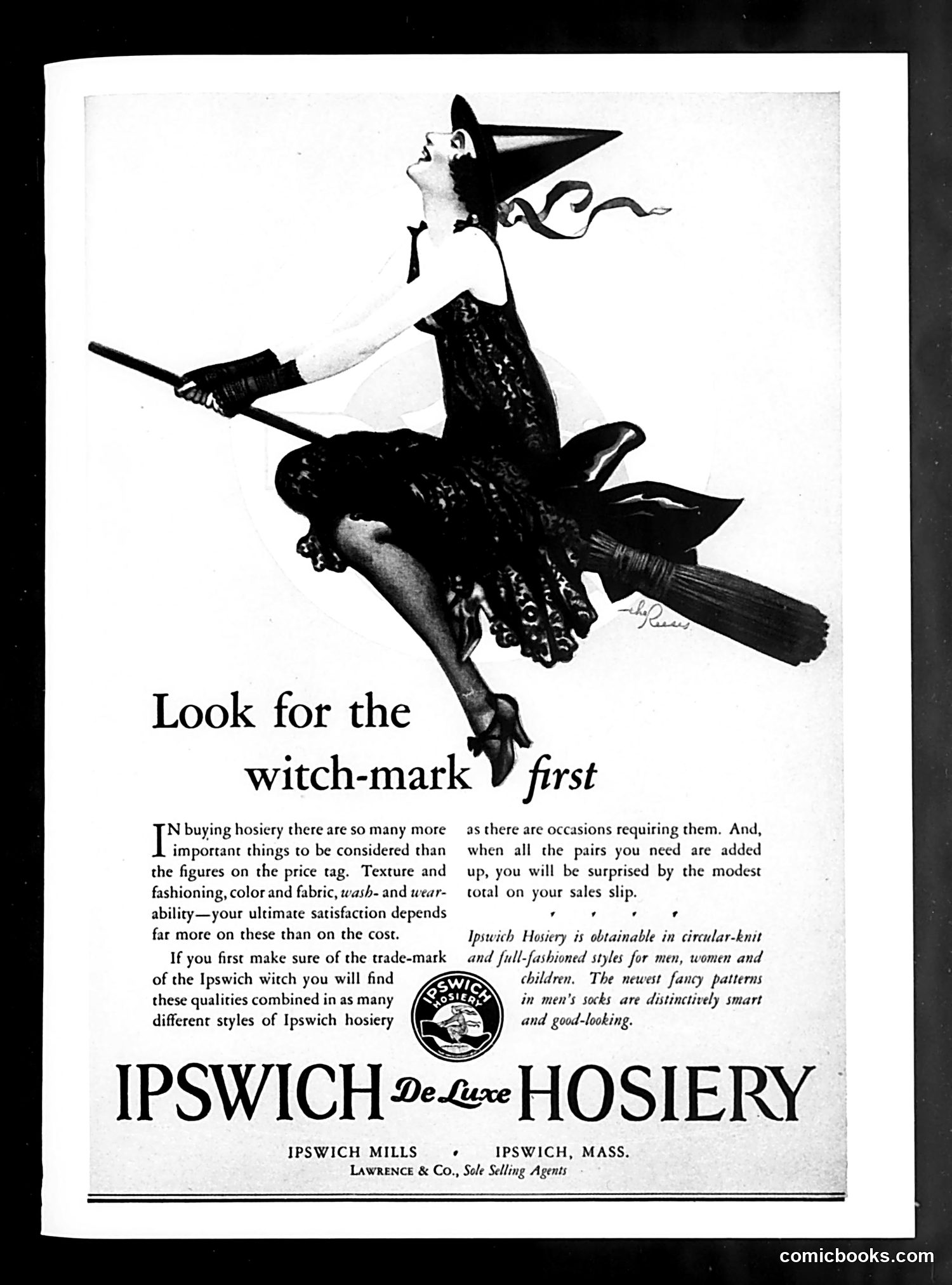
This is a **vintage advertisement** for Ipswich De-Luxe Hosiery, not a political cartoon. The illustration depicts a stylized witch riding a broomstick—a playful visual pun on the company's brand mascot, "the Ipswich witch." The "witch-mark" referenced is the company's **trade-mark/logo**, which appears as a circular seal in the ad. The copy urges consumers to look for this identifying mark when purchasing hosiery, emphasizing that quality (texture, color, durability) matters more than price. The witch imagery was a whimsical marketing device common in early-to-mid 20th-century advertising—not a reference to actual witchcraft or contemporary witch hunts. The brand used the witch character to create memorable, distinctive branding. Modern readers might initially interpret "witch-mark" literally, missing that it simply means the company's identifying label or trademark.
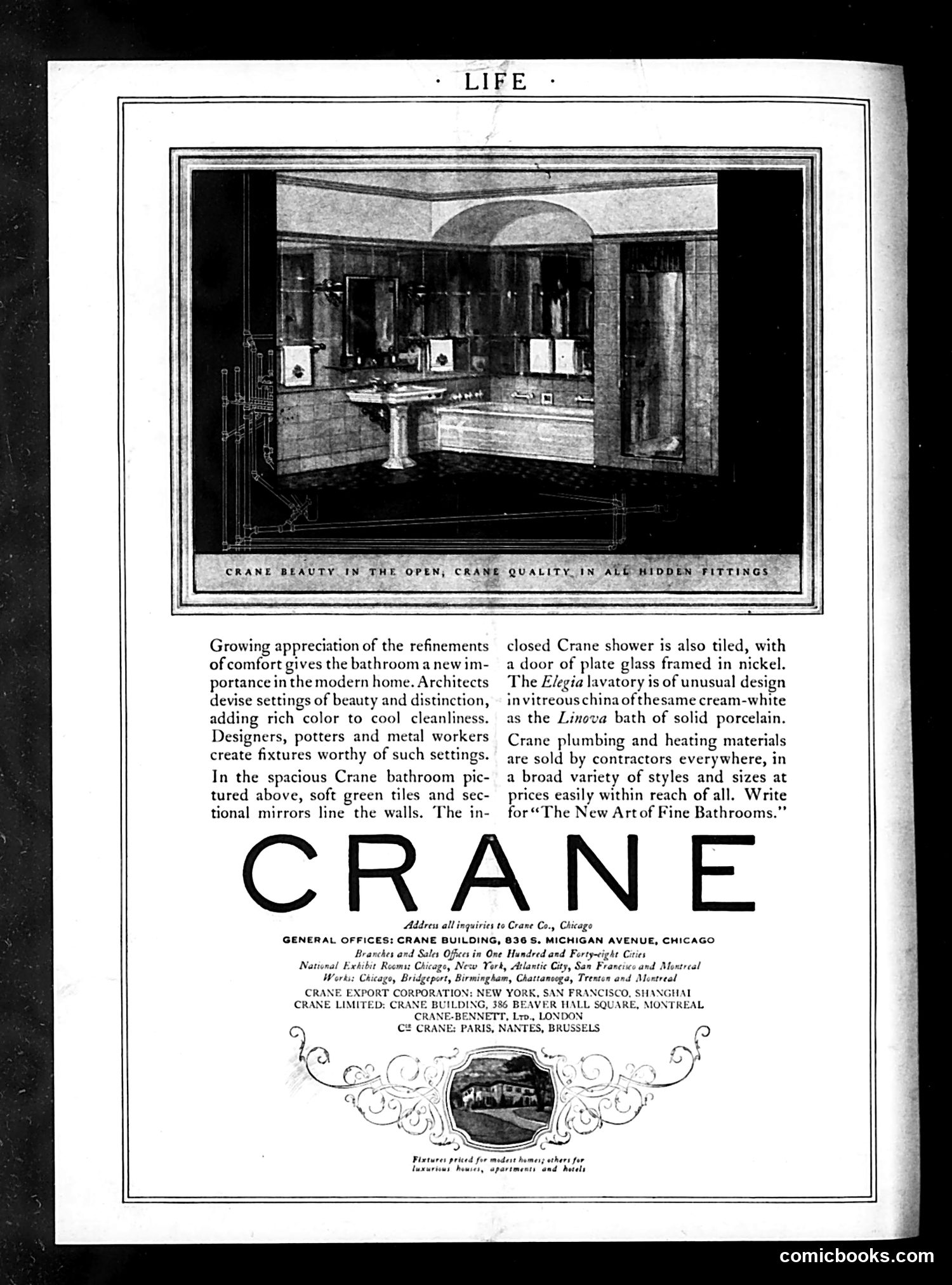
This page is not satire or political commentary. It's a **full-page advertisement for Crane plumbing fixtures**, published in *Life* magazine. The image shows a modern bathroom showroom featuring Crane's products: the Elegia lavatory, Linova bathtub, and tiled shower with glass doors. The text emphasizes that bathrooms have become important spaces of "beauty and distinction" in modern homes, and that Crane products—while elegant and well-designed—are "easily within reach of all" price-wise. The ad positions quality plumbing as aspirational yet accessible to middle-class homeowners. There are no figures, caricatures, or political references to decode. This reflects early 20th-century consumer culture, where *Life* (originally a humor magazine) carried substantial advertising alongside editorial content.

I can see this appears to be a page from Life magazine, but the image is extremely dark and low contrast, making it nearly impossible to discern any cartoon illustrations, text content, or specific details beyond the "comicbooks.com" watermark at the bottom. While I can make out what might be circular or spiral patterns in the darker areas, I cannot reliably identify any figures, caricatures, political references, or satirical content with confidence. To provide an accurate analysis following your rules, I would need a higher quality or better-lit version of this page. I cannot assert details about cartoons, figures, or jokes that I cannot clearly see.