
Life, 1925-06-18 · page 22 of 43
Life — June 18, 1925 — page 22: what you’re looking at
What you’re looking at
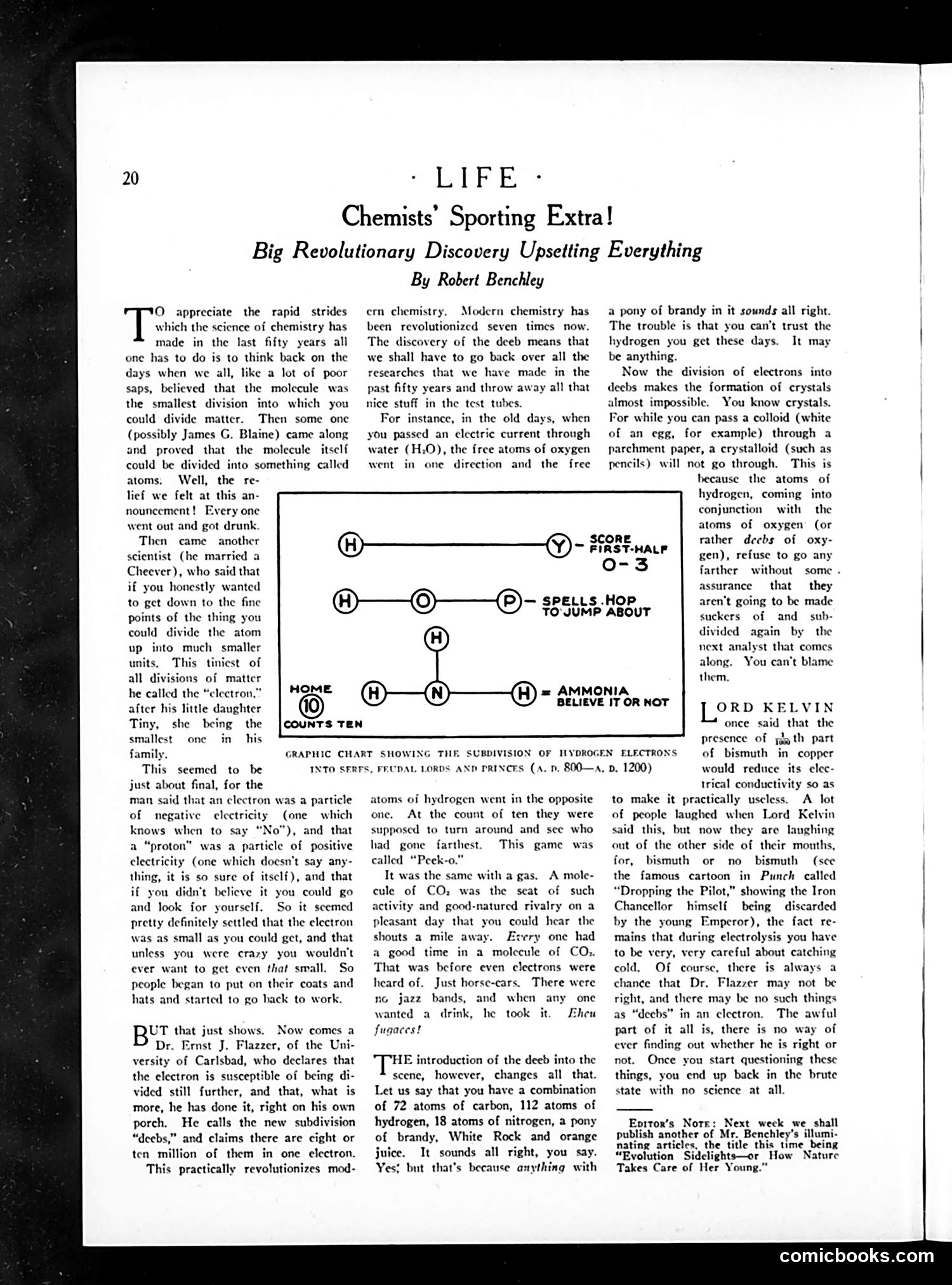
This is a satirical essay by Robert Benchley mocking the rapid succession of scientific discoveries in chemistry. The humor rests on the idea that scientists keep subdividing matter into smaller and smaller units—molecules, atoms, electrons, and now the newly invented "deebs"—each discovery supposedly "revolutionizing" chemistry and rendering previous research obsolete. The joke targets both scientific hubris and the public's gullible acceptance of each new theory. Benchley invents a fictional Dr. Ernst J. Flazzer who claims to have discovered "deebs" (even smaller than electrons) in his porch laboratory. The accompanying diagram humorously presents these discoveries as a "graphic chart" with chemical notation. The satire suggests that scientists keep moving the goalposts, making confident pronouncements about nature's fundamental building blocks only to be contradicted shortly after. By the 1920s (Life's era), this pattern of constant scientific revision was already well-established enough to merit mockery from a humor magazine.
📄 Transcribed text from this page (OCR, searchable)
Machine-transcribed from the original scan — historical spelling and the odd misread are preserved.
« LIFE = Chemists’ Sporting Extra! Big Revolutionary Discovery Upsetting Everything O appreciate the rapid strides "Tet the science of chemistry has made in the last fifty years all one has to do is to think back on the days when we all, like a lot of poor saps, believed that the molecule was the smallest division into which you could divide matter. Then some onc (possibly James G. Blaine) came along and proved that the molecule itself could be divided into something called atoms. Well, the re- lief we felt at this an- nouncement! Every one went out and got drunk. Then came another scientist (he married a Cheever), who said that if you honestly wanted to get down to the fine points of the thing you could divide the atom up into much smaller units, This tiniest of all divisions of matter he called the “electron,” after his little daughter Tiny, she being the smallest one in his family. This seemed to be just about final, for the man said that an electron was a particle of negative electricity (one which knows when to say “No”), and that a “proton” was a particle of positive electricity (one which doesn’t say any- thing, it is so sure of itself), and that if you didn't believe it you could go and look for yourself. So it seemed pretty definitely scttled that the electron was as small as you could get, and that unless you were crazy you wouldn't ever want to get even that small. So people began to put on their coats and hats and started to go hack to work. HOME UT that just shows. Now comes a Dr. Ernst J. Flazzer, of the Uni- versity of Carlsbad, who declares that the electron is susceptible of being di- vided still further, and that, what is more, he has done it, right on his own porch. He calls the new subdivision “deebs,” and claims there are cight or ten million of them in one electron. This practically revolutionizes mod- GRAPHIC CHART SHOWING INTO SERFS, FEUDAL LORDS AND PRINCES (a. p. 800—a, v. 1200) By Robert Benchley ern chemistry. Modern chemistry has been revolutionized seven times now, The discovery of the deeb means that we shall have to go back over all the researches that we have made in the past fifty years and throw away all that nice stuff in the test tubes. For instance, in the old days, when you passed an electric current through water (H:O), the free atoms of oxygen went in one direction and the free TO'YUMP (H) (H)—{N) THE SUBDIVISION atoms of hydrogen went in the opposite one. At the count of ten they were supposed to turn around and see who had gone farthest. This game was called “Peek-o.” It was the same with a gas. A mole- cule of CO: was the scat of such activity and good-natured rivalry on a pleasant day that you could hear the shouts a mile away. Every one had a good time in a molecule of CO. That was before even electrons were heard of. Just horse-cars, There were no jazz bands, and when any one wanted drink, he took it. Ehen fugaces! a IE introduction of the deeb into the scene, however, changes all that. Let us say that you have a combination of 72 atoms of carbon, 112 atoms of hydrogen, 18 atoms of nitrogen, a pony of brandy, White Rock and orange juice. It sounds all right, you say. Yes! but that’s because anything with — SPELLS. OF HYDROGEN a pony of brandy in it sounds all right. The trouble is that you can’t trust the hydrogen you get these days. It may be anything. Now the division of electrons into deebs makes the formation of crystals almost impossible. You know crystals. For while you can pass a colloid (white of an egg, for example) through a parchment paper, a crystalloid (such as pencils) will not go through. This is because the atoms of hydrogen, coming into conjunction with the atoms of oxygen (or rather decbs of oxy- gen), refuse to go any o-3 farther without some . assurance that they Hop aren't going to be made aBour suckers of and sub- divided again by the next analyst that comes along. You can’t blame them. = AMMONIA BELIEVE IT OR NOT ORD KELVIN once said that the presence of yaa th part of bismuth in copper would reduce its elec- trical conductivity so as to make it practically uscless. A lot of people laughed when Lord Kelvin said this, but now they are laughing out of the other side of their mouths, for, bismuth or no bismuth (sce the famous cartoon in Punch called “Dropping the Pilot,” showing the Iron Chancellor himself being discarded by the young Emperor), the fact re- mains that during electrolysis you have to be very, very careful about catching cold, Of course, there is always a chance that Dr. Flazzer may not be right, and there may be no such things as “decbs” in an electron. The awful part of it all is, there is no way of ever finding out whether he is right or not. Once you start questioning these things, you end up back in the brute state with no science at all. ELECTRONS Epitor’s Note: Next weck we shall publish another of Mr. Benchley’s illumi- nating articles, the title this time being “Evolution Sidelights—or How Nature Takes Care of Her Young.” comicbooks.com