
Life, 1925-06-18 · page 25 of 43
Life — June 18, 1925 — page 25: what you’re looking at
What you’re looking at
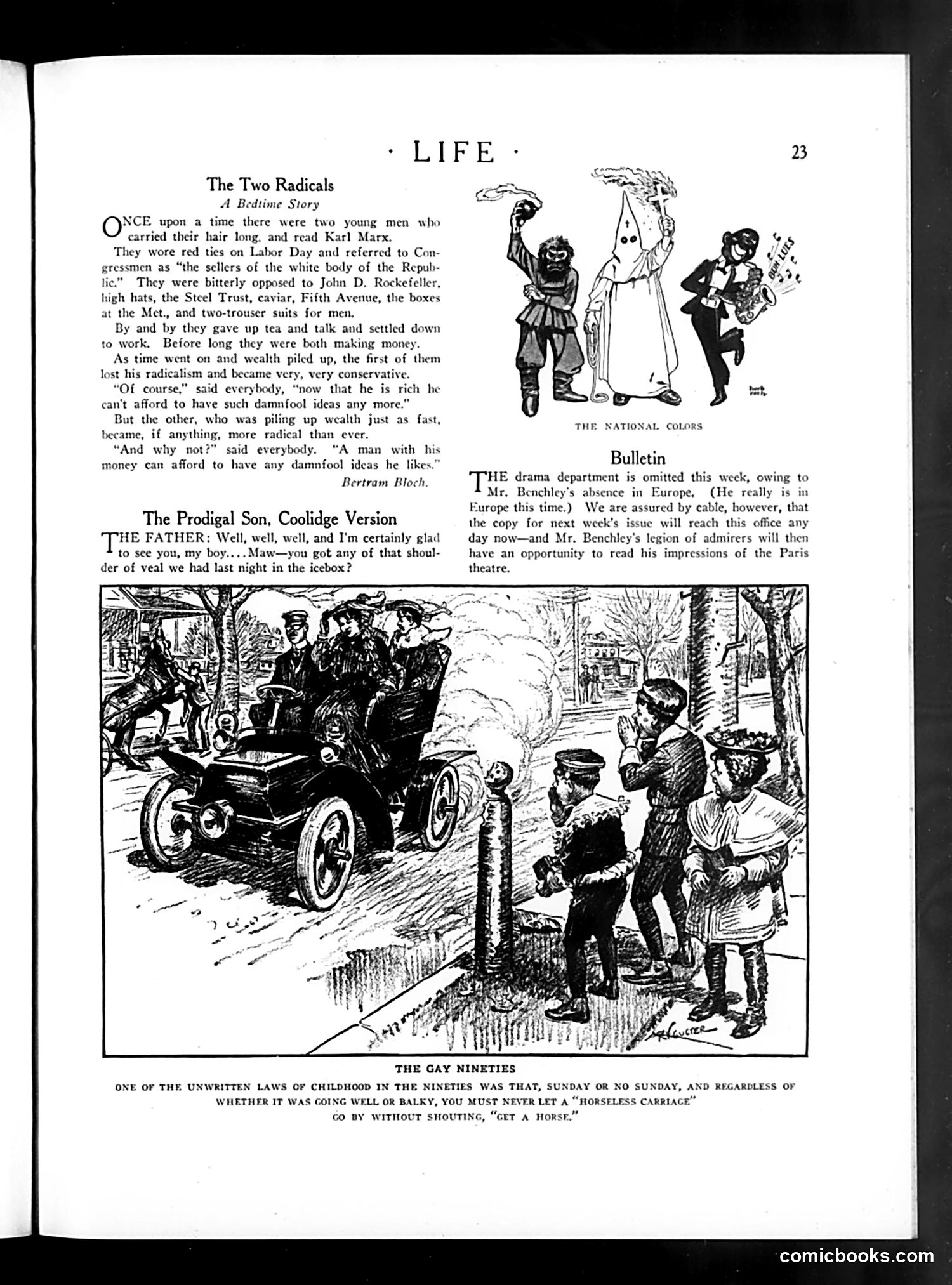
**"The Two Radicals"** mocks ideological consistency. Two young radicals—long-haired Marx readers who despised Rockefeller, the Steel Trust, and wealth—both became rich. One abandoned his radical beliefs once wealthy (the expected outcome). The other grew *more* radical despite accumulating the same wealth. The joke exposes hypocrisy: society excuses abandoning principles for money but finds a wealthy radical inexplicably committed to his stated beliefs—suggesting radical ideology is merely affectation, not genuine conviction. **"The Prodigal Son, Coolidge Version"** is a brief, untranslated dialogue fragment likely referencing President Calvin Coolidge through the biblical parable of the prodigal son returning home. **"The Gay Nineties"** illustration shows children shouting at a horseless carriage (early automobile), reflecting genuine 1890s childhood behavior—the novelty of automobiles inspired children to demand drivers "get a horse," treating cars as curiosities destined to fail.
📄 Transcribed text from this page (OCR, searchable)
Machine-transcribed from the original scan — historical spelling and the odd misread are preserved.
The Two Radicals A Bedtime Story OE upon a time there were two young men who carried their hair long, and read Karl Marx. They wore red tics on Labor Day and referred to Con- gressmen as “the sellers of the white body of the Repub- ” They were bitterly opposed to John D. Rockefeller, high hats, the Steel Trust, caviar, Fifth Avenue, the boxes at the Met., and two-trouser suits for men, By and by they gave up tea and talk and settled down to work. Before long they were both making money. As time went on and wealth piled up, the first of them lost his radicalism and became very, very conservative. “Of course,” said everybody, “now that he is rich he can’t afford to have such damnfool ideas any more.” But the other, who was piling up wealth just as fast, became, if anything, more radical than ever. “And why not?” said everybody. “A man with his money can afford to have any damnfool ideas he likes.” Bertram Bloch. lic.’ The Prodigal Son, Coolidge Version HE FATHER: Well, well, well, and I'm certainly glad to see you, my boy.... Maw—you got any of that shoul- der of veal we had last night in the icebox? THE NATIONAL COLORS Bulletin THE drama department is omitted this week, owing to Mr. Benchley’s absence in Europe. (He really is in Europe this time.) We are assured by cable, however, that the copy for next week’s issue will reach this office any day now—and Mr. Benchley’s legion of admirers will then have an opportunity to read his impressions of the Paris theatre. THE GAY NINETIES ONE OF THE UNWRITTEN LAWS OF CHILDHOOD IN THE NINETIES WAS THAT, SUNDAY OR NO SUNDAY, AND REGARDLESS OF WHETHER IT WAS GOING WELL OR BALKY, YOU MUST NEVER LET A “HORSELESS CARRIAGE” CO BY WITHOUT SHOUTING, “GET A HorsF.” comicbooks.com