
Life, 1925-06-18 · page 28 of 43
Life — June 18, 1925 — page 28: what you’re looking at
What you’re looking at
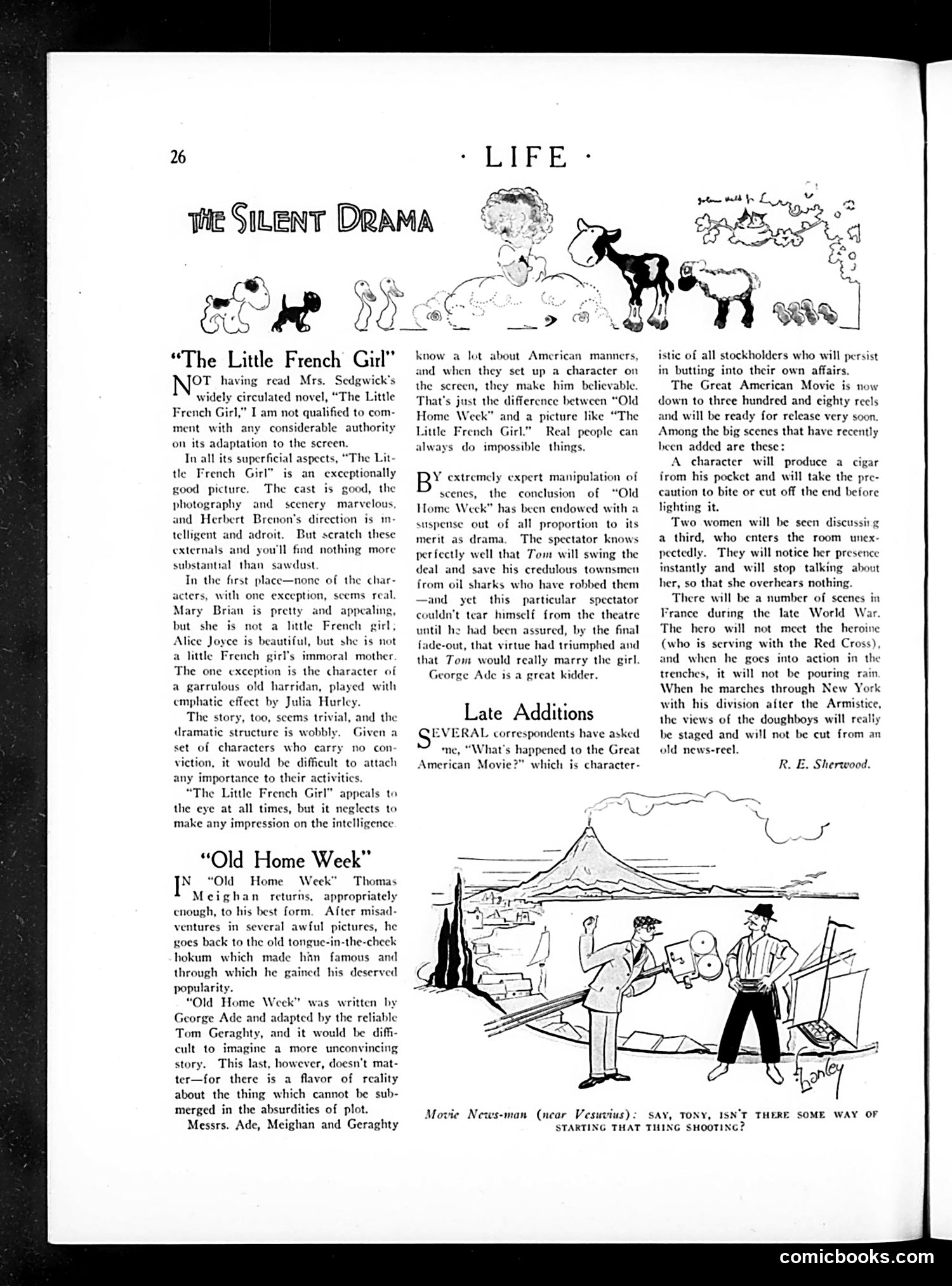
This Life magazine page (page 26) reviews three films. The main cartoon satirizes Hollywood's formulaic approach to movies. A "Movie News-man" near a volcano asks about starting "that thing shooting"—mocking how filmmakers mechanically produce scenes without creativity or logic. The page critiques "The Little French Girl" for being visually polished but dramatically hollow ("nothing more substantial than sawdust"), while praising "Old Home Week" because its writer George Ade and star Thomas Meighan understand authentic American character and behavior—real people can make even implausible plots work. The "Late Additions" section mockingly lists trivial scenes being added to Hollywood's bloated "Great American Movie"—a 380-reel film (absurdly long). The satire suggests Hollywood is manufacturing standardized, predictable content rather than creating meaningful cinema. The tone criticizes the industry's formulaic, audience-manipulation tactics during the silent film era.
📄 Transcribed text from this page (OCR, searchable)
Machine-transcribed from the original scan — historical spelling and the odd misread are preserved.
26 lon “The Little French Girl” OT having read Mrs. Sedgwick’s widely circulated novel, “The Little French Girl,” I am not qualified to com- ment with any considerable authority on its adaptation to the screen. In all its superficial aspects, “The Lit- tle French Girl” is an exceptionally good picture. The cast is good, the photography and marvelous, and Herbert Brenon’s direction is im- telligent and adroit. But scratch these externals and you'll find nothing more substantial than sawdust In the first place—none of the char- acters, with one exception, scems real. Mary Brian is pretty and appealing, but not a little French girl, Alice Joyce is beautiful, but she is not a little French girl's immoral mother. The one exception is the character of a garrulous old harridan, played with emphatic effect by Julia Hurley. The story, too, scems trivial, and the dramatic structure is wobbly. scenery she is yen a set of characters who carry no con- viction, it would be difficult to attach any importance to their activitic “The Little French Girl” appeals to the eye at all times, but it neglects to make any impression on the intelligence “Old Home Week” IX “Old Home Weel Thomas Meighan returns, appropriately cnough, to his best form. After misad- ventures in several awful pictur goes back to the old tongue-in-the-cheek hokum which made han famous and through which he gained his deserved popularity. “Old Home Week” was written by George Ade and adapted by the reliable Tom Geraghty, and it would be diffi- cult to imagine a more unconvincing story. This last, however, doesn’t mat- ter—for there is a flavor of reality about the thing which cannot be sub- merged in the absurdities of plot. Messrs. Ade, Meighan and Geraghty 6 know a lot about American manners, and when they set up a character on the screen, they make him believable. That's just the difference between “Old Home Weck” and a picture like “The Little French Girl.” Real people can always do impossible things. Y extremely expert manipulation of scenes, the conclusion of “Old Home We has been endowed with a suspense out of all proportion to its merit as drama. The spectator knows perfectly well that Tom will swing the deal and save his credulous townsme from oil sharks who have robbed them —and yet this ticular spectator couldn't tear himself from the theatre until he had been assured, by the final fade-out, that virtue had triumphed and that Tom would really marry the girl. George Ade is a great kidder. Late Additions ZVERAL correspondents have asked me, “What's happened to the Great American Movie?” which is character- Movie News-man (near Vesuvius) : istic of all stockholders who will persist in butting into their own affairs. The Great American Movie is now down to three hundred and eighty reels and will be ready for release very soon. Among the big scenes that have recently een added are these: A character will produce a cigar irom his pocket and will take the pre- caution to bite or cut off the end before lighting it. Two women will be seen discussit g a third, who enters the room unex- pectedly. They will notice her presence instantly and will stop talking about her, so that she overhears nothing. There will be a number of scenes in France during the late World War. The hero will not meet the heroine (who is serving with the Red Cross), and when he goes into action in the trenches, it will not be pouring rain When he marches through New Yo with his division after the Armistice, the views of the doughboys will really be staged and will not be cut from an old news-reel. R. E, Sherwood. SAY, TONY, ISN'T THERE SOME WAY OF STARTING THAT THING SHOOTING? comicbooks.com