
Life, 1925-06-18 · page 18 of 43
Life — June 18, 1925 — page 18: what you’re looking at
What you’re looking at
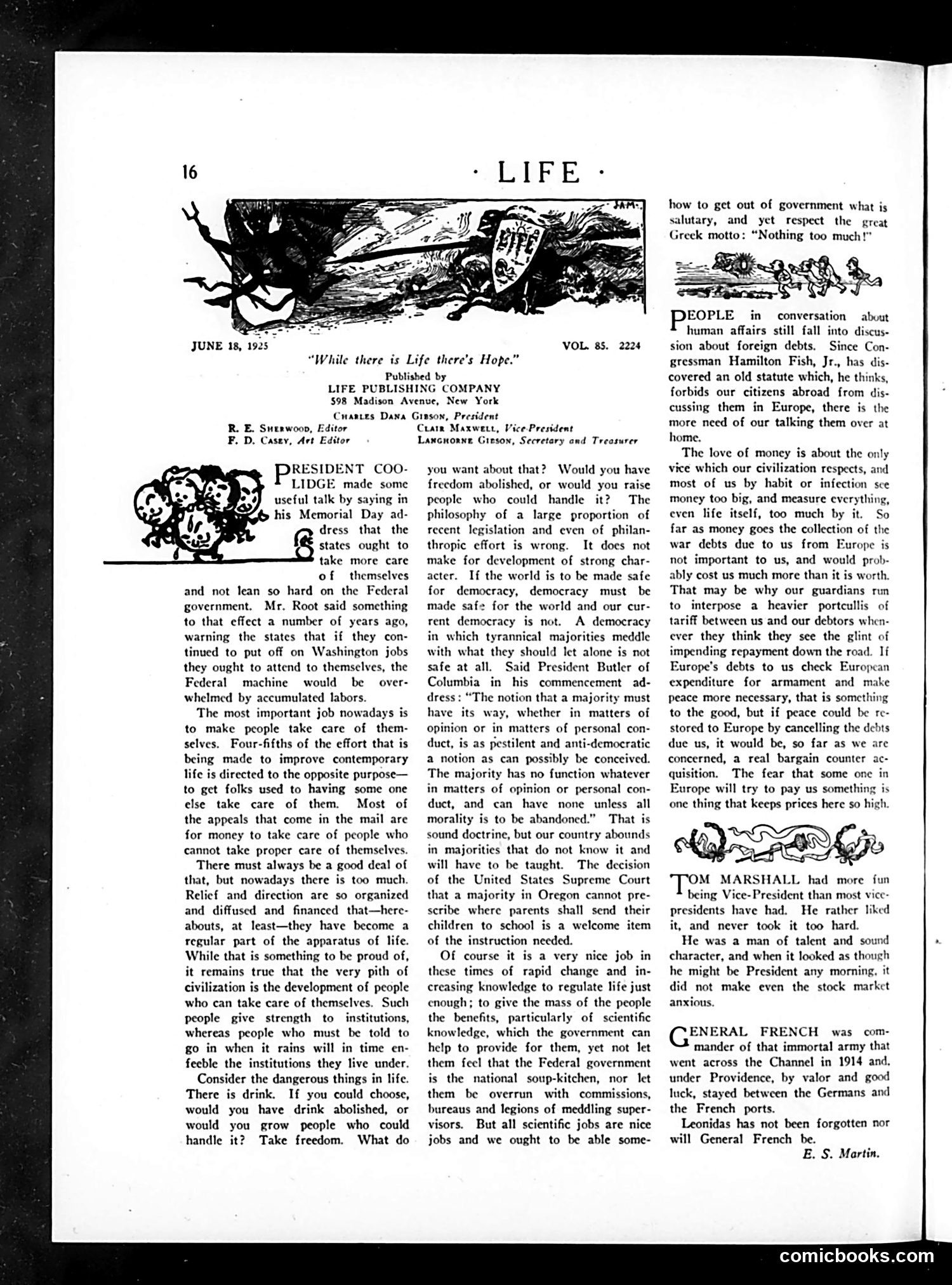
The main editorial by the magazine's leadership attacks the growing expansion of government relief and social programs. The argument: Americans are becoming too dependent on government assistance rather than developing self-reliance and strong character. President Coolidge is referenced approvingly for his Memorial Day address urging states to reduce federal dependence. The editor invokes the anti-majoritarian philosophy of Columbia University President Nicholas Murray Butler, celebrating the Supreme Court's recent Oregon decision striking down compulsory public schooling laws. The satire targets progressive reformers and philanthropic organizations whose "appeals" for charity money the magazine views as weakening American independence. The core conservative argument: civilization depends on people managing their own affairs, not on institutional safety nets or government "meddling." This reflects 1920s conservative ideology opposing the expansion of government social welfare—a debate that remains politically relevant today, though the specific reference to Oregon school attendance laws now appears historically distant.
📄 Transcribed text from this page (OCR, searchable)
Machine-transcribed from the original scan — historical spelling and the odd misread are preserved.
VOL, 85. 2224 “While there is Life there's Hope.” Published by LIFE PUBLISHING COMPANY $98 Madison Avenue, New York Cuaates Dana Giason, President R. E. Sueewoon, Editor F. D. Casey, Art Editor RESIDENT COO- LIDGE made some useful talk by saying in & his Memorial Day ad- dress that the states ought to take more care of themselves and not lean so hard on the Federal government. Mr. Root said something to that effect a number of years ago, warning the states that if they con- tinued to put off on Washington jobs they ought to attend to themselves, the Federal machine would be over- whelmed by accumulated labors. The most important job nowadays is to make people take care of them- selves. Four-fifths of the effort that is being made to improve contemporary life is directed to the opposite purpose— to get folks used to having some one else take care of them. Most of the appeals that come in the mail are for money to take care of people who cannot take proper care of themselves. There must always be a good deal of that, but nowadays there is too much. Relicf and direction are so organized and diffused and financed that—here- abouts, at least—they have become a regular part of the apparatus of life. While that is something to be proud of, it remains true that the very pith of civilization is the development of people who can take care of themselves. Such people give strength to institutions, whereas people who must be told to go in when it rains will in time en- feeble the institutions they live under. Consider the dangerous things in life. There is drink. If you could choose, would you have drink abolished, or would you grow people who could handle it? Take freedom. What do Crate Maxwett, Vice-President Laxcnonne Girson, Secretary and Treasurer you want about that? Would you have freedom abolished, or would you raise people who could handle it? The philosophy of a large proportion of recent legislation and even of philan- thropic effort is wrong. It does not make for development of strong char- acter. If the world is to be made safe for democracy, democracy must be made safe for the world and our cur- rent democracy is not. A democracy in which tyrannical majorities meddle with what they should let alone is not safe at all. Said President Butler of Columbia in his commencement ad- dress: “The notion that a majority must have its way, whether in matters of opinion or in matters of personal con- duct, is as pestilent and anti-democratic a notion as can possibly be conceived. The majority has no function whatever in matters of opinion or personal con- duct, and can have none unless all morality is to be abandoned.” That is sound doctrine, but our country abounds in majorities that do not know it and will have to be taught. The decision of the United States Supreme Court that a majority in Oregon cannot pre- scribe where parents shall send their children to school is a welcome item of the instruction needed. Of course it is a very nice job in these times of rapid change and in- creasing knowledge to regulate life just cnough; to give the mass of the people the benefits, particularly of scientific knowledge, which the government can help to provide for them, yet not let them feel that the Federal government is the national soup-kitchen, nor let them be overrun with commissions, bureaus and legions of meddling super- visors. But all scientific jobs are nice jobs and we ought to be able some- how to get out of government what is salutary, and yet respect the great Greek motto: “Nothing too much!" St EOPLE in conversation abvut human affairs still fall into discus- sion about foreign debts. Since Con- gressman Hamilton Fish, Jr., has dis- covered an old statute which, he thinks, forbids our citizens abroad from dis- cussing them in Europe, there is the more need of our talking them over at home. The love of money is about the only vice which our civilization respects, and most of us by habit or infection sce money too big, and measure everything, even life itself, too much by it. So far as money goes the collection of the war debts due to us from Europe is not important to us, and would prob- ably cost us much more than it is worth. That may be why our guardians mm to interpose a heavier portcullis of tariff between us and our debtors when- ever they think they see the glint of impending repayment down the road. If Europe’s debts to us check European expenditure for armament and make peace more necessary, that is something to the good, but if peace could be re- stored to Europe by cancelling the debts due us, it would be, so far as we are concerned, a real bargain counter ac- quisition. The fear that some one in Europe will try to pay us something is one thing that keeps prices here so high. ASTOR ER M MARSHALL had more fun being Vice-President than most vice- presidents have had. He rather liked it, and never took it too hard. He was a man of talent and sound character, and when it looked as though he might be President any morning, it did not make even the stock market anxious. ENERAL FRENCH was com- mander of that immortal army that went across the Channel in 1914 and, under Providence, by valor and good luck, stayed between the Germans and the French ports. Leonidas has not been forgotten nor will General French be. E. S. Martin. comicbooks.com