
A complete issue · 41 pages · 1925
Life — April 9, 1925
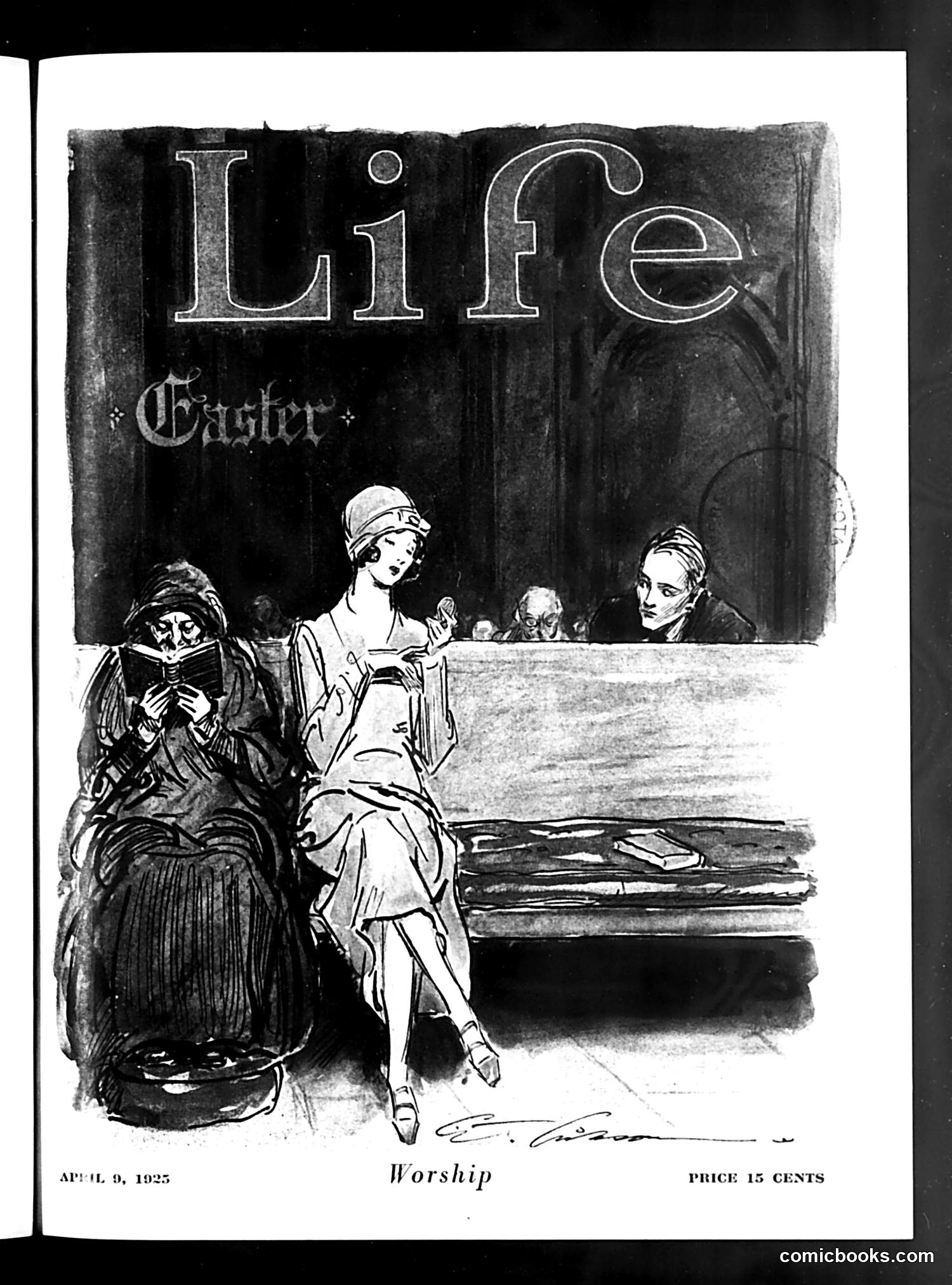
This is the cover illustration for Life's Easter issue, subtitled "Worship." The cartoon depicts an Easter service scene with social commentary embedded in the composition. A fashionably dressed young woman in a cloche hat sits prominently in the foreground, her posture and expression suggesting distraction or disengagement during worship. Beside her sits an elderly woman in dark, old-fashioned clothing—likely representing traditional religious devotion. In the background, other congregants are visible. The satire appears to critique the generational and class divide in 1920s religious practice: the "modern" younger generation's superficial or fashionable approach to Easter observance versus older generations' earnest faith. The contrast between the women's appearances and demeanor suggests commentary on how Jazz Age materialism and style have displaced genuine spiritual reverence among the young.
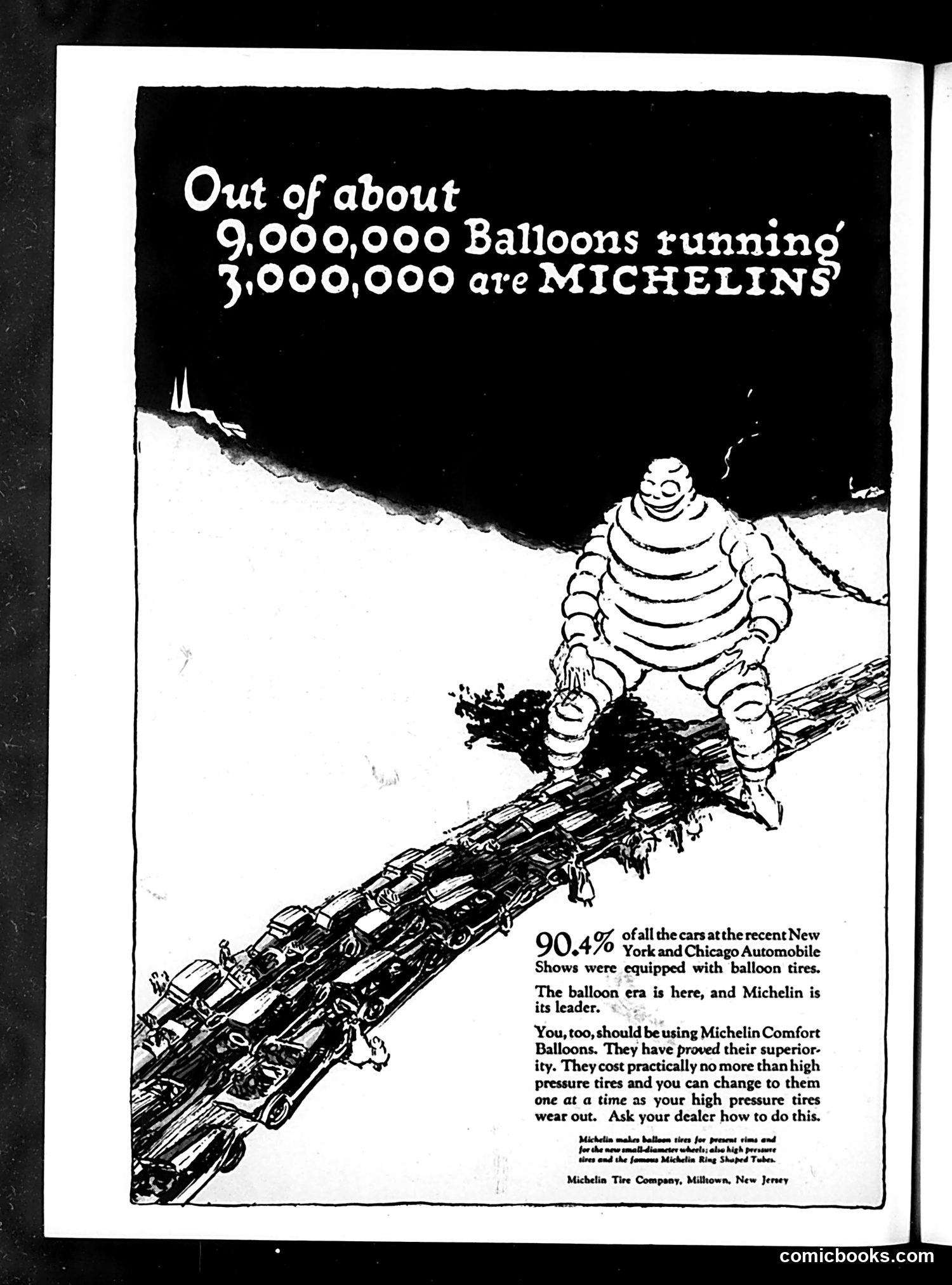
This is primarily a **Michelin tire advertisement**, not satire or political commentary. The page features the Michelin Man (Bibendum), the company's mascot—a rotund figure made of stacked tire rings. The ad claims that of 9 million balloons at recent automobile shows, 3 million were Michelin balloons, suggesting market dominance. It notes that 90.4% of cars at New York and Chicago Auto Shows used Michelin balloon tires. The ad promotes Michelin Comfort Balloons as superior to high-pressure tires, claiming they cost similarly but last longer and can be changed individually as they wear. The Michelin Man sits atop a stack of cars, emphasizing the brand's prevalence. This is straightforward product advertising using their iconic mascot and market statistics as persuasion.
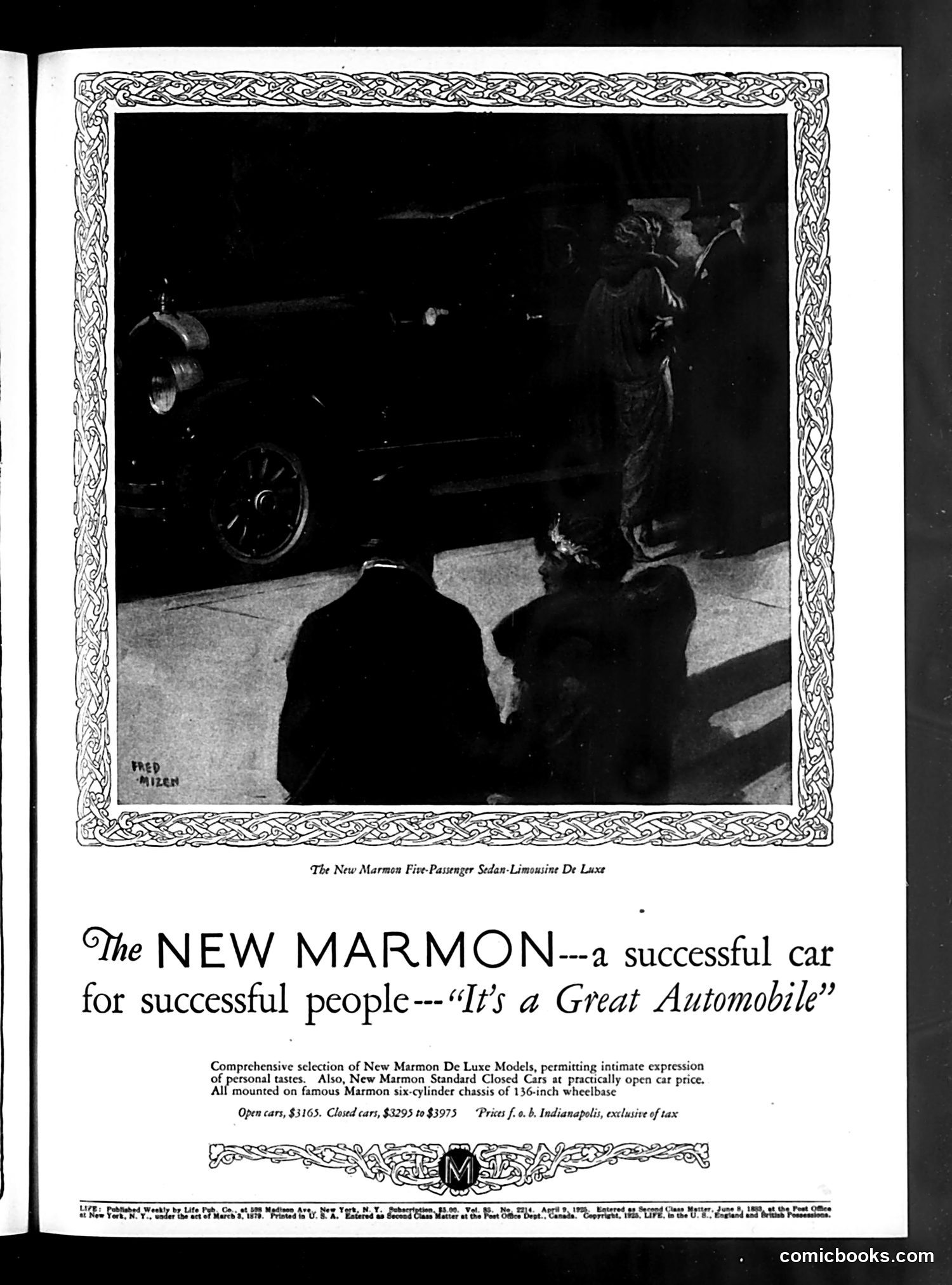
This page is primarily an **advertisement**, not political satire. It promotes the "New Marmon" automobile as "a successful car for successful people" with the tagline "It's a Great Automobile." The photograph shows a nighttime street scene with well-dressed figures near a luxury sedan, presumably demonstrating the car's appeal to affluent consumers. The ornate Celtic border and elegant typography reinforce the product's upscale positioning. The ad lists specific Marmon De Luxe models and prices ($2,295 to $3,975), emphasizing the car's prestigious six-cylinder chassis with a 156-inch wheelbase. The Marmon was a real American luxury automobile manufacturer active in the early 20th century, targeting wealthy buyers seeking refinement and technical sophistication. No political commentary or satire is evident—this is straightforward luxury marketing.
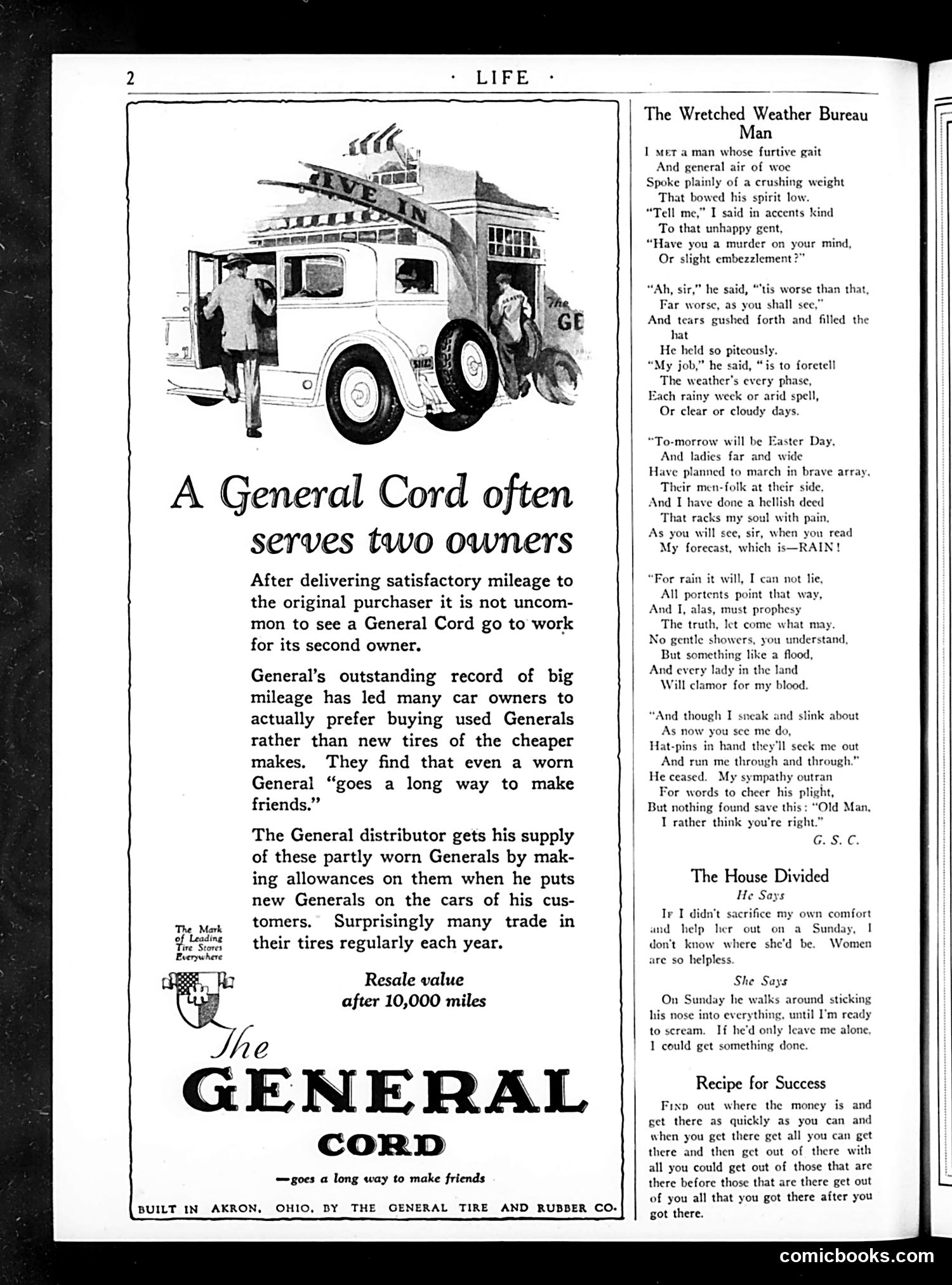
**Left side:** A General Cord tire advertisement showing a delivery truck, emphasizing the tire's durability and resale value after 10,000 miles. The ad targets budget-conscious car owners by promoting used General Cords as superior to cheaper new tires. This reflects 1920s-30s economic concerns about value and practicality. **Right side:** Three separate pieces—a humorous poem about a weather forecaster whose Easter Day prediction of rain causes distress, a domestic dispute dialogue titled "The House Divided," and a cynical "Recipe for Success" about financial opportunism. These satirize everyday frustrations: incompetent professionals, marital tensions, and get-rich-quick schemes. The tone is lighthearted social commentary typical of Life magazine's satirical approach.
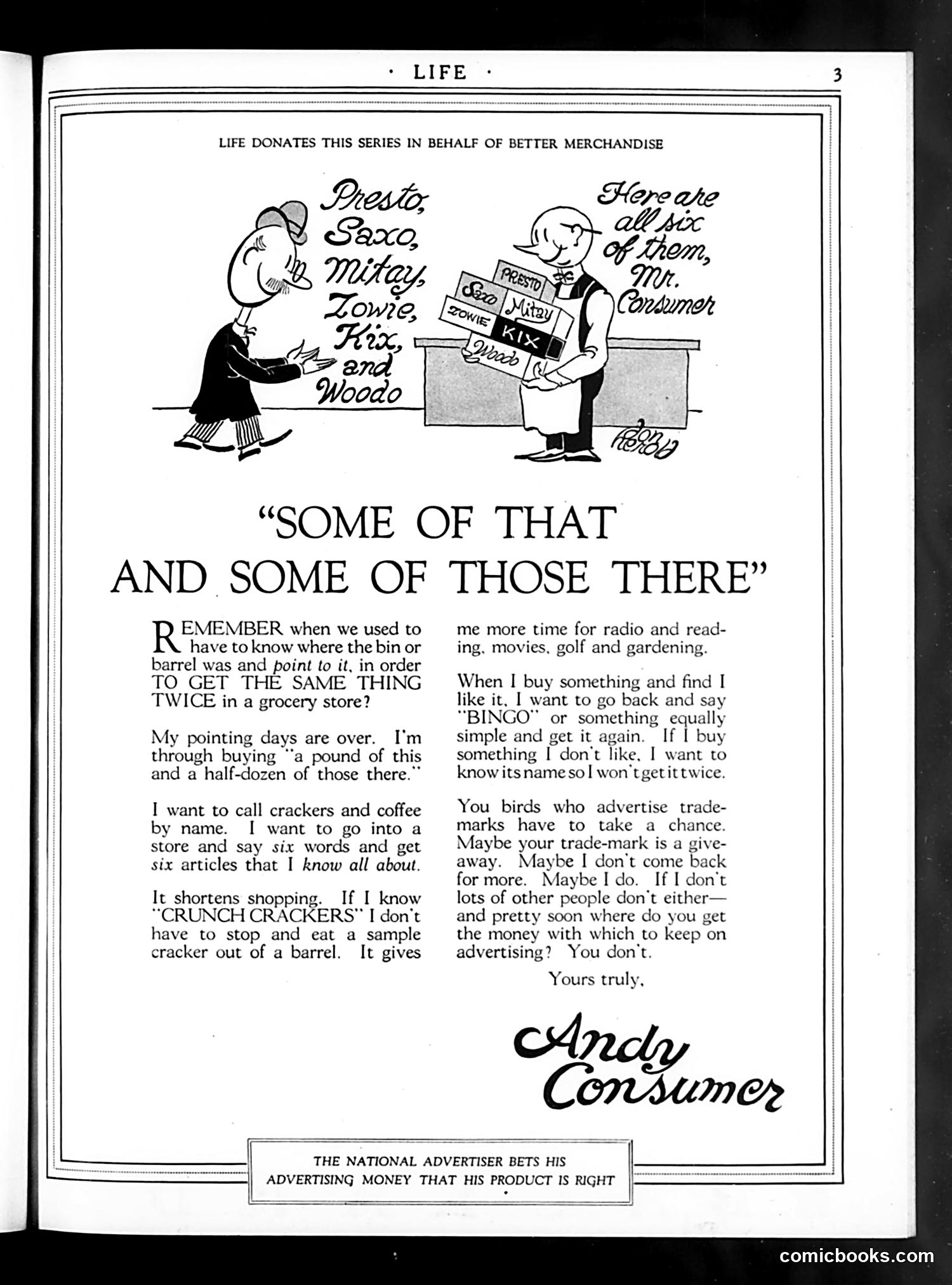
This is a satirical advertisement masquerading as consumer advice. A character named "Andy Consumer" critiques grocery shopping practices and brand loyalty. The illustration shows a shopkeeper presenting six product boxes to a consumer—labeled as "Presto," "Saxo," "Miffay," "Lowie," "Kix," and "Wooao." Andy's complaint is straightforward: consumers once had to hunt through stores to find specific items, but now face overwhelming brand proliferation. He argues that standardized product names would simplify shopping and give him time for leisure activities. The satire's point: Life magazine is mocking how manufacturers use trademarks and advertising to differentiate nearly identical products, forcing consumers into brand loyalty rather than rational choice. The fictional products with similar names emphasize how interchangeable these goods actually are—undercutting the national advertiser's claim that "his product is right."
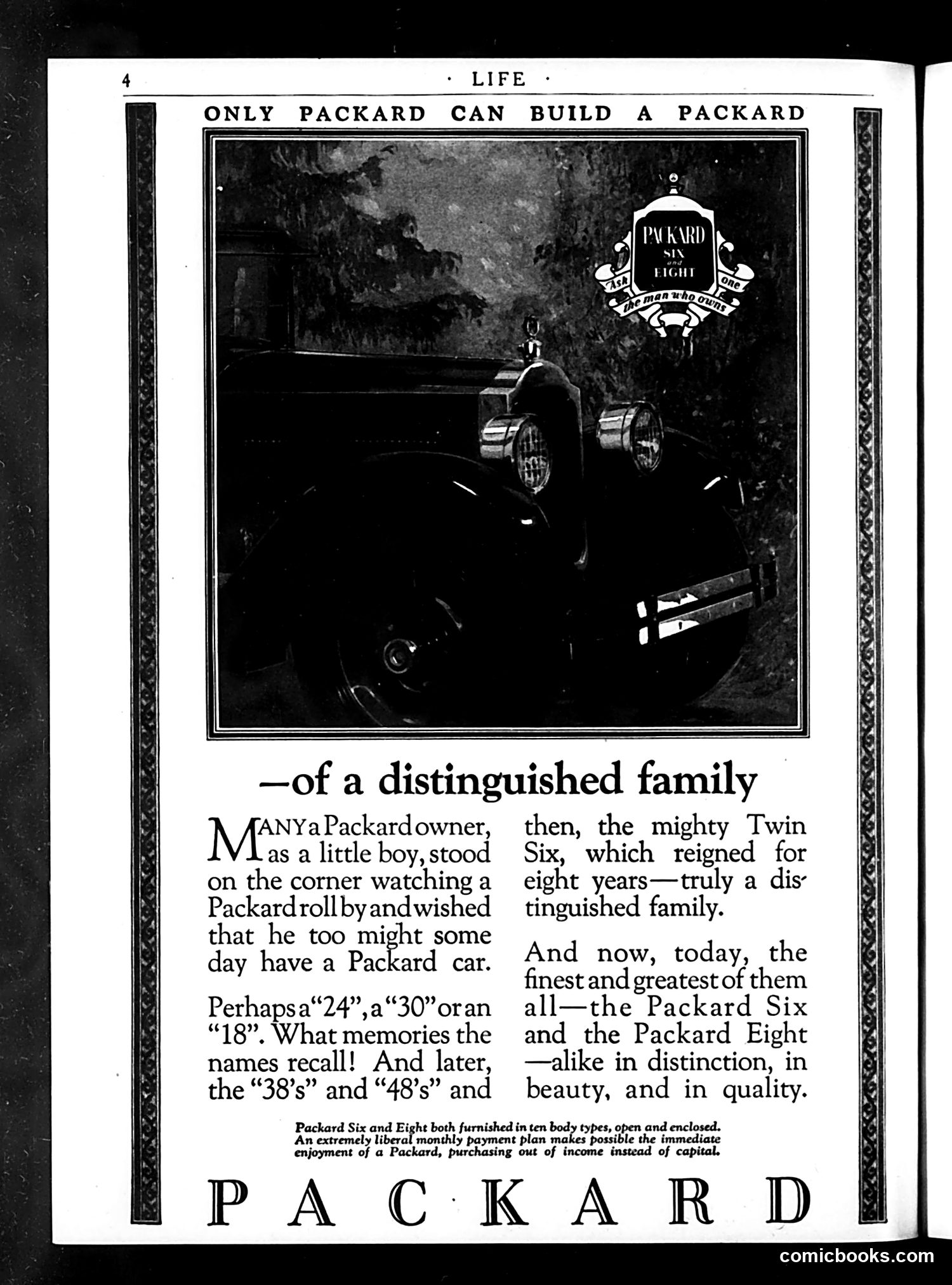
This is primarily a **Packard automobile advertisement**, not political satire. The page uses nostalgic storytelling to market luxury cars. The ad describes a boy who dreamed of owning a Packard, later seeing the "Twin Six" (an 8-year production run model) as the pinnacle. The copywriting references earlier Packard models ("'24," "'30," "'18") to establish brand heritage, then promotes the current Packard Six and Eight as the "finest and greatest." The photograph shows a Packard automobile on a nighttime road. The advertisement emphasizes quality and distinction, and mentions flexible payment plans for upper-class buyers. This reflects 1920s-30s marketing targeting affluent consumers with appeals to aspiration and tradition rather than practical features.
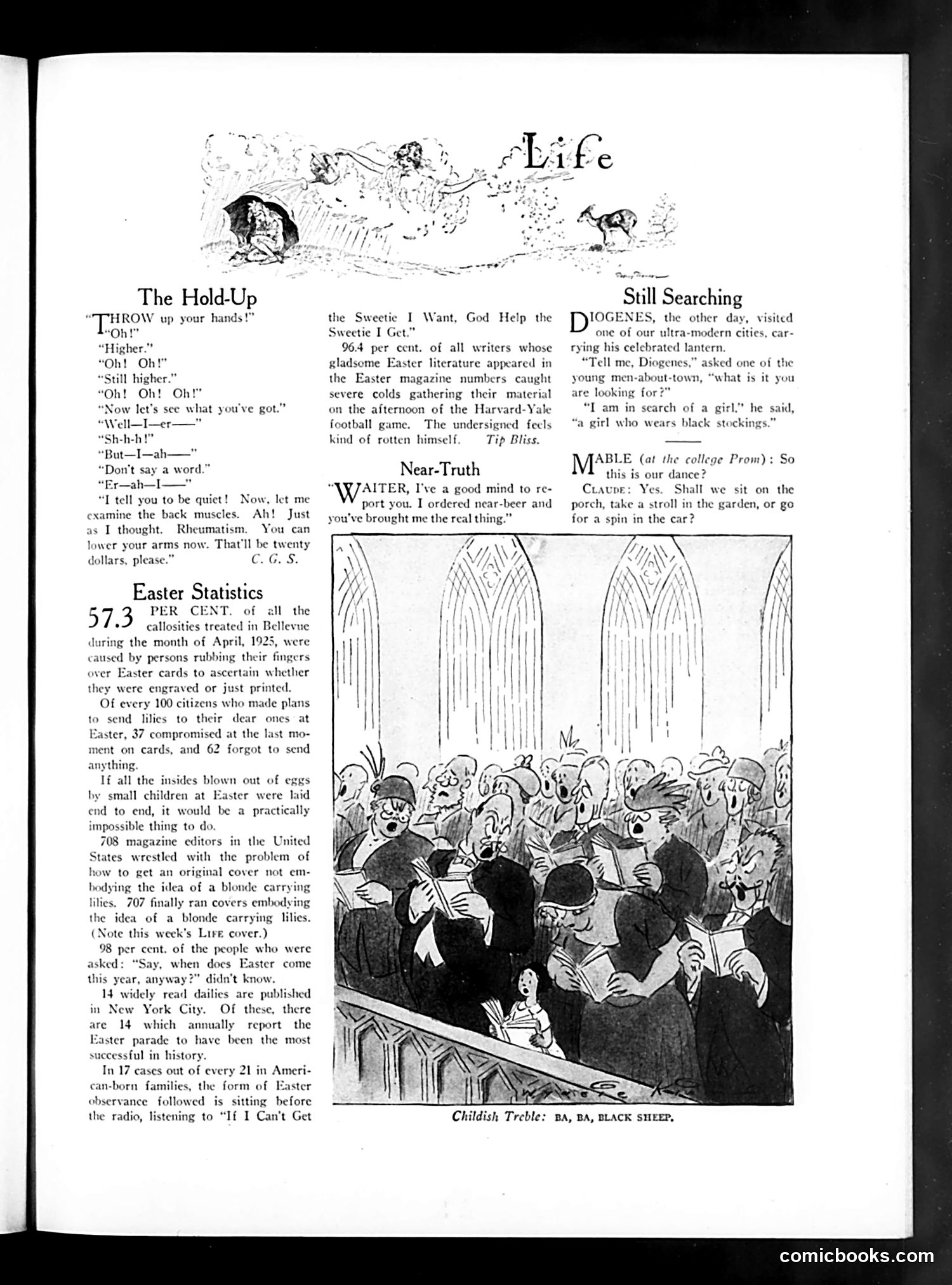
This Life magazine page contains three separate pieces of humor: **"The Hold-Up"** is a comedic monologue where a patient demands a doctor examine his back, using increasingly frantic exclamations ("Oh! Oh!") to convey urgency—the joke being the absurd escalation. **"Easter Statistics"** presents satirical data about Easter observances in 1925, mocking Americans' limited engagement with the holiday (only 37% of people planning to send Easter cards actually do). The humor targets American commercialism and apathy. **"Near-Truth"** is a brief dialogue between a waiter and customer about near-beer (alcohol substitute during Prohibition), playing on the absurdity of fake beverages. **"Childish Treble"** is a large cartoon showing children singing in a church choir. The caption "BA, BA, BLACK SHEEP" suggests the humor involves children's nursery-rhyme quality voices disrupting a formal religious setting.
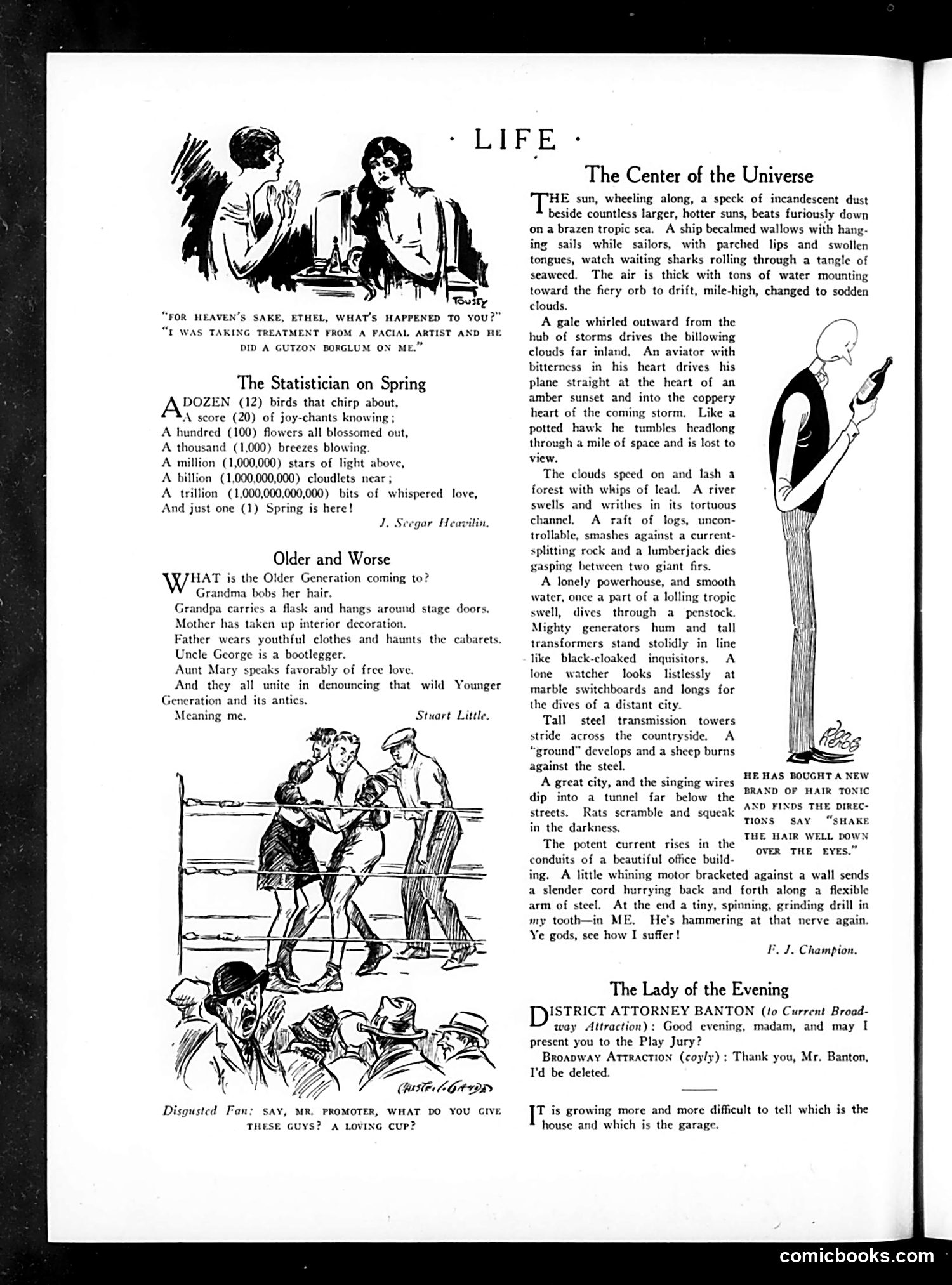
This page contains satirical poetry and prose pieces typical of Life's humor section. "The Statistician on Spring" uses numerical wordplay (a dozen birds, a score of joy-chants, a hundred blossoms) to mock overwrought spring poetry. "Older and Worse" by Stuart Little satirizes generational decline, listing increasingly embarrassing relatives—grandma losing hair, mother's poor taste, uncle as bootlegger—suggesting moral decay. The cartoon shows a "Disgusted Fan" confronting what appears to be a theater promoter about treating performers poorly ("what do you give these guys? A loving cup?"). "The Lady of the Evening" mocks District Attorney Banton's theatrical pretensions through a brief comedic exchange about courtroom jury duty versus Broadway. The overall tone criticizes social affectation, theatrical vanity, and generational morality.
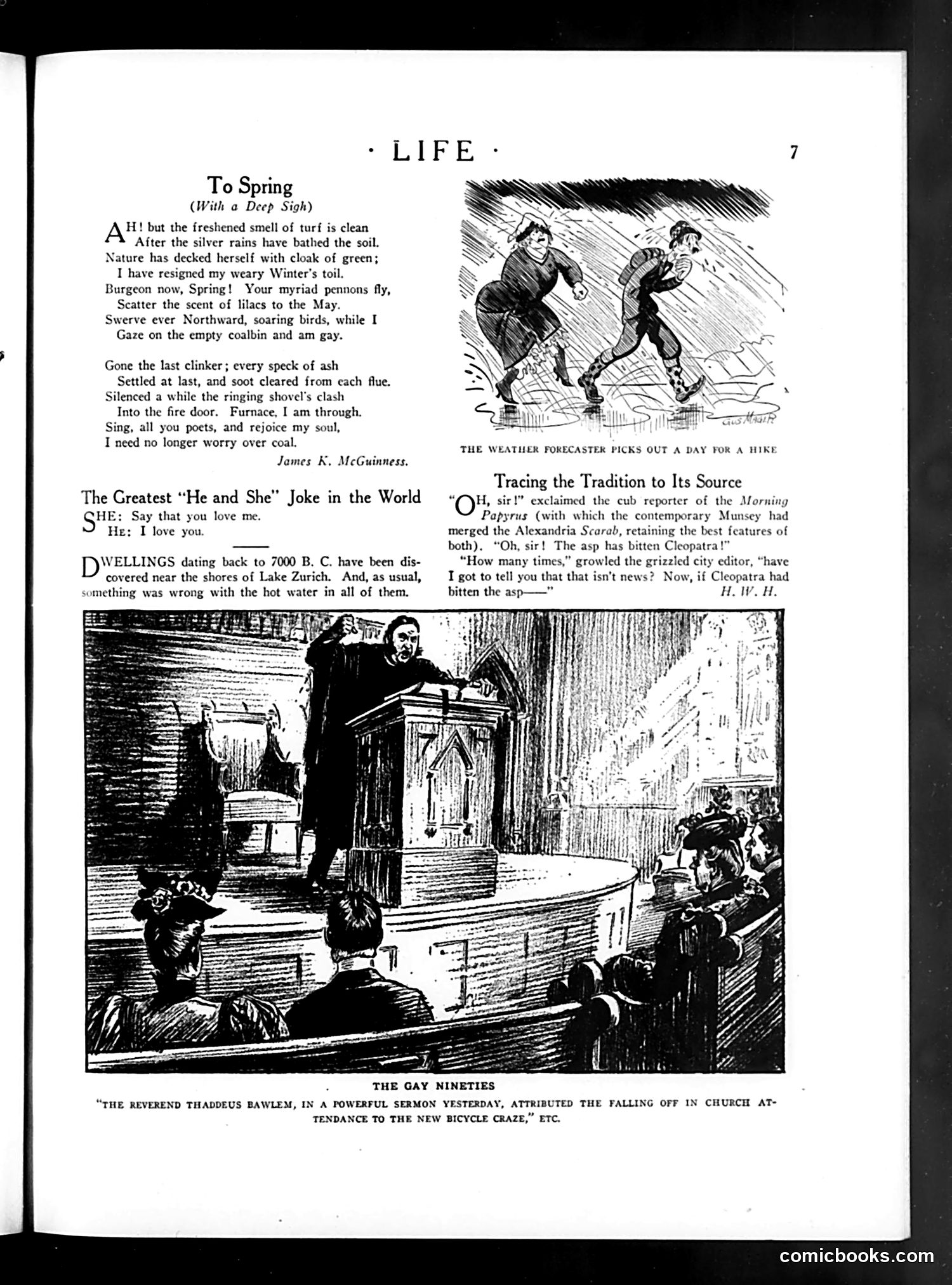
This cartoon satirizes late-19th-century religious fervor about moral decline. The caption attributes falling church attendance to "the new bicycle craze," a reference to how bicycles—particularly women's bicycles—were genuinely blamed by some clergy for corrupting youth and encouraging improper behavior (allowing unchaperoned mobility and requiring less restrictive clothing). The image shows a preacher at a pulpit addressing a sparse congregation, visualizing the satirical complaint. Life's point: clergy were out of touch, blaming fashionable new technology rather than examining religion's actual relevance. The "Gay Nineties" title ironically invokes nostalgia while mocking this era's anxieties about modernity and moral panic over bicycles—a concern that seems absurdly quaint to modern readers.
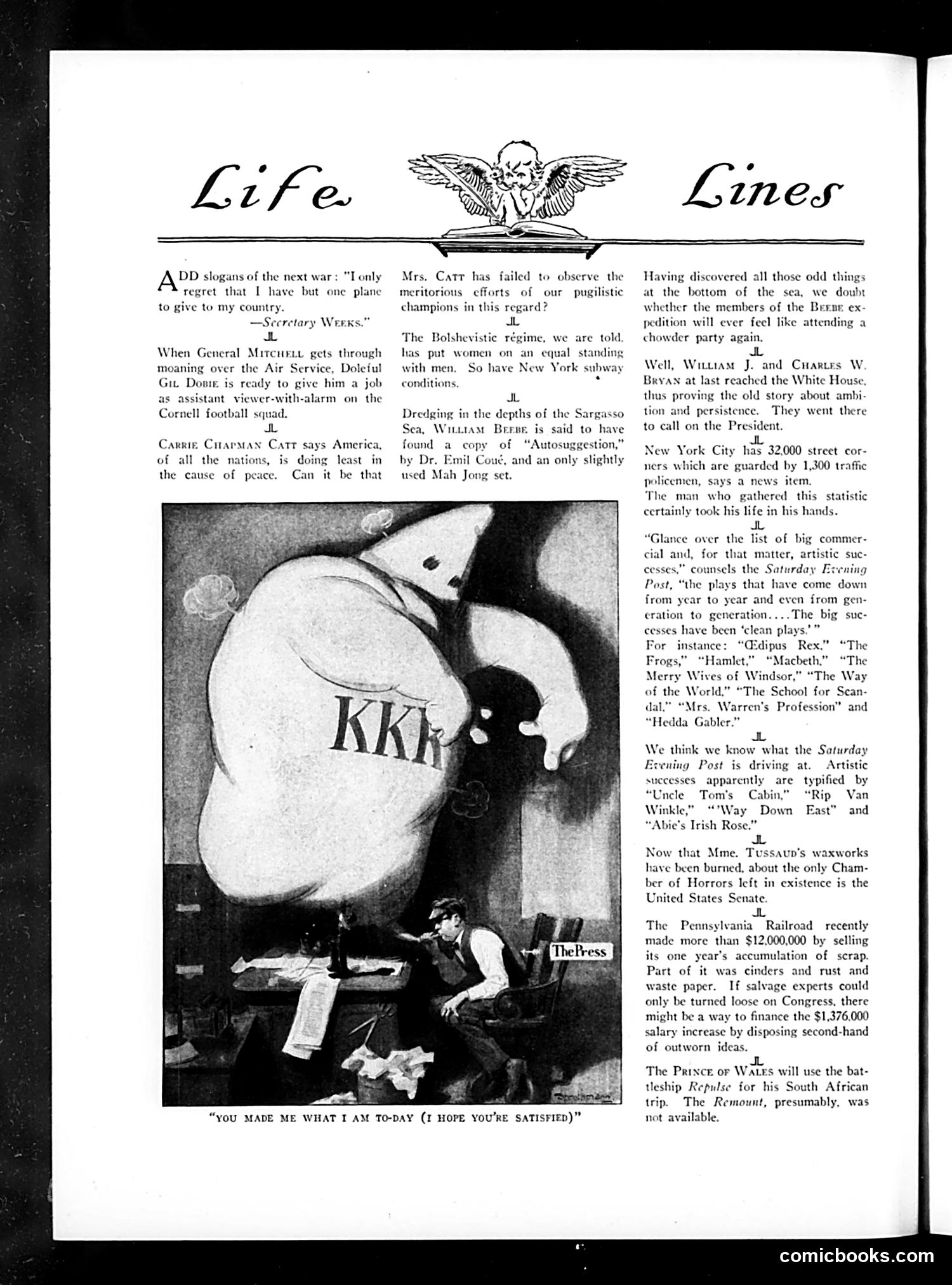
This page from *Life* magazine contains a satirical cartoon and brief commentary items. The main image depicts a large figure labeled "KKK" being manipulated like a puppet by a smaller figure labeled "ThePress," with the caption: "YOU MADE ME WHAT I AM TO-DAY (I HOPE YOU'RE SATISFIED)" **The satire:** The cartoon blames newspapers and media for amplifying the Ku Klux Klan's prominence and power. By portraying the KKK as a creation of press coverage, *Life* criticizes sensationalist journalism for inadvertently promoting the organization through attention and publicity. The accompanying text items mock various public figures and institutions—from political figures to commercial theater successes—in typical satirical fashion for the era.
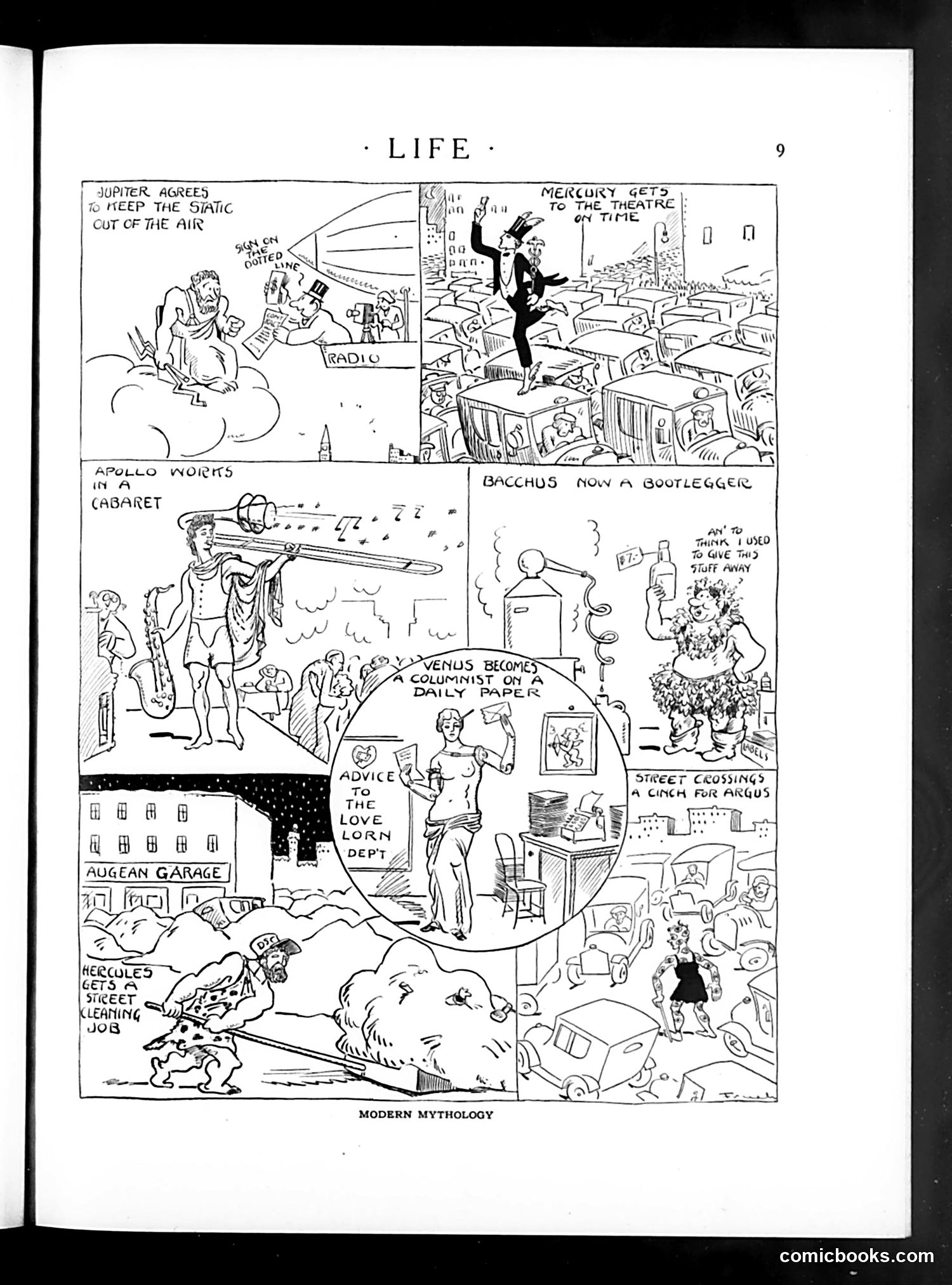
This satirical page reimagines classical mythological figures in contemporary 1920s settings, mocking modern life through classical parallels. **Notable panels:** - **Jupiter** controls radio broadcasts instead of thunder - **Mercury** arrives at a theatre "on time" (ironic commentary on punctuality) - **Apollo** performs in a cabaret rather than as a god - **Bacchus** becomes a bootlegger (referencing Prohibition-era illegal alcohol) - **Venus** works as a newspaper columnist instead of a goddess - **Hercules** does cleaning work at an "Augean Garage" (referencing the mythological Augean stables) - **Argus** guards a street crossing The satire suggests that modern society has reduced classical ideals to mundane, commercialized activities—gods now work ordinary jobs in mass media, retail, and bootlegging. It's commentary on how American modernity had displaced traditional values.
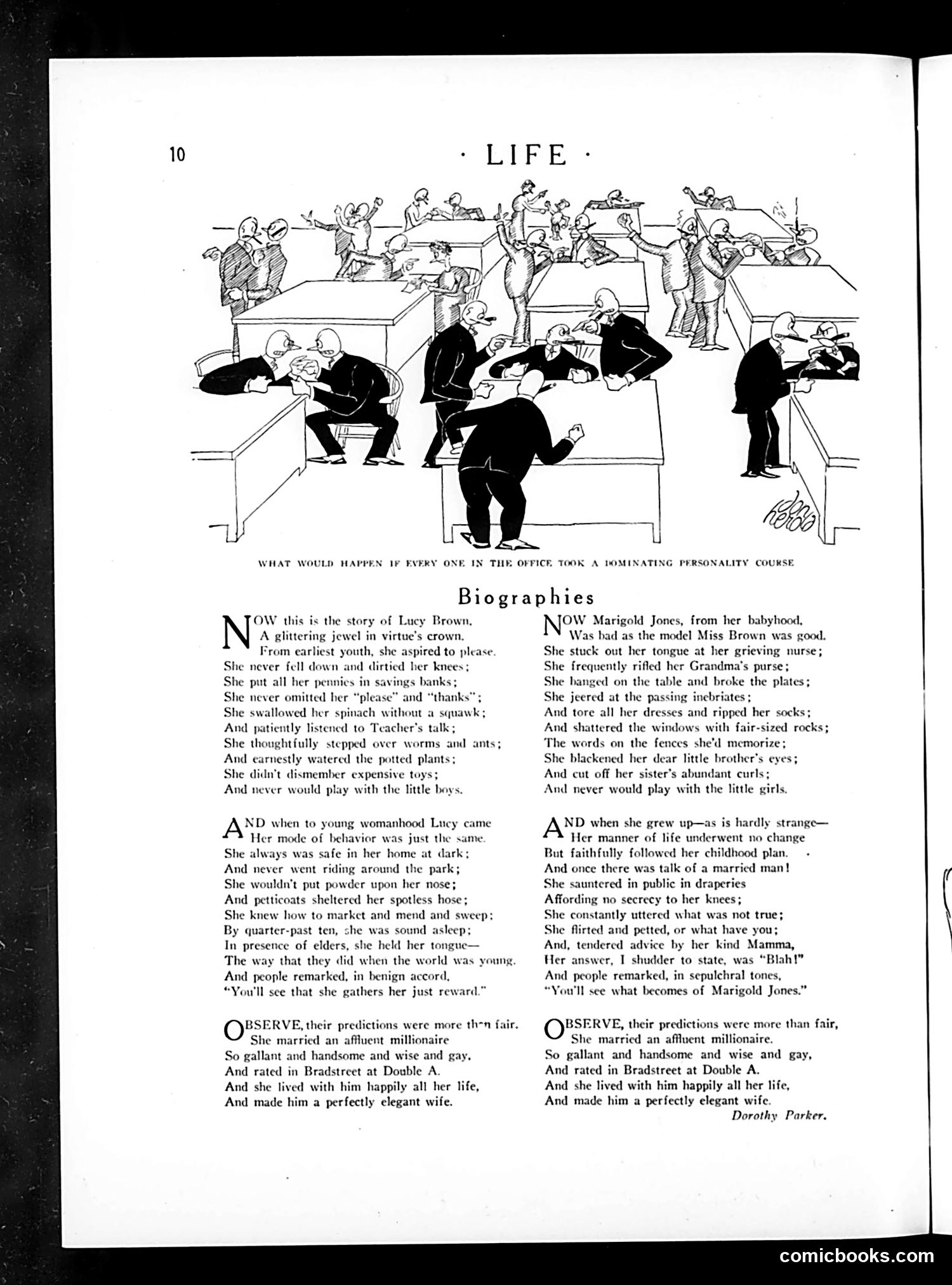
This page presents two "Biographies" by Dorothy Parker, a satirical commentary on conformity and social expectations for women. The cartoon at top depicts office workers in exaggerated poses—some contorted beneath desks, others in unusual positions—illustrating the caption: "WHAT WOULD HAPPEN IF EVERY ONE IN THE OFFICE TOOK A DOMINATING PERSONALITY COURSE." The satire targets the 1920s self-help trend of "personality courses," suggesting such training would create chaos rather than improvement. The biographies of Lucy Brown and Marigold Jones mock how women of different temperaments both inevitably end up as "perfectly elegant wives" to wealthy men, regardless of their individual personalities. Parker's point: society constrains women into identical roles regardless of their actual character or aspirations, reducing diverse individuals to a single prescribed outcome.
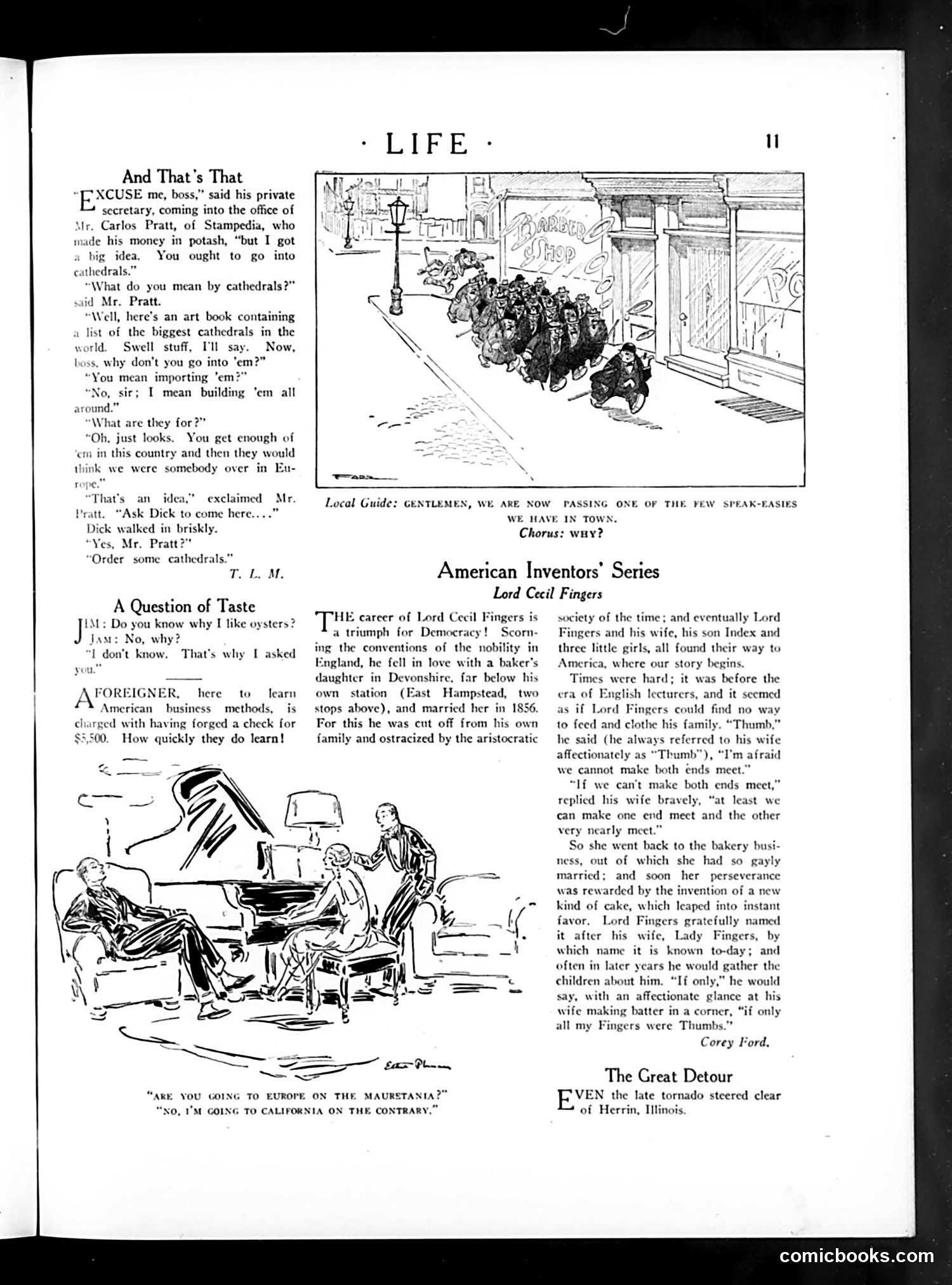
This page contains three separate humor pieces typical of early 20th-century Life magazine: 1. **"And That's That"**: A joke about a businessman (Mr. Pratt) suggesting his secretary visit art book exhibitions of cathedrals to seem more cultured—a satire on superficial self-improvement and class pretension. 2. **"A Question of Taste"**: A brief joke about oysters, illustrated with a scene of a foreigner learning American business methods and quickly forging a check. 3. **"American Inventors' Series - Lord Cecil Fingers"**: An article about the historical figure who married a baker's daughter despite class differences, resulting in a cake named "Lady Fingers" after his wife. The satire mocks aristocratic rigidity and suggests humble origins produce lasting legacies. The humor targets class consciousness, pretension, and social mobility—core themes of Edwardian-era American satire.
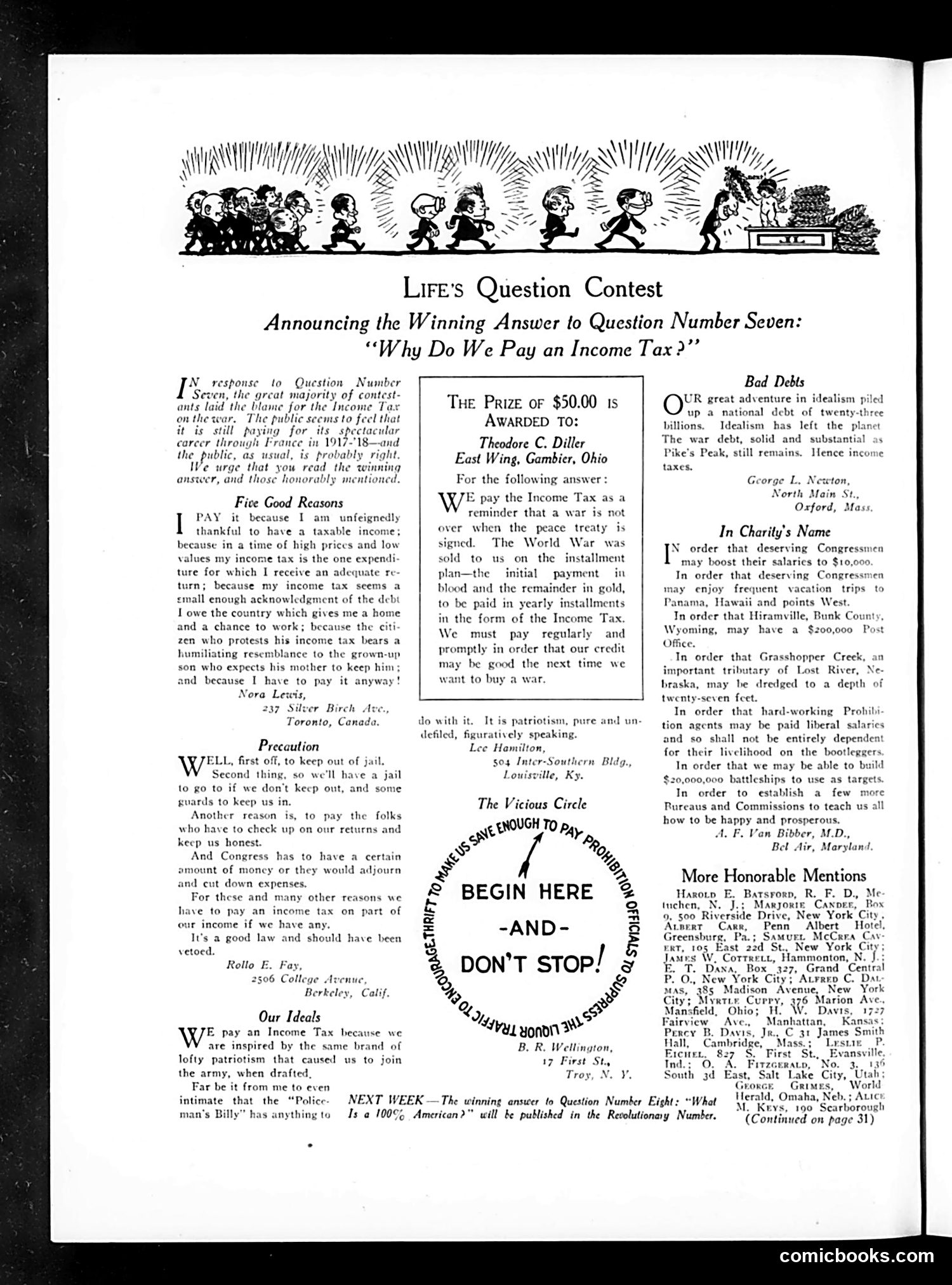
This page announces the winning answer to "Why Do We Pay an Income Tax?" The contest solicited humorous explanations from readers. The winning answer by Theodore C. Diller (East Wing, Gambier, Ohio) argues that income taxes fund war debts from World War I—paid in installments like a credit purchase. The satire suggests Americans are financing wartime costs through taxation while the government withholds honest explanation. Other submitted answers mock various targets: bad national debts, congressional salary increases, bureaucratic expansion, and wasteful spending. The circular diagram reading "BEGIN HERE AND DON'T STOP" satirizes the endless, circular reasoning justifying taxes. The overall point: Americans pay income taxes for reasons the government obscures, with the real answers being either wartime expenses or simple governmental necessity—presented here as darkly comedic.
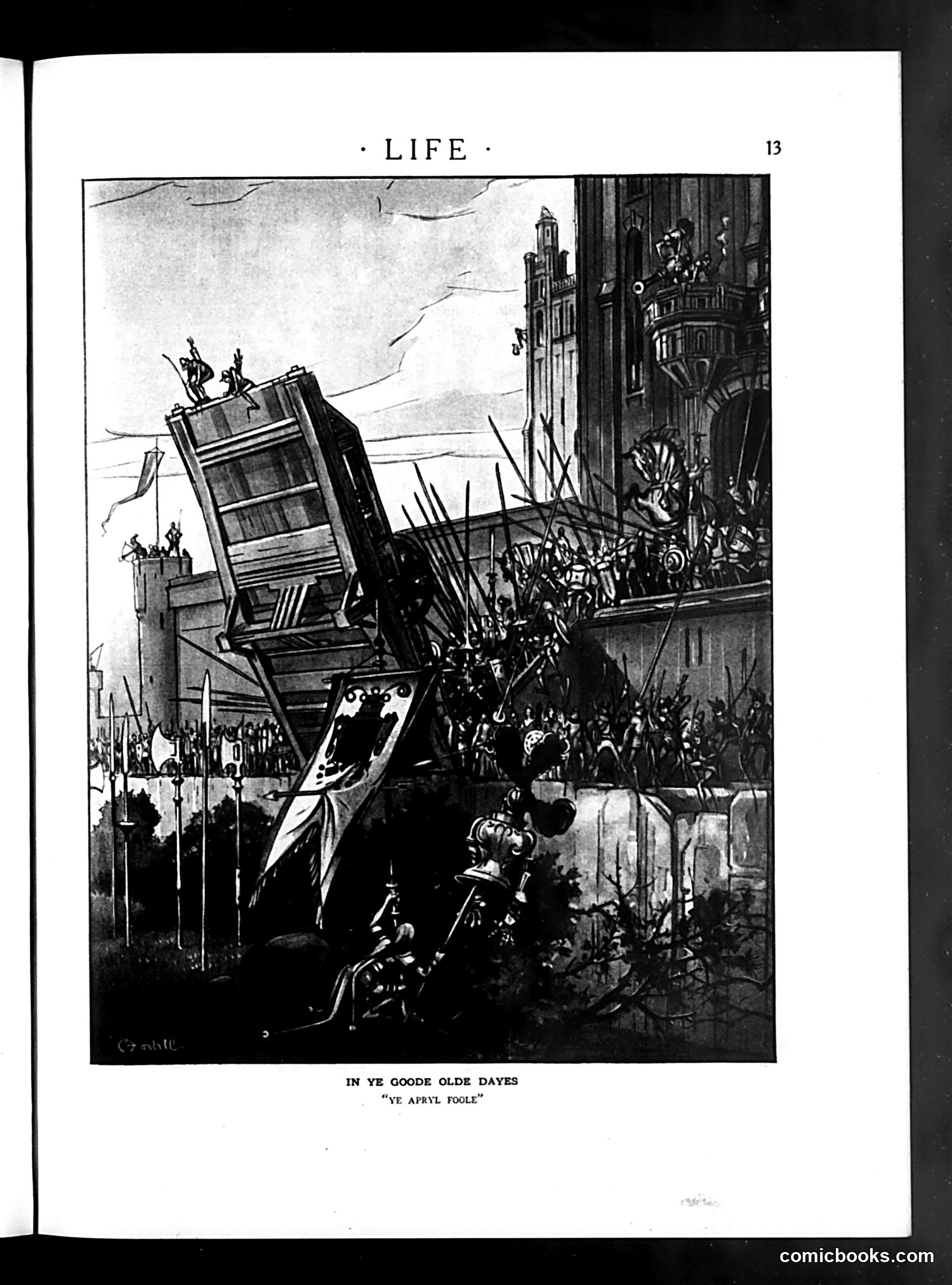
This satirical illustration depicts an April Fools' Day scene set in medieval or Renaissance times. A massive wooden structure—appears to be a catapult or siege weapon—is being launched toward a fortified city with towers and walls. Crowds of armed soldiers and townspeople gather to witness the event. The satire likely mocks elaborate pranks or foolish military schemes. The "April Foole" caption suggests this destructive contraption represents an absurd, pointless prank—perhaps satirizing contemporary foolishness presented as tradition or custom. The medieval setting adds ironic distance, implying that such foolish behavior belongs to outdated times. The artist's name appears signed in the lower left corner.
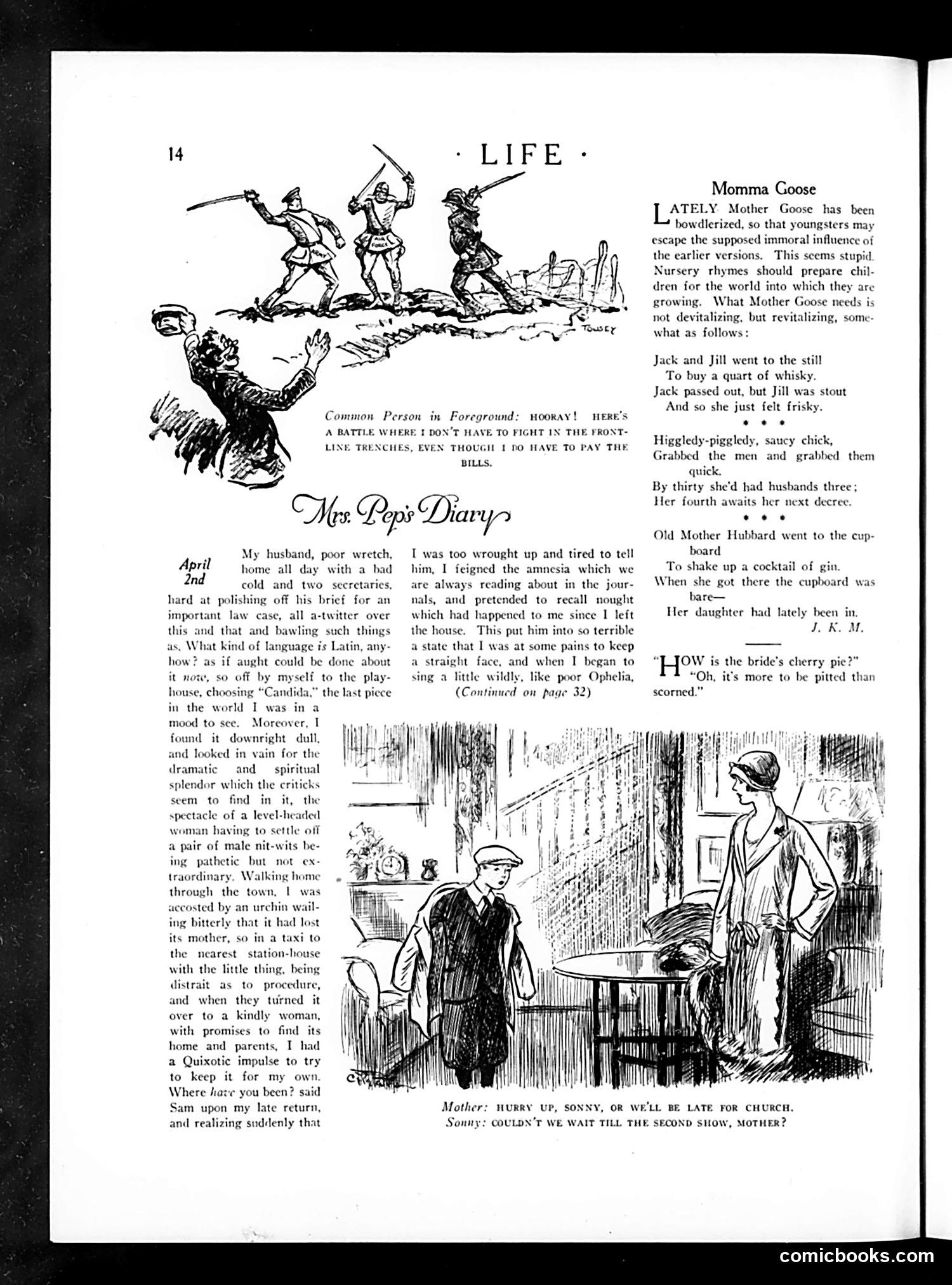
This page contains three distinct pieces: 1. **"Common Person in Foreground" cartoon** (top): A satirical illustration of a soldier in a trench, captioned as someone who "won't have to fight in the front-line trenches, even though I do have to pay the bills." This references WWI's class disparities—wealthy men could avoid combat through bribery or connections while ordinary citizens bore the burden. 2. **"Mrs. Pops's Diary"** (left): A woman's account of her exhausted husband's behavior and her theatrical frustrations. The humor derives from domestic dissatisfaction and marital conflict. 3. **"How is the bride's cherry pie?" scene** (bottom right): A domestic exchange between mother and son about church attendance, using food as conversational pretext. The satire mocks rigid maternal authority and reluctant compliance.
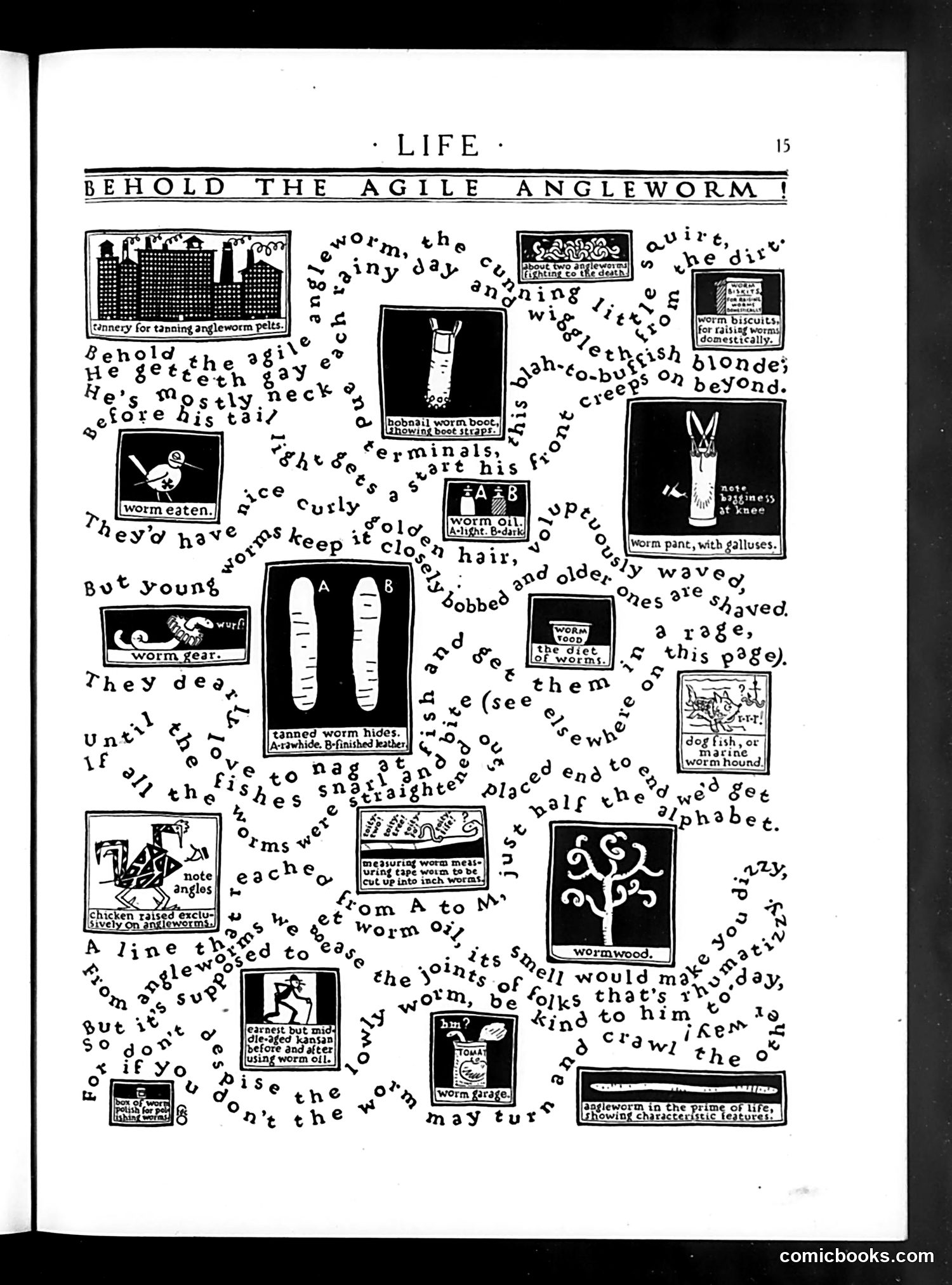
This is a humorous illustrated feature about earthworms, organized as a visual poem spiraling around various small woodcut illustrations. The text playfully describes angleworms' characteristics and behaviors: their appearance ("gay colored"), their use as fishing bait ("worm eaten"), their segmented bodies ("tanned worm hides"), and their habitat ("wormwood"). The illustrations show practical details—worm biscuits for domestic raising, worm oil, worm pants with "galluses" (suspenders), and a "worm garage." The final caption references "Angleworm in the prime of life, showing characteristic features." This appears to be lighthearted natural history presented as whimsical satire, likely appealing to readers interested in either fishing or the magazine's typical absurdist humor. The detailed illustrations suggest genuine educational intent wrapped in comedic presentation.
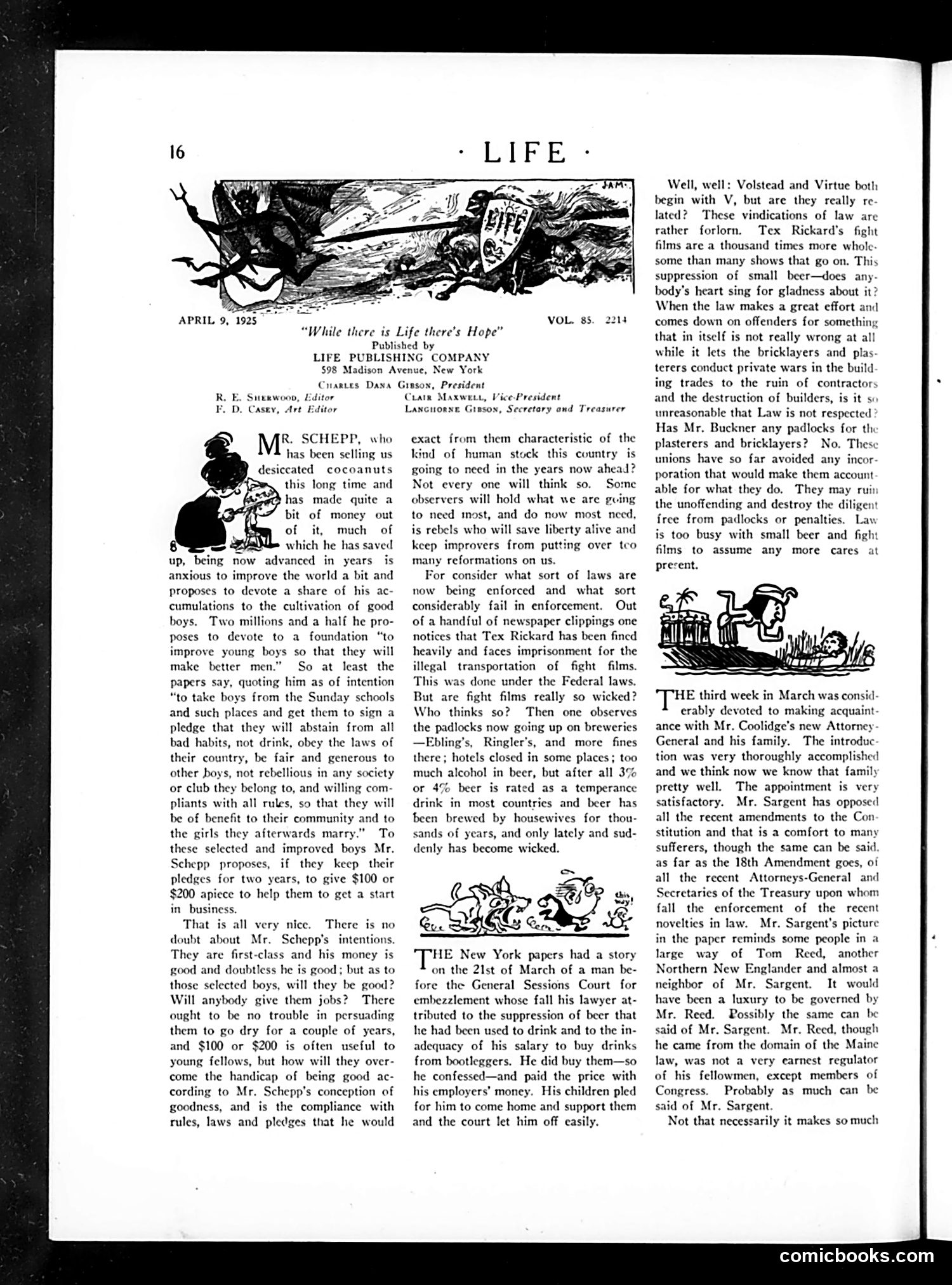
This 1925 *Life* magazine editorial critiques Prohibition-era law enforcement as selective and counterproductive. The author discusses R. Schepp's philanthropic plan to fund boys who pledge total abstinence and rule-compliance, questioning whether such "goodness" actually benefits society. The satire's core: authorities aggressively prosecute fight promoter Tex Rickard for illegal film transportation and close breweries for minor alcohol violations, yet simultaneously release an embezzler who blamed beer suppression for his crimes. The piece argues that rigid Prohibition laws are unevenly enforced, create perverse incentives (driving people to illegal bootleggers), and damage otherwise law-abiding citizens while paradoxically letting actual criminals escape consequences. The author's point: strict moral reform laws ("Volstead and Virtue") don't correlate—and may harm the liberty and individual judgment the nation actually needs. The editorial champions pragmatism over idealistic, rigid rule-following.
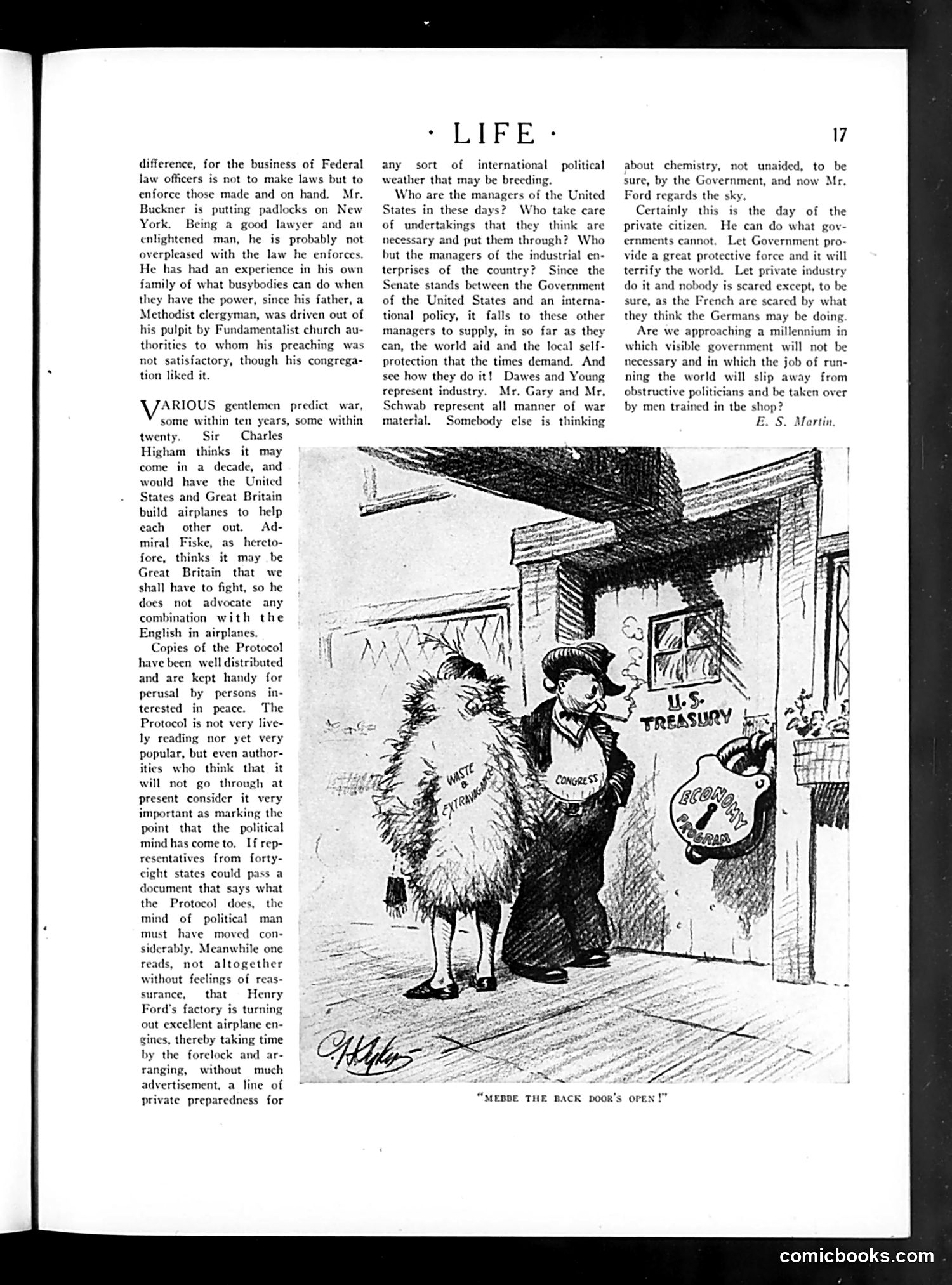
This cartoon satirizes Congressional efforts to exclude unwanted foreign influences or goods—likely referencing Prohibition enforcement or tariff policies. The figure labeled "Congress" guards the U.S. Treasury's front entrance, blocking "Contraband" (depicted as a shaggy, disreputable character marked "Illicit" and "Private Enterprise"). The joke: while Congress proudly secures the official entrance, the back door stands wide open—suggesting their legislation is ineffective and smuggling/black-market activity will continue regardless. The businessman figure represents private enterprise circumventing federal controls. The accompanying article discusses how industrial leaders (Dawes, Young, Gary, Ford) increasingly manage national affairs that government cannot, implying that official policy is similarly ineffectual. The cartoon reinforces this theme: government's visible restrictions are performative while real activity happens behind the scenes through private channels.
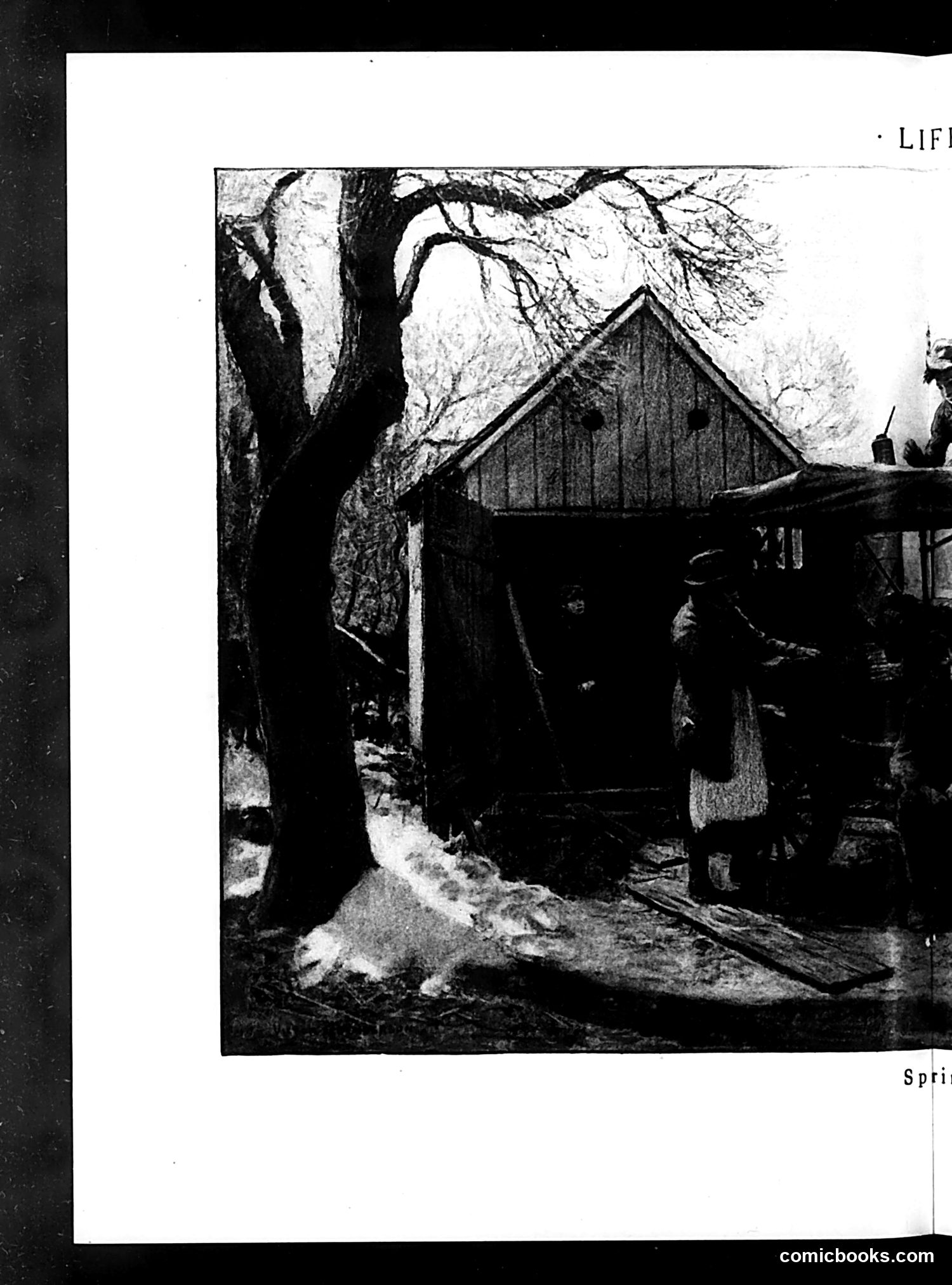
This black-and-white photograph shows a rustic wooden structure (appears to be a shed or barn) beneath a large, gnarled tree. A figure stands near the building. The image quality and composition suggest this is from an early-to-mid 20th century publication. However, **I cannot reliably identify the specific political or social satire** this image conveys. The OCR text provides only "comicbooks.com" and partial words ("Sprin," "LIFE"), which are insufficient to determine the intended message, figures depicted, or historical reference. Without additional context, caption text, or accompanying article, I cannot accurately explain what modern readers would be missing about this image's satirical intent or topical relevance.
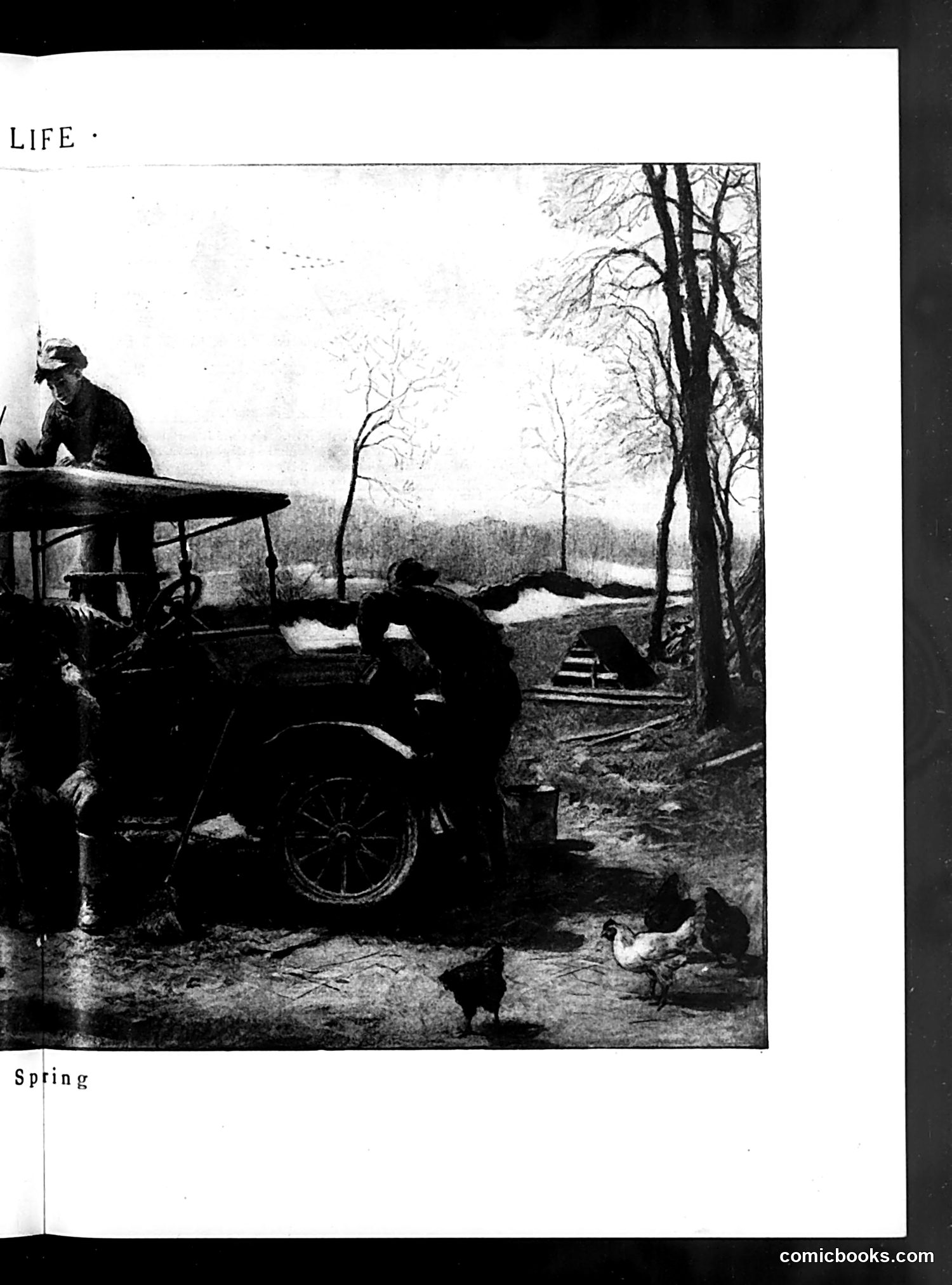
This is a seasonal illustration titled "Spring," depicting a rural scene with bare trees beginning to leaf out and a body of water in the background. The image shows several figures around an old automobile or cart, with what appears to be laundry or fabric hanging to dry. A dog is visible in the foreground. The scene captures everyday rural or working-class life during spring—a time of renewal and activity after winter. Rather than overt political satire, this appears to be a nostalgic or gently observational illustration of American domestic life, showing how ordinary people spent their time during the season. The specific social commentary, if any, is not immediately apparent from the visual elements alone.
This page critiques theatrical productions directed by Basil Dean, particularly his staging of J.M. Barrie plays ("Peter Pan" and "The Little Minister"). The satire targets Dean's heavy-handed direction of whimsical material. **The central complaint:** Dean presents Barrie's genuinely sentimental dialogue and staging choices literally and literally—without the theatrical magic that made them palatable. Examples include actress Chatterton toe-dancing to an already awkward romantic line ("The moon and I"), and a mob scene staged as a musical-comedy-style off-stage horse-race commentary. **The joke:** The reviewer acknowledges the original material is embarrassing, but Dean deserves blame for stripping away the "elfin trousers"—the theatrical charm that previously made audiences accept it. The inserted fairy-song quote underscores the frivolous nature of the material. **Context:** This reflects 1920s theater criticism where directorial choices could either enhance or expose a script's weaknesses. Dean is mocked as winning an annual award for "Least Necessary Importation from England."
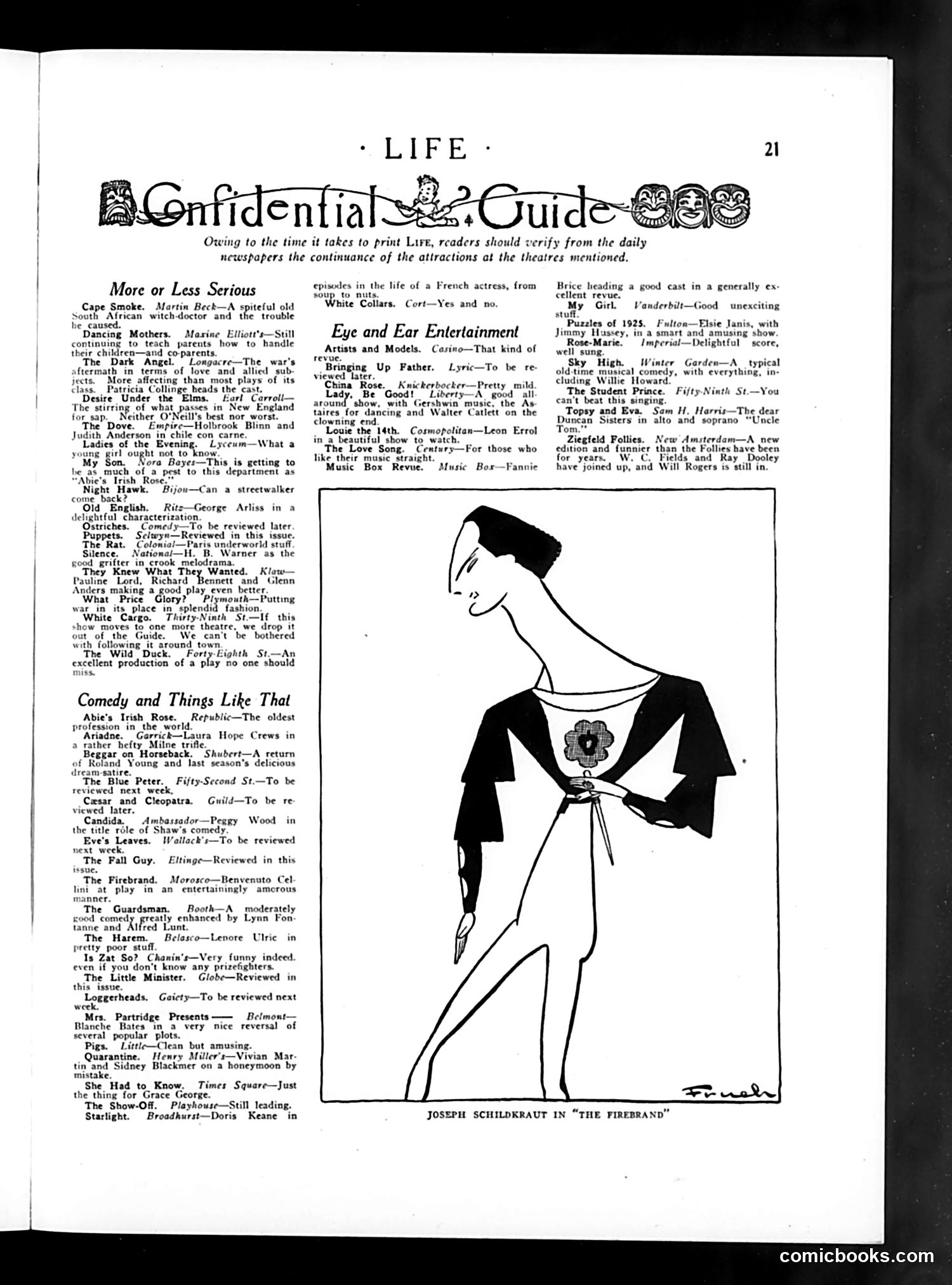
This is a **theater guide** from Life magazine listing Broadway shows currently running, organized by genre ("More or Less Serious," "Comedy," "Eye and Ear Entertainment"). The accompanying **illustration** shows Joseph Schildkraut in "The Firebrand"—a stylized Art Deco drawing of a man in Renaissance costume, capturing the theatrical glamour of 1920s Broadway. The guide's brief, sardonic **reviews** mock the productions' plots and performers. Examples: "Dancing Mothers" teaches parents "how to handle their children—and co-parents"; "White Cargo" moved theaters so often the magazine threatened to drop coverage; "Is Zat So?" is "very funny indeed, even if you don't know any prizefighters." This reflects Life's role as a **sophisticated satire magazine** targeting educated readers familiar with current theater. The snark assumes readers share the magazine's urbane skepticism about Broadway's commercial formulas and melodramatic conventions.
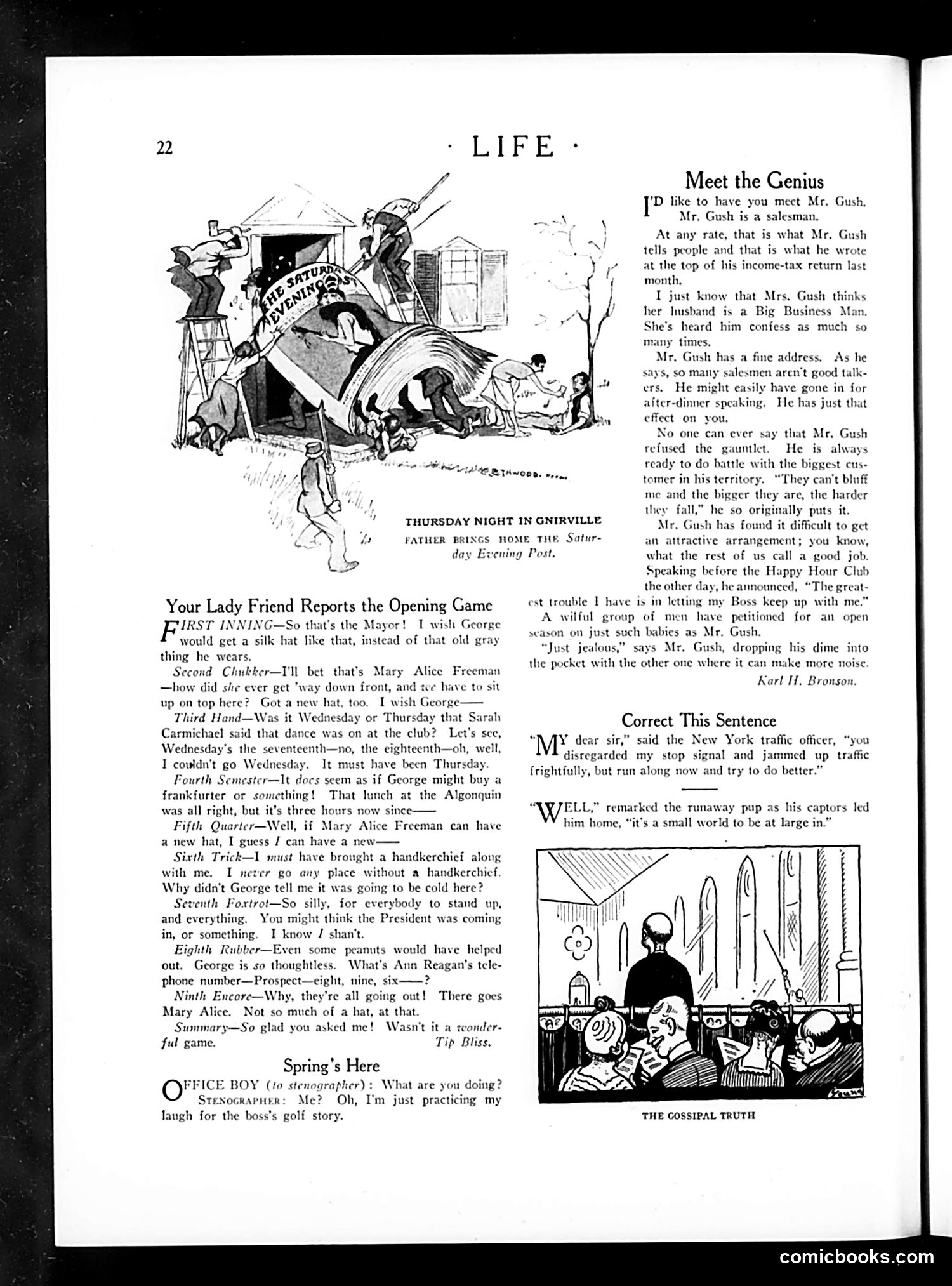
This page satirizes **early 20th-century American social pretension and workplace dynamics**. The main cartoon "Thursday Night in Gnirville" mocks women attending a baseball game who are entirely indifferent to the sport itself. Their commentary focuses obsessively on fashion (hats, dressing well), social hierarchy, and gossip—with running mental complaints about their husbands' cheapness. The satire targets how women were expected to attend public events while remaining detached and status-conscious. The "Meet the Genius" profile ridicules **Mr. Gush**, a mediocre salesman who inflates his importance through bluster and self-aggrandizement. He claims to dominate clients while secretly struggling to maintain employment—satirizing the gap between salesmen's boastful self-promotion and actual competence. The office-boy joke mocks corporate culture: employees must laugh performatively at their boss's golf anecdotes regardless of humor. Overall, the page satirizes **class anxiety, gender role performance, and workplace inauthenticity** in early 20th-century America.
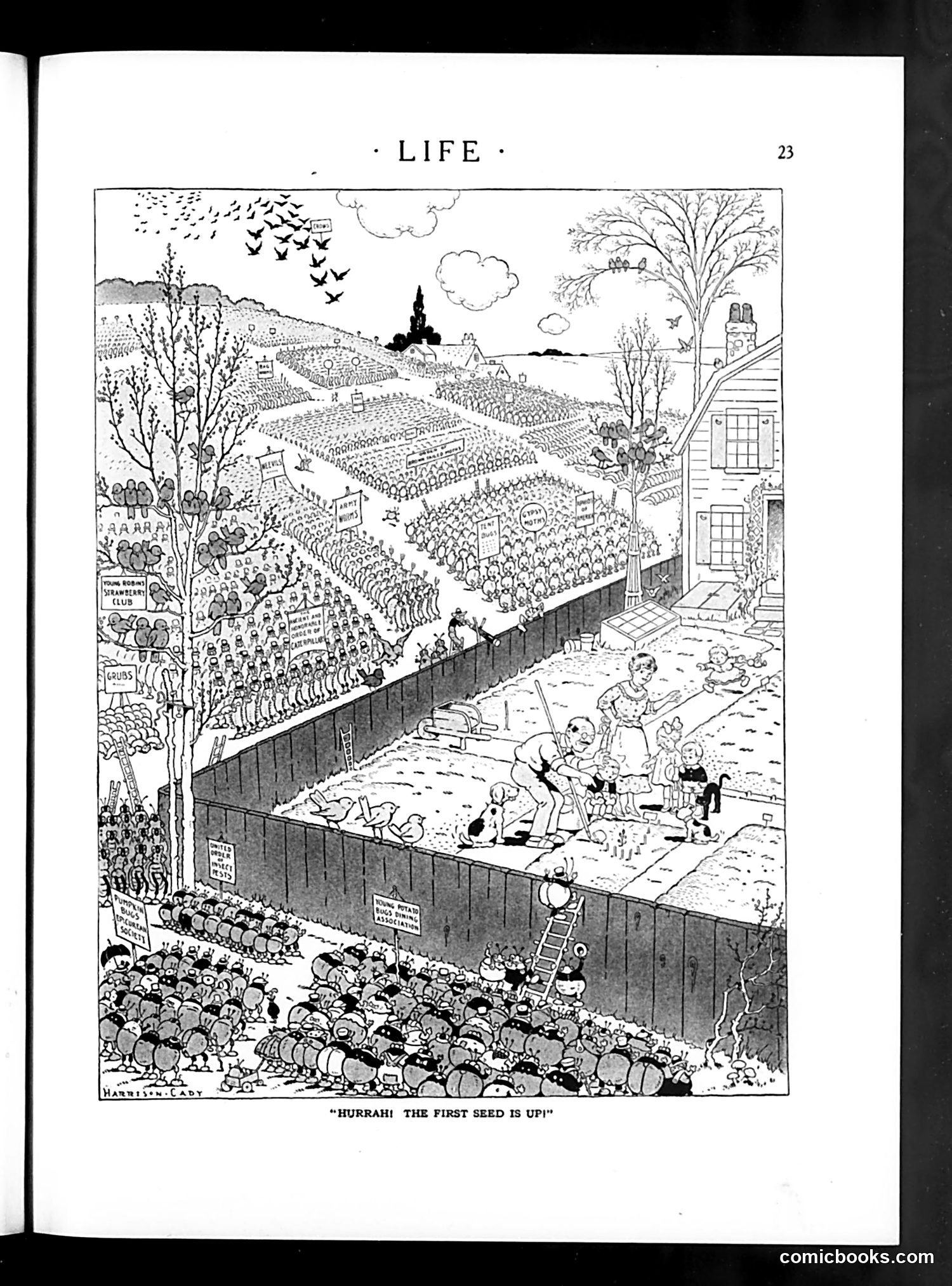
This is a satirical cartoon titled "Hurrah! The First Seed is Up!" depicting a massive crowd of identical round-headed figures at the bottom celebrating, while above them a walled enclosure contains children playing freely in a spacious yard with buildings and farmland visible beyond. The satire appears to contrast **overpopulation anxiety** with **childhood innocence**. The indistinguishable masses below—rendered as repetitive, featureless crowds—likely represent working-class or immigrant populations, a common early 20th-century satirical trope. The "seed" metaphor suggests population growth, treated as something to celebrate or fear depending on perspective. The cartoon likely critiques either class divisions, eugenic anxieties about "undesirable" population growth, or urban overcrowding—common satirical subjects in Life magazine during this era.
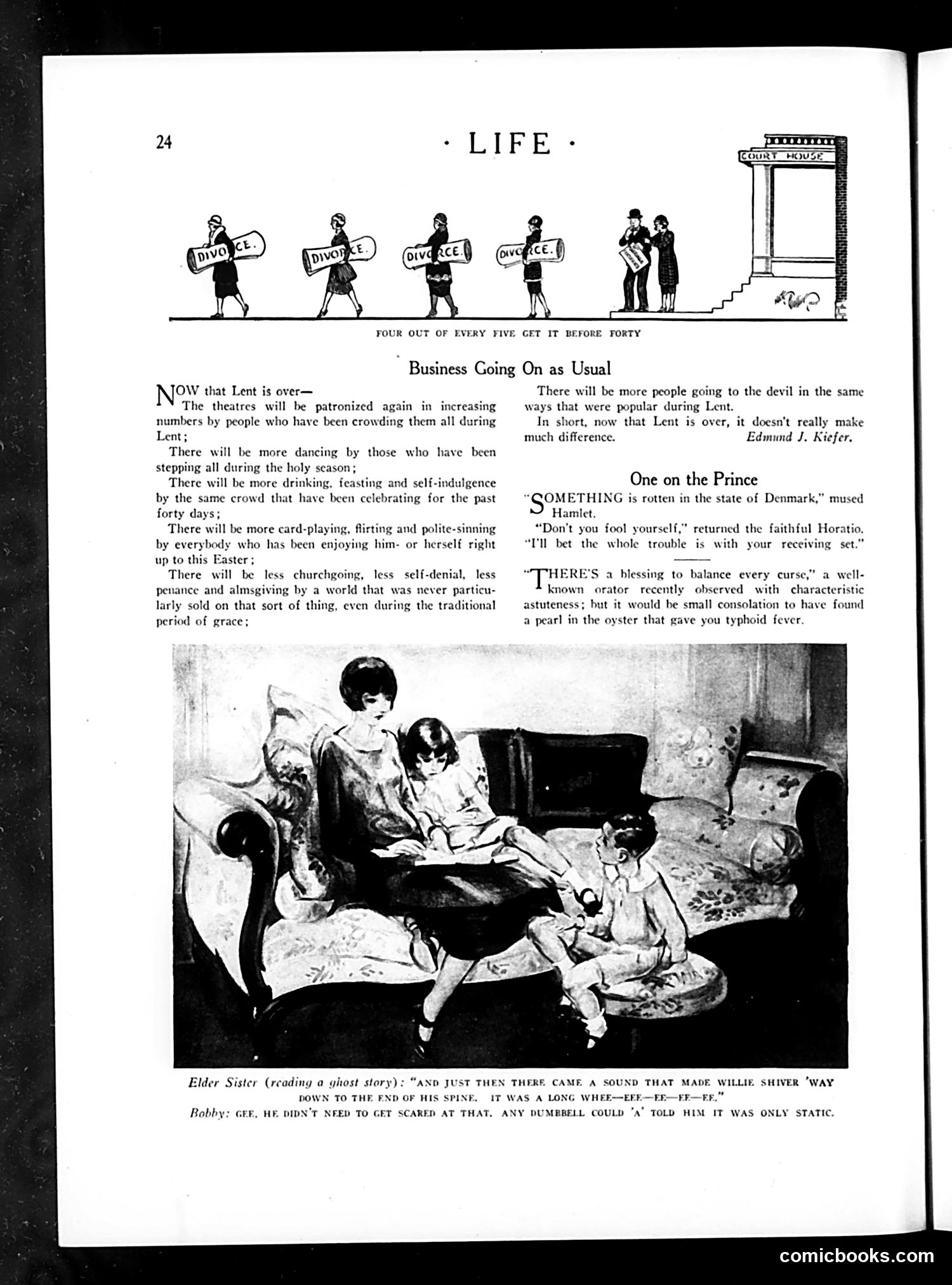
**Top Cartoon**: The strip showing five figures carrying "DIVORCE" signs illustrates the article's headline "Four Out of Every Five Get It Before Forty"—a commentary on divorce rates among Americans. **Main Article "Business Going On as Usual"**: This satirizes post-Lenten hypocrisy. After Lent (the Christian period of abstinence and penance), people immediately return to drinking, dancing, card-playing, and "polite-sinning." The author's point: society claims religious observance during Lent but abandons it immediately after, suggesting little genuine moral improvement occurs. **"One on the Prince"**: A joke where Hamlet's famous line about Denmark being rotten receives a modern twist—Horatio suggests the problem is Hamlet's radio reception ("receiving set"), mocking contemporary obsession with new technology. **Bottom Image**: An "Elder Sister" reads a ghost story to children. Bobby dismissively notes the supernatural sound effect was merely "static"—suggesting even children now understand modern radio technology enough to recognize technical artifacts rather than be frightened by traditional spooky stories.
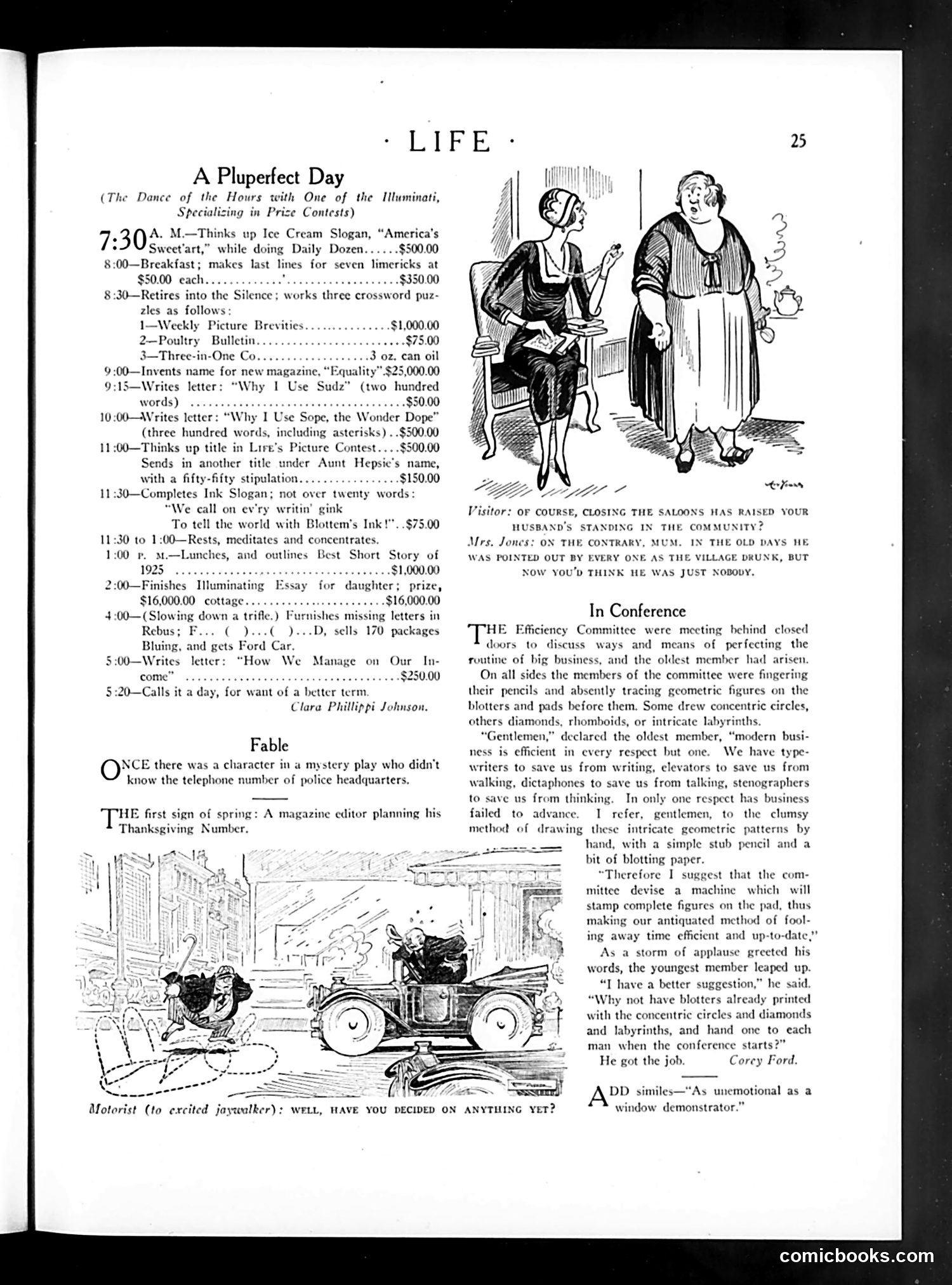
This page satirizes modern commercial culture and corporate efficiency obsession circa the 1920s. **"A Pluperfect Day"** mocks the proliferation of prize contests and commercial writing competitions. The protagonist earns money throughout the day by submitting slogans, limericks, contest entries, and advertising copy—often duplicative or absurd efforts. The satire targets how ordinary people monetize creativity through mass-market contests, and how magazines exploit free/cheap content by offering modest prizes. **"In Conference"** ridicules corporate efficiency movements that obsess over saving time through machinery and systems, yet miss obvious solutions. The committee debates inventing a machine to stamp geometric doodles on blotting paper (time-wasting during meetings), until the youngest member suggests simply printing pre-made patterns on blotters. The joke: corporate "efficiency experts" overcomplicate problems while ignoring simple answers. **The jaywalker cartoon** references Prohibition—commenting that closing saloons has made a chronic drunk respectable by erasing his public identity, rather than actually improving society.
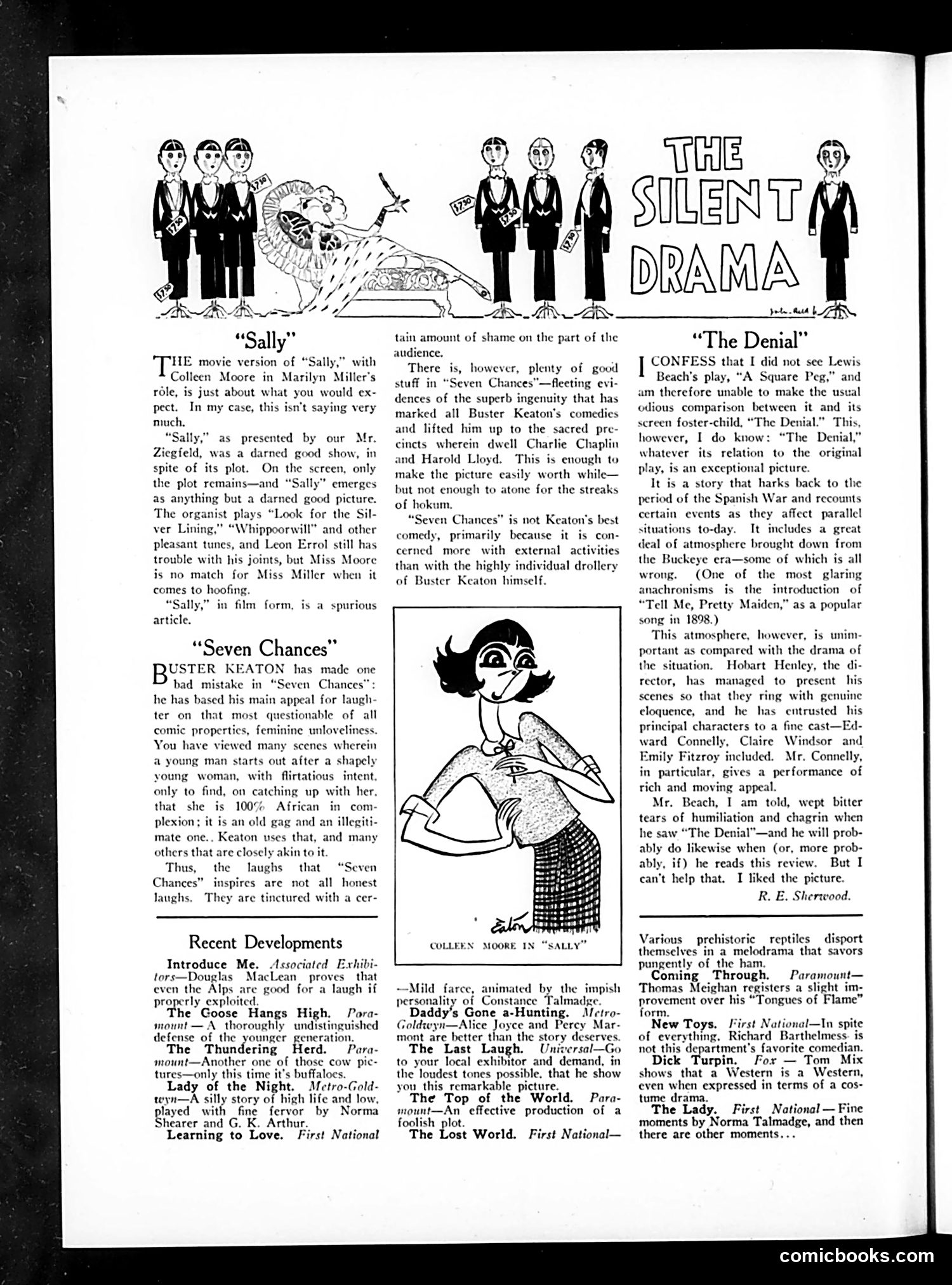
This Life magazine page reviews silent films from the 1920s. The main cartoon shows Colleen Moore in "Sally"—a screen adaptation of a successful stage musical. The critic complains the film loses what made the original (starring Marilyn Miller) appealing: Moore lacks Miller's dancing talent, leaving only a weak plot. The reviews critique Buster Keaton's "Seven Chances" for relying on a racist gag—a man pursuing a woman who turns out to be Black—which the critic calls "an old gag and an illegitimate one." While acknowledging Keaton's usual comedic genius, the reviewer argues this film sacrifices his signature individual humor for crude external comedy. Other reviews briefly assess recent releases like "The Denial" (praised as exceptional) and "The Last Laugh" (enthusiastically recommended). The page reflects 1920s cinema standards and, notably, the casual acceptance of racist humor as legitimate comedy criticism material.
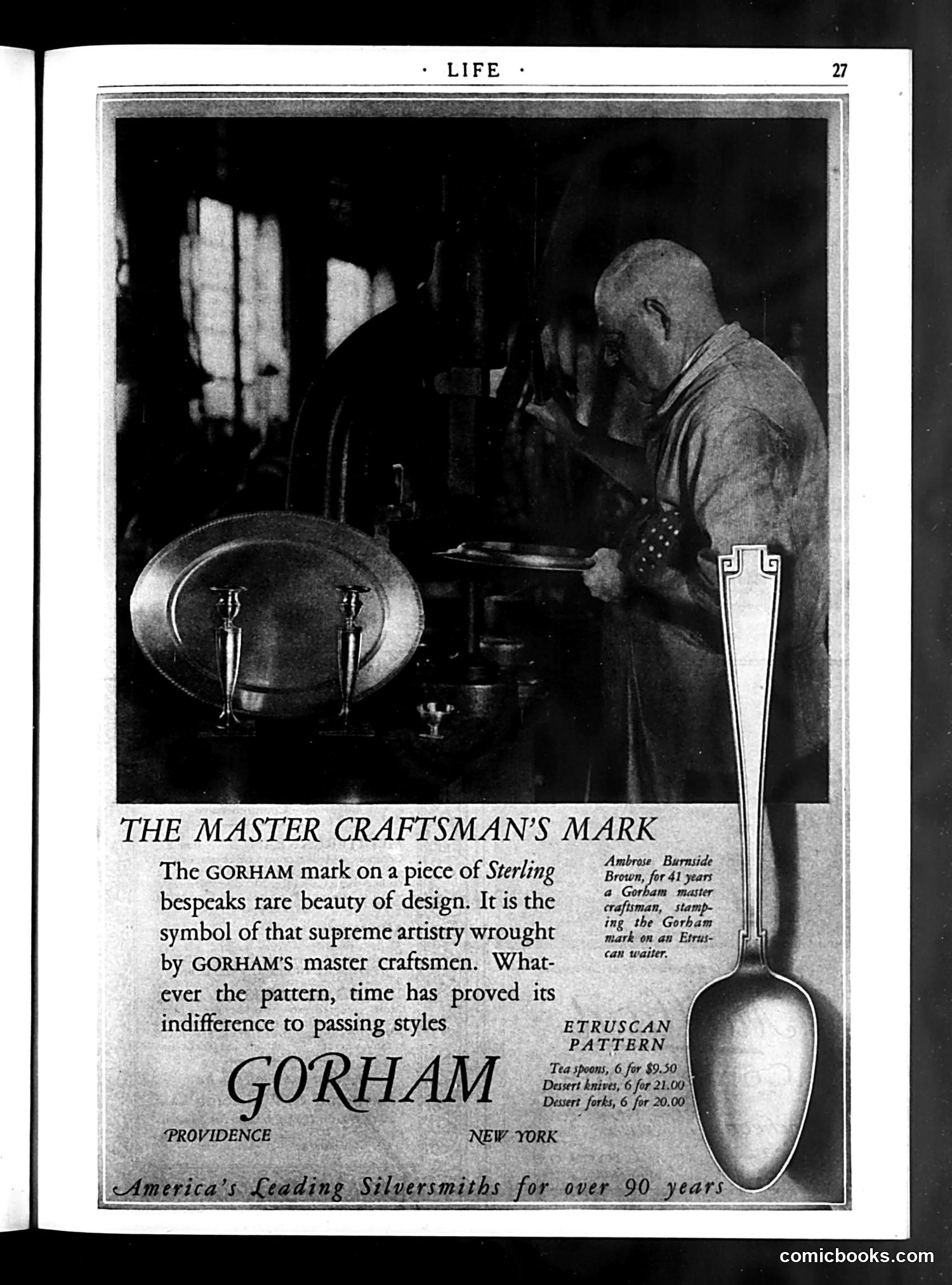
This is not a cartoon or satire—it's a **straight advertisement** for Gorham silverware, a real company. The page from *Life* magazine features a photograph of an elderly master craftsman (Ambrose Burnside Brown, identified as having worked for Gorham for 41 years) stamping the Gorham mark onto a sterling silver piece. The ad emphasizes craftsmanship and timelessness: the Gorham mark signifies "supreme artistry" and quality that transcends "passing styles." It includes product details and pricing for the "Etruscan Pattern" flatware. There is no political satire or social commentary here—simply a prestige brand advertisement leveraging the prestige of master craftsmanship to sell luxury goods. This reflects early-to-mid twentieth-century advertising strategy of emphasizing heritage and artisanal quality over mass production.
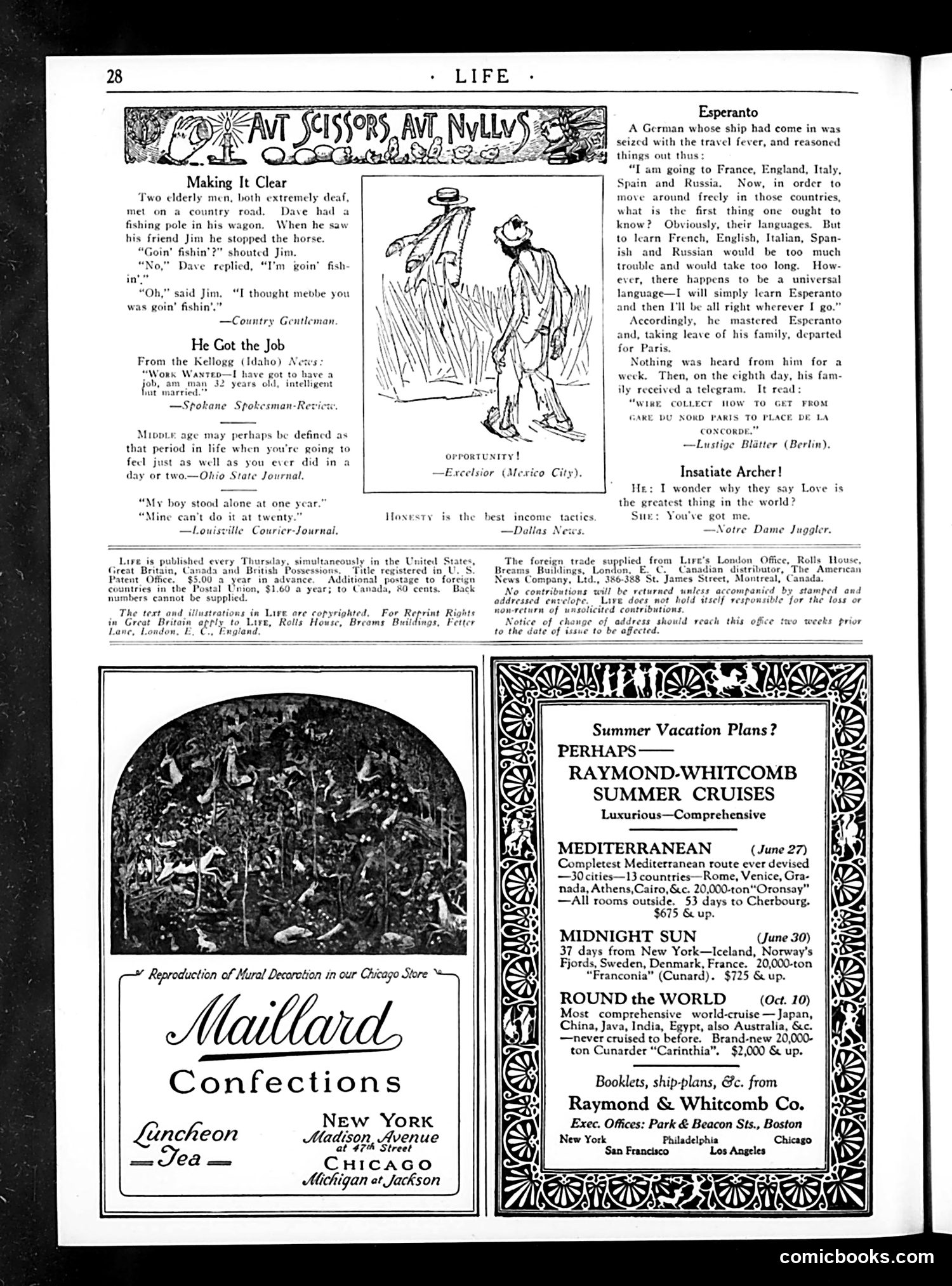
This page contains **multiple brief humorous anecdotes** typical of *Life* magazine's satirical format, plus advertisements. **The main cartoons/jokes:** 1. **"Making It Clear"** — Two extremely deaf elderly men mishear each other about fishing, creating a circular misunderstanding. The humor relies on slapstick miscommunication. 2. **"Esperanto"** — A German businessman decides to travel Europe using only Esperanto (a constructed universal language promoted in the early 1900s as a solution to language barriers). The satire mocks the impracticality: he masters Esperanto but arrives in Paris unable to navigate—the language fails its purpose. This critiques naive technological/linguistic solutions to real-world problems. 3. **"He Got the Job"** and **"Insatiate Archer"** — Brief one-liners about employment and romance. The page is primarily **advertising and miscellaneous humor** rather than political commentary. The Esperanto piece is the sharpest satire, gently mocking early-20th-century utopian language schemes as disconnected from practical reality.
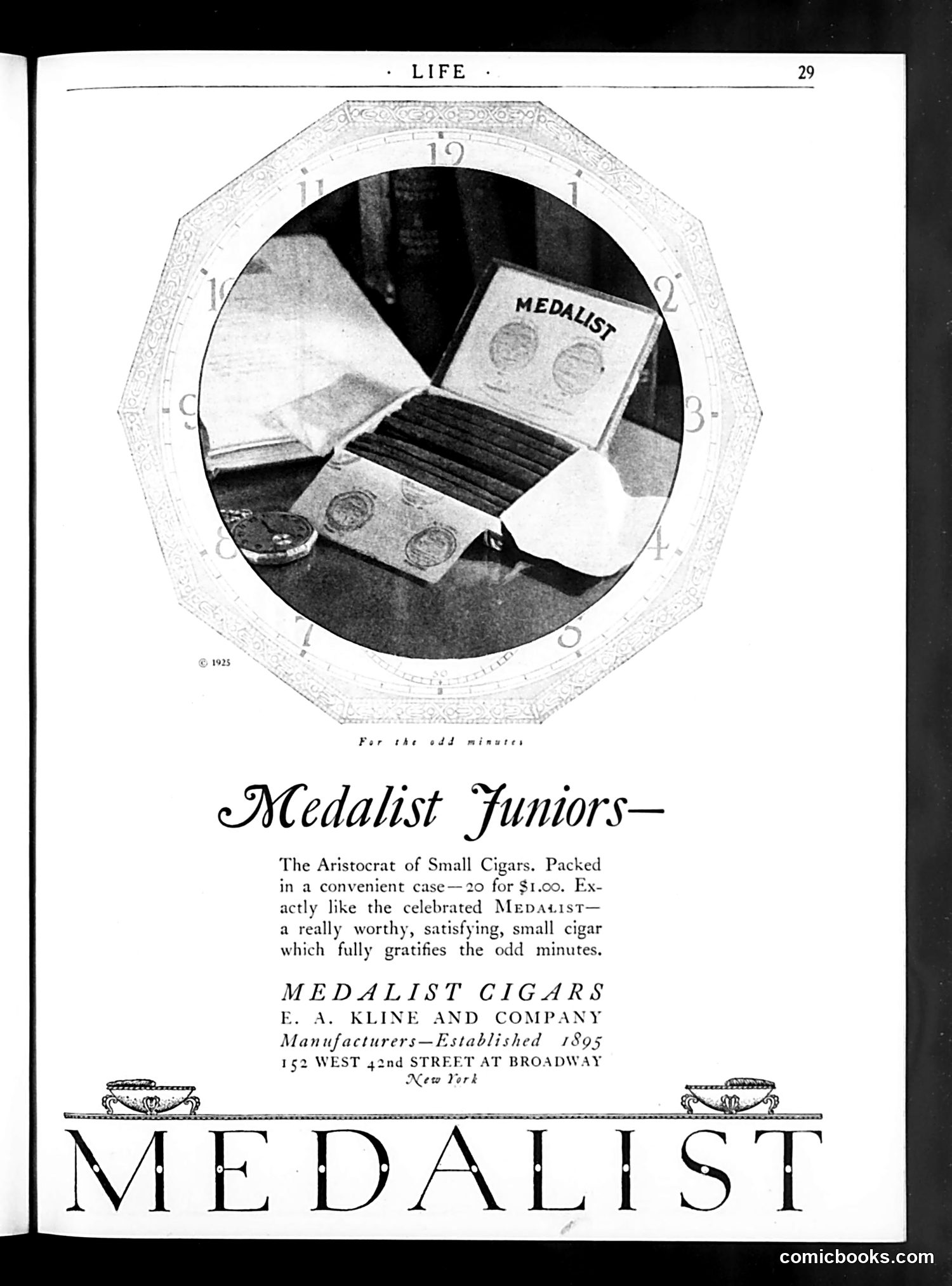
This is a 1925 advertisement for Medalist Juniors cigars, not political satire. The page features a product photo displayed within a clock face, emphasizing the marketing concept of "for the odd minutes"—suggesting these small cigars are perfect for brief leisure breaks during a busy day. The ad positions Medalist Juniors as affordable luxury ("The Aristocrat of Small Cigars") at $1.00 for twenty cigars. It references the established Medalist brand, implying the Juniors are a smaller, convenient variant of the same quality product. The clock imagery reinforces the target use: quick smoking breaks throughout the workday. This reflects early 20th-century advertising strategies appealing to efficiency-minded consumers during America's industrial era.
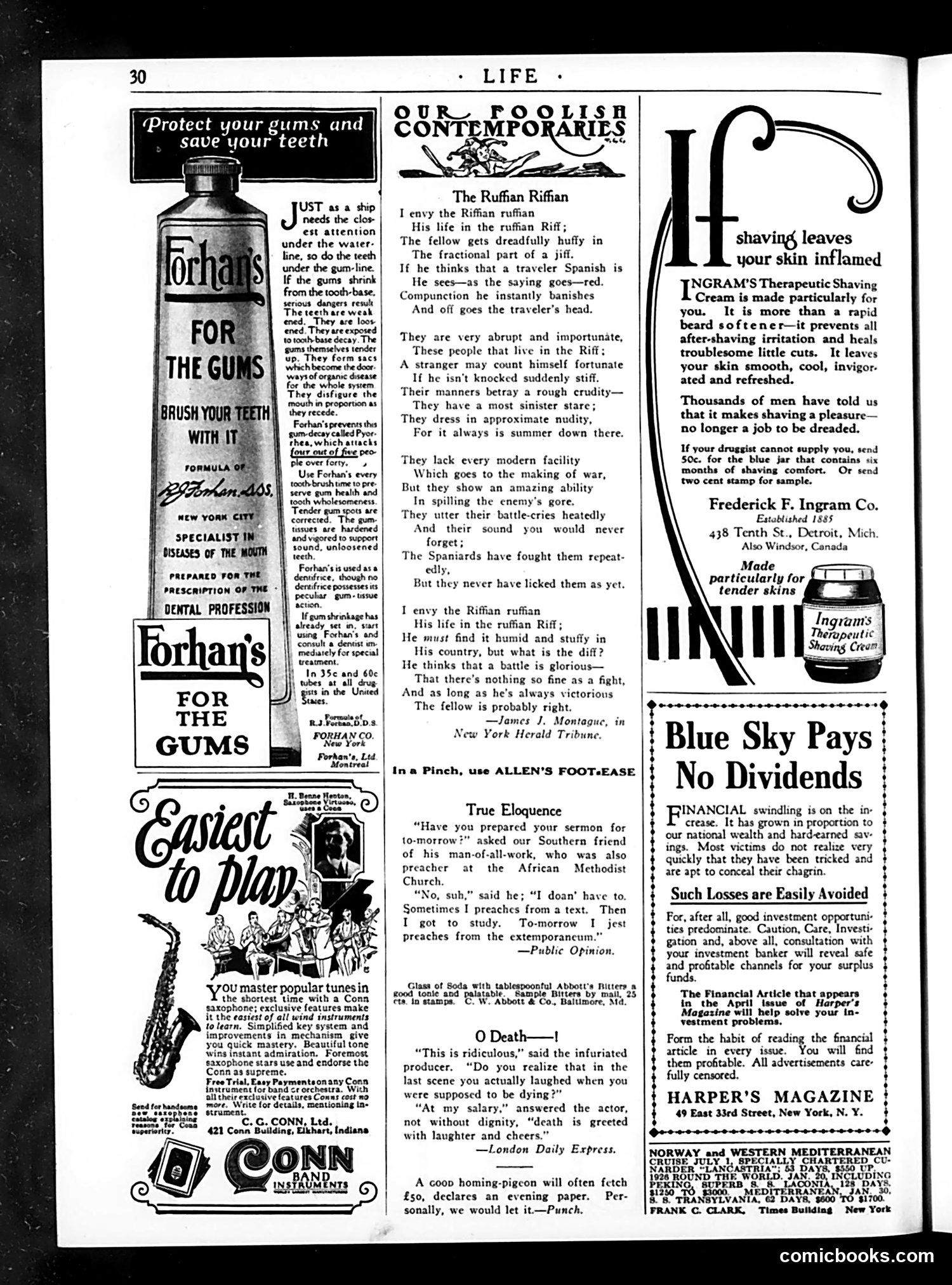
This page primarily contains **advertisements and light satirical pieces** rather than political cartoons. The main illustrated content is a humorous poem titled "The Ruffian Riffian" by James J. Montague, referencing the **Rif (or Riff) region of Morocco**. The poem satirizes Riffian warriors as crude, violent, and uncivilized—they lack "modern facility," dress poorly, and resort to brutality in warfare. The speaker ironically "envies" their simple warrior culture. This reflects early 20th-century Western attitudes portraying North African peoples as primitive and dangerous. The remainder consists of period advertisements: **Forhan's toothpaste** (protecting gums), **Ingram's Therapeutic Shaving Cream**, and articles on investment caution and sermon preparation. These ads and filler content were typical of Life magazine's commercial model. The "Blue Sky Pays No Dividends" piece warns readers against financial schemes—reflecting contemporary concern about investment fraud.
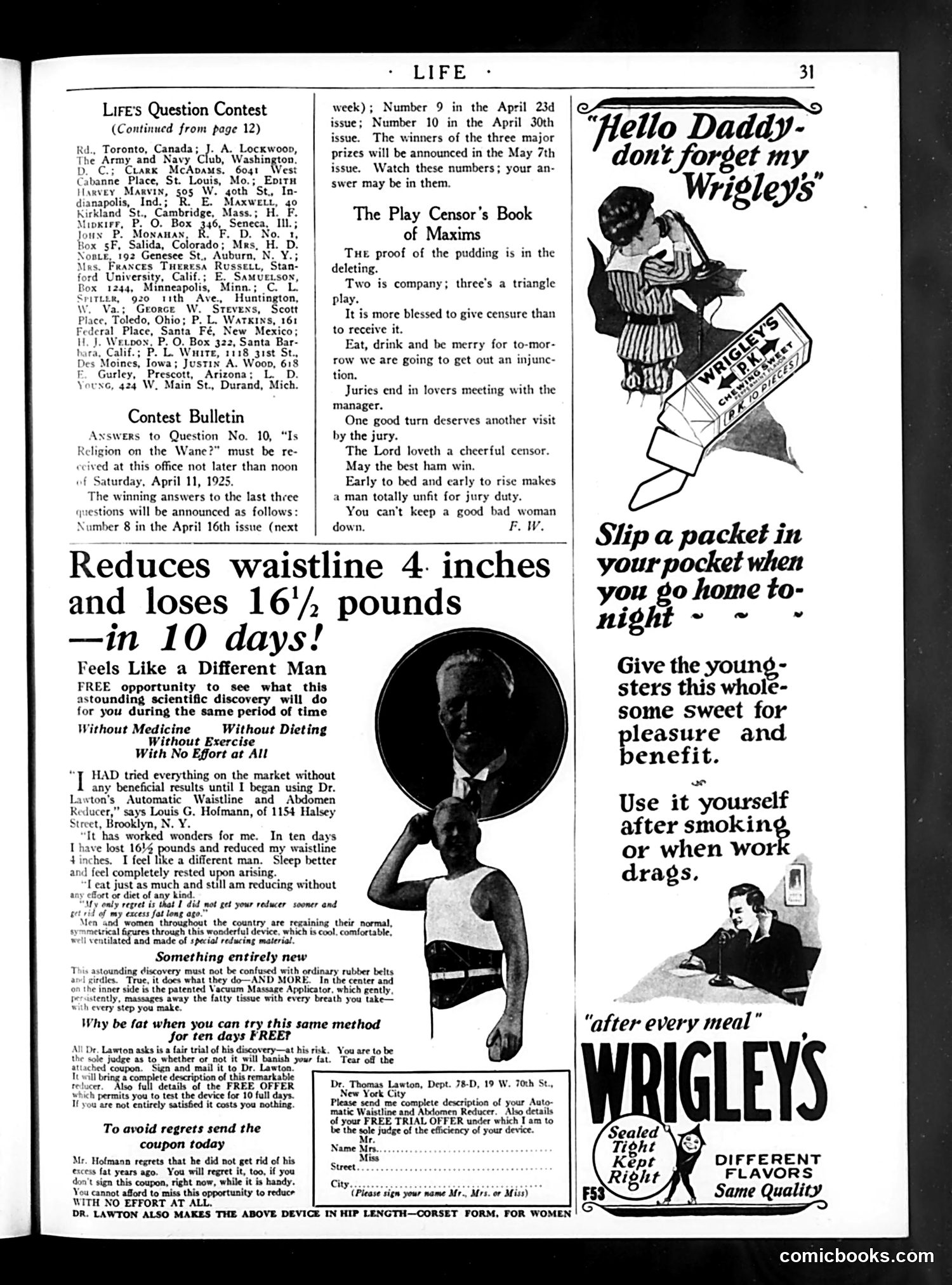
This page mixes satirical content with period advertising. **"The Play Censor's Book of Maxims"** is satirical commentary on theatrical censorship—a major social issue in 1925. The censor was a powerful figure who could demand script changes or deny productions, so the jokes mock this authority (e.g., "It is more blessed to give censure than to receive it"). The satire suggests censors were arbitrary and self-serving. The rest of the page is **genuine advertising**: the Dr. Lawton "Automatic Waistline Reducer" (a mechanical belt device) and Wrigley's chewing gum. Both used testimonials and exaggerated claims typical of 1920s marketing. The Wrigley's ad promotes gum as a sweet treat and breath freshener—selling it for multiple occasions including after meals and work breaks. These ads reflect period attitudes about weight loss devices and consumer goods being unregulated by modern standards.
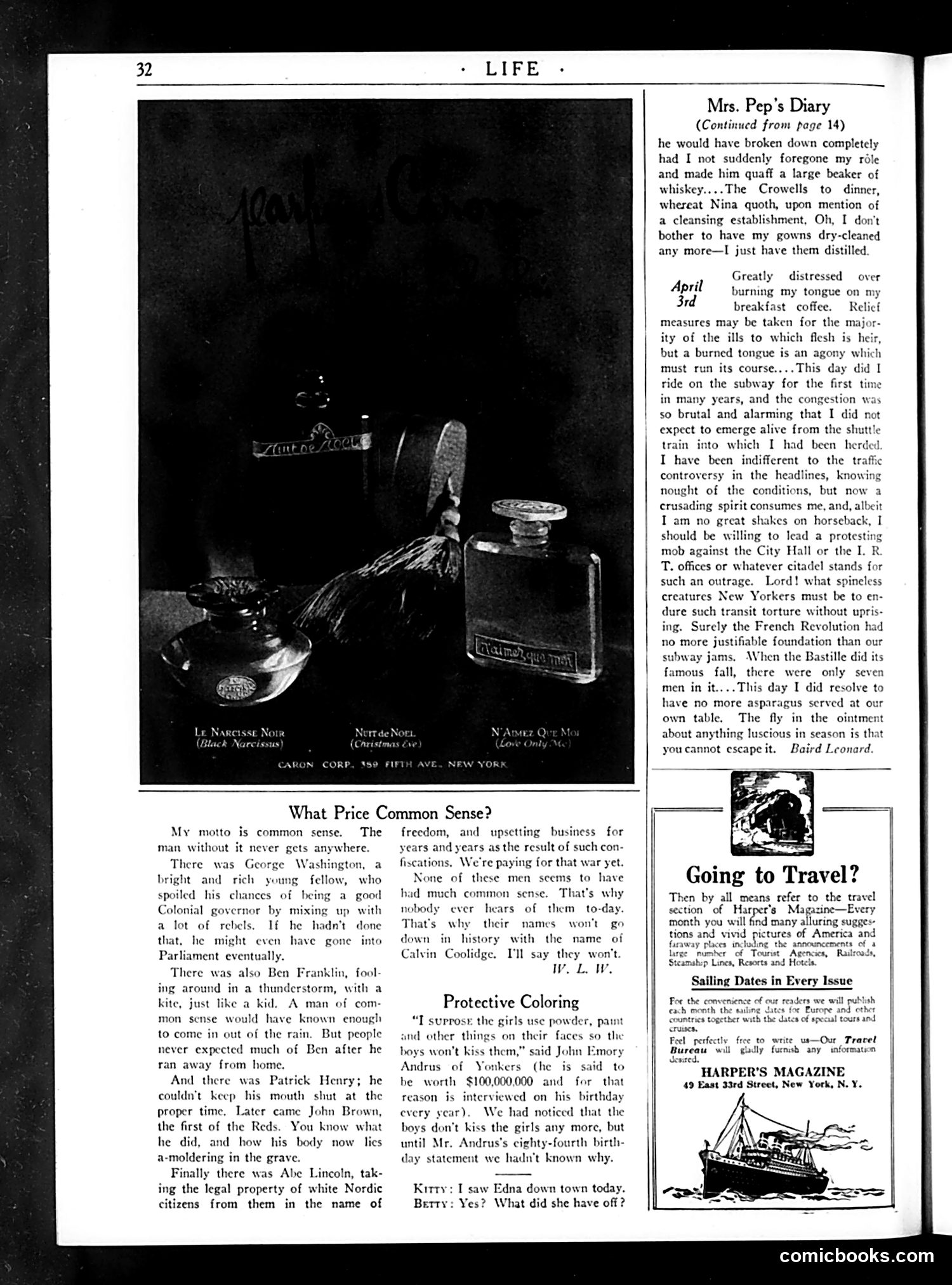
This article mocks the veneration of practical mediocrity, particularly the era's celebration of President Calvin Coolidge. The author sarcastically argues that historical figures—Washington, Franklin, Patrick Henry, John Brown, and Lincoln—lacked "common sense" because they took principled stands (rebellion, experimentation, abolition) that disrupted business and comfort. The satire's target is clear: the 1920s cultural obsession with passive pragmatism over moral courage. By claiming Coolidge's "common sense" will outlast these revolutionaries in history, the writer exposes how hollow and forgettable such complacency actually is. The joke inverts itself—these "senseless" rebels are remembered precisely because they acted boldly, while Coolidge represents forgettable conformity. The piece critiques American society's post-WWI retreat into conservatism and business-friendly politics, mocking those who value stability over justice or principle.
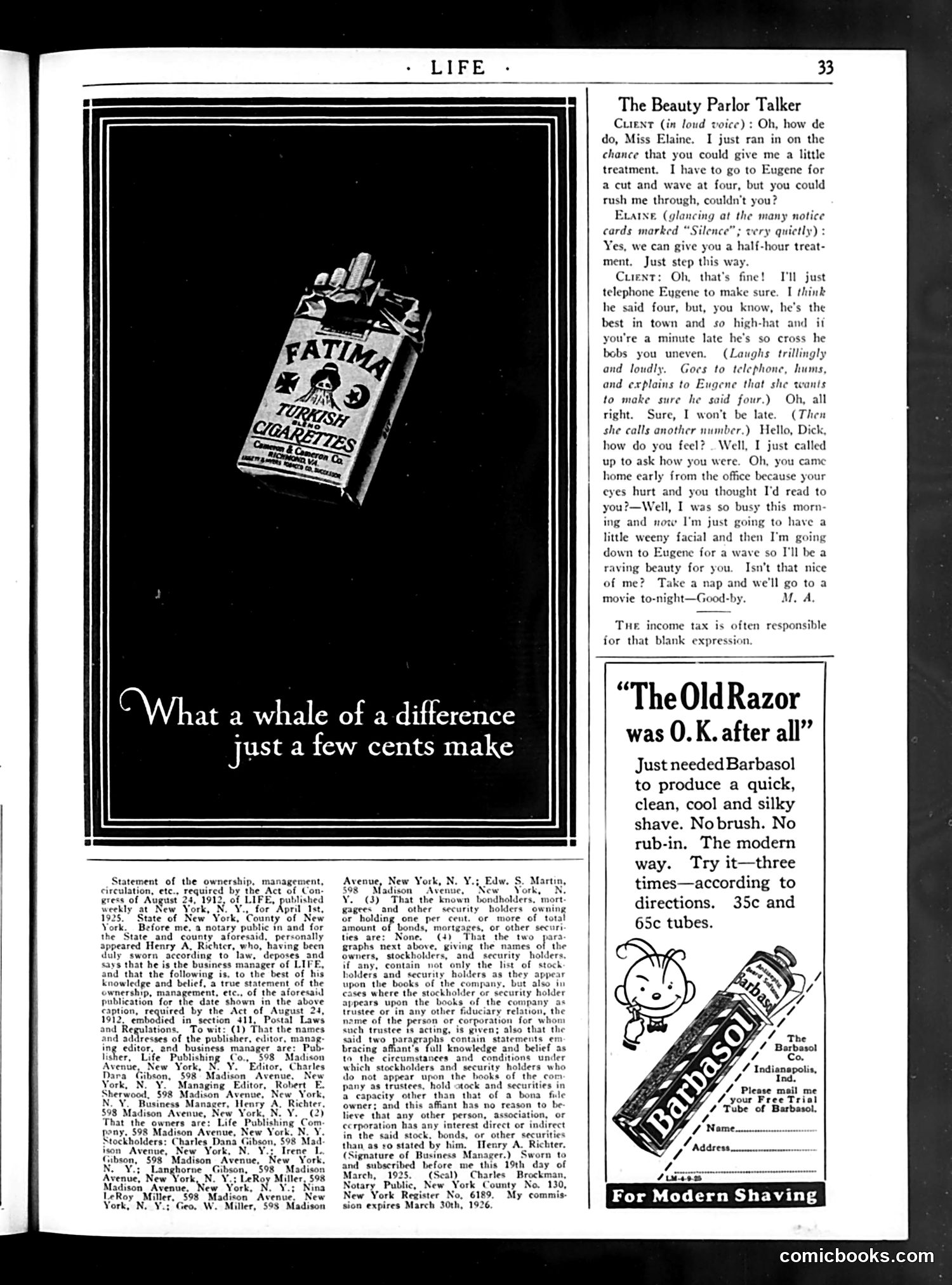
This satirical sketch mocks a loudmouthed beauty salon client who violates the "Silence" notices posted throughout the parlor. Despite clear signs requesting quiet, she speaks in a loud voice, laughs "trillingly and loudly," and makes multiple phone calls—first to her hairdresser Eugene, then to someone named Dick at home. The humor lies in the contrast: the salon has explicitly posted silence rules (likely for customers' relaxation), yet this oblivious woman ignores them completely, babbling about her schedule and personal life to whoever will listen. The beautician Elaine responds "very quietly," emphasizing the client's inconsiderate loudness. The accompanying caption notes: "The income tax is often responsible for that blank expression"—suggesting people are too distracted by financial worries to notice social courtesy. This reflects 1920s anxieties about rising taxes and portrays a common social irritant: the person unaware of (or indifferent to) how their behavior affects others.
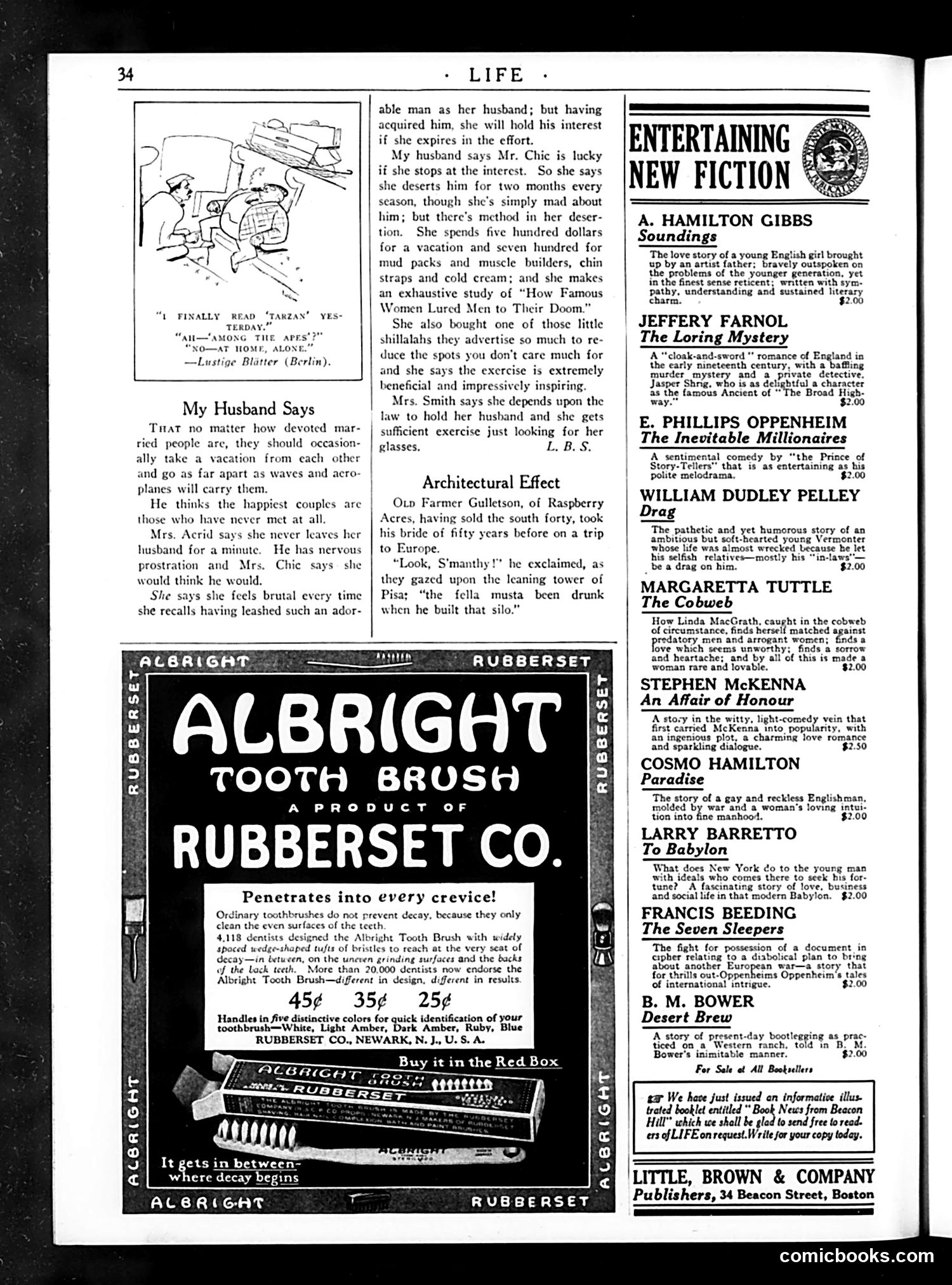
## The Main Cartoon The cartoon titled "My Husband Says" is a satirical commentary on married couples and vacations. It presents several anecdotes mocking marital dynamics: - **Mrs. Acrid** never leaves her husband (he has nervous prostration—implying she's the cause) - **Mrs. Chic** abandons her husband for two months annually, spending lavishly on beauty treatments and studying "How Famous Women Lured Men to Their Doom"—suggesting women use strategic absence and self-improvement to maintain marital interest - **Mrs. Smith** relies on legal obligation rather than effort The humor satirizes 1920s marriage expectations: wives' supposed responsibility for maintaining husbands' interest through either constant attendance or calculated absences and beauty maintenance. ## The Secondary Joke "Old Farmer Gulletson" visiting the Leaning Tower of Pisa and mistaking it for a drunk man's silo provides rural American contrast—unsophisticated tourism humor common to the era. The page is primarily advertisement (Albright toothbrush) and book listings.
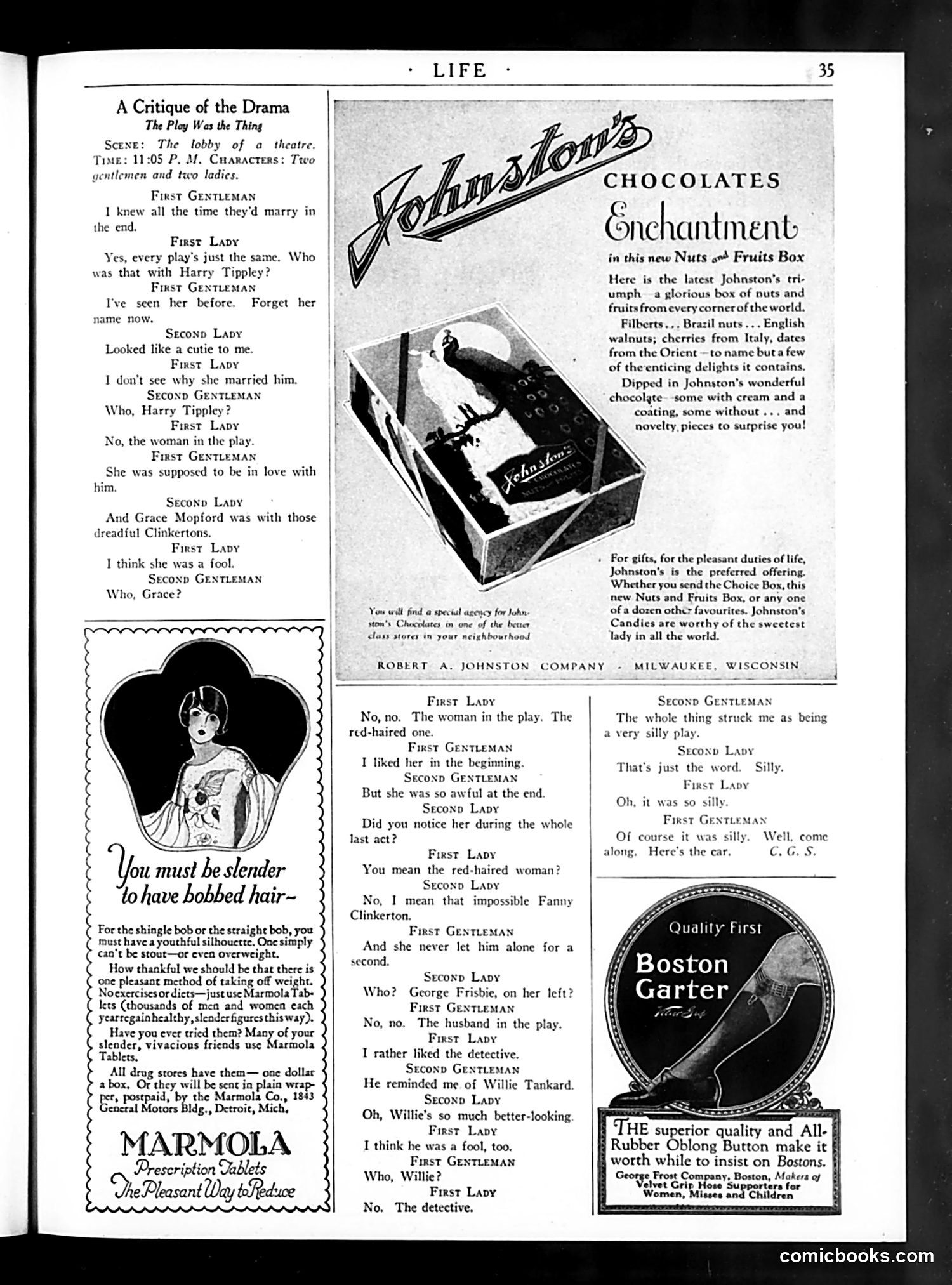
This is a satirical sketch mocking theatre audiences of the 1920s. Four patrons exit a play, and the joke becomes immediately clear: **none of them were actually paying attention**. They discuss the plot with complete confusion—mixing up character names, forgetting who actors were, and fundamentally misunderstanding the storyline. Yet they confidently critique the performance as "silly" anyway. The satire targets a specific social behavior: attending theatre as a fashionable social obligation rather than genuine entertainment. The characters seem more interested in who else was in the lobby and who sat with whom than in the actual play. This reflects 1920s upper-class theatre culture, where going to plays was often performative—about being seen in the right places with the right people. The sketch suggests audiences were distracted, inattentive, and prone to pretentious judgment of art they hadn't really engaged with. The surrounding advertisements (for Marmola weight-loss tablets, Johnston's chocolates, and Boston garters) reinforce the page's focus on superficial social concerns over substance.
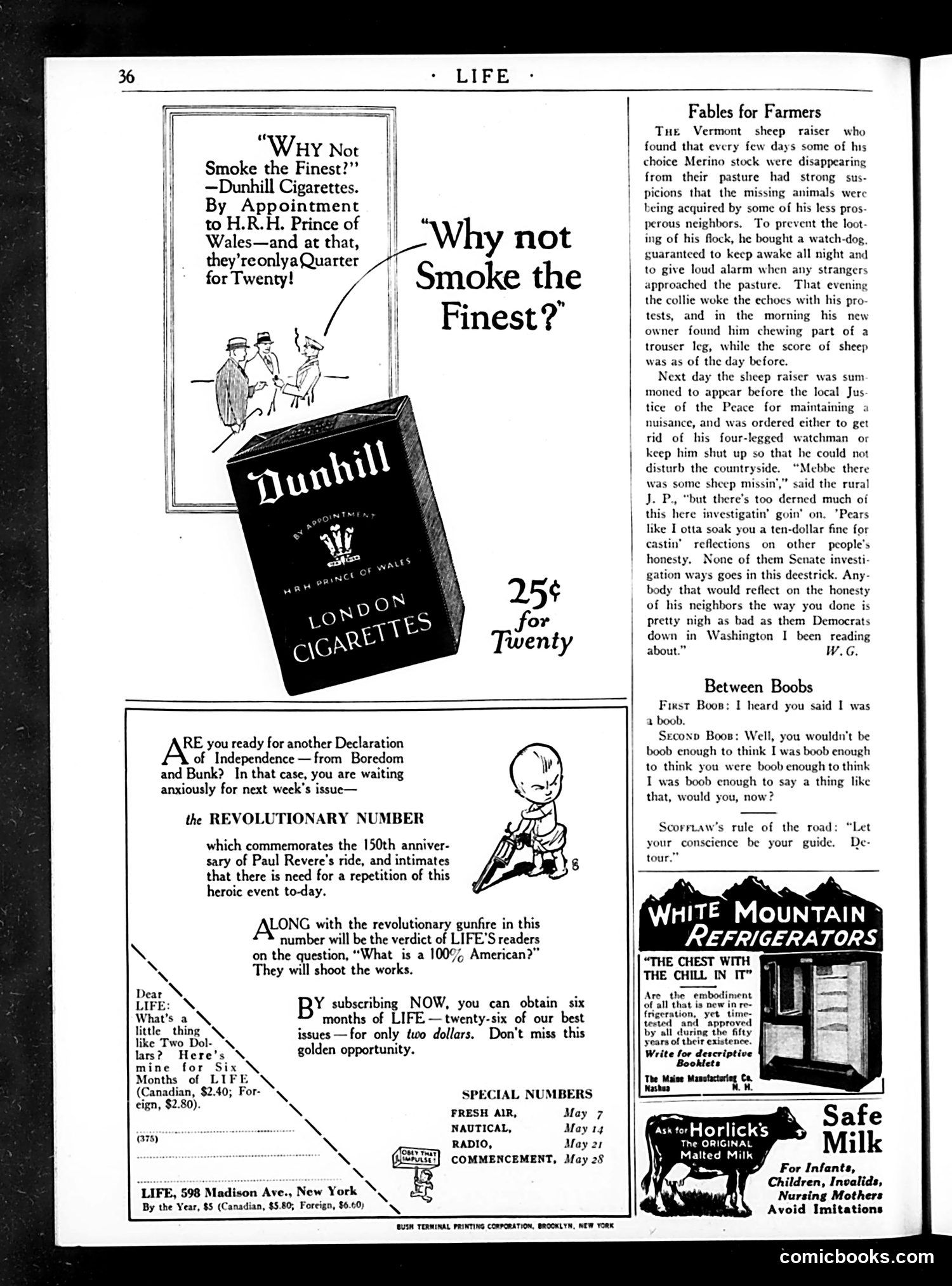
This page contains satirical humor typical of 1920s Life magazine, mixed with advertisements. **"Fables for Farmers"** presents a rural parable mocking small-town hypocrisy. A Vermont farmer buys a watchdog to catch sheep thieves from his neighbors, but when the dog barks and disturbs the peace, the local Justice of the Peace fines *him*—not the actual thieves. The joke satirizes how rural communities protect dishonesty: the JP refuses to investigate theft but punishes the farmer for exposing it, comparing this moral cowardice to Democrats in Washington. The story criticizes small-town corruption disguised as neighborly discretion. **"Between Boobs"** is a brief wordplay joke about two men insulting each other with circular logic, each claiming the other is too foolish to have said something insulting. The page also advertises **Dunhill Cigarettes** and promotes Life's upcoming "Revolutionary Number" commemorating Paul Revere's 150th anniversary ride, plus various product advertisements (refrigerators, malted milk).
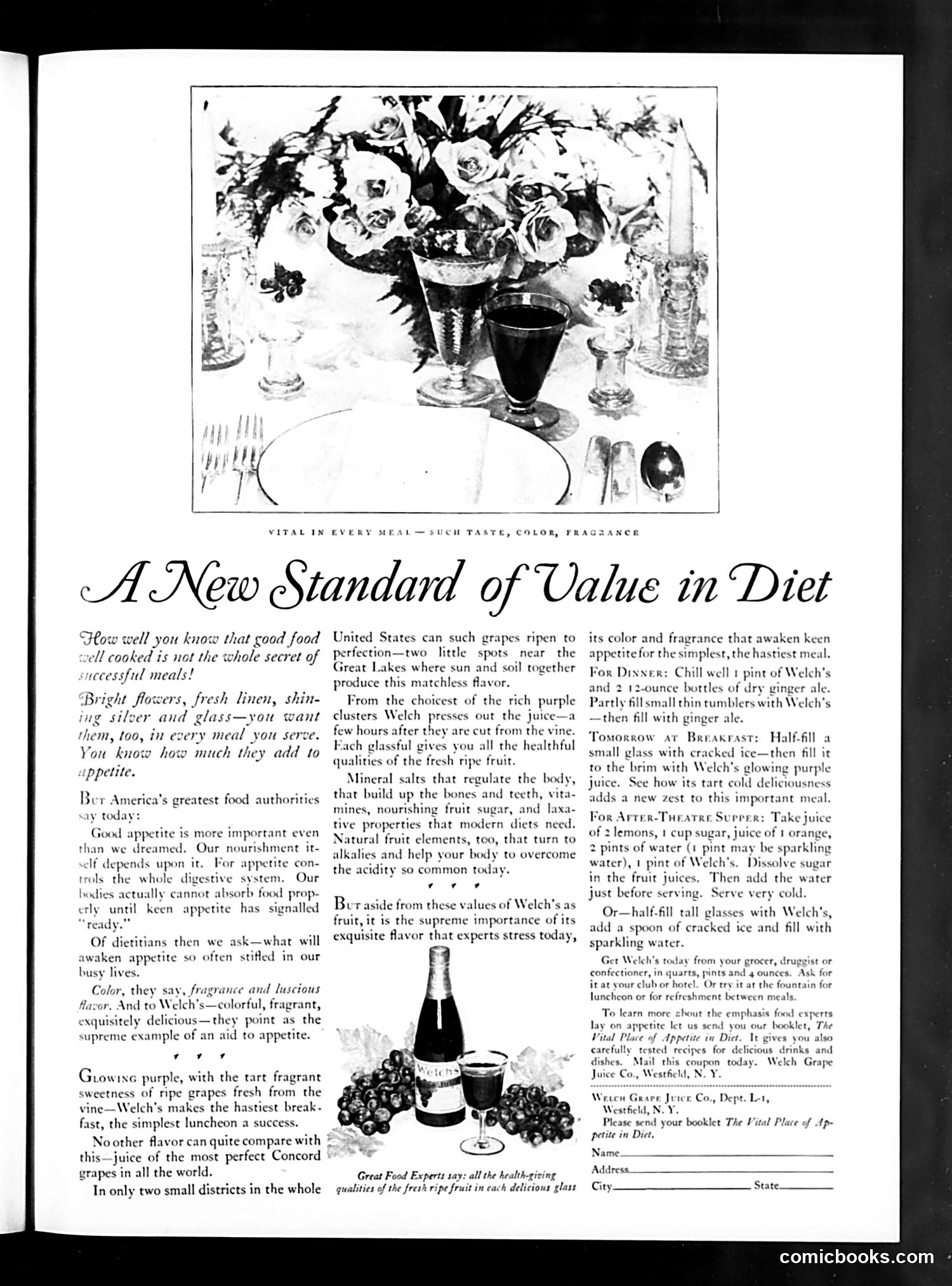
This is **not a political cartoon or satirical content**—it's a straightforward **advertisement for Welch's Grape Juice**, likely from the 1910s-1920s. The page promotes grape juice as a health product by appealing to contemporary dietary trends. It emphasizes that good nutrition requires not just food quality but also visual appeal and appetite stimulation—concepts aligned with emerging nutrition science of the era. The ad stresses Welch's juice contains "mineral salts," "vitamines," and natural fruit elements beneficial to digestion. The image shows an elegant table setting with fresh flowers, quality glassware, and serving suggestions, reinforcing that consuming Welch's elevates the dining experience. Multiple recipe suggestions (for breakfast, dinner, and after-theater) demonstrate versatility. The text references "America's greatest food authorities" and "dietitians" to lend scientific credibility—a marketing tactic common when nutritional science was gaining public attention. This is purely commercial persuasion, not satire or political commentary.
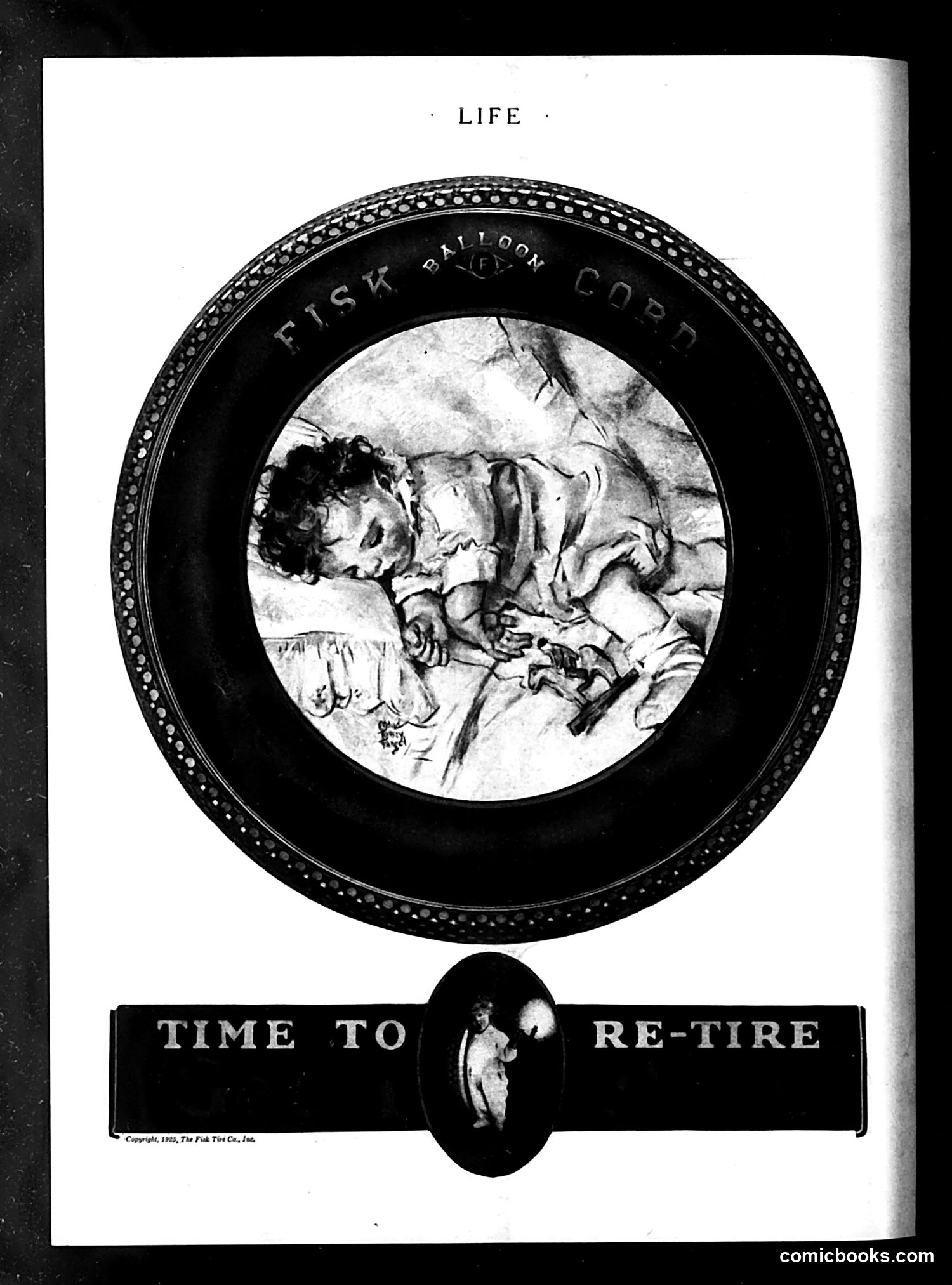
This is a 1925 Life magazine advertisement for Fisk tires. The circular image shows a sleeping child in a nightgown, with text reading "TIME TO RE-TIRE" — a pun on "retire" (go to bed) and "re-tire" (replace tires). The advertisement uses the famous Fisk Tire mascot, a sleepy child known as "the Fisk Boy," which was the company's iconic advertising character during this era. The joke combines the child's bedtime with the need to replace worn tires on automobiles. This represents early 20th-century advertising strategy: using memorable, emotionally appealing imagery and wordplay to promote consumer products. The sleeping child conveys comfort and reliability—qualities the brand wanted associated with their tires.

I can see this is a mostly blank or very dark page from Life magazine with minimal visible content. The only clearly legible text is "comicbooks.com" at the bottom right, which appears to be a watermark or attribution mark added to the image itself, not original to the historical publication. The page is too dark and unclear for me to reliably identify any cartoons, caricatures, political figures, or satirical content. Without being able to read the actual text or see the illustrations clearly, I cannot accurately explain what this page's satire or jokes were meant to convey to contemporary readers. To properly analyze this Life magazine page, a clearer or higher-contrast image would be needed.