
Life, 1925-04-09 · page 28 of 41
Life — April 9, 1925 — page 28: what you’re looking at
What you’re looking at
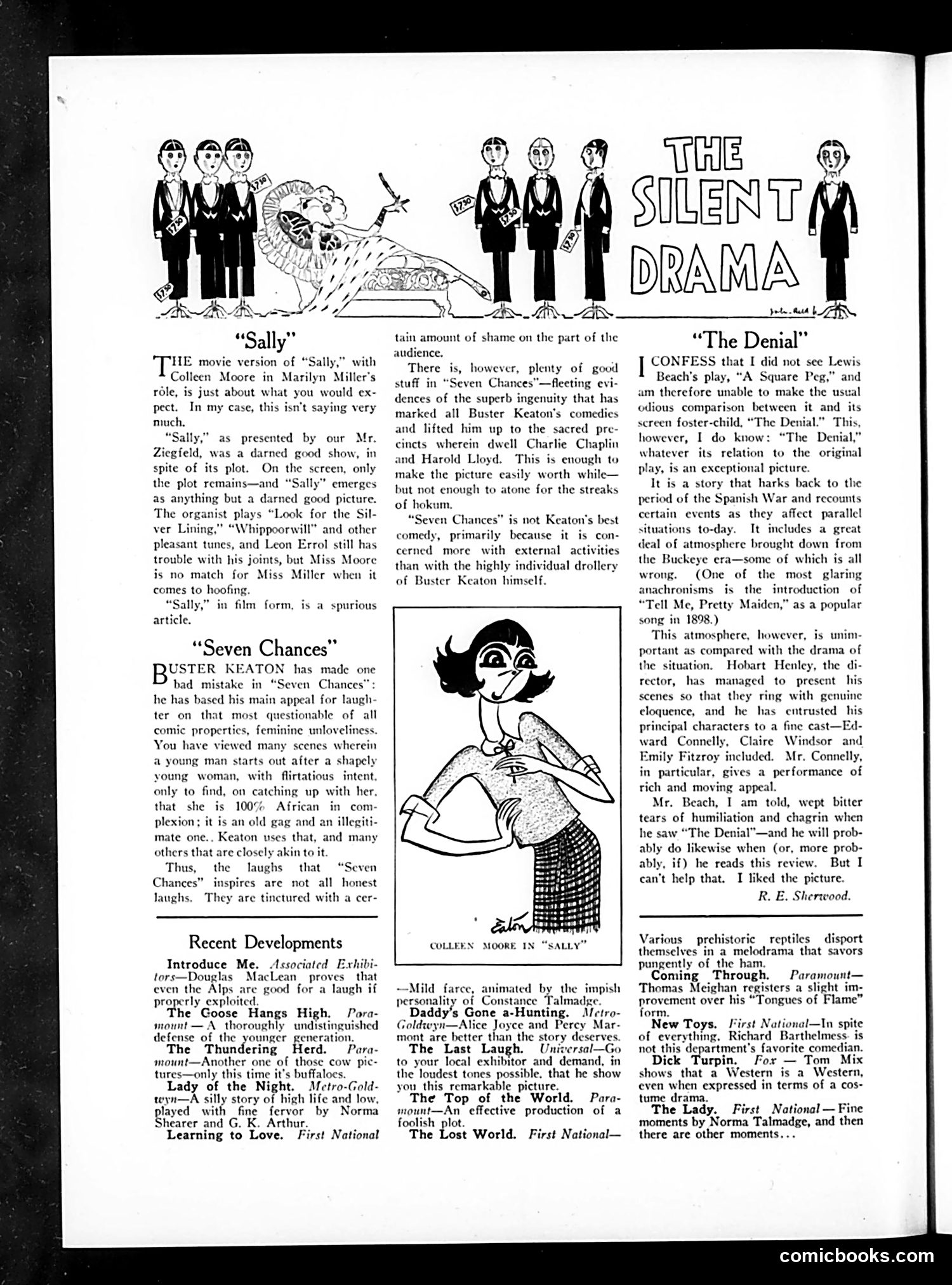
This Life magazine page reviews silent films from the 1920s. The main cartoon shows Colleen Moore in "Sally"—a screen adaptation of a successful stage musical. The critic complains the film loses what made the original (starring Marilyn Miller) appealing: Moore lacks Miller's dancing talent, leaving only a weak plot. The reviews critique Buster Keaton's "Seven Chances" for relying on a racist gag—a man pursuing a woman who turns out to be Black—which the critic calls "an old gag and an illegitimate one." While acknowledging Keaton's usual comedic genius, the reviewer argues this film sacrifices his signature individual humor for crude external comedy. Other reviews briefly assess recent releases like "The Denial" (praised as exceptional) and "The Last Laugh" (enthusiastically recommended). The page reflects 1920s cinema standards and, notably, the casual acceptance of racist humor as legitimate comedy criticism material.
📄 Transcribed text from this page (OCR, searchable)
Machine-transcribed from the original scan — historical spelling and the odd misread are preserved.
HE movie version of “Sally,” Colleen Moore in Marilyn Miller's role, is just about what you would ex- pect. In my case, this isn’t saying very much, “Sally,” as presented by our Mr. Ziegfeld, was a darned good show, in spite of its plot. On the screen, only the plot remains—and “Sally” emerges as anything but a darned good picture. The organist plays “Look for the Sil- ver Lining,” “Whippoorwill” and other pleasant tunes, and Leon Errol still has trouble with his joints, but Miss Moore is no match for Miss Miller when it comes to hoofing. “Sally,” in film form, article. is a spurious “Seven Chances” USTER KEATON has made one bad mistake in “Seven Chances”: he has based his main appeal for laugh- ter on that most questionable of all comic properties You have viewed many scenes wherein a young man starts out after a shapely young woman, with flirtatious intent. only to find, on catching up with her, that she is 100% African in com- plexion; it is an old gag and an illegiti- mate one., Keaton uses that, and many others that are closely akin to it. Thus, the laughs that “Seven Chances” inspires are not all honest laughs. They are tinctured with a cer- feminine unloveliness. Recent Developments Introduce Me. Associated Exhibi- tors—Douglas MacLean proves that even the Alps are good for a laugh if proper rly cabled. Goose Hangs High, Pora- mount — A thoroughly undistinguished defense of the younger generation. The Thundering Herd. Para- mount—Another one of those cow pic- tures—only this time it’s buffaloe Lady of the Night. Mctro-Gold- yn—A silly story of high life and low, played with fine fervor by Norma Shearer and G. K. Arthur. Learning to Love. First National tain amount of shame on the part of the audience. There is, however, plenty of good stuff in “Seven Chances”—fleeting evi- dences of the superb ingenuity that has marked all Buster Keaton’s comedies and lifted him up to the sacred pre- cincts wherein dwell Charlie Chaplin and Harold Lloyd. This is enough to make the picture easily worth while— but not enough to atone for the streaks of hokum, “Seven Chances” is not Keaton’s best comedy, primarily because it is con- cerned more with external activities than with the highly individual drollery of Buster Keaton himself. COLLEEN MOORE IN “: ~Mild farce, animated by the impish rersonainy of Constance Talmadge. Daddy’s Gone a-Hunting. Ae Goldwyn—Alice Joyce and Percy Mar- mont are better than the story deserves. The Last Laugh. Universal—Go to your local exhibitor and demand, in the loudest tones possible, that he show you this remarkable picture. The Top of the World. Para- mount—An_ effective production of a foolish plot. The Lost World. First National— “The Denial” | CONFESS that I did not see Lewis Beach's play, “A Square Peg,” and am therefore unable to make the usual odious comparison between it and its screen foster-child, “The Denial.” This, however, I do know: “The Denial,” whatever its relation to the original play, is an exceptional picture. It is a story that harks back to the period of the Spanish War and recounts events as they affect parallel ns to-day. It includes a great deal of atmosphere brought down from the Buckeye era—some of which is all wrong. (One of the most glaring anachronisms is the introduction of “Tell Me, Pretty Maiden,” as a popular song in 1898.) This atmosphere, however, is unim- portant as compared with the drama of the situation. Hobart Henley, the di- rector, has managed to present his scenes so that they ring with genuine eloquence, and he has entrusted his principal characters to a fine cast—Ed- ward Connel Claire Windsor and Emily Fitzroy included. Mr. Connelly, in particular, gives a performance of rich and moving appeal. Mr. Beach, I am told, wept bitter tears of humiliation and chagrin when he saw “The Denial”—and he will prob- ably do likewise when (or, more prob- ably, if) he reads this review. But I can't help that. I liked the picture. R. E. Sherwood. — Various prehistoric reptiles disport themselves in a melodrama that savors pungently of the ham. Coming Through. Paramount— Thomas Meighan registers a slight im- provement over his “Tongues of Flame” form. New Toys. Jirst National—In spite of everything. Richard Barthelmess- is not this department's favorite comedian. Dick Turpin. For — Tom Mix shows that a Western is a Western, even when expressed in terms of a cos- tume drama. The Lady. First National — Fine moments by Norma Talmadge, and then there are other moments. comicbooks.com