
Life, 1925-04-09 · page 18 of 41
Life — April 9, 1925 — page 18: what you’re looking at
What you’re looking at
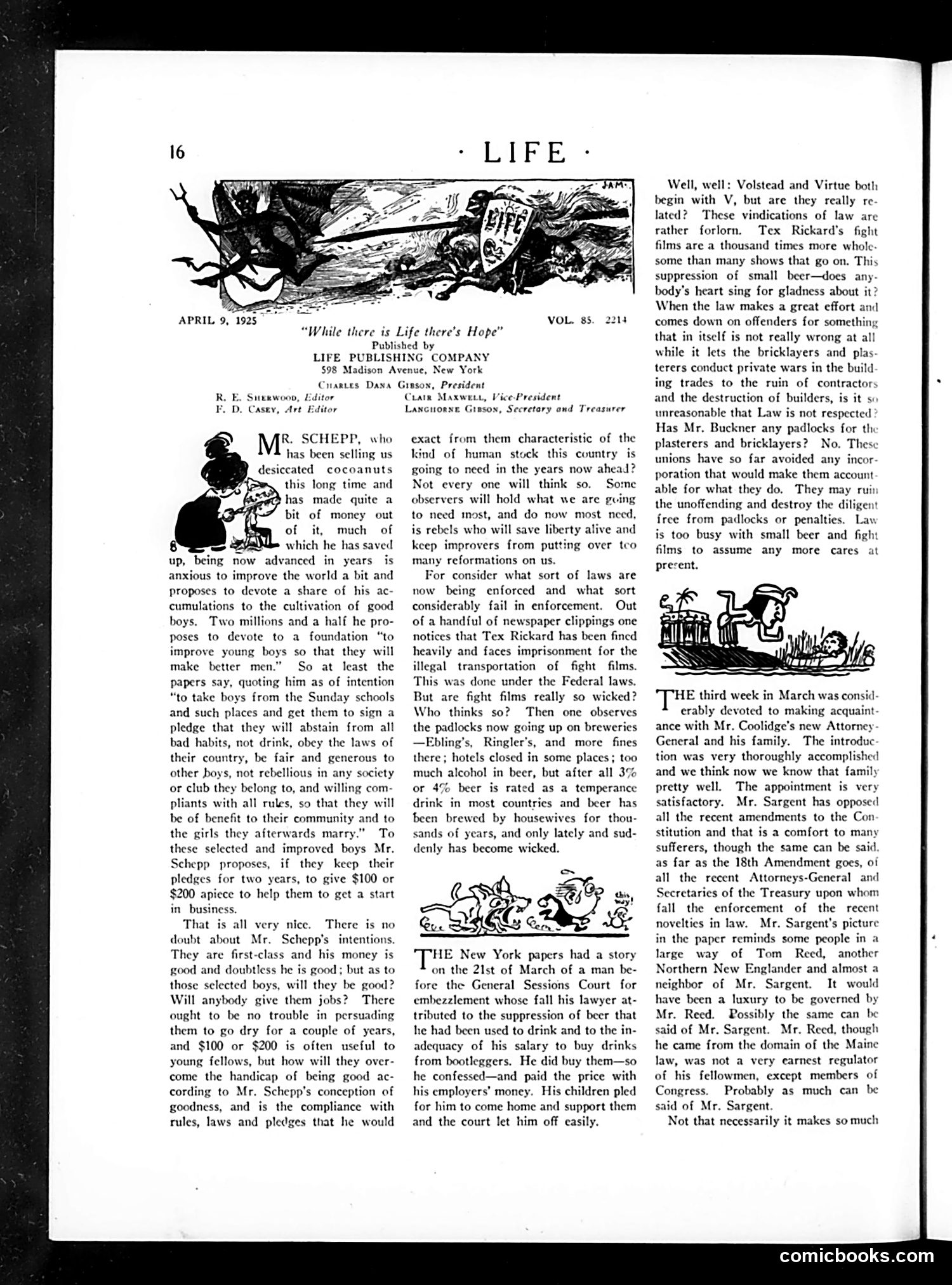
This 1925 *Life* magazine editorial critiques Prohibition-era law enforcement as selective and counterproductive. The author discusses R. Schepp's philanthropic plan to fund boys who pledge total abstinence and rule-compliance, questioning whether such "goodness" actually benefits society. The satire's core: authorities aggressively prosecute fight promoter Tex Rickard for illegal film transportation and close breweries for minor alcohol violations, yet simultaneously release an embezzler who blamed beer suppression for his crimes. The piece argues that rigid Prohibition laws are unevenly enforced, create perverse incentives (driving people to illegal bootleggers), and damage otherwise law-abiding citizens while paradoxically letting actual criminals escape consequences. The author's point: strict moral reform laws ("Volstead and Virtue") don't correlate—and may harm the liberty and individual judgment the nation actually needs. The editorial champions pragmatism over idealistic, rigid rule-following.
📄 Transcribed text from this page (OCR, searchable)
Machine-transcribed from the original scan — historical spelling and the odd misread are preserved.
APRIL 9, 1925 VOL. 85. 2214 “While there is Life there's Hope” Published by LIFE PUBLISHING COMPANY $98 Madison Avenue, New York Cnaates Dawa Grasox, President R. E. Suxrwooo, Editor F. D, Casey, Art Editor R. SCHEPP, who has been selling us desiccated cocoanuts this long time and has made quite a bit of money out of it, much of OS SAME which he has saved up, being now advanced in years is anxious to improve the world a bit and Proposes to devote a share of his ac- cumulations to the cultivation of good boys. Two millions and a half he pro- poses to devote to a foundation “to improve young boys so that they will make better men.” So at least the papers , quoting him as of intention “to take boys from the Sunday schools and such places and get them to sign a pledge that they will abstain from all bad habits, not drink, obey the laws of their country, be fair and generous to other boys, not rebellious in any society or club they belong to, and willing com- pliants with all rules, so that they will be of benefit to their community and to the girls they afterwards marry.” To these selected and improved boys Mr. Schepp proposes, if they keep their pledges for two years, to give $100 or $200 apiece to help them to get a start in business. That all very nice. There is no doubt about Mr. Schepp’s intentions. They are first-class and his money is good and doubtless he is good; but as to those selected boys, will they be good? Will anybody give them jobs? There ought to be no trouble in persuading them to go dry for a couple of years, and $100 or $200 is often useful to young fellows, but how will they over- come the handicap of being good ac- cording to Mr. Schepp’s conception of goodness, and is the compliance with rules, laws and pledges that he would Craik Maxwett, Vice-President Lancuorne Grasox, Secretary and Treasurer exact from them characteristic of the kind of human stock this country is going to need in the years now ahead? Not every one will think so. Some observers will hold what we are going to need most, and do now most need, is rebels who will save liberty alive and keep improvers from putting over tco many reformations on us. For consider what sort of laws are now being enforced and what sort considerably fail in enforcement. Out of a handful of newspaper clippings one notices that Tex Rickard has been fined heavily and faces imprisonment for the illegal transportation of fight films. This was done under the Federal laws. But are fight films really so wicked? Who thinks so? Then one observes the padlocks now going up on breweries —Ebling’s, Ringler’s, and more fines there; hotels closed in some places; too much alcohol in beer, but after all 3% or 4% beer is rated as a temperance drink in most countries and beer has been brewed by housewives for thou- sands of years, and only lately and sud- denly has become wicked. HE New York papers had a story on the 21st of March of a man be- fore the General Sessions Court for embezzlement whose fall his lawyer at- tributed to the suppression of beer that he had been used to drink and to the in- adequacy of his salary to buy drinks from bootleggers. He did buy them—so he confessed—and paid the price with his employers’ money. His children pled for him to come home and support them and the court let him off easily. Well, well: Volstead and Virtue both begin with V, but are they really re- lated? These vindications of law are rather forlorn. Tex Rickard’s fight films are a thousand times more whole- some than many shows that go on. This suppression of small beer—does any- body's heart sing for gladness about it? When the law makes a great effort and comes down on offenders for something that in itself is not really wrong at all while it lets the bricklayers and plas- terers conduct private wars in the build ing trades to the ruin of contractors and the destruction of builders, is it so unreasonable that Law is not respected Has Mr. Buckner any padlocks for th plasterers and bricklayers? No. These unions have so far avoided any incor- poration that would make them account able for what they do. They may ruin the unoffending and destroy the dili free from padlocks or penalties. La is too busy with small beer and fig films to assume any more cares at present. E third week in March was consid- erably devoted to making acquaint- ance with Mr. Coolidge’s new Attorney General and his family. The introduc tion was very thoroughly accomplished and we think now we know that family pretty well. The appointment is very satisfactory. Mr. Sargent has opposed all the recent amendments to the Con stitution and that is a comfort to many sufferers, though the same can be said. as far as the 18th Amendment goes, oi all the recent Attorneys-General and Secretaries of the Treasury upon whom fall the enforcement of the recent novelties in law. Mr. Sargent's picture in the paper reminds some people in a large way of Tom Reed, another Northern New Englander and almost a neighbor of Mr. Sargent. It would have been a luxury to be governed by Mr. Reed. Possibly the same can be said of Mr. Sargent. Mr. Reed, though he came from the domain of the Maine law, was not a very earnest regulator of his fellowmen, except members of Congress. Probably as much can be said of Mr. Sargent. Not that necessarily it makes so much comicbooks.com