
Life, 1925-04-09 · page 19 of 41
Life — April 9, 1925 — page 19: what you’re looking at
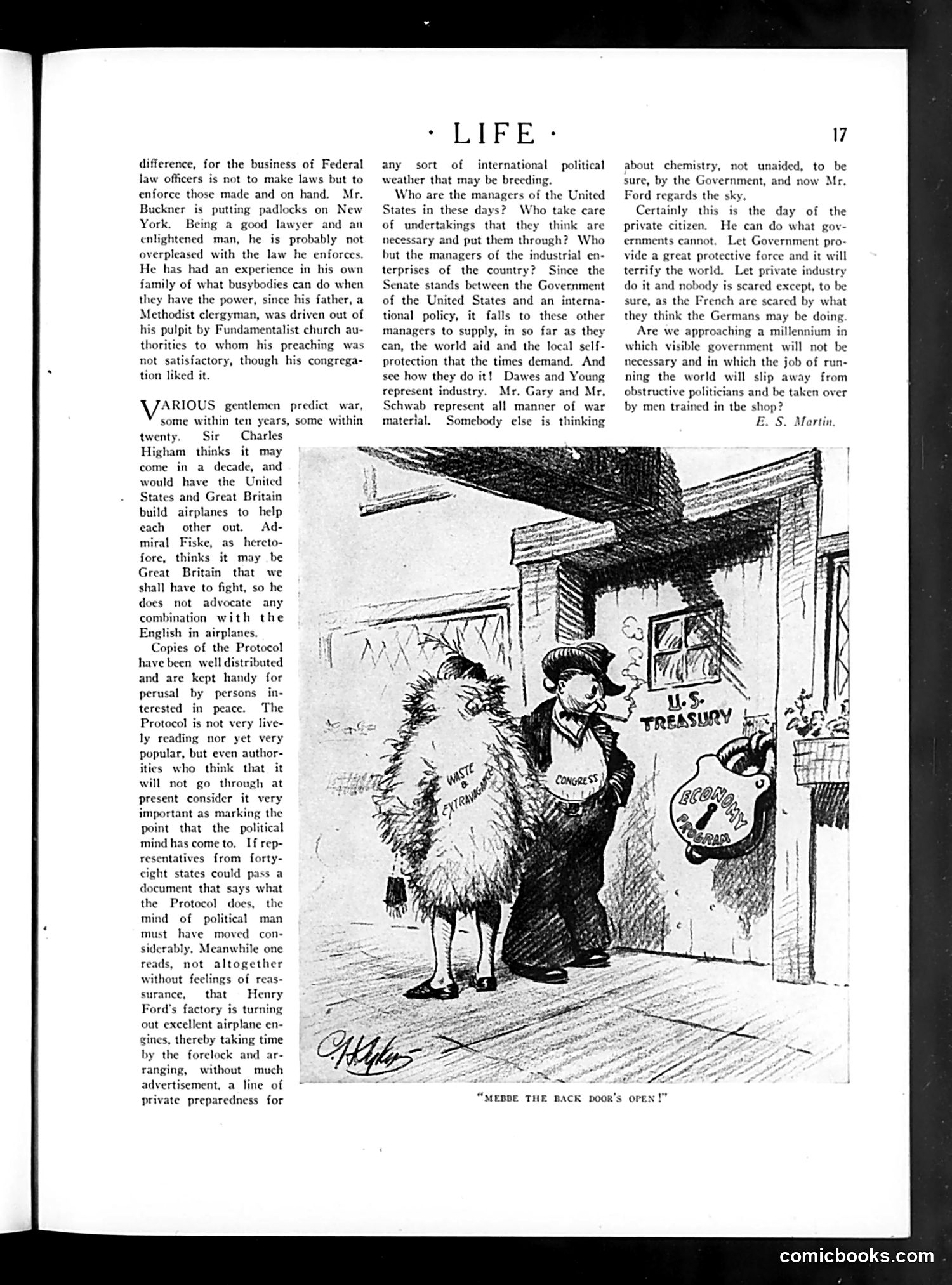
What you’re looking at
This cartoon satirizes Congressional efforts to exclude unwanted foreign influences or goods—likely referencing Prohibition enforcement or tariff policies. The figure labeled "Congress" guards the U.S. Treasury's front entrance, blocking "Contraband" (depicted as a shaggy, disreputable character marked "Illicit" and "Private Enterprise"). The joke: while Congress proudly secures the official entrance, the back door stands wide open—suggesting their legislation is ineffective and smuggling/black-market activity will continue regardless. The businessman figure represents private enterprise circumventing federal controls. The accompanying article discusses how industrial leaders (Dawes, Young, Gary, Ford) increasingly manage national affairs that government cannot, implying that official policy is similarly ineffectual. The cartoon reinforces this theme: government's visible restrictions are performative while real activity happens behind the scenes through private channels.
📄 Transcribed text from this page (OCR, searchable)
Machine-transcribed from the original scan — historical spelling and the odd misread are preserved.
difference, for the business of Federal law officers is not to make laws but to enforce those made and on hand. Mr. Buckner is putting padlocks on New York. Being a good lawyer and an enlightened man, he is probably not overpleased with the law he enforces. He has had an experience in his own family of what busybodies can do when they have the power, since his father, a Methodist clergyman, was driven out of his pulpit by Fundamentalist church au- thorities to whom his preaching w: not satisfactory, though his congrega- tion liked it. ARIOUS gentlemen predict war, some within ten years, some within twenty. Sir Charles Higham thinks it may come in a decade, and would have the United States and Great Britain build airplanes to help each other out. Ad- miral Fiske, as hereto- fore, thinks it may be Great Britain that we shall have to fight, so he does not advocate any combination with the English in airplanes. Copies of the Protocol have been well distributed and are kept handy for perusal by persons in- terested in peace. The Protocol is not very live- ly reading nor yet very popular, but even author- ities who think that it will not go through at present consider it very important as marking the point that the political mind has come to. If rep- resentatives from forty- cight states could pass a document that says what the Protocol does, the mind of political man must have moved con- siderably, Meanwhile one not altogether without feelings of reas- surance, that Henry Ford's factory is turning out excellent airplane en- gines, thereby taking time by the forelock and ar- ranging, without much advertisement, a line of private preparedness for reads, * LIFE, * any sort of international weather that may be breeding. Who are the managers of the United States in these days? Who take care of undertakings that they think are necessary and put them through? Who but the managers of the industrial en- terprises of the country? Since the Senate stands between the Government of the United States and an interna- tional policy, it falls to these other managers to supply, in so far as they can, the world aid and the local self- protection that the times demand. And see how they do it! Dawes and Young represent industry. Mr. Gary and Mr. Schwab represent all manner of war material. Somebody else is thinking political =e te 17 about chemistry, not unaided, to be sure, by the Government, and now Mr. Ford regards the sky, Certainly this is the day of the private citizen. He can do what gov- ernments cannot. Let Government pro- vide a great protective force and it will terrify the world. Let priv do it and nobody is scared except, to be sure, as the French are scared by what they think the Germans may be doing. Are we approaching a millennium in which visible government will not be necessary and in which the job of run- ning the world will slip away from obstructive politicians and be taken over by men trained in the shop? EvS: ¢ industry Martin “MEBBE THE BACK poOR'S OPE, comicbooks.com