
A complete issue · 44 pages · 1925
Life — April 2, 1925
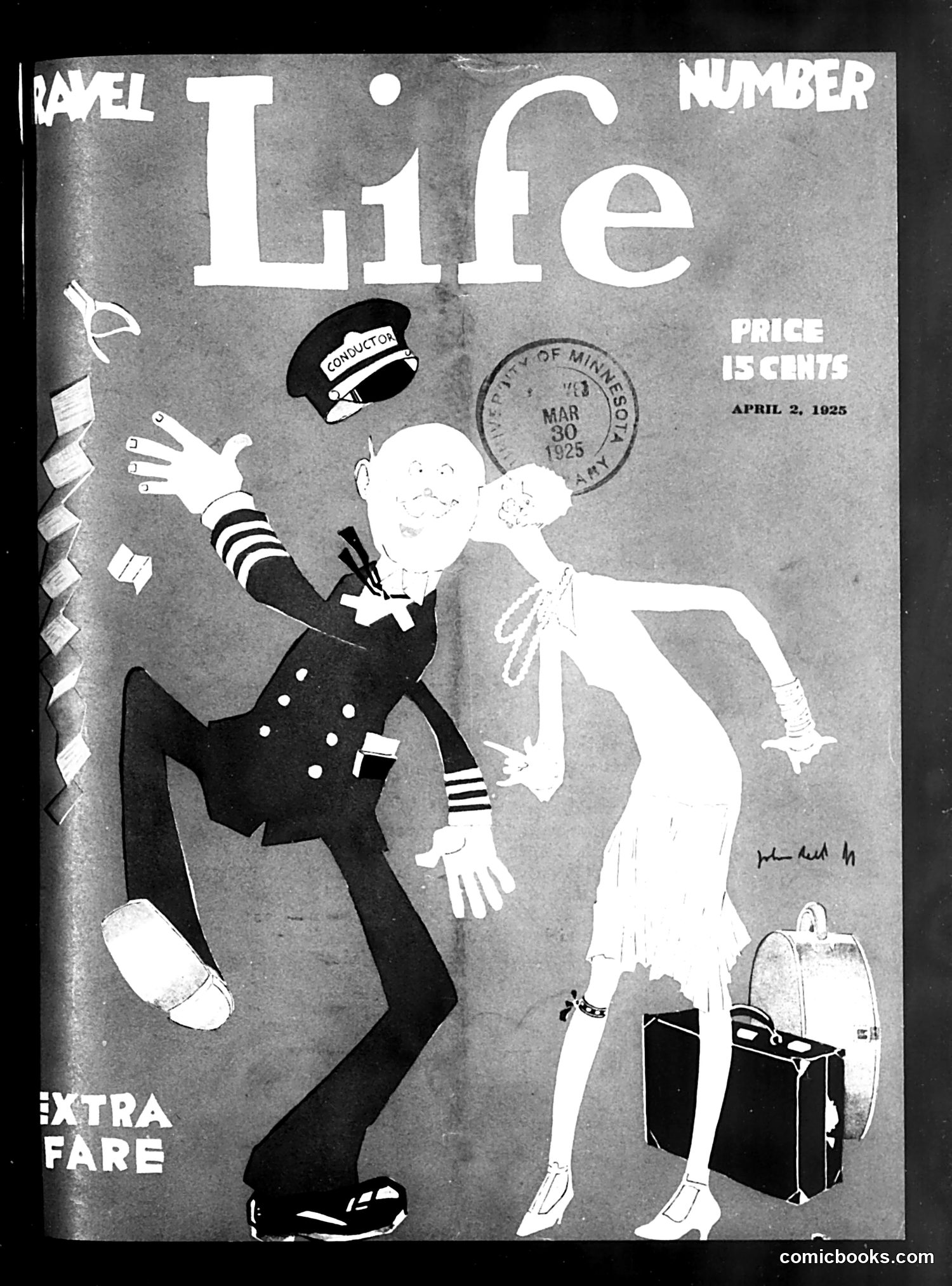
This cover depicts a jazz-age scene featuring a stylishly dressed couple traveling together. The male figure wears a conductor's uniform with striped sleeves, while the female wears a fashionable short 1920s dress with rolled stockings—typical flapper attire. Both carry luggage, suggesting travel or elopement. The "Conductor" label on the man's cap and their casual, somewhat scandalous pose likely satirizes contemporary anxieties about modern youth behavior and loose social conventions. The 1920s witnessed widespread concern among conservatives about flappers, jazz culture, and young people's perceived moral decline. The "extra fare" notation suggests additional commentary about luxury or impropriety. This reflects Life magazine's satirical take on jazz-age social upheaval and generational conflict of the Roaring Twenties.
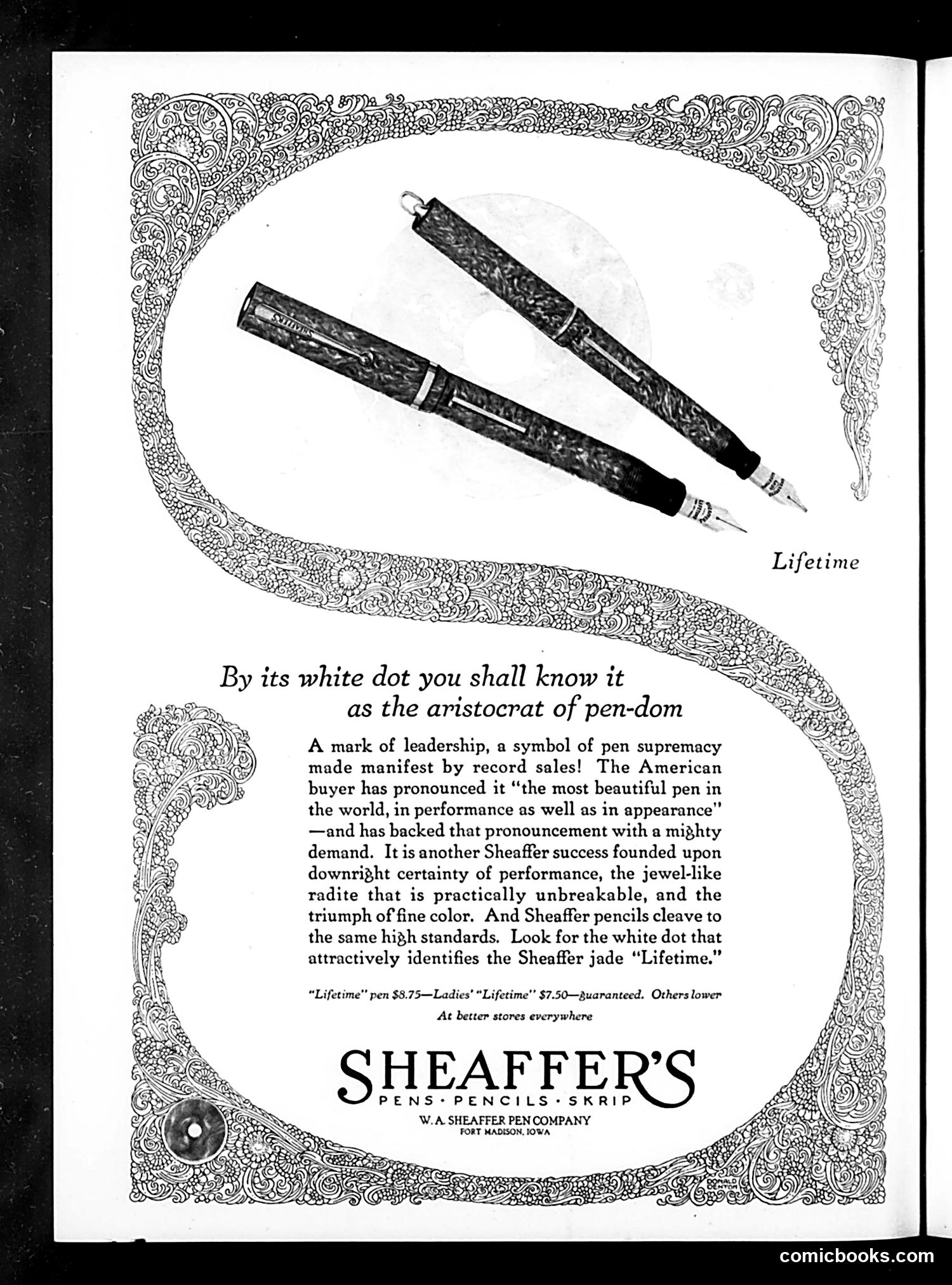
This is not a political cartoon or satire—it's a **straightforward advertisement** for Sheaffer fountain pens and pencils, circa early 20th century. The page displays two "Lifetime" brand writing instruments against an ornate decorative border. The ad claims these pens represent "the aristocrat of pen-dom" and feature a distinctive white dot marking for identification. The copy emphasizes durability ("practically unbreakable"), superior performance, and aesthetic appeal, calling it "the most beautiful pen in the world." Pricing is listed as $8.75 for men's pens and $7.50 for women's models. The company, W.A. Sheaffer Pen Company of Fort Madison, Iowa, positions the product as a status symbol and mark of leadership. This reflects early 20th-century luxury goods marketing targeting affluent consumers.
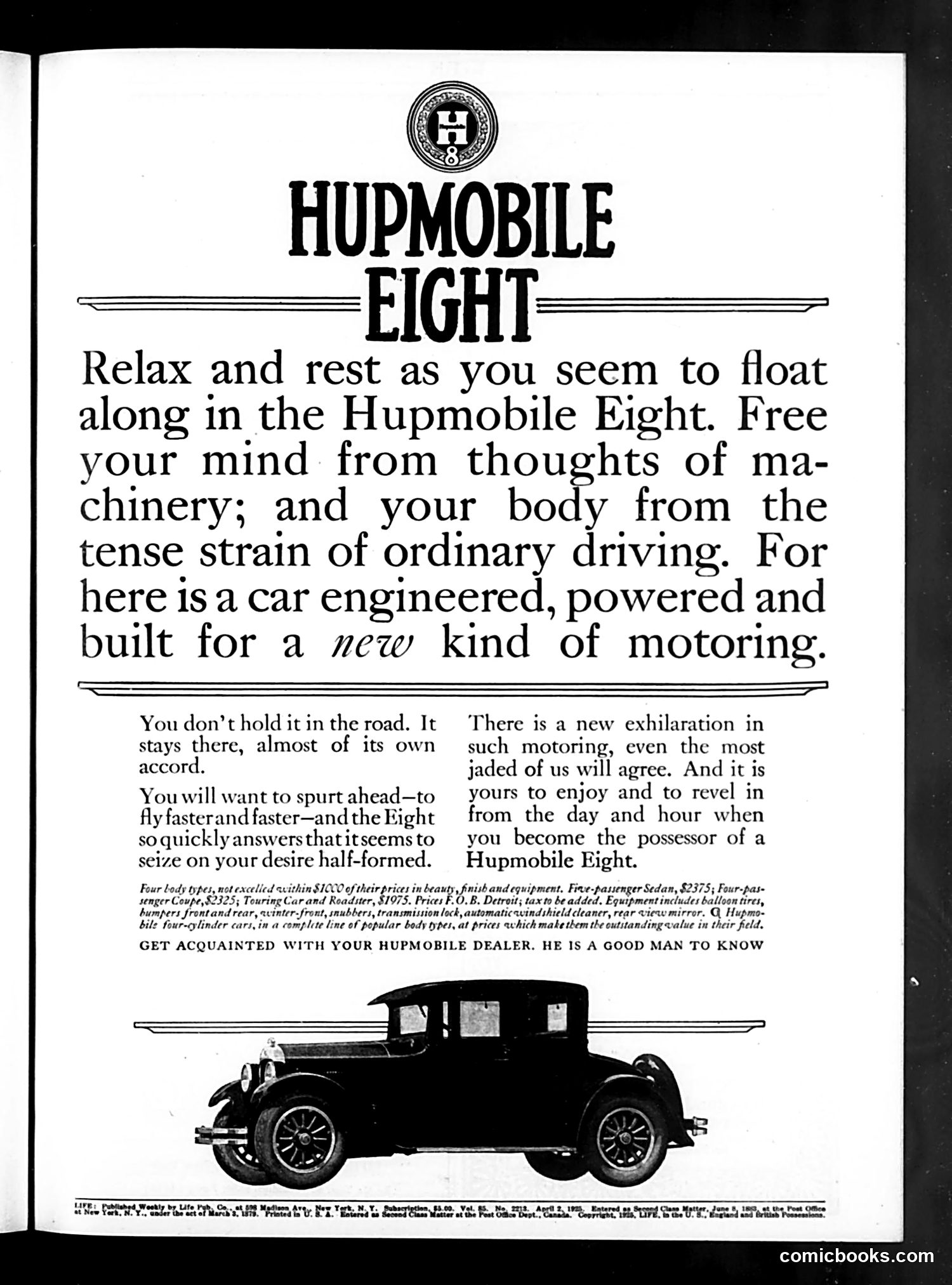
This is **not satire or political commentary** — it's a straightforward automobile advertisement for the Hupmobile Eight, a luxury car model. The ad promotes the vehicle's advanced engineering and comfort features, emphasizing that drivers can "relax and rest" while the car handles itself almost autonomously ("You don't hold it in the road. It stays there, almost of its own accord"). This suggests early automatic transmission or power steering technology — innovations that seemed remarkable to 1920s readers. The marketing pitch emphasizes leisure and effortless driving as status symbols for wealthy consumers. The silhouette illustration shows a sedentary touring sedan typical of the era. This represents marketing language common in Life magazine's advertising section, not editorial content or satire.
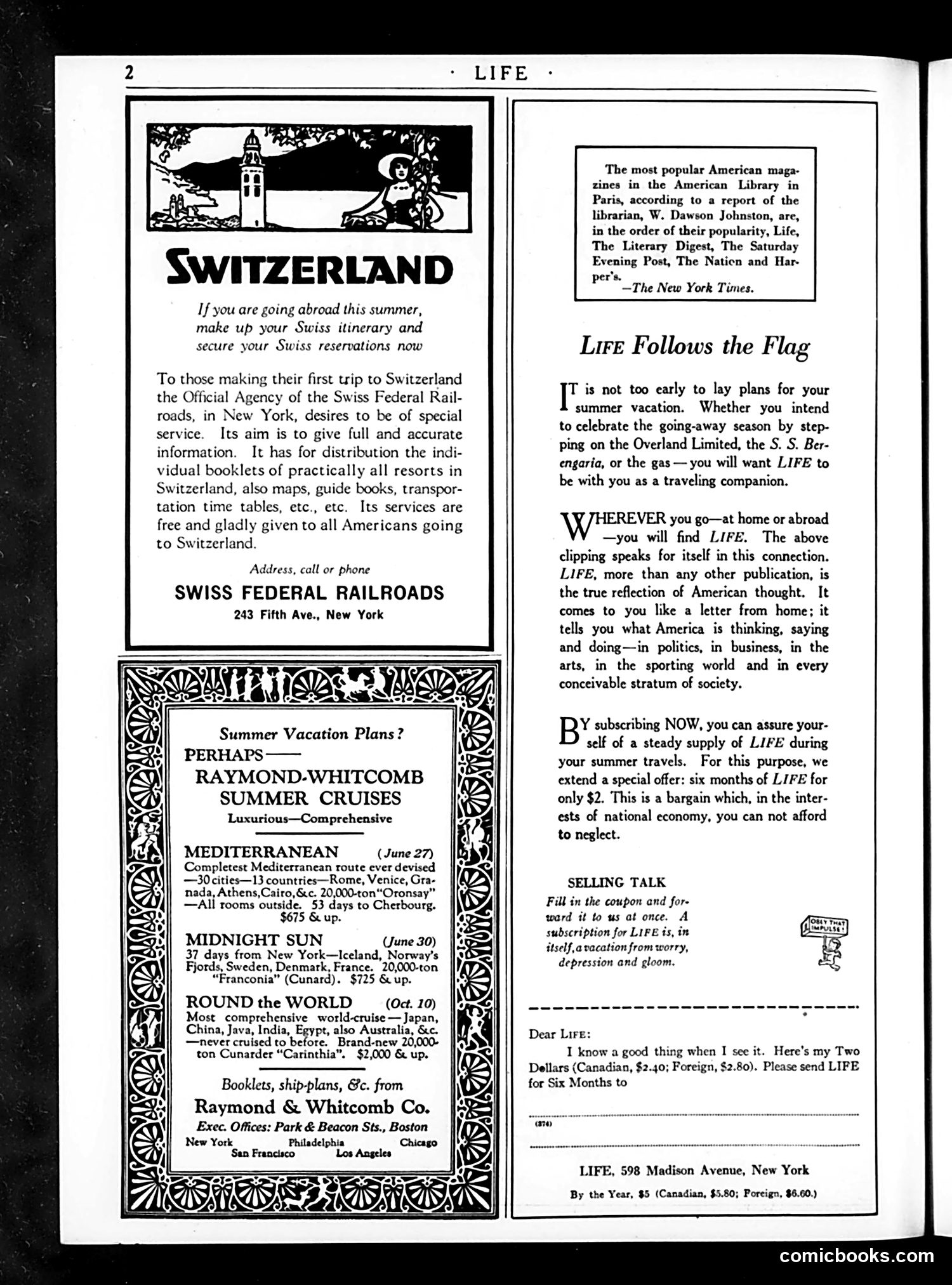
This page is primarily **advertising and promotional content**, not political satire. The left column features a Swiss Federal Railroads advertisement encouraging American summer travel, followed by Raymond & Whitcomb cruise line ads offering Mediterranean, Scandinavian, and world voyages. The right side promotes **Life magazine subscriptions**, with a testimonial section called "Life Follows the Flag." The magazine claims to reflect authentic American thought across politics, business, arts, and society. A subscription offer for six months at $2 is presented as economical patriotic duty. The single illustration appears to be a small **subscription coupon graphic**, not a political cartoon. This is essentially a **magazine house ad**—self-promotion rather than satire.
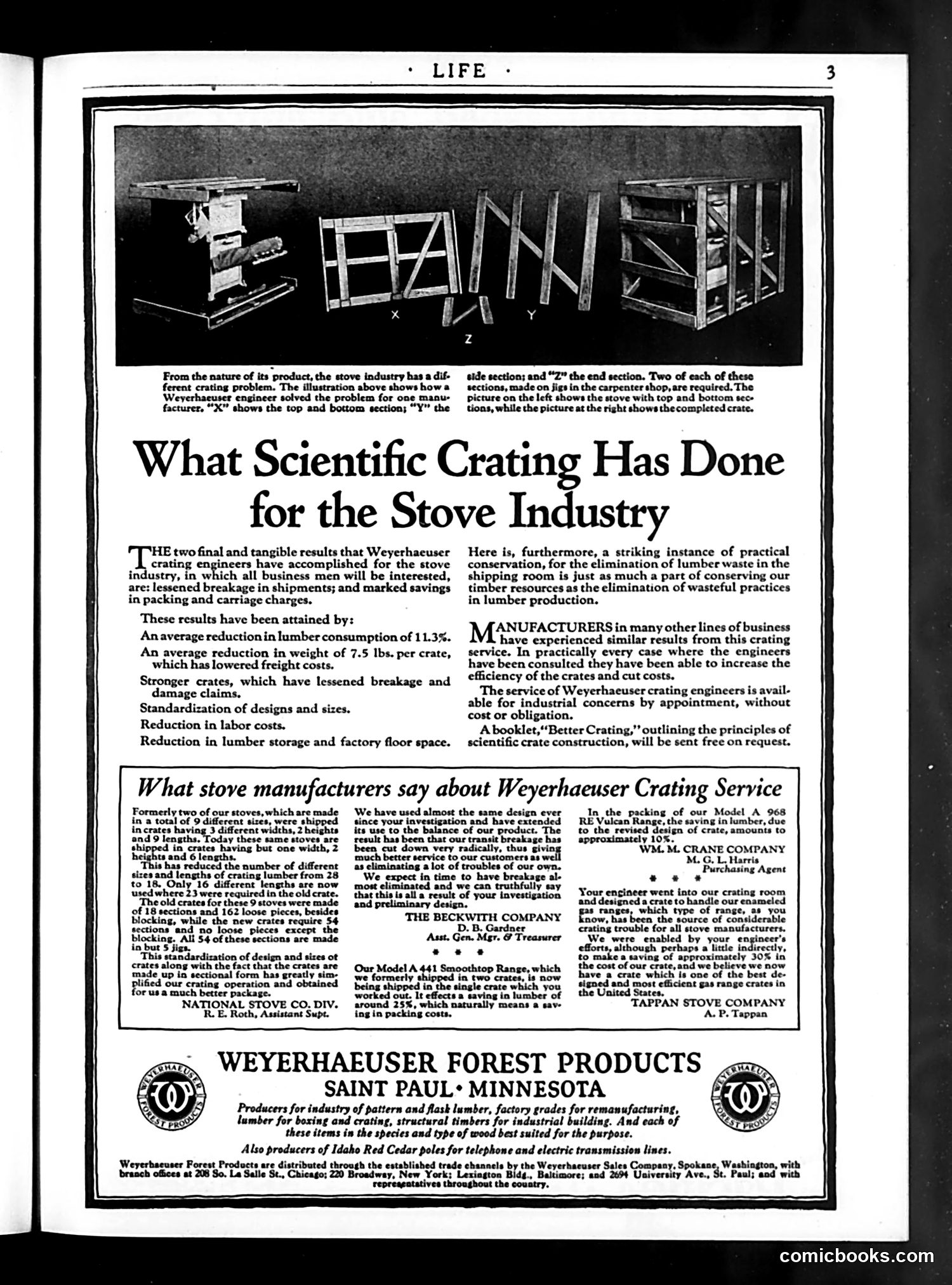
This page is **not a political cartoon or satire**—it's primarily **advertising content** disguised as editorial material. The layout presents what appears to be a technical article titled "What Scientific Crating Has Done for the Stove Industry," featuring diagrams of wooden shipping crates (labeled X, Y, Z). However, the bulk of the page consists of **testimonial advertisements** from stove manufacturers praising Weyerhaeuser's crating engineering services. The "content" functions as promotional material showcasing how scientific crate design reduces shipping damage, lumber waste, and costs. The bottom features a **company advertisement** for Weyerhaeuser Forest Products of Saint Paul, Minnesota. This represents early 20th-century **native advertising**—commercial messaging presented in editorial format to appear as legitimate journalism rather than explicit promotion.
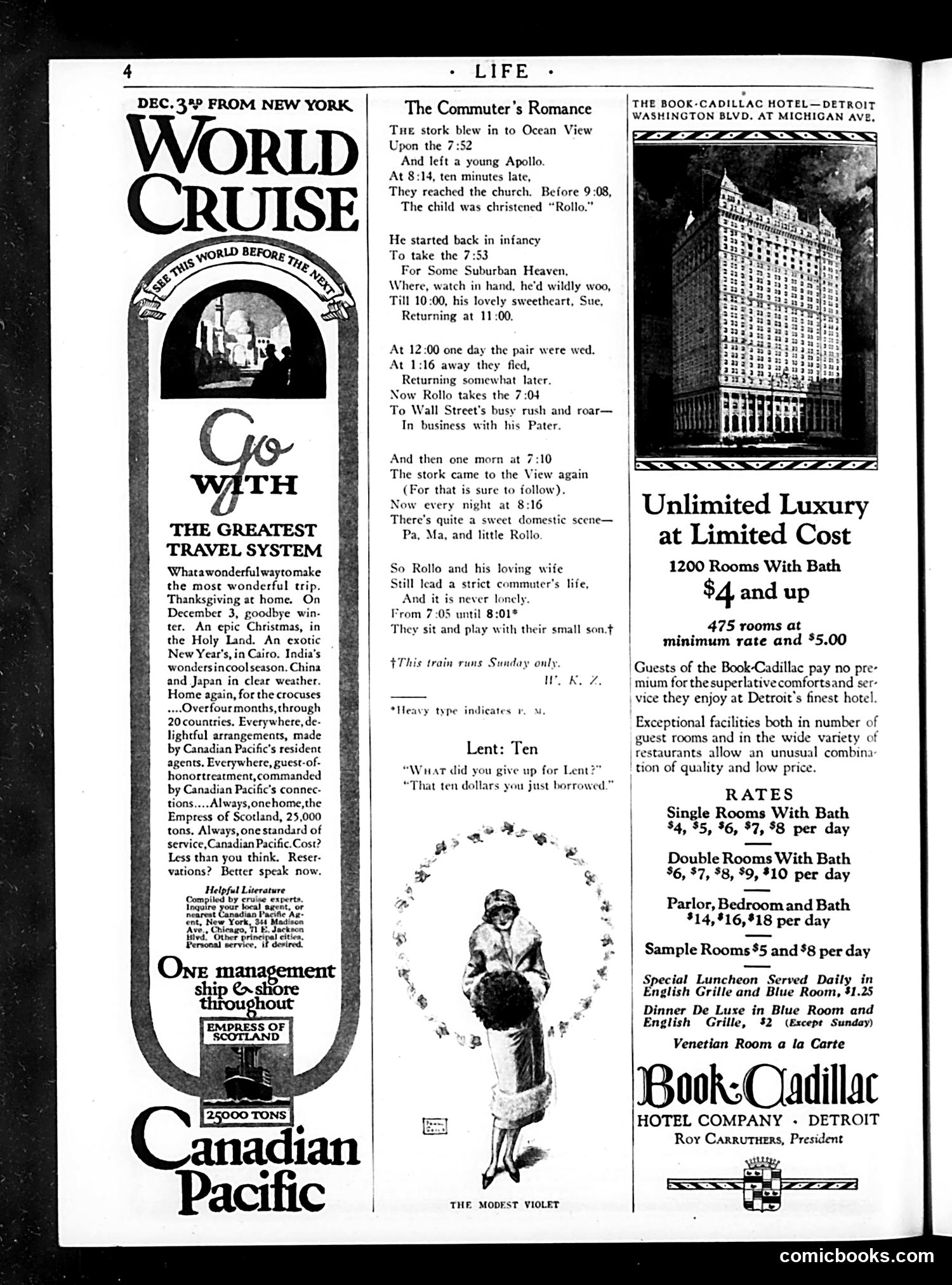
This page is primarily **advertising content** from a December issue of Life magazine, circa 1920s-1930s (based on design and rates). The main illustrated content is "**The Modest Violet**" — a cartoon showing a young woman in a hat surrounded by violet flowers. The accompanying poem, "The Commuter's Romance," is light domestic humor about a man named Rollo who commutes to work while his wife stays home, with the arrival of their baby ("the stork came to the View again"). The satire is gentle: it pokes fun at suburban commuter life and the predictable domestic routine of young married couples — taking trains to work, coming home for dinner, starting families. The "modest violet" illustration plays on Victorian sentimentality about femininity. The rest of the page advertises cruise lines, hotels, and travel services typical of the era's leisure advertising.
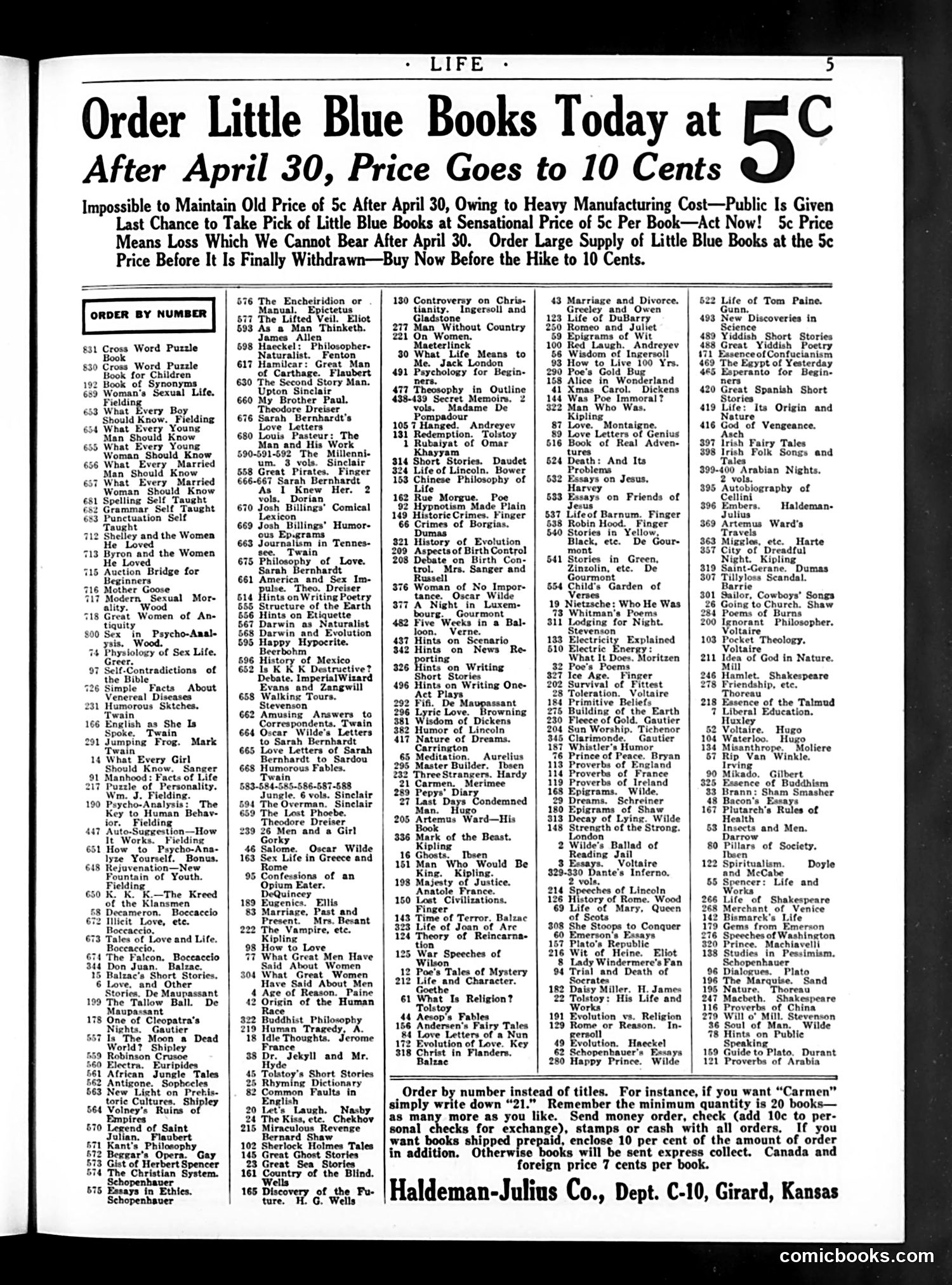
This page is primarily an advertisement for Little Blue Books, a series of inexpensive paperback volumes published by Haldeman-Julius Co. of Girard, Kansas. The advertisement announces a price increase: books currently priced at 5 cents will cost 10 cents after April 30. The ad emphasizes this is the "last chance" to purchase at the lower price, attributing the increase to "heavy manufacturing cost." The bulk of the page consists of an extensive catalog listing hundreds of available titles, organized by order number. Topics range from literature and philosophy to practical guides and humor. There are no political cartoons or satirical illustrations visible on this page—it functions solely as a commercial catalog advertisement, common in early 20th-century magazines like Life.
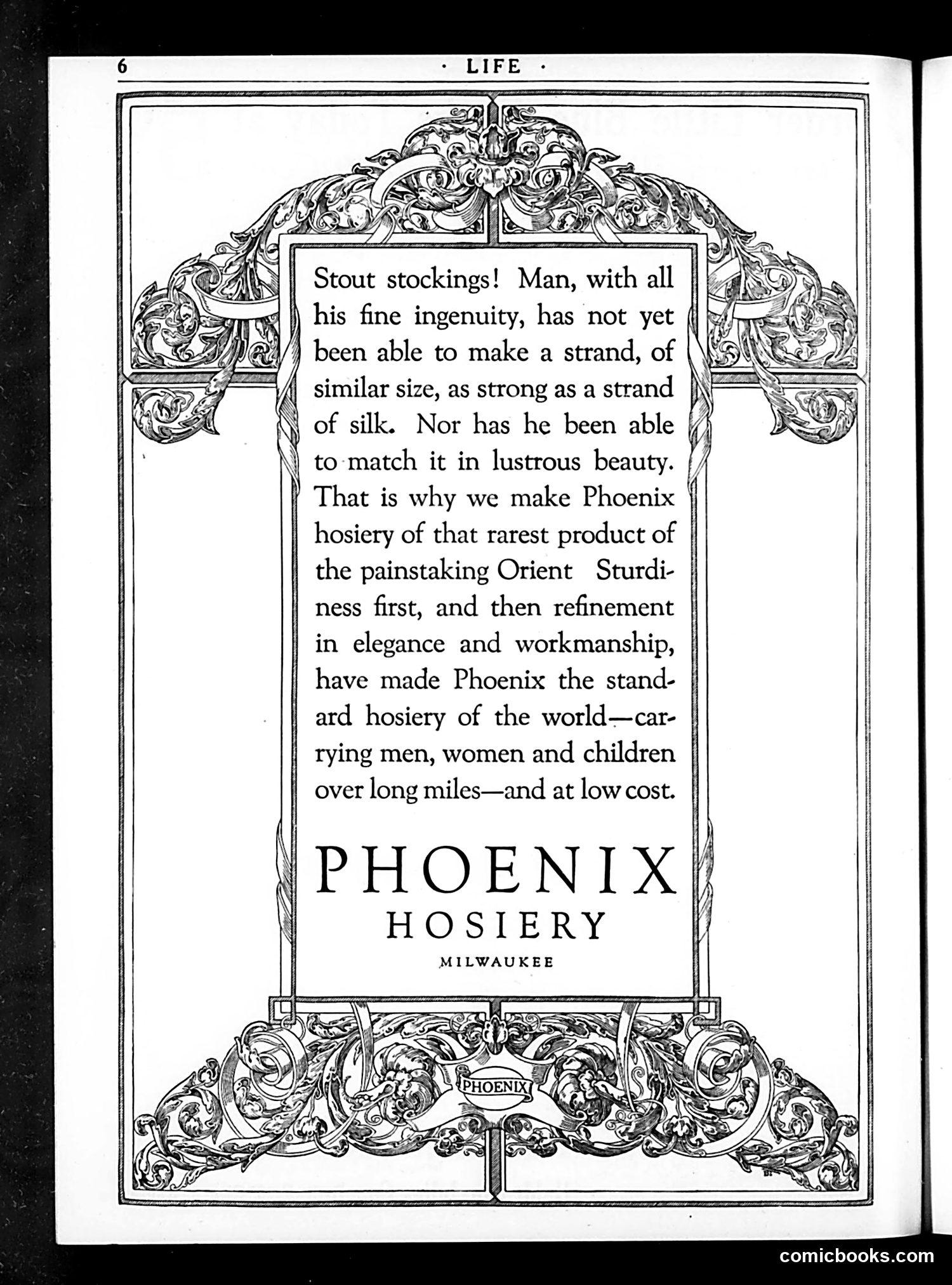
This page is a **commercial advertisement**, not satire or political commentary. It's an ornate, full-page ad for Phoenix Hosiery from Milwaukee. The text makes a straightforward sales pitch: silk stockings made from Oriental silk are superior in strength and beauty compared to synthetic alternatives humans have tried to create. Phoenix claims to use the finest raw materials ("painstaking Orient") combined with refinement in manufacturing, making their product the world standard for hosiery that's also affordable. The elaborate decorative border and formal typography reflect early 20th-century advertising aesthetics aimed at an upscale audience. The ad targets women consumers by emphasizing both durability ("carrying men, women and children over long miles") and elegance—standard marketing approaches for luxury goods during this era.
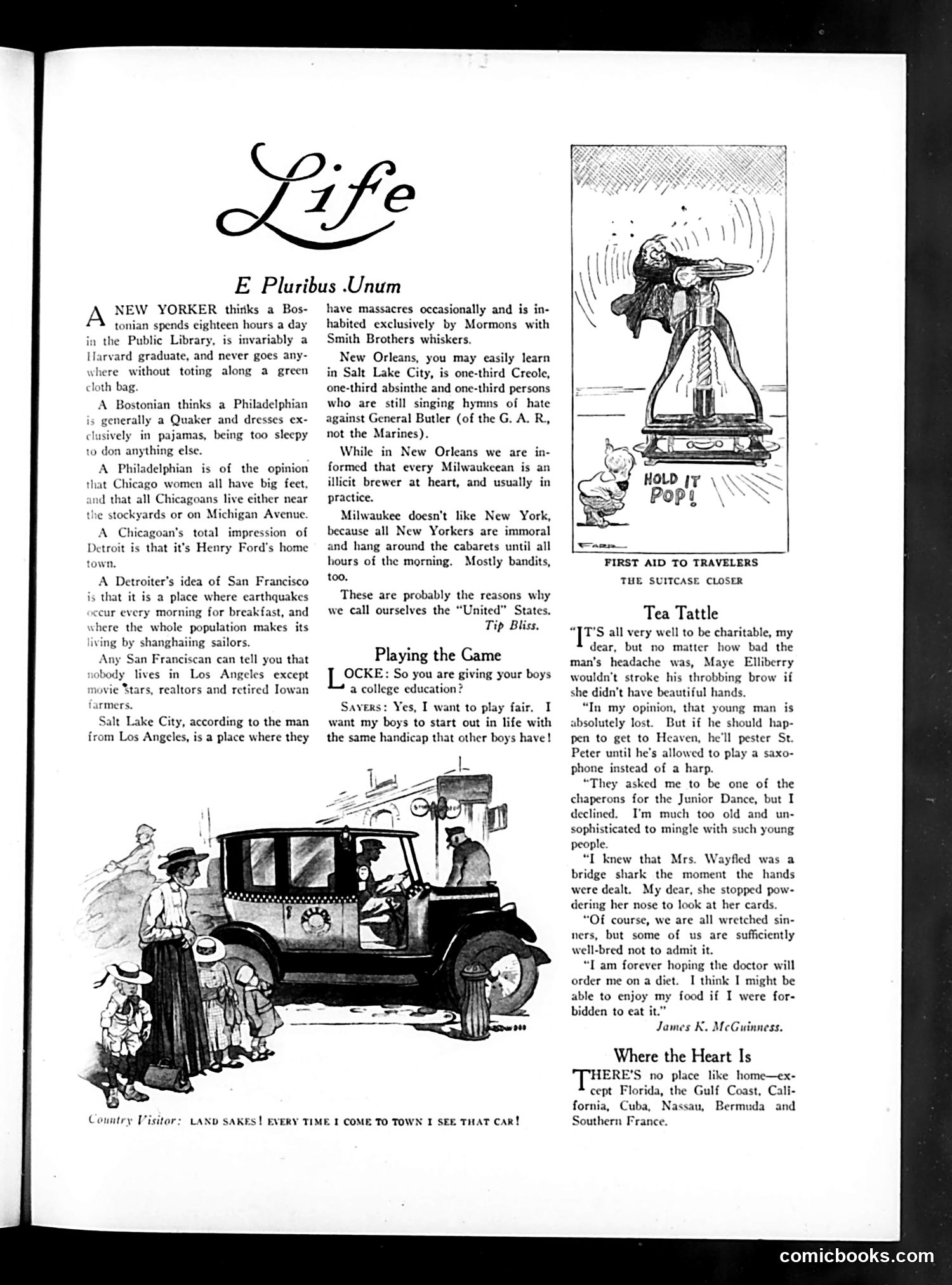
This page contains satirical observations about American regional stereotypes under the heading "E Pluribus Unum" (Out of Many, One). The text mocks various city dwellers: Bostonians are portrayed as Harvard graduates carrying green cloth bags, Philadelphians as Quakers, Chicagoans as having big feet, and New Orleanians as partially Creole speakers. The cartoon shows a taxi driver and pedestrians, captioned "Country Visitor: LAND SAKES! EVERY TIME I COME TO TOWN I SEE THAT CAR!" This jokes about urban modernity and automobiles being increasingly commonplace, surprising rural visitors. The other illustrated section, "First Aid to Travelers," offers humorous anecdotes about regional attitudes and social behaviors, all maintaining the magazine's satirical tone about American diversity and regional differences.
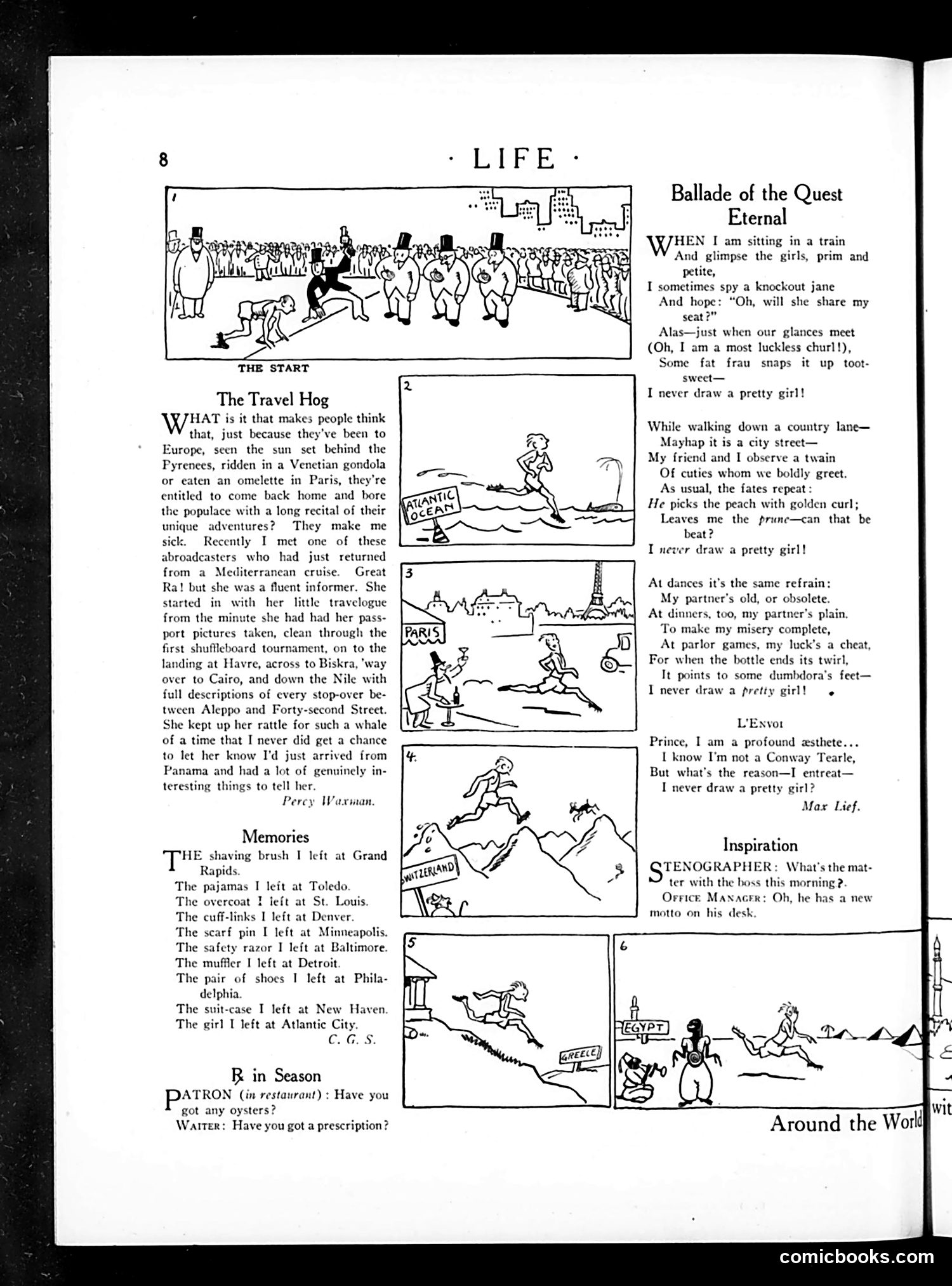
This page presents humorous commentary on early-20th-century social courtship rituals. "The Travel Hog" mocks tourists who boast about European trips—the author met someone who claimed extensive travel but proved unreliable as a dinner companion. The comic strip sequence (panels 1-6) illustrates a man's unsuccessful romantic quest across locations: starting from a crowd, traveling via Atlantic Ocean, through Paris, Switzerland, Greece, and Egypt. Each panel suggests repeated romantic failure despite geographic variety. The "Ballade of the Quest" poem reinforces this theme—a man laments never drawing "a pretty girl," meaning never winning romantic interest despite varied attempts and encounters. The satire targets masculine vanity: travel experiences and worldly sophistication fail to guarantee romantic success. The joke emphasizes that charm and genuine connection matter more than cosmopolitan credentials.
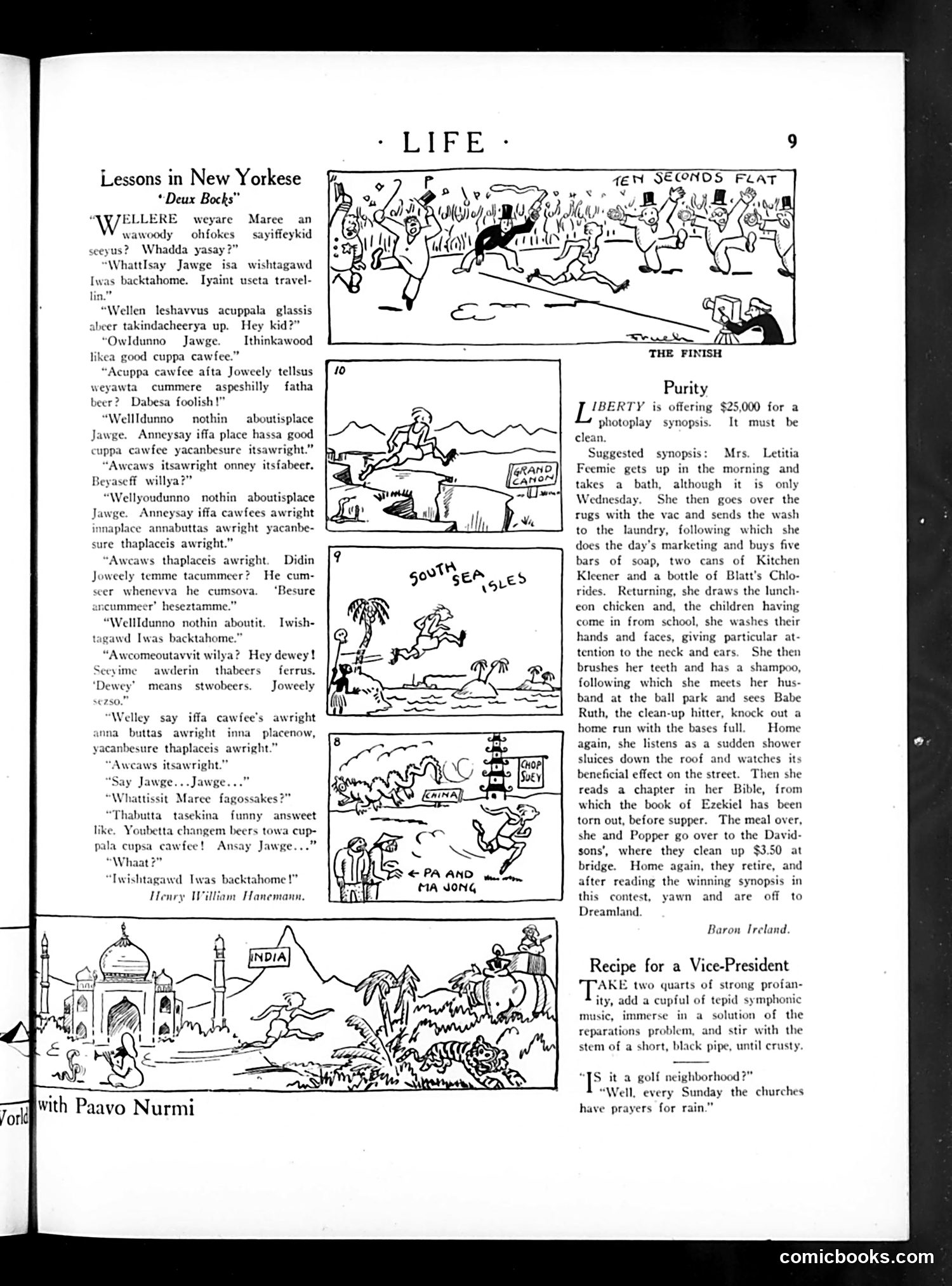
This page contains humorous content rather than political satire. The top section, "Lessons in New Yorkese," presents a comedic dialogue in exaggerated New York dialect—a common ethnic humor trope of the era. The speaker uses intentionally fractured English ("Whadda yasay?" "Hey kid?") to mock working-class New Yorkers. Below are cartoon vignettes depicting tourist destinations: "Ten Seconds Flat" (appears to show a crowded beach scene), "The Finish" (a race), locations in the South Seas, and what appears to be India. The right column contains "Purity," a humorous playlet synopsis about a housewife's daily routine, and "Recipe for a Vice-President," a satirical recipe using medicinal/alchemical language to mock political figures. The humor targets working-class accents and domestic stereotypes typical of 1920s-era satirical magazines.
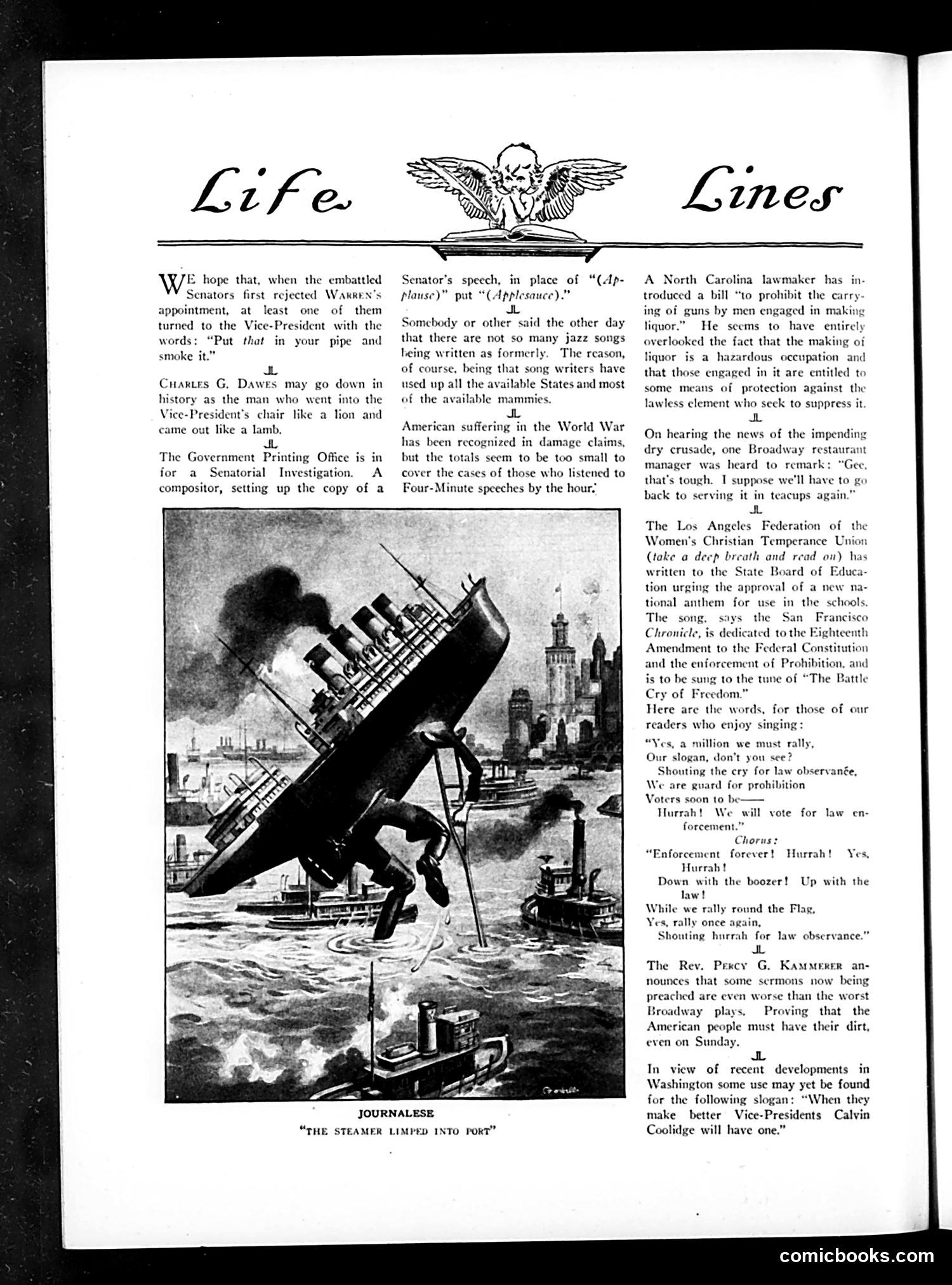
This political cartoon depicts a heavily damaged steamship struggling into harbor, personified as limping with a crutch. The ship's hull is twisted and compromised, with smoke rising from the water below. The visual metaphor represents America's damaged condition following World War I. The text references "American suffering in the World War" and discusses war damage claims, suggesting the cartoon illustrates the nation's economic and social wounds from the conflict. The surrounding "Life Lines" column discusses various post-war topics—Prohibition enforcement, jazz music regulation, and civic recovery—all reflecting 1920s anxieties about America's ability to restore itself after global conflict and internal divisions.
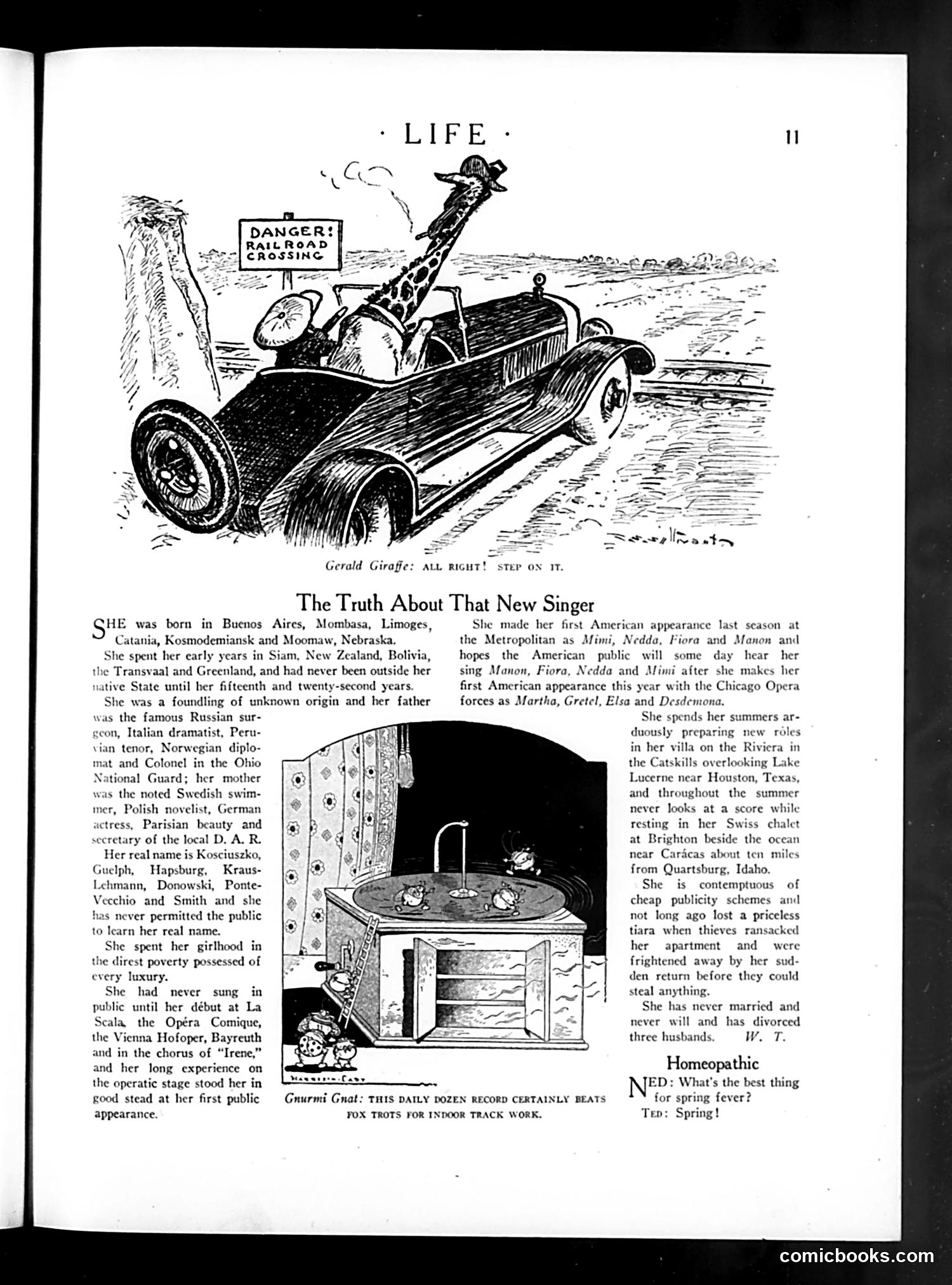
The top cartoon depicts a giraffe in an automobile approaching a "Danger! Railroad Crossing" sign. The giraffe's long neck extends comically high above the vehicle, creating an obvious hazard for railroad crossing wires or structures. The satire appears to target either: 1. Oblivious drivers ignoring warning signs, or 2. The absurdity of certain situations being inherently dangerous regardless of precautions The giraffe—an exotic, out-of-place animal—may represent something incongruous or dangerous operating in ordinary traffic contexts. The caption attributes the image to "Gerald Giraffe," suggesting this is a recurring character. The rest of the page contains an article about a new opera singer and a brief joke section, unrelated to the cartoon.
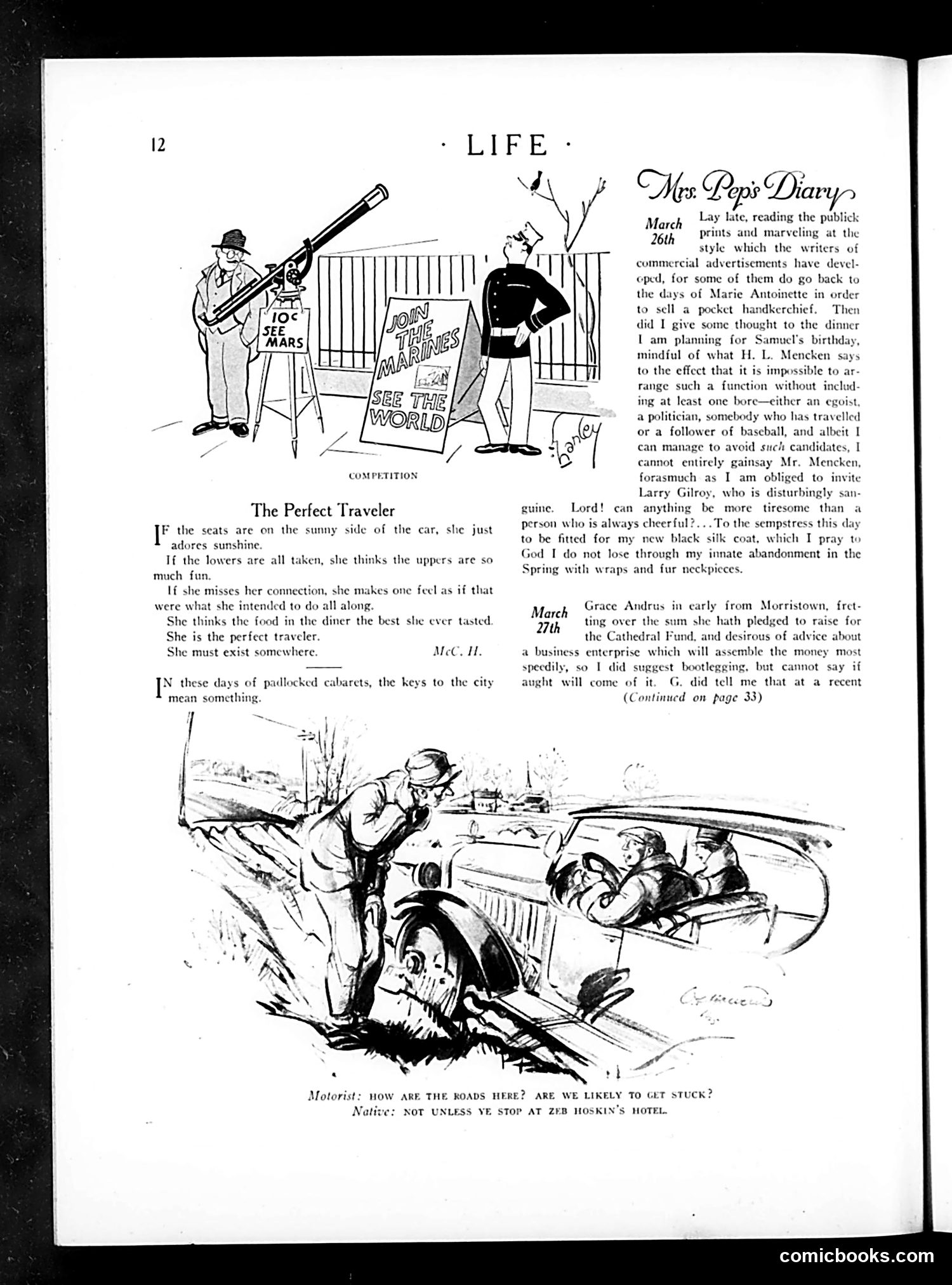
This page contains two pieces of satirical content about travel: **"The Perfect Traveler"** (top) uses poetic verse to mock the ideal passenger—someone who doesn't complain about uncomfortable seats, missed connections, or poor dining car food. The satire suggests travelers were chronically dissatisfied with rail travel experiences. **The motorist cartoon** (bottom) satirizes early automobile travel hazards. A motorist asks about road conditions; a Native American ("Natie") responds that roads are passable only if you stop at "Zeb Hoskin's hotel," implying that roadside establishments profited from travelers stranded by poor road conditions. This mocks both terrible roads and the business opportunism they enabled in the early automotive era.
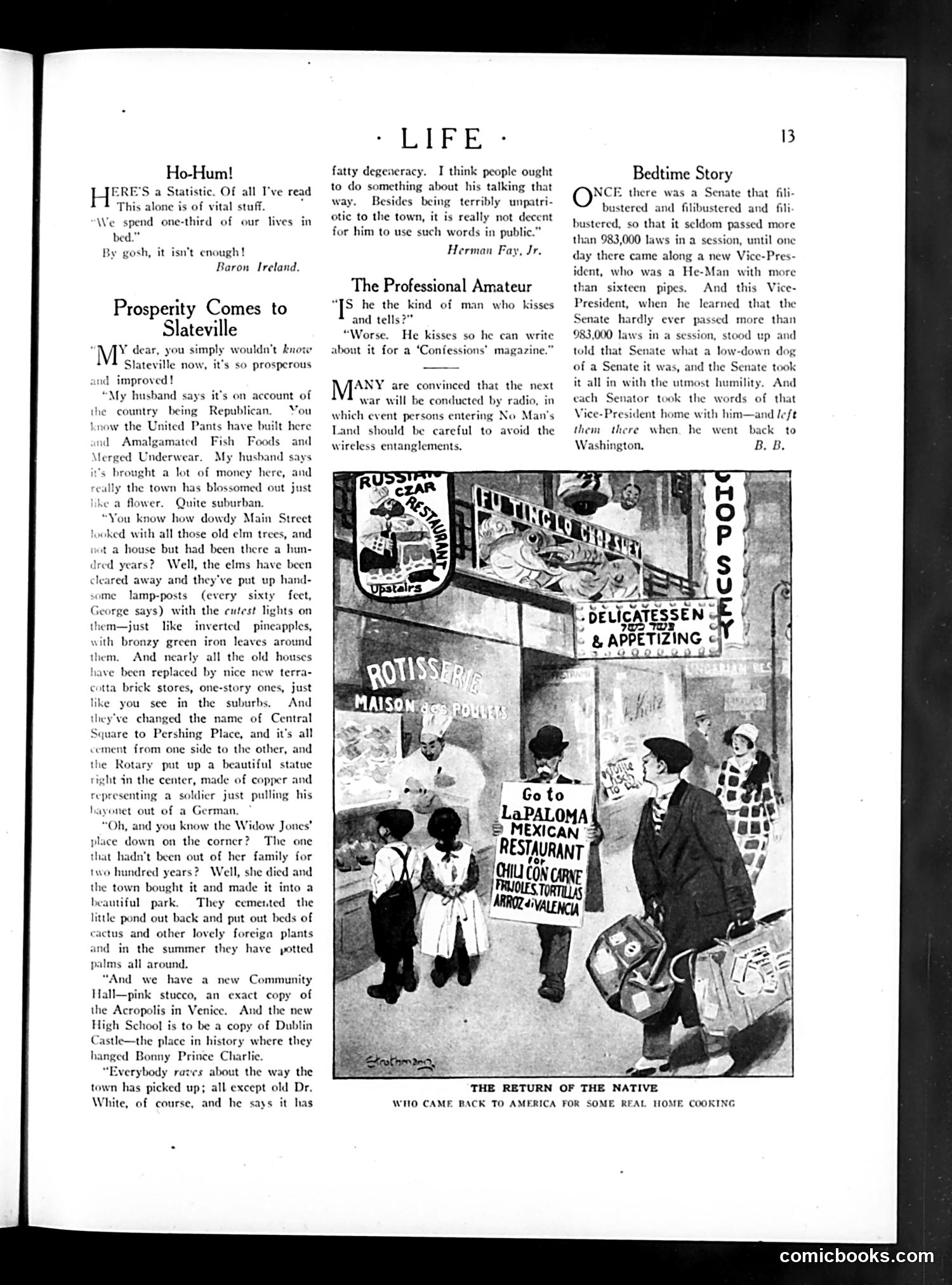
This cartoon satirizes American immigrants returning home after time abroad, specifically seeking authentic ethnic cuisine. The image shows people outside various ethnic restaurants—a Russian tearoom, delicatessen, rotisserie, and "La Paloma Mexican Restaurant"—advertising traditional dishes like chili con carne and arroz a la valenciana. The caption's title references Thomas Hardy's novel about homecoming, suggesting irony: these "natives" have returned to America but must visit ethnic restaurants to find "real home cooking" from their countries of origin. The satire critiques both immigrant nostalgia and America's emerging ethnic restaurant culture as a commercialized substitute for authentic domestic cooking. The cartoon reflects early 20th-century attitudes toward immigrant communities and their culinary traditions.
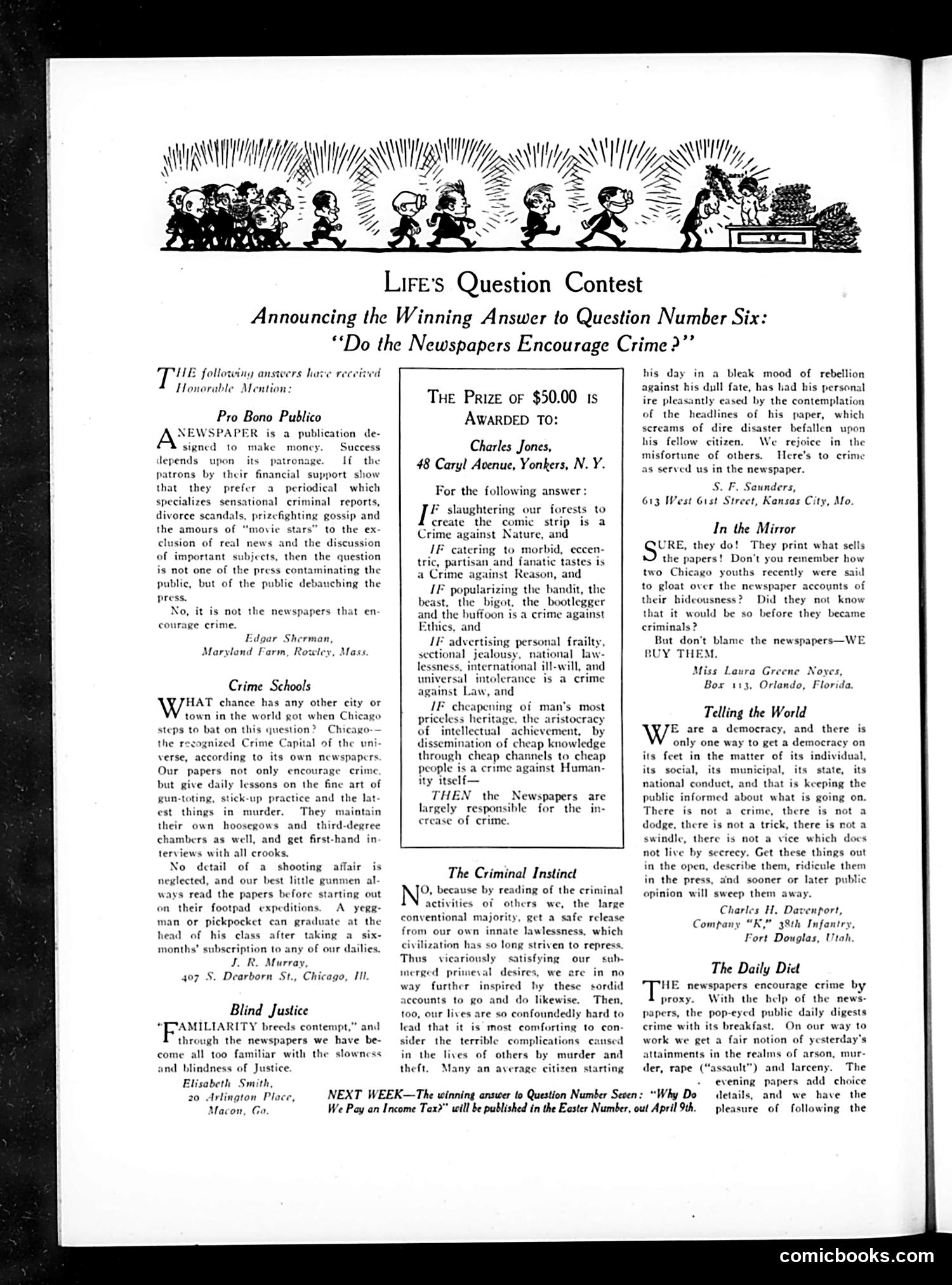
This page announces the winning answer to a debate question about whether newspapers encourage crime. The winning response by Charles Jones of Yonkers, NY argues that yes, newspapers do encourage crime—by sensationalizing crime reporting, glorifying criminals, and catering to morbid tastes rather than promoting reason and ethics. The page also includes responses from other contestants offering competing arguments: that newspapers actually provide transparency; that crime stems from human nature rather than press coverage; and that newspapers help expose criminal activity. The cartoon at the top shows silhouetted figures following a leader toward a trophy or prize, visually representing the contest's competitive nature. This was apparently a recurring reader-participation feature in Life magazine.
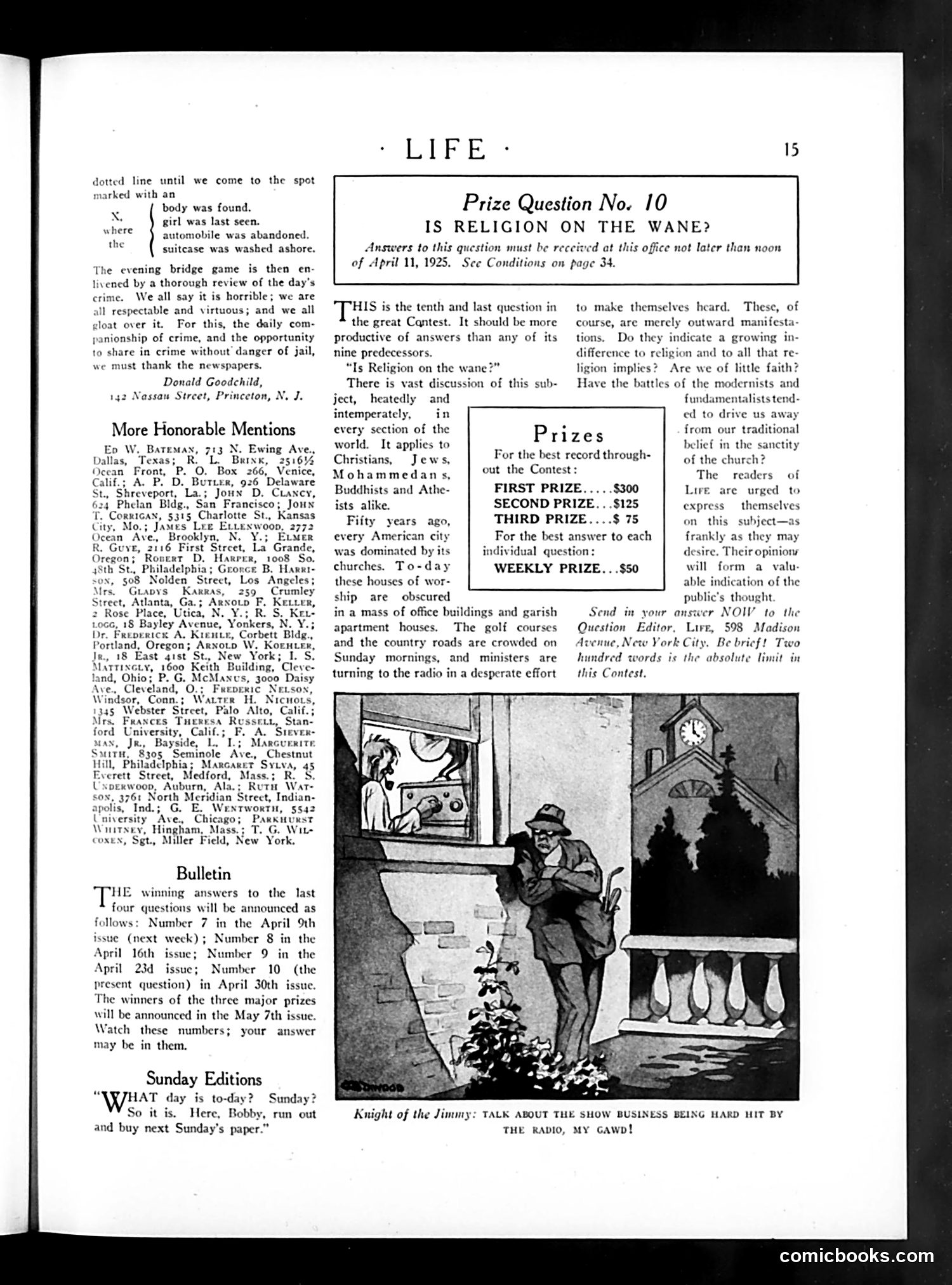
This cartoon satirizes radio's impact on entertainment and business. The image shows a man at a window looking at a clock, while silhouettes of people gather outside—apparently drawn by a radio broadcast rather than attending live entertainment venues. The caption reads: "TALK ABOUT THE SHOW BUSINESS BEING HARD HIT BY THE RADIO, MY GAWD!" The joke targets radio's disruptive effect on traditional entertainment industries (theater, cinema, nightclubs). Instead of paying customers attending live performances, audiences now stay home listening to radio broadcasts for free. This represents genuine economic anxiety from the 1920s about how radio technology was fundamentally disrupting existing entertainment and business models—a concern paralleling modern streaming's impact on traditional media.
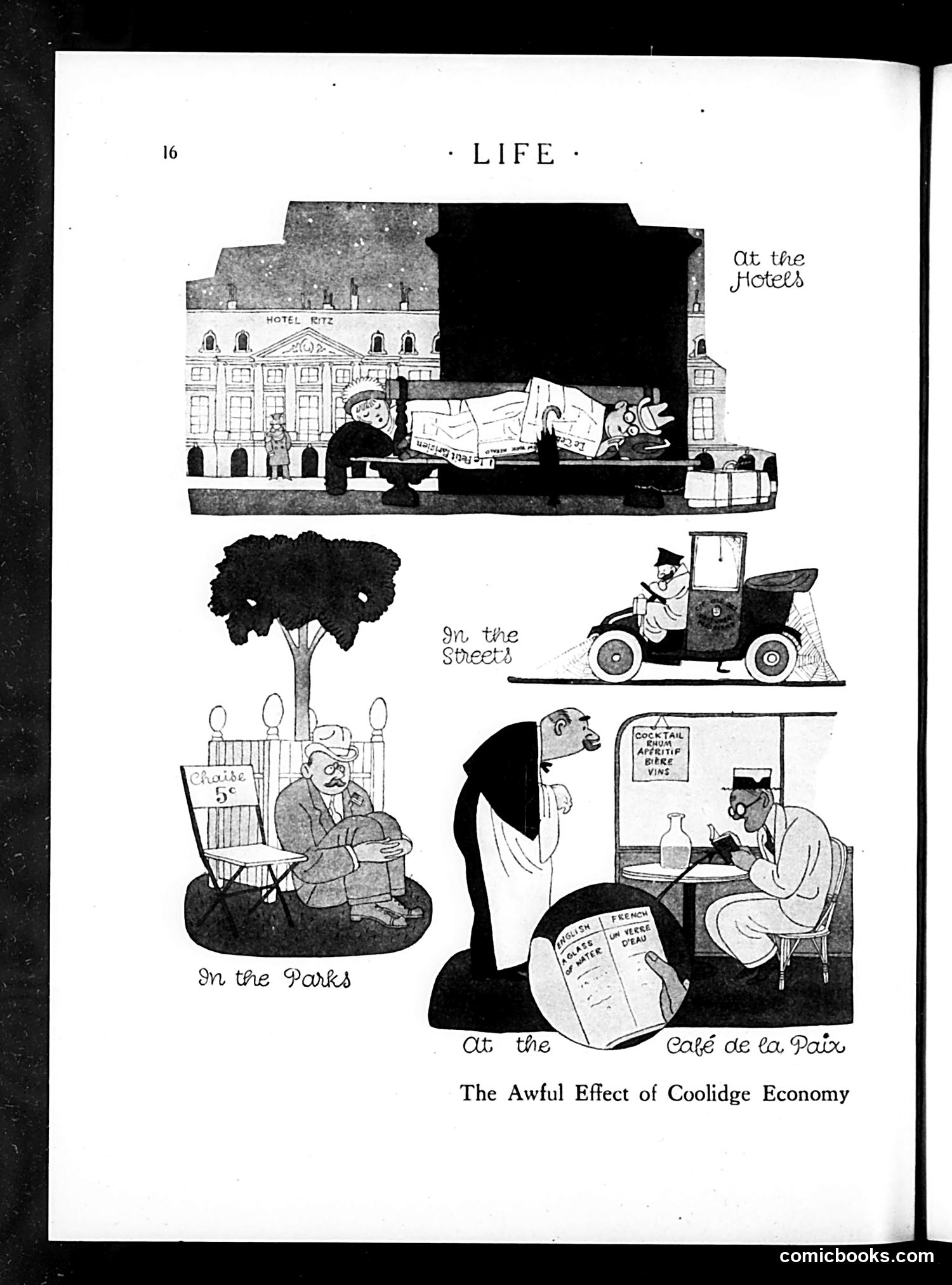
This satirical page depicts the negative consequences of President Calvin Coolidge's cost-cutting policies. The title "At the Hotels" shows a theatrical stage collapsing under financial strain. "In the Streets" depicts a broken-down automobile, suggesting deteriorating infrastructure and commerce. "In the Parks" shows a man in reduced circumstances sitting alone—contrasting with better times. "At the Café de la Paix" depicts a man reading what appears to be a bill or invoice, suggesting financial hardship. The satire argues that Coolidge's economy measures—while intended to reduce government spending—have had widespread harmful effects on business, entertainment, public services, and ordinary citizens' quality of life. The cartoon criticizes these policies as counterproductive and economically damaging.
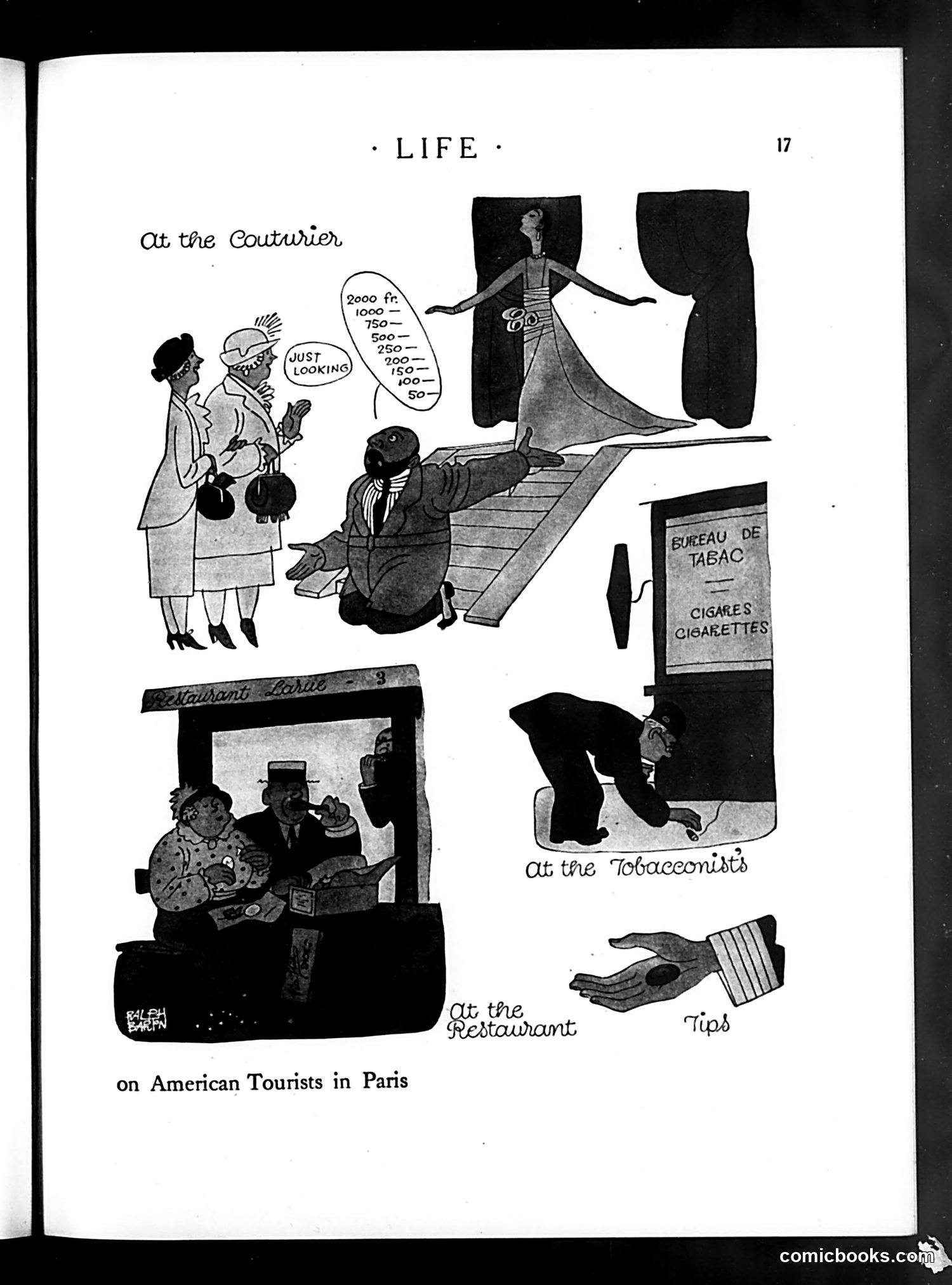
This satirical page mocks American tourists visiting Paris through four vignettes. "At the Couturier" shows tourists gawking at an expensive haute couture model, with dialogue listing inflated prices (2000 francs down to 50). "At the Tobacconist's" depicts a tourist at a cigarette shop. "At the Restaurant" shows diners at a French establishment, and "Tips" illustrates the cultural clash over gratuities—a distinctly American custom. The cartoons play on stereotypes of wealthy but unsophisticated American tourists abroad: their conspicuous consumption, inability to understand French customs, and reputation for excessive spending. The exaggerated prices and caricatured figures emphasize Parisians' exploitation of American visitors' wealth and naïveté during this era of American tourism abroad.
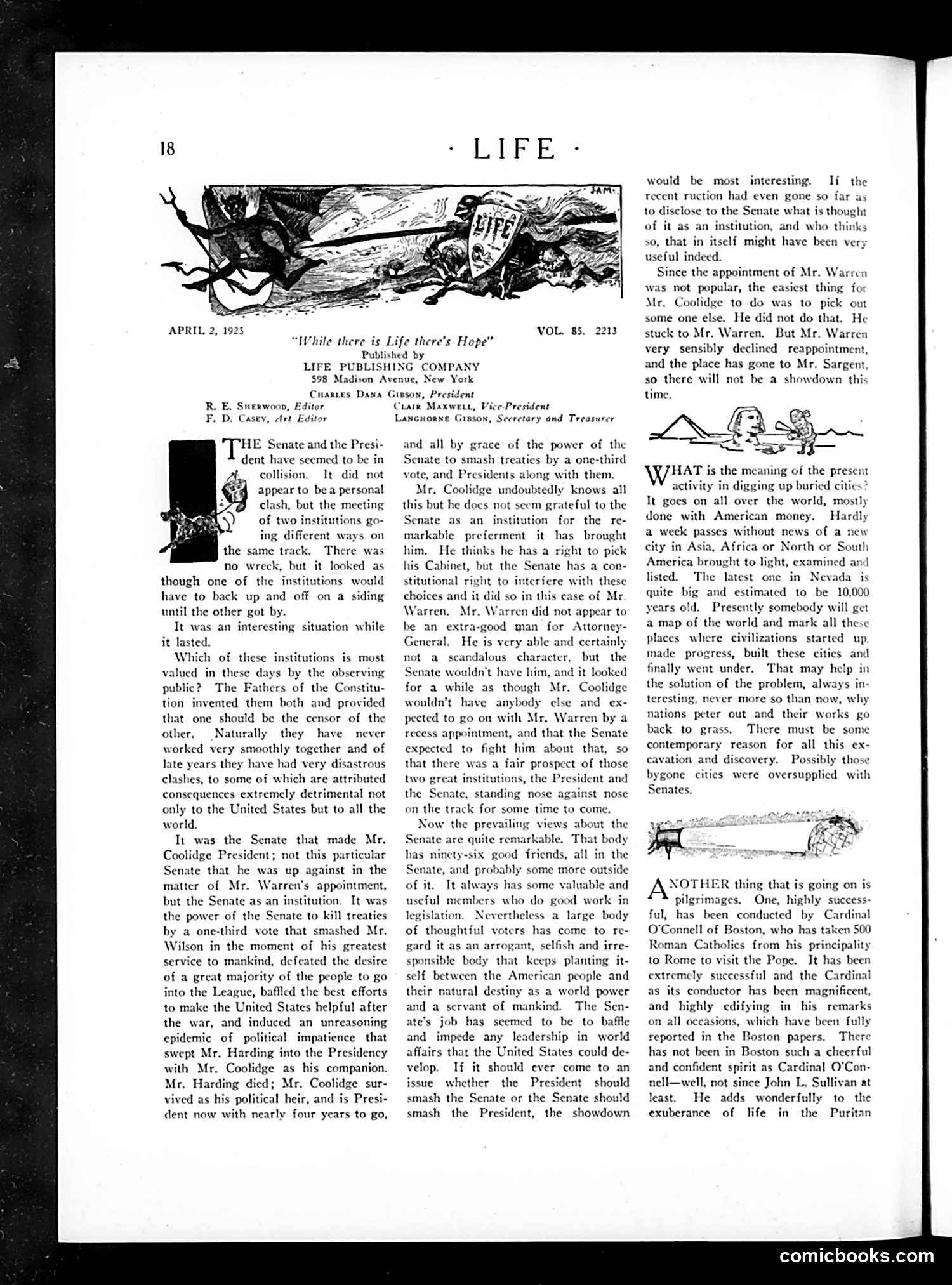
This page discusses a recent constitutional clash between President Calvin Coolidge and the U.S. Senate over Coolidge's cabinet appointment of Mr. Warren as Attorney General. The Senate blocked the nomination, asserting its constitutional right to reject presidential choices. The article argues that while the Senate's power has historically benefited Coolidge (they helped elevate him to the presidency after Harding's death), he appears ungrateful. The editorial presents this as a larger institutional conflict: the Senate is characterized as an "arrogant, selfish and irresponsible body" that impedes American leadership and world power, consistently blocking progressive initiatives. The cartoon at top—showing a figure near a headstone marked "LIFE"—appears to reference the magazine's own stakes in this debate about governmental effectiveness.
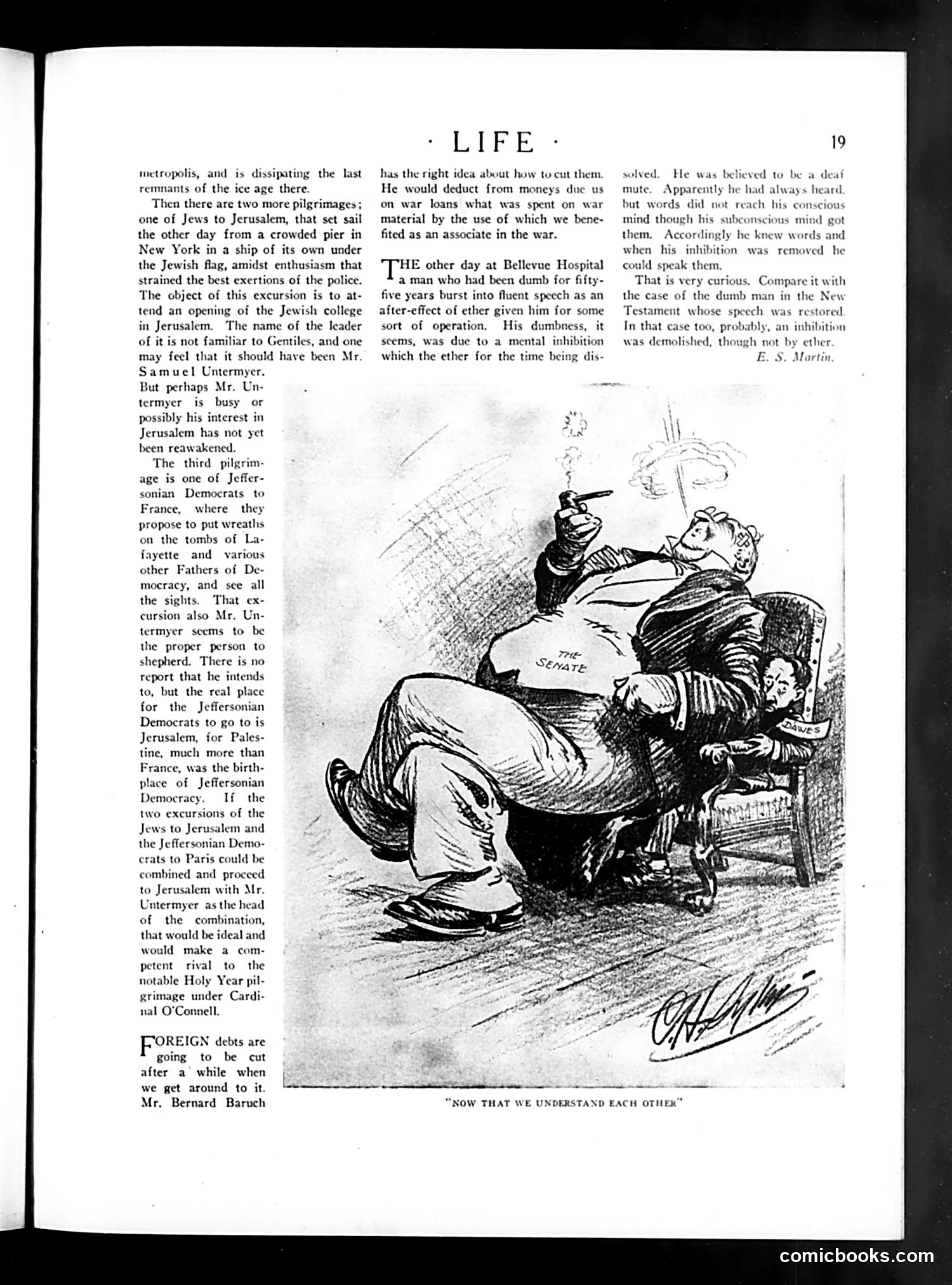
The main cartoon depicts two rotund figures labeled "THE SENATE" in apparent agreement or understanding. The satire concerns political compromise and mutual benefit between parties who previously opposed each other. The surrounding text discusses three pilgrimages: Jews traveling to Jerusalem for a college opening, Jeffersonian Democrats visiting France to honor democratic founders, and a sardonic suggestion that Samuel Untermyer should lead a combined expedition to Jerusalem instead—implying Jerusalem (Palestine), not France, was democracy's true birthplace. The cartoon's caption, "Now That We Understand Each Other," suggests the Senate has reached some backroom deal or compromise, possibly regarding foreign debts (mentioned in the text) or war reparations. The joke satirizes how politicians achieve agreement through mutual self-interest rather than principle. The page also includes an anecdote about a deaf-mute who regains speech after anesthesia, used as a philosophical parallel about removing mental inhibitions.
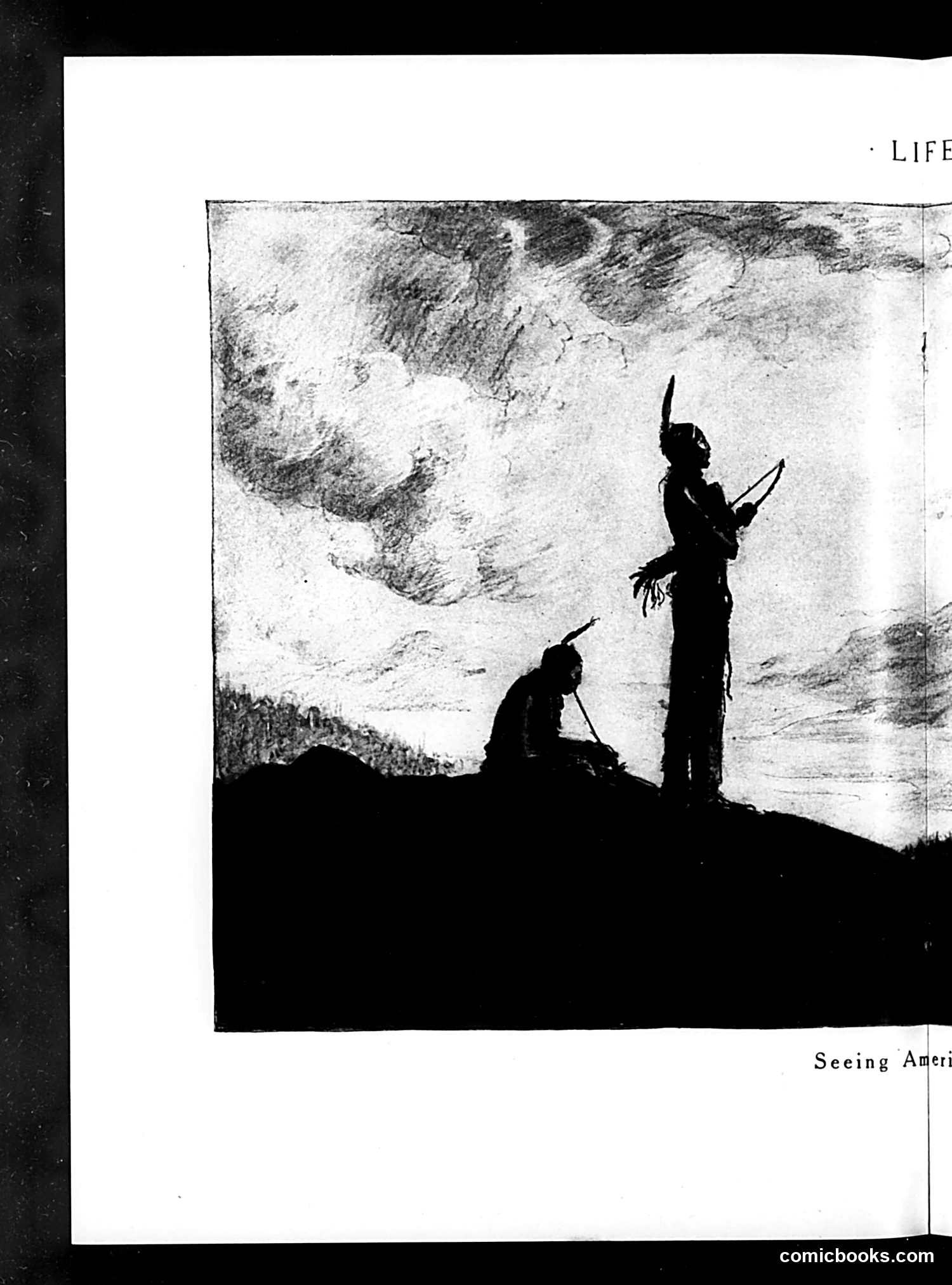
This appears to be a silhouette illustration titled "Seeing America" (text partially visible at bottom). The image shows two figures in silhouette against a landscape—one seated and one standing on elevated ground, both appearing to hold surveying or measuring instruments. The standing figure wears what appears to be a feathered headdress, suggesting a Native American subject. The composition likely satirizes early American exploration or territorial surveys, possibly contrasting perspectives on "seeing" or claiming America—the indigenous view versus the settler/colonial perspective. Without additional context or visible date, I cannot specify the exact satirical target, but the piece appears to comment on American territorial expansion and differing viewpoints on the land.
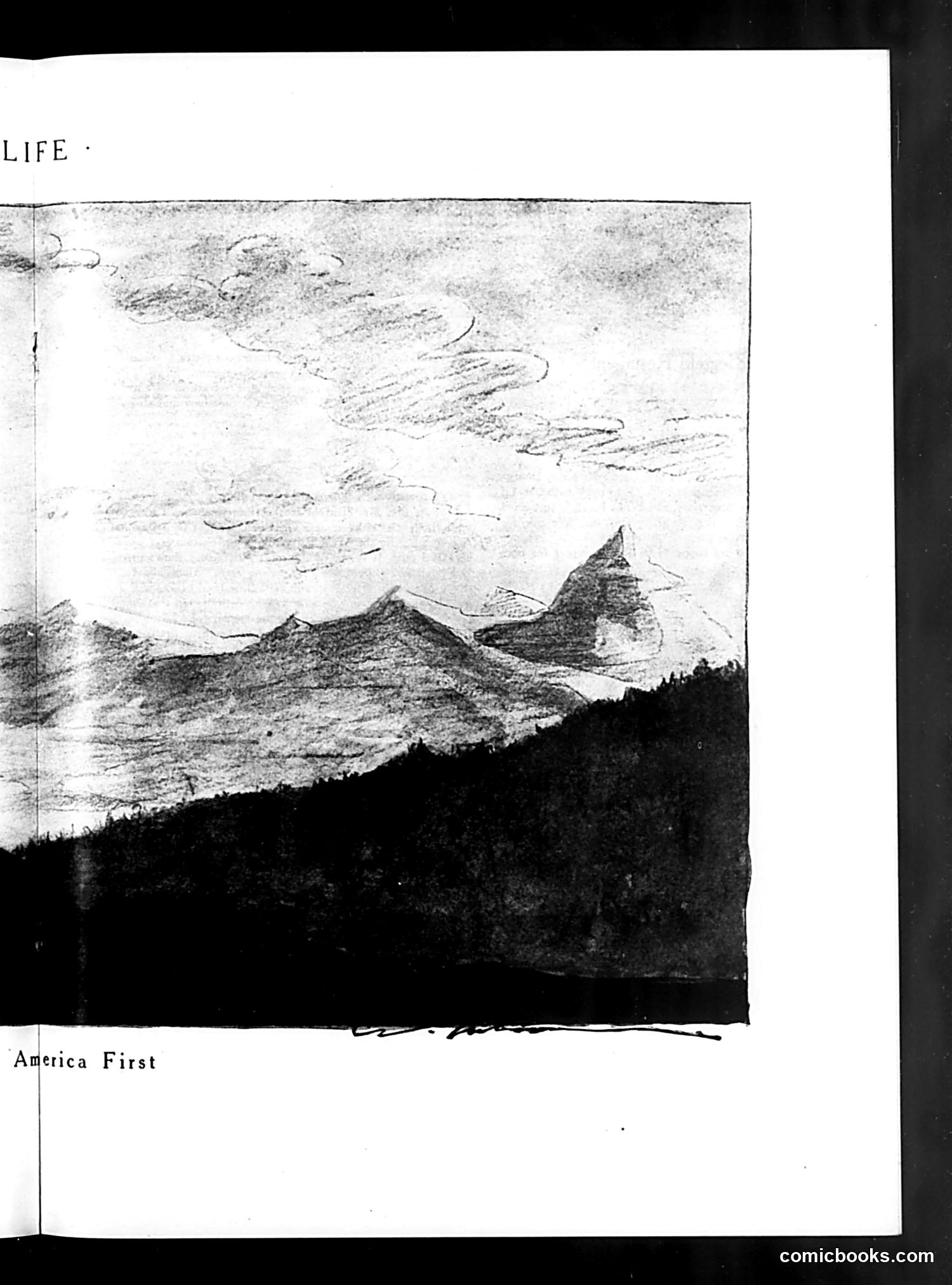
This page from *Life* magazine shows a landscape illustration of snow-capped mountains with forested slopes. The heading "LIFE" appears at the top left, with "America First" captioned below the image. The satire appears to reference the America First movement (likely 1930s-40s isolationism). The majestic, pristine mountain scenery—untouched and self-contained—seems to visually represent the America First ideal: a nation focused inward, isolated from outside concerns. The image's romantic depiction of American wilderness suggests idealized American exceptionalism that the movement promoted. However, without additional text or captions on this page, the specific satirical point remains somewhat unclear. The juxtaposition of the pristine landscape with the "America First" label may critique isolationism as naïve or disconnected from global reality, though the exact critique isn't explicit here.
This is a theater review praising Florenz Ziegfeld's Broadway productions. The article discusses two shows: **"The Follies"** (featuring W.C. Fields and Baby Peggy) - The critic praises Fields' "Back Porch" sketch, claiming it surpasses a similar English scene from Charlot's Revue. He credits designer John Held Jr. for innovative costumes (notably the "three inches of open space" between stockings and undergarments—a risqué detail for the 1920s). Norman-Bel Geddes' sets receive praise for revolutionary design. **"Louie the 14th"** (starring Leon Errol) - A colorful spectacle the critic finds visually satisfying, though admitting the plot is "obtrusively unimportant." Errol's comedic performance impresses even the skeptical reviewer. The piece celebrates American theatrical innovation competing favorably against British productions, reflecting 1920s Broadway's cultural confidence.
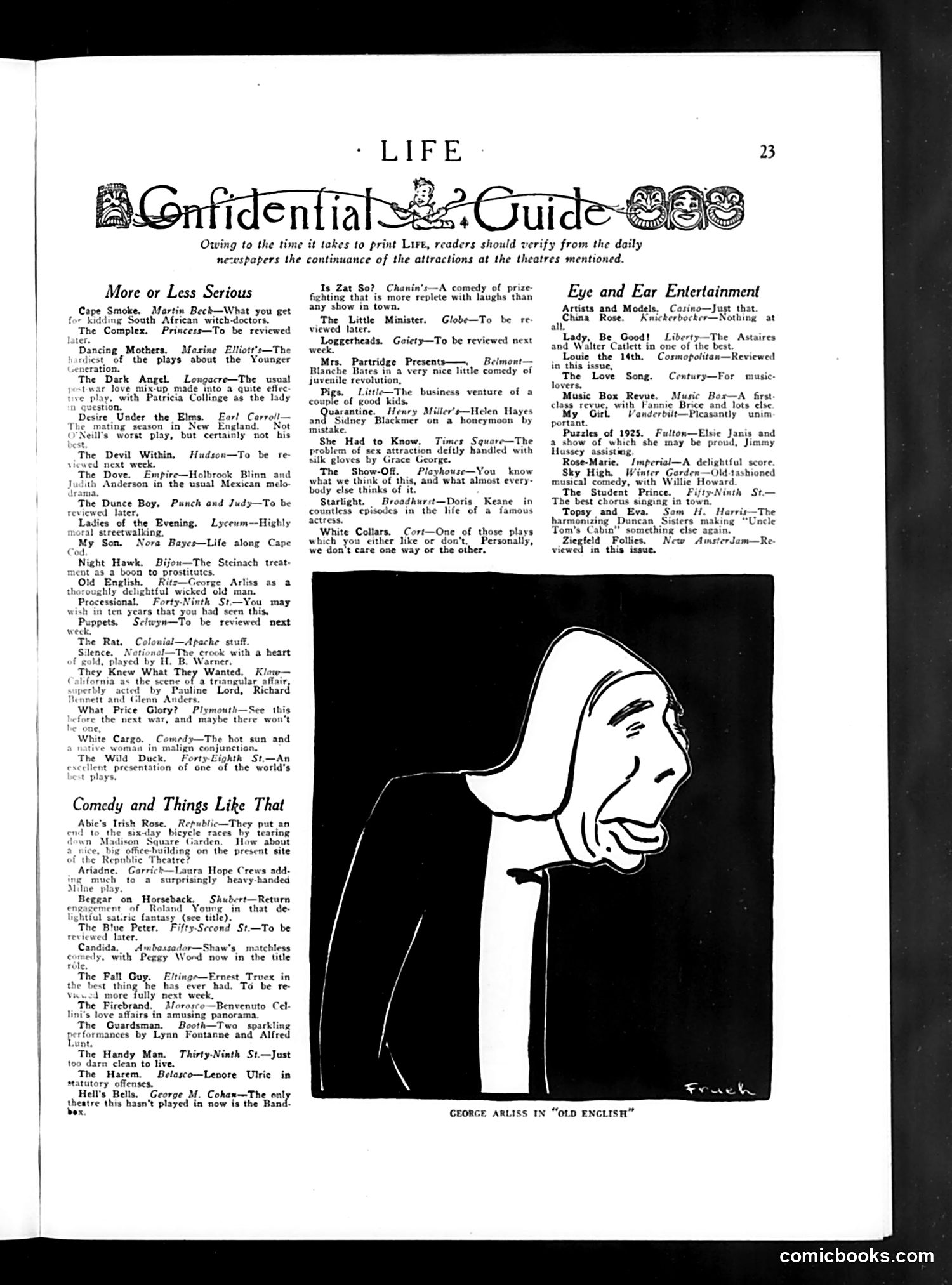
This page from Life magazine (likely mid-1920s) is primarily a **theater review section**, not a political cartoon page. The main illustration shows a caricatured face in profile—identified in the caption as **George Arliss in "Old English"**—drawn in an exaggerated theatrical style typical of the era's entertainment journalism. The page consists mostly of **brief, witty capsule reviews** of Broadway productions. Life's reviewing style is sardonic and dismissive; descriptions like "just too darn clean to live" (about *The Handy Man*) and the one-liner about *Hell's Bells*—"The only theatre this hasn't played in now is the Band-box"—showcase the magazine's trademark irreverent humor aimed at theatergoers. The content reflects 1920s theatrical preoccupations: jazz-age morality plays, immigrant melodramas, and sex-themed comedies. This was Life's standard entertainment coverage—popular culture criticism delivered with sharp, knowing commentary for educated urban readers.
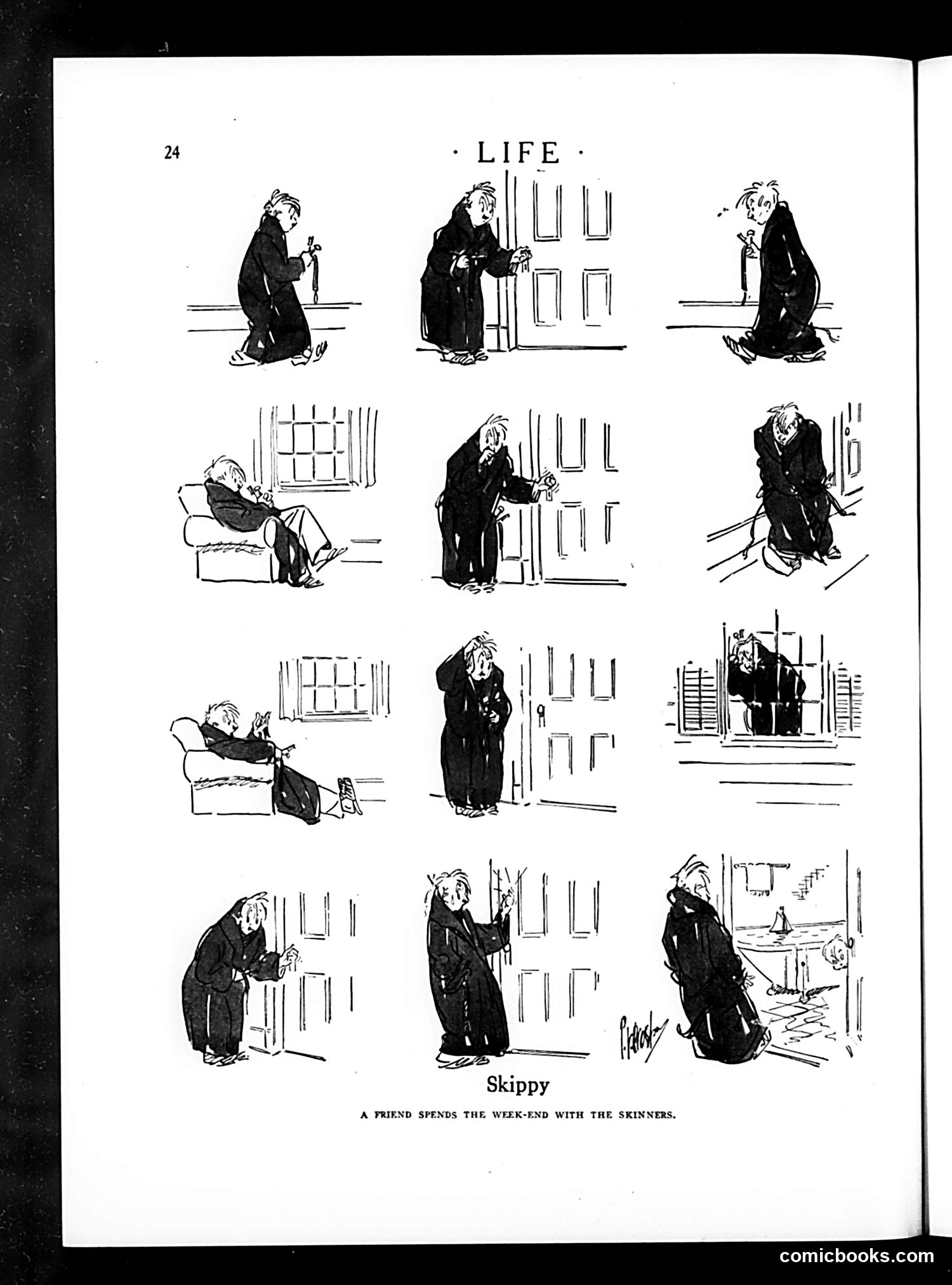
This is a comic strip featuring the character Skippy (a popular 1920s-30s comic strip character) visiting his friend's family, the Skinners. The twelve panels depict various domestic scenes: the guest arriving, being greeted at doors, sitting in parlors, and interacting with family members in their home. The humor appears to derive from typical weekend-visit awkwardness—the guest's formal posture contrasts with the casual family activities around him. The satire likely mocks the social conventions and formal etiquette surrounding house visits during the era, showing how guests and hosts navigate polite behavior in close quarters. The exaggerated body language suggests discomfort or stiffness in social situations common to early 20th-century American middle-class life.
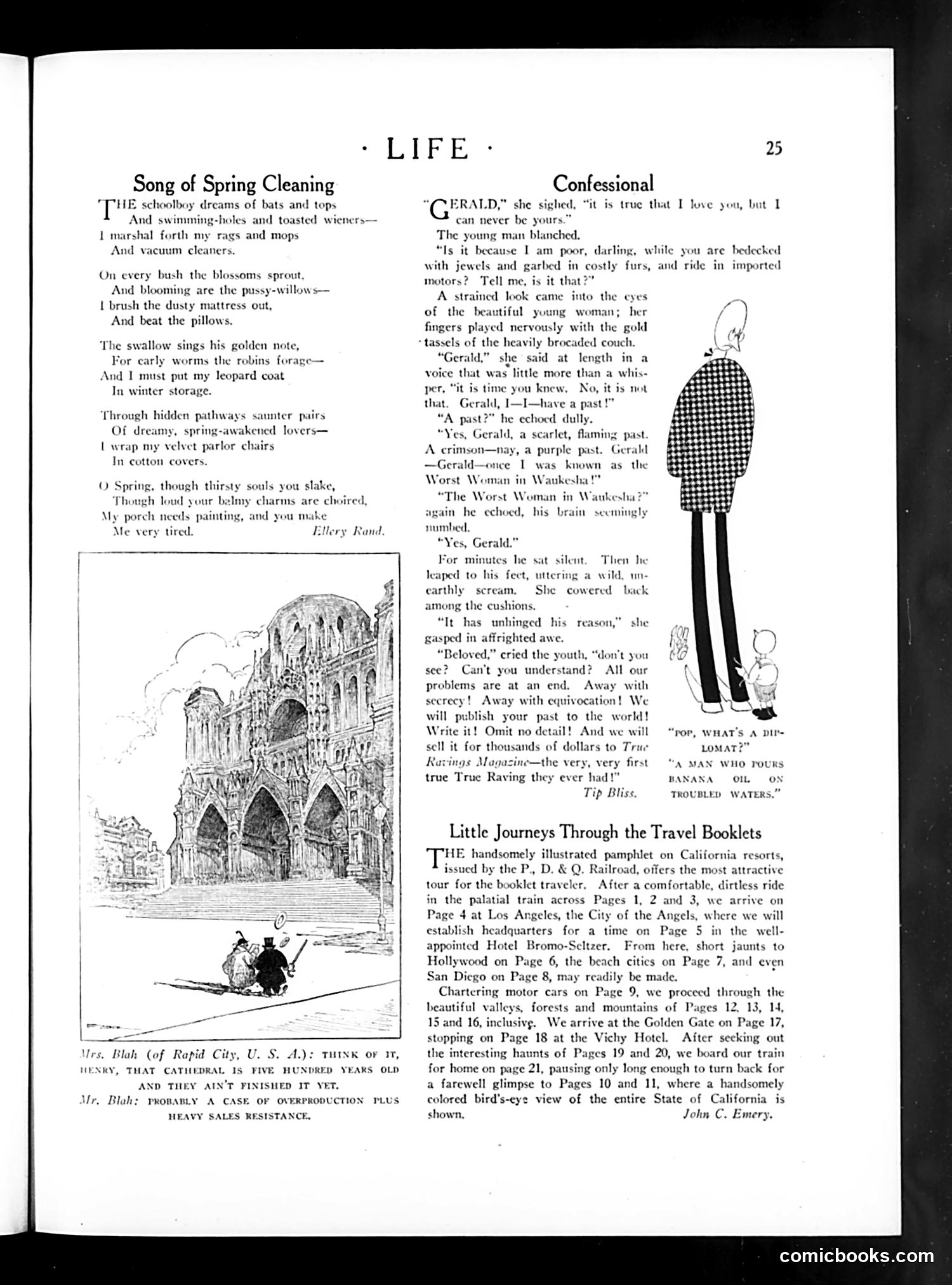
**"Song of Spring Cleaning"** by Ellery Rand satirizes the disconnect between spring's romantic promise and domestic drudgery. While poets celebrate spring's awakening of love and nature, the female speaker is preoccupied with unglamorous housework—beating pillows, painting porches, storing coats. The joke mocks the gap between idealized spring sentiment and mundane reality. **The cathedral cartoon** features two tourists viewing a partially-constructed European cathedral. One remarks it's 500 years old and "ain't finished." The other quips it's "probably a case of overproduction plus heavy sales resistance"—applying modern business jargon to medieval architecture. This satirizes Americans' tendency to view everything through a commercial/industrial lens, even ancient monuments. **"Confessional"** by Tip Bliss parodies melodramatic romance fiction. A woman's "scandalous past" as "Worst Woman in Waukesha" devastates her suitor—until he realizes he can monetize her confession, selling it to "True Ravings Magazine" for thousands. The satire targets both overwrought period romance and emerging tabloid sensationalism.
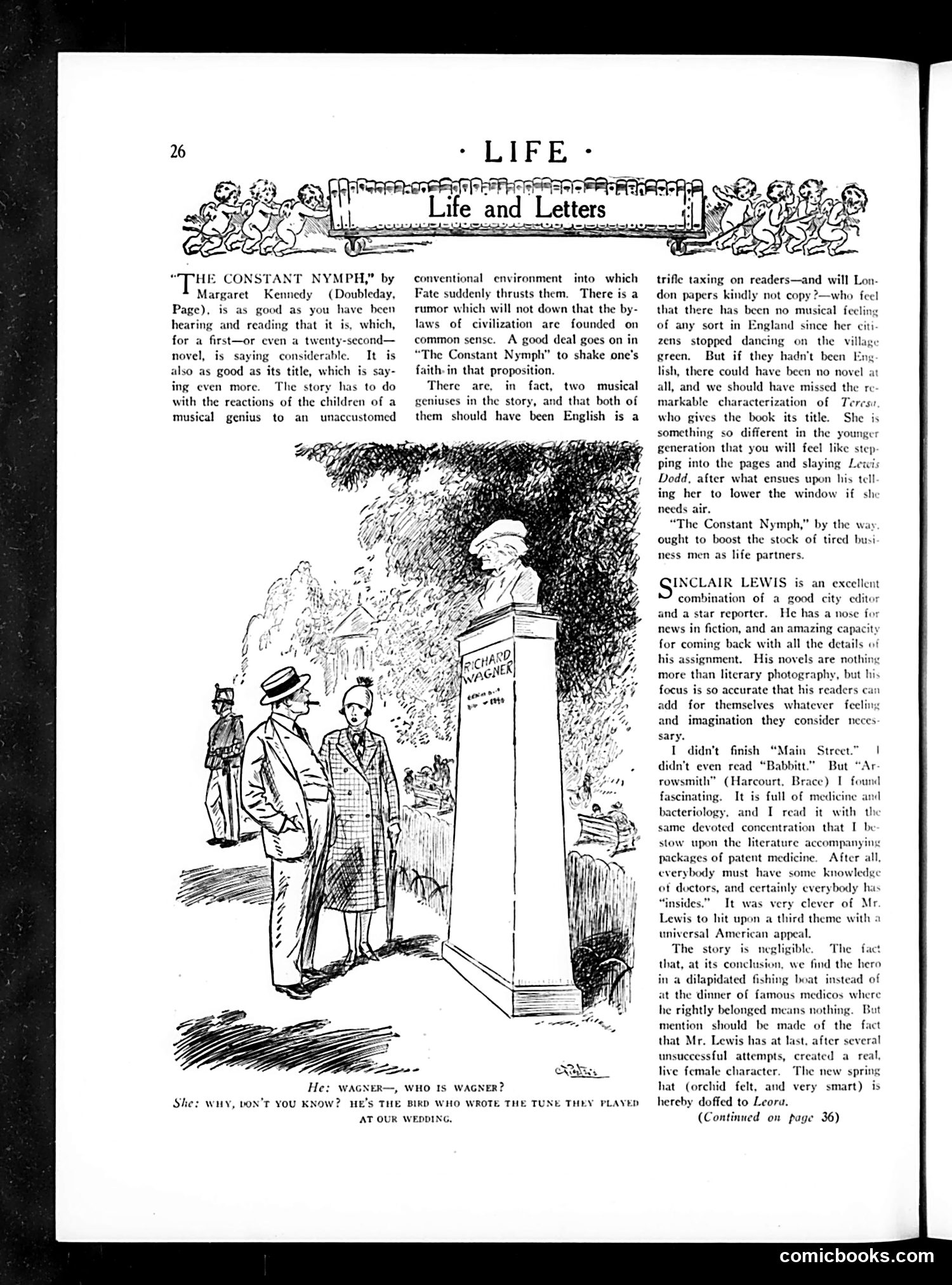
This is a literary review section from Life magazine discussing Margaret Kennedy's novel *The Constant Nymph* and Sinclair Lewis's *Arrowsmith*. **The cartoon** depicts a couple at what appears to be a wedding or social gathering. The husband asks "Who is Wagner?" and the wife responds that Wagner is "the bird who wrote the tune they played at our wedding"—a joke about musical ignorance. Wagner, the famous 19th-century composer, is being reduced to merely "the guy whose music played at our wedding" by someone unaware of his historical significance. This satirizes ordinary people's lack of classical music knowledge. **The reviews** praise both novels. Kennedy's book is celebrated for its sophisticated portrayal of unconventional characters. Lewis's *Arrowsmith* is commended for its accurate depiction of medicine and its creation of a realistic female character (Leora), though the reviewer dismisses the plot as "negligible"—valuing Lewis's journalistic accuracy over storytelling craft. The overall tone suggests Life valued literary realism and social observation over romantic plot.
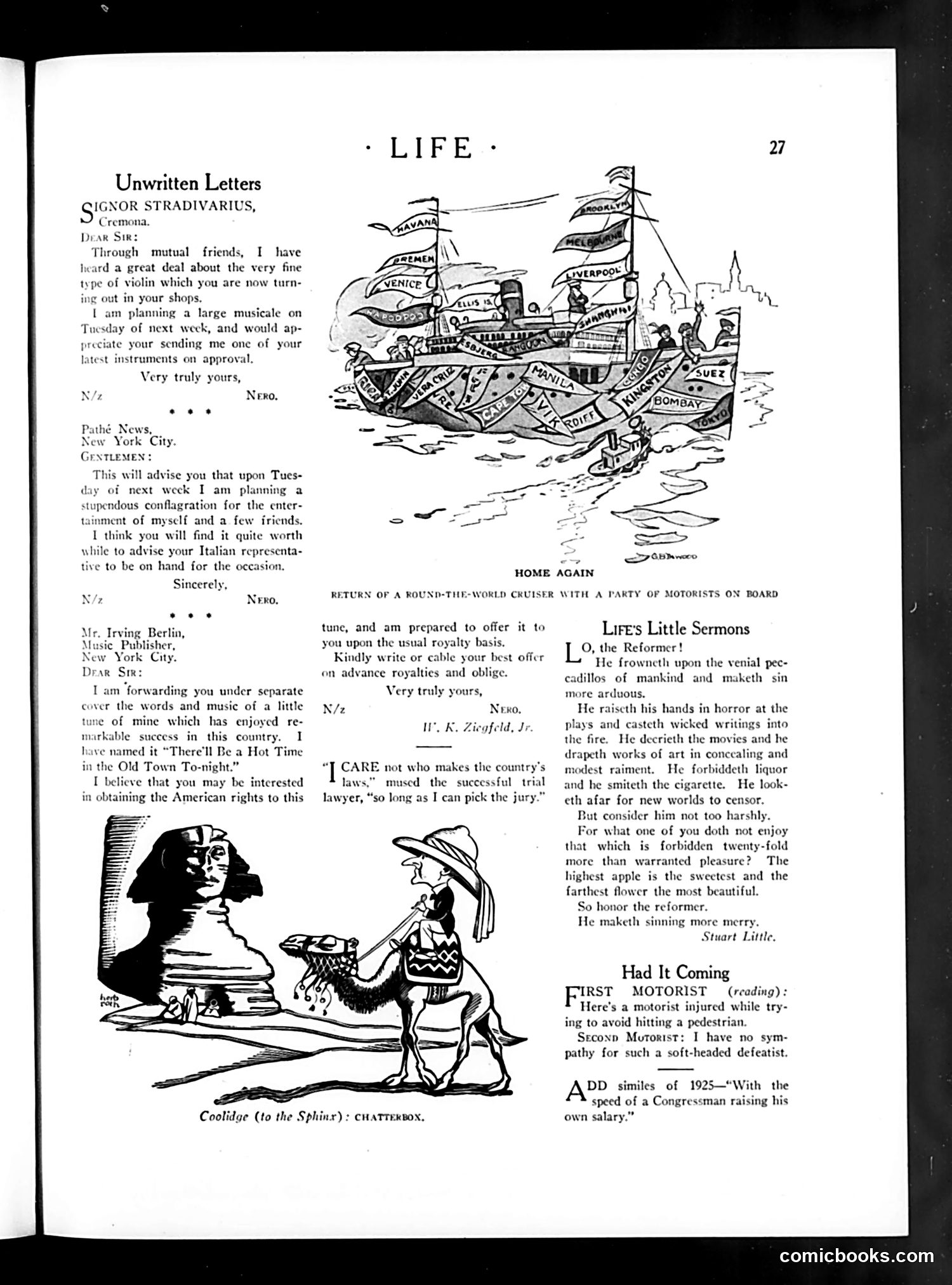
This page satirizes **historical figures making absurd modern requests**. The "Unwritten Letters" section features **Nero**, the Roman emperor infamous for allegedly fiddling while Rome burned, now writing to: 1. **Stradivarius** (famous violin maker) requesting an instrument for a musicale 2. **Pathé News** announcing plans for a "stupendous conflaguration" (fire) for entertainment—a dark joke alluding to his legendary role in Rome's destruction 3. **Irving Berlin** (real music publisher) about acquiring rights to "There'll Be a Hot Time in the Old Town To-night" The humor lies in treating ancient history as contemporary business correspondence, with Nero's requests darkly ironic given his historical infamy. The page also includes **Life's Little Sermons** (moral commentary on reformers), a **Coolidge/Sphinx cartoon** (unclear reference), and a joke about motorists lacking sympathy for accident victims, reflecting 1920s attitudes toward traffic safety.
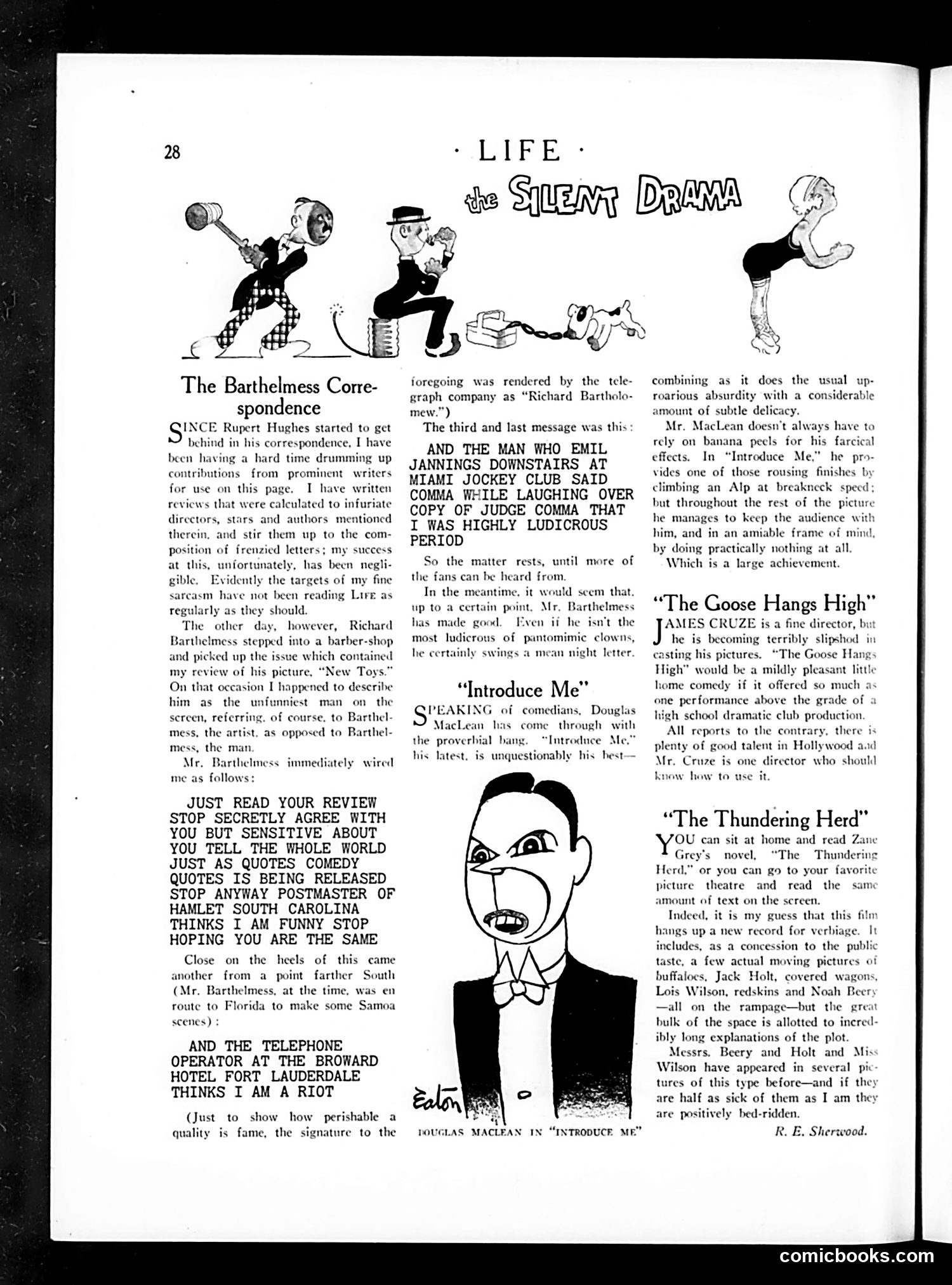
This page contains satirical film criticism from Life magazine's entertainment section. The main feature is "The Barthelmess Correspondence," a humorous exchange where critic Rupert Hughes reviewed actor Richard Barthelmess's film "New Toys" as "the unfunniest man on the screen." Barthelmess, good-naturedly, telegraphed back agreeing but requesting discretion—then followed with absurd follow-up telegrams claiming random people (a telephone operator, a man at a Miami jockey club) found him hilarious. The joke mocks both the critic's cutting review and the actor's tongue-in-cheek response. The page also reviews three silent films: Douglas MacLean's "Introduce Me," James Cruze's "The Goose Hangs High," and "The Thundering Herd." The reviews praise MacLean's comedy but criticize Cruze's casting choices and "The Thundering Herd" for excessive intertitles drowning out actual moving pictures.
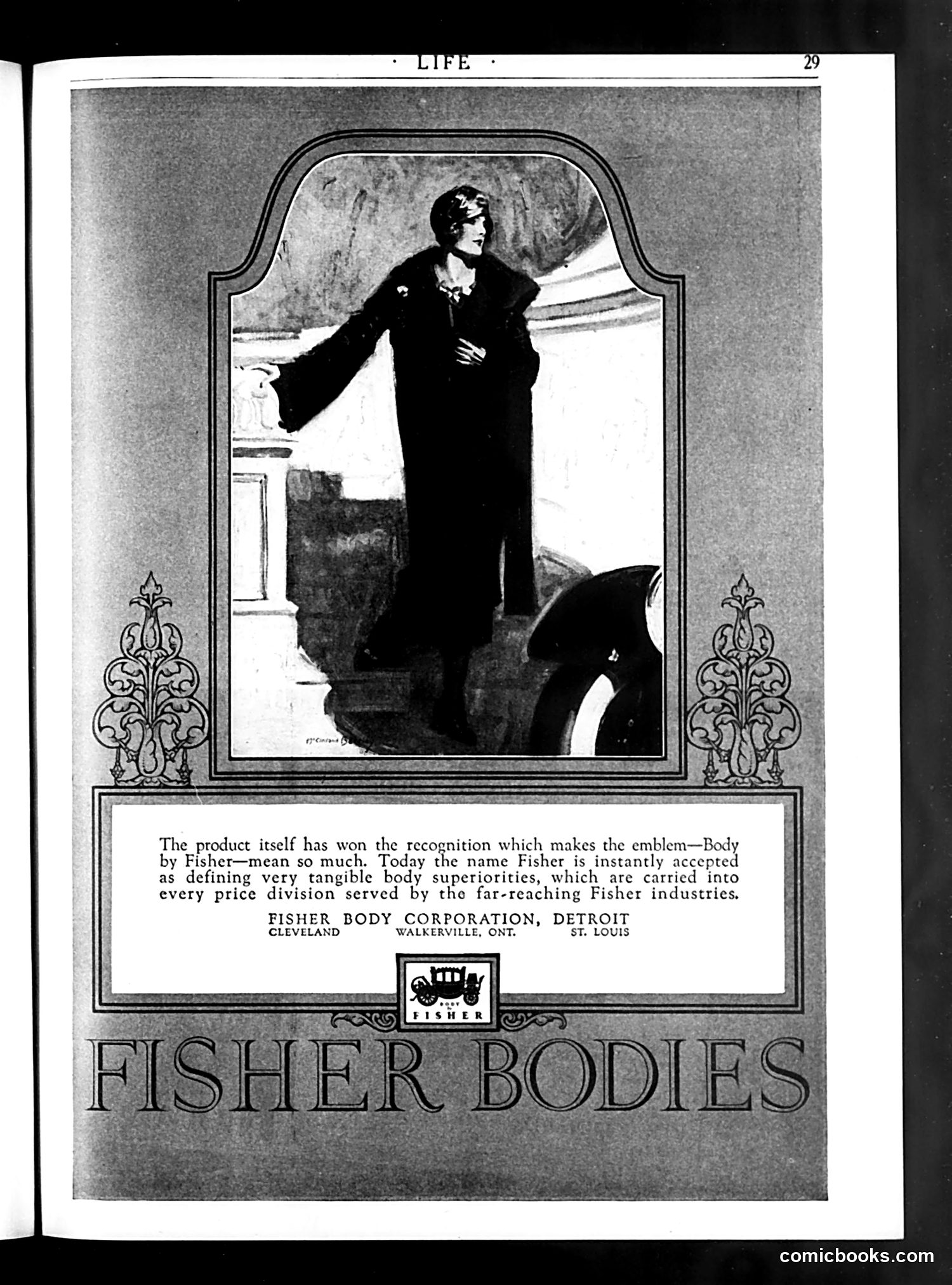
This is a **full-page advertisement**, not political satire. It promotes Fisher Body Corporation, an automobile body manufacturer with plants in Detroit, Cleveland, Walkerville (Ontario), and St. Louis. The image shows an elegantly dressed woman in a dark coat gesturing toward what appears to be an automobile interior or body panel, presented in an ornate frame. The ad claims that "Fisher" has become synonymous with superior car bodies across all price points. This represents early automotive advertising emphasizing quality craftsmanship and brand prestige. Fisher Body was a significant supplier to major automakers before General Motors acquired it in 1926. The sophisticated visual presentation and text appeal to consumers' desire for status and durability in their vehicles.
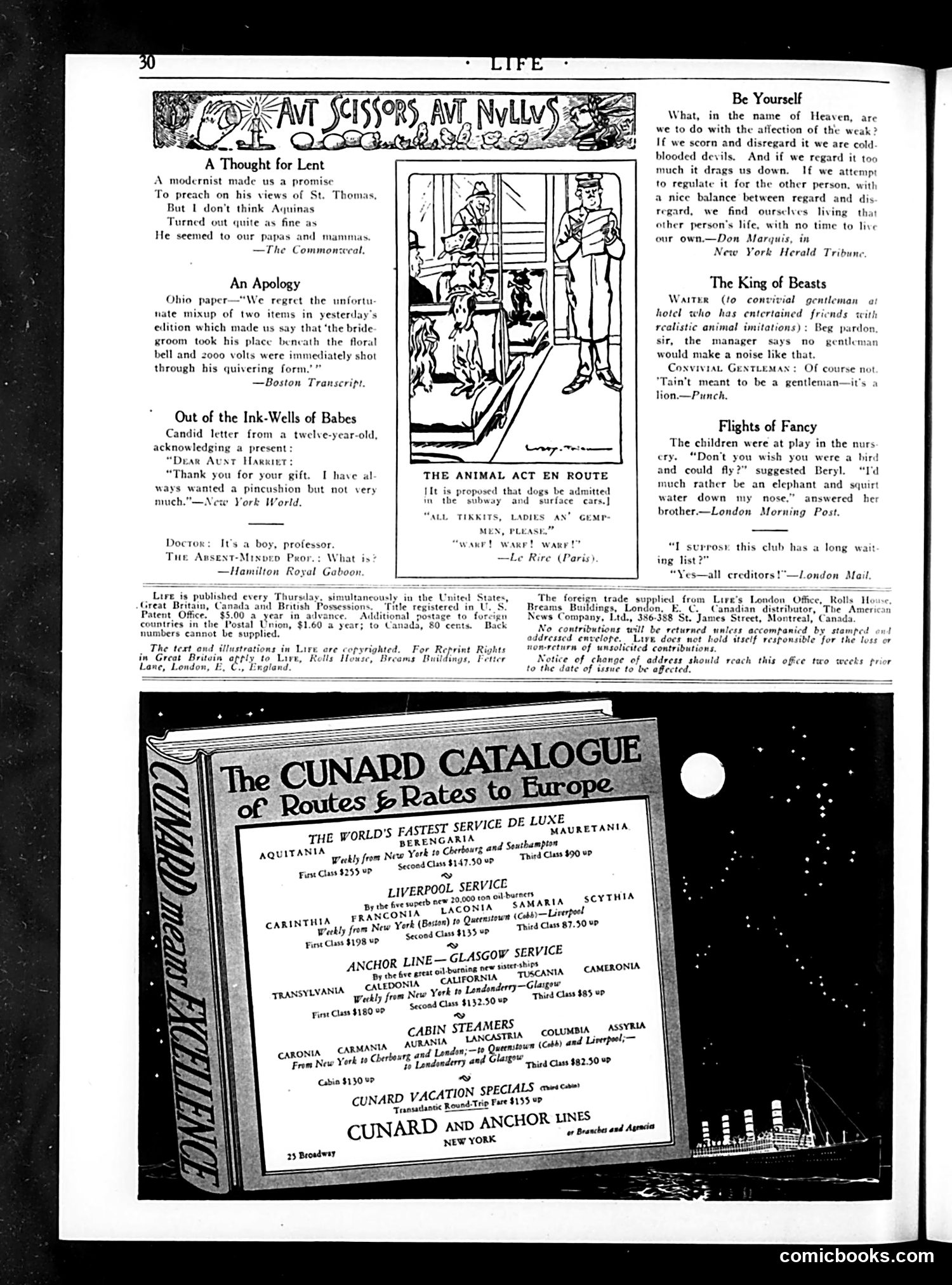
This page contains several satirical short pieces typical of Life's humor section, plus a Cunard shipping advertisement. The cartoon titled "THE ANIMAL ACT EN ROUTE" depicts a streetcar conductor announcing tickets while passengers—including what appears to be a dog—ride inside. The caption reads "ALL TICKETS, LADIES AN' GENTLEMEN, PLEASE" / "WARF! WARF! WARF!" The joke satirizes a proposed law (referenced in the text below) to admit dogs onto streetcars and buses. The humor mocks the absurdity: if dogs were allowed, they'd disrupt service with barking, creating chaos for other passengers and conductors. The other pieces are brief humorous anecdotes: a modernist priest's sermon compared unfavorably to traditional theology; a newspaper's mortifying typo mixing wedding and electrocution details; and a child's lukewarm thank-you note. These mock pretension, editorial incompetence, and insincere politeness respectively.
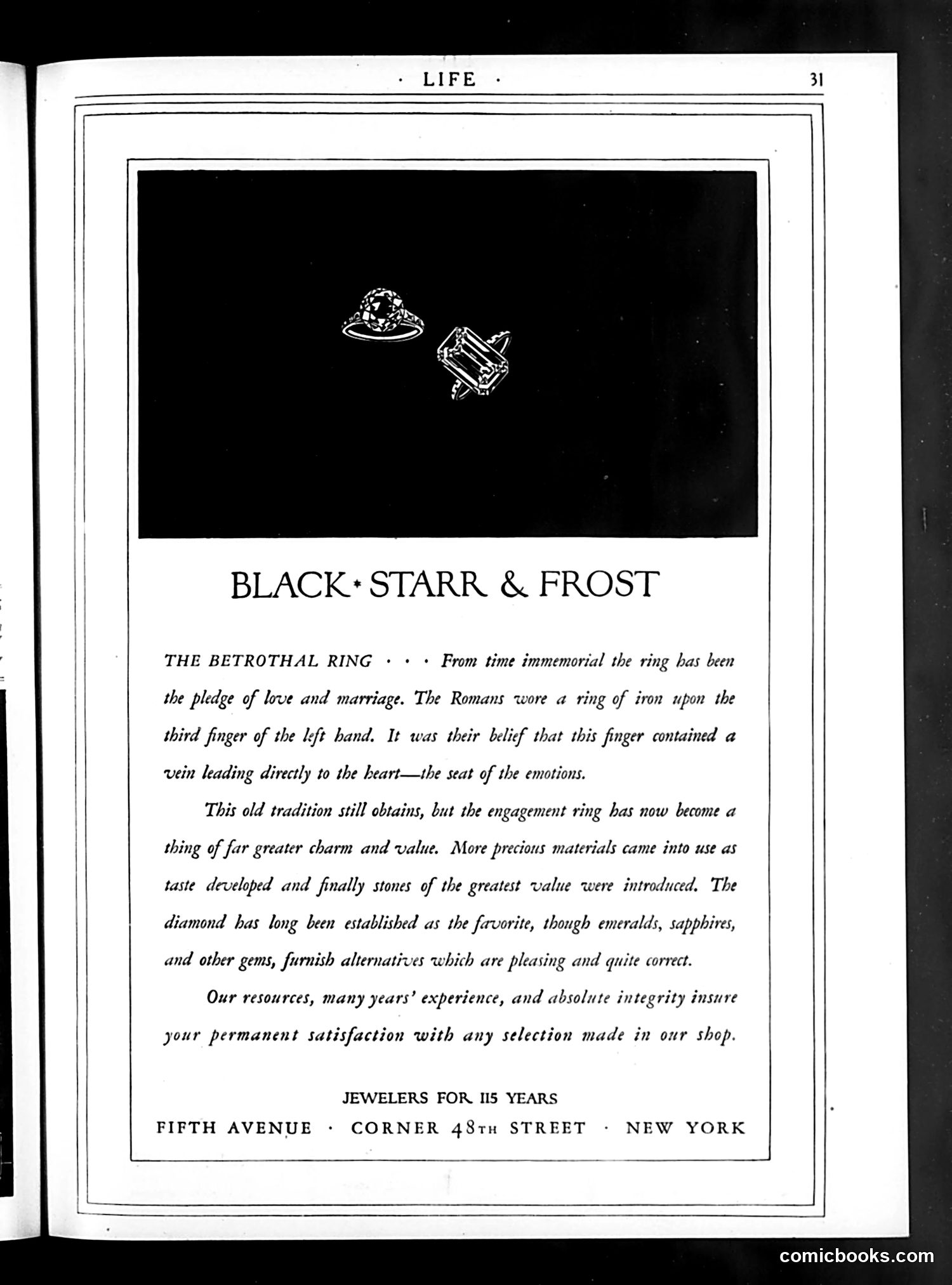
This is primarily a **jewelry advertisement**, not a political cartoon. The page features an illustration of two engagement rings against a black background. The text is an informational advertisement from Black, Starr & Frost, a New York jeweler claiming 115 years in business. It traces the history of betrothal rings from Roman times (when iron rings symbolized commitment) through to the modern era, explaining how engagement rings evolved into precious luxury items centered on diamonds. The implicit message targets potential customers—likely men shopping for engagement rings—by: - Lending historical legitimacy to the tradition - Positioning diamonds as the established choice - Appealing to "absolute integrity" and "permanent satisfaction" This reflects early-to-mid 20th-century marketing that romanticized and commercialized engagement ring-giving as a cultural necessity. There is **no satire or political commentary visible** on this page; it is straightforward commercial messaging aimed at affluent New York consumers.
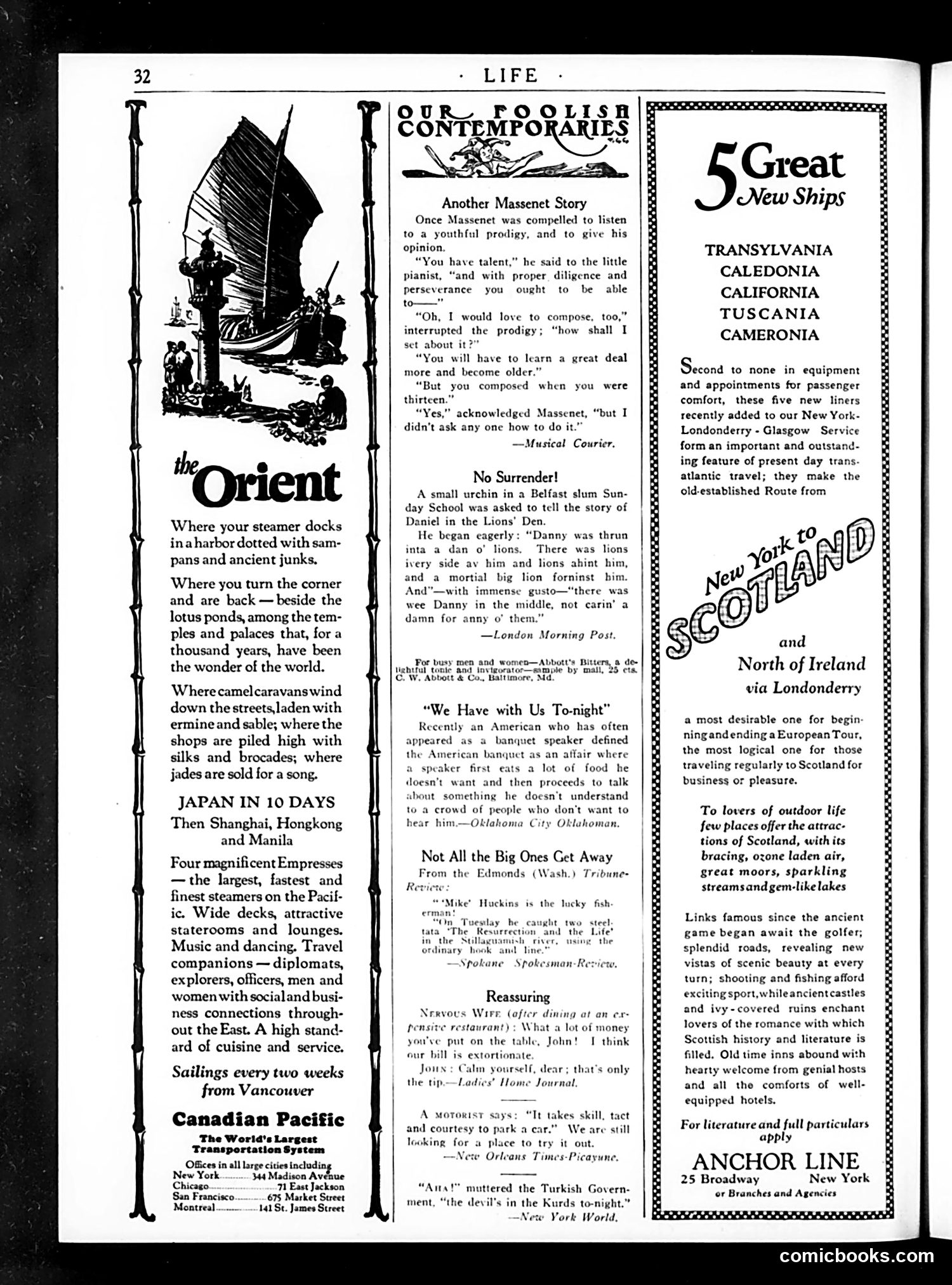
This page is primarily **advertising** with some humorous anecdotes. The main content includes: **Left side:** A Canadian Pacific steamship advertisement for "the Orient" featuring Japan tours ("Japan in 10 days") and Asian luxury travel. The romantic imagery emphasizes exotic markets, temples, and silks—appealing to wealthy early-20th-century travelers. **Center:** Brief comic stories, including one about composer Massenet discouraging a young pianist from composing, and a Belfast child's fearless retelling of Daniel in the Lions' Den. These are light humor pieces. **Right side:** An Anchor Line advertisement promoting ocean liners and Scottish tourism to American travelers. **Context for moderns:** This reflects the era's fascination with "the Orient" as exotic and mystical—a colonialist perspective now considered outdated. The ads target affluent passengers seeking adventure and prestige through international travel.
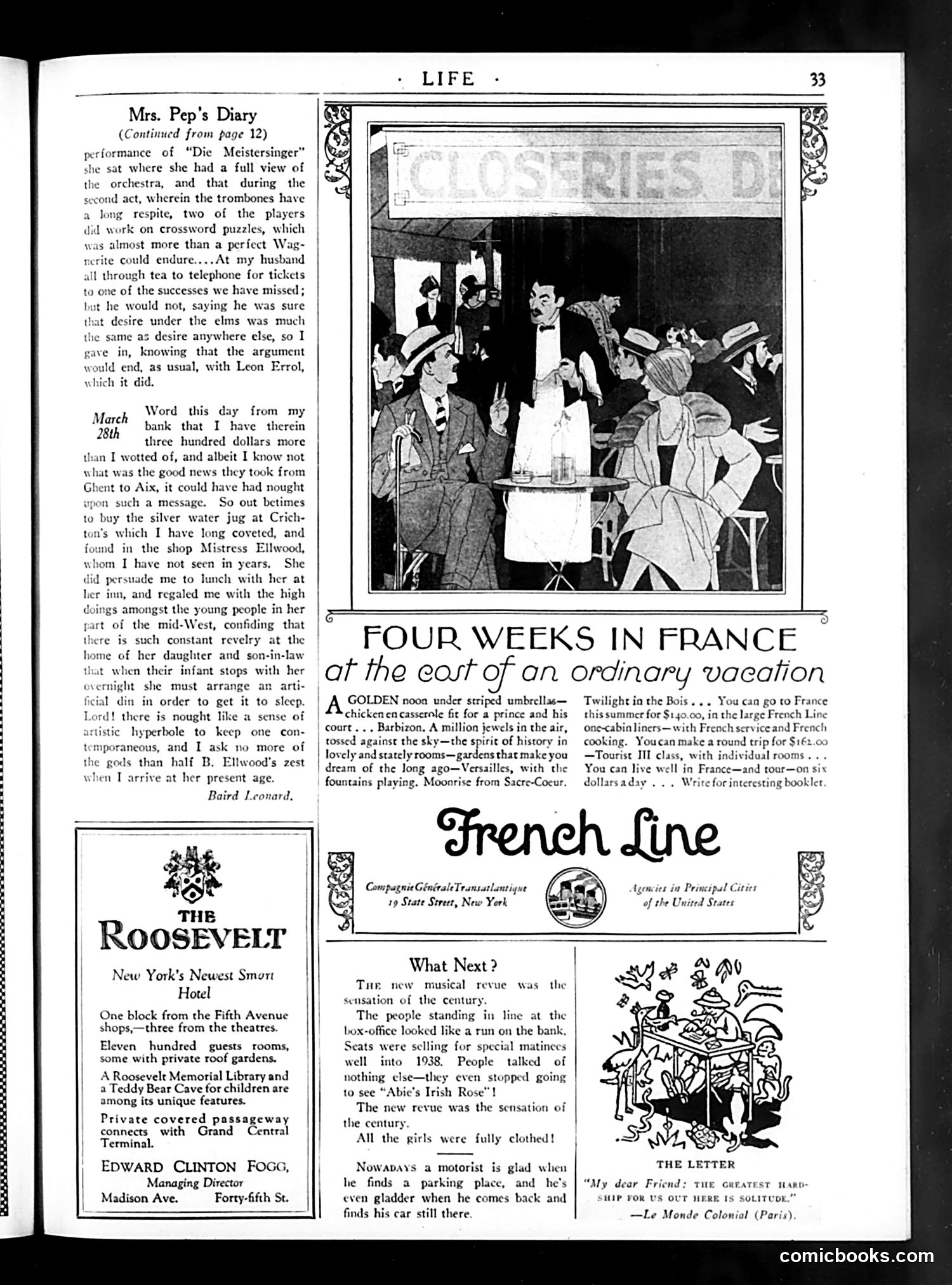
This page from *Life* magazine (dated March 28th based on the diary entry) contains **Mrs. Pep's Diary**—a satirical column mocking upper-class society pretensions. The humor centers on theatrical snobbery: Mrs. Pep attends Wagner's "Die Meistersinger" and is scandalized that orchestra musicians work crossword puzzles during a trombone rest, suggesting their lack of artistic devotion. The diary also references a windfall inheritance and shopping for luxury items—typical frivolous concerns of wealthy Manhattan society. The page includes advertisements (The Roosevelt Hotel, French Line steamship cruises) and a brief comic section titled "What Next?" that satirizes theatrical trends, noting the sensation of a new musical revue where "all the girls were fully clothed"—a joking reference to 1920s Broadway's increasingly revealing fashion standards. The overall tone is gentle mockery of Manhattan's cultural elite and their obsessive concern with social status and fashionable entertainment.
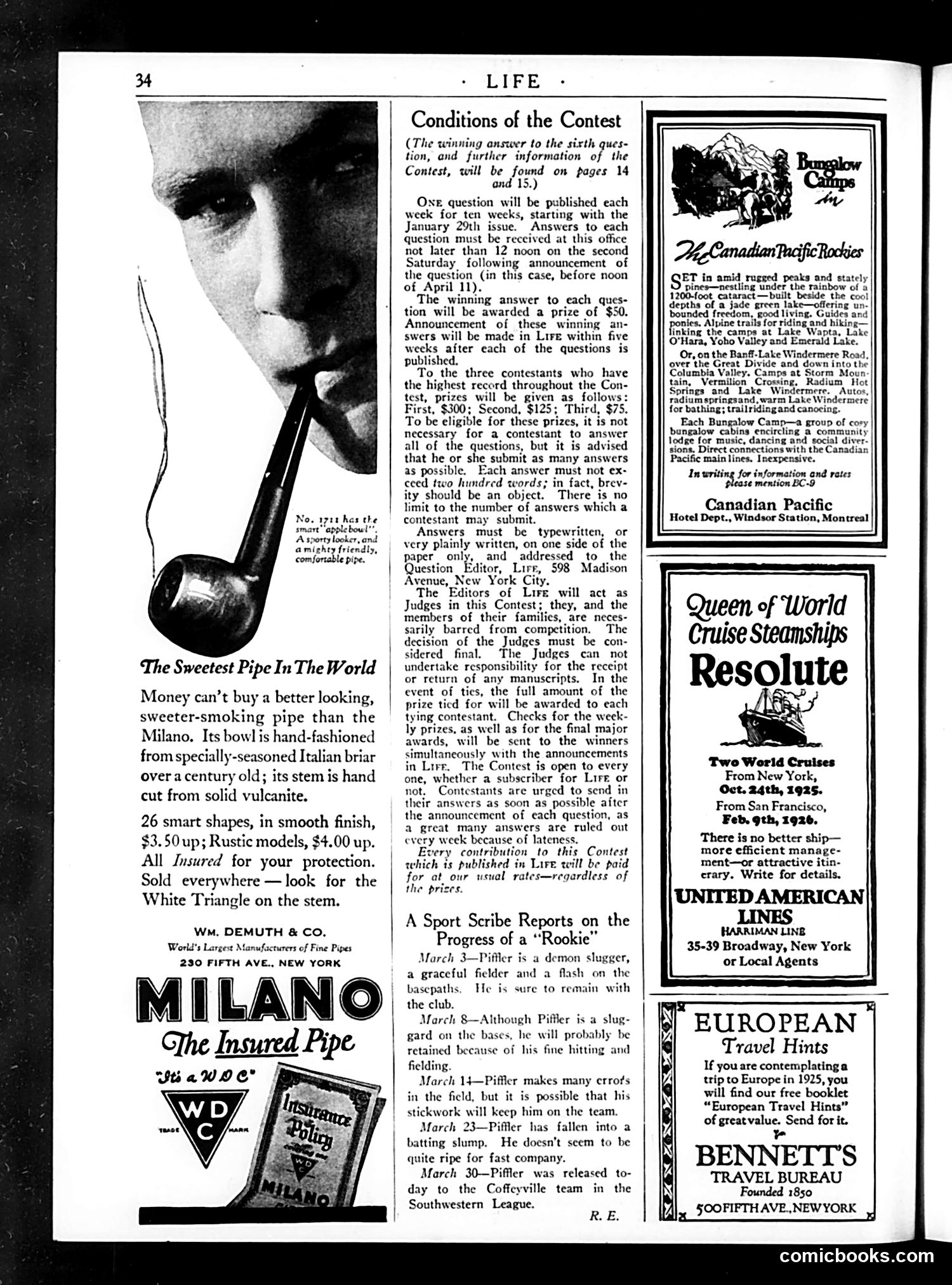
This page primarily contains **contest rules and advertising** rather than political satire or cartoons. The main content announces Life's ten-week **question-and-answer contest** with cash prizes ($50 per weekly answer; $300/$125/$75 for top overall contestants). Answers must be typewritten, under 200 words, and submitted by specific deadlines. **Notable content:** The **Milano pipe advertisement** features a portrait of a man smoking an ornate pipe, marketed as "The Sweetest Pipe In The World" — a straightforward luxury good pitch emphasizing Italian briar and hand-craftsmanship. **"A Sport Scribe Reports on the Progress of a 'Rookie'"** is a satirical sports column by R.E. tracking a baseball player named Piffler from March 3-30. The humor lies in the contradictions: initially praised as a "demon slugger," Piffler is progressively downgraded (sluggard, error-prone, slumping) before being released to the minor leagues by month's end. It's gentle mockery of sportswriter hyperbole and athlete inconsistency. Remaining space contains travel and cruise ship advertisements.
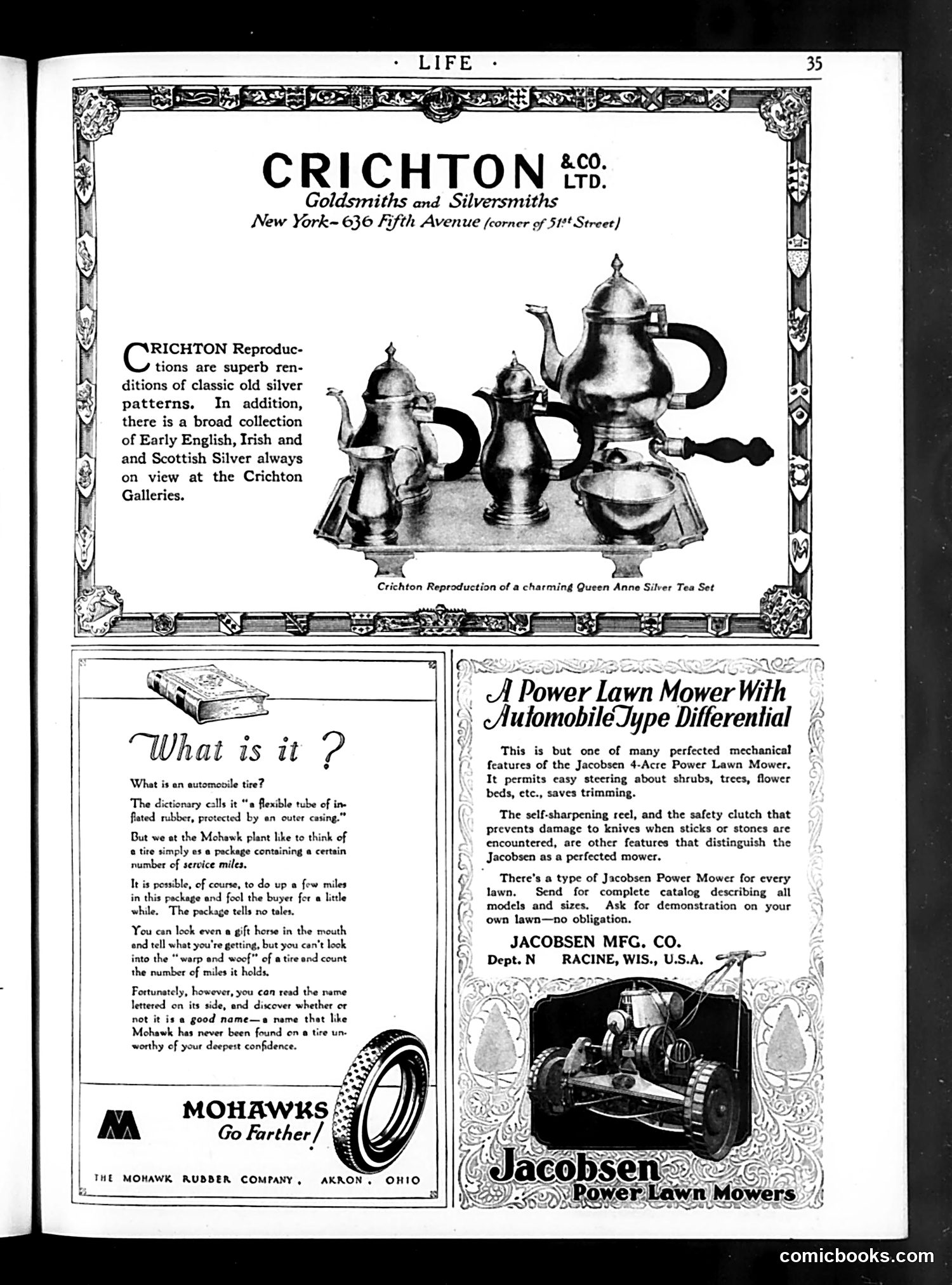
This page is primarily **advertising**, not satire or editorial content. It contains three product advertisements: 1. **Crichton & Co.** (top): A luxury silversmith displaying a "Queen Anne Silver Tea Set" reproduction, marketing fine silver goods at their Fifth Avenue location. 2. **Mohawk Tires** (bottom left): An ad addressing consumer skepticism about tire quality. The "What is it?" section uses humor to explain that while tires are technically "rubber tubes," buyers can't inspect their interior durability—so they must trust the brand name. Mohawk positions itself as a trustworthy, established name. 3. **Jacobsen Power Lawn Mowers** (bottom right): Highlights the "Automobile Type Differential" steering feature and self-sharpening reel, positioning the mower as technologically advanced for suburban homeowners. The page reflects 1920s consumer culture: luxury goods, automobile-related products, and mechanical innovations for suburban living. No political satire is present—this is straightforward commercial messaging.
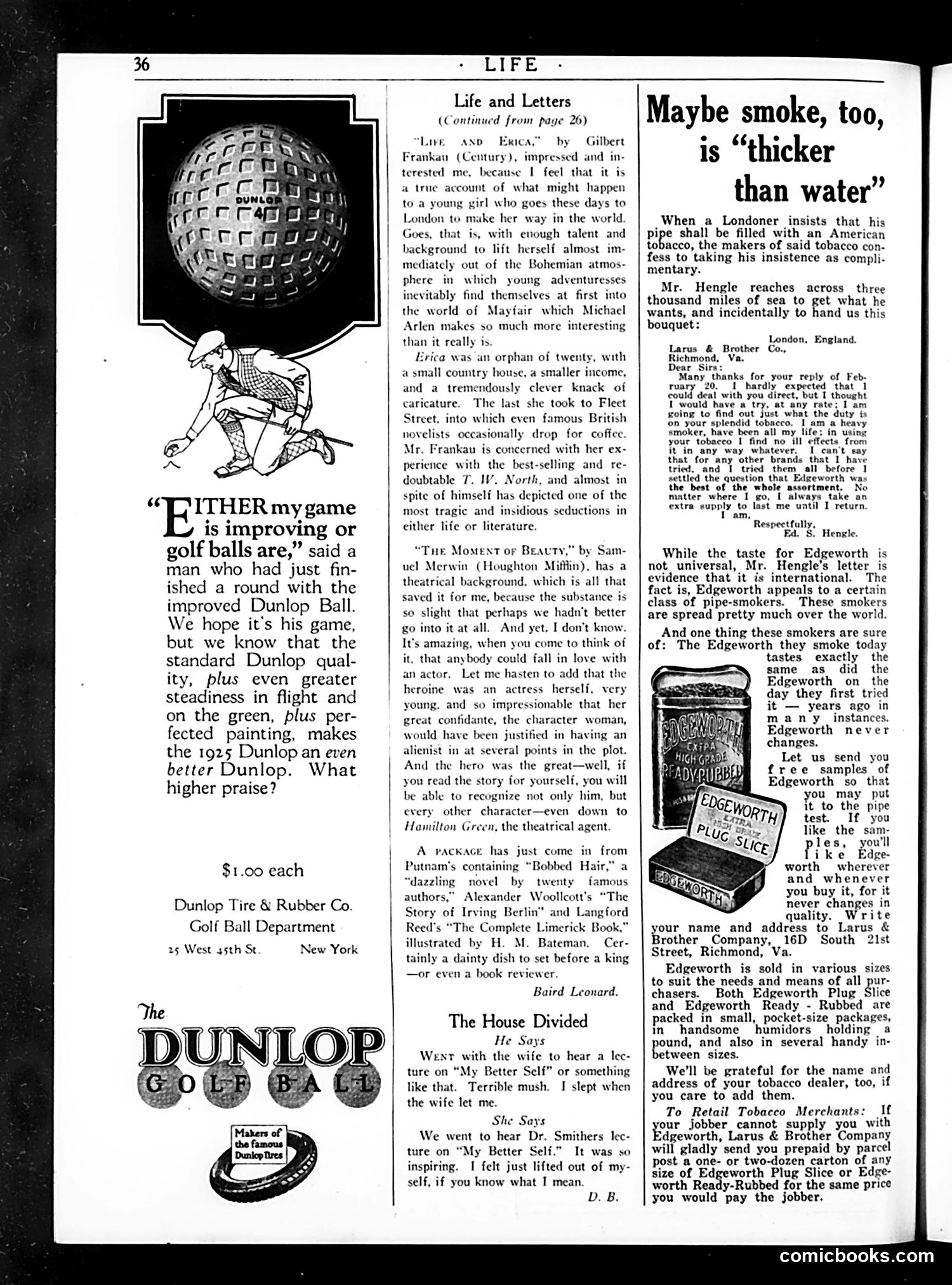
This page combines advertising and literary content typical of 1925 Life magazine. **The Main Cartoon/Advertisement** (left side): A golfer holding an improved Dunlop golf ball. The joke relies on a self-deprecating premise—a golfer claims his game is improving, but the advertiser humorously suggests the credit belongs to the superior ball, not the player's skill. This is gentle humor designed to sell the product by implying the ball compensates for poor technique. **"The House Divided"** (center): A brief domestic comedy sketch showing how the same lecture on "My Better Self" produces opposite reactions in husband and wife—he slept through it; she found it inspirational. The satire mocks marital disconnect and differing sensibilities. **Tobacco Advertisement** (right): A customer letter praising Edgeworth pipe tobacco, emphasizing its American quality appeals to British smokers. The phrase "thicker than water" (playing on "blood is thicker than water") suggests tobacco loyalty transcends nationality. The page reflects 1920s consumer culture and gender stereotypes common in the era's satirical magazines.
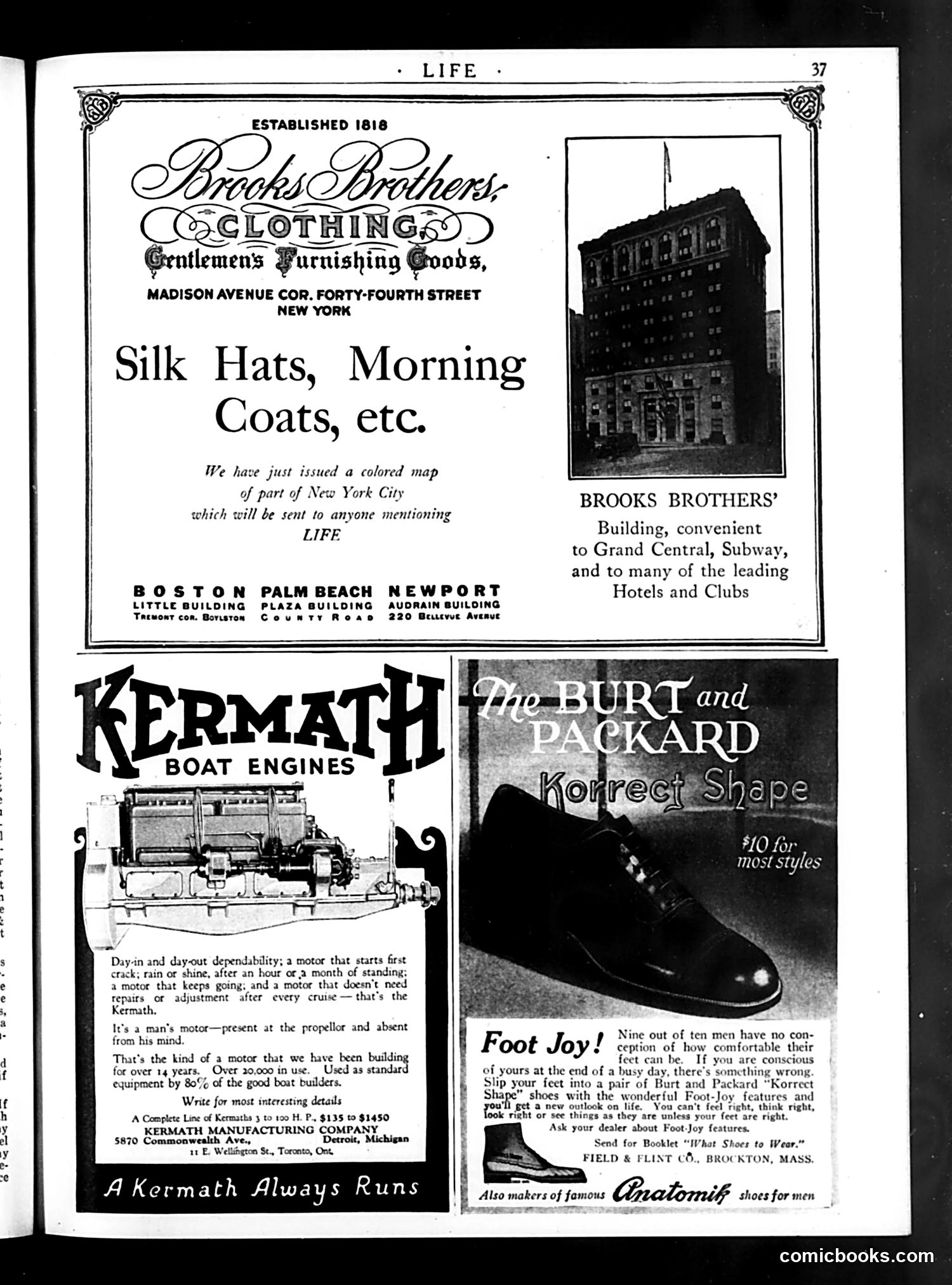
This page is primarily **advertising**, not satire or political content. It contains four commercial advertisements typical of early 20th-century American magazines: 1. **Brooks Brothers** (top): Established 1818, advertising gentlemen's formal wear—silk hats and morning coats—with their New York headquarters location and branch locations. 2. **Kermath Boat Engines** (bottom left): Marketing reliable marine motors emphasizing durability and dependability for boat builders. 3. **Burt and Packard "Korrect Shape" shoes** (bottom right): Promoting comfortable men's footwear branded "Foot Joy," claiming nine of ten men don't realize uncomfortable feet affect their outlook on life. 4. **Anatomif shoes** (mentioned at bottom): Also advertised by the same manufacturer. The page reflects consumer culture and industrial advertising of the era, with no political commentary or satirical intent visible.
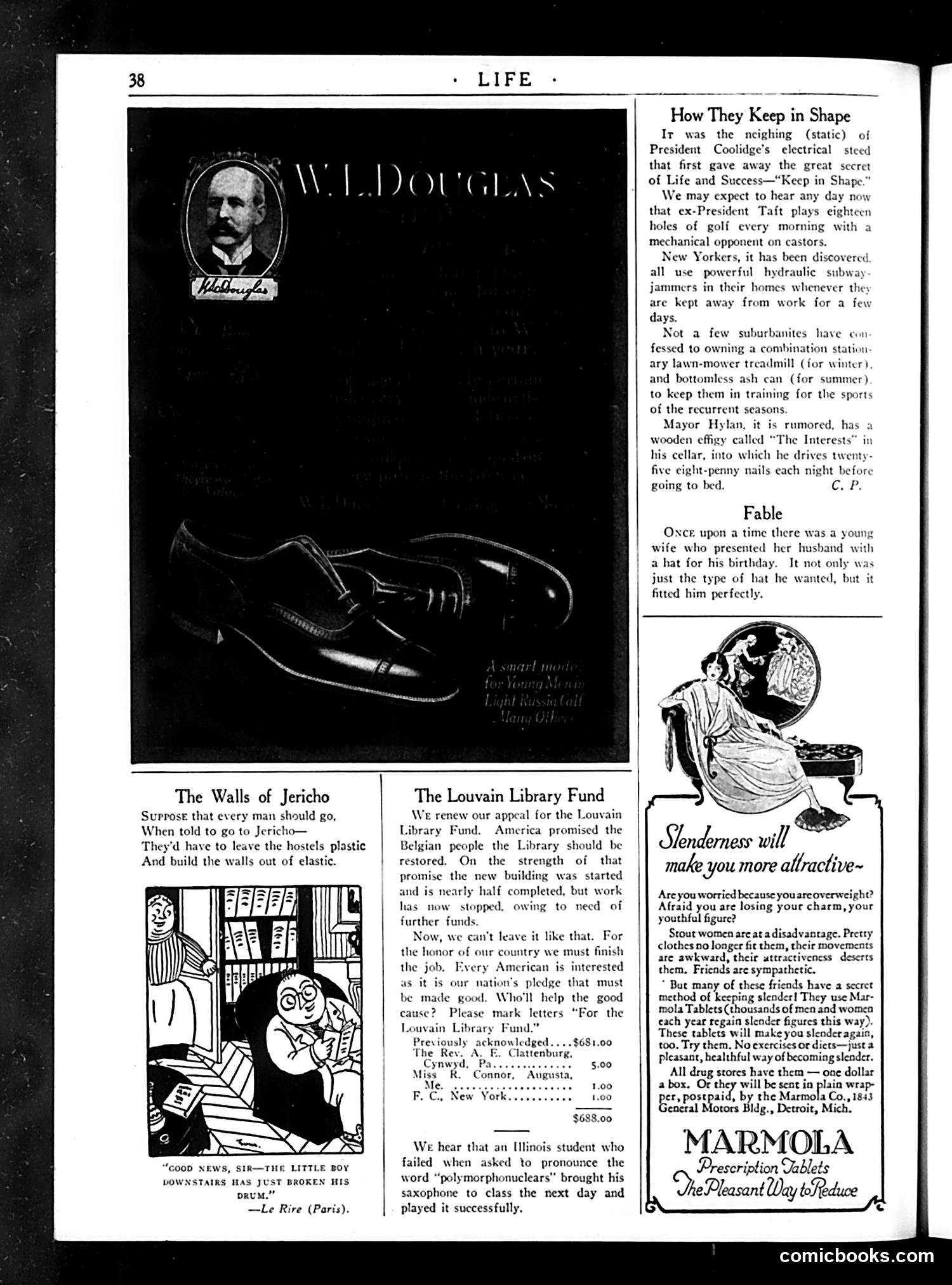
This page contains several distinct pieces of social satire typical of 1920s Life magazine: **"The Walls of Jericho"** — A cartoon mocking the biblical reference as a euphemism for infidelity or moral looseness ("go to Jericho" being slang). The joke suggests if everyone actually heeded such advice, hotels would collapse and society would need elastic walls. **"How They Keep in Shape"** — Satirical commentary on the fitness obsession of the era, mocking prominent figures: President Coolidge (referenced through an "electrical steed"), ex-President Taft, New York Mayor Hylan. The piece ridicules both excessive exercise culture and political figures' attempts to maintain public images of vigor. **"The Louvain Library Fund"** — A serious fundraising appeal for post-WWI Belgian reconstruction, seeking donations to complete a library restoration project as a matter of American honor. **"Fable"** — A brief humorous anecdote about marital gift-giving expectations. The page also contains a Marmola weight-loss advertisement targeting women, typical of period advertising messaging about female appearance and attractiveness.
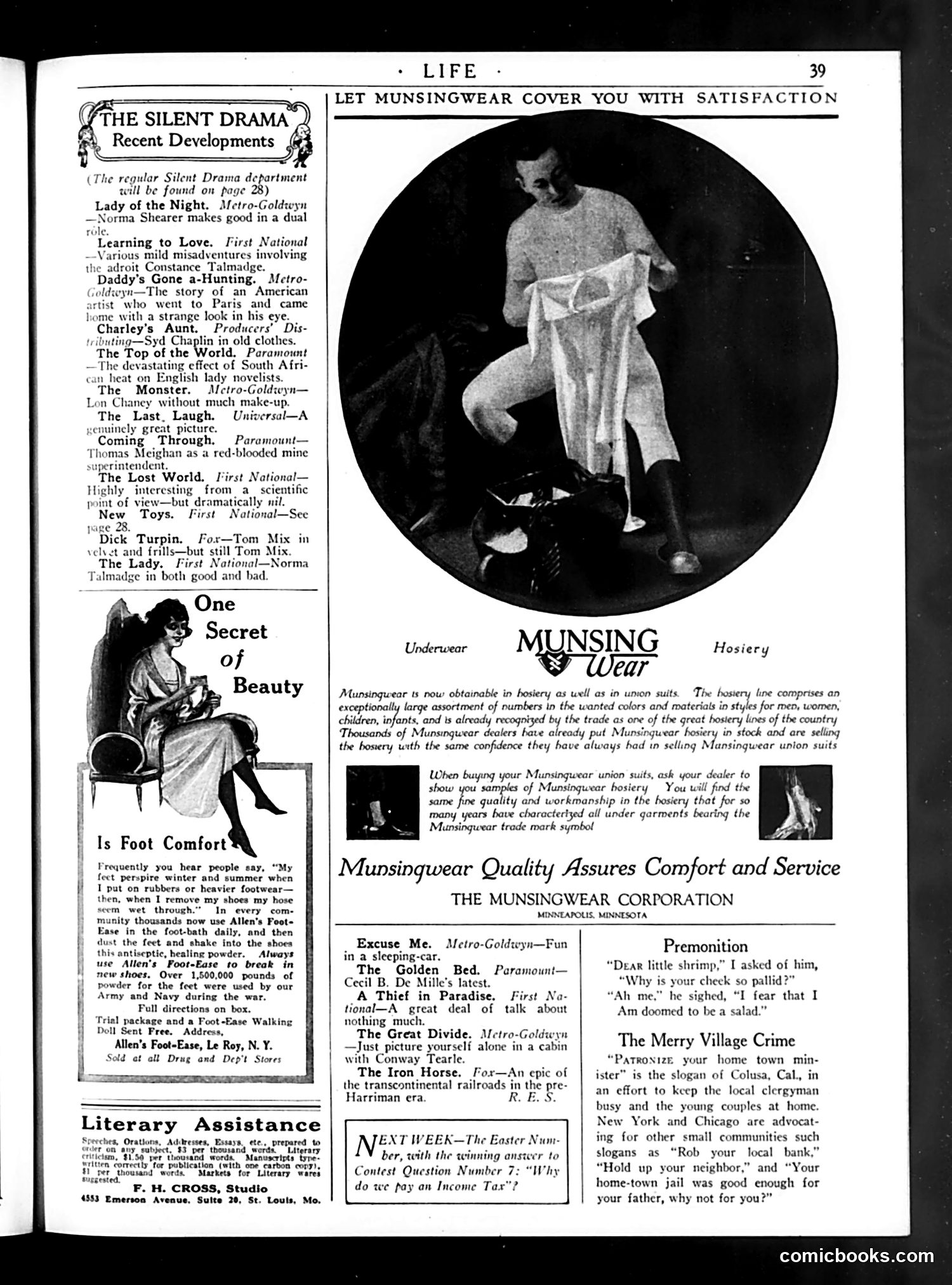
This page is primarily a collection of film reviews and advertisements rather than political satire or comics. The "Silent Drama" section reviews contemporary films (early 1920s) with brief, often witty critiques—such as noting "The Lost World" is "highly interesting from a scientific point of view—but dramatically nil." The humor is mild and focused on plot or casting choices (e.g., "Tom Mix in velvet and frills—but still Tom Mix"). The page also includes two small humorous pieces: "Premonition," a light joke about being "doomed to be a salad," and "The Merry Village Crime," a brief social commentary on supporting local clergy. Most of the page comprises advertisements for Allen's Foot-Ease powder and Munsingwear undergarments and hosiery, featuring product descriptions and endorsements. The content reflects 1920s concerns with hygiene and comfort rather than political satire.
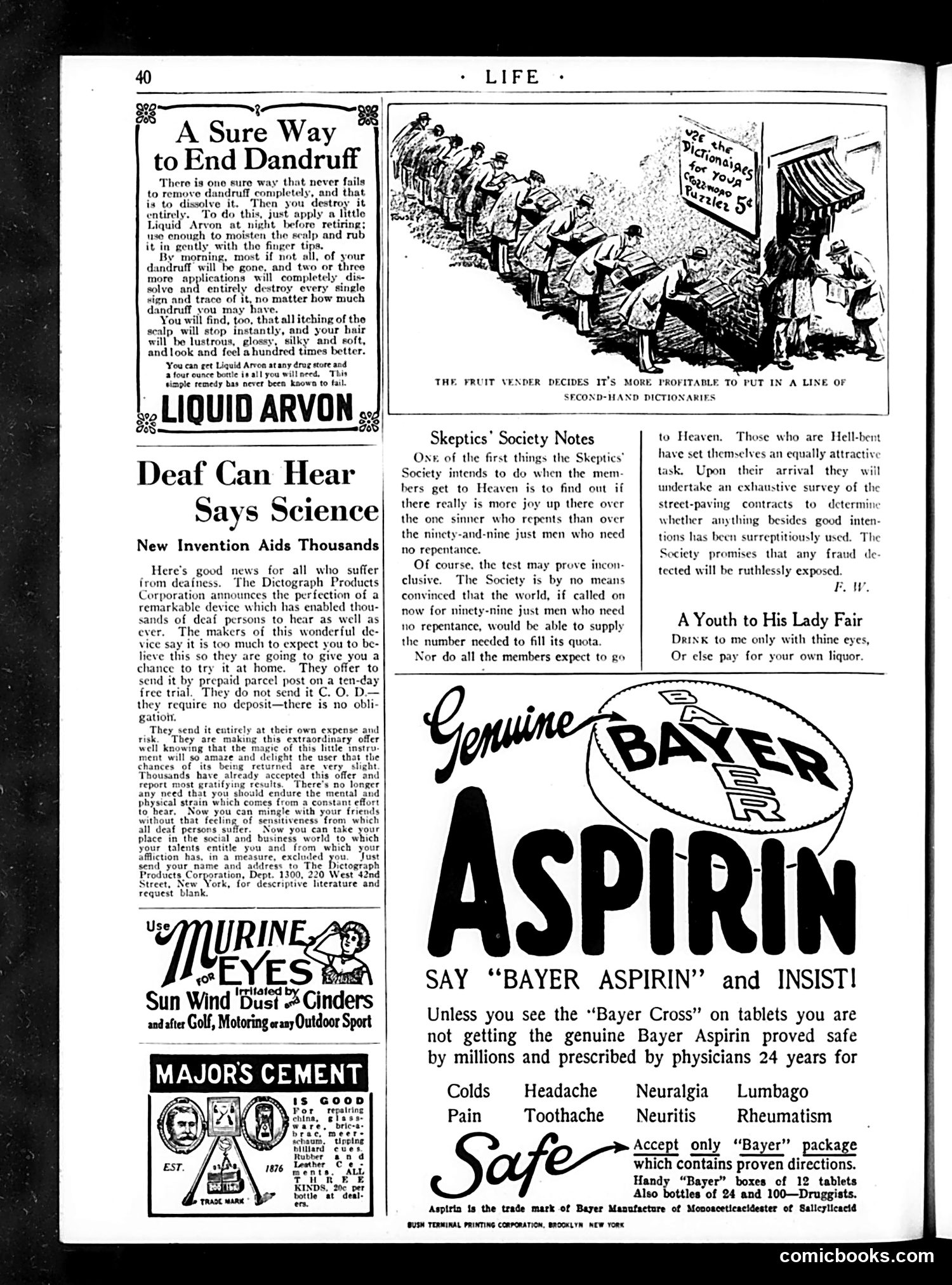
This page is primarily **advertisements and humor columns** from Life magazine (likely early 20th century). The main cartoon shows a fruit vendor abandoning his produce stand to sell "second-hand dictionaries" instead—a satirical jab at entrepreneurial opportunism. The joke: even a fruit seller sees more profit in hawking used books than actual food. The "Skeptics' Society Notes" is humorous religious satire: the society plans to investigate whether Heaven really delivers on its promises (more joy from one repentant sinner than ninety-nine righteous men). The satire mocks both skepticism and organized religion's convenient doctrines. "A Youth to His Lady Fair" is a flippant drinking joke suggesting a suitor should only romance a woman with his eyes—otherwise she should pay for her own alcohol. This reflects casual 1920s attitudes toward courtship and gender. The rest of the page consists of product advertisements (Liquid Arvon dandruff cure, Dictograph hearing device, Bayer Aspirin, etc.) typical of magazine content from this era.
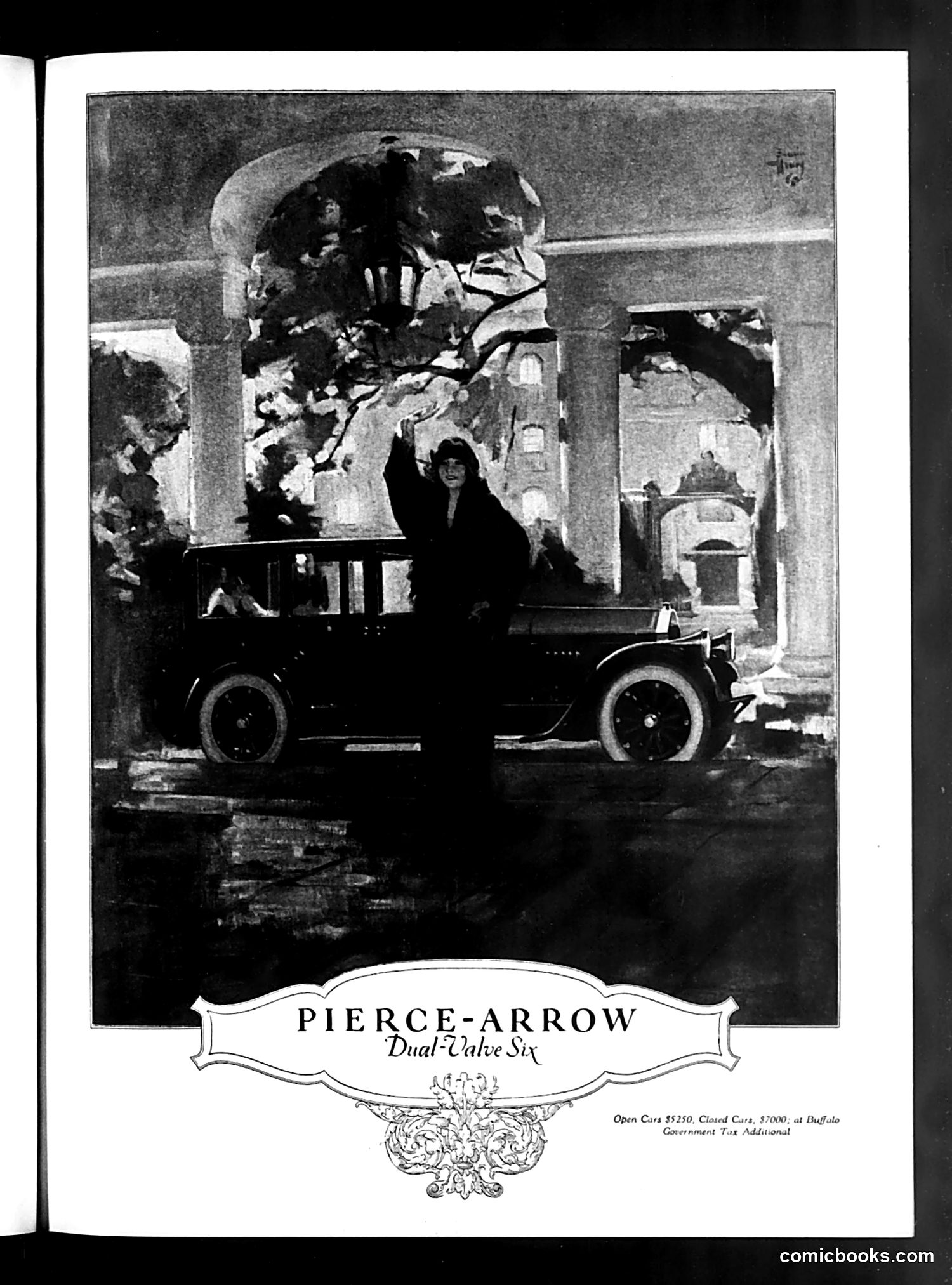
This page is primarily an automobile advertisement for the Pierce-Arrow "Dual-Valve Six" car, not political satire. The image shows a stylized scene of a woman standing in an open car parked beneath classical architecture, likely meant to evoke elegance and sophistication. The pricing information indicates open cars at $2,150 and closed cars at $2,700, with government tax additional. Pierce-Arrow was a luxury American automobile manufacturer. The advertisement uses dramatic staging—the classical columns and architectural setting—to associate the vehicle with refinement and upper-class status. This is a commercial advertisement rather than editorial cartoon or satirical content. The page demonstrates how Life magazine supplemented its satirical editorial content with high-end product advertising aimed at wealthy readers.
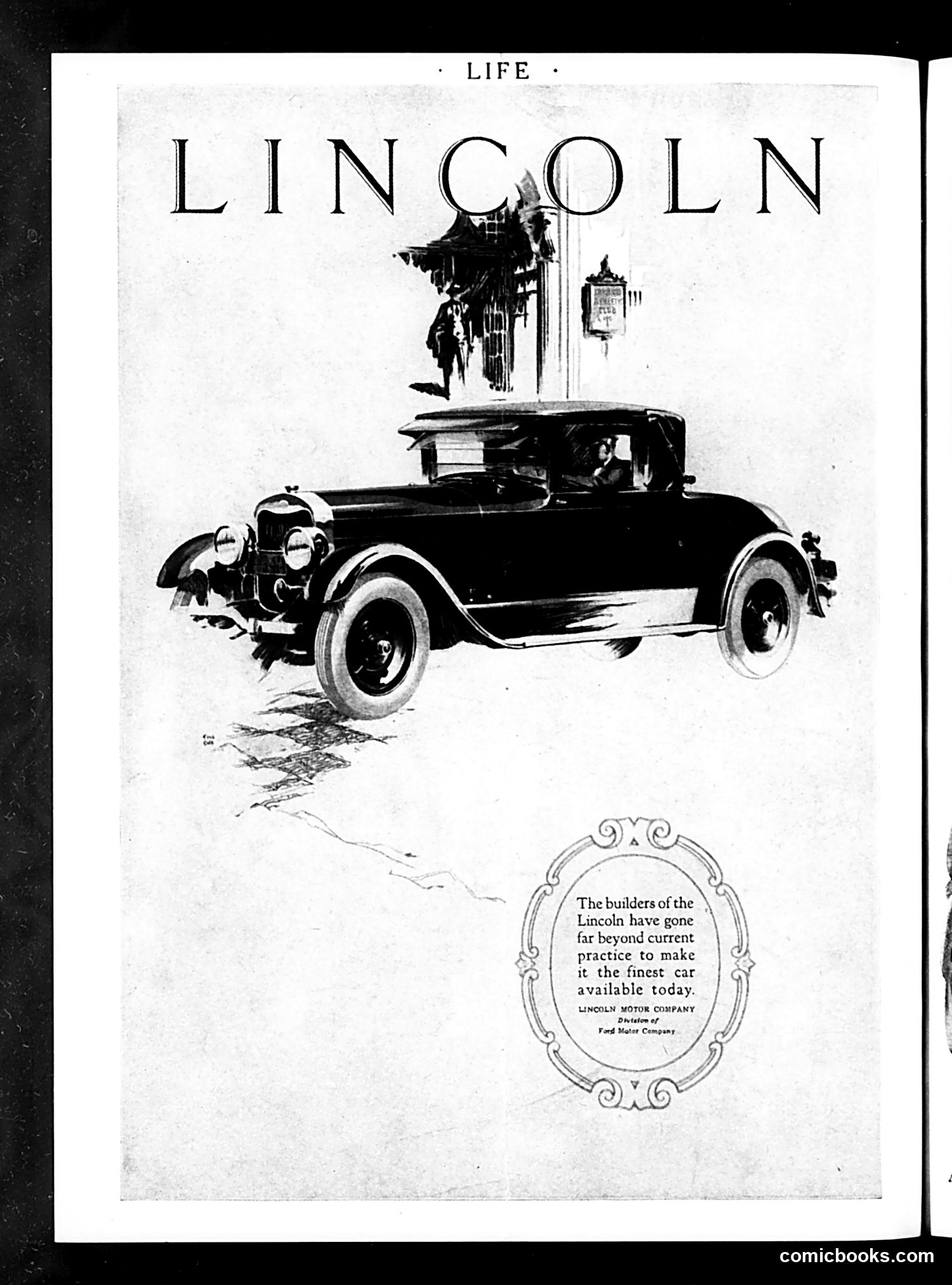
This is a **full-page advertisement** for the Lincoln automobile, not a political cartoon. The page features a luxury car with an elegant illustration of a woman in period dress standing on its roof, pointing toward a mansion in the background. The ad's text claims Lincoln builders have "gone far beyond current practice to make it the finest car available today." This is straightforward commercial messaging emphasizing the car's superior quality and craftsmanship. The imagery associates the Lincoln with wealth, elegance, and aspirational living—the woman's fashionable dress and the grand house suggest luxury and status. Lincoln Motor Company, listed as a division of Ford Motor Company, used this aspirational marketing to position their vehicles as premium products for affluent buyers during what appears to be the 1920s era.