
Life, 1925-04-02 · page 16 of 44
Life — April 2, 1925 — page 16: what you’re looking at
What you’re looking at
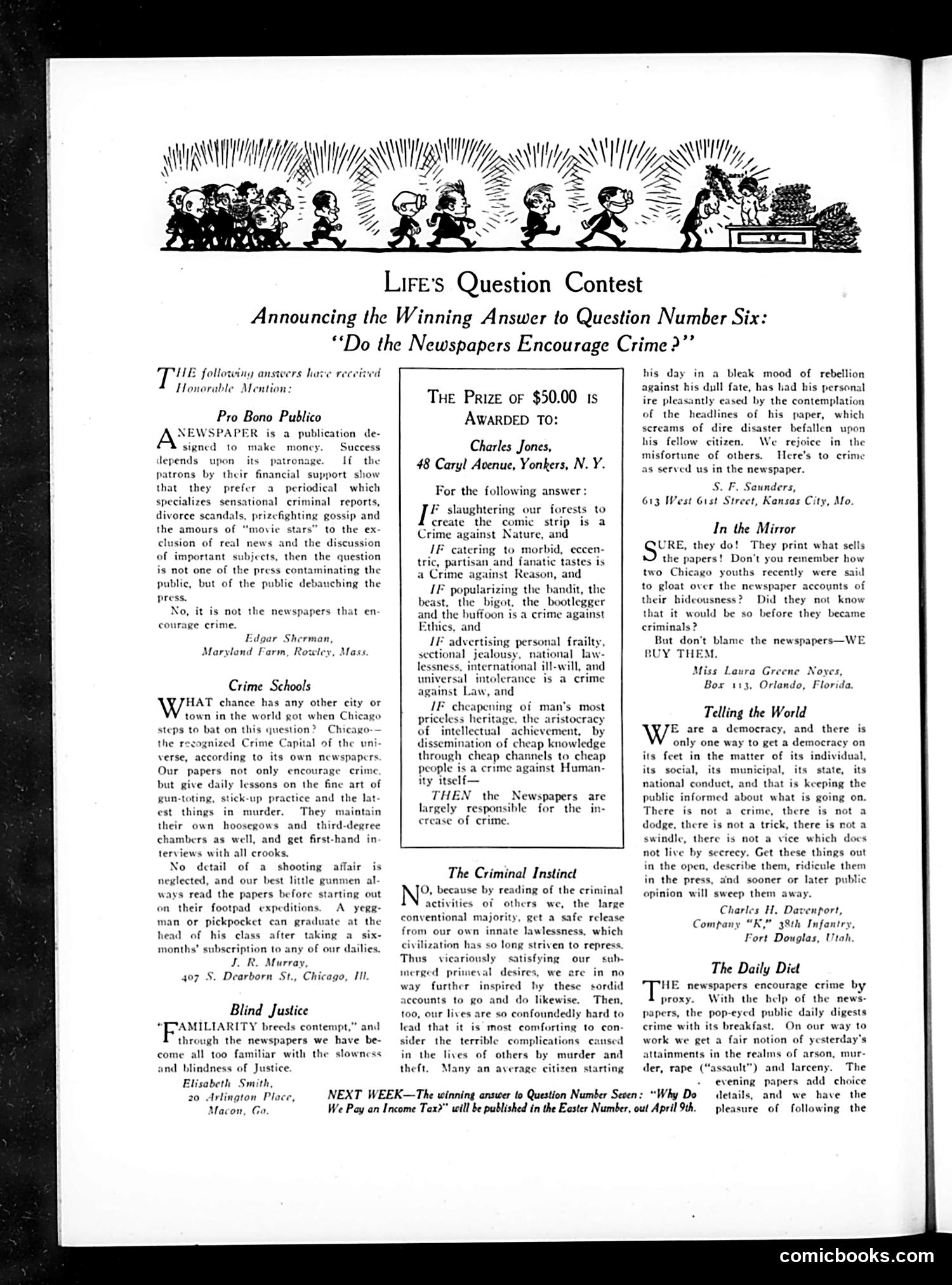
This page announces the winning answer to a debate question about whether newspapers encourage crime. The winning response by Charles Jones of Yonkers, NY argues that yes, newspapers do encourage crime—by sensationalizing crime reporting, glorifying criminals, and catering to morbid tastes rather than promoting reason and ethics. The page also includes responses from other contestants offering competing arguments: that newspapers actually provide transparency; that crime stems from human nature rather than press coverage; and that newspapers help expose criminal activity. The cartoon at the top shows silhouetted figures following a leader toward a trophy or prize, visually representing the contest's competitive nature. This was apparently a recurring reader-participation feature in Life magazine.
📄 Transcribed text from this page (OCR, searchable)
Machine-transcribed from the original scan — historical spelling and the odd misread are preserved.
A ONIN NZ, LiFeE's Question Contest Announcing the Winning Answer to Question Number Six: ‘Do the Newspapers Encourage Crime ?”’ IIE. foll Honorable ing an Shaver Mention: Pro Bono Publico NEWSPAPER is a publication de- signed to make Success depends upon its patronage. If the patrons by their financial support show that they prefer a periodical which specializes sensational criminal reports, divorce scandals, prizefighting gossip and the amours of Ovie to the ex- clusion of real news and the discussion of important subjects, then the question is not one of the press contaminating the public, but of the public debauching the press, No, it is not the newspapers that en courage crime. Edgar Sherman, Maryland Farm, Rowley, money. stars” Mass. Crime Schools HAT chance has any other city or town in the world got when Chicago steps to bat on this question? Chicag the nized Crime Capital of the uni- verse, according to its own newspapers Our papers not only encourage crime but give daily lessons on the fine art of gun-toting, stick-up practice and the lat- est things in murder. They maintain their own hoosegows and third-degree chambers as well, and get first-hand in terviews with all crooks. No detail of a shooting affair is neglected, and our best little gunmen al- ways read the papers before starting out on their footpad expeditions. A yeeg- man or pickpocket can graduate at the head of his class after taking a months’ subscription to any of our dailies. J. R. Murray, 407 S. Dearborn St., Chicago, Ill. six- Blind Justice AMILIARITY breeds contempt,” through the newspapers we have be- come all too familiar with the slowness and blindness of Justice. Elisabeth Smith, 20 Arlington Place, Macon, Go. Tue Prize or $50.00 1s AWARDED TO: Charles Jones, 48 Caryl Avenue, Yonkers, N.Y. For the following answer: slaughtering our forests to the comic strip is a inst Nature, and IF catering to morbid, eccen- tric, partisan and fanatic tastes is a Crime against Reason, and IF popularizing the bandit, the beast, the bigot. the bootlegger and the buffoon is a crime against Ethies, and ing personal frailty, jealousy, national law- ernational ill-will, and universal intolerance is a crime against Law, and JF cheapening oi man’s most priceless heritage. of intellectual achievement, dissemination of cheap knowledge through cheap channels to cheap people is a crime against Human- ity itself— THEN the Newspapers are largely responsible for the in- crease of crime. The Criminal Instinct 'O, because by reading of the criminal activities of others we, the large conventional majority, get a safe release fr our own innate lawlessness, which civilization has so long striven to repress. Thus vicariously satisfying our sub- merged primeval desires, we are in no way further inspired hy these sordid accounts to go and do likewise. Then, too, our lives are so confoundedly hard to lead that it is most comforting to con- sider the terrible complications cansed in the lives of others by murder and theft, Many an average citizen starting NEXT WEEK—The winning answer to Question Number Secen: “Why Do We Pay an Income Tax?” will be published in the Easter Number, out April 9th. his day in a bleak mood of rebellion against his dull fate, has had bis personal ire pleasantly eased by the contemplation of the headlines of his paper, which screams of dire disaster befallen upon his fellow citizen, We rejoice in the misfortune of others, Here's to crime as served us in the newspaper. S. F. Saunders, 613 West 61st Street, Kansas City, Mo. In the Mirror URE, they do! They print what sells the papers! Don't you remember how two Ch youths recently were said to gloat over the newspaper accounts of their hideousness? Did they not know that it would be so before they became criminals ? But don’t blame the newspapers—WE BUY THEM. Miss Laura Greene Noyes, Box 113, Orlando, Florida. Telling the World W E are a democracy, and there is only one way to get a democracy on its feet in the matter of its individual, social, its municipal, its state, its national conduct, and that is kceping the public informed about what is going on. There a crime, there is not a dodge, there is not a trick, there is not a swindle, there is not a vice which does not live by secrecy. Get these things out in the open, describe them, ridicule them in the press, aind sooner or later public opinion will sweep them away. Charles H. Davenport, Company “K,” 38th Infantry, Fort Douglas, Utah. its is not The Daily Diet HE newspapers encourage crime by roxy. With the help of the news- papers, the pop-eyed public daily digests crime with its breakfast. On our way to work we get a fair notion of yesterday's attainments in the realms of arson, mur- der, rape (“assault”) and larceny. The evening papers add choice details, and we have the pleasure of following the comicbooks.com