
Life, 1925-04-02 · page 28 of 44
Life — April 2, 1925 — page 28: what you’re looking at
What you’re looking at
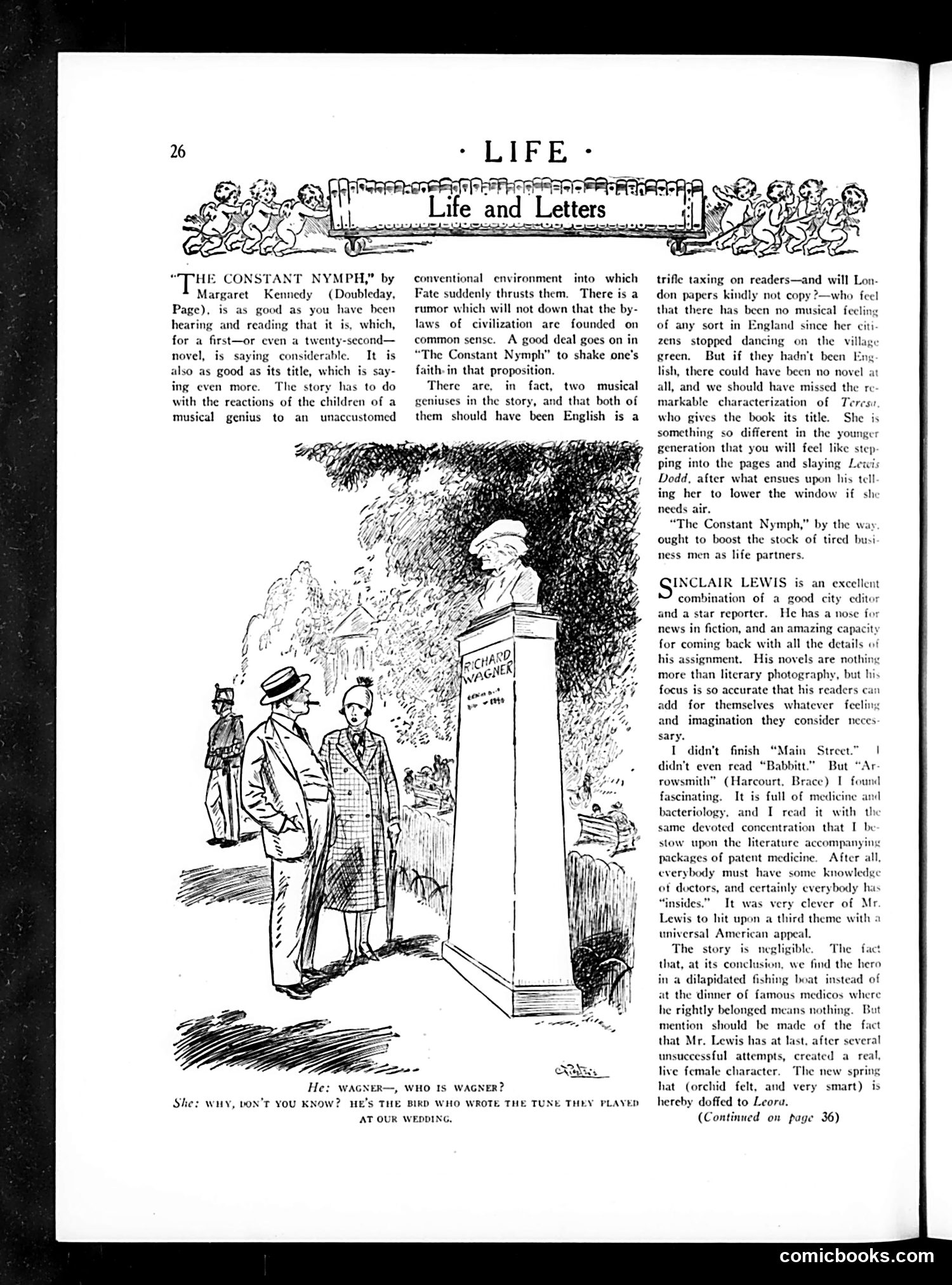
This is a literary review section from Life magazine discussing Margaret Kennedy's novel *The Constant Nymph* and Sinclair Lewis's *Arrowsmith*. **The cartoon** depicts a couple at what appears to be a wedding or social gathering. The husband asks "Who is Wagner?" and the wife responds that Wagner is "the bird who wrote the tune they played at our wedding"—a joke about musical ignorance. Wagner, the famous 19th-century composer, is being reduced to merely "the guy whose music played at our wedding" by someone unaware of his historical significance. This satirizes ordinary people's lack of classical music knowledge. **The reviews** praise both novels. Kennedy's book is celebrated for its sophisticated portrayal of unconventional characters. Lewis's *Arrowsmith* is commended for its accurate depiction of medicine and its creation of a realistic female character (Leora), though the reviewer dismisses the plot as "negligible"—valuing Lewis's journalistic accuracy over storytelling craft. The overall tone suggests Life valued literary realism and social observation over romantic plot.
📄 Transcribed text from this page (OCR, searchable)
Machine-transcribed from the original scan — historical spelling and the odd misread are preserved.
“"THE CONSTANT NYMPH,” by Margaret Kennedy (Doubleday, Page), is as good as you have heen hearing and reading that it is, which, for a first—or even a twenty-second— novel, is saying considerable. It is also as good as its title, which is say- ing even more. The story has to do with the reactions of the children of a musical genius to an unaccustomed s _and Letters bai) ot, SSS conventional environment into which Fate suddenly thrusts them. There is a rumor which will not down that the by- laws of civilization are founded on common sense. A good deal goes on in he Constant Nymph” to shake one’s faith-in that proposition. There are, in fact, two musical geniuses in the story, and that both of them should have been English is a He: WAGNER—, WHO IS WAGNER? She: wuy, von’T YoU KNOW? He's THE BIRD WHO WROTE THE TUNE THEY PLAYED AT OUR WEDDING, trifle taxing on readers—and will Lon- don papers kindly not copy ?—who feel that there has been no musical feeling of any sort in England since her citi- zens stopped dancing on the village green. But if they hadn't been Eng lish, there could have been no novel at all, and we should have missed the re markable characterization of who gives the book its title. She is something so different in the younger generation that you will feel like step ping into the pages and slaying / Dodd, after what ensues upon his tell ing her to lower the window if. sh: needs air. “The Constant Nymph,” by the way ought to boost the stock of tired busi ness men as life partners. Teresu INCLAIR LEWIS is an excellent combination of a good city editor and a star reporter. He has a nose for news in fiction, and an amazing capacity for coming back with all the details of his assignment. His novels are nothing more than literary photography, but his focus is so accurate that his readers can add for themselves whatever feeling and imagination they consider neces sary. I didn't finish “Main Street.” didn’t even read “Babbitt”. But “Ar rowsmith” (Harcourt, Brace) I found fascinating. It is full of medicine and bacteriole and I read it with th same devoted concentration that I be stow upon the literature accompanyins packages of patent medicine. After all, everybody must have some knowledge ot doctors, and certainly everybody has “insides.” It was very clever of Mr. Lewis to hit upon a third theme with a universal American appeal. The story is negligible. The that, at its conclusion, we find the hero. in a dilapidated fishing boat instead of at the dinner of famous medicos where he rightly belonged means nothing. But mention should be made of the fact that Mr. Lewis has at last, after several unsuccessful attempts, created a real, live female character. The new spring hat (orchid felt, and very smart) is hereby doffed to Leora. (Continued on page 36) fact comicbooks.com