
Life, 1925-04-02 · page 20 of 44
Life — April 2, 1925 — page 20: what you’re looking at
What you’re looking at
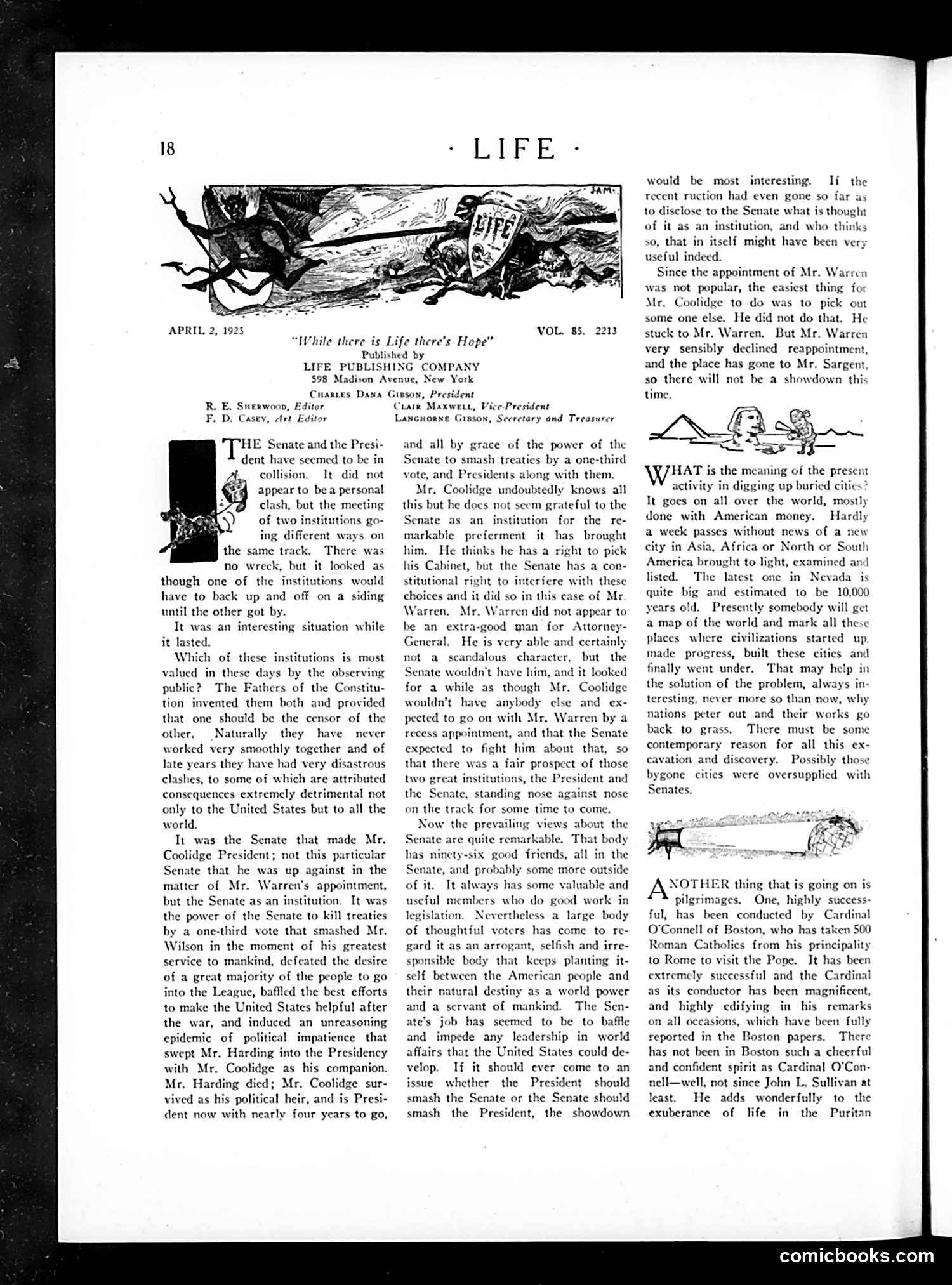
This page discusses a recent constitutional clash between President Calvin Coolidge and the U.S. Senate over Coolidge's cabinet appointment of Mr. Warren as Attorney General. The Senate blocked the nomination, asserting its constitutional right to reject presidential choices. The article argues that while the Senate's power has historically benefited Coolidge (they helped elevate him to the presidency after Harding's death), he appears ungrateful. The editorial presents this as a larger institutional conflict: the Senate is characterized as an "arrogant, selfish and irresponsible body" that impedes American leadership and world power, consistently blocking progressive initiatives. The cartoon at top—showing a figure near a headstone marked "LIFE"—appears to reference the magazine's own stakes in this debate about governmental effectiveness.
📄 Transcribed text from this page (OCR, searchable)
Machine-transcribed from the original scan — historical spelling and the odd misread are preserved.
APRIL 2, 1925 VOL. 85. “While there is Life there's Hope” Published by LIFE PUBLISHID COMPANY $98 Madison Avenue, New York Cuartes Dana Gipson, President R. E. Suexwoon, Editor F, D, Casey, Art Editor HE Senate and the Pr dent have seemed to be in Zi. collision. It did not appear to bea personal D clash, but the meeting yy of two institutions go- ing different ways on the same track. There was no wreck, but it looked as though one of the institutions would have to back up and off on a siding until the other got by. It was an interesting situation while it lasted. Which of these institutions is most valued in these days by the observing public? The Fathers of the Constitu- tion invented them both and provided that one should be the censor of the other, Naturally they have never worked very smoothly together and of late years they have had very disastrous clashes, to some of which are attributed consequences extremely detrimental not only to the United States but to all the world. Tt was the Senate that made Mr. Coolidge President; not this particular Senate that he was up against in the matter of Mr. Warren's appointment, but the Senate as an institution. It was the power of the Senate to kill treaties by a one-third vote that smashed Mr. Wilson in the moment of his greatest service to mankind, defeated the desire of a great majority of the people to go into the League, baffled the best efforts to make the United States helpful after the war, and induced an unreasoning epidemic of political impatience that swept Mr. Harding into the Presidency with Mr. Coolidge as his companion. Mr. Harding died; Mr. Coolidge sur- vived as his political heir, and is Presi- dent now with nearly four years to go, CLain Maxweit, Vice-President Lancuorne Ginson, Secretary and Treasurer and all by grace of the power of the Senate to smash treaties by a one-third vote, and Presidents along with them. Mr. Coolidge undoubtedly knows all this but he does not seem grateful to the Senate as an institution for the re- markable preferment it has brought him, He thinks he has a right to pick his Cabinet, but the Senate has a con- stitutional right to interfere with these choices and it did so in this case of Mr Warren, Mr. Warren did not appear to be an extra-good man for Attorney- General. He is very able and certainly not a scandalous character, but the Senate wouldn't have him, and it looked for a while as though Mr. Coolidge wouldn't have anybody else and ex- pected to go on with Mr. Warren by a recess appointment, and that the Senate expected to fight him about that, so that there w fair prospect of those two great institutions, the President and the Sen standing nose against nose me time to come. ing views about the ¢ quite remarkable. That body has ninety-six good friends, all in the Senate, and probably some more outside of it. It always has some valuable and useful members who do good work legislation. Nevertheless a large body of thoughtful voters has come to re- gard it as an arrogant, selfish and irre- sponsible body that keeps planting it- self between the American people and their natural destiny as a world power and a servant of mankind. The Sen- ate’s job has seemed to be to baffle and impede any leadership in world affairs that the United States could de- velop. If it should ever come to an issue whether the President should smash the Senate or the Senate should smash the President, the showdown Senat would be most interesting. If the recent ruction had even gone so far to disclose to the Senate what is thought of it as an institution, and who thinks so, that in itself might have been very useful indeed. ince the appointment of Mr. Warren not popular, the easiest thing for Mr. Coolidge to do was to pick out some one else. He did not do that. He stuck to Mr. Warren. But Mr. Warren very sensibly declined reappointment, and the place has gone to Mr. Sargent so there will not be a showdown this time. HAT is the meaning of the present activity in digging up buried cities? It goes on all over the world, mostly done with American money. Hardly a week passes without news of a new Africa or North or South ght to light, examined a: listed. The latest one in Nevada quite big and estimated to be 10,000 years old. Presently somebody will get a map of the world and mark all these places where civilizations started up. made progress, built these cities and finally went under. That may help in the solution of the problem, always in- teresting, never more so than now, why nations peter out and their works go back to grass. There must be some contemporary reason for all this ex- cavation and discovery. Possibly those bygone cities were oversupplied with Senates. NOTHER thing that is going on is pilgrimages. One, highly success- ful, has been conducted by Cardinal O'Connell of Boston, who has taken 500 Roman Catholics from his principality to Rome to visit the Pope. It has been extremely successful and the Cardinal as its conductor has been magnificent, and highly edifying in his remarks on all occasions, which have been fully reported in the Boston papers. There has not been in Boston such a cheerful and confident spirit as Cardinal O'Con- nell—well, not since John L. Sullivan at least. He adds wonderfully to the exuberance of life in the Puritan comicbooks.com