
A complete issue · 37 pages · 1925
Life — January 1, 1925
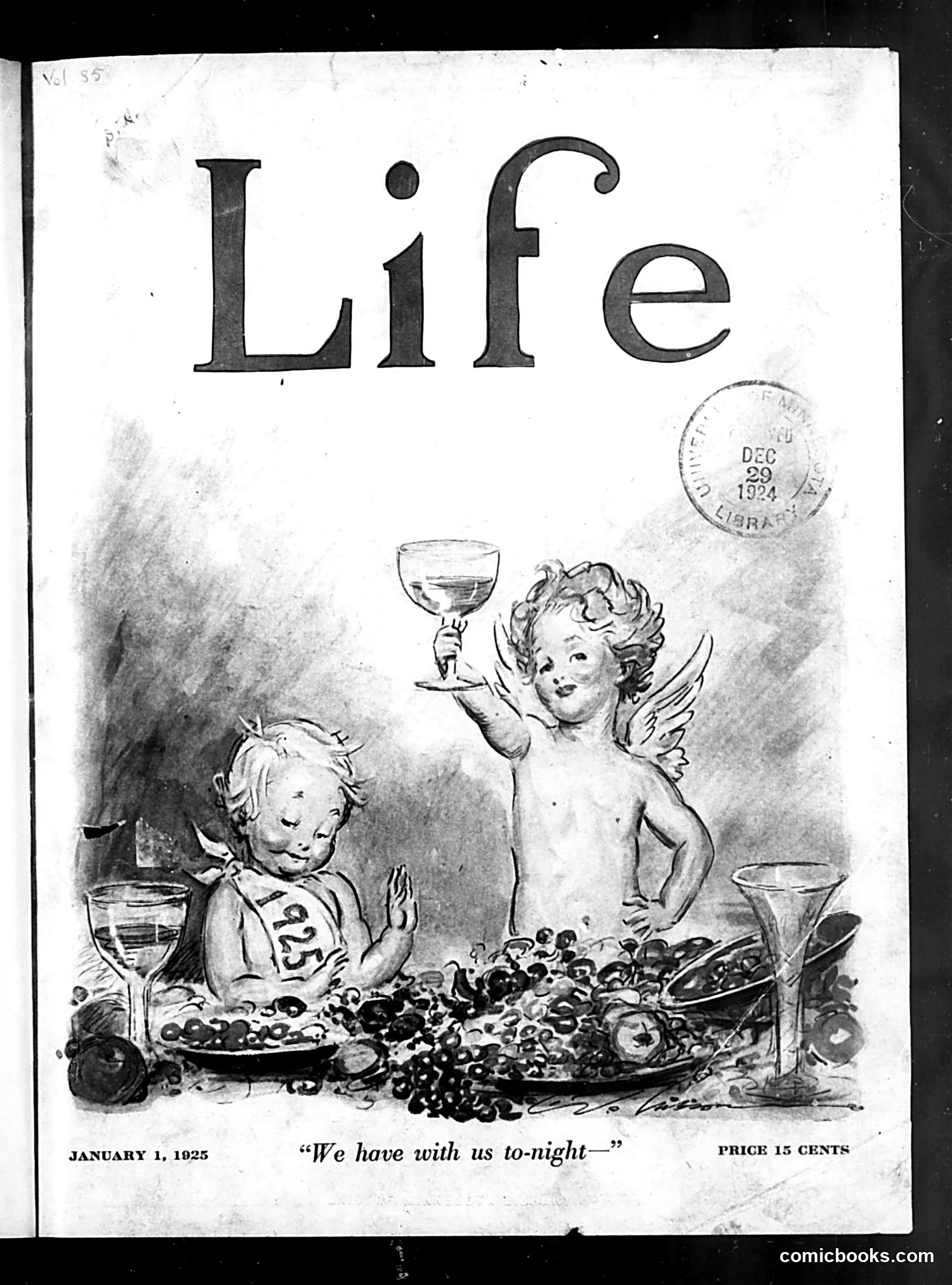
This is a *Life* magazine cover featuring two cherub figures (cupids) celebrating with wine glasses and fresh fruit. The tagline reads "We have with us to-night," suggesting a New Year's Eve or New Year's Day celebration. The imagery appears to reference **Prohibition-era humor**. In 1925, alcohol was illegal in America (Prohibition: 1920-1933), yet the cover depicts cherubs openly enjoying wine and grapes—luxurious foods associated with wine culture. This represents satirical commentary on widespread violation of Prohibition laws, particularly among wealthy or sophisticated circles who continued drinking despite the ban. The price of 15 cents and library stamp indicate this is archival material from that specific historical moment.
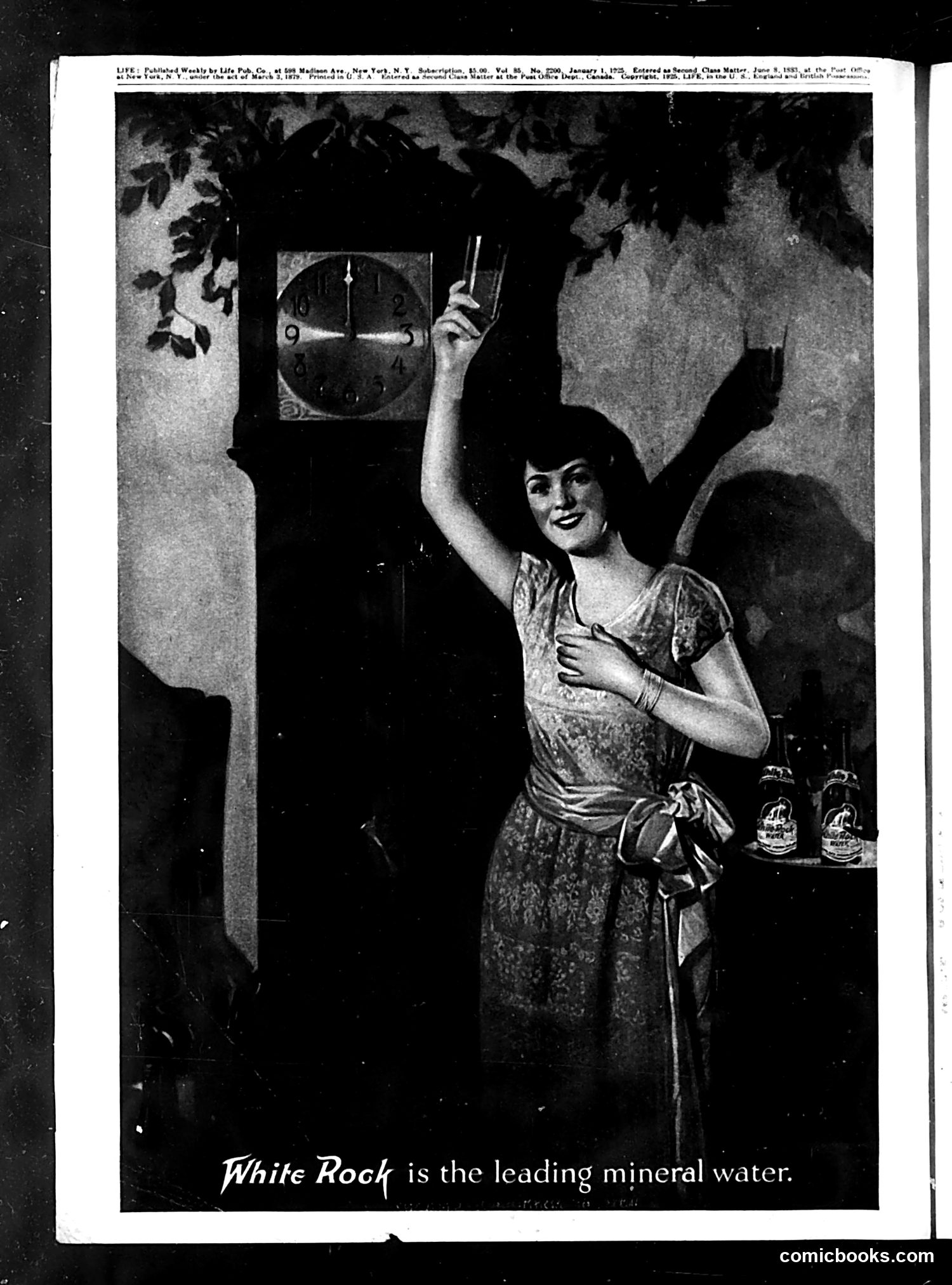
This is a **vintage advertisement**, not political satire. The page promotes White Rock mineral water, featuring a woman in 1920s-30s attire reaching up to adjust a wall clock while holding bottles of the product. The ad's tagline reads: "White Rock is the leading mineral water." The imagery appears designed to convey **modernity and domestic convenience**—the woman's fashionable dress and the prominent clock suggest efficiency and contemporary living. The bottles displayed on the table reinforce the product placement. This represents typical **early 20th-century advertising strategy**: associating a consumer product with aspirational lifestyle imagery rather than emphasizing product qualities. The scene suggests White Rock as part of a stylish, up-to-date household. No political commentary or satire is evident here.
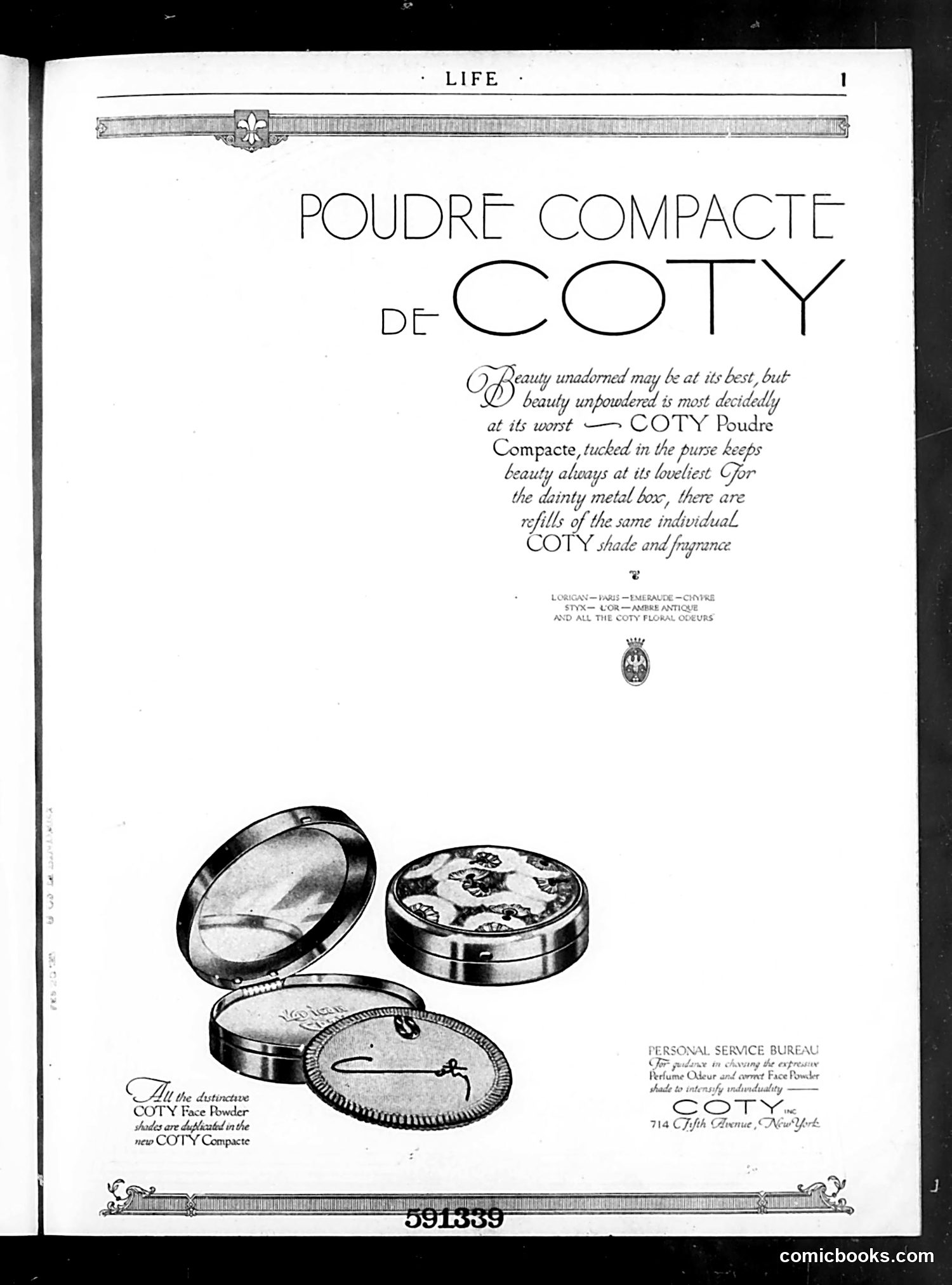
This page is **not a political cartoon or satirical content**—it's a **beauty product advertisement** for Coty's compact powder. The ad features an illustration of an ornate metal compact powder case shown open from multiple angles, displaying the product's design and applicator. The text uses period-appropriate marketing language ("beauty unadorned may be at its best, but beauty unpowdered is most decidedly at its worst") to promote the compact's convenience and portability for women. The page includes product details listing available shades (Lorgan, Éméraide, Cityenne, Styx, L'Or, Ambre Antique) and company information for Coty at 714 Fifth Avenue, New York. This is straightforward **commercial advertising**, not editorial or satirical content from Life magazine.
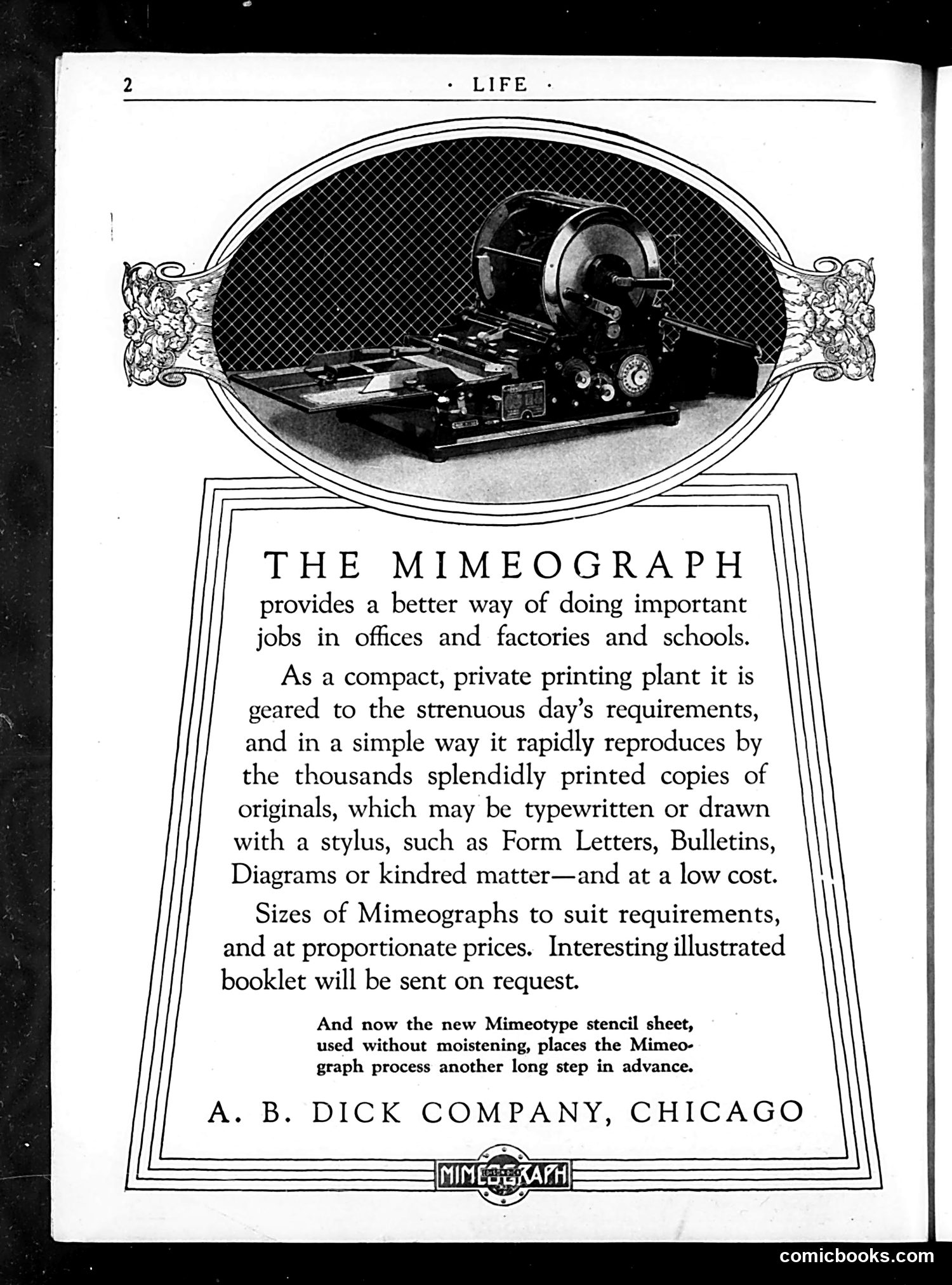
This page is **primarily an advertisement**, not a political cartoon. It promotes the Mimeograph, a document reproduction machine manufactured by the A.B. Dick Company of Chicago. The advertisement highlights the Mimeograph as a practical office technology for the early 20th century, emphasizing its ability to produce numerous copies of typed or hand-drawn documents (letters, bulletins, diagrams) quickly and inexpensively. The decorative ornamental elements flanking the central product image are typical of period advertising design rather than satirical commentary. The mention of "the new Mimeotype stencil sheet, used without moistening" indicates this is promoting a technological improvement—likely a significant convenience feature for contemporary office workers. This represents commercial rather than editorial content.
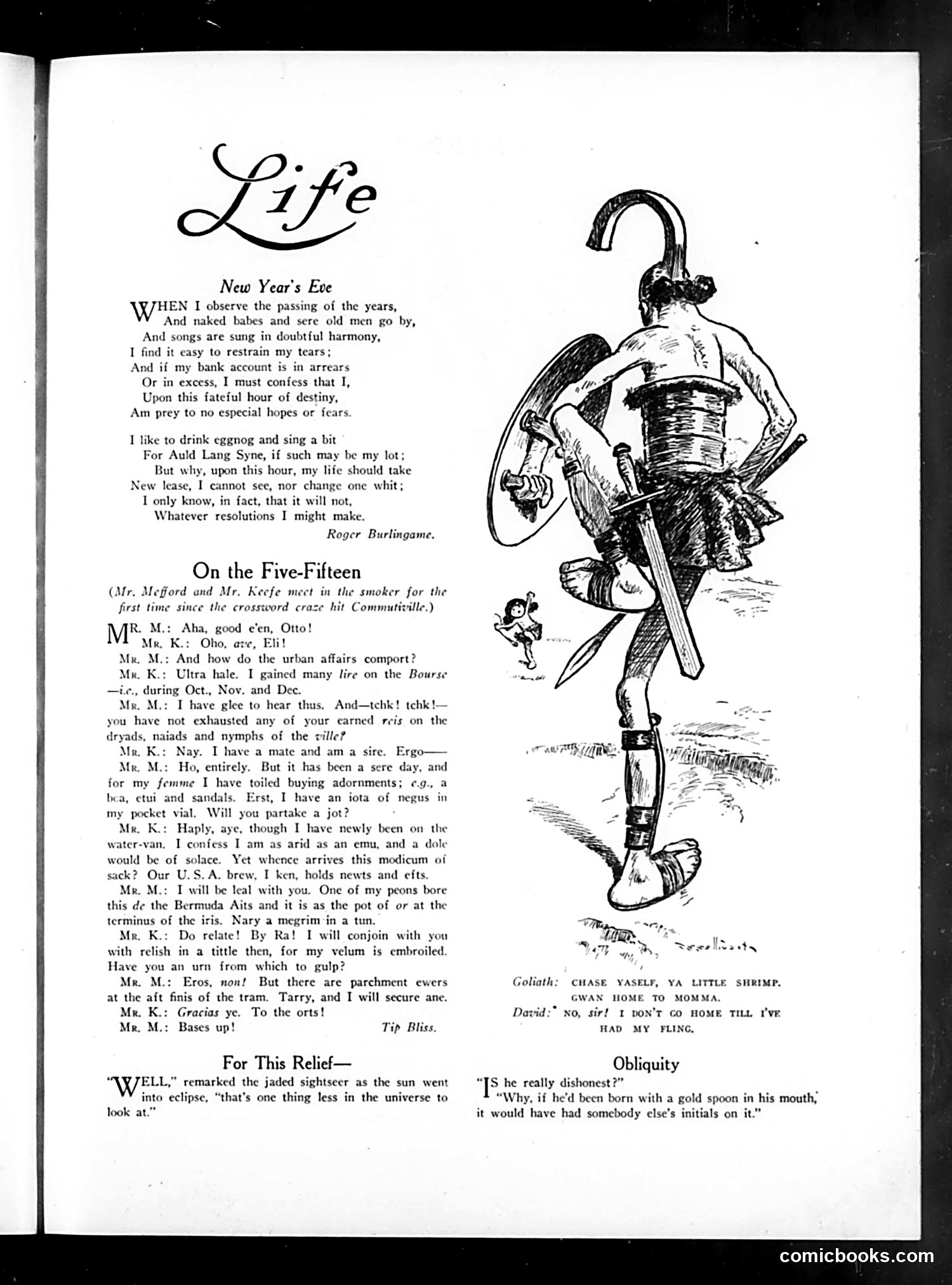
This page contains three literary/humorous pieces rather than political cartoons: 1. **"New Year's Eve"** by Roger Burlingame: A poem about financial anxiety and resolutions, reflecting post-WWI economic uncertainty. 2. **"On the Five-Fifteen"**: A dialogue between Mr. McFord and Mr. Keele discussing urban life, stock market gains ("fire on the Bourse"), and financial concerns. References to "U.S. A. brew" suggest Prohibition-era America. 3. The accompanying illustration depicts a grotesque figure with exaggerated features—likely representing general anxiety or financial worry personified. 4. **Brief jokes** at page bottom about dishonesty and privilege. The overarching theme is economic anxiety and social observation typical of 1920s American satire, targeting middle-class concerns about money and propriety during the Jazz Age.
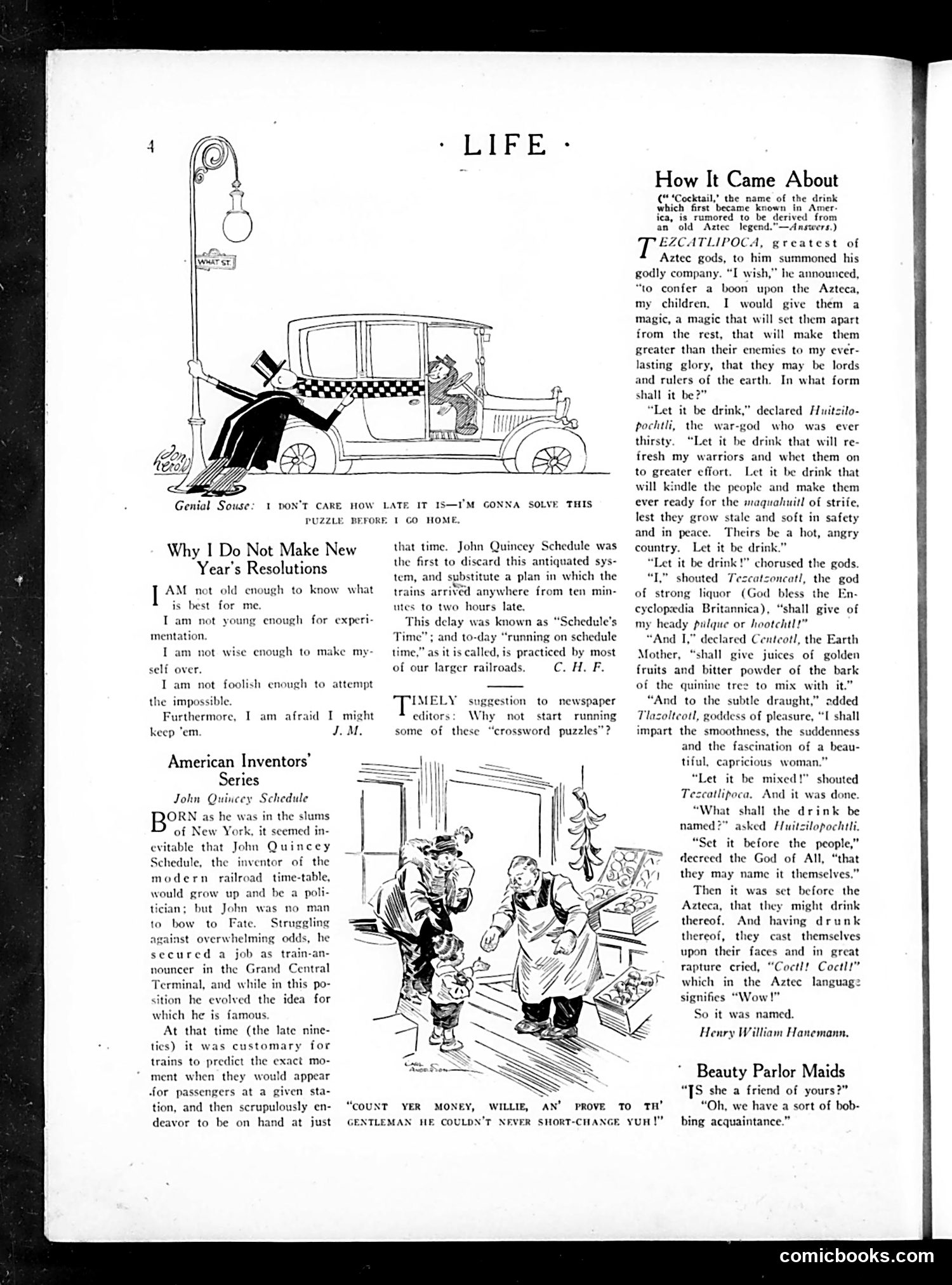
**Top Cartoon - "Genial Source"**: A man in formal attire struggles with a broken-down automobile while a street lamp looms above. The caption reads "I don't care how late it is—I'm gonna solve this puzzle before I go home." This satirizes the frustration of early automobile ownership and the obsessive problem-solving mentality, likely commenting on the novelty and unreliability of cars in this era. **"Why I Do Not Make New Year's Resolutions"**: A humorous first-person essay rejecting self-improvement pledges, using self-deprecating wit about age, foolishness, and avoiding impossible goals. **"American Inventors' Series - John Quincy Schedule"**: Biographical text about the railroad inventor who standardized train schedules, enabling predictable departure times—a significant 19th-century innovation improving passenger travel reliability.
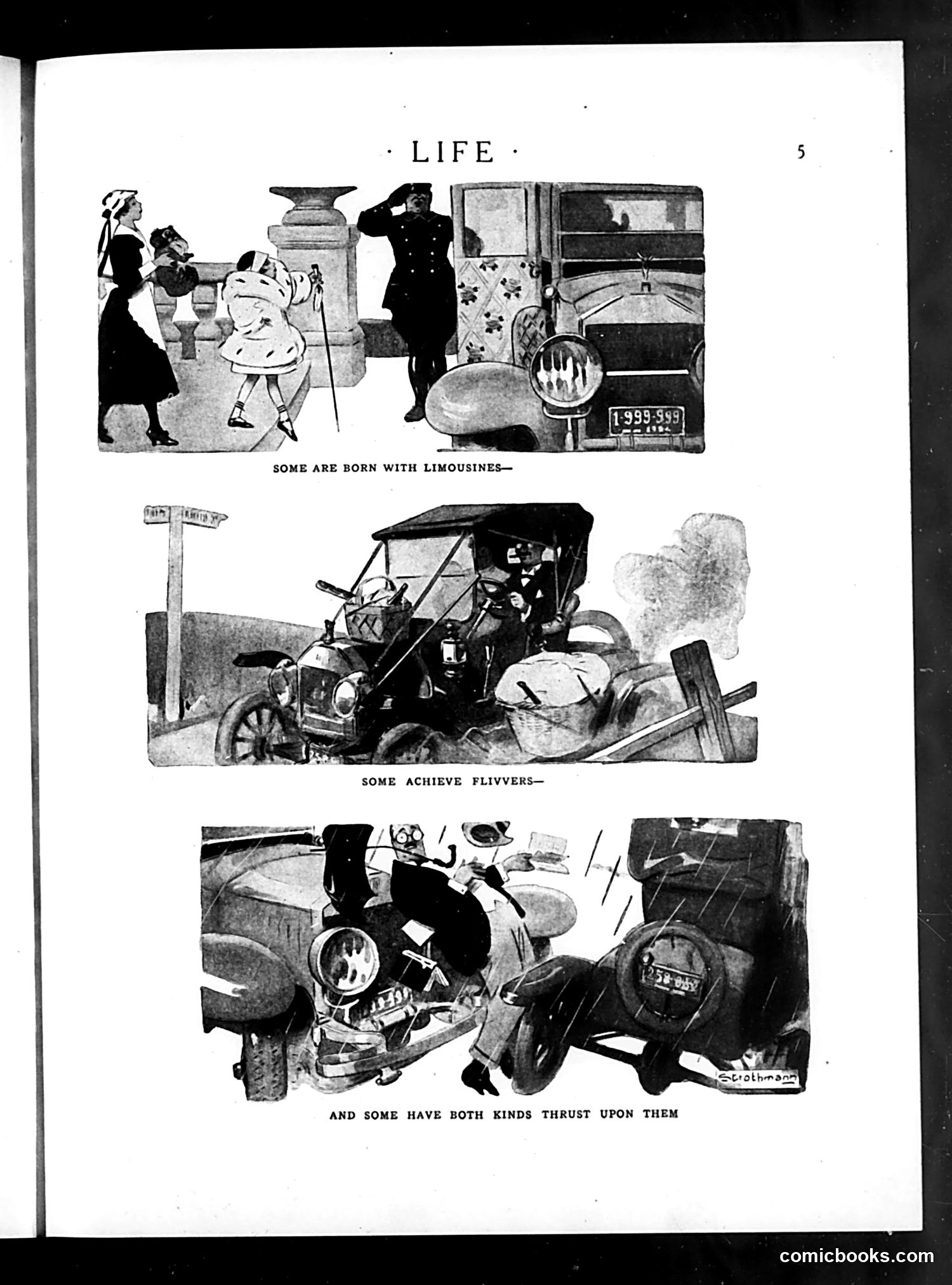
This three-panel cartoon satirizes class differences regarding automobiles in early 20th-century America. **Panel 1** ("Some are born with limousines"): Shows wealthy figures with a chauffeur-driven luxury automobile, establishing privilege by birth. **Panel 2** ("Some achieve flivvers"): Depicts someone who has earned enough to purchase a modest "flivver" (cheap car, likely a Model T Ford), representing self-made success. **Panel 3** ("And some have both kinds thrust upon them"): Shows a chaotic accident scene where vehicles collide—apparently satirizing those who gain cars through misfortune or disaster rather than legitimate means. The joke mocks different routes to automobile ownership while suggesting some achieve vehicles through unfortunate circumstances (accidents/collisions) rather than wealth or honest work.
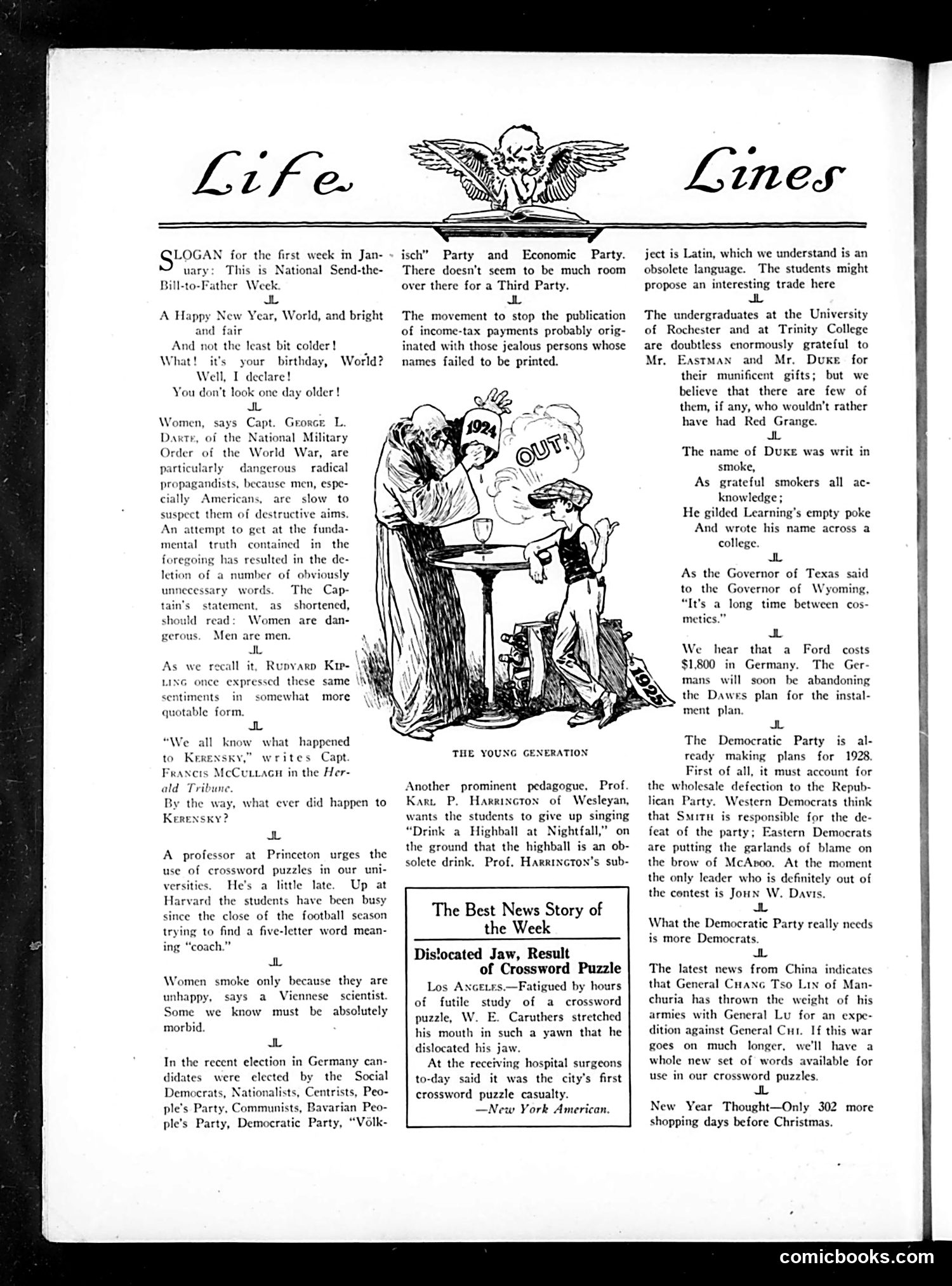
This page from *Life* magazine contains satirical commentary on 1920s American politics and culture. The central cartoon, titled "The Young Generation," depicts a figure labeled "1924" offering a drink to a young person, satirizing concerns about youth rebellion and Prohibition-era lawbreaking. The text references contemporary political figures and debates: Captain George L. Daffe on women's pacifism, Rudyard Kipling's views on Bolshevism, and Professor Kamp's criticism of student drinking. A boxed item mocks a crossword puzzle enthusiast who dislocated his jaw. The page concludes with commentary on the 1928 Democratic Party and ongoing disputes with General Chang Tso Lin in China—reflecting America's engagement with both domestic politics and international affairs of the era.
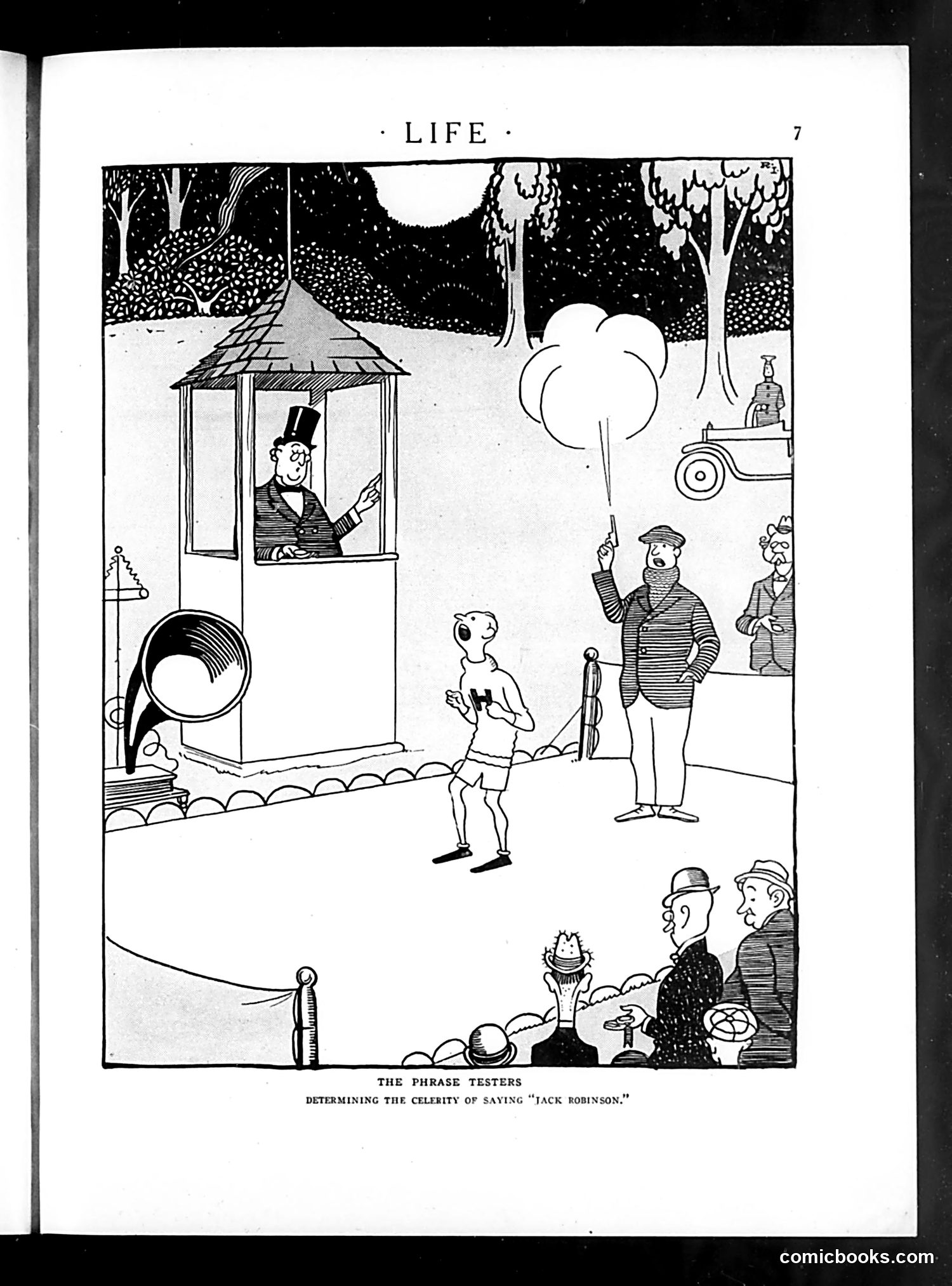
This cartoon satirizes the phenomenon of testing whether common phrases have become clichéd or lost their impact. The caption reads: "Determining the Celerity of Saying 'Jack Robinson.'" The scene depicts a circus or carnival setting where a man in a booth (likely a carnival barker or impresario) is conducting an experiment. A shirtless performer appears to be running or demonstrating speed, while spectators observe and presumably time the phrase "Jack Robinson" — likely the expression "faster than you can say Jack Robinson," meaning something happens very quickly. The satire targets the contemporary obsession with testing whether familiar expressions retain their original meaning and force, or have become so overused they've lost their punch. It's a commentary on linguistic fads and the somewhat absurd nature of phrase analysis.
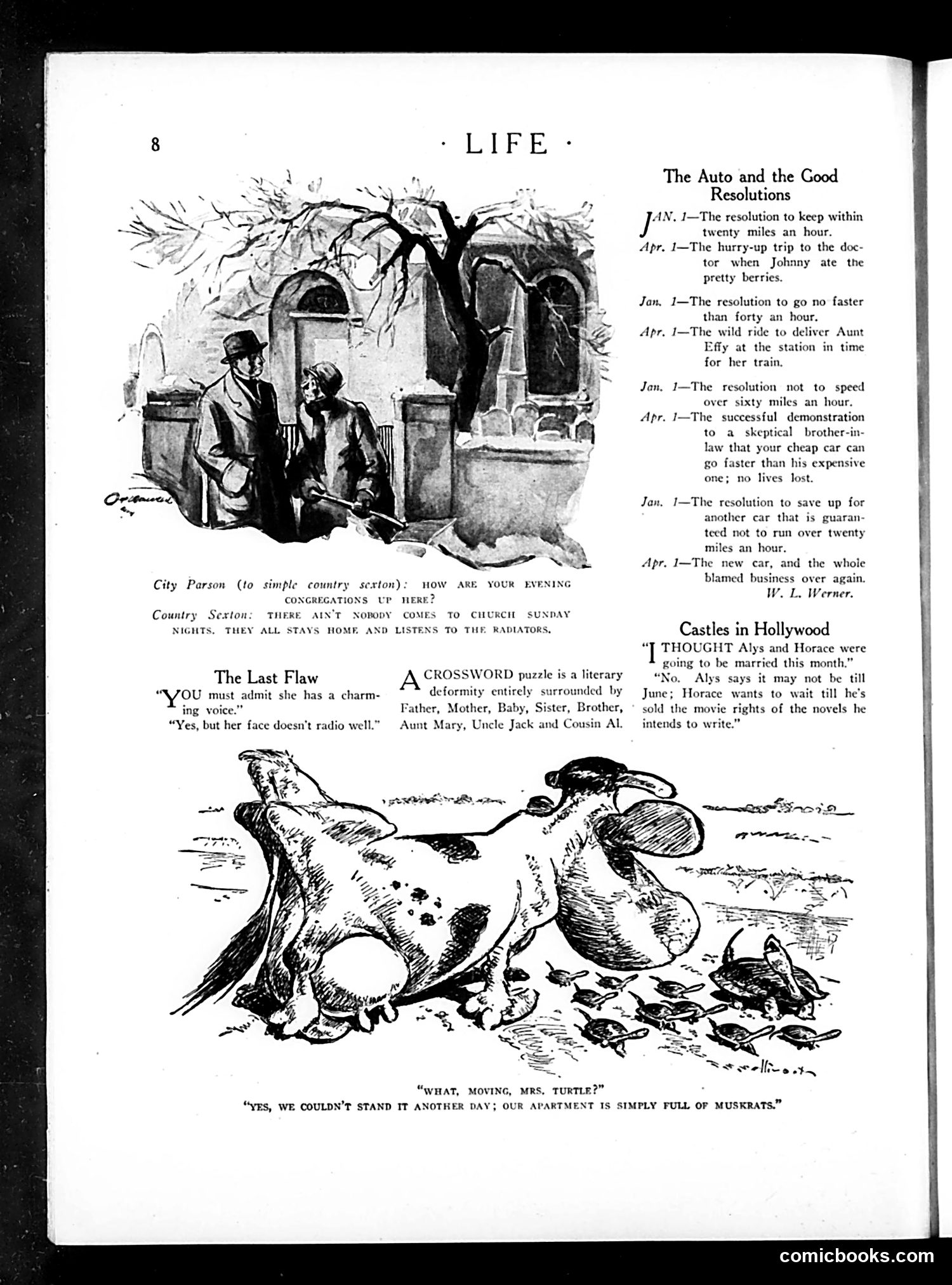
This page contains three satirical pieces: 1. **"The Auto and the Good Resolutions"**: A humorous list contrasting January resolutions about safe driving (keeping under twenty miles per hour, not speeding over sixty mph) with April reality—where drivers ignore these pledges and demonstrate their cheap cars outperform expensive ones, with "no lives lost" being the sarcastic punchline. 2. **"The Last Flaw"**: A cartoon about radio technology, joking that while a woman has charm and a good voice, her face "doesn't radio well"—satirizing early radio's popularity and the then-new medium's displacement of visual entertainment. 3. **"Castles in Hollywood"**: A brief note about actors Alys and Horace delaying marriage while negotiating film rights to novels. The page reflects 1920s-30s concerns: automobile safety, emerging radio technology, and Hollywood business practices.
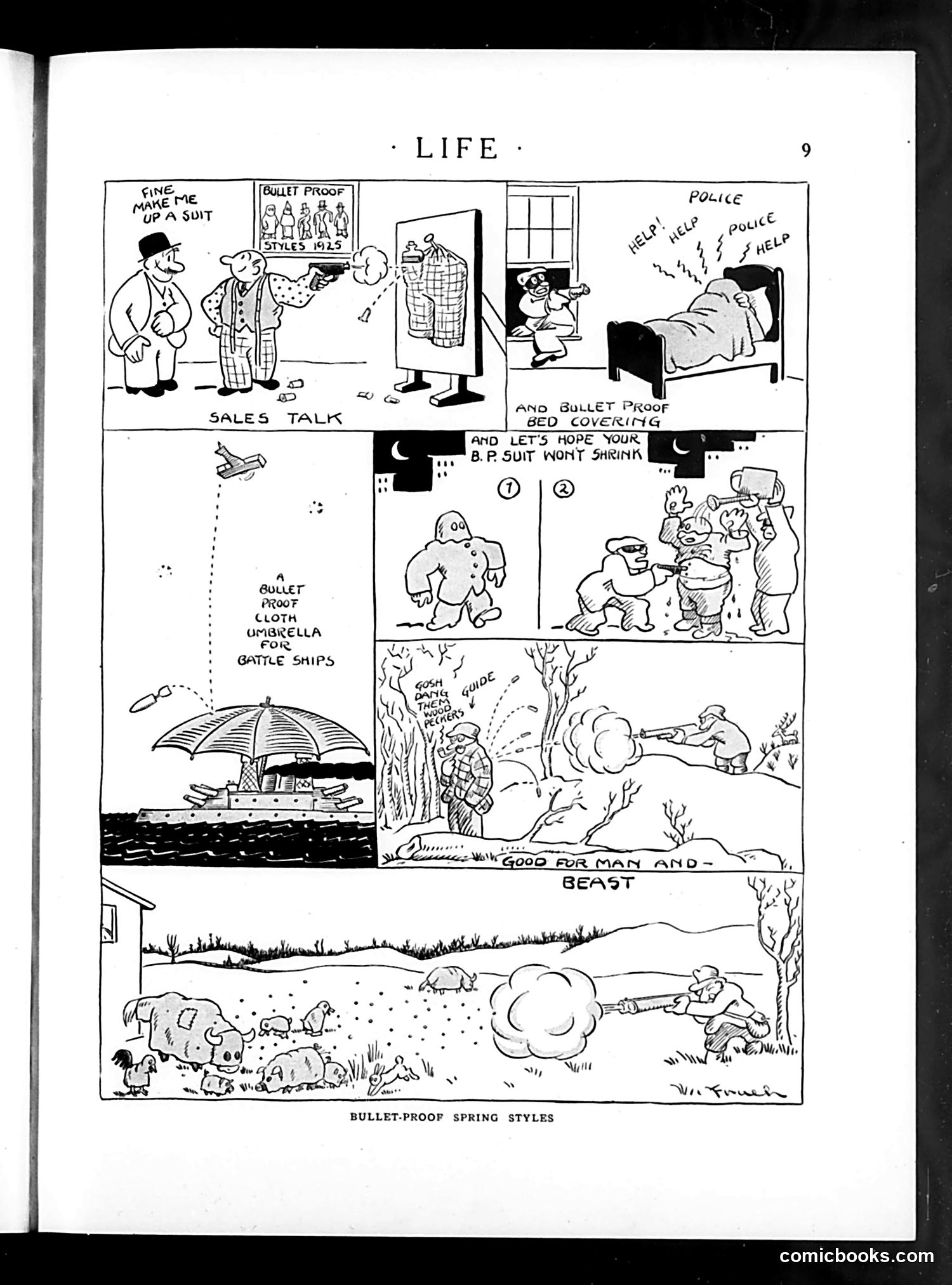
This satirical comic page mocks the marketing of "bullet-proof" consumer products—likely referencing 1920s crime anxieties during Prohibition. The top panels show salesmen hawking bullet-proof suits, beds, and umbrellas to nervous customers. One panel depicts someone calling police while hiding in bed with bullet-proof coverings. The lower panels humorously escalate: bullet-proof umbrellas for "gentle ships," a guide protecting people from bullets during outdoor activities, and finally a person firing a gun while crouching behind a turtle—suggesting the absurdity of trying to make ordinary life bullet-proof. The satire critiques both commercialism exploiting public fear and the impracticality of such "safety" products. The humor lies in applying armor-like protection to everyday situations, highlighting how pervasive violence concerns had become in American culture.
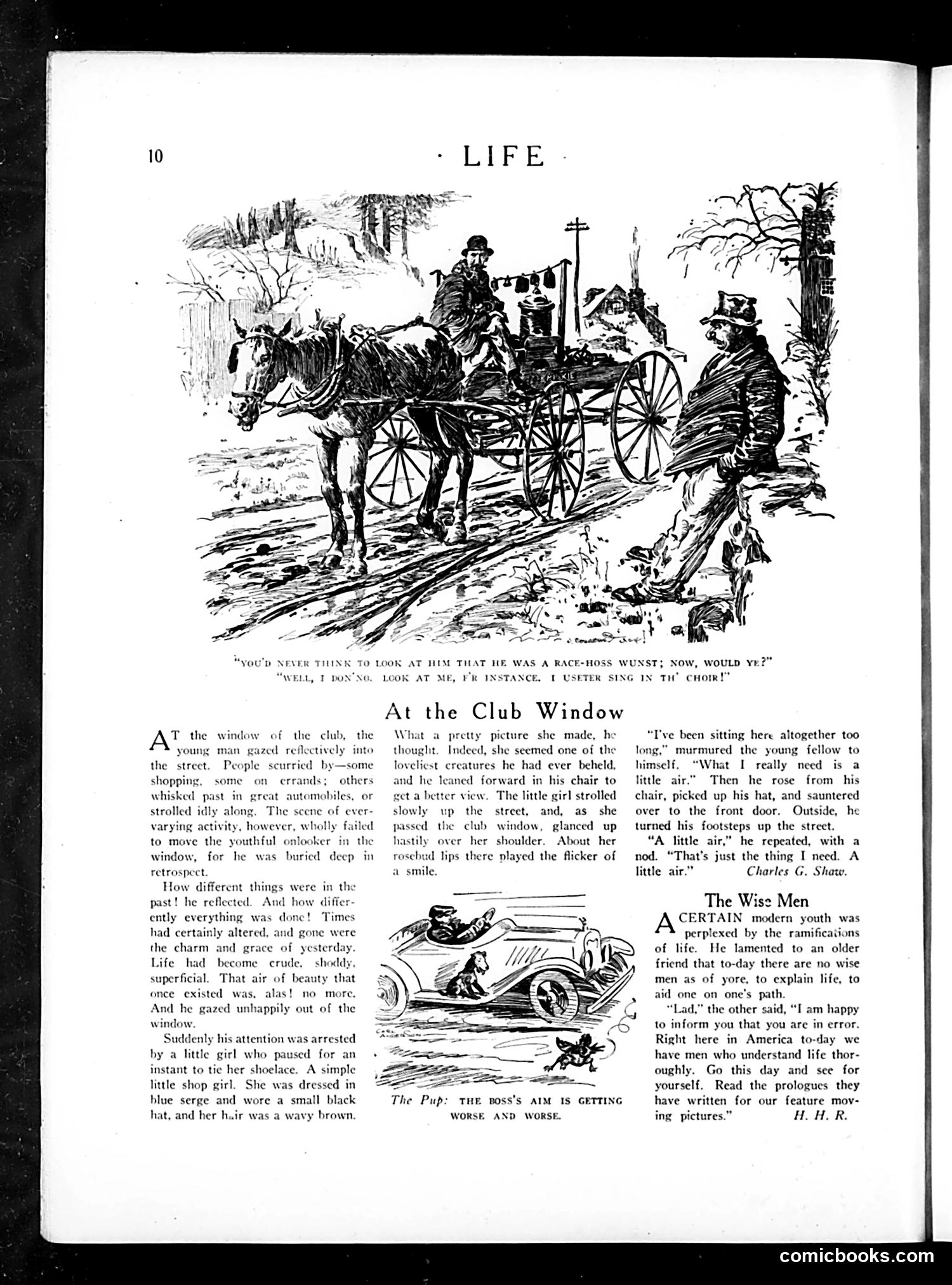
This page contains two separate humor pieces. The main illustration depicts a street scene where a young shop girl in modest dress (blue serge and black hat) pauses at a club window. The accompanying story reflects on how the world has changed — life now seems "crude" and lacking the beauty of yesterday. The cartoon below, captioned "The Pup: The Boss's Aim is Getting Worse and Worse," shows a small dog being chased or struck, appearing as office humor about workplace mishaps. The second column, "The Wise Men," discusses modern youth's confusion about understanding life and society, suggesting contemporary young people should read Life magazine's feature articles for guidance on navigating American society. The overall tone satirizes early 20th-century nostalgia and generational disconnect.
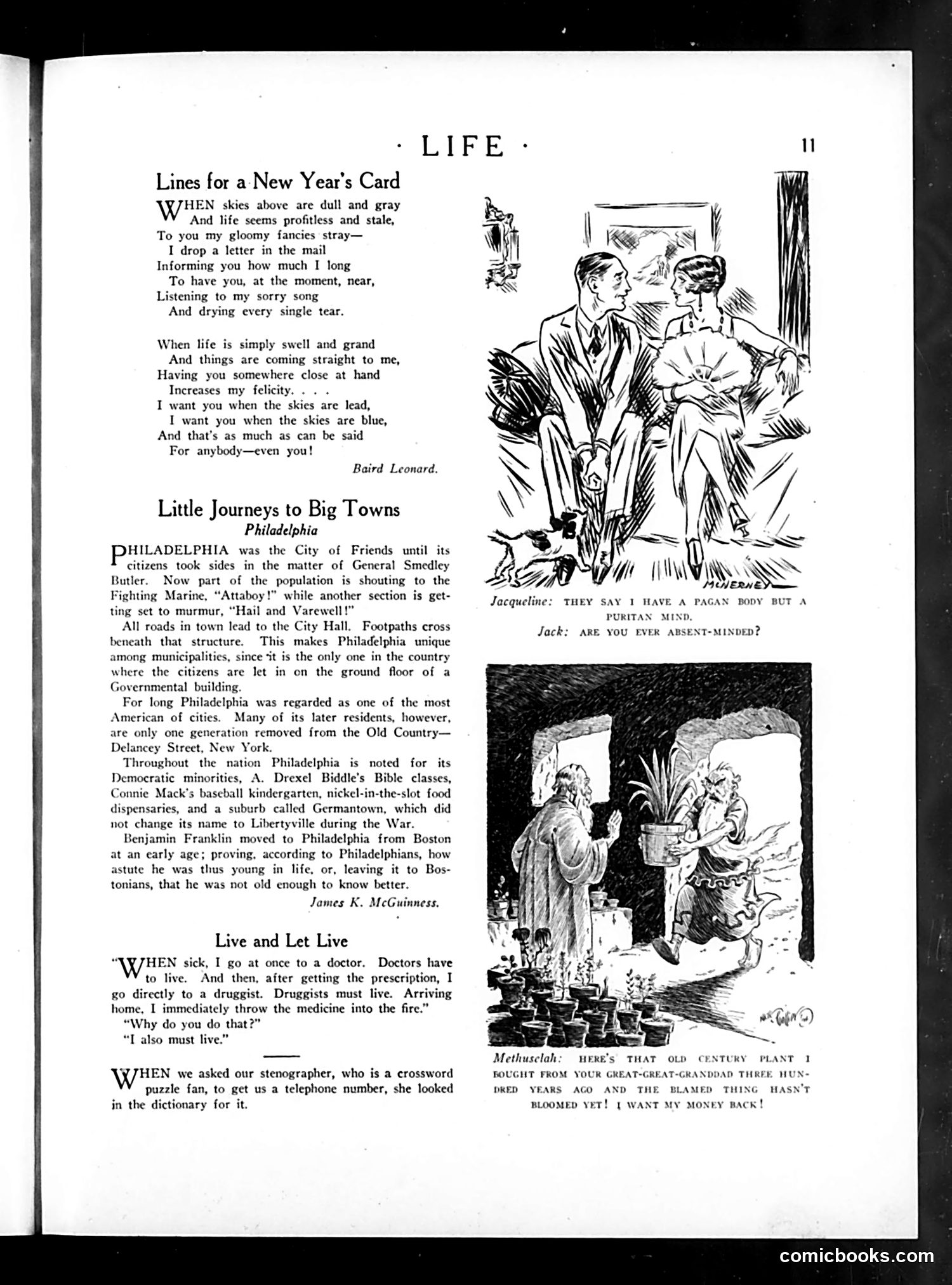
This page contains three distinct sections: a poem titled "Lines for a New Year's Card" by Baird Leonard; an essay on Philadelphia by James K. McGuinness; and humorous illustrated vignettes. The two captioned illustrations satirize domestic life. The top drawing shows a couple where the woman (Jacqueline) claims "a pagan body but a puritan mind," while the man (Jack) asks if she's "ever absent-minded?"—suggesting marital tension around fidelity and restraint. The lower illustration depicts two people arguing over a plant, with one demanding money back for a century-old specimen that "hasn't bloomed yet." These cartoons mock middle-class anxieties about morality, materialism, and spousal expectations—typical satirical subjects for Life magazine's urbane readership.
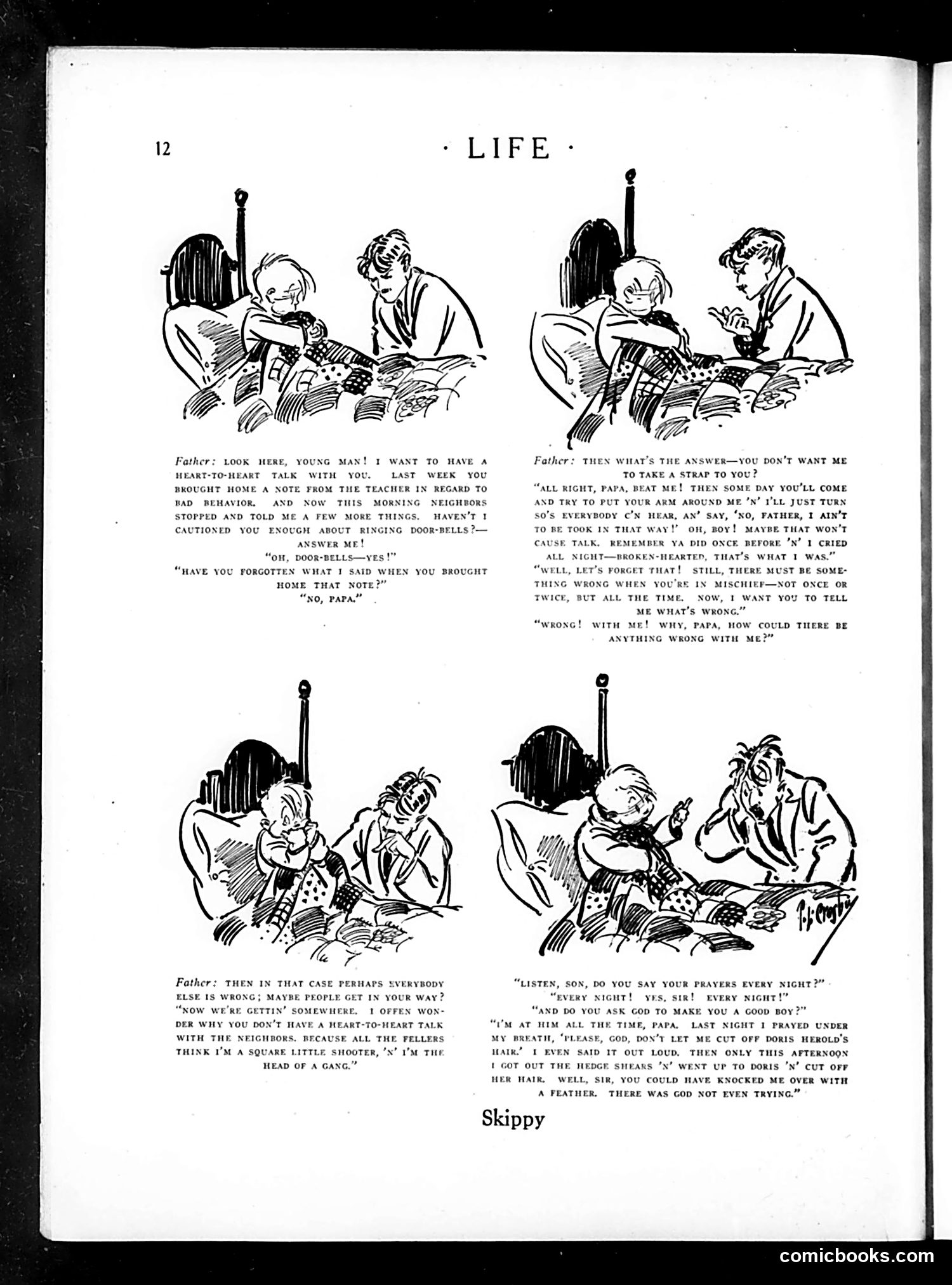
This is a four-panel comic strip titled "Skippy" depicting a father-son conversation about misbehavior. The father initially wants to have a serious talk with his son about ringing doorbells and causing neighborhood complaints. However, the son deflects by asking if the father has forgotten his own childhood mischief—referencing a note the father brought home. The satire targets parental hypocrisy: the father, now respectable, attempts moral instruction while his son exposes his own youthful misconduct. The final panel's punchline—the son's prayer mockingly suggesting God "could have knocked me over with a feather"—undercuts the father's authority through humor. This reflects Depression-era comedy about generational conflict and the gap between adult pretense and actual behavior, using a child's perspective to expose adult contradictions.
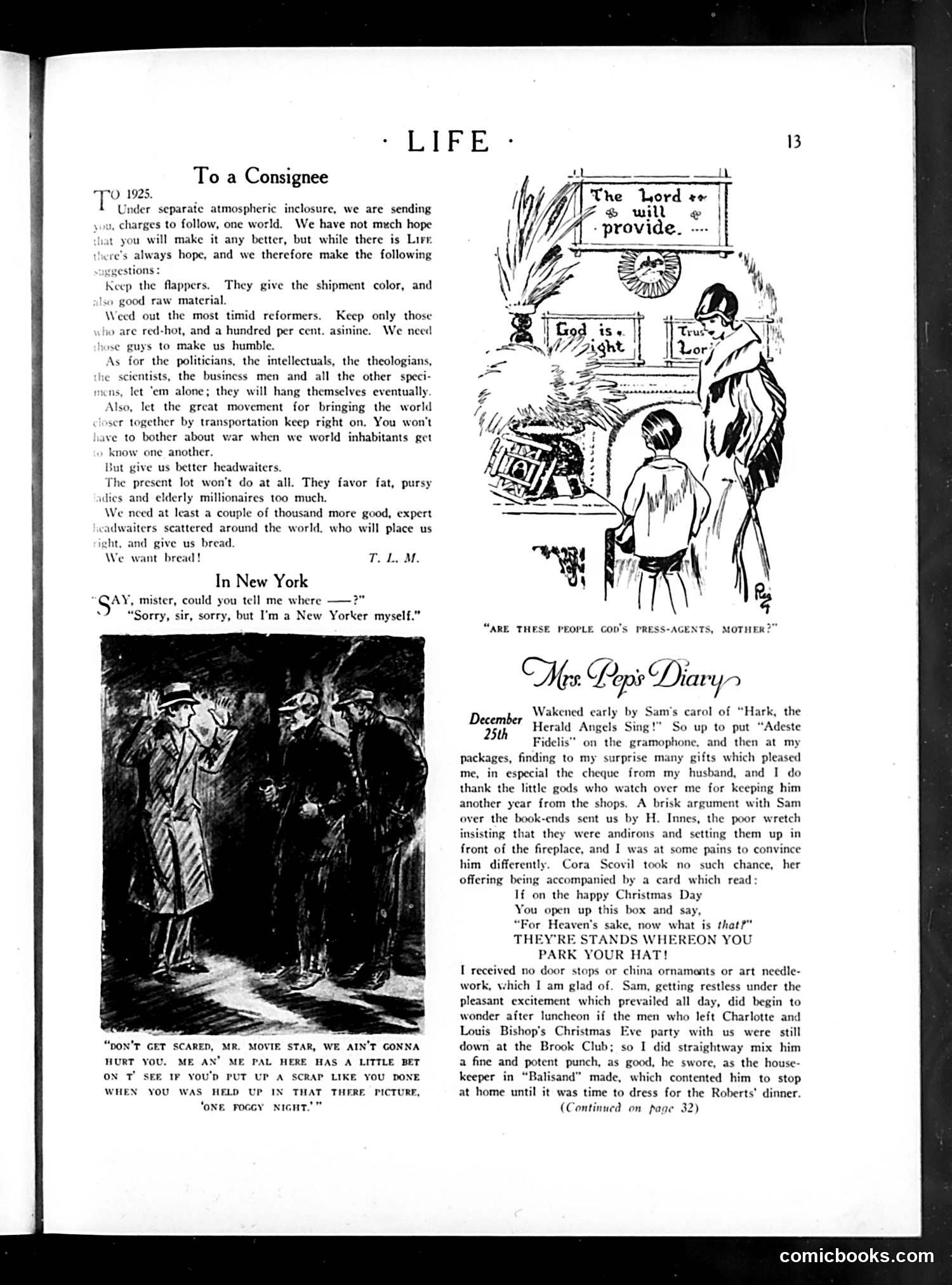
**"To a Consignee" (T.L.M.):** A letter mocking post-WWI relief shipments to Europe in 1925. The author sarcastically advises keeping only the most radical reformers among recipients and suggests that politicians, intellectuals, and scientists will "eventually" solve world problems through transportation. The tone is bitter toward contemporary aid efforts and their perceived ineffectiveness. **"In New York":** A brief joke about a New Yorker's inability to give directions, playing on the stereotype of New York insularity and self-absorption. **"Mrs. Pep's Diary":** Domestic humor about Christmas preparations and family gatherings, detailing gift-receiving, party planning, and household management during the holiday season. The page exemplifies Life's mix of social commentary, urban wit, and domestic satire typical of 1920s American humor magazines.
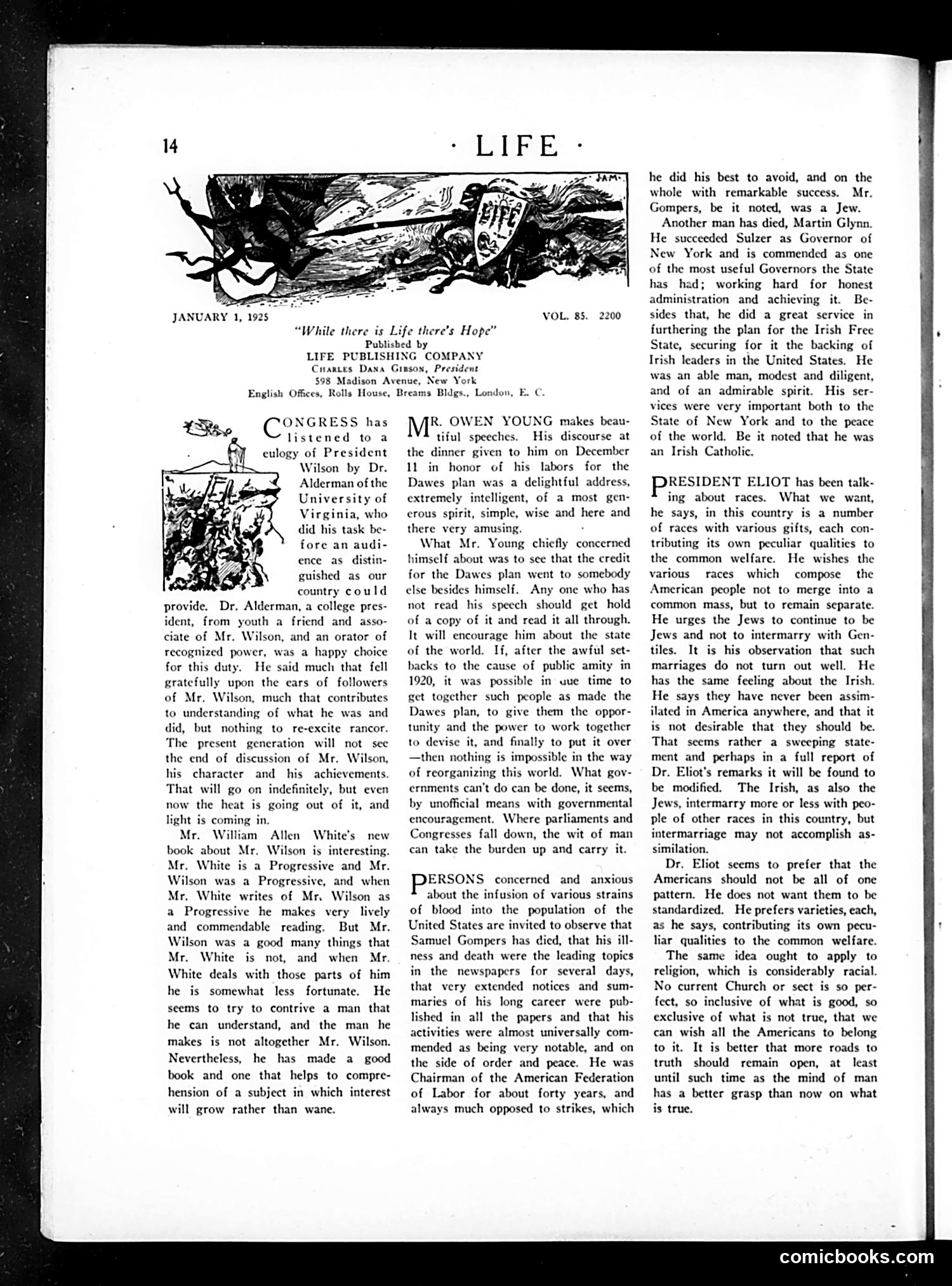
The page's header illustration shows a skeletal death figure labeled "LIFE" — likely satirizing the magazine's own title and commenting on mortality or social decay. The text discusses President Wilson's legacy and contemporary political figures, including Owen Young (who gave speeches about the Dawes Plan for post-WWI reparations) and Martin Glynn (who succeeded Sulzer as New York Governor). The magazine also critiques President Eliot's remarks about racial intermarriage, opposing his suggestion that various immigrant groups should assimilate into "one American people" rather than remain distinct. The overall tone reflects 1920s anxieties about immigration, assimilation, and America's post-war role — debating whether ethnic/religious identity should be preserved or dissolved into a unified American identity.
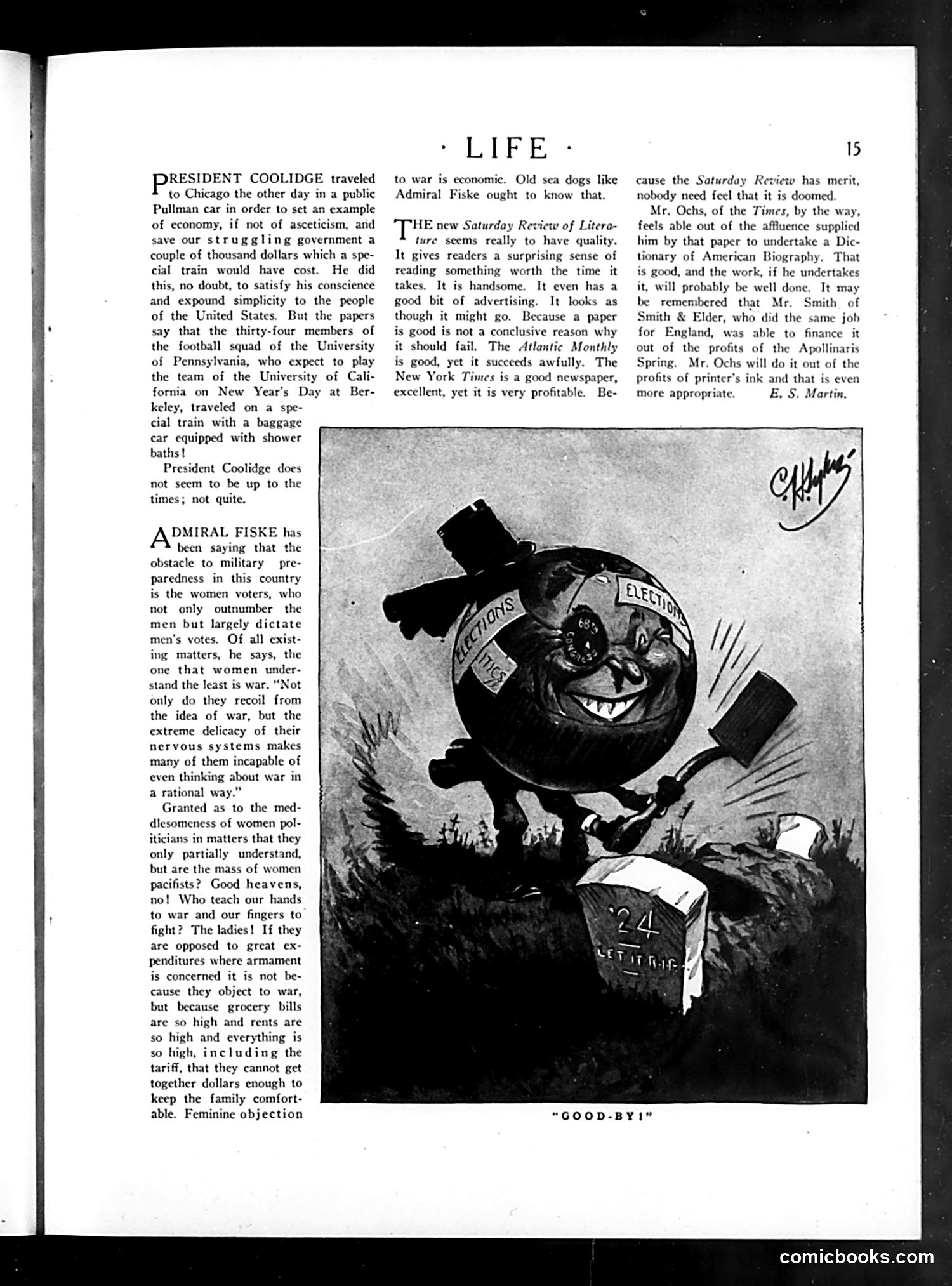
This political cartoon depicts a grotesque caricatured figure labeled with "ELECTIONS," "ACTIONS," and "LEFT IT HERE," wearing a top hat and appearing distressed or defeated. The figure stands over what appears to be numbered items ("24" visible), suggesting ballot-related content. The cartoon critiques women's political participation, which the accompanying text explicitly addresses. Admiral Fiske's quoted statement argues that women voters are obstacles to military preparedness, claiming their "delicate nervous systems" prevent rational thinking about warfare. The cartoon visually mocks this political moment—likely the early 20th century when women's suffrage was debated—by representing women's electoral influence as something grotesque and chaotic. The satire cuts both ways: it ridicules both Fiske's misogynistic objections and, through exaggeration, the anxiety surrounding female voters entering politics.
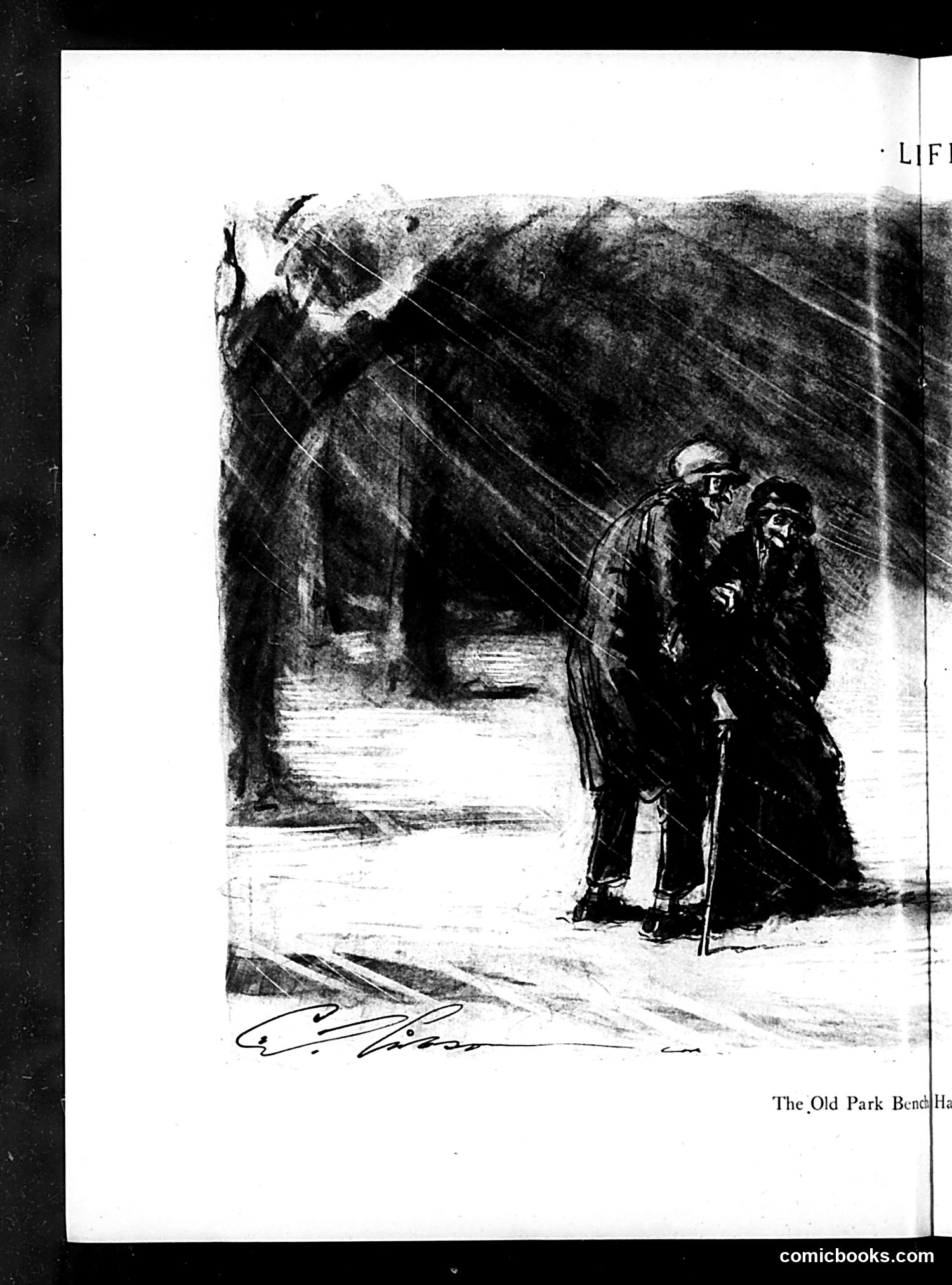
This illustration depicts two figures standing together on a park bench, rendered in dark, sketchy charcoal or ink. The style is characteristic of early 20th-century Life magazine satirical art. The caption reads "The Old Park Bench," but the OCR text is incomplete and unclear. Without the full caption or article text, the specific satirical point is difficult to determine with certainty. The figures appear to be in conversation or intimate proximity, suggesting this may comment on social interactions, romance, or urban life. The artistic signature is visible but not clearly legible. The moody, atmospheric rendering suggests social commentary, though the exact target of satire remains unclear without additional context.
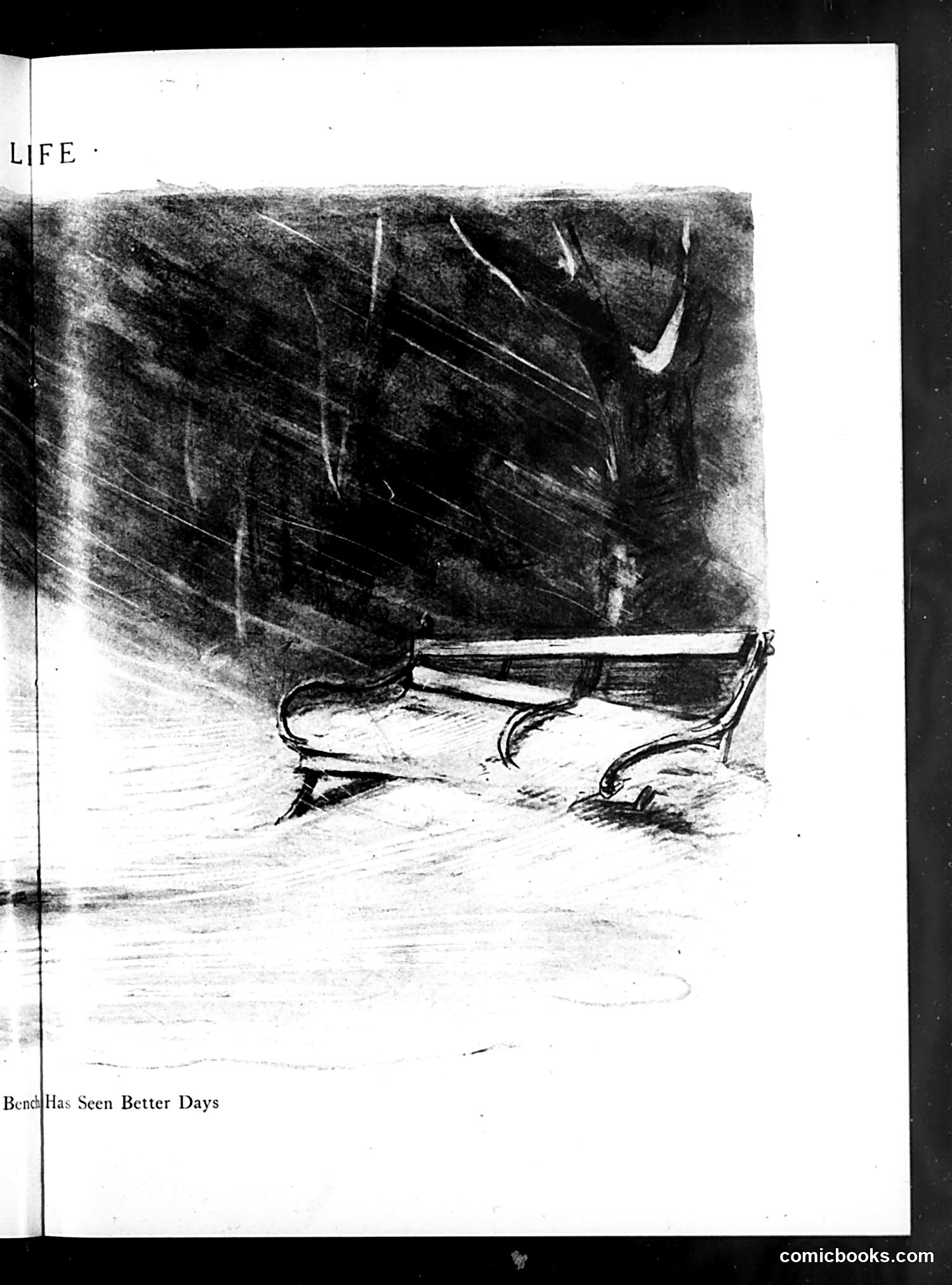
This cartoon depicts a dilapidated park bench in a desolate setting, rendered in stark black and white. The bench appears weathered and broken, situated in an empty, barren landscape with dark, heavy shading suggesting decay or abandonment. The caption "Bend Has Seen Better Days" uses a visual pun: the word "Bend" refers both to the physical deterioration of the bench structure and possibly to Bend, Oregon (a real city). The satire suggests either economic decline in a specific location, or more broadly comments on American infrastructure decay and neglect. The anthropomorphic treatment of the bench—as if it has experienced better times—adds wry humor to social commentary about urban deterioration or abandonment during what appears to be an economically challenging period.
This page reviews three Broadway plays opening in 1925. The main focus is **Raymond Hitchcock**, a comedian returning to performance in "The Sap." The critic praises Hitchcock's comedic talents, noting he'd recently wasted his abilities on preachy satirical work attacking Prohibition, censorship, and other serious topics. Now that he's returned to pure comedy, the critic celebrates his comeback. The review of "The Sap" mocks its implausible moral logic: a bank employee steals twice the embezzled amount to invest it, intending to repay everything through lucky gambling—apparently making theft acceptable if profitable. Brief mentions follow for "Quarantine" (starring Helen Hayes), which the critic finds derivative, claiming they'd seen essentially the same play in London two years prior. The ornamental illustrations are typical period magazine decoration.
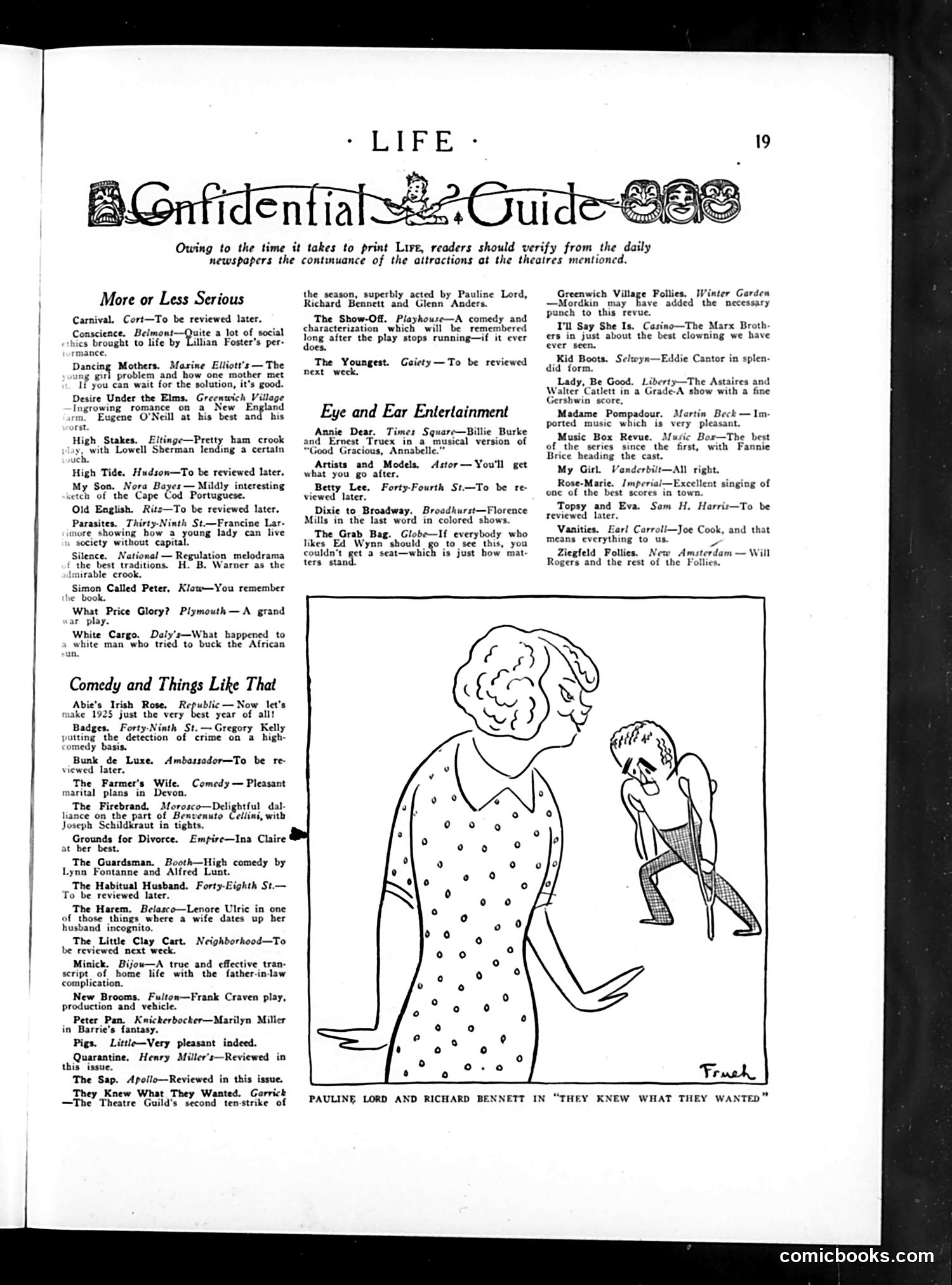
This is a theatrical review page featuring a cartoon by Frueh depicting a scene from the play "They Knew What They Wanted" starring Pauline Lord and Richard Bennett. The cartoon shows a woman in a polka-dotted dress (Lord's character) being embraced or grabbed by a smaller man (Bennett's character) who appears excited or aggressive. The visual joke likely plays on the play's plot—a comedy about romantic misunderstanding or physical comedy. Without knowing the specific plot details, the cartoon appears to satirize either the play's physical humor or an awkward romantic situation central to the story. The text identifies this as "The Theatre Guild's second ten-strike," suggesting it was a critical and commercial success. The cartoon's humor depends on recognizing these popular performers and the play's scenario, which contemporary readers would have understood immediately.
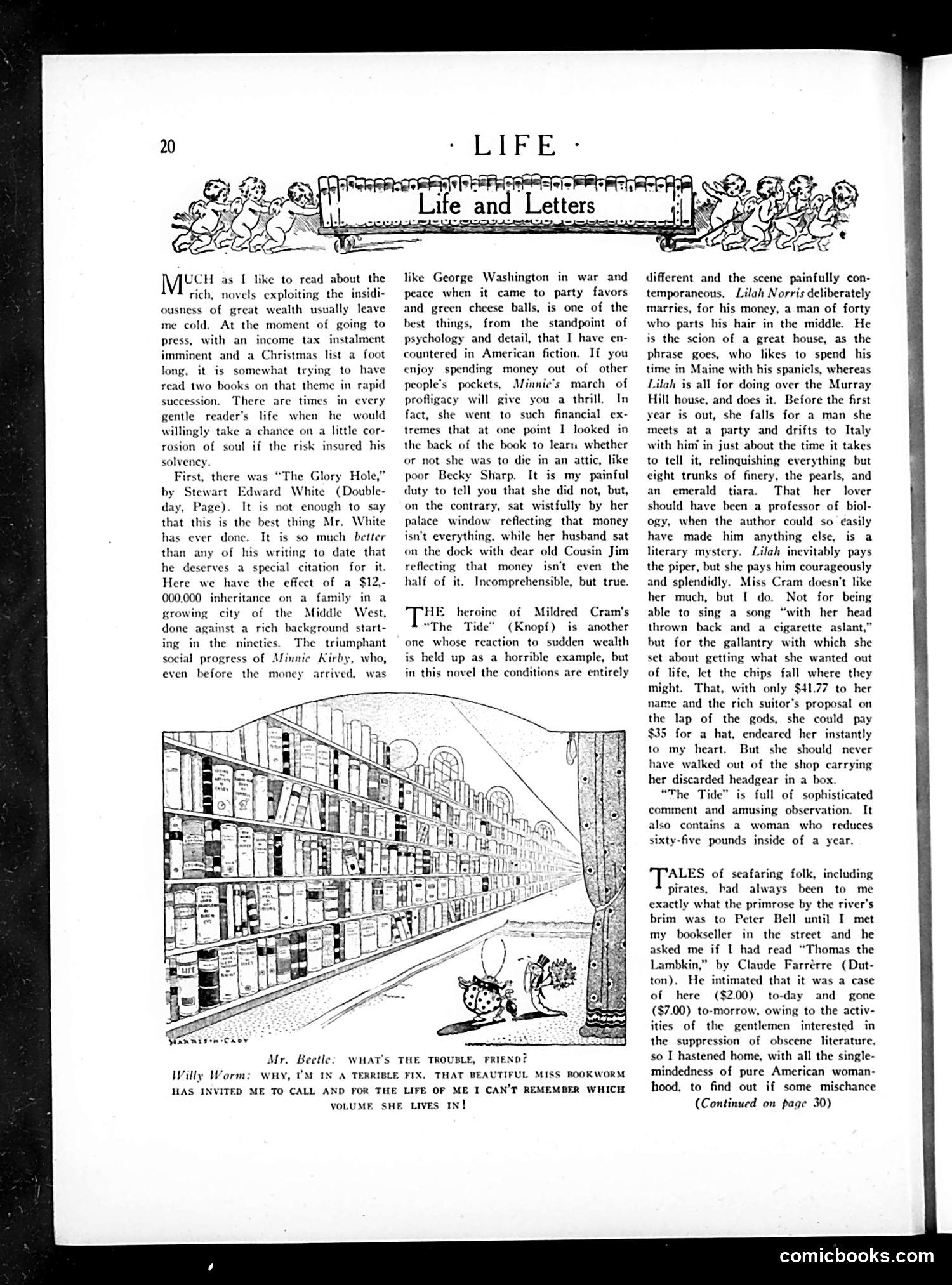
This is a literary review page from Life magazine, not primarily a political cartoon. The main content discusses two novels about wealthy characters: "The Glory Hole" by Stewart Edward White and "The Tide" by Mildred Cram. The **small cartoon at bottom** shows two insects—Mr. Beetle and Willy Worm—making a joke about a "Miss Bookworm" who has invited Willy to visit but he can't remember "which volume she lives in!" This is a lighthearted pun: bookworms literally live in books (volumes), so the joke plays on the double meaning of "volume" as both a book and a unit of space. The reviews themselves are satirical commentary on wealth-obsessed fiction. The reviewer criticizes novels depicting the corrupting effects of sudden riches as tedious, then discusses how these two novels handle that theme differently. No specific political figures or events are referenced—this is social satire about literary tropes and human behavior regarding money.
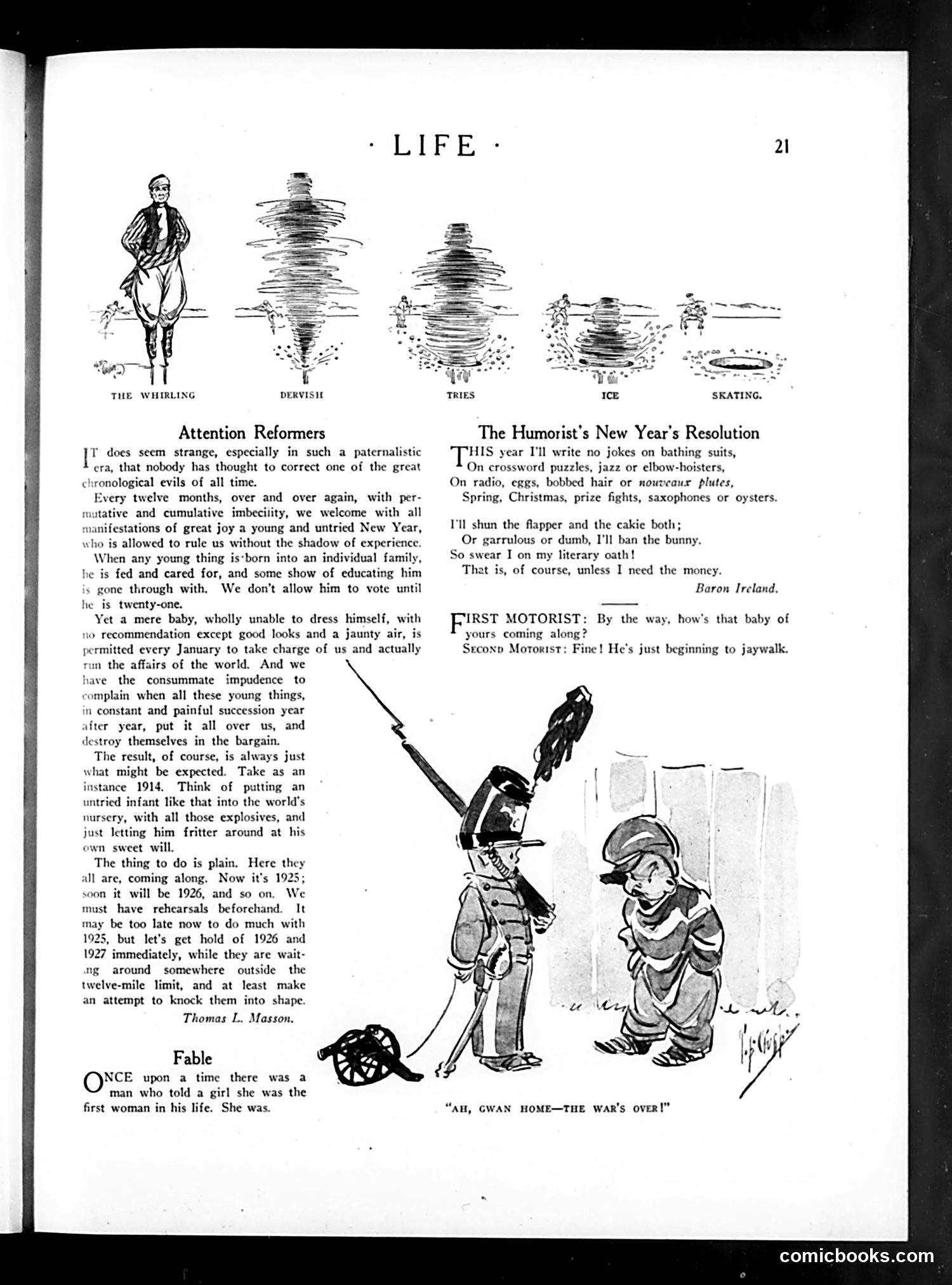
This page from Life magazine (circa 1925, based on references to 1925-1927) contains several satirical pieces mocking contemporary American society: **"Attention Reformers"** by Thomas L. Masson argues that New Year personifications are treated irresponsibly—given power without experience or training, unlike actual infants. He uses 1914 (likely alluding to World War I's outbreak) as an example of a "young year" causing catastrophe, and proposes we "rehearse" upcoming years like 1926-1927 to prevent disaster. **"The Humorist's New Year's Resolution"** by Baron Ireland humorously pledges to avoid tired joke subjects (bathing suits, bobbed hair, flappers, saxophones) while admitting financial need will break this oath—mocking humor writers' desperation. **The motorist joke** references parents teaching children dangerous behavior (jaywalking), satirizing modern urban hazards. **The illustration** "Ah, Gwan Home—The War's Over!" appears to show soldiers, likely referencing post-WWI disillusionment among returning troops. The page emphasizes 1920s social anxieties: reckless youth, modernism's excesses, and lingering war trauma.
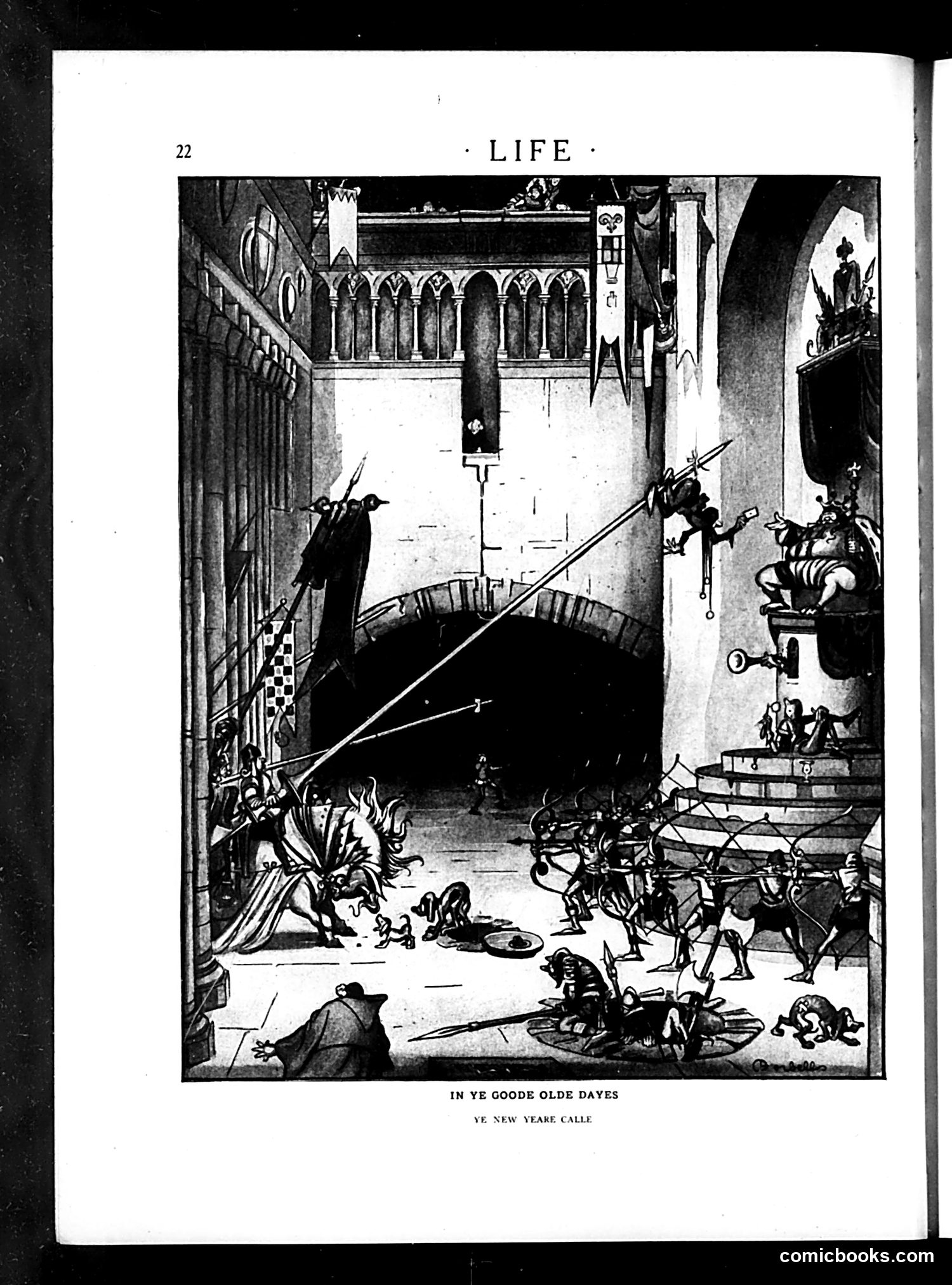
This is a satirical illustration depicting a medieval or fantasy castle scene titled "Ye New Yeares Calle" (New Year's Call). The image shows a chaotic courtly gathering with various figures in period costume engaged in revelry and celebration. The satire appears to mock nostalgic romanticization of the past—the "good old days" referenced in the title. Rather than depicting an idealized medieval setting, the illustration reveals bedlam: characters in disarray, dancing demons or devils, figures in states of undress or intoxication, and general mayhem within a grand hall. The joke targets readers who sentimentally idealize history. By contrasting the phrase "goode olde dayes" with this anarchic, crude scene, Life magazine suggests that past eras were actually no more civilized or orderly than contemporary society—puncturing Victorian nostalgia.
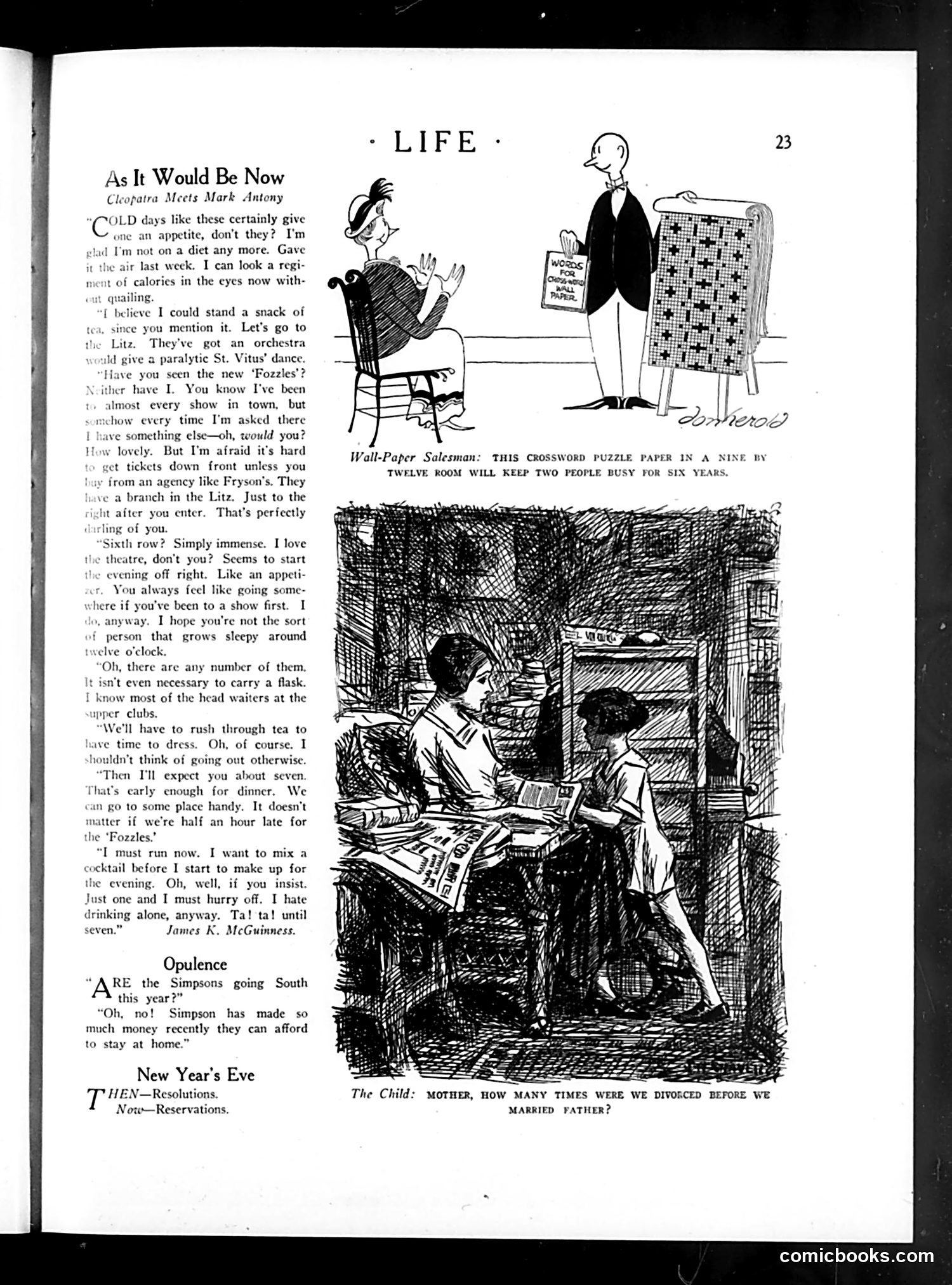
This page from *Life* magazine contains several satirical pieces mocking 1920s American social habits: **"As It Would Be Now"** imagines Cleopatra and Mark Antony speaking in modern Jazz Age vernacular—obsessing over theater tickets, cocktails, dinner reservations, and nightclub culture. The joke is the absurd contrast between ancient historical figures and contemporary shallow materialism. **"Opulence"** is a brief quip about wealth: the Simpsons are now *so* rich they can afford to stay home rather than travel south—inverting normal status symbols. **"New Year's Eve"** contrasts old traditions (resolutions/self-improvement) with modern ones (restaurant reservations)—satirizing how materialism has replaced moral reflection. The **Wall-Paper Salesman** cartoon jokes about a crossword-puzzle wallpaper keeping a couple busy for years—suggesting marital discord or boredom. **"The Child"** darkly jokes about casual divorce among the wealthy, with a child casually asking about multiple divorces before her parents' current marriage—mocking both marital instability and parental detachment. The recurring theme: 1920s upper-class excess, materialism, and moral emptiness.
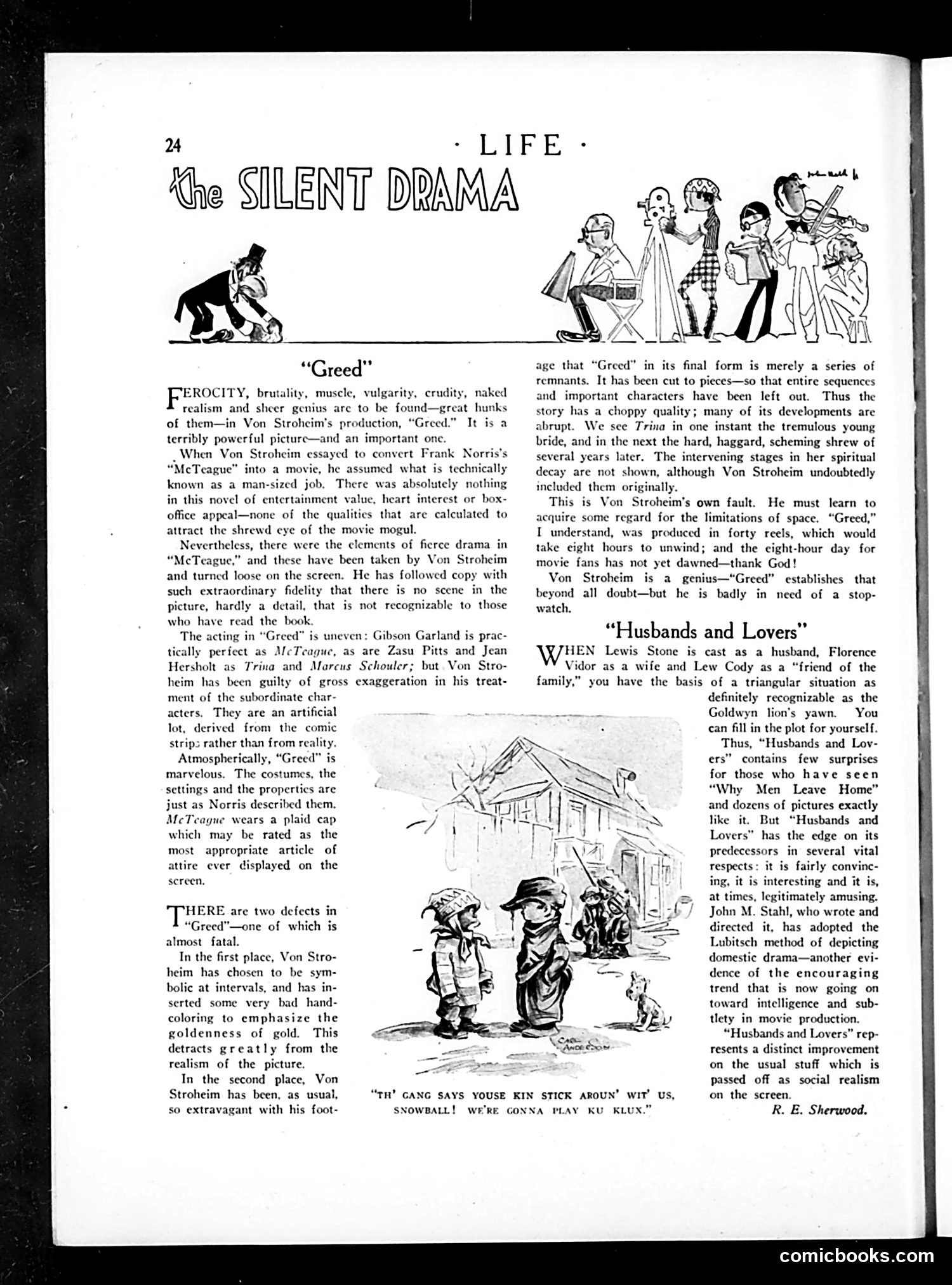
This page contains two film reviews from Life magazine's silent film criticism section. **"Greed"** reviews director Erich von Stroheim's adaptation of Frank Norris's novel. The critic praises the film's raw power and realistic detail but identifies two fatal flaws: von Stroheim's symbolic hand-coloring of gold (undermining realism) and severe over-editing. The original 40-reel cut was trimmed drastically, creating narrative chopiness—Trina abruptly transforms from tremulous bride to scheming shrew with missing character development. The reviewer concludes von Stroheim is a genius but needs a "stop-watch" to respect audience limits. **"Husbands and Lovers"** reviews a conventional romantic triangle starring Lewis Stone, Florence Vidor, and Lew Cody. The critic acknowledges it's formulaic and unsurprising to audiences familiar with similar films like "Why Men Leave Home," but credits director John M. Stahl for adopting the sophisticated "Lubitsch method" of domestic drama—evidence of improving intelligence in film production. Both reviews reflect 1920s silent cinema's artistic ambitions and technical constraints.
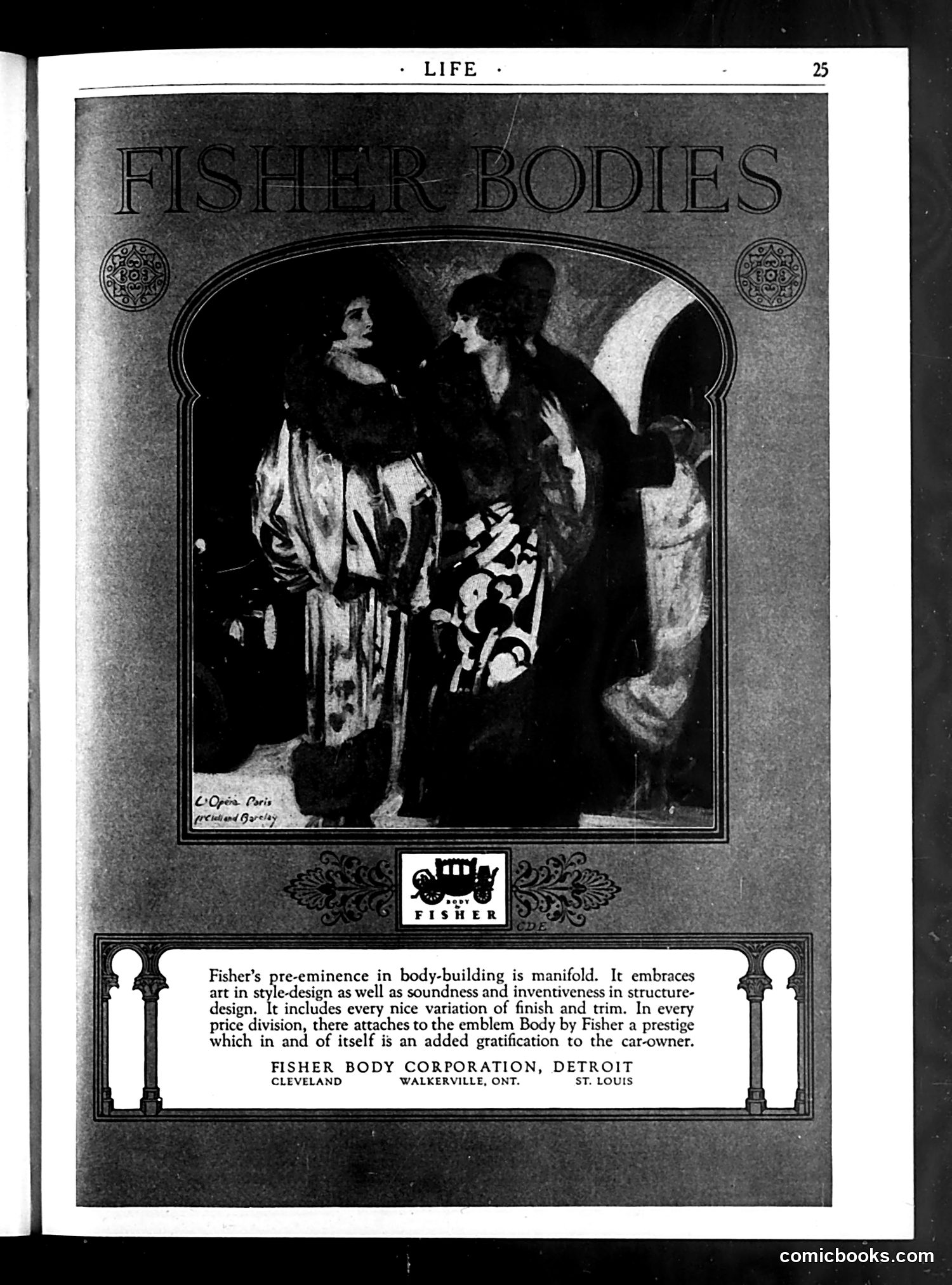
This is a **Fisher Body advertisement**, not a political cartoon. It appears on page 25 of *Life* magazine and promotes Fisher Body Corporation, a major automobile body manufacturer. The image shows what appears to be elegantly dressed women in an interior setting, likely meant to suggest luxury and sophistication. The ad copy emphasizes Fisher's reputation for quality "body-building" (car body construction)—claiming their craftsmanship adds prestige and gratification to vehicle ownership across all price ranges. Fisher Body was a real company that became famous for manufacturing car bodies, later acquired by General Motors. This ad exploits the association between quality automotive bodies and refined aesthetics/status to appeal to car buyers. The theatrical staging suggests aspirational lifestyle marketing typical of 1920s-era automobile advertising.
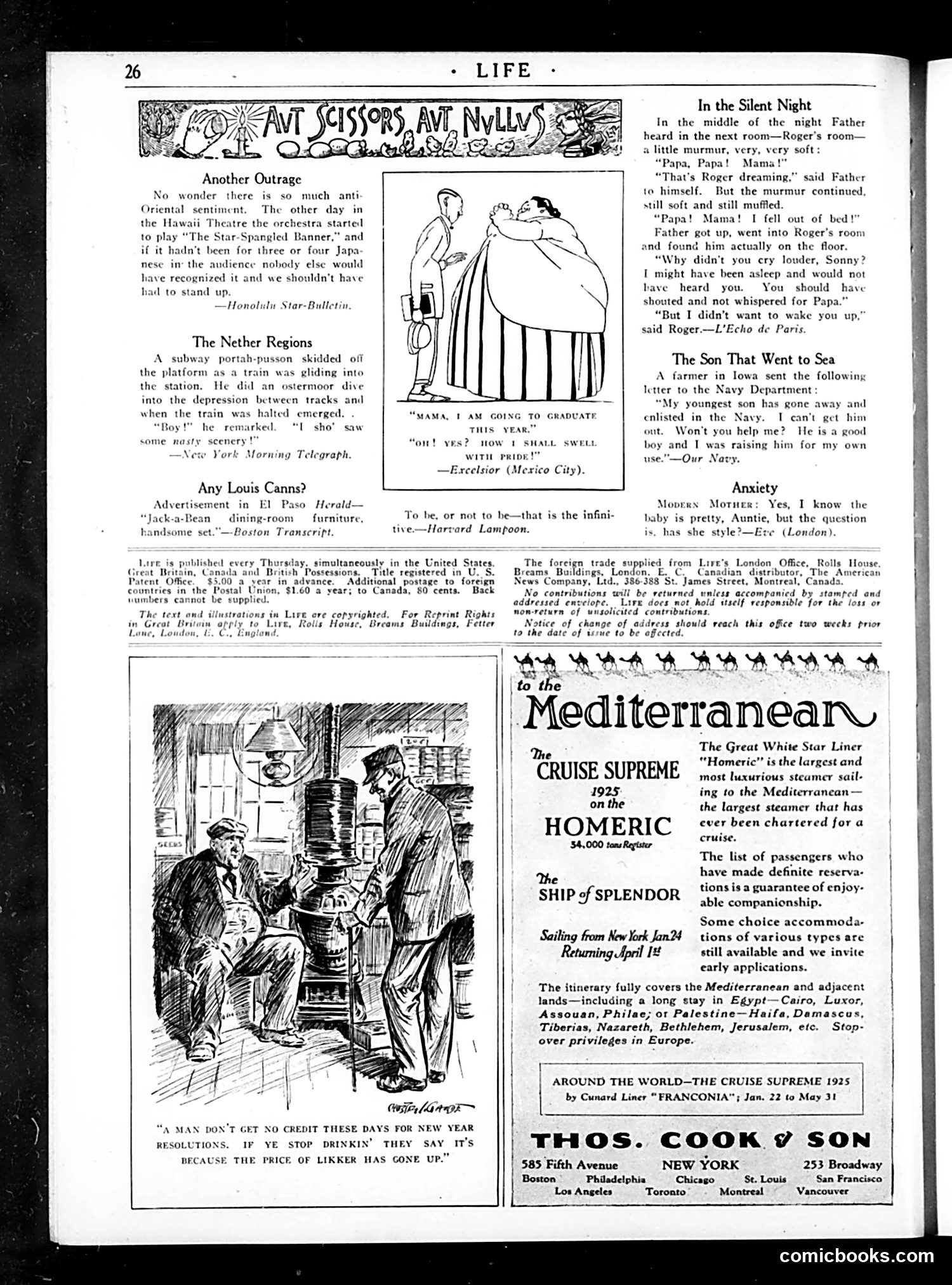
This page contains **multiple short humorous pieces** typical of Life magazine's satirical format: **"In the Silent Night"** depicts a child's quiet voice calling from bed—the joke being the father's surprise that the boy actually fell out of bed rather than merely dreaming. **"Another Outrage"** quotes a Hawaii newspaper's complaint that Japanese audience members were the only ones who recognized "The Star-Spangled Banner" when played, reflecting **anti-Japanese sentiment** of the 1920s. **"The Nether Regions"** jokes about a subway worker who dived between tracks and emerged unharmed, claiming to have "saw some nasty scenery." **"Any Louis Canns?"** mocks a furniture advertisement's typo. The bottom cartoon depicts a man explaining his failure at New Year's resolutions: drinking continued because "the price of likker has gone up"—a reference to **Prohibition-era bootlegging costs**. The remainder consists of **cruise ship advertisements** for Mediterranean voyages, typical period marketing.
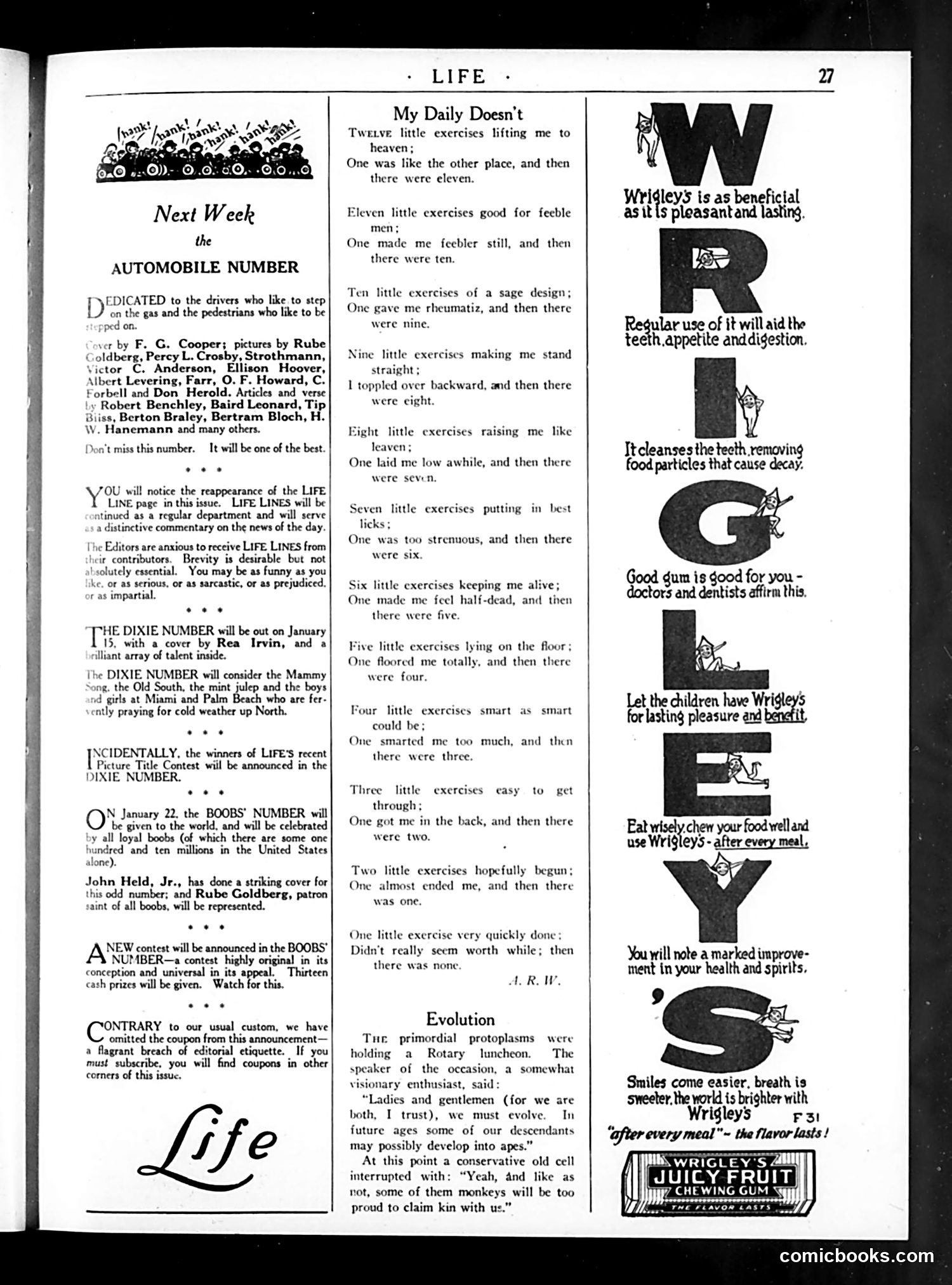
This page from *Life* magazine (date unclear from image) contains satirical humor typical of early 20th-century American comedy: **"My Daily Doesn't"** is a parody of the nursery rhyme "Ten Little Indians," humorously documenting the failure of exercise regimens. Each stanza describes attempting increasingly desperate physical exercises, with each one backfiring—causing injury, exhaustion, or failure—until none remain. The satire mocks both the fitness fad and people's inability to maintain discipline. **"Evolution"** presents a brief joke about evolutionary theory. Primordial protoplasms attend a Rotary Club luncheon where a speaker advocates evolution, suggesting future descendants might develop into apes. A conservative cell interjects with dark humor: even if humans evolved from these creatures, future monkeys would be "too proud" to acknowledge the kinship. This satirizes both overzealous evolutionists and working-class dignity. The right side features *Wrigley's* chewing gum advertisements emphasizing dental and digestive benefits—typical 1920s health-marketing claims.
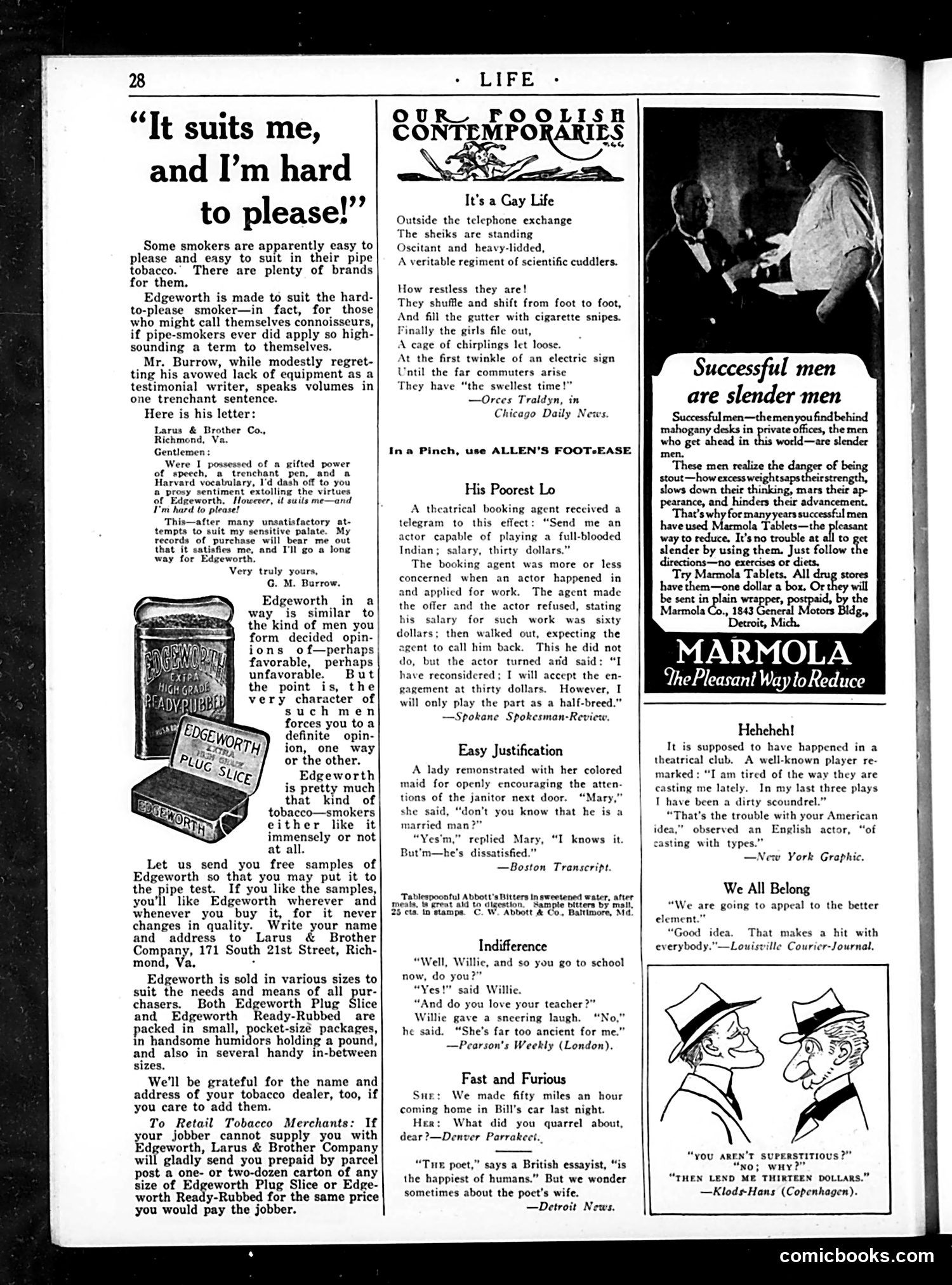
This page is primarily **advertising** for Edgeworth pipe tobacco, featuring a testimonial letter from "G. M. Burrow" claiming the product suits discerning smokers. The page also contains several brief **humorous anecdotes** under "Our Foolish Contemporaries" (a regular satirical column): - A poem mocking young people loitering outside a telephone exchange, calling them "sheiks" and "chirplings" - A joke about a theatrical agent offering $30 to play a "full-blooded Indian," with an actor refusing then accepting if he can play a "half-breed" instead—satirizing actors' desperation and racial attitudes of the era - A partial anecdote about a maid and janitor The cartoons at right advertise **Marmola weight-loss tablets** and show a joke about superstition. The content reflects 1920s attitudes toward dating, class, and casual racism, presented as light humor typical of the period.
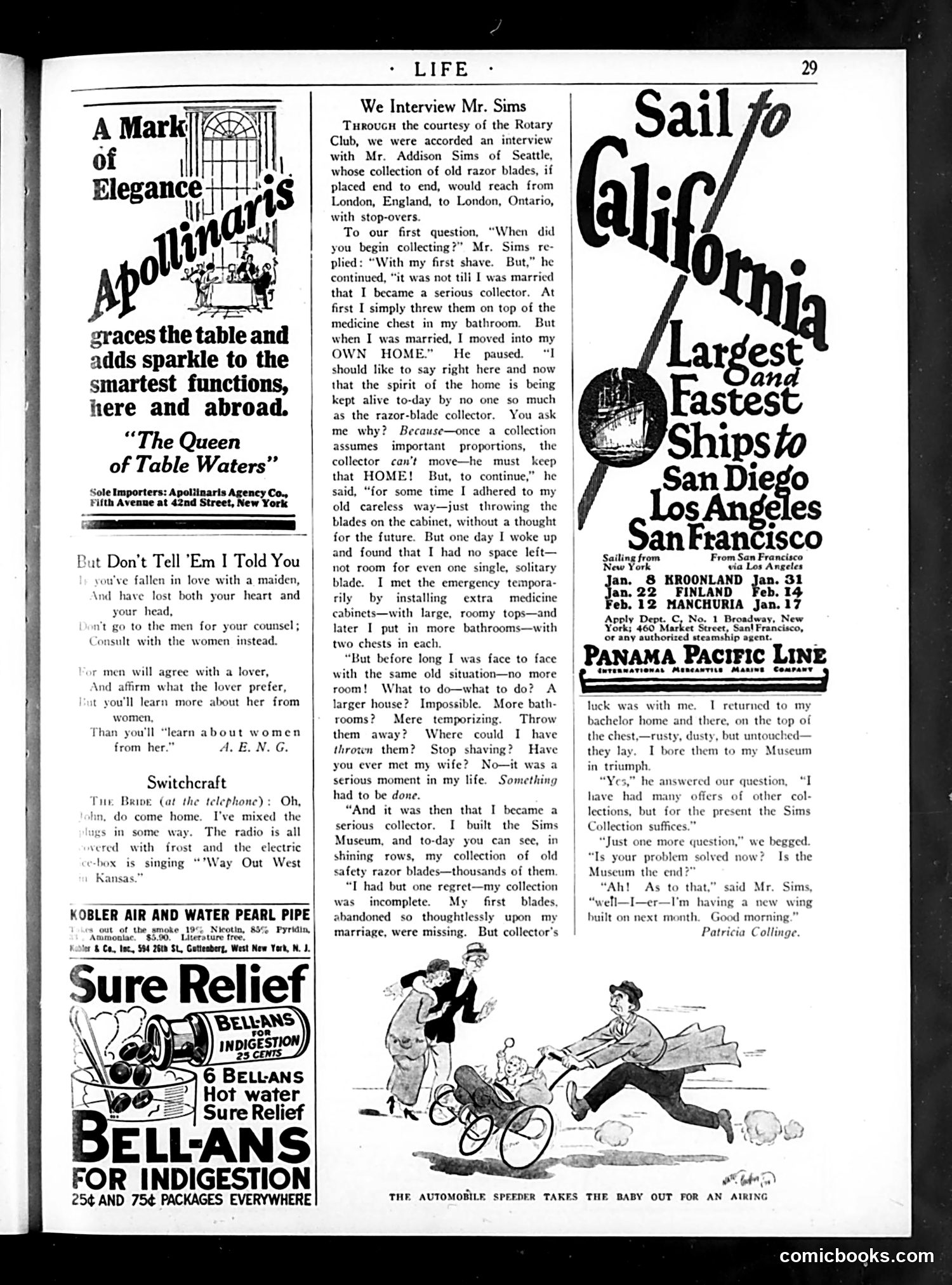
This page contains satirical humor typical of 1920s *Life* magazine. The main feature is "We Interview Mr. Sims," which parodies obsessive collecting culture through absurdist humor. Mr. Sims of Seattle has built an entire museum dedicated to old razor blades—supposedly enough to stretch from London, England to London, Ontario if laid end-to-end. The satire targets several things: the collecting mania of the era, how marriage supposedly "settles" people into domesticity, and the earnest seriousness with which wealthy hobbyists pursued their collections. The joke is that Sims treats used razor blades with the reverence typically reserved for fine art or artifacts, having constructed bathrooms and an entire museum to house them. The accompanying cartoons and advertisements are standard period content—domestic humor ("Switchcraft" about a wife), product ads (Bellans indigestion tablets, water filters), and shipping line advertisements. The page reflects 1920s anxieties about modernity, home life, and consumer culture presented through gentle mockery.
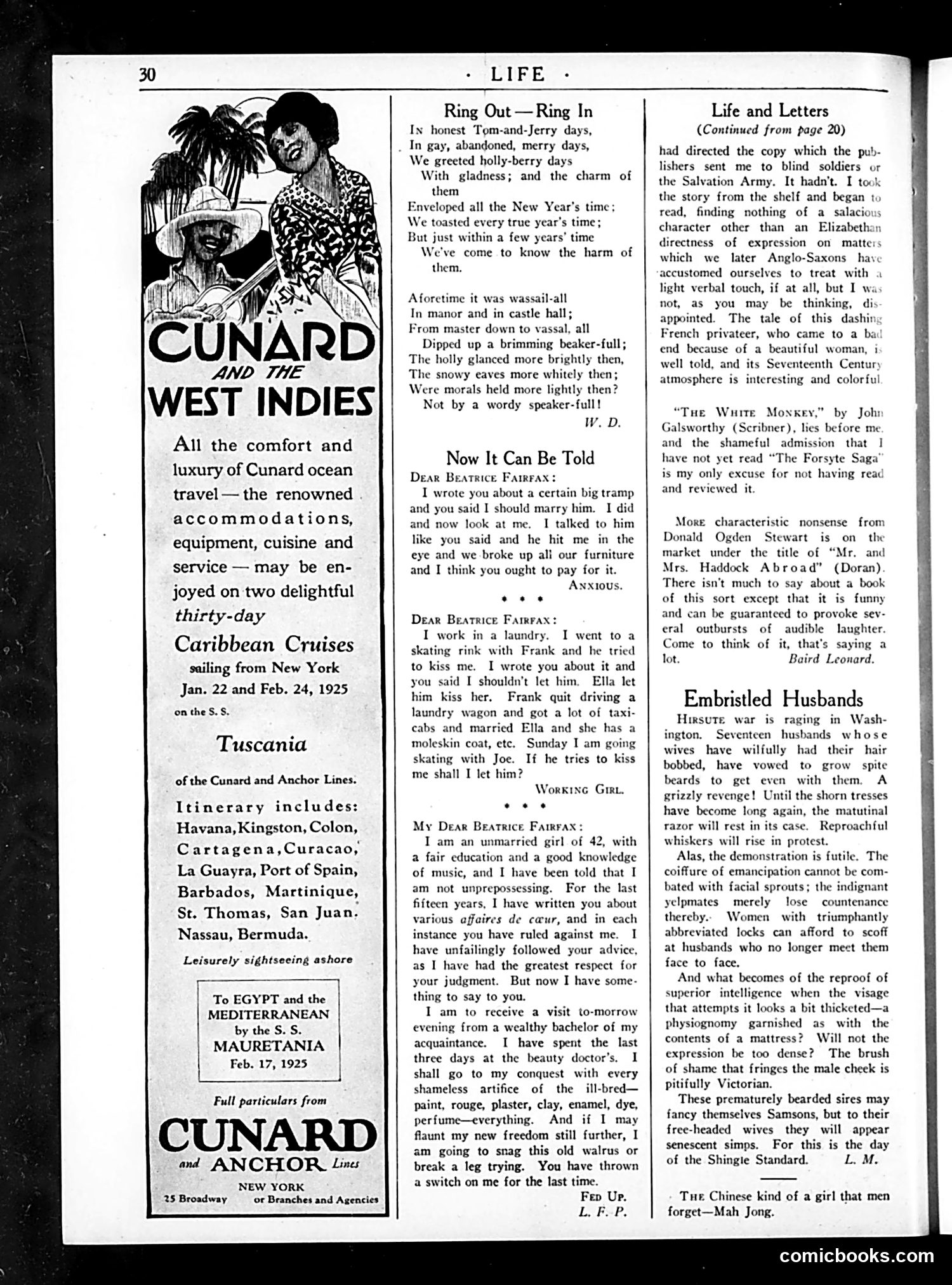
This page is primarily **advertising** (Cunard cruise lines) and an **advice column** ("Life and Letters"), not political satire. The notable content is the **"Now It Can Be Told"** section, which parodies the popular advice columnist "Beatrice Fairfax" through darkly humorous letters. The satire targets the gap between idealized romantic advice and harsh reality: a woman who followed dating advice gets beaten; another woman's restraint loses her a boyfriend to a rival; a 42-year-old woman, after 15 years of heeding Fairfax's conservative guidance, rebels and plans seduction using "shameless artifice." The satirical point: women's advice columns offer naive moralism disconnected from actual outcomes, and their prescriptive rules may backfire. This reflects 1920s anxieties about changing gender roles and courtship norms during the "Jazz Age." The opening poem "Ring Out—Ring In" nostalgically compares past New Year celebrations to present ones, questioning whether morality has declined.
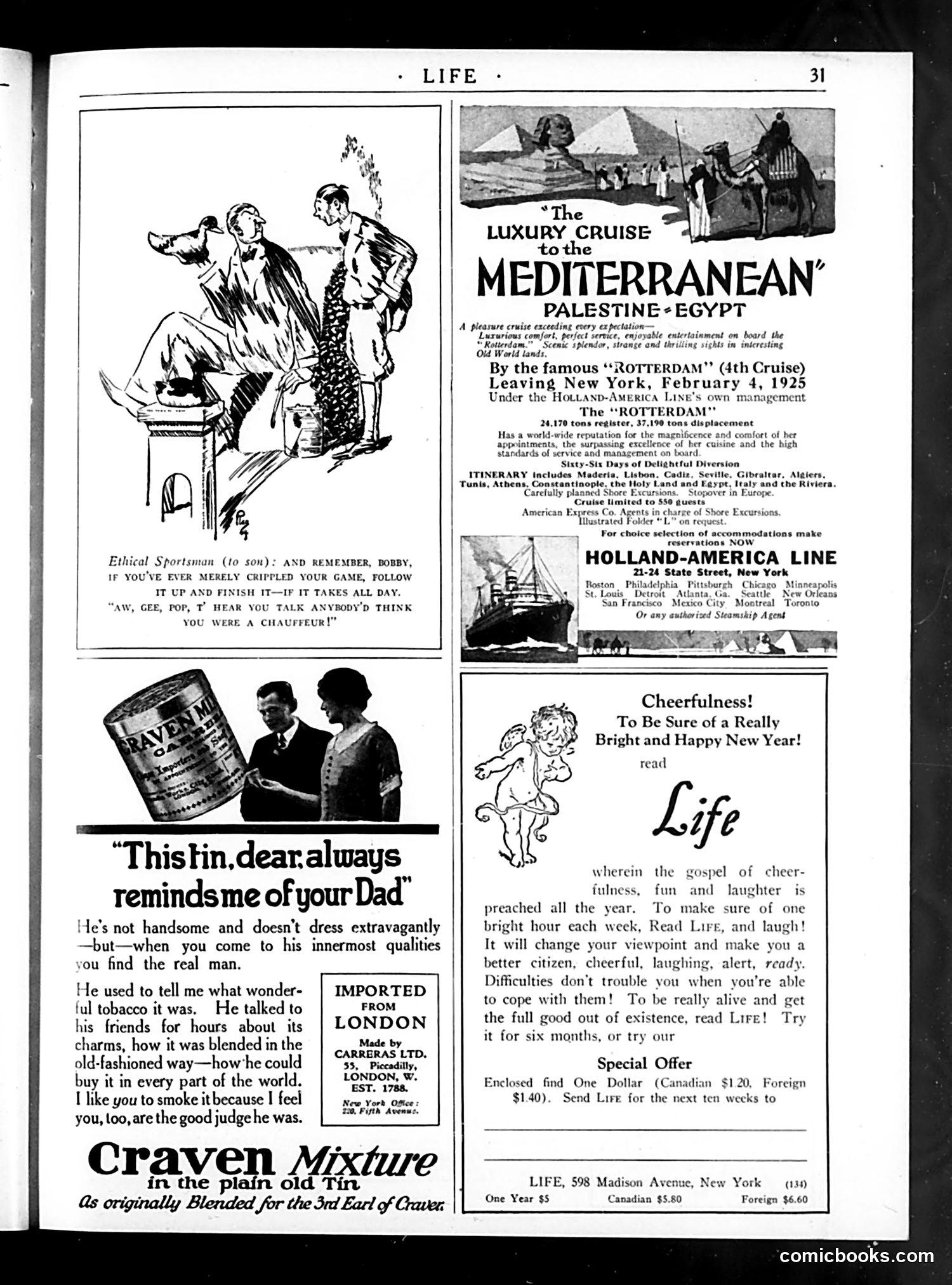
This page combines satirical cartoons with period advertisements. **Top cartoon**: An "Ethical Sportsman" instructs his son to always finish wounded game. The boy responds that such talk makes him sound like a "chauffeur"—implying that professional drivers (working-class men) supposedly lacked refinement. The satire mocks upper-class hypocrisy: the father's brutal hunting philosophy contradicts claims of gentlemanly ethics. **Craven Mixture tobacco ad**: Uses nostalgic appeal, with a woman praising the brand by comparing it to her late father's refined taste. It's a sentimental sales pitch emphasizing tradition and masculine virtue. **Holland-America cruise ad**: Advertises luxury Mediterranean travel (1925), targeting wealthy Americans seeking exotic destinations. **Life magazine self-promotion**: The final section pitches the magazine itself as promoting "cheerfulness" and mental health—positioning reading Life as a moral good for modern citizens. The page reflects 1920s consumer culture, class consciousness, and advertising's increasing sophistication in appealing to emotion rather than function.
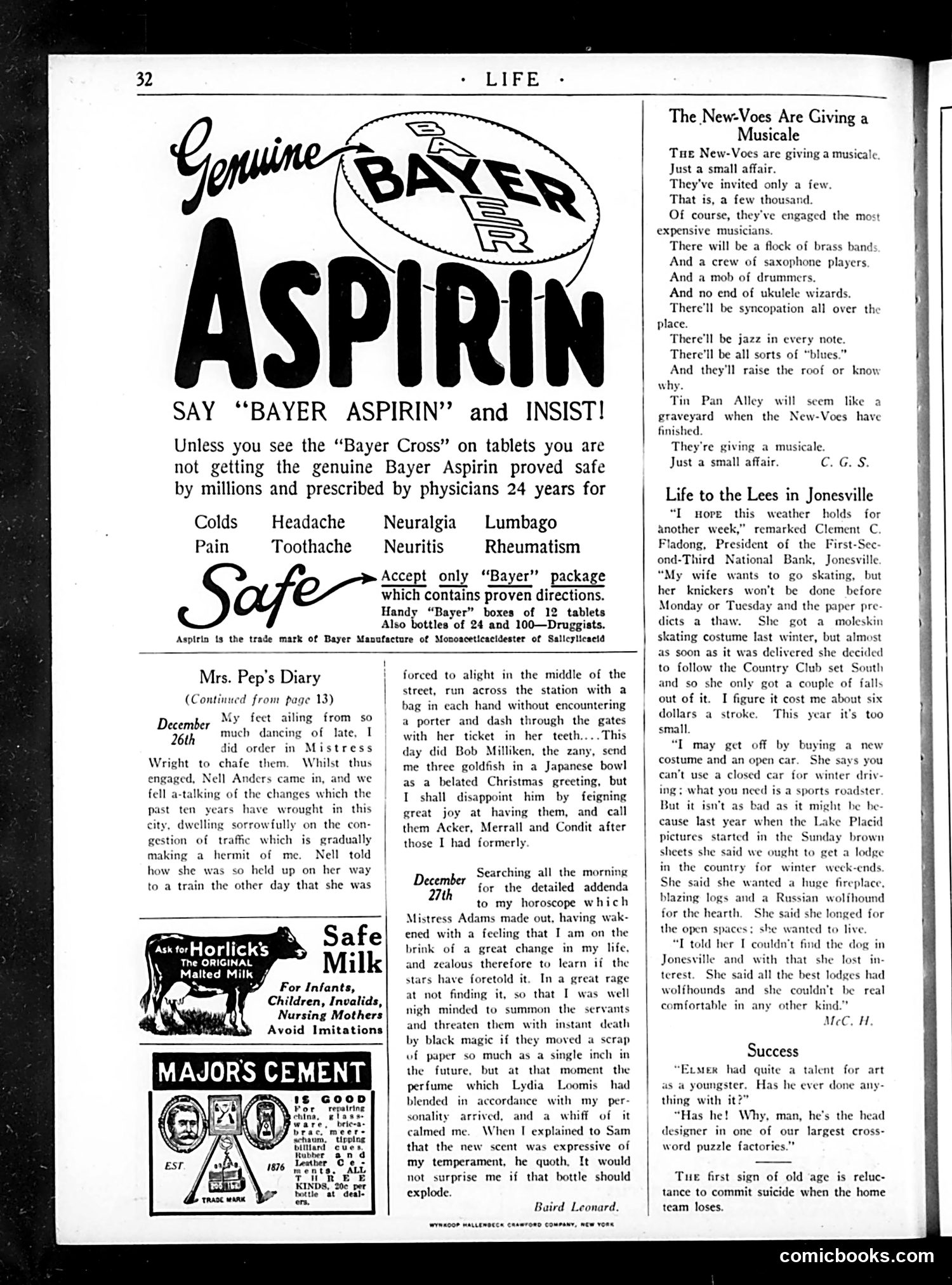
This page contains primarily **advertisements and satirical columns**, not political cartoons. The **Bayer Aspirin ad** (top) emphasizes brand authenticity—urging consumers to insist on the "Bayer Cross" trademark, reflecting early 20th-century concerns about generic imitations and patent protection. Aspirin was relatively new medicine then. **"Mrs. Pep's Diary"** is a humorous society column mocking upper-class concerns: traffic congestion, servants, astrology, and frivolous spending. The entry about Clement C. Fladong satirizes wealthy husbands indulging wives' expensive hobbies (skating costumes costing six dollars per use—substantial then). **"The New-Voes Are Giving a Musicale"** satirizes excessive wealthy social gatherings, mocking the pretension of inviting "a few thousand" guests and hiring expensive musicians while calling it a "small affair." These pieces reflect 1920s satirical humor targeting urban congestion, class pretension, and consumerism.
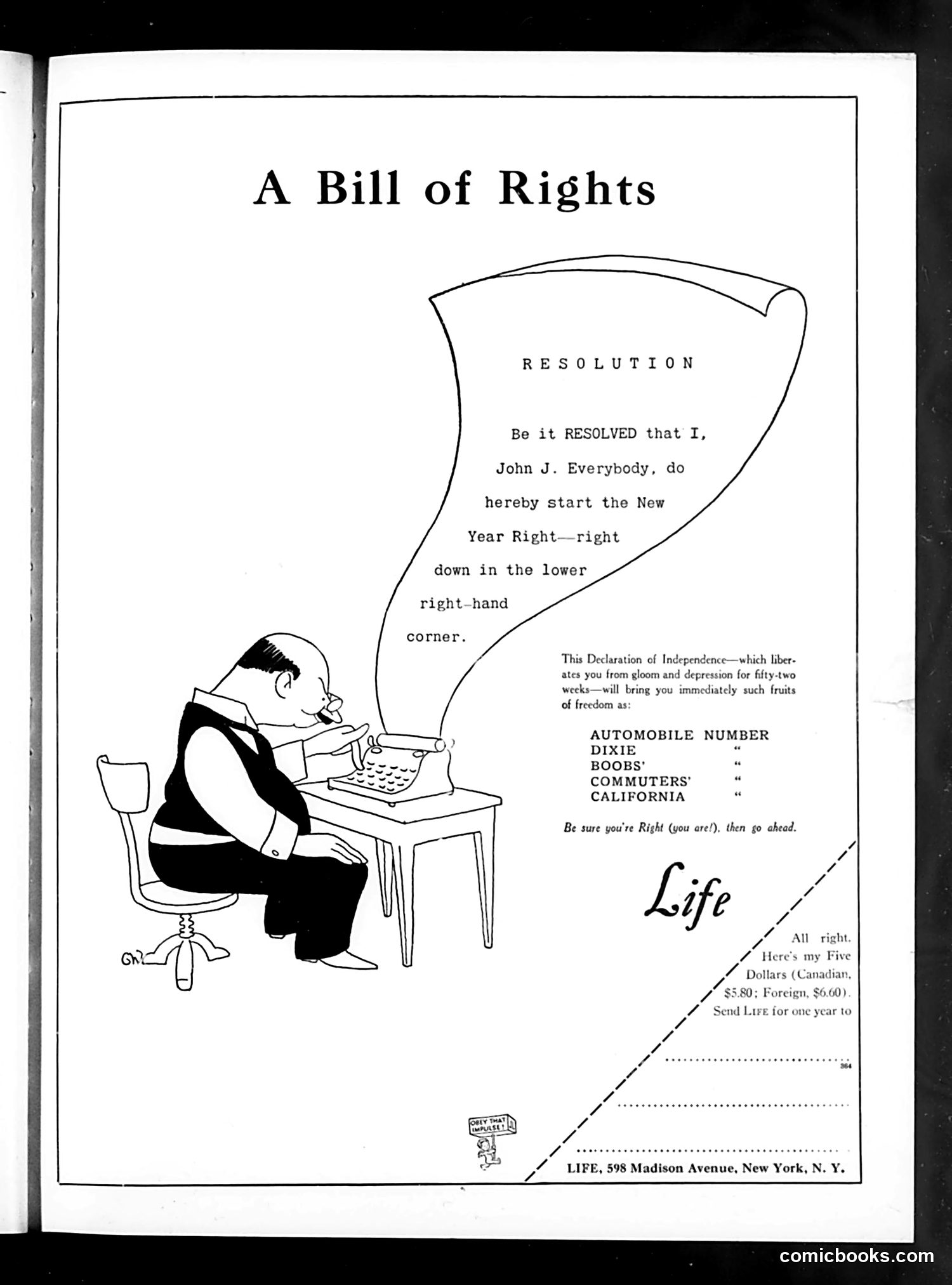
This is a satirical New Year's resolution ad for *Life* magazine. The cartoon shows "John J. Everybody" (an everyman figure) making a tongue-in-cheek "Declaration of Independence" by subscribing to the magazine for the coming year. The joke is that *Life* promises liberation from "gloom and depression for fifty-two weeks" through entertainment—but the promised "fruits of freedom" are mundane: automobile numbers, gossip ("boobs"), commuter humor, and California content. The satire mocks both New Year's resolutions (often quickly abandoned) and consumerism's false promise that buying something (magazine subscription) equals actual freedom or happiness. The earnest language mimicking the Declaration of Independence intensifies the comic deflation—America's founding document reduced to justifying a $5 magazine purchase as a path to happiness. This reflects 1930s-era satirical humor about consumer culture and optimism.
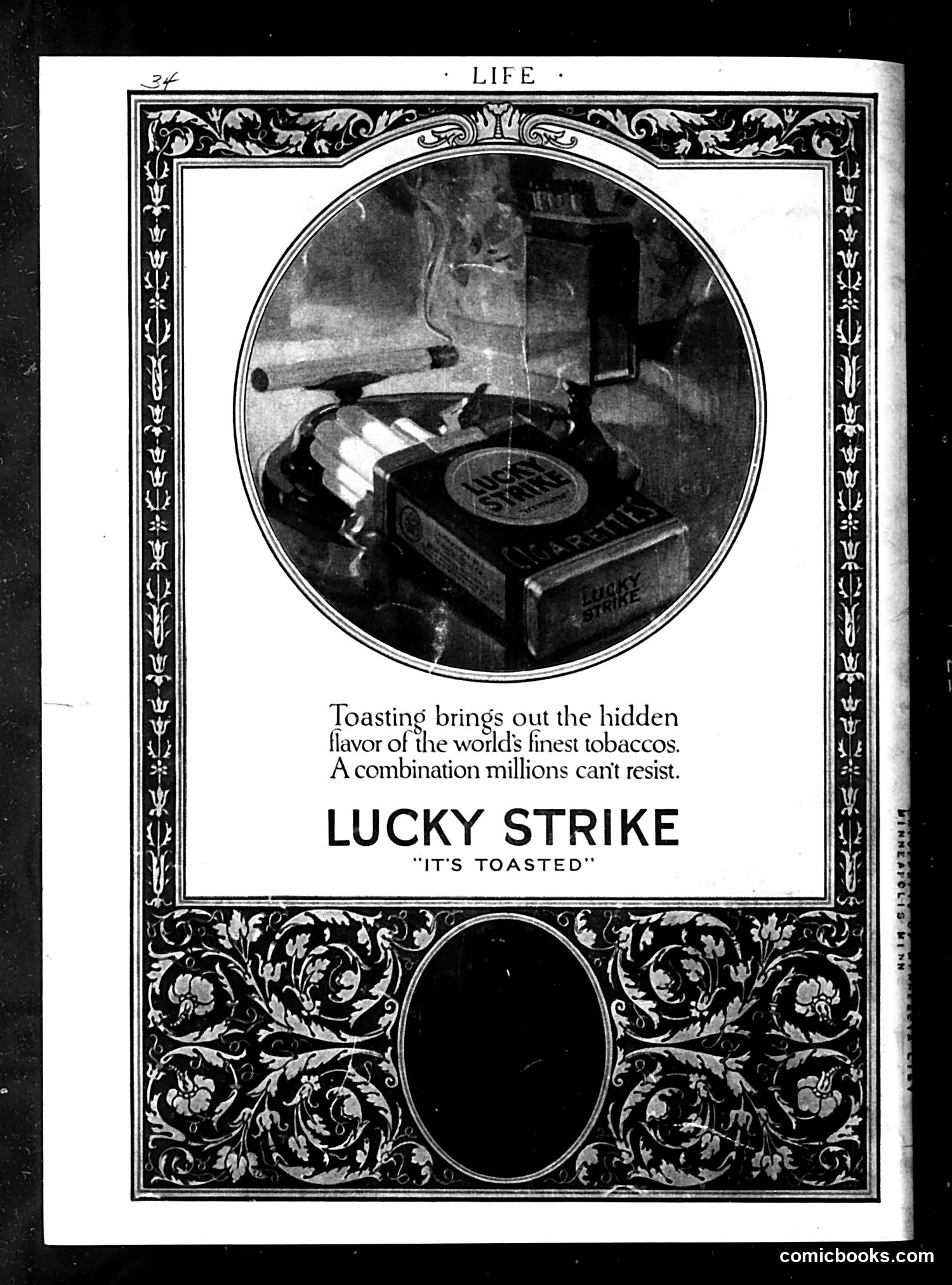
This is a **Lucky Strike cigarette advertisement**, not political satire. The page shows a photograph of a toasting mechanism—the device used to heat tobacco during cigarette manufacturing. The ad's claim is straightforward product marketing: "Toasting brings out the hidden flavor of the world's finest tobaccos. A combination millions can't resist." The slogan "It's Toasted" was Lucky Strike's actual advertising tagline. For modern readers, this reveals how openly cigarettes were advertised in early-to-mid 20th century American magazines like *Life*. The ad presents tobacco processing as a sophisticated technique that enhances flavor, with no health warnings or regulatory disclaimers—a stark contrast to today's required warnings and advertising restrictions on tobacco products. This represents a historical moment before cigarette health dangers were widely acknowledged or legally mandated to be disclosed.

I cannot reliably analyze this image. The page is extremely dark and degraded, making it nearly impossible to discern cartoon figures, captions, or specific content details. While there appears to be some illustrated material on the right side with what might be circular or spiral patterns, and text elements along the left margin, the image quality prevents confident identification of any political figures, satirical subjects, or historical references. To properly explain the satire and context to a modern reader, I would need a clearer reproduction of this page from *Life* magazine. I cannot responsibly guess at identities or meanings without being able to see the actual content clearly.