
Life, 1925-01-01 · page 22 of 37
Life — January 1, 1925 — page 22: what you’re looking at
What you’re looking at
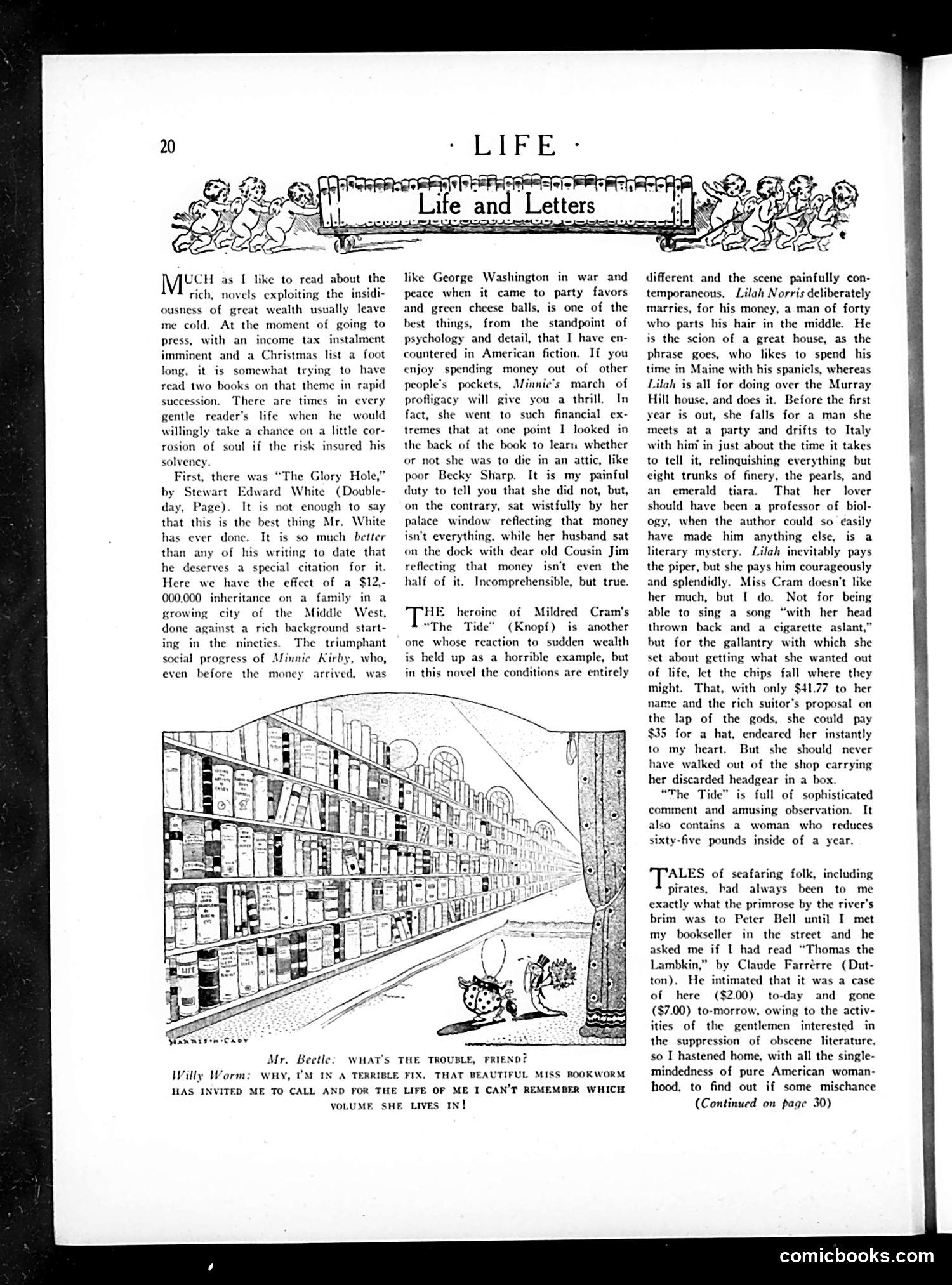
This is a literary review page from Life magazine, not primarily a political cartoon. The main content discusses two novels about wealthy characters: "The Glory Hole" by Stewart Edward White and "The Tide" by Mildred Cram. The **small cartoon at bottom** shows two insects—Mr. Beetle and Willy Worm—making a joke about a "Miss Bookworm" who has invited Willy to visit but he can't remember "which volume she lives in!" This is a lighthearted pun: bookworms literally live in books (volumes), so the joke plays on the double meaning of "volume" as both a book and a unit of space. The reviews themselves are satirical commentary on wealth-obsessed fiction. The reviewer criticizes novels depicting the corrupting effects of sudden riches as tedious, then discusses how these two novels handle that theme differently. No specific political figures or events are referenced—this is social satire about literary tropes and human behavior regarding money.
📄 Transcribed text from this page (OCR, searchable)
Machine-transcribed from the original scan — historical spelling and the odd misread are preserved.
Mee H_ as I like to read about the rich, novels exploiting the insidi- ousness of great wealth usually leave me cold. At the moment of going to press, with an income tax instalment imminent and a Christmas list a foot long, it is somewhat trying to have read two books on that theme in rapid succession. There are times in every gentle reader's life when he would willingly take a chance on a little cor- rosion of soul if the risk insured his solvency. First, there was “The Glory Hole,” by Stewart Edward White (Double- day, Page). It is not enough to say that this is the best thing Mr. White has ever done. It is so much better than any of his writing to date that he deserves a special citation for it. Here we have the effect of a $12,- 000,000 inheritance on a family in a growing city of the Middle West, done against a rich background start- ing in the nineties. The triumphant social progress of Minnie Kirby, who, even before the money arrived, was co... WannisensCacy Mr. Beetle: Willy Worm: WHAT'S THE TROUBLE, WHY, I'M IN A TERRIBLE FIX, THAT BEAUTIFUL MISS BOOKWORM like George Washington in war and peace when it came to party favors and green cheese balls, is one of the best things, from the standpoint of psychology and detail, that I have en- countered in American fiction, If you enjoy spending money out of other people's pockets, Minnie’s march of profligacy will give you a thrill, In fact, she went to such financial ex- tremes that at one point I looked in the back of the book to learn whether or not she was to die in an attic, like poor Becky Sharp. It is my painful duty to tell you that she did not, but, on the contrary, sat wistfully by her palace window reflecting that money isn’t everything, while her husband sat on the dock with dear old Cousin Jim reflecting that money isn’t even the half of it. Incomprehensible, but true. HE heroine of Mildred Cram's “The Tide” (Knopf) is another one whose reaction to sudden wealth is held up as a horrible example, but in this novel the conditions are entirely FRIEND? HAS INVITED ME TO CALL AND FOR THE LIFE OF ME I CAN'T REMEMBER WHICH VOLUME SHE Lives IN! different and the scene painfully con- temporaneous. Lilah Norris deliberately marries, for his money, a man of forty who parts his hair in the middle. He is the scion of a great house, as the phrase goes, who likes to spend his time in Maine with his spaniels, whereas Lilah is all for doing over the Murray Hill house, and does it. Before the first year is out, she falls for a man she meets at a party and drifts to Italy with him in just about the time it takes to tell it, relinquishing everything but eight trunks of finery, the pearls, and an emerald tiara. That her lover should have been a professor of biol- ogy, when the author could so easily have made him anything else, is a literary mystery. Lilah inevitably pays the piper, but she pays him courageously and splendidly. Miss Cram doesn't like her much, but I do. Not for being able to sing a song “with her head thrown back and a cigarette aslant,” but for the gallantry with which she set about getting what she wanted out of life, let the chips fall where they might. That, with only $41.77 to her name and the rich suitor’s proposal on the lap of the gods, she could pay $35 for a hat, endeared her instantly to my heart. But she should never have walked out of the shop carrying her discarded headgear in a box. “The Tide” is full of sophisticated comment and amusing observation. It also contains a woman who reduces sixty-five pounds inside of a year. ‘ALES of seafaring folk, including pirates, bad always been to me exactly what the primrose by the river's brim was to Peter Bell until I met my bookseller in the street and he asked me if I had read “Thomas the Lambkin,” by Claude Farrérre (Dut- ton). He intimated that it was a case of here ($2.00) to- and gone ($7.00) to-morrow, owing to the activ- ities of the gentlemen interested in the suppression of obscene literature, so I hastened home, with all the single- mindedness of pure American woman- hood, to find out if some mischance (Continued on page 30) comicbooks.com