
Life, 1925-01-01 · page 20 of 37
Life — January 1, 1925 — page 20: what you’re looking at
What you’re looking at
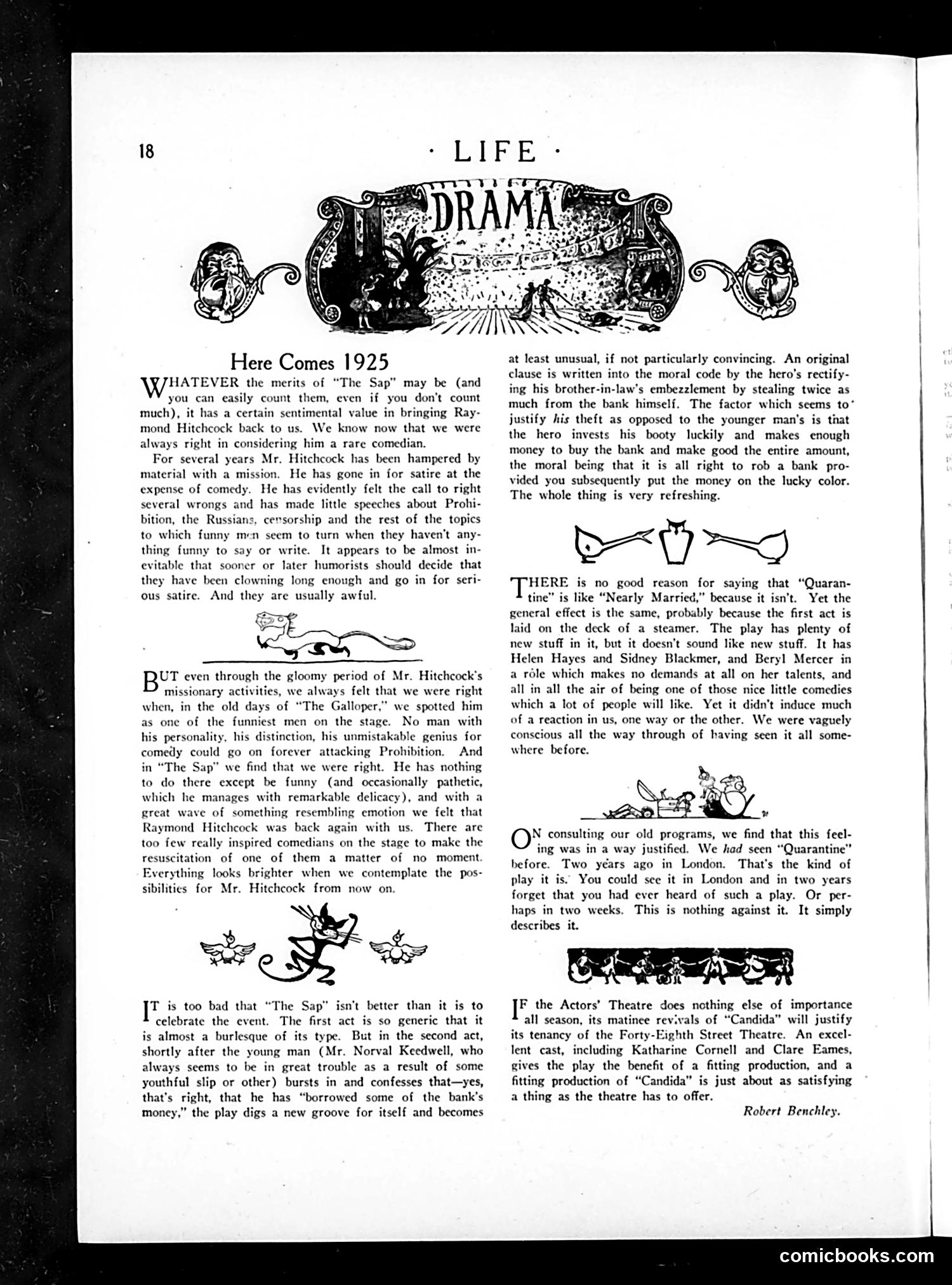
This page reviews three Broadway plays opening in 1925. The main focus is **Raymond Hitchcock**, a comedian returning to performance in "The Sap." The critic praises Hitchcock's comedic talents, noting he'd recently wasted his abilities on preachy satirical work attacking Prohibition, censorship, and other serious topics. Now that he's returned to pure comedy, the critic celebrates his comeback. The review of "The Sap" mocks its implausible moral logic: a bank employee steals twice the embezzled amount to invest it, intending to repay everything through lucky gambling—apparently making theft acceptable if profitable. Brief mentions follow for "Quarantine" (starring Helen Hayes), which the critic finds derivative, claiming they'd seen essentially the same play in London two years prior. The ornamental illustrations are typical period magazine decoration.
📄 Transcribed text from this page (OCR, searchable)
Machine-transcribed from the original scan — historical spelling and the odd misread are preserved.
Here Comes 1925 HATEVER the merits of “The Sap” may be (and you can easily count them, even if you don’t count much), it has a certain sentimental value in bringing Ray- mond Hitchcock back to us. We know now that we were always right in considering him a rare comedian. For several years Mr. Hitchcock has been hampered by material with a mission. He has gone in for satire at the expense of comedy. He has evidently felt the call to right veral wrongs and has made little speeches about Prohi- bition, the Russians, cersorship and the rest of the topics to which funny men seem to turn when they haven't any- thing funny to say or write. It appears to be almost in- evitable that sooner or later humorists should decide that they have been clowning long enough and go in for seri- ous satire. And they are usually awful. UT even through the gloomy period of Mr. Hitchcock's missionary activities, we always felt that we were right when, in the old days of “The Galloper,” we spotted him as one of the funniest men on the stage. No man with his personality, his distinction, his unmistakable genius for comedy could go on forever attacking Prohibition. And in “The Sap” we find that we were right. He has nothing to do there except be funny (and occasionally pathetic, which he manages with remarkable delicacy), and with a great wave of something resembling emotion we felt that Raymond Hitchcock was back again with us. There are too few really inspired comedians on the stage to make the resuscitation of one of them a matter of no moment Everything looks brighter when we contemplate the pos- sibilities for Mr. Hitchcock from now on. Sere We T is too bad that “The Sap” isn’t better than it is to celebrate the event. The first act is so generic that it is almost a burlesque of its type. But in the second act, shortly after the young man (Mr. Norval Keedwell, who always seems to be in great trouble as a result of some youthful slip or other) bursts in and confesses that—yes, that’s right, that he has “borrowed some of the bank's money,” the play digs a new groove for itself and becomes at least unusual, if not particularly convincing. An original clause is written into the moral code by the hero's rectify- ing his brother-in-law’s embezzlement by stealing twice as much from the bank himself. The factor which seems to* justify his theft as opposed to the younger man’s is that the hero invests his booty luckily and makes enough money to buy the bank and make good the entire amount, the moral being that it is all right to rob a bank pro- vided you subsequently put the money on the lucky color. The whole thing is very refreshing. DTP HERE is no good reason for saying that “Quaran- tine” is like “Nearly Married,” because it isn’t. Yet the general effect is the same, probably because the first act is laid on the deck of a steamer. The play has plenty of new stuff in it, but it doesn’t sound like new stuff. It has Helen Hayes and Sidney Blackmer, and Beryl Mercer in a role which makes no demands at all on her talents, and all in all the air of being one of those nice little comedies which a lot of people will like. Yet it didn’t induce much of a reaction in us, one way or the other. We were vaguely conscious all the way through of having seen it all some- where before. N consulting our old programs, we find that this feel- ing was in a way justified, We had seen “Quarantine” hefore. Two years ago in London. That's the kind of play it is. You could sce it in London and in two years forget that you had ever heard of such a play. Or per- haps in two weeks. This is nothing against it. It simply describes it. IF the Actors’ Theatre does nothing else of importance all season, its matinee revivals of “Candida” will justify its tenancy of the Forty-Eighth Street Theatre. An excel- lent cast, including Katharine Cornell and Clare Eames, gives the play the benefit of a fitting production, and a fitting production of “Candida” is just about as satisfying a thing as the theatre has to offer. Robert Benchley. comicbooks.com