
Life, 1925-01-01 · page 32 of 37
Life — January 1, 1925 — page 32: what you’re looking at
What you’re looking at
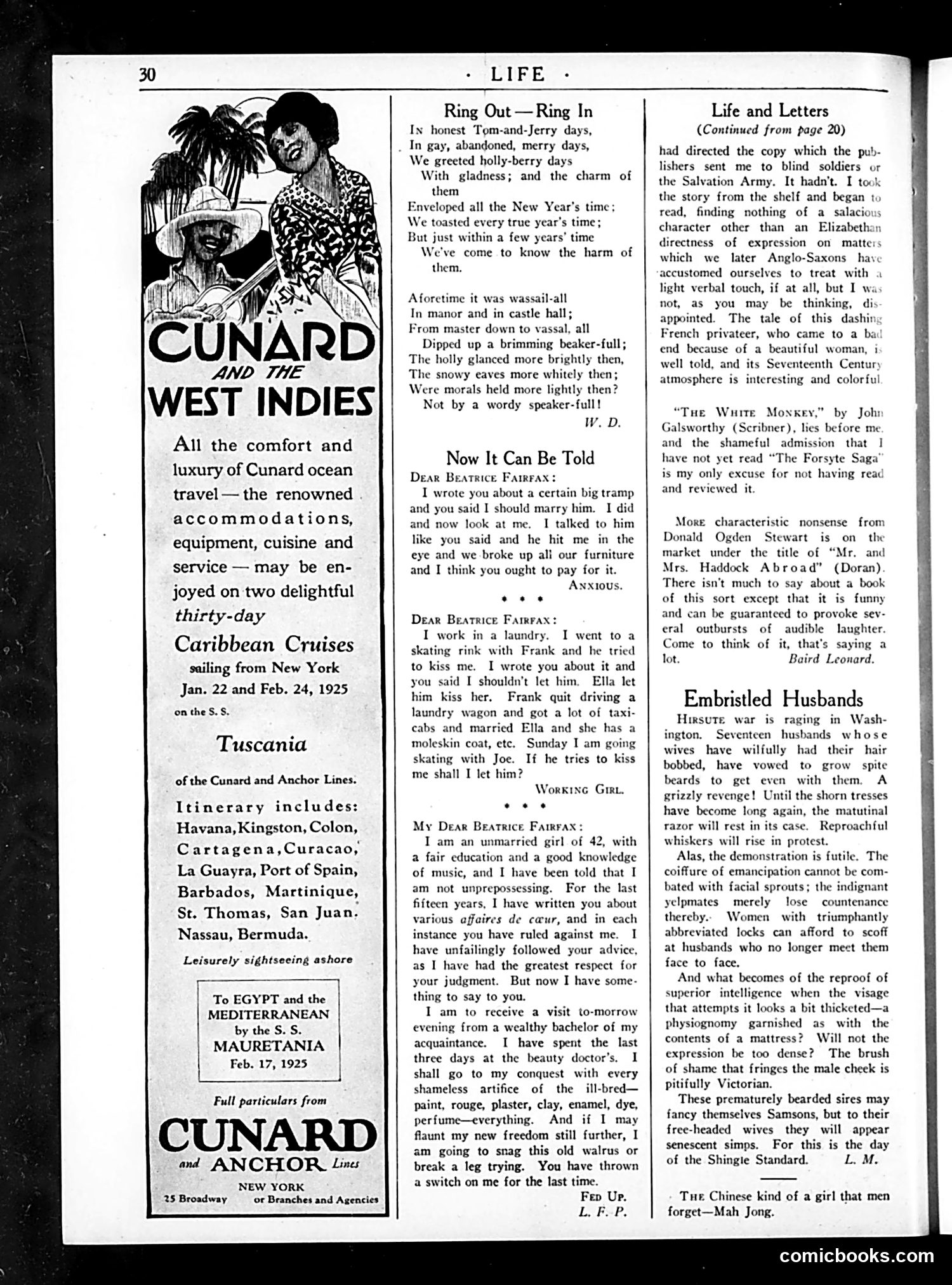
This page is primarily **advertising** (Cunard cruise lines) and an **advice column** ("Life and Letters"), not political satire. The notable content is the **"Now It Can Be Told"** section, which parodies the popular advice columnist "Beatrice Fairfax" through darkly humorous letters. The satire targets the gap between idealized romantic advice and harsh reality: a woman who followed dating advice gets beaten; another woman's restraint loses her a boyfriend to a rival; a 42-year-old woman, after 15 years of heeding Fairfax's conservative guidance, rebels and plans seduction using "shameless artifice." The satirical point: women's advice columns offer naive moralism disconnected from actual outcomes, and their prescriptive rules may backfire. This reflects 1920s anxieties about changing gender roles and courtship norms during the "Jazz Age." The opening poem "Ring Out—Ring In" nostalgically compares past New Year celebrations to present ones, questioning whether morality has declined.
📄 Transcribed text from this page (OCR, searchable)
Machine-transcribed from the original scan — historical spelling and the odd misread are preserved.
All the comfort and luxury of Cunard ocean travel— the renowned accommodations, equipment, cuisine and service — may be en- joyed on two delightful thirty-day Caribbean Cruises sailing from New York Jan. 22 and Feb. 24, 1925 on the S. S. Tuscania of the Cunard and Anchor Lines. Itinerary includes: Havana, Kingston, Colon, Cartagena,Curacao, La Guayra, Port of Spain, Barbados, Martinique, St. Thomas, San Juan. Nassau, Bermuda. Leisurely sightseeing ashore | To EGYPT and the MEDITERRANEAN by the S. S. MAURETANIA Feb. 17,1925. | Full particulars from CUNARD and ANCHOR Lis NEW YORK 25 Broadway or Branches and Agencies + LIFE - Ring Out — Ring In In honest Tom-and-Jerry days, In gay, abandoned, merry days, We greeted holly-berry days With gladness; and the charm of them Enveloped all the New Year's time; We toasted every true year’s time; But just within a few years’ time We've come to know the harm of them. Aforetime it was wassail-all In manor and in castle hall; From master down to vassal, all Dipped up a brimming beaker-full; The holly glanced more brightly then, The snowy eaves more whitely then; Were morals held more lightly then? Not by a wordy speaker-full! W, D. Now It Can Be Told Dear Beatrice Farrrax: I wrote you about a certain big tramp and you said I should marry him. I did and now look at me, I talked to him like you said and he hit me in the eye and we broke up ali our furniture and I think you ought to pay for it. Anxious. eee Dear Beatrice Famrax: I work in a laundry. I went to a skating rink with Frank and he tried to kiss me. I wrote you about it and you said I shouldn't let him. Ella let him kiss her, Frank quit driving a laundry wagon and got a lot of taxi- cabs and married Ella and she has a moleskin coat, ete. Sunday I am going skating with Joe. If he tries to kiss me shall I let him? Workine Grew. eee My Dear Beatrice Farrrax: I am an unmarried girl of 42, with a fair education and a good knowledge of music, and I have been told that I am not unprepossessing. For the last fifteen years, I have written you about various affaires de cur, and in each instance you have ruled against me. I have unfailingly followed your advice, as I have had the greatest respect for your judgment. But now I have some- thing to say to you. I am to receive a visit to-morrow evening from a wealthy bachelor of my acquaintance. I have spent the last three days at the beauty doctor’s. 1 shall go to my conquest with every shameless artifice of the ill-bred— paint, rouge, plaster, clay, enamel, dye, perfume—everything. And if I may flaunt my new freedom still further, I am going to snag this old walrus or break a leg trying. You have thrown a switch on me for the last time. Feo Up. L. FP. Life and Letters (Continued from page 20) had directed the copy which the pub- lishers sent me to blind soldiers or the Salvation Army. It hadn't. I took the story from the shelf and began t read, finding nothing of a salacious character other than an Elizabethan directness of expression on matters which we later Anglo-Saxons havc accustomed ourselves to treat with « light verbal touch, if at all, but I was not, as you may be thinking, dis appointed. The tale of this dashir French privateer, who came to a ba end because of a beautiful woman, i well told, and its Seventeenth Century atmosphere is interesting and colorful “Tue Wuite Monke Galsworthy (Scribner), lies before me and the shameful admission that | have not yet read “The Forsyte Saga is my only excuse for not having reac and reviewed it. ‘,” by Johr More characteristic nonsense from Donald Ogden Stewart is on the market under the title of “Mr. and Mrs. Haddock Abroad” (Doran) There isn’t much to say about a book of this sort except that it is funny and can be guaranteed to provoke sev- eral outbursts of audible laughter. Come to think of it, that's saying a lot. Baird Leonard. Embristled Husbands Hirsute war is raging in Wash- ington. Seventeen husbands whose wives have wilfully had their hair bobbed, have vowed to grow spite beards to get even with them. A grizzly revenge! Until the shorn tresses have become long again, the matutinal razor will rest in case. Reproachful whiskers will rise in protest. Alas, the demonstration is futile. The coiffure of emancipation cannot be com- bated with facial sprouts; the indignant yelpmates merely lose countenance thereby. Women with triumphantly abbreviated locks can afford to scoff at husbands who no longer meet them face to face, And what becomes of the reproof of superior intelligence when the visage that attempts it looks a bit thicketed—a physiognomy garnished as with the contents of a mattress? Will not the expression be too dense? The brush of shame that fringes the male cheek is pitifully Victorian. These prematurely bearded sires may fancy themselves Samsons, but to their free-headed wives they will appear senescent simps. For this is the day of the Shingle Standard. L. M. Tue Chinese kind of a girl that men forget—Mah Jong. comicbooks.com