
Life, 1925-01-01 · page 16 of 37
Life — January 1, 1925 — page 16: what you’re looking at
What you’re looking at
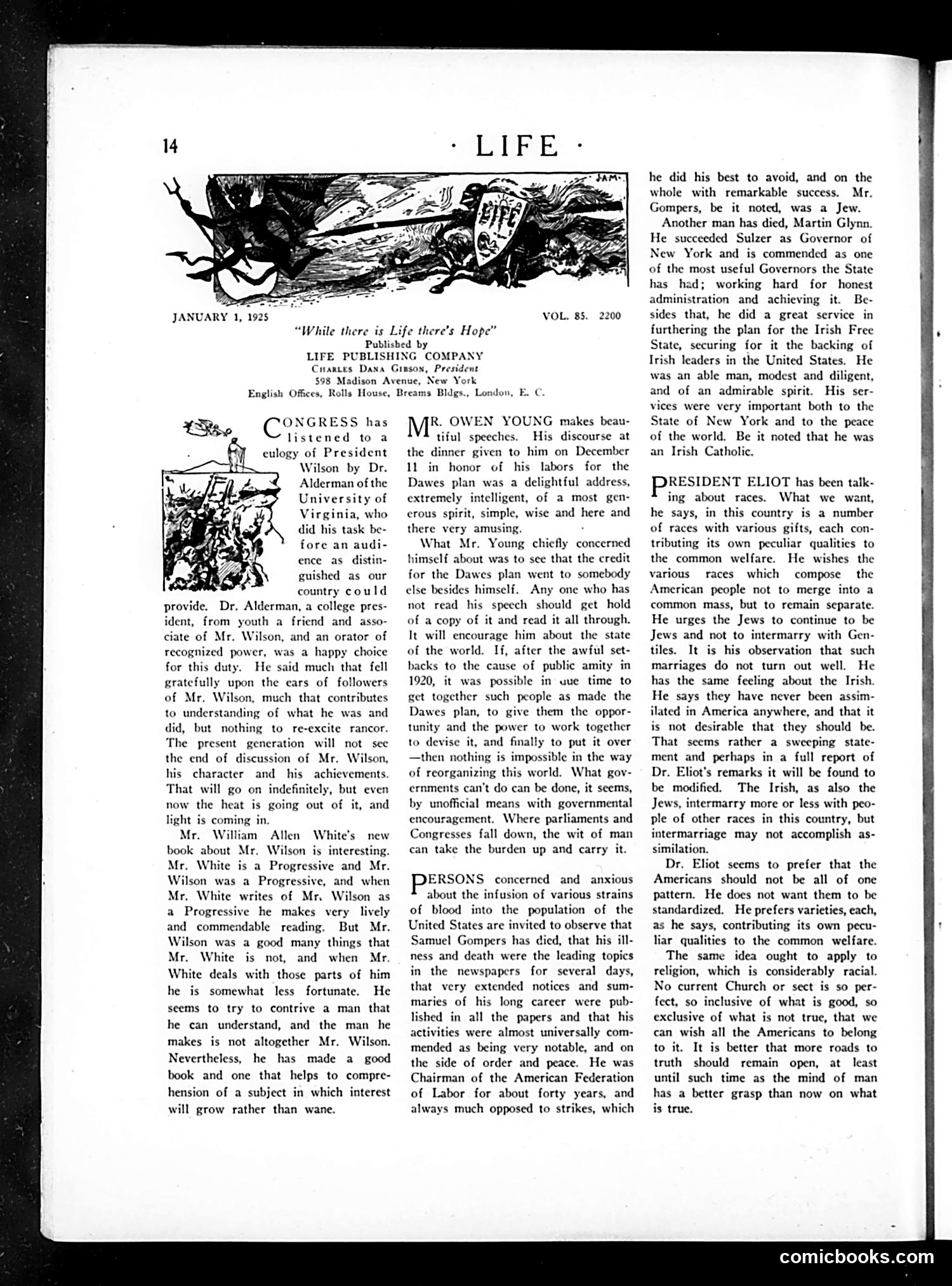
The page's header illustration shows a skeletal death figure labeled "LIFE" — likely satirizing the magazine's own title and commenting on mortality or social decay. The text discusses President Wilson's legacy and contemporary political figures, including Owen Young (who gave speeches about the Dawes Plan for post-WWI reparations) and Martin Glynn (who succeeded Sulzer as New York Governor). The magazine also critiques President Eliot's remarks about racial intermarriage, opposing his suggestion that various immigrant groups should assimilate into "one American people" rather than remain distinct. The overall tone reflects 1920s anxieties about immigration, assimilation, and America's post-war role — debating whether ethnic/religious identity should be preserved or dissolved into a unified American identity.
📄 Transcribed text from this page (OCR, searchable)
Machine-transcribed from the original scan — historical spelling and the odd misread are preserved.
JANUARY 1, 1925 VOL. 85. 2200 “While there is Life there’s Hope” Published by LIFE PUBLISHING COMPANY Cuartes Daxa Gtasox, President 598 Madison Avenue, New York English Offices, Rolls House, Breams Blugs., London, E. ONGRESS has listened to a culogy of President Wilson by Dr. Alderman of the University of Virginia, who did his task be- fore an audi- ence as distin- guished as our country could provide. Dr. Alderman, a college pres- ident, from youth a friend and asso- ciate of Mr. Wilson, and an orator of recognized power, was a happy choice for this duty. He said much that fell gratefully upon the ears of followers of Mr. Wilson, much that contributes to understanding of what he was and did, but nothing to re-excite rancor. The present generation will not sec the end of discussion of Mr. Wilson, his character and his achievements. That will go on indefinitely, but even now the heat is going out of it, and light is coming in. Mr. William Allen White's new book about Mr. Wilson is interesting. Mr. White is a Progressive and Mr. Wilson was a Progressive, and when Mr. White writes of Mr. Wilson as a Progressive he makes very lively and commendable reading. But Mr. Wilson was a good many things that Mr. White is not, and when Mr. White deals with those parts of him he is somewhat less fortunate. He seems to try to contrive a man that he can understand, and the man he makes is not altogether Mr. Wilson. Nevertheless, he has made a good book and one that helps to compre- hension of a subject in which interest will grow rather than wane. R. OWEN YOUNG makes beau- tiful speeches. His discourse at the dinner given to him on December 11 in honor of his labors for the Dawes plan was a delightful address, extremely intelligent, of a most gen- erous spirit, simple, wise and here and there very amusing. . What Mr. Young chiefly concerned himself about was to sce that the credit for the Dawes plan went to somebody else besides himself. Any one who has not read his speech should get hold of a copy of it and read it all through. It will encourage him about the state of the world. Ii, after the awful set- backs to the cause of public amity in 1920, it was possible in uue time to get together such people as made the Dawes plan, to give them the oppor- tunity and the power to work together to devise it, and finally to put it over —then nothing is impossible in the way of reorganizing this world. What gov- ernments can’t do can be done, it seems, by unofficial means with governmental encouragement. Where parliaments and Congresses fall down, the wit of man can take the burden up and carry it. ERSONS concerned and anxious about the infusion of various strains of blood into the population of the United States are invited to observe that Samuel Gompers has died, that his ill- ness and death were the leading topics in the newspapers for several days, that very extended notices and sum- maries of his long career were pub- lished in all the papers and that his activities were almost universally com- mended as being very notable, and on the side of order and peace. He was Chairman of the American Federation of Labor for about forty years, and always much opposed to strikes, which he did his best to avoid, and on the whole with remarkable success. Mr. Gompers, be it noted, was a Jew. Another man has died, Martin Glynn. He succeeded Sulzer as Governor of New York and is commended as one of the most useful Governors the State has had; working hard for honest administration and achieving it. Be- sides that, he did a great service in furthering the plan for the Irish Free State, securing for it the backing of Irish leaders in the United States. He was an able man, modest and diligent, and of an admirable spirit. His ser- vices were very important both to the State of New York and to the peace of the world. Be it noted that he was an Irish Catholic. RESIDENT ELIOT has been talk- ing about races. What we want, he says, in this country is a number of races with various gifts, each con- tributing its own peculiar qualities to the common welfare. He wishes the various races which compose the American people not to merge into a common mass, but to remain separate. He urges the Jews to continue to be Jews and not to intermarry with Gen- tiles. It is his observation that such marriages do not turn out well. He has the same feeling about the Irish. He says they have never been assim- ilated in America anywhere, and that it is not desirable that they should be. That seems rather a sweeping state- ment and perhaps in a full report of Dr. Eliot's remarks it will be found to be modified. The Irish, as also the Jews, intermarry more or less with peo- ple of other races in this country, but intermarriage may not accomplish as- similation. Dr. Eliot seems to prefer that the Americans should not be all of one pattern. He does not want them to be standardized. He prefers varieties, each, as he says, contributing its own pecu- liar qualities to the common welfare. The same idea ought to apply to religion, which is considerably racial. No current Church or sect is so per- fect, so inclusive of what is good, so exclusive of what is not true, that we can wish all the Americans to belong to it. It is better that more roads to truth should remain open, at least until such time as the mind of man has a better grasp than now on what is true. comicbooks.com