
Life, 1925-01-01 · page 21 of 37
Life — January 1, 1925 — page 21: what you’re looking at
What you’re looking at
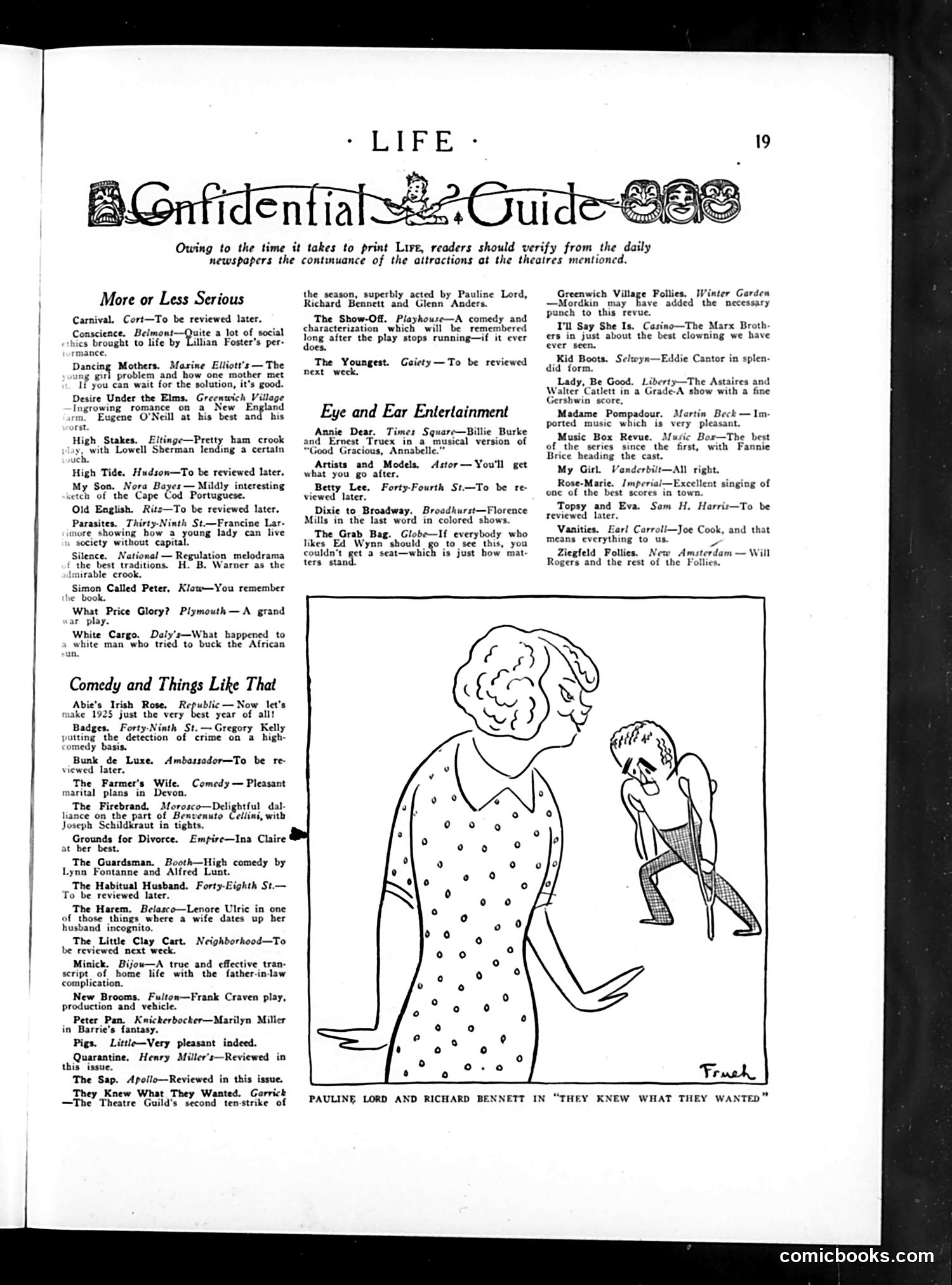
This is a theatrical review page featuring a cartoon by Frueh depicting a scene from the play "They Knew What They Wanted" starring Pauline Lord and Richard Bennett. The cartoon shows a woman in a polka-dotted dress (Lord's character) being embraced or grabbed by a smaller man (Bennett's character) who appears excited or aggressive. The visual joke likely plays on the play's plot—a comedy about romantic misunderstanding or physical comedy. Without knowing the specific plot details, the cartoon appears to satirize either the play's physical humor or an awkward romantic situation central to the story. The text identifies this as "The Theatre Guild's second ten-strike," suggesting it was a critical and commercial success. The cartoon's humor depends on recognizing these popular performers and the play's scenario, which contemporary readers would have understood immediately.
📄 Transcribed text from this page (OCR, searchable)
Machine-transcribed from the original scan — historical spelling and the odd misread are preserved.
Owing to the time it takes to print Lire, readers should verify from the daily newspapers the continuance of the attractions at the theatres mentioned. More or Less Serious Carnival. Cort—To be reviewed later. Conscience. Beiment—Ouite a lot of social ies brought to life by Lillian Foster’s per- rmance, Dancing Mothers. Maxine Elliott's —The ng git] problem and how one mother met If you can wait for the solution, it's good. Desire Under the Elms. Greenwich Villoge Ingrowing romance on a New England rm. Eugene O'Neill at his best and his rst. High Stakes. Eltinge—Prett vy, with Lowell Sherman len uch. High Tide. Hudson—To be reviewed later. My Son. Nora Bayes — Mildly interesting cetch of the Cape Cod Portuguese. Old English. Rits—To be reviewed later. Parasites. Thirty-Ninth St—Francine Lar- mnore showing how a young lady can live \ society without capital. Silence. National — Regulation melodrama (the best traditions. H. B. Warner as the imirable crook. Simon Called Peter, Klow—You remember © bool What Price Glory? Plymouth—A grand ar play. White Cargo. Daly's—What happened to . white man who tried to buck the African sun, Comedy and Things Like That Abie's Irish Rose. Republic — Now let's make 192$ just the very best year of all! Badges. Forty-Ninth St.— Gregory Kelly putting the detection of crime on a high- ‘omedy basis. Bunk de Luxe. Ambassodor—To be re- viewed later. The Farmer's Wife. Comedy — Pleasant marital plans in Devon. The Firebrand. Morosco—Delightful dal- liance on the part of Benvenuto Cellini, with Joseph Schildkraut in tights. Grounds for Divorce. Empire—Ina Claire at her best. The Guardsman. Booth—High comedy by Lynn Fontanne and Alfred Lunt. The Habitual Husband. Forty-Eighth St.— To be reviewed later. The Harem. Belasco—Lenore Ulric in one of those things where a wife dates up her husband incognito. The Little Clay Cart. Neighborhood—To be reviewed next week. Minick. Bijow—A true and effective tran- script of home life with the father-in-law complication. New Brooms. Fulton—Frank Craven play, production and vehicle. Peter Pan. Knickerbocker—Marilyn Miller in Barrie's fantasy, Pigs. Littl—Very pleasant indeed. Quarantine. Henry Miller's—Reviewed in this issue. The Sap. Apollo—Reviewed in this issue. They Knew What They Wanted. Garrick —The Theatre Guild's second ten-strike of ham crook ing a certain the season, superbly acted by Pauline Lord, Richard Bennett and Glenn Anders. The Show-Off. Playhouse—A comedy and characterization which will be remembered long after the play stops running—if it ever joes. The Youngest. Giety—To be reviewed next week. Eye and Ear Entertainment Annie Dear. Times Squarc—Billie Burke 4 Ernest Truex in a musical version of good Gracious, Annabelle.” Artists and Models, Astor—You'll get what you go after. Betty Lee. Forty-Fourth St—To be re- viewed later. Dixie to Broadway. Broadhurst—Florence Mills in the last word in colored shows. The Grab Bag. Globe—If everybody who likes Ed Wynn should go to see this, you couldn’t get a seat—which is just bow’ mat- ters. stan Greenwich Village Follies. inter Garden —Mordkin may have added the necessary punch to this revue. I'll Say She Is, Casino—The Marx Broth- ers in just about the best clowning we have ever seen. Kid Boots. Selwyn—Eddie Cantor in splen- did form, Lady, Be Good. Liberty—The Astaires and Walter Catlett in'a GradeA show with a fine Gershwin score, Madame Pompadour. Martin Beck —Im- ported music which is very pleasant. Music Box Revue. Music Bor—The best of the series since the first, with Fannie Brice heading the cast. My Girl, Vanderbilt—All right. Rose-Marie. Imperiai—Excellent singing of one of the best scores in town. Topsy and Eva. Sam H. Harris—To be reviewed later. Vanities. Ear! Corrolli—Joe Cook, and that means everything to us. » Ziegfeld Follies. New Amsterdam — Will Rogers and the rest of the Follies, PAULINE LORD AND RICHARD BENNETT IN “THEY KNEW WHAT THEY WANTED” comicbooks.com