
Life, 1925-01-01 · page 23 of 37
Life — January 1, 1925 — page 23: what you’re looking at
What you’re looking at
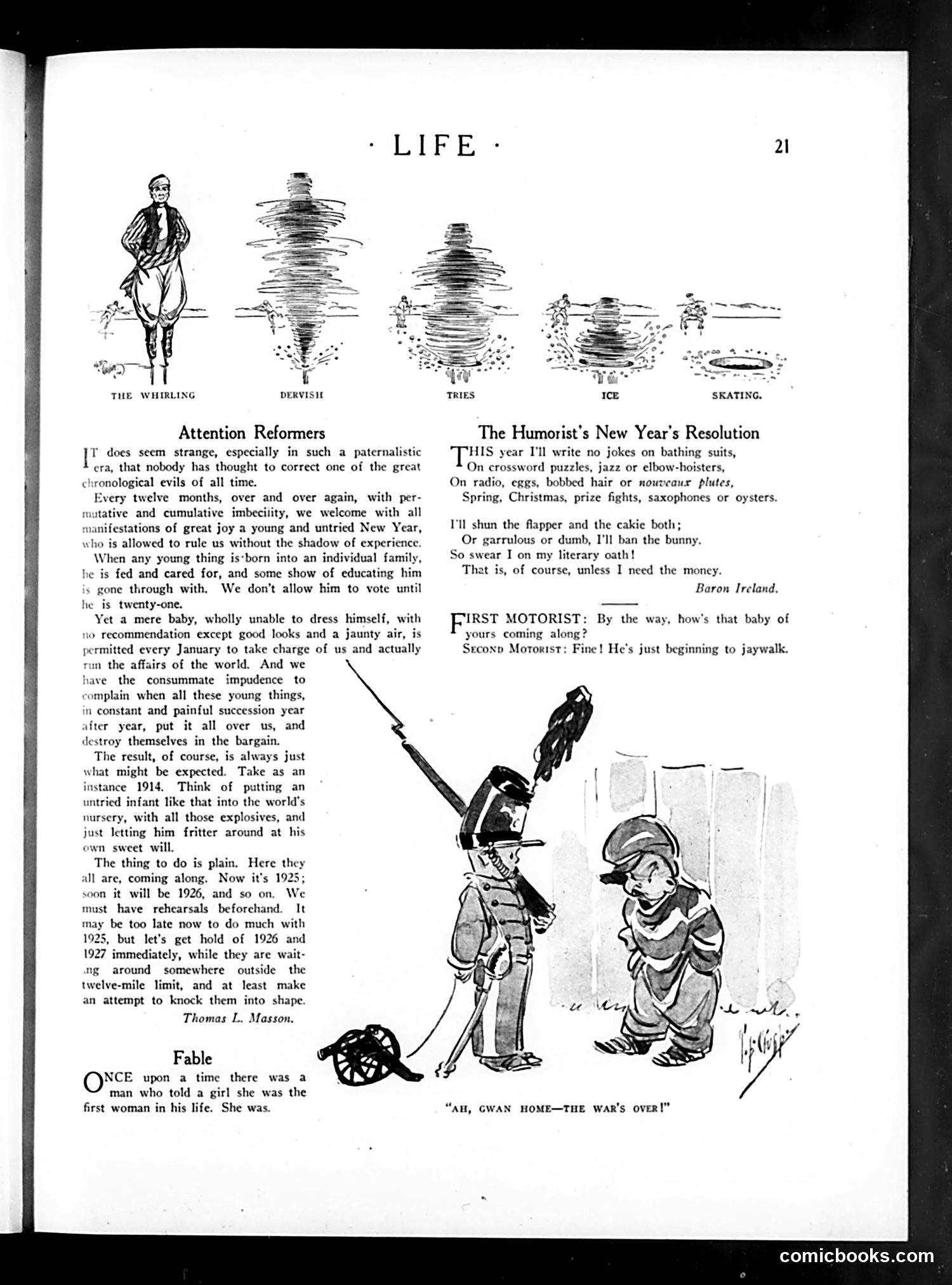
This page from Life magazine (circa 1925, based on references to 1925-1927) contains several satirical pieces mocking contemporary American society: **"Attention Reformers"** by Thomas L. Masson argues that New Year personifications are treated irresponsibly—given power without experience or training, unlike actual infants. He uses 1914 (likely alluding to World War I's outbreak) as an example of a "young year" causing catastrophe, and proposes we "rehearse" upcoming years like 1926-1927 to prevent disaster. **"The Humorist's New Year's Resolution"** by Baron Ireland humorously pledges to avoid tired joke subjects (bathing suits, bobbed hair, flappers, saxophones) while admitting financial need will break this oath—mocking humor writers' desperation. **The motorist joke** references parents teaching children dangerous behavior (jaywalking), satirizing modern urban hazards. **The illustration** "Ah, Gwan Home—The War's Over!" appears to show soldiers, likely referencing post-WWI disillusionment among returning troops. The page emphasizes 1920s social anxieties: reckless youth, modernism's excesses, and lingering war trauma.
📄 Transcribed text from this page (OCR, searchable)
Machine-transcribed from the original scan — historical spelling and the odd misread are preserved.
THE WHIRLING DERVISIE Attention Reformers I" does seem strange, especially in such a paternalistic cra, that nobody has thought to correct one of the great chronological evils of all time. Every twelve months, over and over again, with per- mutative and cumulative imbecility, we welcome with all manifestations of great joy a young and untried New Year, who is allowed to rule us without the shadow of experience. When any young thing is-born into an individual fami he is fed and cared for, and some show of educating him s gone through with. We don't allow him to vote until he is twenty-one. Yet a mere baby, wholly unable to dress himself, with no recommendation except good looks and a jaunty air, is permitted every January to take charge of us and actually run the affairs of the world. And we have the consummate impudence to complain when all these young things, in constant and painful succession year after year, put it all over us, and destroy themselves in the bargain. The result, of course, is always just what might be expected. Take as an instance 1914. Think of putting an untried infant like that into the world's nursery, with all those explosives, and just letting him fritter around at his own sweet will. The thing to do is plain. Here they all are, coming along. Now it's 1925; soon it will be 1926, and so on. We must have rehearsals beforehand. It may be too late now to do much with 1925, but let's get hold of 1926 and 1927 immediately, while they are wait- ng around somewhere outside the twelve-mile limit, and at least make an attempt to knock them into shape. Thomas L. Masson. Fable NCE upon a time there was a man who told a girl she was the first woman in his life. She was. SKATING. The Humorist’s New Year's Resolution THs year I'll write no jokes on bathing suits, On crossword puzzles, jazz or elbow-hoisters, On radio, eggs, bobbed hair or nouveaur plutes, Spring, Christmas, prize fights, saxophones or oysters. I'll shun the flapper and the cakie both; Or garrulous or dumb, I'll ban the bunny, So swear I on my literary oath! That is, of course, unless I need the money. Baron Ireland. FIRST MOTORIST: By the way, how's that baby of yours coming along? Seconp Morortst: Fine! He's just beginning to jaywalk. “AH, GWAN HOME—THE war's over!” comicbooks.com