
Life, 1925-01-01 · page 26 of 37
Life — January 1, 1925 — page 26: what you’re looking at
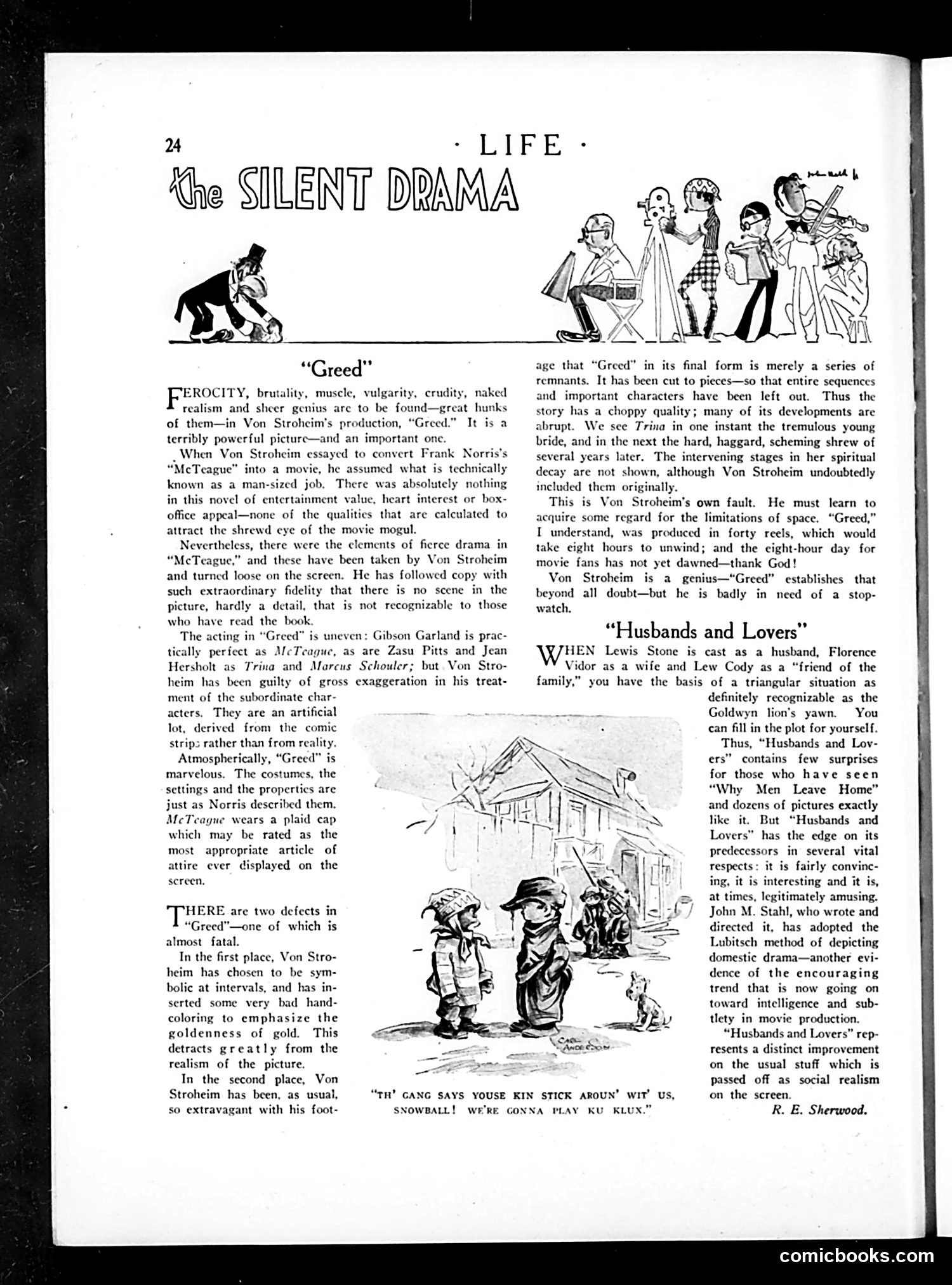
What you’re looking at
This page contains two film reviews from Life magazine's silent film criticism section. **"Greed"** reviews director Erich von Stroheim's adaptation of Frank Norris's novel. The critic praises the film's raw power and realistic detail but identifies two fatal flaws: von Stroheim's symbolic hand-coloring of gold (undermining realism) and severe over-editing. The original 40-reel cut was trimmed drastically, creating narrative chopiness—Trina abruptly transforms from tremulous bride to scheming shrew with missing character development. The reviewer concludes von Stroheim is a genius but needs a "stop-watch" to respect audience limits. **"Husbands and Lovers"** reviews a conventional romantic triangle starring Lewis Stone, Florence Vidor, and Lew Cody. The critic acknowledges it's formulaic and unsurprising to audiences familiar with similar films like "Why Men Leave Home," but credits director John M. Stahl for adopting the sophisticated "Lubitsch method" of domestic drama—evidence of improving intelligence in film production. Both reviews reflect 1920s silent cinema's artistic ambitions and technical constraints.
📄 Transcribed text from this page (OCR, searchable)
Machine-transcribed from the original scan — historical spelling and the odd misread are preserved.
~ LIFE - NY DRAMA naked hunks. It is a ROCITY, brutality, muscle, vulgarity, crudit; realism and shcer genius are to be found—gre: of them—in Von Stroheim’s production, “Greed.” terribly powerful picture—and an important onc. When Von Stroheim essayed to convert Frank Norris's (cTeague” into a movie, he assumed what is technically known as a man-sized job, There was absolutely nothing in this novel of entertainment value, heart interest or box- office appeal—none of the qualitics that are calculated to attract the shrewd eye of the movie mogul. Nevertheless, there were the elements of fierce drama in “McTeague,” and these have been taken by Von Stroheim and turned loose on the screen. He has followed copy with such extraordinary fidelity that there is no scene in the picture, hardly a detail, that is not recognizable to those who have read the bool The acting in “Gre is uneven: Gibson Garland is prac- tically perfect as McTeague, as are Zasu Pitts and Jean Hersholt as Trina and Marcus Schouler; but Von Stro- heim has been guilty of gross exaggeration in his treat- ment of the subordinate char- acters. They are an artificial lot, derived from the comic strips rather than from reality. Atmospherically, “Greed” is marvelous. The costumes, the settings and the properties are just as Norris described them. McTeague wears a plaid cap which may be rated as the most appropriate article of attire ever displayed on the screen. HERE are two defects in “Greed"—one of which is almost fatal. In the first place, Von Stro- heim has chosen to be sym- bolic at intervals, and has in- serted some very bad hand- coloring to emphasize the goldenness of gold. This detracts greatly from the realism of the picture. In the second place, Von Stroheim has been, as usual, so extravagant with his foot- “TH SNowBALL! GANG SAYS YOUSE KIN STICK AROUN’ wit’ US, WE'RE GONNA age that “Greed” in its final form is merely a series of remnants. It has been cut to pieces—so that entire sequences and important characters have been left out. Thus the story has a choppy quality; many of its developments are abrupt. We see Trina in one instant the tremulous young bride, and in the next the hard, haggard, scheming shrew of several years later. The intervening stages in her spiritual decay are not shown, although Von Strohcim undoubtedly included them originally. This is Von Stroheim’s own fault. He must learn to acquire some regard for the limitations of space. “Greed,” I understand, was produced in forty reels, which would take cight hours to unwind; and the eight-hour day for movie fans has not yet dawned—thank God! Von Stroheim is a genius—“Greed” establishes that beyond all doubt—but he is badly in need of a stop- watch. “Husbands and Lovers” HEN Lewis Stone is cast as a husband, Florence Vidor as a wife and Lew Cody as a “friend of the you have the basis of a triangular situation as definitely recognizable as the Goldwyn lion's yawn. You can fill in the plot for yourself. Thus, “Husbands and Lov- ers” contains few surprises for those who have seen “Why Men Leave Home” and dozens of ures exactly like it. But “Husbands and Lovers” has the edge on its predecessors in several vital respects: it is fairly convine- ing, it is interesting and it is, at times, legitimately amusing. John M. Stahl, who wrote and directed it, has adopted the Lubitsch method of depicting domestic drama—another evi- dence of the encouraging trend that is now going on toward intelligence and sub- tlety in movie production. “Husbands and Lovers” rep- resents a distinct improvement on the usual stuff which is passed off as social realism on the screen. R. E. Sherwood. PLAY KU KLUX.” comicbooks.com