
A complete issue · 36 pages · 1924
Life — December 11, 1924
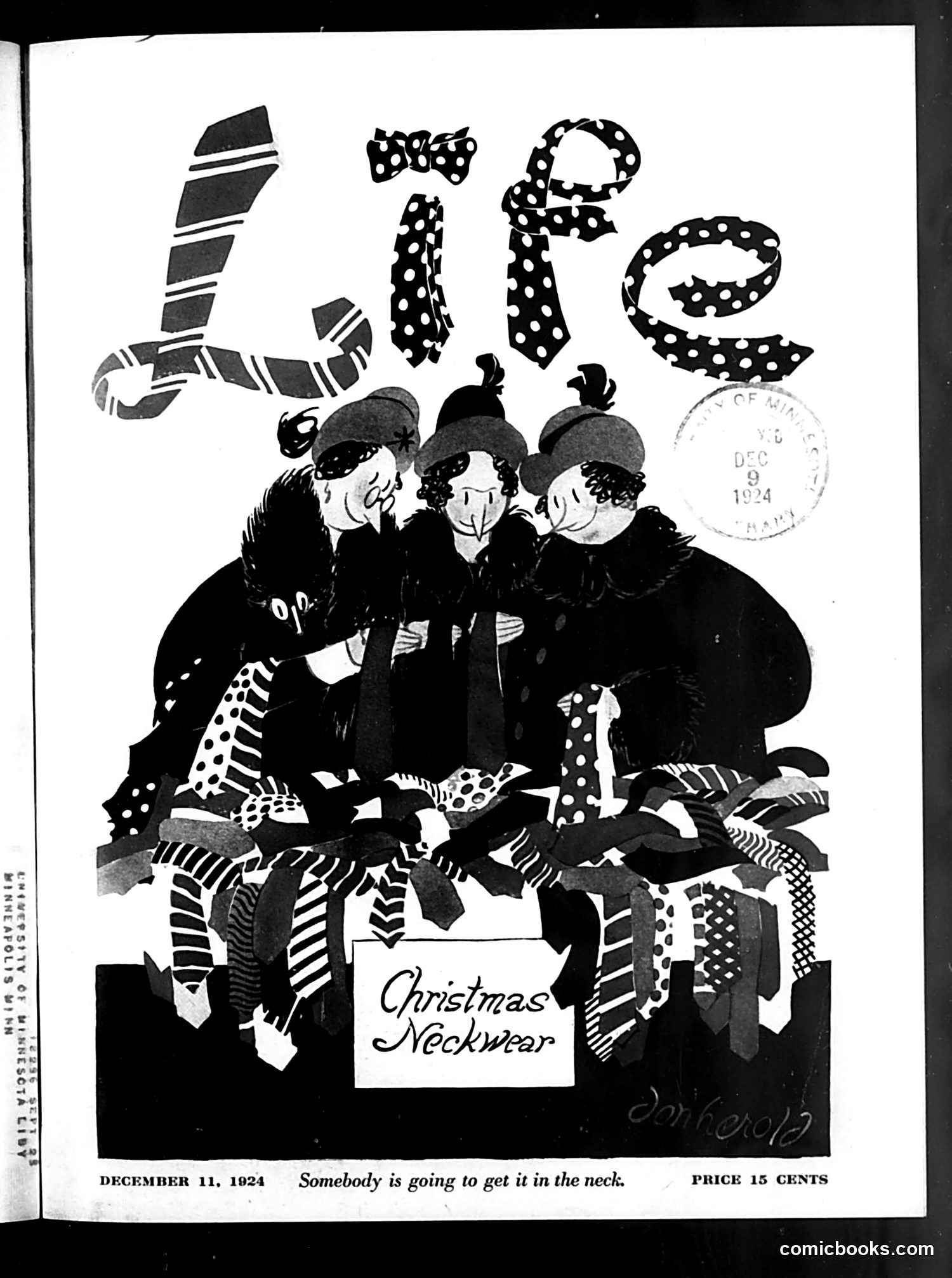
This is a Christmas neckwear advertisement disguised as satirical cartoon. Three caricatured figures wearing winter coats and hats sit surrounded by various patterned ties and neckties—striped, polka-dotted, and patterned designs. The large text "Life" above them and the caption "Somebody is going to get it in the neck" create a visual pun: the phrase means someone will face consequences, while the image literally shows neckwear as the "it." The three figures appear to represent generic holiday gift-givers or recipients. The advertisement promotes Christmas neckties as gifts, using humor to suggest that giving ties—presumably unfashionable or ill-chosen ones—is a dubious present. Price: 15 cents. The joke relies on the common complaint that neckties make disappointing gifts.
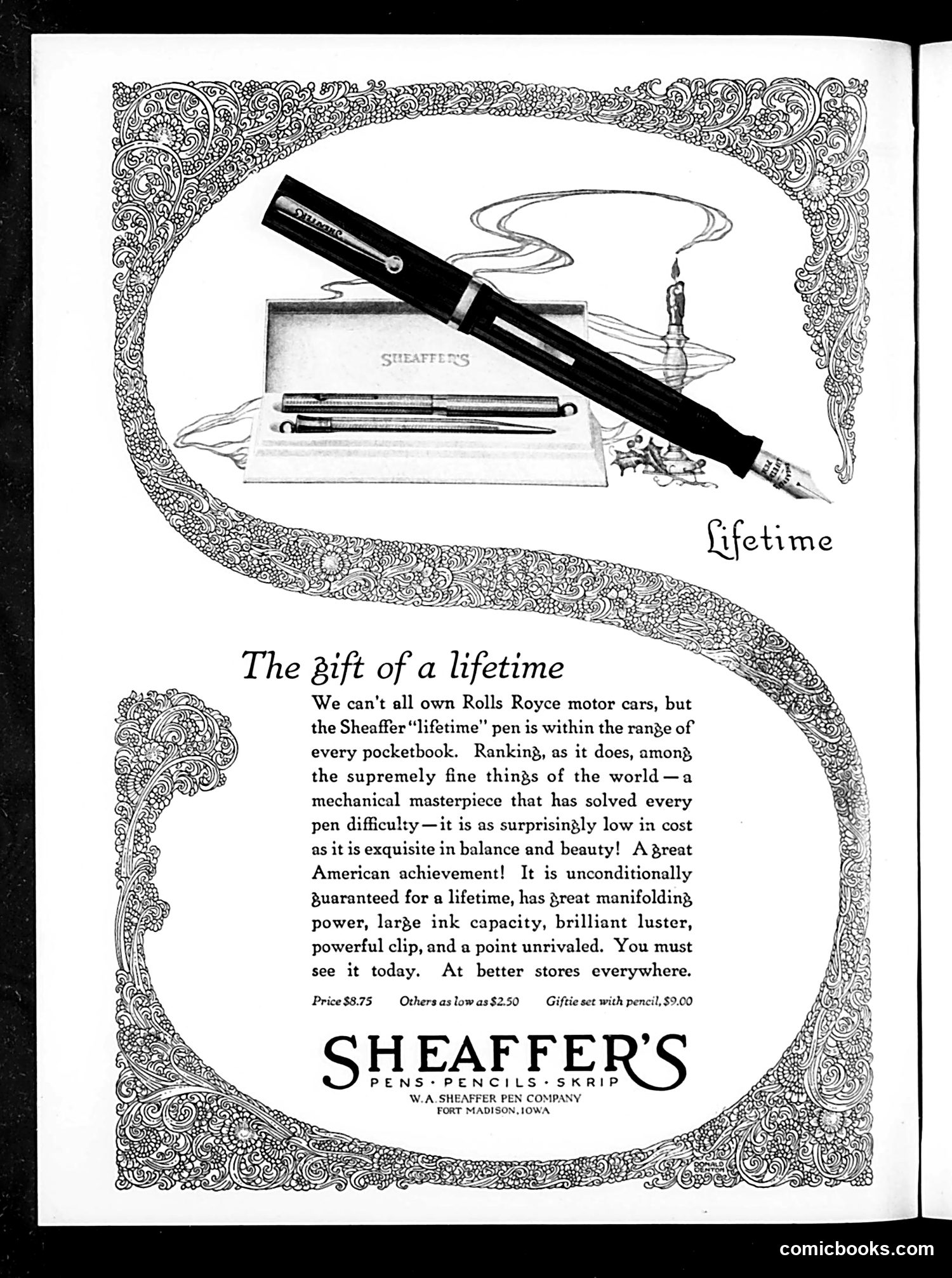
This is **not a political cartoon or satire**—it's a straightforward **product advertisement** for Sheaffer pens and pencils. The ad promotes the "lifetime" pen as an affordable luxury item, contrasting it with expensive goods like Rolls-Royce automobiles. The ornamental border and elegant presentation are typical design choices meant to convey quality and sophistication. Key selling points emphasized: lifetime guarantee, reliable mechanical function, large ink capacity, and "brilliant luster." The ad notes the pen costs $3.75 with cheaper options at $2.50, positioning it as accessible to middle-class consumers. This appears in *Life* magazine, which carried both satire and advertisements. There is no joke or political commentary here—just vintage marketing positioning a writing instrument as a durable, refined gift.
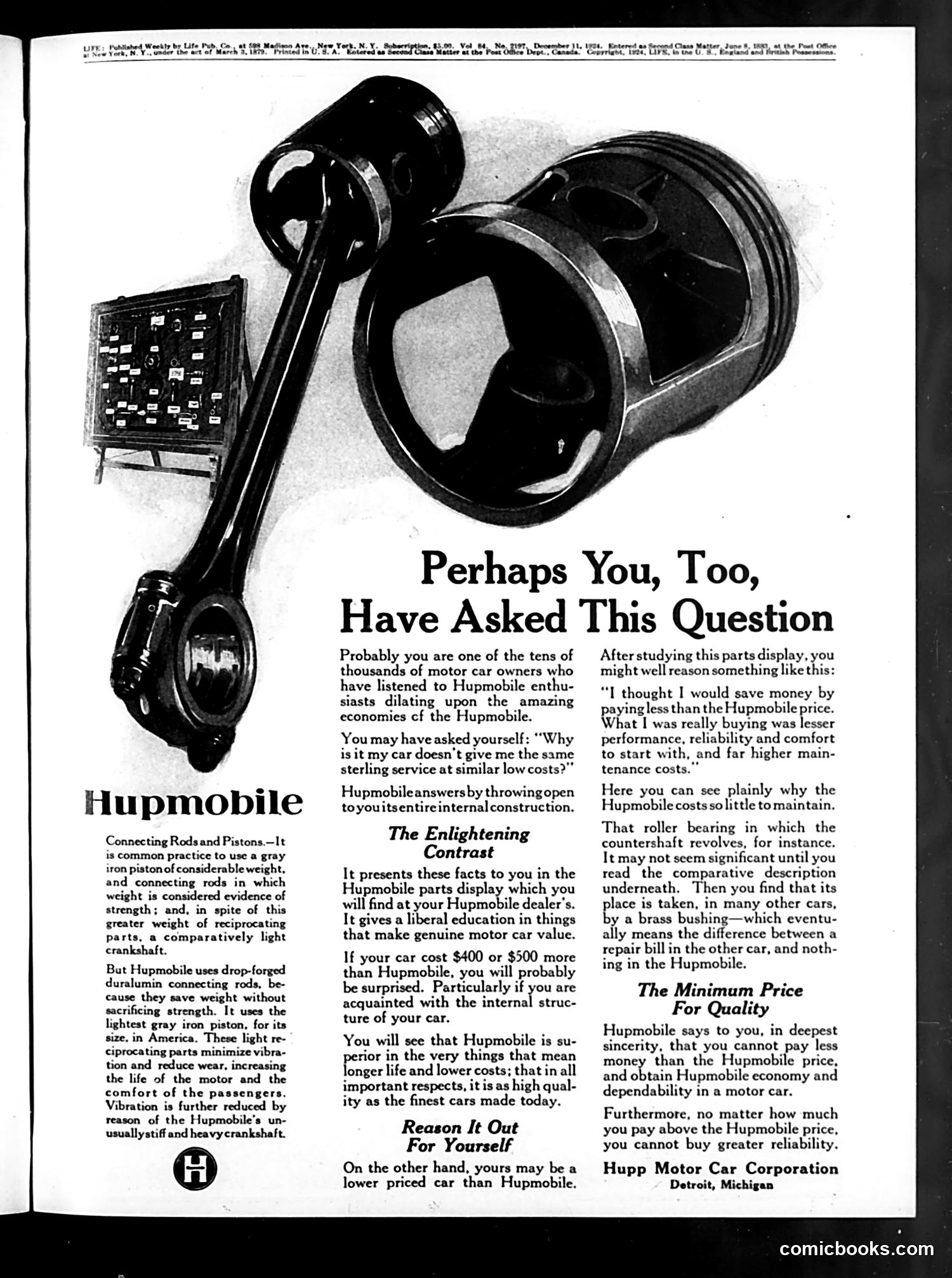
This is **not a political cartoon but a vintage advertisement** for Hupmobile automobiles, circa early 1900s. The image shows mechanical engine parts (connecting rods, pistons, and a roller bearing) displayed alongside the vehicle's components. The ad addresses a common consumer question: why pay more for a Hupmobile when cheaper cars exist? The "satire" is gentle marketing irony—acknowledging the price premium while arguing superior construction justifies it. The company emphasizes durable materials, lighter weight iron parts, and precise engineering as reasons their car offers better reliability and lower maintenance costs despite higher purchase price. This reflects early automotive industry marketing strategies emphasizing mechanical superiority and durability as value propositions to affluent buyers.
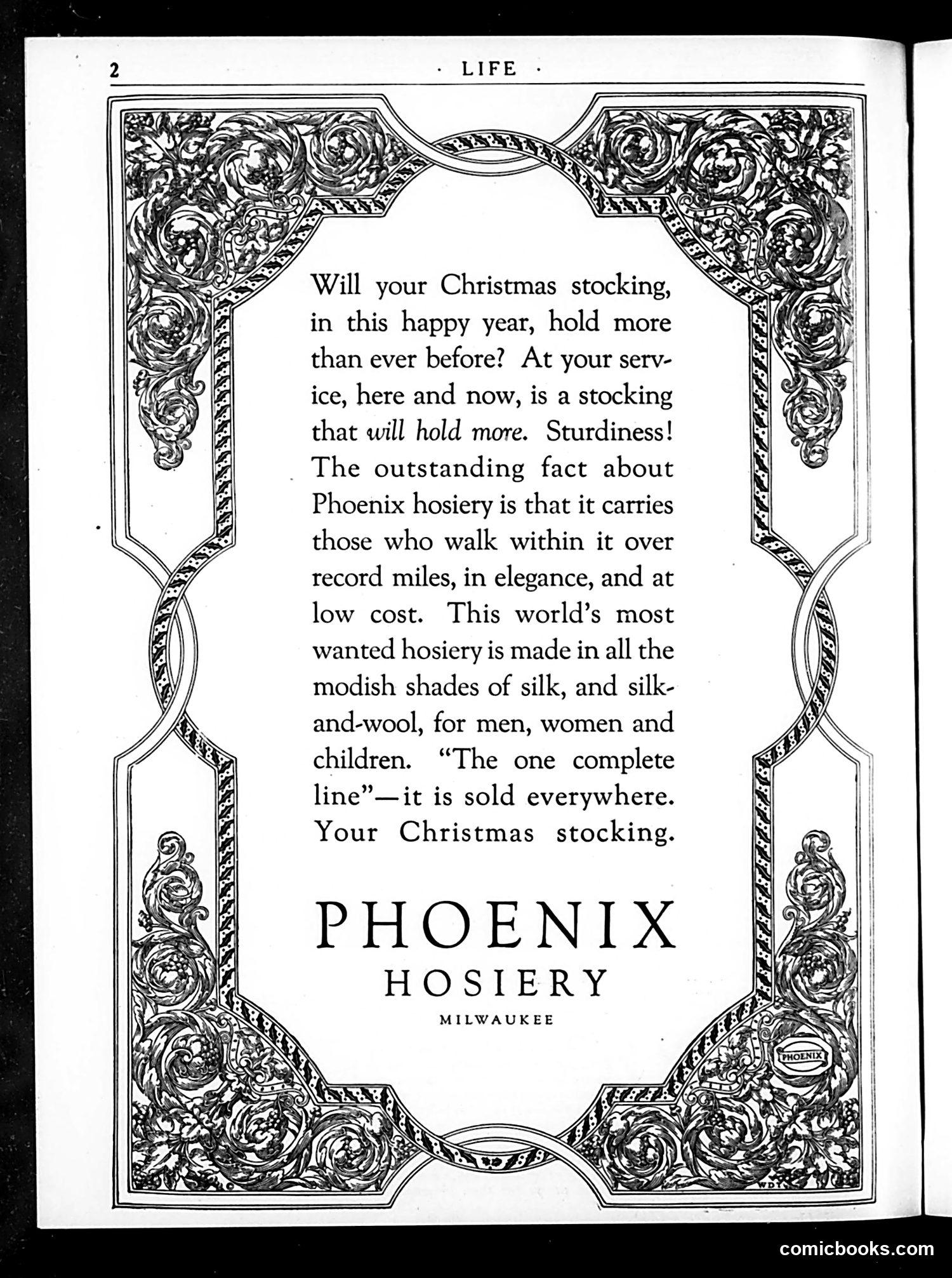
This page is **not a cartoon or satirical content**—it's a **full-page advertisement** for Phoenix Hosiery, a Milwaukee manufacturer. The ad uses ornate Art Nouveau-style decorative borders (typical of early 20th-century magazine design) to promote Christmas stockings as gifts. The copy emphasizes that Phoenix hosiery is durable ("will hold more"), available in fashionable materials (silk and silk-and-wool blends), affordable, and sold widely as "the one complete line." There is no political satire, no caricatures, and no social commentary here. *Life* magazine, while known for humor and satire, also carried paid advertisements to fund publication. This particular page represents that commercial side of the publication.
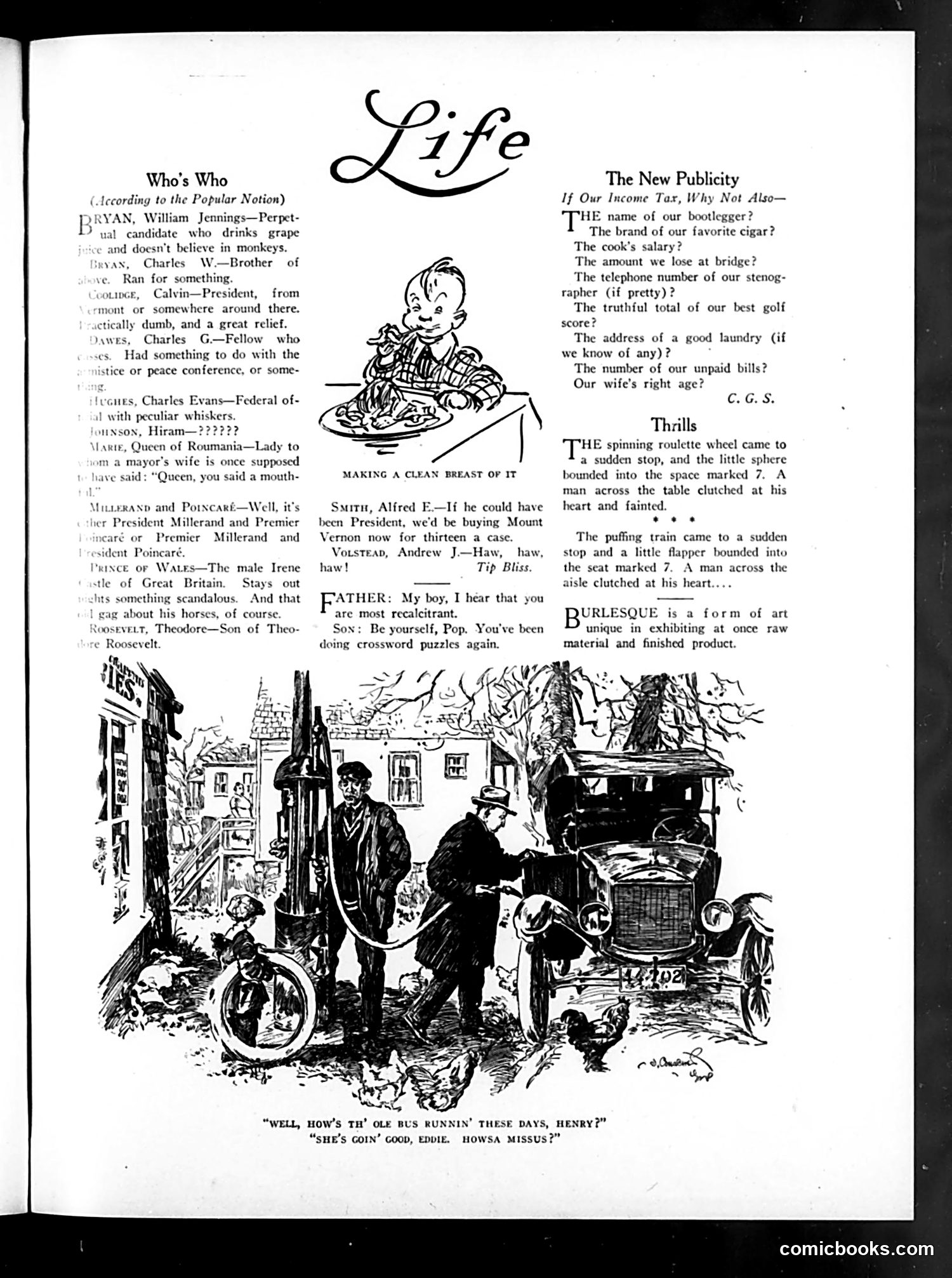
This satirical page contains several humor sections typical of early 20th-century Life magazine: **"Who's Who"** mocks prominent figures through unflattering descriptions—politicians like Bryan and Coolidge, royalty (Queen of Romania), and British nobility (Prince of Wales). **"The New Publicity"** jokes about modern income tax by listing mundane personal details now supposedly public knowledge—cigar brands, laundry addresses, golf scores. This reflects anxiety about government intrusion via the newly-enacted income tax. **"Thrills"** and **"Burlesque"** are brief comedic anecdotes about everyday incidents and art forms. The large illustration depicts early automobiles and pedestrians, captioned humorously about an old bus driver ("How's th' ole bus runnin' these days, Henry?"). This reflects the period's fascination and mild anxiety about emerging automobile technology and urban transportation.
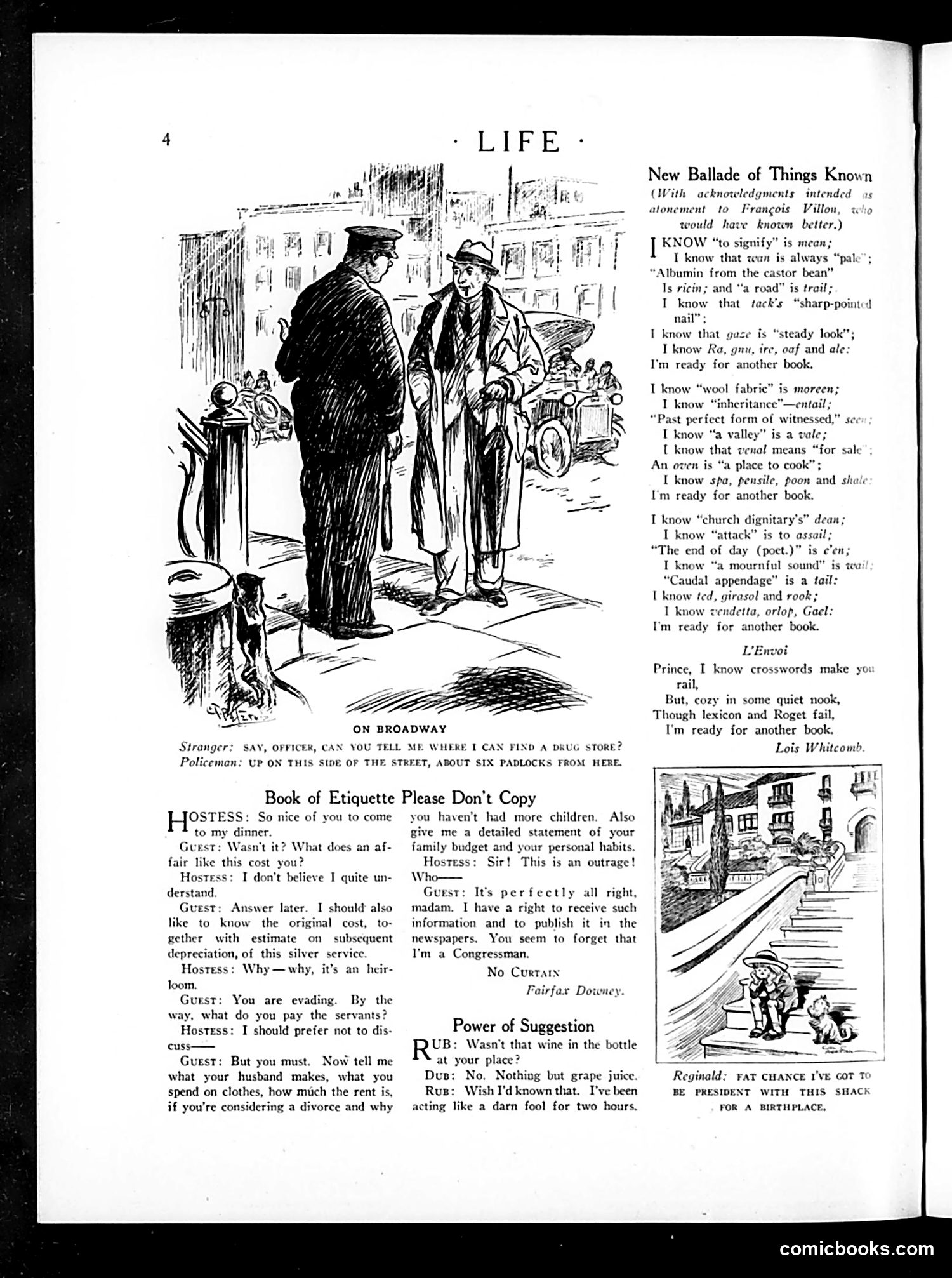
**Main Cartoon ("On Broadway"):** A stranger asks a policeman for a drug store location. The humor satirizes urban anonymity—a cop supposedly knows the neighborhood but must direct someone six blocks away to find a basic service. This reflects early 20th-century city congestion and the proliferation of chain drugstores. **"Book of Etiquette Please Don't Copy":** A guest interrogates a hostess about her silver service's cost, depreciation, and family finances, then demands her husband's income details—claiming Congressional privilege. The satire mocks aggressive nouveau riche behavior and entitled politicians who abuse their status. **"Power of Suggestion":** A drunk mistakes grape juice for wine, illustrating how expectation shapes perception—likely referencing Prohibition-era deception about beverages.
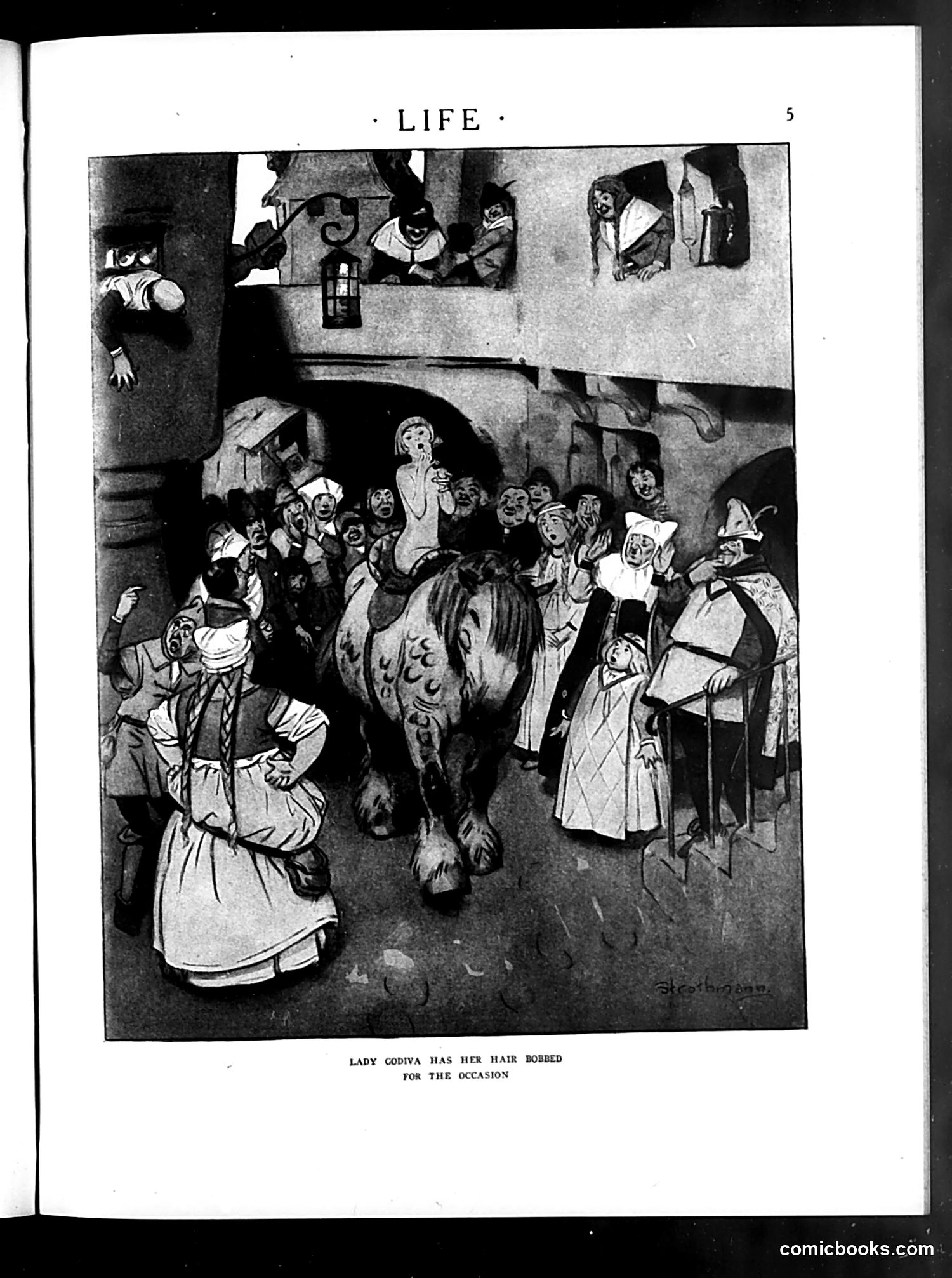
This is a satirical illustration from *Life* magazine showing "Lady Godiva" having her hair bobbed for an occasion. The cartoon depicts a medieval legend—the noblewoman who rode naked through town—reimagined in a modern context with 1920s-style bobbed hair. The satire targets the "bobbed hair" trend of the 1920s, a controversial women's fashion statement symbolizing modernity and liberation from Victorian norms. By connecting this contemporary hairstyle to the historical Lady Godiva (famous for her dramatic, rule-breaking gesture), the cartoon suggests that bobbing one's hair is similarly shocking and transgressive to early 20th-century sensibilities. The crowd's reaction reflects the public controversy surrounding women's fashion choices during this era.
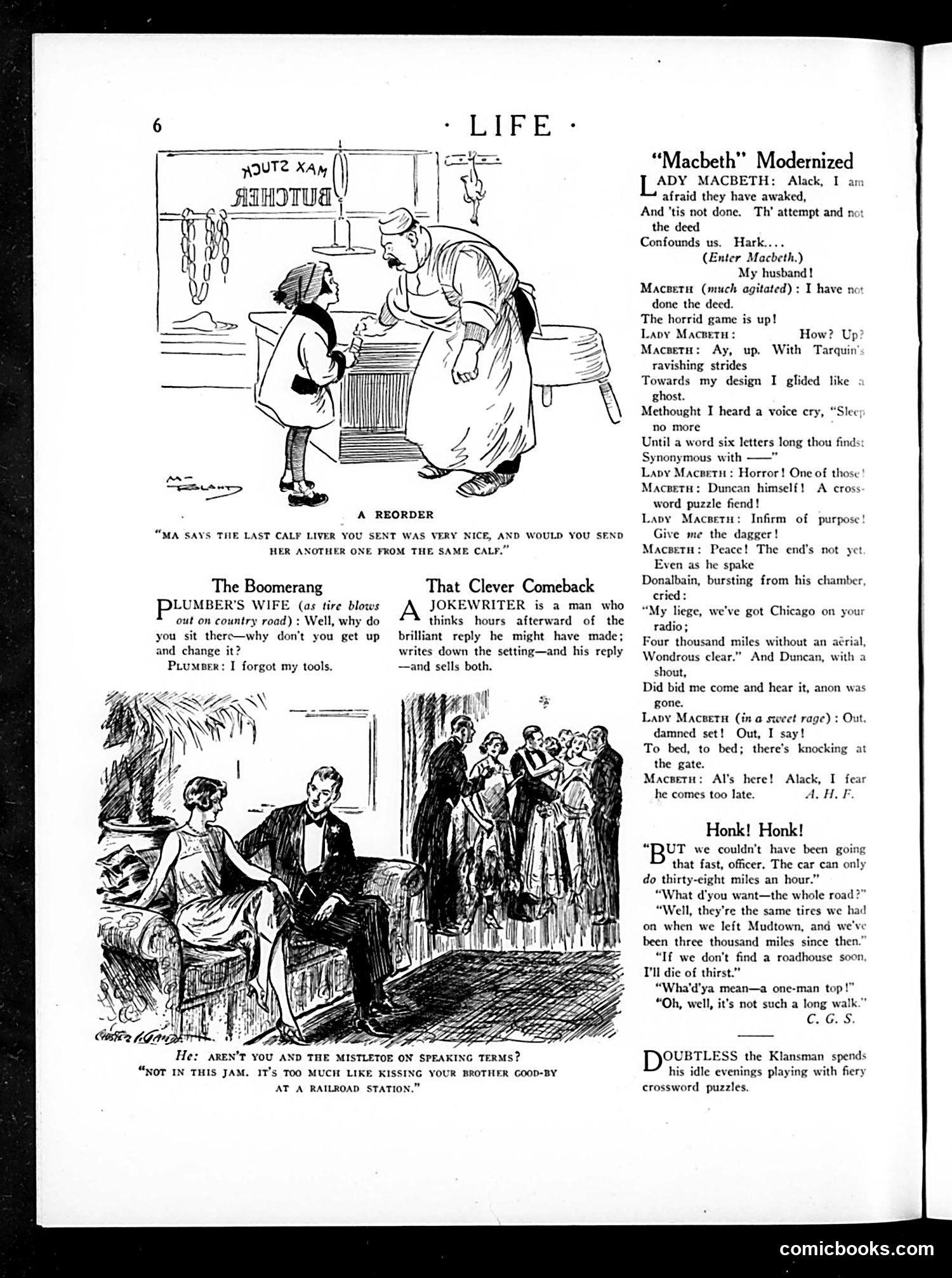
This page contains three satirical pieces from early 20th-century Life magazine: 1. **"A Reorder"** (top): A butcher's wife asks her husband to resend a calf liver, praising the previous one—a domestic humor piece about household complaints. 2. **"The Boomerang"** (left): A plumber's wife complains he never comes home, suggesting he avoid forgetting his tools. The cartoon shows a couple, likely depicting marital friction over work habits—common satirical subject matter. 3. **"That Clever Comeback"** (right): Features "Macbeth Modernized," a comedic adaptation of Shakespeare's tragedy set in contemporary times, with characters discussing crossword puzzles and radio—satire mocking both modernization and literary adaptation trends. The page reflects early 20th-century middle-class domestic humor and parody of highbrow literature for comic effect.
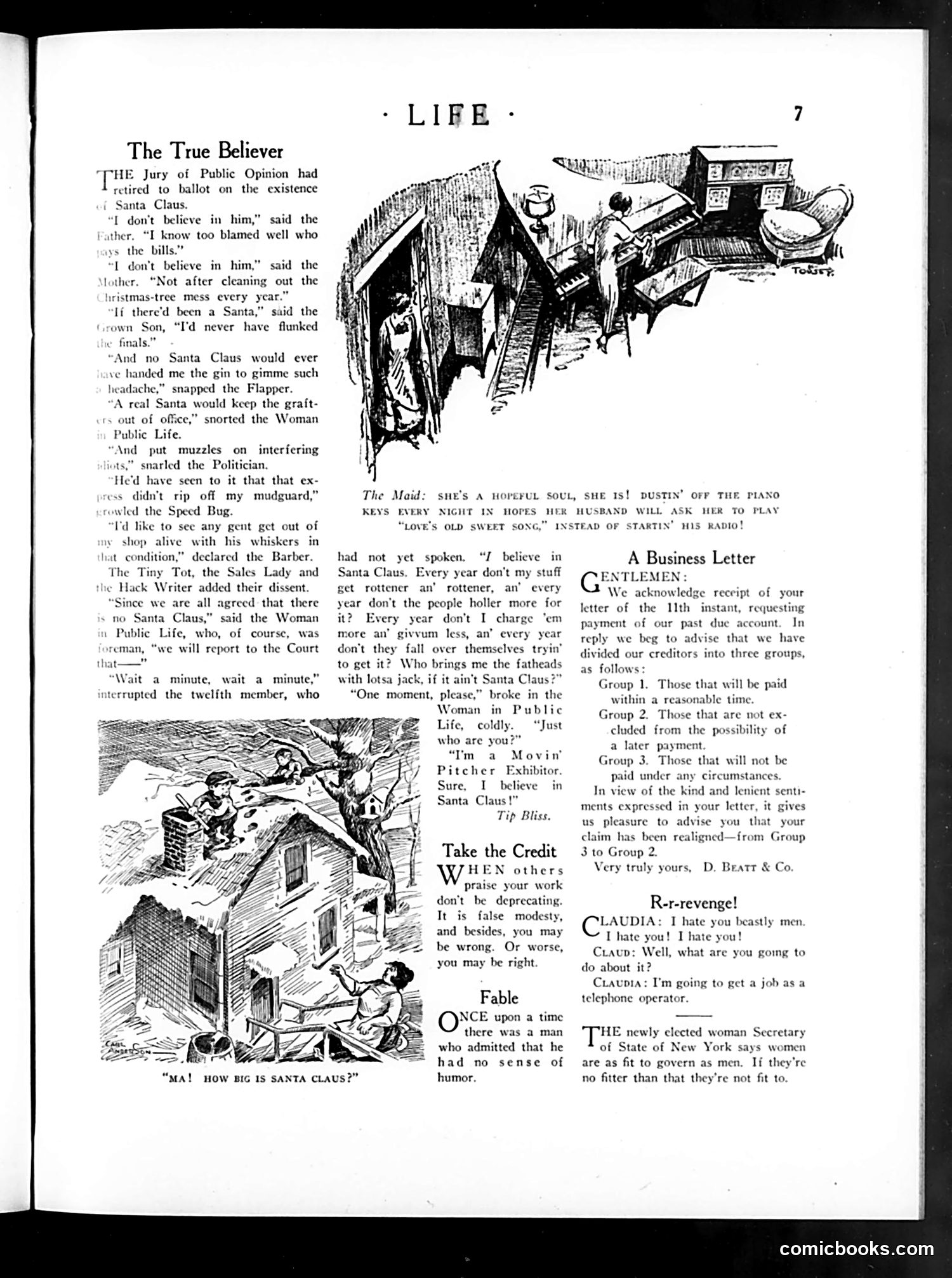
This page satirizes a jury debate about whether Santa Claus exists. Various characters argue their positions: a Father blames bills for disbelief, a Mother criticizes messy Christmas cleanup, a Politician wants muzzles on "interfering" elements, and a Barber, Hack Writer, and others contribute cynical takes. The central cartoon shows a woman at a piano—captioned as hopefully playing "Love's Old Sweet Song" instead of starting her husband's radio—a domestic joke about competing entertainments. Below, "Ma! How Big Is Santa Claus?" depicts a child asking about Santa's size, likely illustrating childhood innocence versus adult skepticism. The satire mocks adults' loss of Christmas wonder through cynicism, bills, and modern distractions.
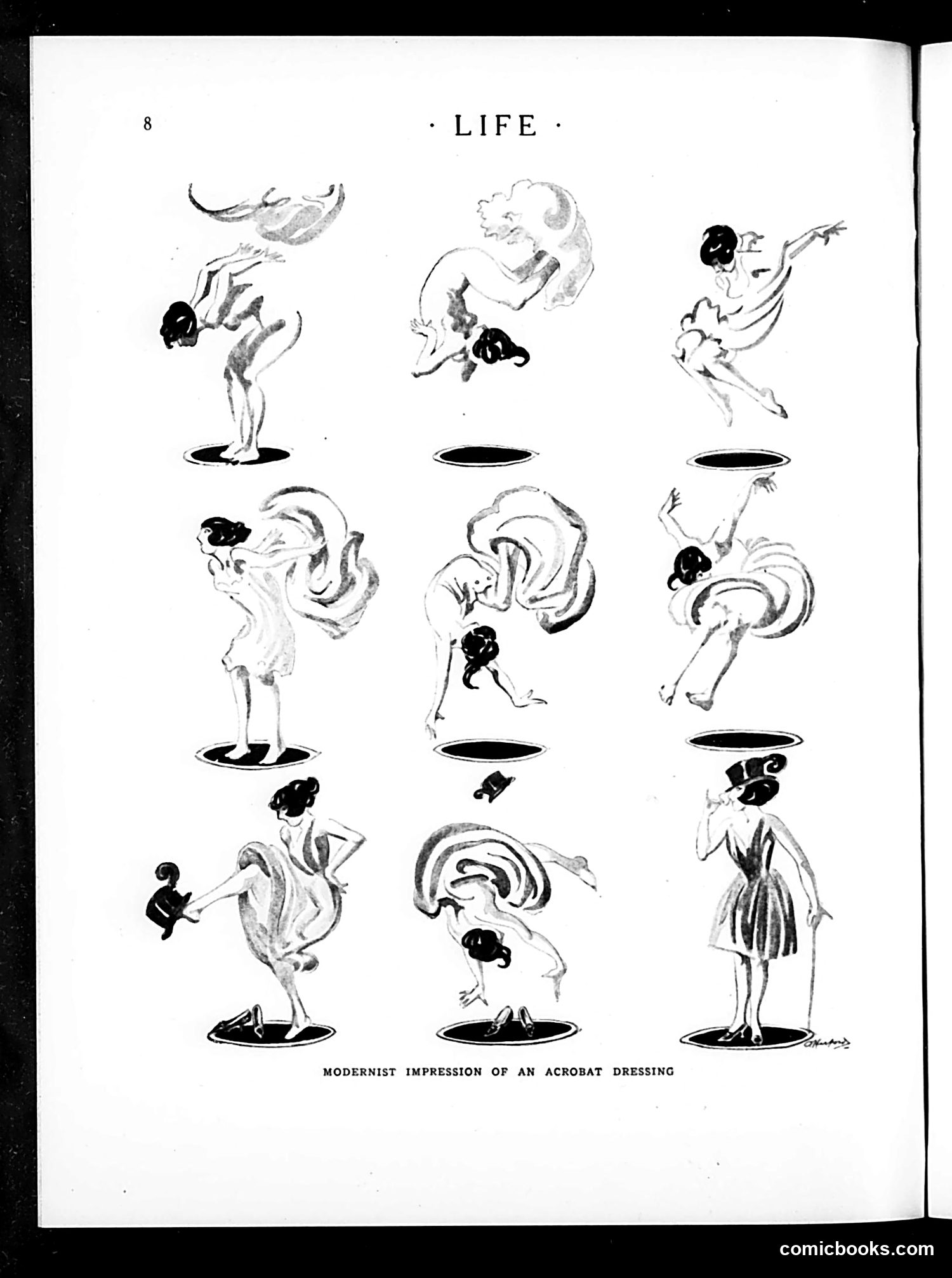
This satirical cartoon mocks modernist art through a sequence showing a female acrobat getting dressed. The nine panels progress from nude to fully clothed, with her body contorted in increasingly abstract poses. The satire targets the modernist art movement's abstraction and distortion of the human form. By depicting ordinary dressing as a series of deliberately awkward, contorted positions—mirroring cubist and futurist artistic styles—the cartoonist suggests that modernist art is simply exaggerated nonsense, no more meaningful than an acrobat's physical contortions. The "modernist impression" framing implies that modernist artists artificially complicate simple subjects through distortion and abstraction, creating art that is unintelligible rather than insightful. This reflects early 20th-century conservative skepticism toward avant-garde movements.
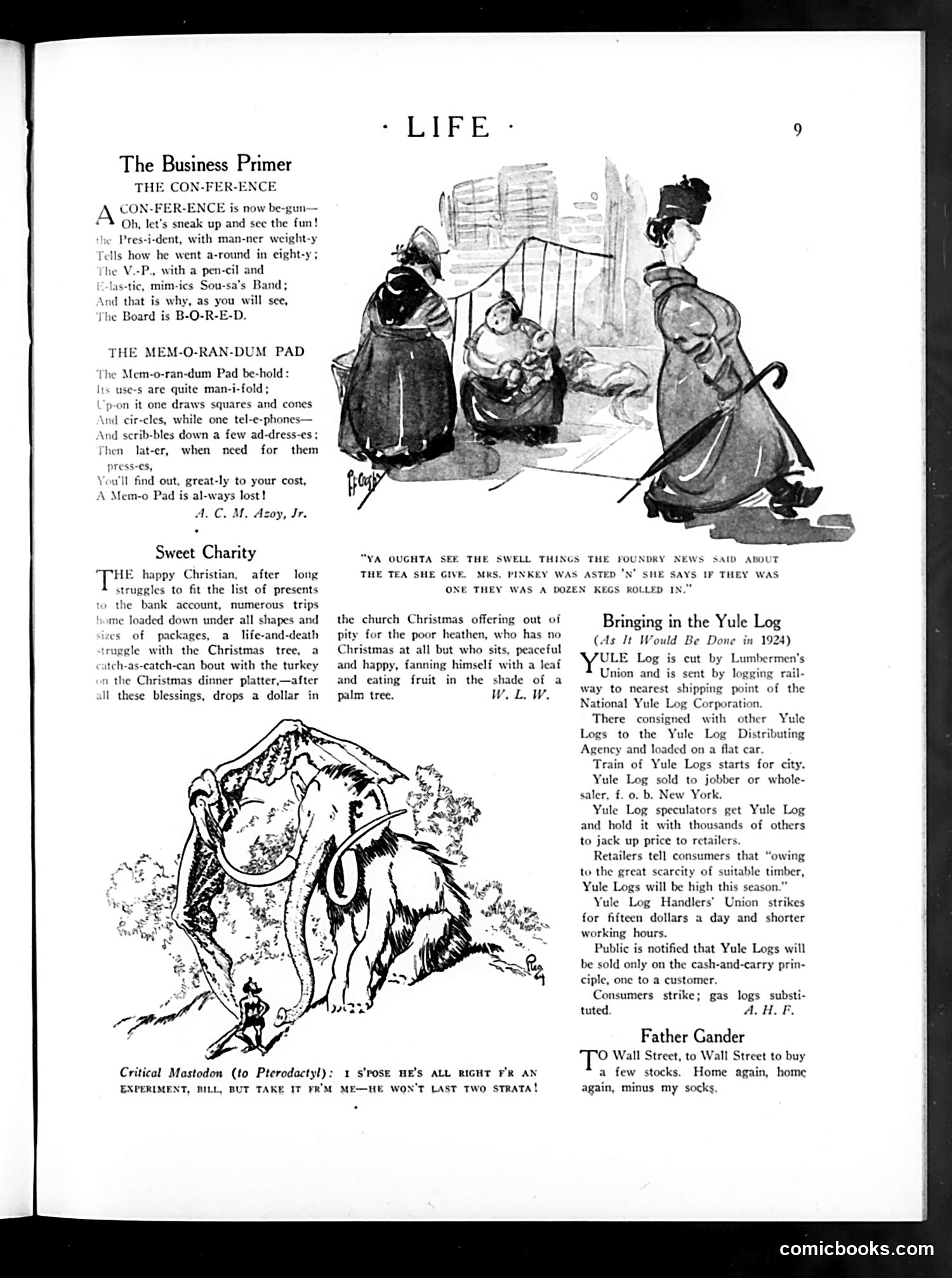
This page contains three satirical pieces about early 20th-century business and social customs: **"The Business Primer"** mocks corporate jargon through nonsense rhymes about a "CON-FER-ENCE" and board meetings, satirizing how business-speak obscures simple activities. **"The Mem-o-ran-dum Pad"** jokes about office inefficiency—these pads supposedly collect notes and phone numbers, then get lost, causing financial damage. The satire targets how poor office organization wastes time and money. **"Sweet Charity"** depicts Christmas gift-giving awkwardness, illustrating how someone frantically assembles mismatched presents for church charity. The accompanying mastodon cartoon suggests absurd, impractical gift choices. **"Bringing in the Yule Log"** describes holiday log distribution as a unionized, commercialized enterprise with strikes and price speculation—satirizing how even traditions become profit-driven enterprises. These pieces mock Victorian-era business culture, office inefficiency, and commercialized charity.
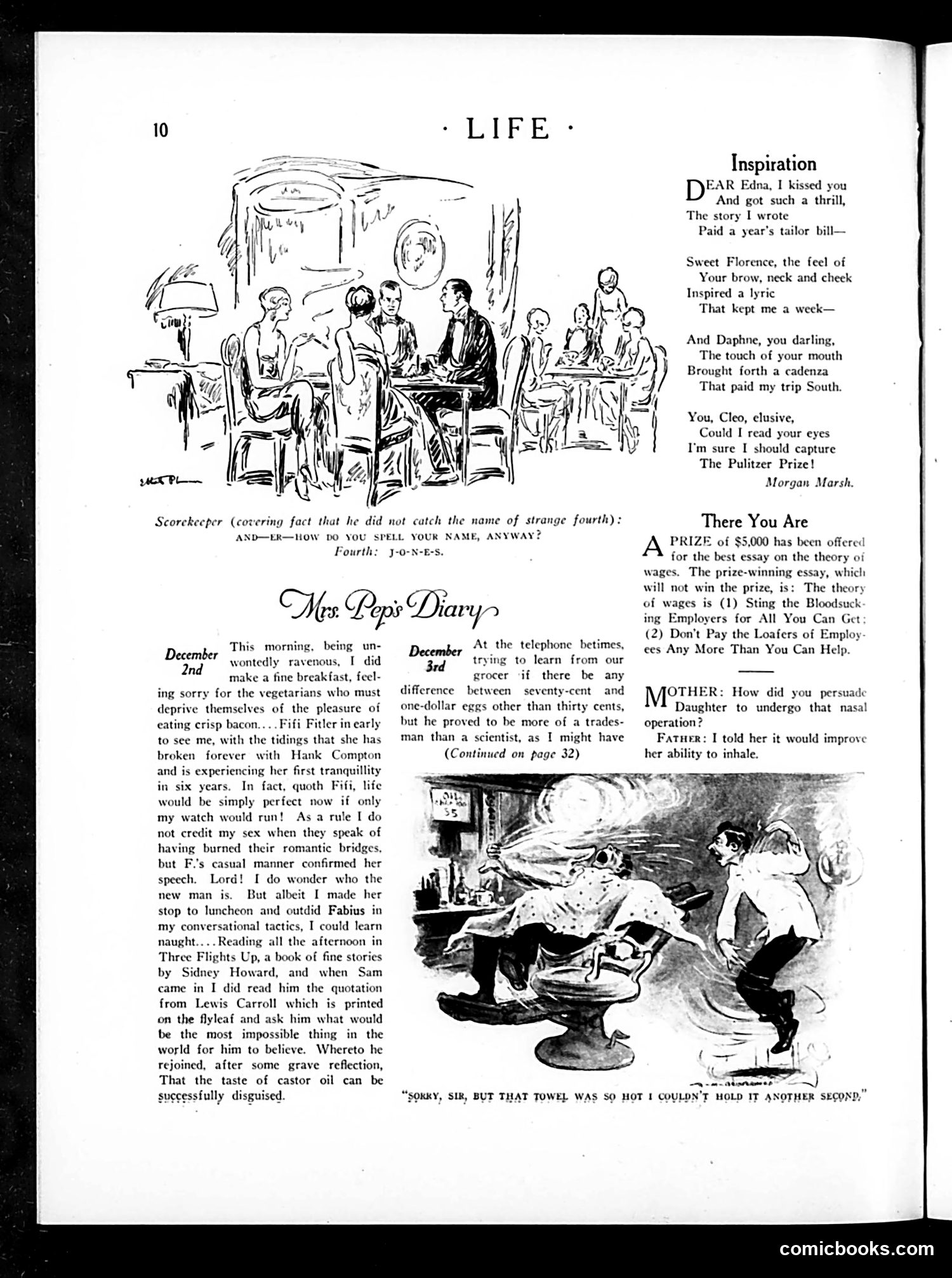
**Top Cartoon:** A scorekeeper at what appears to be a social gathering struggles to spell a guest's name ("Fourth: J-O-N-E-S"). The satire mocks the pretentiousness of high society—the joke is that even simple names become incomprehensible in formal settings where people affect exaggerated manners. **"Mrs. Pep's Diary" Section:** A domestic humor column where the narrator describes trying castor oil to improve her daughter's nasal capacity, following her husband's suggestion. The satire ridicules both quack health remedies and the naive acceptance of dubious medical advice within families. **"There You Are" Contest:** Announces a $5,000 essay prize on wage theory, with the ironic caveat that the best essay won't actually win—satirizing intellectual pretense and contradictory institutional logic.
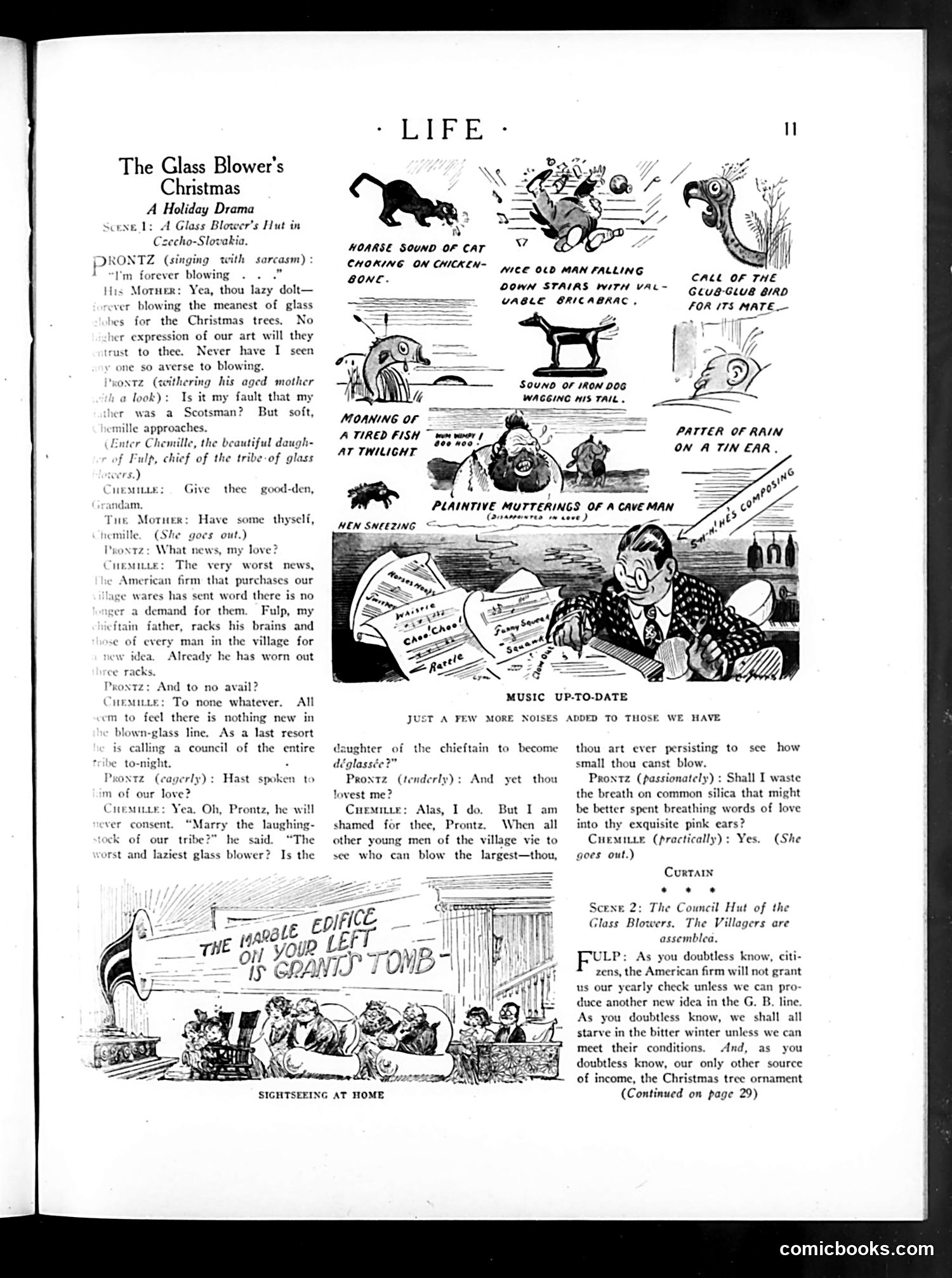
This page presents a holiday drama about a glass-blower who wants to create something meaningful for Christmas rather than pursue commercial success. The satirical elements mock both: 1. **American commercialism**: The dialogue critiques how villages exploit their craftspeople and demand profitable innovations ("Christmas tree ornament") rather than supporting authentic artistry. 2. **Industrial pressure**: Characters debate whether the craftsman should waste talent on "common silica" when he could create "exquisite" work, highlighting tensions between artistic integrity and market demands. The illustrated sound-effects panel ("Hoarse sound of cat choking on chicken-bone," "Moaning of tired fish at twilight") appears satirical commentary on overly sentimental or absurdist modern entertainment, mocking contemporary taste in humor and advertising. The overall message critiques how capitalism pressures artisans to commercialize rather than pursue genuine creative expression.
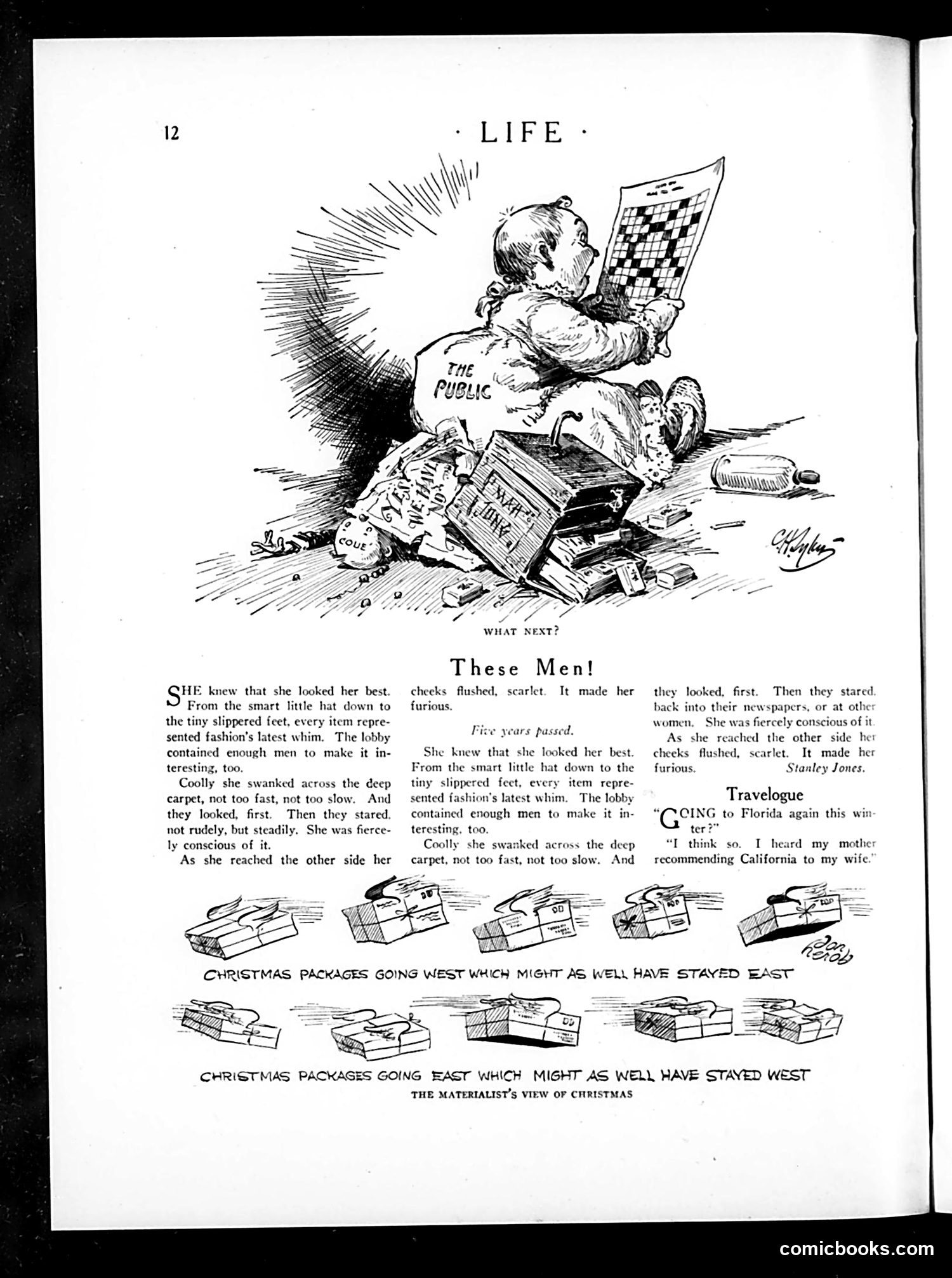
The top cartoon depicts a figure labeled "THE PUBLIC" being manipulated like a puppet, holding a crossword puzzle while surrounded by scattered items and books. The artist suggests the public is distracted by trivial entertainments (crosswords, fashion, gossip) while serious matters go unnoticed—a critique of public apathy or media manipulation. Below, "The Materialist's View of Christmas" mocks consumerism by showing packages traveling east and west, with the caption implying Christmas gifts are merely commodities in transit rather than meaningful expressions. The satire suggests society has reduced the holiday to commercial materialism. The accompanying text stories ("These Men!" and "Travelogue") appear to be social commentary features, though their specific content is partially obscured.
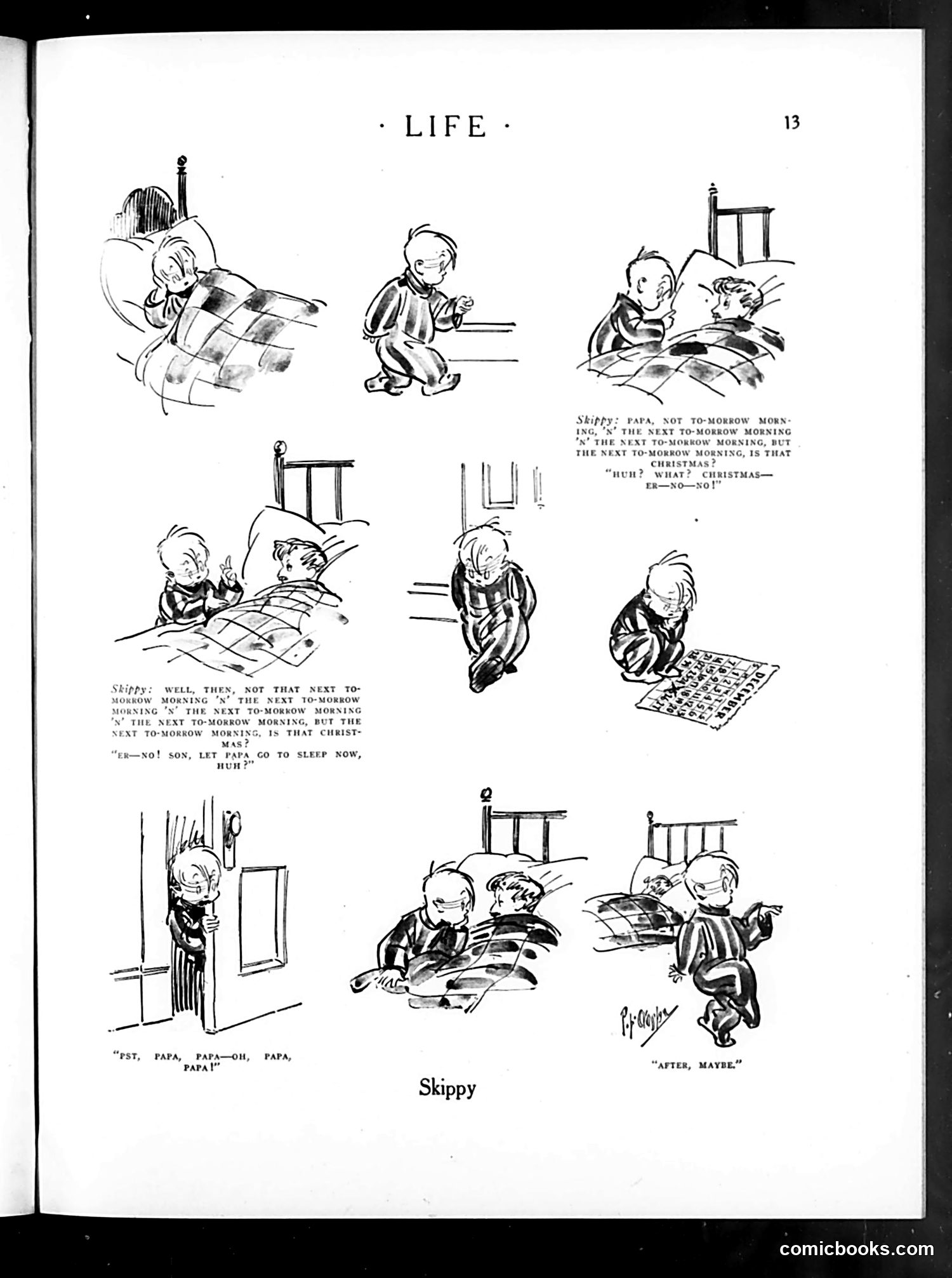
This is a comic strip titled "Skippy" depicting a young boy's persistent questioning about Christmas. The humor centers on a child's relentless logic: Skippy argues that since Christmas occurs "the next to-morrow morning," and tomorrow will eventually become "the next to-morrow morning," every day technically qualifies as Christmas. His father, exasperated, finally tells him to sleep. The satire gently mocks childhood reasoning and parental exhaustion. The strip captures universal family dynamics—a clever child using circular logic to pester his father about a beloved holiday, while the adult simply wants peace and quiet. The joke requires no specific historical or political knowledge, relying instead on timeless generational humor about children's persistence and adult fatigue.
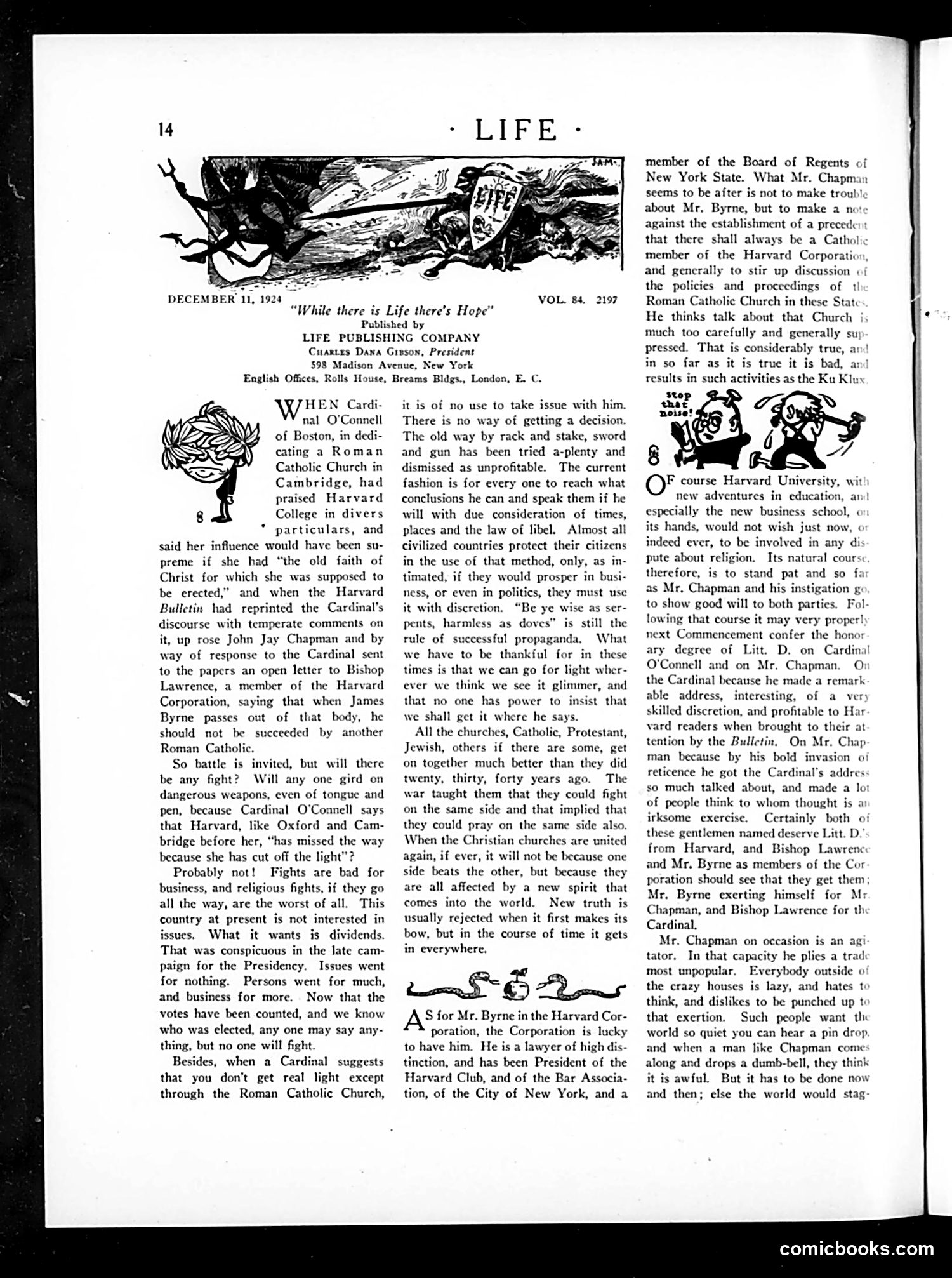
This page discusses a controversy involving Cardinal O'Connell of Boston, who publicly criticized Harvard University and James Byrne, a Harvard Corporation member. The small illustrated figures (labeled with numbers 8 and 9) appear to be caricatures of the disputants, though their specific identities aren't entirely clear from the image alone. The satire concerns O'Connell's attempt to influence Harvard's policies regarding Catholic Church representation. The text argues that while the Cardinal's concerns may have merit, his public attacks were counterproductive. The cartoon mocks the ecclesiastical interference in university governance—a recurring tension between Catholic leadership and secular academic institutions in 1920s America. The overall tone suggests the author finds the Cardinal's approach heavy-handed and self-defeating.
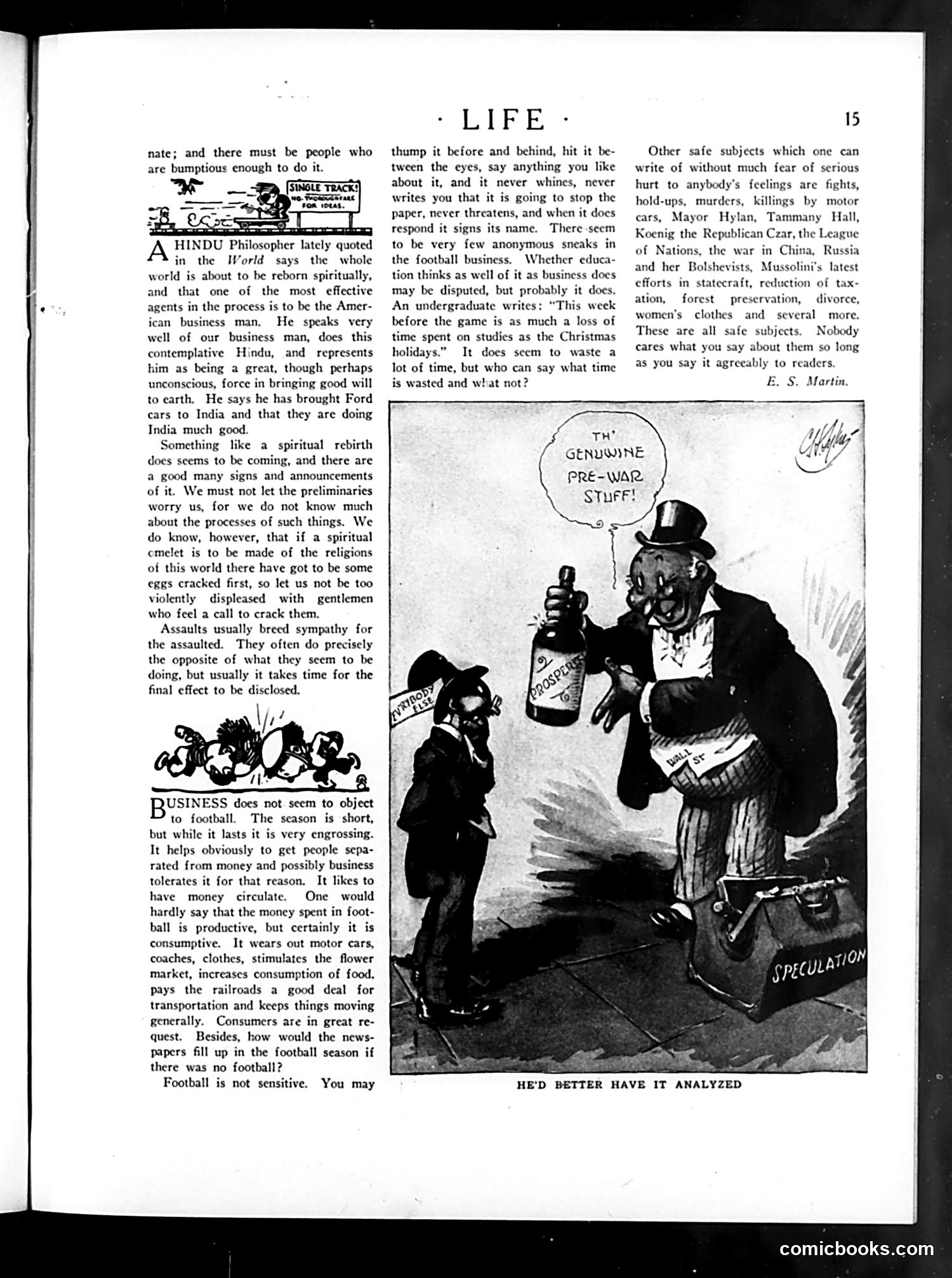
The main cartoon titled "He'd Better Have It Analyzed" depicts a caricatured figure (appearing to represent a profiteer or speculator) hawking bottles labeled "Pre-War Stuff" and "Speculation" to customers. The satire targets post-World War I economic opportunism—individuals selling allegedly "genuine pre-war" goods at inflated prices to consumers nostalgic for pre-war quality and stability. The accompanying text discusses business, football, and anonymity in print. The cartoon's message: wartime speculators and profiteers exploited public sentiment by marketing inferior or fraudulent "pre-war" products, claiming authentic quality. The joke suggests such claims deserved skeptical analysis before purchase—a commentary on consumer vulnerability and unscrupulous marketing during economic readjustment after WWI.
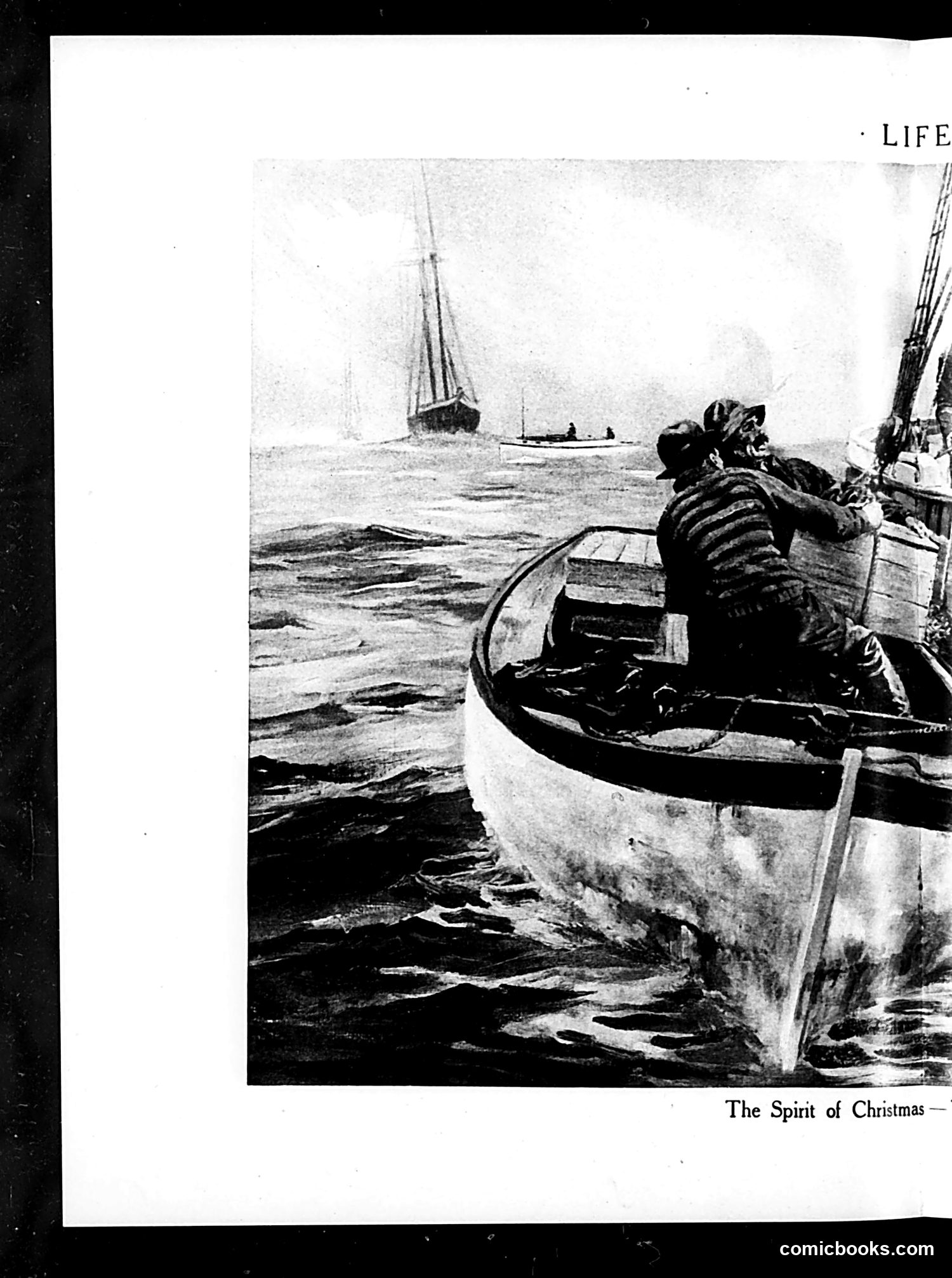
This Life magazine page presents a maritime scene captioned "The Spirit of Christmas." The image shows a small rowboat in the foreground with a bundled figure, positioned near larger sailing vessels on open water. The photograph appears to be making a thematic or emotional point about Christmas through maritime imagery—possibly contrasting human vulnerability or hardship against the vastness of the sea, or illustrating charity and rescue during the holiday season. Without additional context about the publication date or surrounding articles, the specific satirical or political reference remains unclear. The image may be sentimental rather than satirical, depicting the "spirit" of Christmas through a dramatic or poignant maritime moment. The composition emphasizes isolation and scale in a way meant to evoke emotional resonance with holiday themes.
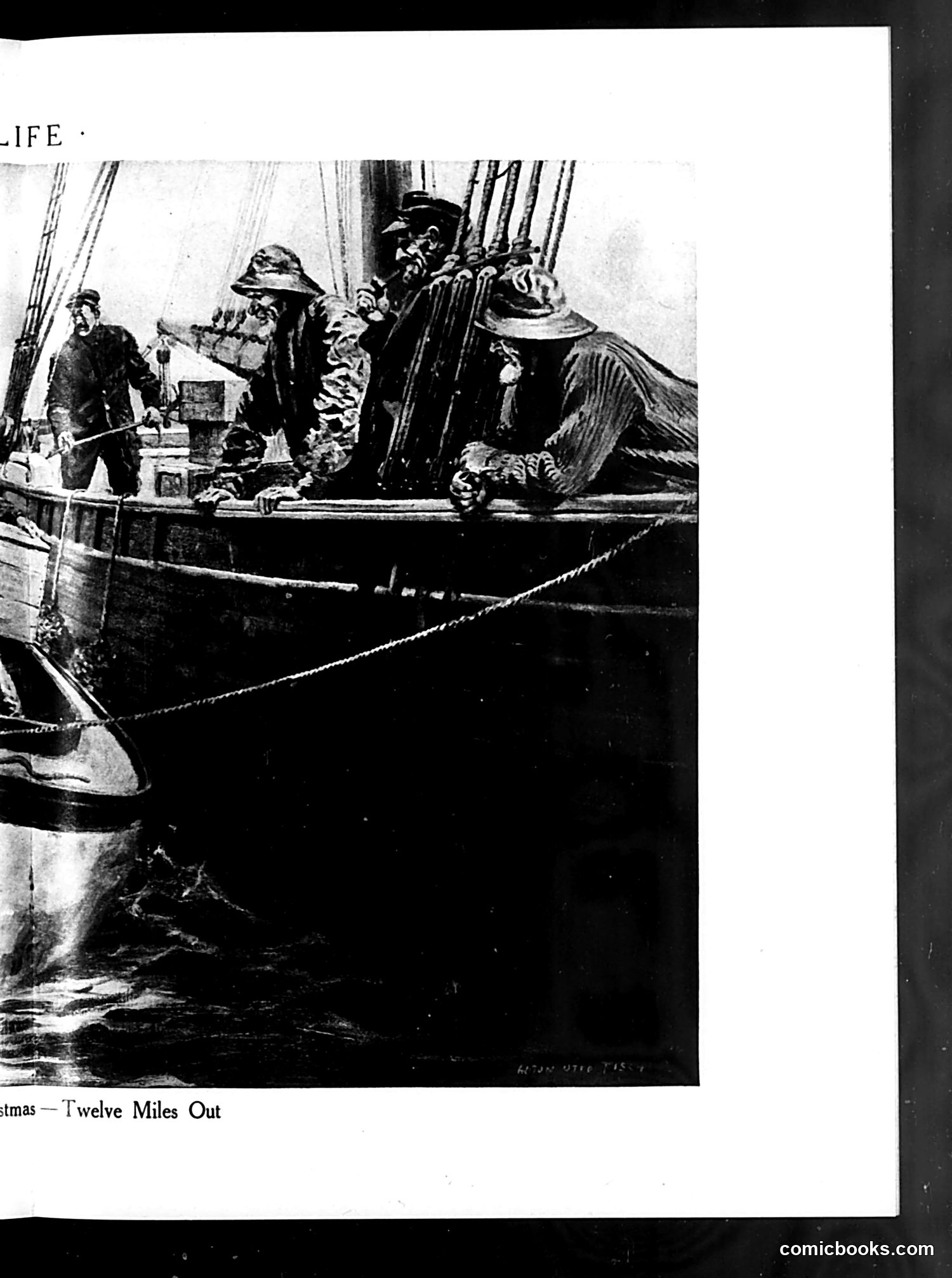
This appears to be a satirical illustration depicting a maritime scene during the Christmas season. The image shows several figures aboard what looks like a boat or ship, with sailors and possibly wealthy passengers in period dress (early 20th century based on the clothing and artistic style). The caption "Twelve Miles Out" likely references the twelve-mile limit of U.S. territorial waters—a crucial detail during Prohibition era (1920-1933), when alcohol was banned domestically but legal beyond that boundary. The satire likely mocks wealthy Americans who would travel offshore specifically to drink alcohol illegally during the Christmas holidays, evading federal law while celebrating. The contrast between formal holiday attire and the illicit nature of the voyage creates the satirical point.
This page reviews two contemporary Broadway productions built on the same plot: a love triangle involving an older husband, younger wife, and virile young man. **Eugene O'Neill's "Desire Under the Elms"** is praised for its opening half—its atmospheric New England farm setting and dialect work—but criticized for descending into unintentional comedy. The reviewer mocks O'Neill's escalating melodrama, comparing him to Thomas Hardy: when characters resort to extreme actions (threatening to "turn all the cows loose"), the tragedy becomes absurd rather than moving. **Sidney Howard's "They Knew What They Wanted"** handles the identical material more successfully by embracing comedy, with Pauline Lord delivering an "perfect performance" and Glenn Anders providing strong supporting work. The satire targets O'Neill's theatrical excess—his overuse of "significant situations" and dramatic clichés (ending with orchestral "Funeral March")—suggesting serious drama can fail when it becomes too self-consciously tragic and loses touch with human reality.
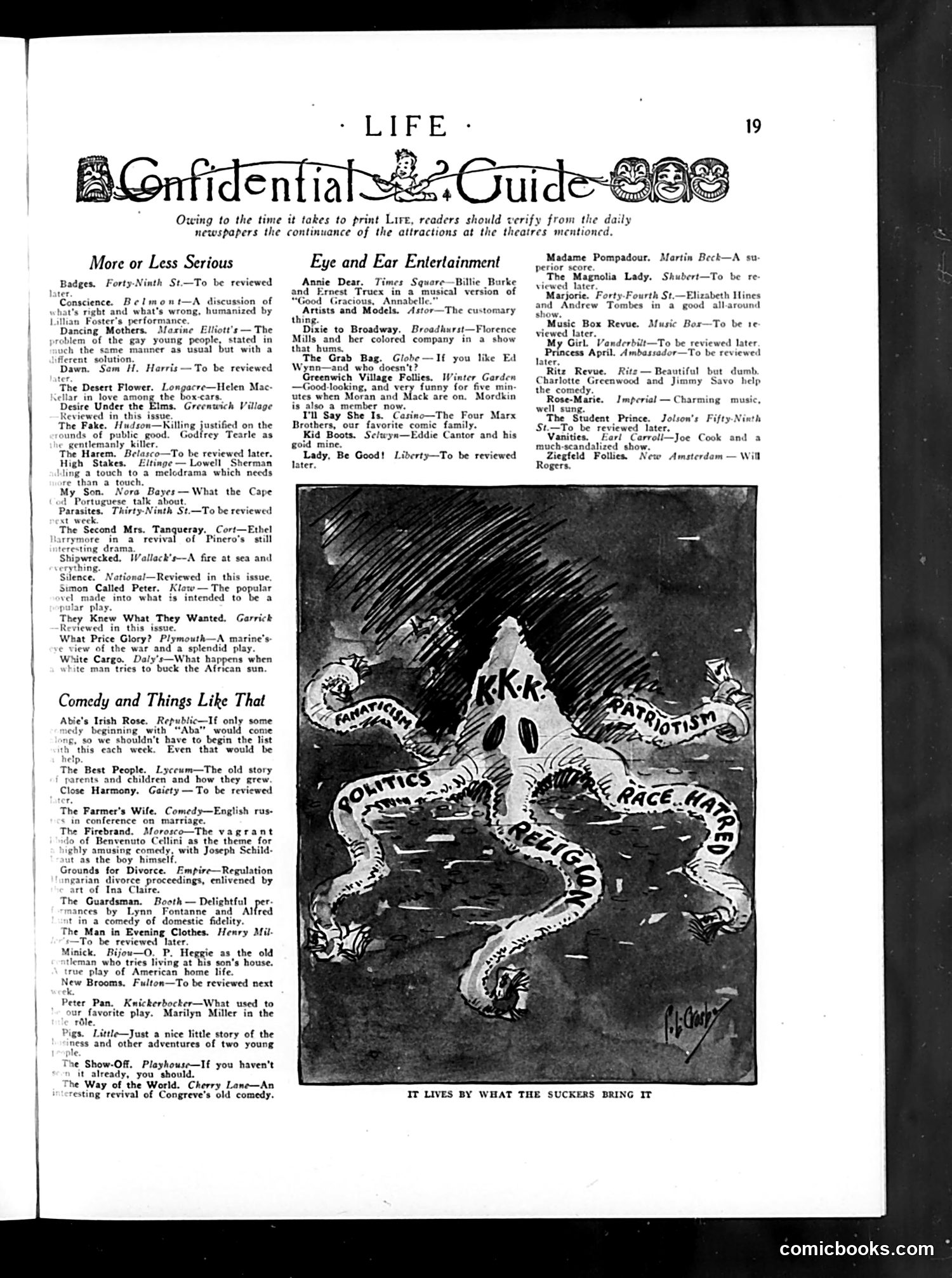
This political cartoon depicts a grotesque creature labeled with social ills—"POLITICS," "RACE HATRED," "PROFITEERING," and "K.K.K."—being fed by what appear to be various malevolent forces or influences. The creature itself seems to represent corruption or societal decay that thrives on these negative inputs. The cartoon is satirizing how destructive social forces are sustained and strengthened by public participation or tolerance. The title suggests the beast survives because people ("suckers") enable it through their actions or apathy. Given the Life magazine context of the 1920s and the explicit mention of the KKK, this appears to be social commentary warning against allowing intolerance, racial hatred, and political corruption to flourish unchecked. The cartoonist (signature appears present) is making a pointed critique of American society's complicity in perpetuating these systemic problems.
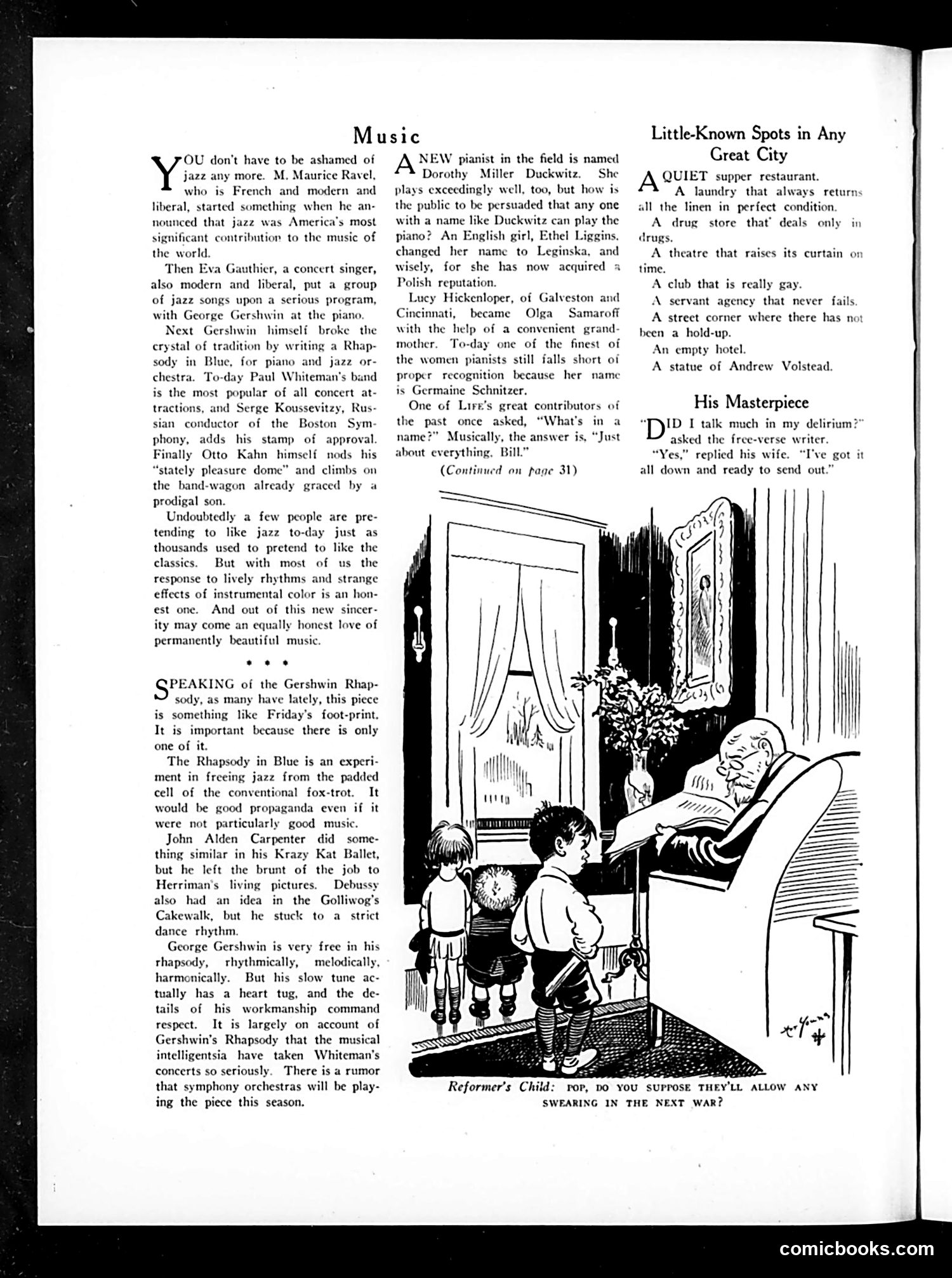
This page contains two distinct sections: a music essay and satirical commentary. **The Music Essay** discusses jazz's newfound respectability in American high culture. It celebrates that composers like George Gershwin and conductors like Serge Koussevitsky have legitimized jazz—once dismissed—as serious art. The essay notes the irony that some people pretend to like jazz just as others once pretended to like classical music. **The Cartoon** depicts a father figure (likely representing a Prohibitionist reformer, given the reference to "Andrew Volstead"—architect of Prohibition) reclining while his child asks whether swearing will be permitted in the next war. The humor is dark: it satirizes reformers obsessed with controlling morality while ignoring larger social catastrophes like war. The child's innocent question exposes the absurdity of prioritizing small moral issues over genuine human suffering. The page's sidebar lists satirical "little-known spots in any great city"—impossibilities like empty hotels and servant agencies that never fail—expressing cynicism about urban life and service industries.
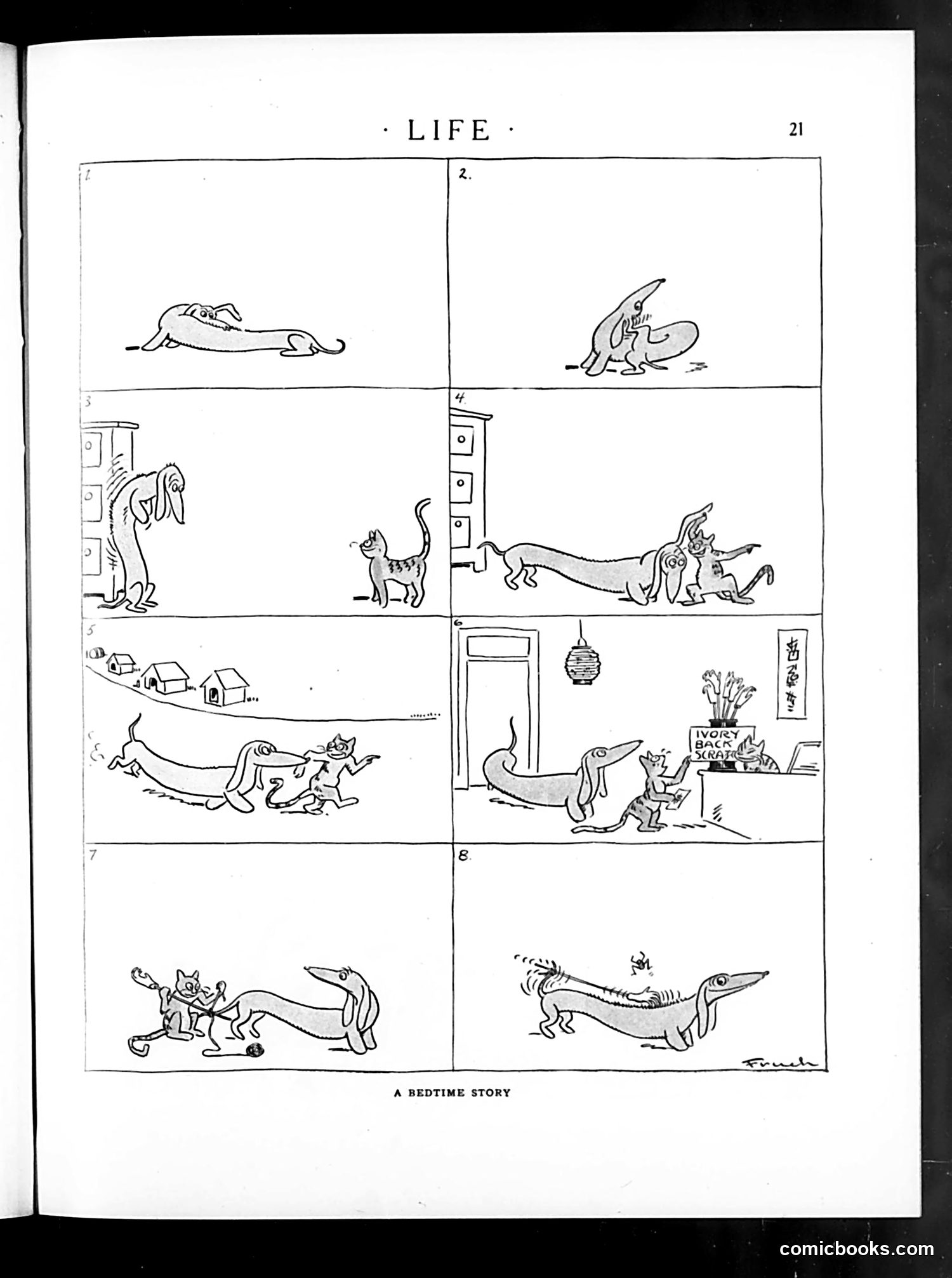
This is an eight-panel visual narrative titled "A Bedtime Story" depicting the life cycle of a dachshund (wiener dog). The sequence shows: 1. The dog lying down 2. The dog playing/jumping 3. Various scenes of the dog interacting with its environment—climbing, playing with cats, running around a house 4. Indoor domestic scenes with the dog and a child 5. The dog playing with children outdoors 6. Evening/nighttime scenes showing the dog's activities winding down The humor appears to be gentle and observational, documenting typical daily activities and mischief of a pet dachshund through a complete day cycle, culminating in bedtime. The comic relies on visual storytelling rather than dialogue, presenting the dog's perspective on ordinary domestic life in an era when such pet-focused humor was common in magazines like Life.
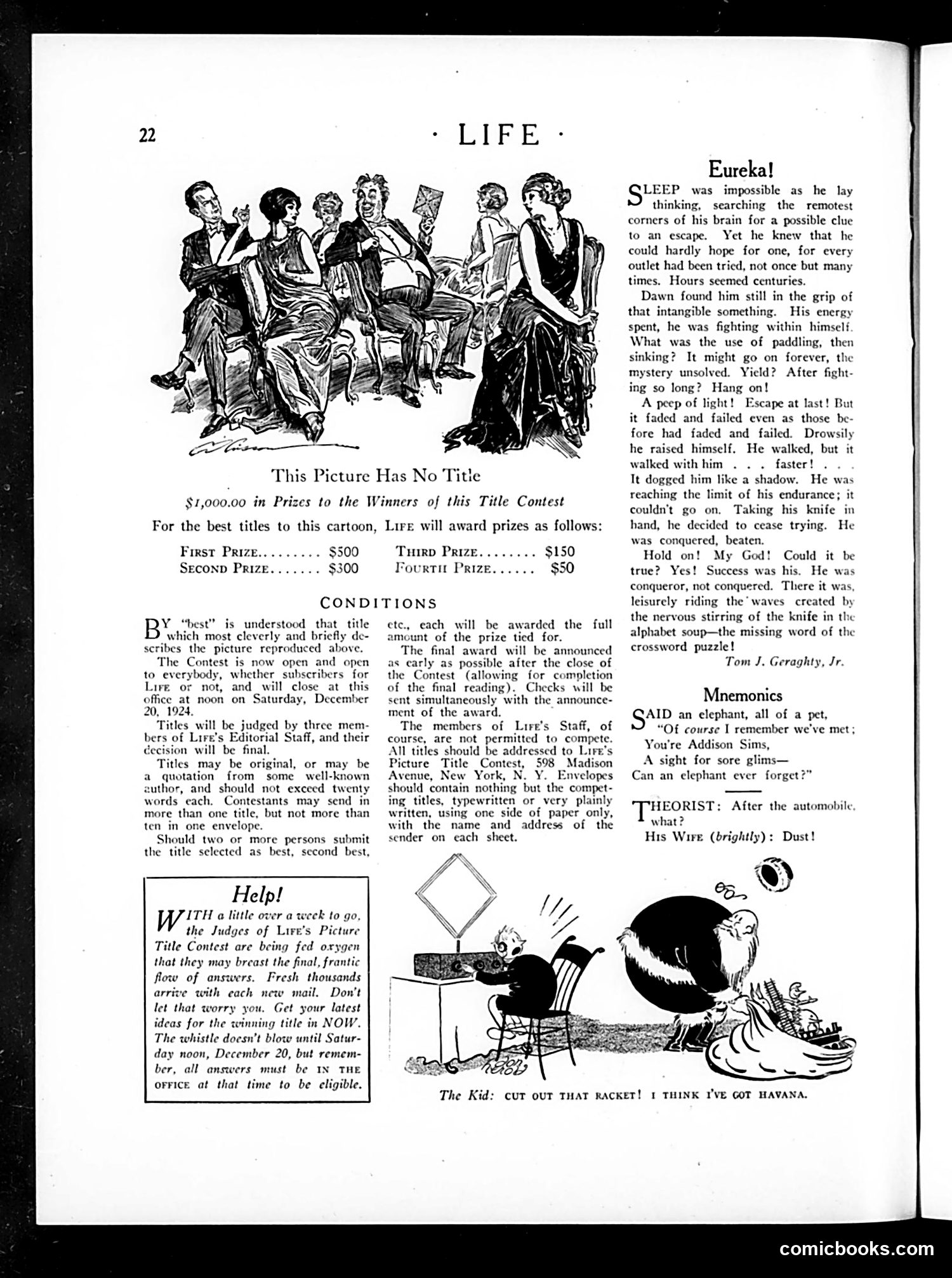
This page from *Life* (December 1924) features a title-contest promotion around an untitled cartoon showing well-dressed adults in animated conversation—apparently arguing or debating something. The contest offers $1,000 in prizes for readers to submit clever titles for the cartoon, with entries due December 20, 1924. The page also includes two humorous short pieces: "Eureka!" depicts someone's desperate mental struggle that turns out to be searching for a crossword puzzle word in alphabet soup—a parody of dramatic escape narratives. Below that, "Mnemonics" offers a light verse about remembering an elephant named Addison Sims, followed by a brief joke: a theorist asks "After the automobile, what?" and his wife answers "Dust!"—satirizing the rapid technological change and accompanying pollution of the 1920s. The content reflects *Life*'s style as a satirical magazine mixing visual humor with wordplay.
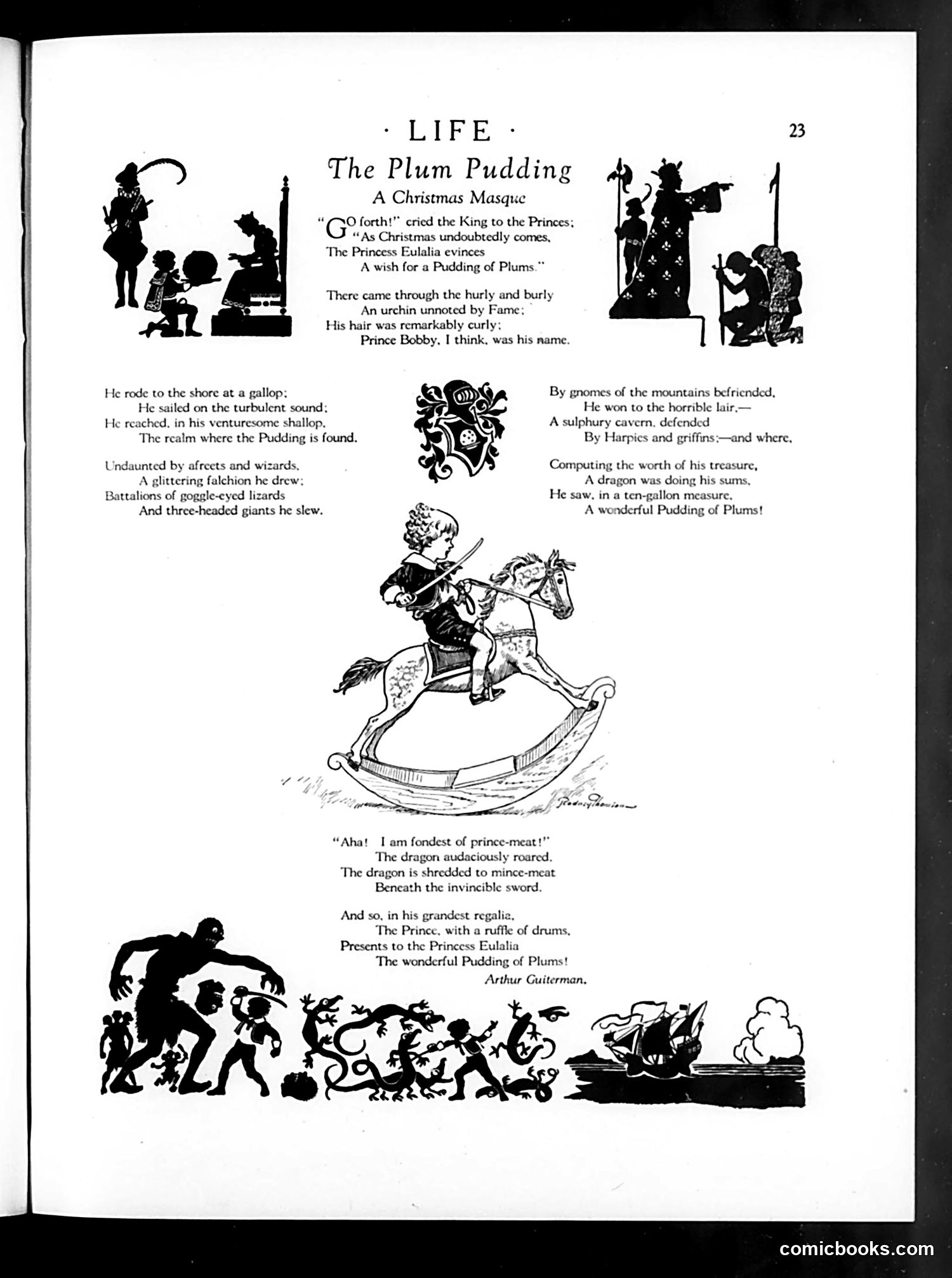
This is a whimsical Christmas poem by Arthur Guiterman, not political satire. It's a fairy-tale adventure masque about Prince Bobby, who undertakes a quest to retrieve a legendary plum pudding for Princess Eulalia as a Christmas gift. The narrative follows a classic heroic pattern: the young prince sails to a magical realm, battles fantastical creatures (dragons, giants, harpies, griffins), defeats a dragon who wants to eat him, and triumphantly presents the plum pudding to the princess. The accompanying silhouette illustrations depict scenes from the adventure—soldiers, the prince on a rocking horse, magical creatures, and celebratory figures at bottom. This appears to be purely festive entertainment for *Life* magazine's Christmas issue, blending whimsy, adventure, and holiday tradition rather than commenting on contemporary politics or social issues.
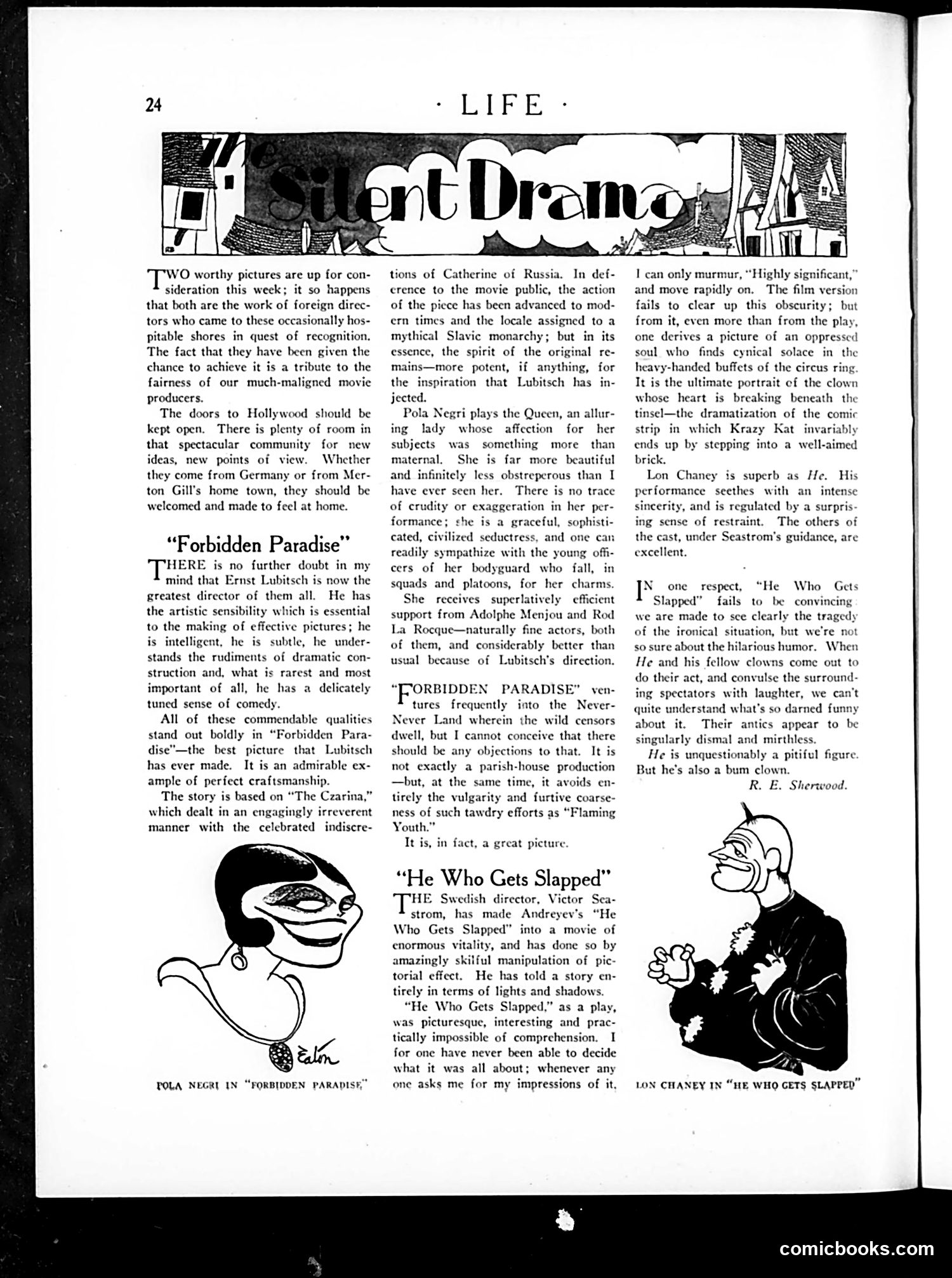
This page reviews two foreign-directed silent films. The critic praises Ernst Lubitsch's "Forbidden Paradise," starring Pola Negri as a seductive queen in a fictional Slavic monarchy (loosely based on Catherine of Russia). The reviewer notes Negri's refined performance and calls it Lubitsch's best work—sophisticated comedy that tastefully navigates censorship concerns without vulgarity. The second review covers Victor Sjöström's "He Who Gets Slapped," adapted from a Russian play. The critic acknowledges the film's visual artistry (told "entirely in terms of lights and shadows") but admits confusion about its meaning, calling it "highly significant" while unable to articulate what it's about. He interprets it as a tragic portrait of an oppressed soul finding solace in circus performance—a broken heart beneath the clown's mask. Both reviews celebrate foreign directors' contributions to American cinema, arguing Hollywood should remain open to international talent and perspectives.
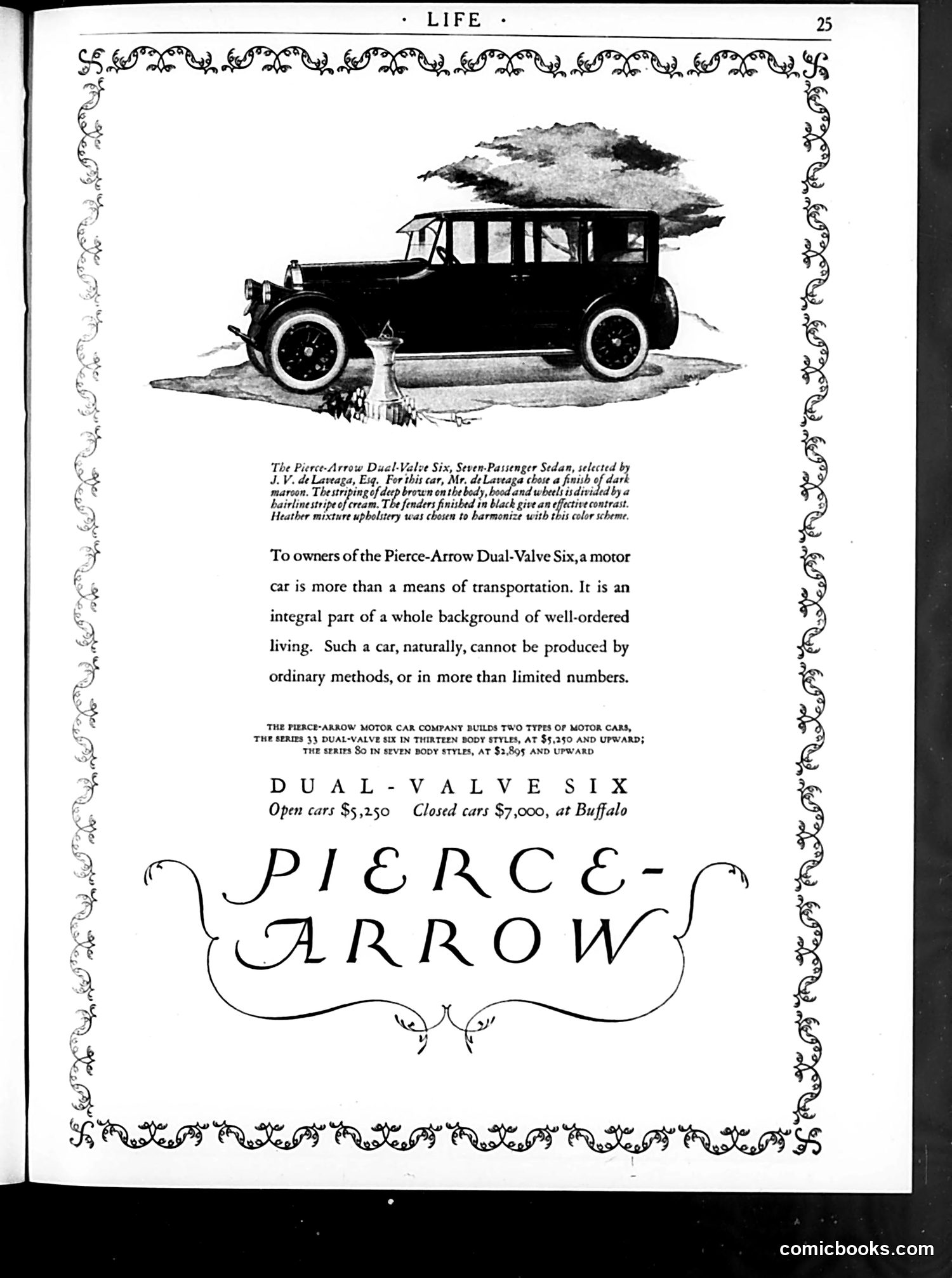
This is a **luxury automobile advertisement**, not a political cartoon or satire. The page promotes the Pierce-Arrow Dual-Valve Six, a high-end motor car. The image shows a seven-passenger sedan in dark maroon with cream and black trim details, positioned beneath a stylized tree. The ad targets wealthy consumers by emphasizing exclusivity and craftsmanship. The opening paragraph explicitly states that owning such a car represents "a whole background of well-ordered living" and cannot be "produced by ordinary methods, or in more than limited numbers"—a direct appeal to elite sensibilities and status consciousness. Prices listed ($5,250-$7,000 for closed cars) confirm this was marketed to the affluent. The mention of "J.V. de Laveaga, Esq." selecting this vehicle serves as social endorsement from a notable owner. This reflects early 20th-century automotive advertising that equated luxury cars with refined taste and social standing.
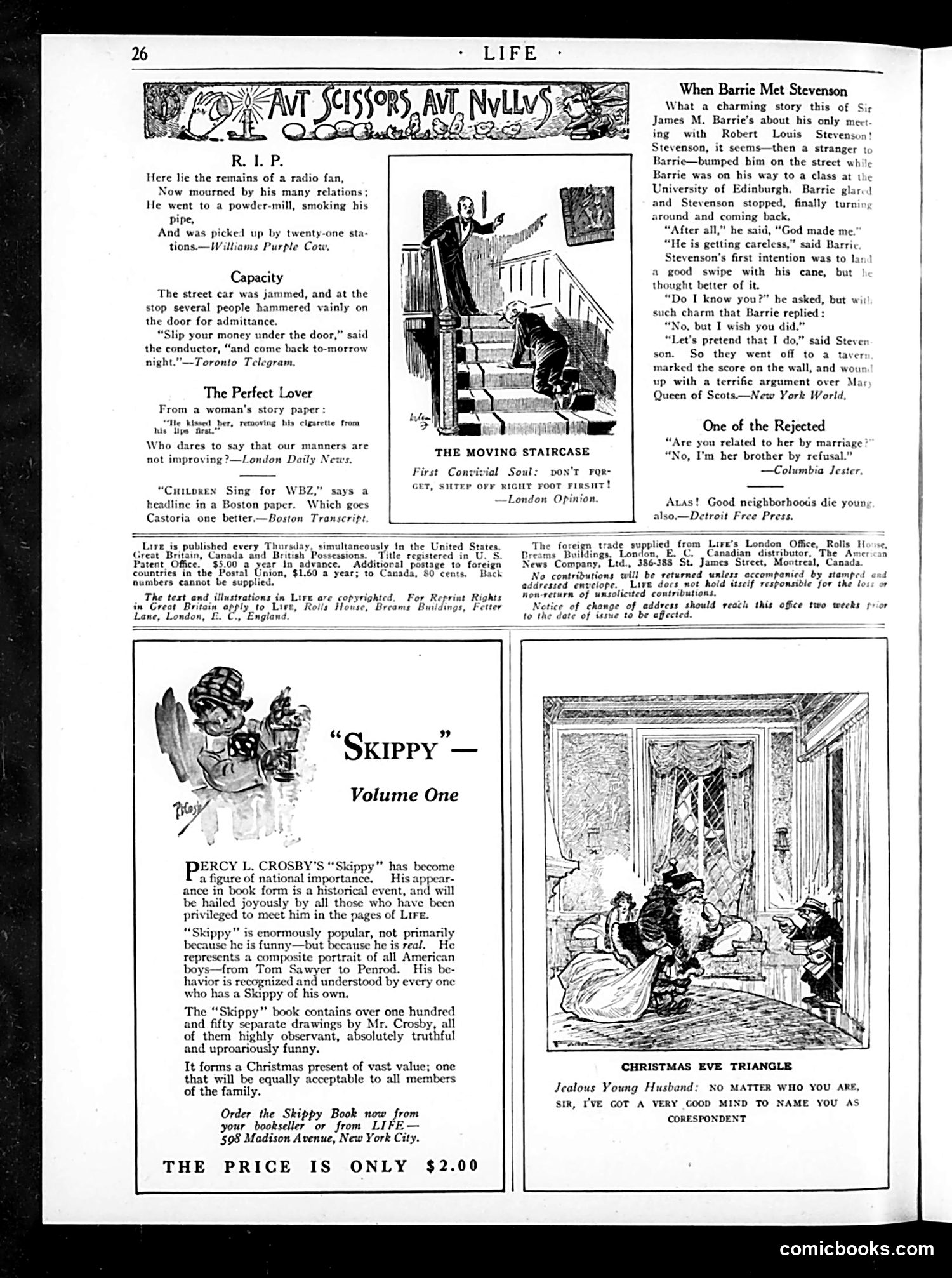
This page contains satirical short humor pieces typical of 1920s Life magazine, plus advertising for the "Skippy" book collection. **The Cartoons/Jokes:** The visual content shows two illustrated pieces: "The Moving Staircase" (a London Opinion cartoon about navigating escalators) and "Christmas Eve Triangle" (depicting domestic conflict). The text jokes ridicule modern absurdities: a radio fan dies at a powder mill and is "picked up by twenty-one stations" (pun on radio reception); a streetcar conductor tells people to slip money under the door; a Boston paper's headline about children singing is compared unfavorably to a Castoria advertisement. **The Barrie-Stevenson Story:** This anecdote about Scottish authors James Barrie and Robert Louis Stevenson humorously depicts their chance meeting at Edinburgh University—they nearly fight after colliding, then befriend each other over drinks and debate about Mary Queen of Scots. **Overall Context:** The page reflects early 20th-century American satire focused on modern inconveniences (transportation, radio), social etiquette, and literary culture. The advertisement promotes "Skippy," a popular cartoon character book for Christmas gifts.
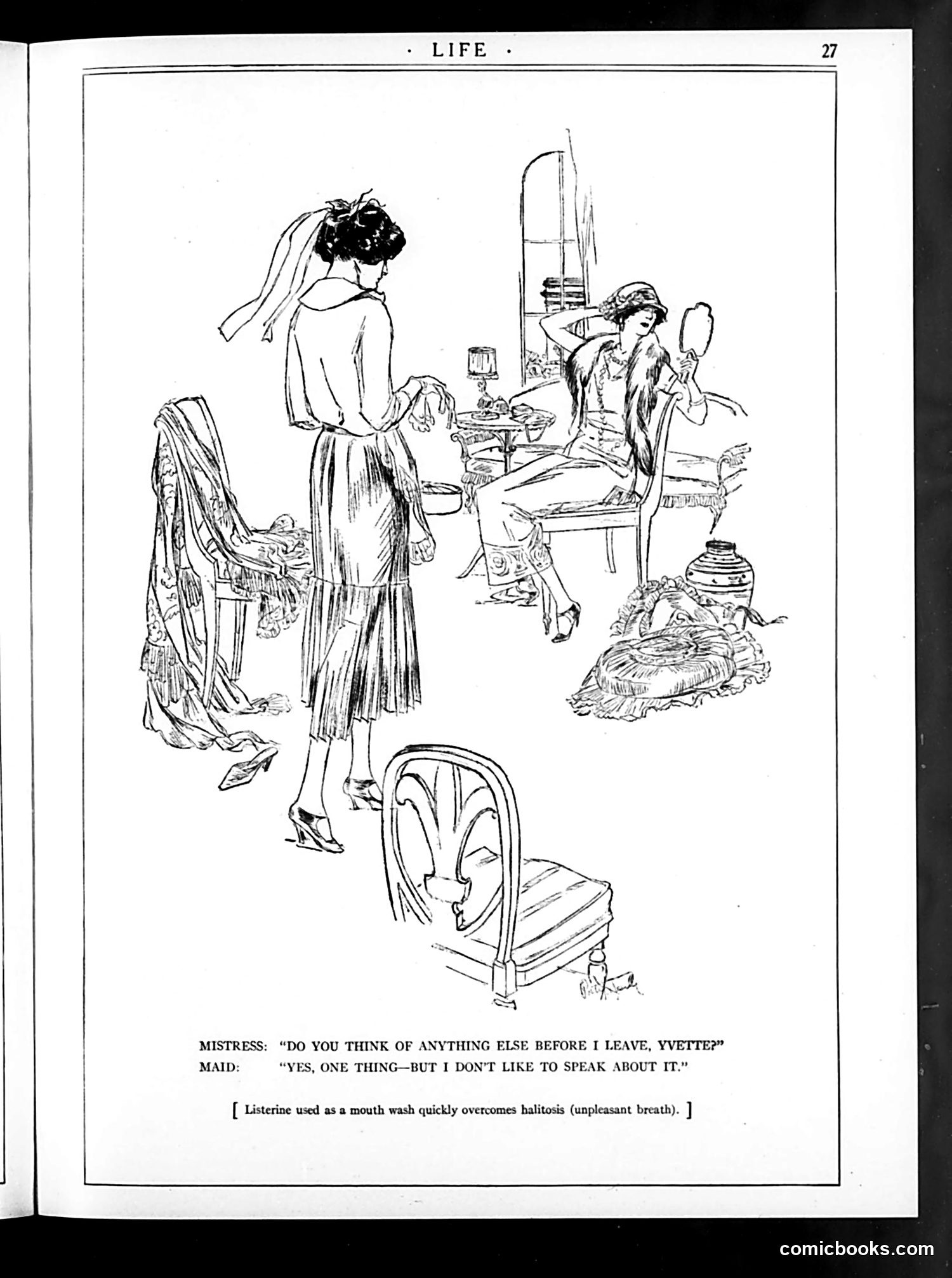
This is a **Listerine advertisement disguised as a cartoon joke** from Life magazine's advertising section. The humor relies on a social embarrassment: a wealthy mistress (shown in an elegant bedroom with mirror and vanity) asks her maid Yvette if she needs anything before leaving. Yvette's reluctant response hints at an unspoken problem—the mistress has bad breath (halitosis). The advertisement below explicitly states that Listerine mouthwash solves this delicate social problem. The satire is gentle: rather than directly stating "you have bad breath," the ad uses the awkward servant-employer dynamic to make the point humorous and memorable. The joke implies that even intimate domestic relationships suffer from this embarrassing condition, making Listerine seem like a social necessity. This reflects early 20th-century advertising's invention of "halitosis" as a widespread anxiety to drive product sales.
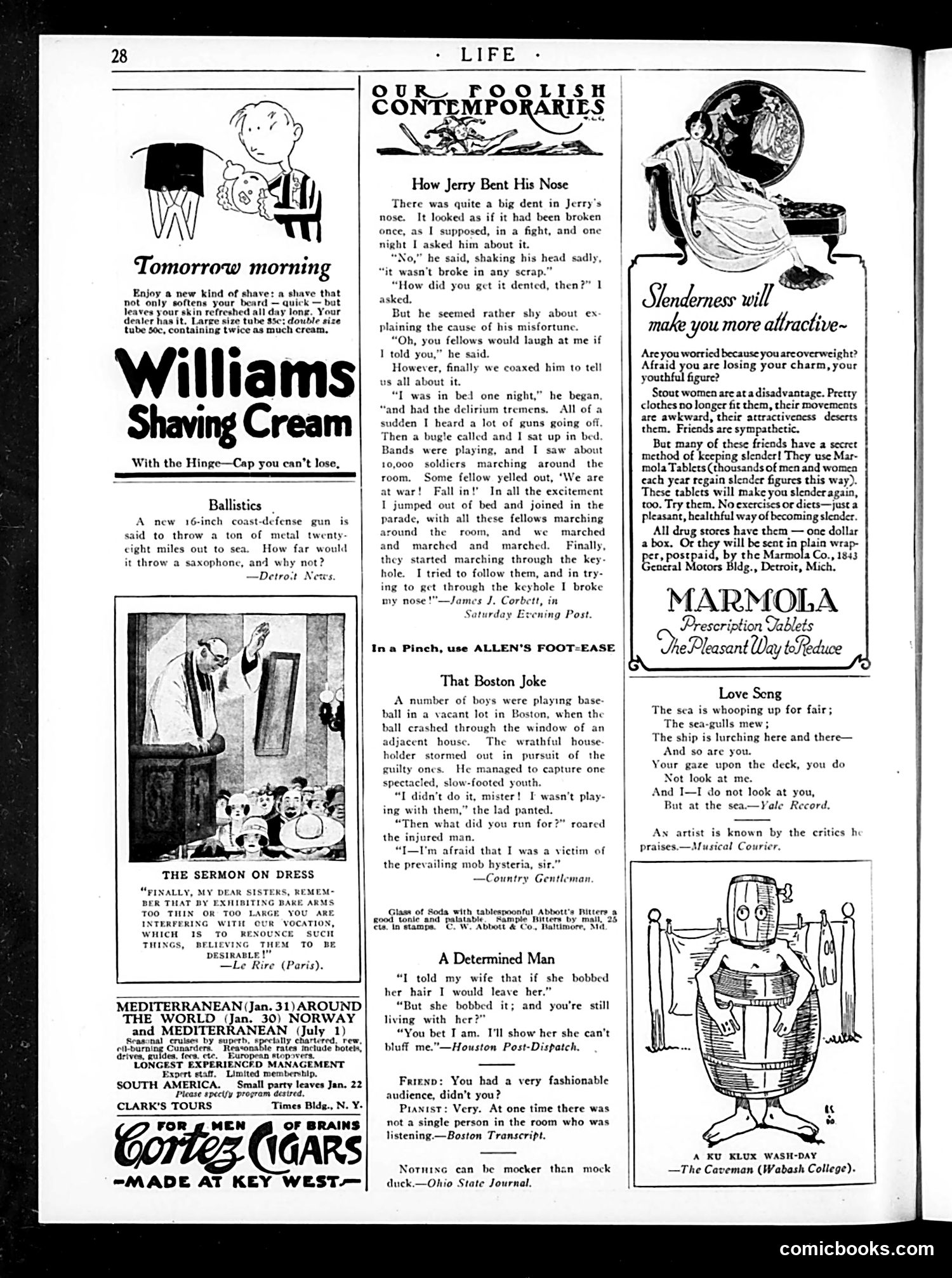
This page from *Life* magazine presents satirical humor typical of the 1920s era, mixing short jokes, anecdotes, and advertisements. **Main Contents:** The "Sermon on Dress" cartoon mocks Parisian clergy who hypocritically condemn women's bare arms as immoral while claiming to renounce worldly desires—the satire being their obvious interest in women's bodies. **Featured Anecdotes:** Jerry's bent nose story (attributed to boxer James J. Corbett) is an absurdist tall tale: a drunk man damages his nose trying to follow soldiers through a keyhole during delirium tremens—humor deriving from the ridiculous explanation. The Boston joke satirizes mob mentality: a boy runs from police not from guilt but from "prevailing mob hysteria." **Advertisements** dominate the page, including Williams Shaving Cream, Marmola weight-reduction tablets, and Clark's Tours—representing consumer products marketed to early 20th-century readers. The overall tone reflects *Life*'s satirical approach to contemporary social follies: vanity, mob behavior, and advertising-driven consumer culture.
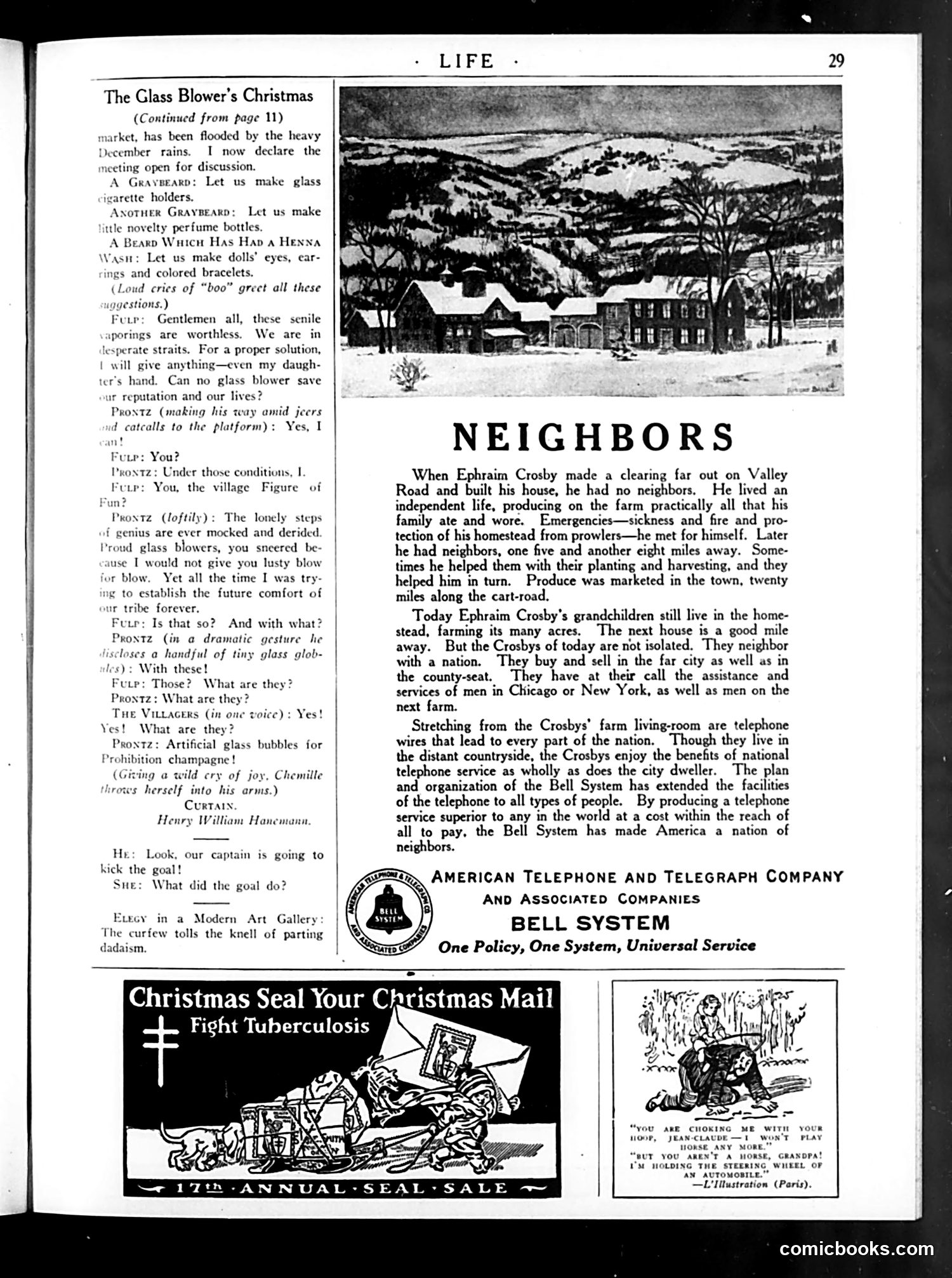
This page contains two distinct items: **"The Glass Blower's Christmas"** is a satirical play script mocking Prohibition-era desperation. Glass blowers face economic ruin after December rains flood markets. A character named Prontz proposes manufacturing artificial glass bubbles marketed as "Prohibition champagne"—a joke about illegal alcohol substitutes during the 1920s-1930s ban. The satire targets both the absurdity of Prohibition and entrepreneurs exploiting it. **"Neighbors"** is a Bell Telephone advertisement using rural Americana to promote nationwide connectivity. It contrasts Ephraim Crosby's isolated 19th-century farm life with his modern descendants who, though still rural, connect nationally via telephones. The message: Bell System service democratizes urban convenience for rural Americans. The bottom cartoon, captioned about a horse/automobile, illustrates generational change—a grandfather confused by modern technology replacing horses, typical progressive-era humor about technological disruption.
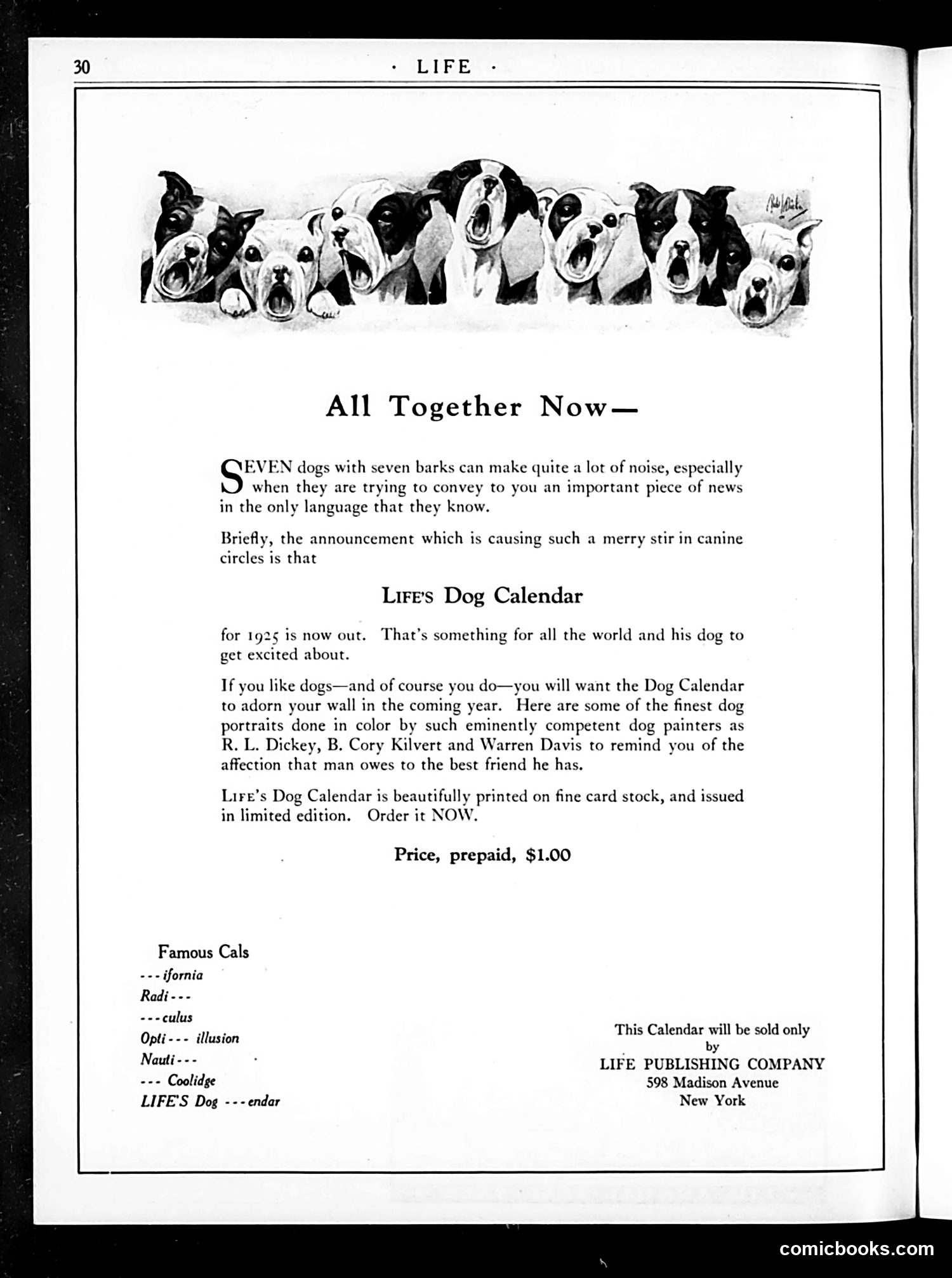
This is primarily **advertising content**, not satire or political commentary. The page promotes *Life* magazine's 1925 Dog Calendar featuring color portraits by professional dog artists (R. L. Dickey, B. Cory Kilvert, Warren Davis). The cartoon at top shows seven barking dogs, illustrating the humorous opening line about dogs making noise when sharing "important news"—here, the calendar's release. This playful tone frames the product as something dogs themselves would be excited about. The "Famous Cals" section at bottom appears to list calendar months through wordplay (appears to reference: California, Radius, Calculus, Optical illusion, Nautical, Coolidge, and Life's Dog calendar)—a lighthearted puzzle rather than political commentary, though "Coolidge" (President Calvin Coolidge, 1923-1929) may be a period-appropriate reference. The ad emphasizes the calendar's quality printing and limited edition status to justify the $1.00 price—substantial for 1925.
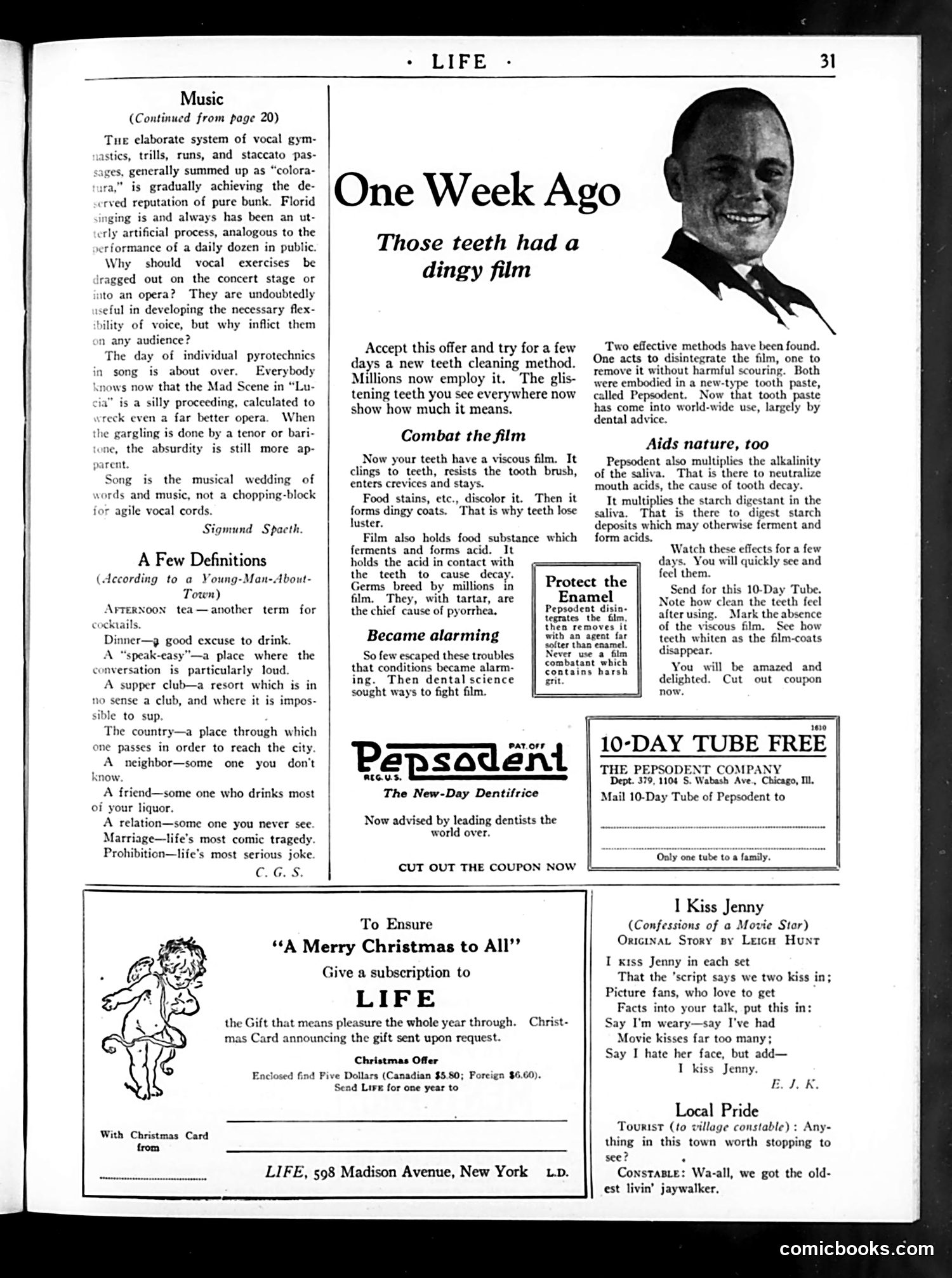
This page contains a music critique, satirical definitions, and a Pepsodent toothpaste advertisement. **Music Section**: Critic Sigmund Spaeth argues against elaborate vocal techniques ("coloratura") in opera and concert performance, calling them artificial and tedious—essentially outdated showmanship that audiences shouldn't endure. **"A Few Definitions"**: Humorous satire mocking 1920s upper-class life and Prohibition-era speech. Terms like "afternoon tea" meaning cocktails, "speak-easy" as a loud gathering place, and "prohibition" as "life's most serious joke" reflect post-WWI American social hypocrisy—the wealthy openly acknowledged drinking despite the legal ban. **Pepsodent Ad**: The "One Week Ago" section uses before-and-after marketing showing dingy teeth with film buildup, then promoting Pepsodent's new formula as scientifically superior. This reflects 1920s advertising's shift toward pseudo-scientific health claims to sell consumer goods. The page exemplifies *Life*'s blend of satirical social commentary and modern advertising, capturing Jazz Age attitudes toward tradition, prohibition flouting, and consumerism.
This page is primarily **advertisements and miscellaneous content** rather than political satire or editorial cartoon material. The page contains: 1. **"The Slacker"** — A brief satirical piece mocking a man whose wife won the "Crossword Puzzlers" championship. The joke: his children will someday ask what *he* accomplished during "the Great Tournament" (WWI), shaming him by contrast. This targets men who avoided military service during World War I. 2. **Mrs. Pep's Diary** — A humorous personal essay about holiday shopping and domestic life, without political content. 3. **Multiple advertisements** — Golf resort promotions, a dog remedy book, cough drops, and smoking pipes dominate the page. 4. **"The Louvain Library Fund"** — A brief notice soliciting donations to rebuild a Belgian library destroyed in WWI, reflecting American post-war charitable sentiment. The page lacks substantial political cartooning or satirical commentary beyond the brief "Slacker" piece, which uses light ridicule to enforce WWI-era social pressure on non-participants.
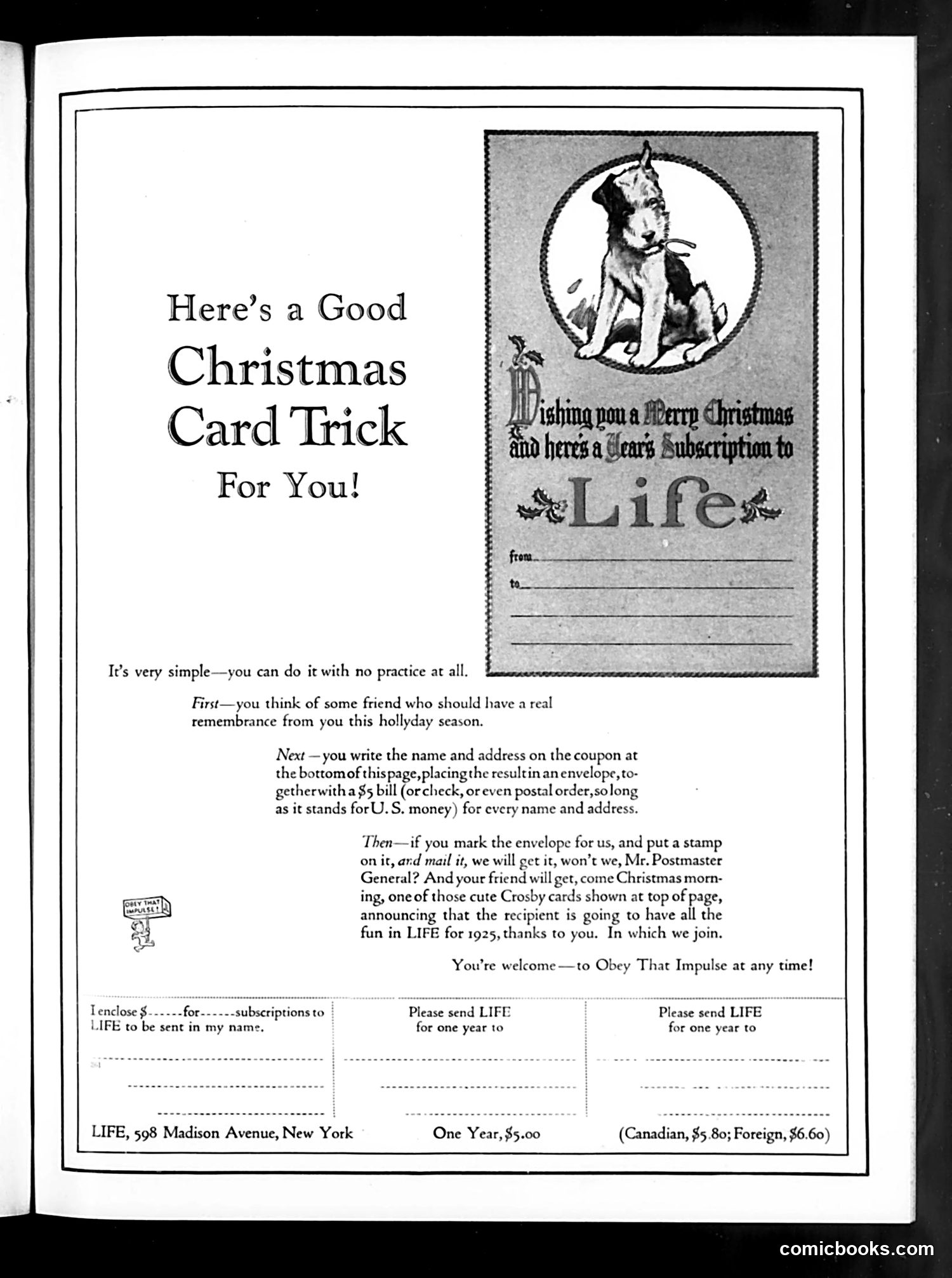
This page is primarily **advertising/promotion**, not a political cartoon. Life magazine is pitching a Christmas gift idea: giving friends one-year magazine subscriptions as presents. The "trick" is straightforward: readers send Life $5 per recipient, and the magazine will mail each friend a decorative "Crosby card" (likely referring to Bing Crosby, popular at the time) announcing their year-long subscription gift. The small illustration at top right shows a jovial figure—possibly meant to evoke Santa or a generic "gift-giver"—on a vintage Christmas card design. The satire is gentle: Life presents this as an effortless, clever gift solution requiring minimal effort from the sender. The phrase "Obey That Impulse" playfully encourages impulse giving. There's no deeper political commentary—this is simply a magazine leveraging the holiday season to solicit subscription sales through personal recommendations.
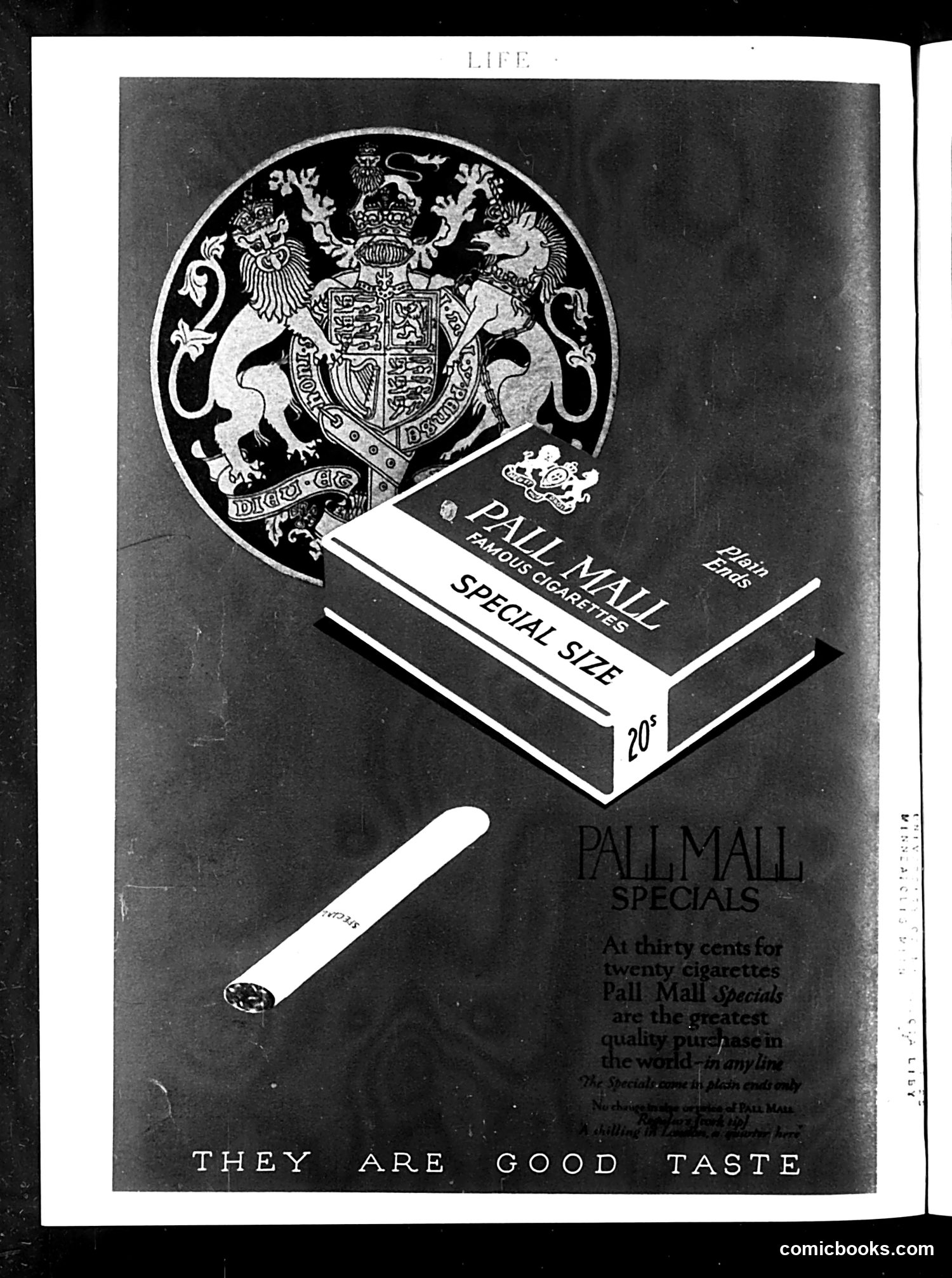
This is a cigarette advertisement, not political satire. It features the British royal coat of arms prominently displayed above a box of Pall Mall Special Size cigarettes (priced at 20¢ for twenty cigarettes), along with a single cigarette below. The ad's strategy uses royal imagery to convey prestige and quality, suggesting that Pall Mall cigarettes represent "famous" luxury goods. The tagline "They Are Good Taste" attempts to associate smoking with sophistication and refinement. The text promises "the greatest quality purchase in the world," appealing to consumers' desire for status. This reflects early-to-mid 20th century advertising tactics that leveraged British aristocratic imagery to market American consumer products as aspirational and elite.