
Life, 1924-12-11 · page 20 of 36
Life — December 11, 1924 — page 20: what you’re looking at
What you’re looking at
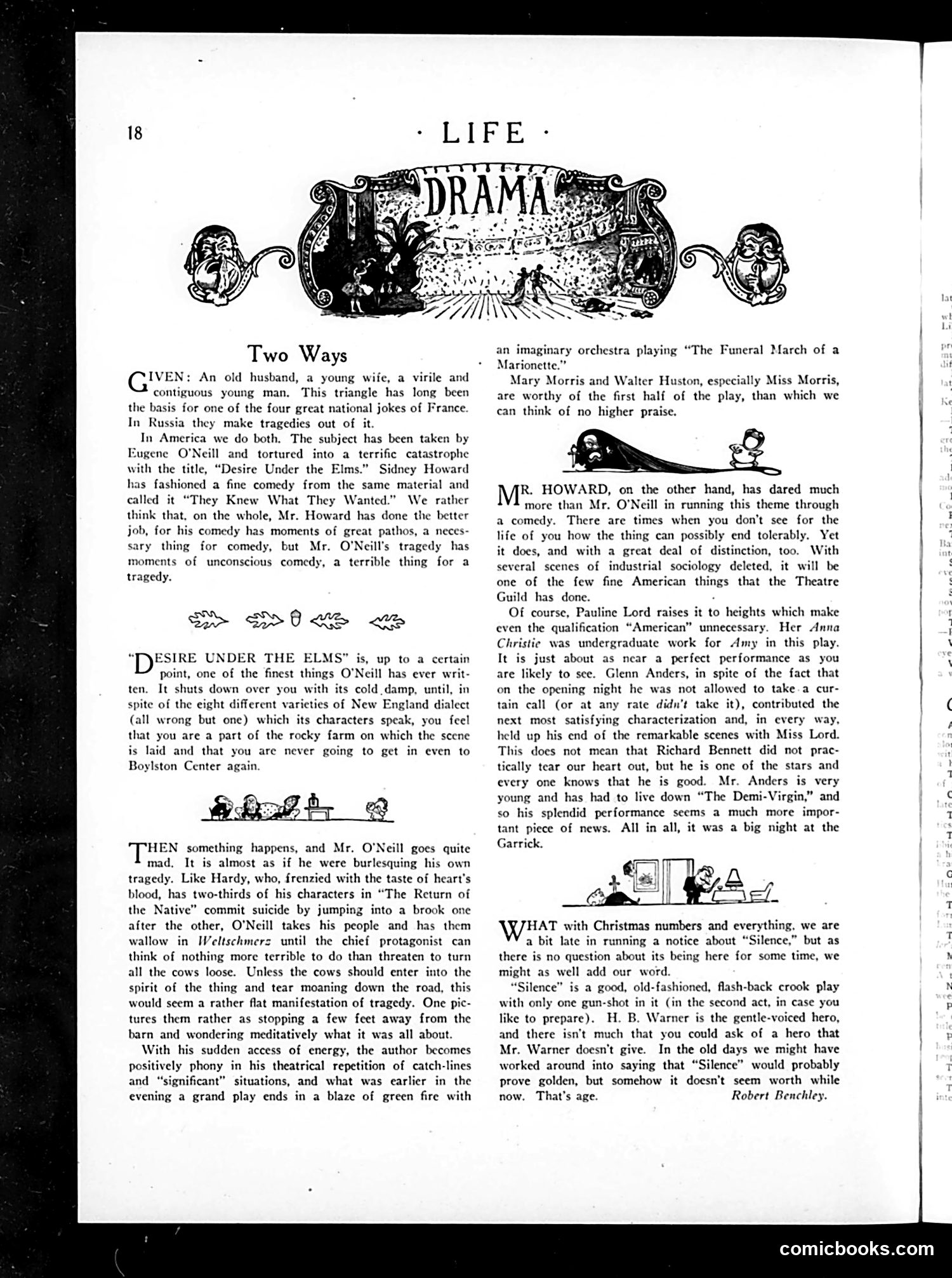
This page reviews two contemporary Broadway productions built on the same plot: a love triangle involving an older husband, younger wife, and virile young man. **Eugene O'Neill's "Desire Under the Elms"** is praised for its opening half—its atmospheric New England farm setting and dialect work—but criticized for descending into unintentional comedy. The reviewer mocks O'Neill's escalating melodrama, comparing him to Thomas Hardy: when characters resort to extreme actions (threatening to "turn all the cows loose"), the tragedy becomes absurd rather than moving. **Sidney Howard's "They Knew What They Wanted"** handles the identical material more successfully by embracing comedy, with Pauline Lord delivering an "perfect performance" and Glenn Anders providing strong supporting work. The satire targets O'Neill's theatrical excess—his overuse of "significant situations" and dramatic clichés (ending with orchestral "Funeral March")—suggesting serious drama can fail when it becomes too self-consciously tragic and loses touch with human reality.
📄 Transcribed text from this page (OCR, searchable)
Machine-transcribed from the original scan — historical spelling and the odd misread are preserved.
IVEN: An old husband, a young wife, a virile and contiguous young man, This triangle has long been the basis for one of the four great national jokes of France. In Russia they make tragedies out of it. In America we do both. The subject has been taken by Eugene O'Neill and tortured into a terrific catastrophe with the title, “Desire Under the Elms.” Sidney Howard has fashioned a fine comedy from the same material and called it “They Knew What They Wanted.” We rather think that, on the whole, Mr. Howard has done the better job, for his comedy has moments of great pathos, a neces- sary thing for comedy, but Mr. O'Neill’s tragedy has moments of unconscious comedy, a terrible thing for a tragedy. Se EO Ke we “TYESIRE UNDER THE ELMS” is, up to a certain point, one of the finest things O'Neill has ever writ- ten. It shuts down over you with its cold damp, until, in spite of the eight different varieties of New England dialect (all wrong but one) which its characters speak, you feel that you are a part of the rocky farm on which the scene is laid and that you are never going to get in even to Boylston Center again. HEN something happens, and Mr. O'Neill goes quite mad. It is almost as if he were burlesquing his own tragedy. Like Hardy, who, frenzied with the taste of heart's blood, has two-thirds of his characters in “The Return of the Native” commit suicide by jumping into a brook one after the other, O'Neill takes his people and has them wallow in IWeltschmerz until the chief protagonist can think of nothing more terrible to do than threaten to turn all the cows loose. Unless the cows should enter into the spirit of the thing and tear moaning down the road, this would seem a rather flat manifestation of tragedy. One pic- tures them rather as stopping a few feet away from the barn and wondering meditatively what it was all about. With his sudden access of energy, the author becomes positively phony in his theatrical repetition of catch-lines and “significant” situations, and what was earlier in the evening a grand play ends in a blaze of green fire with an imaginary orchestra playing “The Funeral March of a Marionette.” Mary Morris and Walter Huston, especially Miss Morris, are worthy of the first half of the play, than which we can think of no higher praise. R. HOWARD, on the other hand, has dared much more than Mr. O'Neill in running this theme through a comedy. There are times when you don’t see for the life of you how the thing can possibly end tolerably, Yet it does, and with a great deal of distinction, too. With several scenes of industrial sociology deleted, it will be one of the few fine American things that the Theatre Guild has done. : Of course, Pauline Lord raises it to heights which make even the qualification “American” unnecessary. Her Anna Christie was undergraduate work for Amy in this play. It is just about as near a perfect performance as you are likely to sce. Glenn Anders, in spite of the fact that on the opening night he was not allowed to take.a cur- tain call (or at any rate didn’t take it), contributed the next most satisfying characterization and, in every way, held up his end of the remarkable scenes with Miss Lord. This does not mean that Richard Bennett did not prac- tically tear our heart out, but he is one of the stars and every one knows that he is good. Mr. Anders is very young and has had to live down “The Demi-Virgin,” and so his splendid performance seems a much more impor- tant piece of news. All in all, it was a big night at the Garrick. = +a] HAT with Christmas numbers and everything, we are a bit late in running a notice about “Silence,” but as there is no question about its being here for some time, we might as well add our word. “Silence” is a good, old-fashioned, flash-back crook play with only one gun-shot in it (in the second act, in case you like to prepare). H. B. Warner is the gentle-voiced hero, and there isn't much that you could ask of a hero that Mr. Warner doesn’t give. In the old days we might have worked around into saying that “Silence” would probably prove golden, but somehow it doesn't seem worth while now. That's age. Robert Benchley. comicbooks.com ‘