
Life, 1924-12-11 · page 26 of 36
Life — December 11, 1924 — page 26: what you’re looking at
What you’re looking at
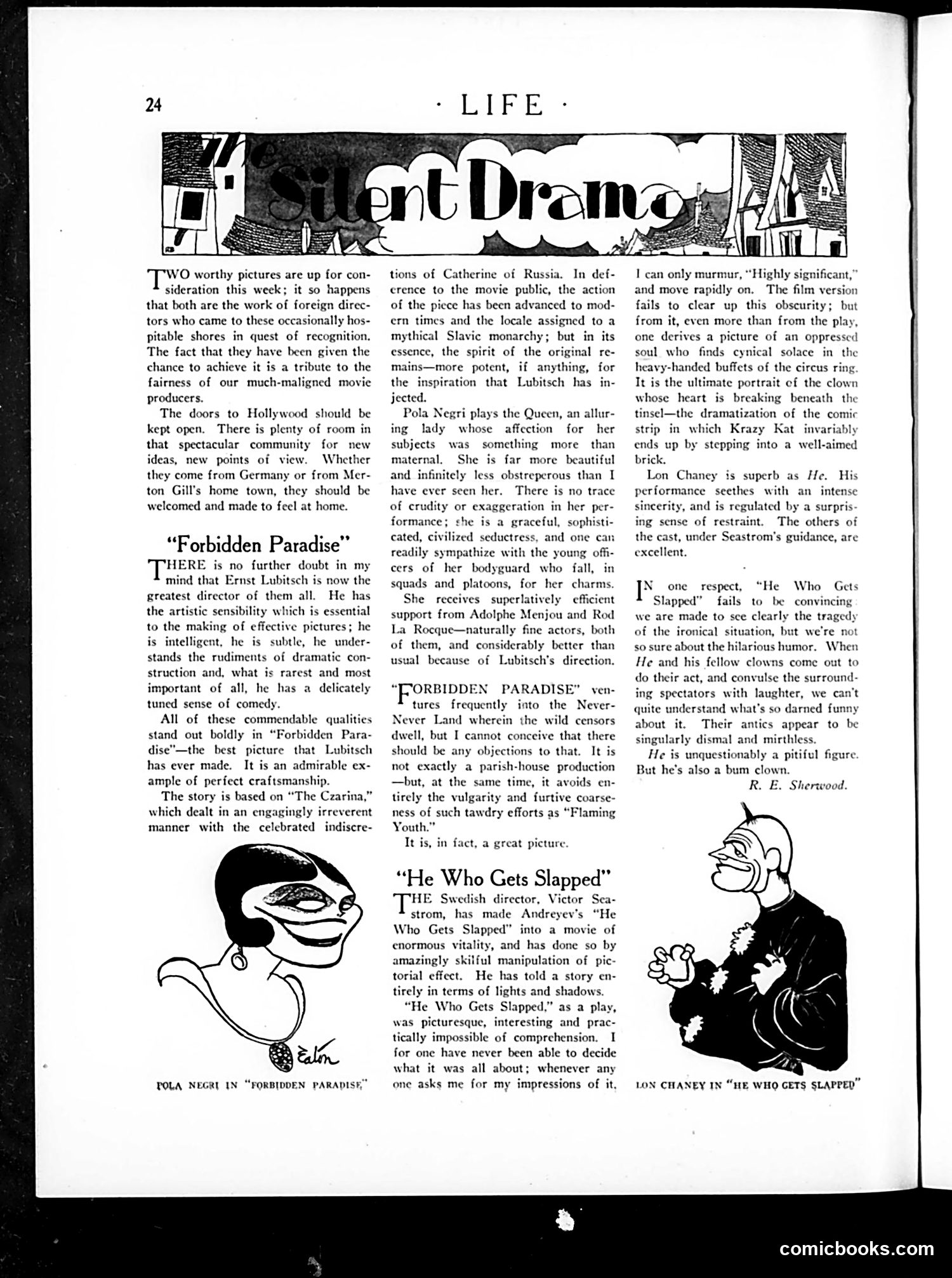
This page reviews two foreign-directed silent films. The critic praises Ernst Lubitsch's "Forbidden Paradise," starring Pola Negri as a seductive queen in a fictional Slavic monarchy (loosely based on Catherine of Russia). The reviewer notes Negri's refined performance and calls it Lubitsch's best work—sophisticated comedy that tastefully navigates censorship concerns without vulgarity. The second review covers Victor Sjöström's "He Who Gets Slapped," adapted from a Russian play. The critic acknowledges the film's visual artistry (told "entirely in terms of lights and shadows") but admits confusion about its meaning, calling it "highly significant" while unable to articulate what it's about. He interprets it as a tragic portrait of an oppressed soul finding solace in circus performance—a broken heart beneath the clown's mask. Both reviews celebrate foreign directors' contributions to American cinema, arguing Hollywood should remain open to international talent and perspectives.
📄 Transcribed text from this page (OCR, searchable)
Machine-transcribed from the original scan — historical spelling and the odd misread are preserved.
WO worthy pictures are up for con- sideration this week; it so happens that both are the work of foreign direc- tors who came to these occasionally hos- pitable shores in quest of recognition. The fact that they have been given the chance to achieve it is a tribute to the fairness of our much-maligned movie producers. The doors to Hollywood should be kept open. There is plenty of room in that spectacular community for new ideas, new points of view. Whether they come from Germany or from Mer- ton Gill's home town, they should be welcomed and made to feel at home. “Forbidden Paradise” HERE is no further doubt in my mind that Ernst Lubitsch is now the greatest director of them all. He has the artistic sensibility which is essential to the making of effective pictures; he is intelligent, he is subtle, he under- stands the rudiments of dra con- struction and, what is rarest and most important of all, he has a delicately tuned sense of comedy. All of these commendable qualities stand out boldly in “Forbidden Para- dise"—the best picture that Lubitsch has ever made. It is an admirable ex- ample of perfect craftsmanship. The story is based on “The Caarina, which dealt in an engagingly irreverent manner with the celebrated indiscre- POLA NEGRL IN “FORBIDDEN PARADL tions of Catherine of Russia. In def- erence to the movie public, the action of the piece has been advanced to mod- ern times and the locale assigned to a mythical Slavic monarchy; but in its essence, the spirit of the original re- mains—more potent, if anything, for the inspiration that Lubitsch has in- jected. Pola Negri plays the Queen, an allur- ing lady affection for her subjects was something more than maternal. She is far more beautiful and infinitely less obstreperous than I have ever seen her. There is no trace of crudity or exaggeration in her per- formance; she is a graceful, sophisti- cated, civilized seductress, and one can readily sympathize with the young offi- cers of her bodyguard who fall, in whose squads and platoons, for her charms. She superlatively efficient support from Adolphe Menjou and Rod La Rocque—naturally fine actors, both of them, and considerably better than usual because of Lubitsch’s direction. receives “FORBIDDEN PARADISE” ven- tures frequently into the Never- Never Land wherein the wild censors dwell, but I cannot conceive that there should be any objections to that. It is not exactly a parish-house production —but, at the same time, it avoids en- tirely the vulgarity and furtive coarse- ness of such tawdry efforts as “Flaming Youth. It is, in fact, a great picture. “He Who Gets Slapped” THE Swedish director, Victor Sea- strom, has made Andreyev’s “He Who Gets Slapped” into a movie of enormous vitality, and has done so by amazingly skilful manipulation of pic- torial effect. He has told a story en- tirely in terms of lights and shadows. “He Who Gets Slapped,” as a play was picturesque, interesting and prac- tically impossible of comprehension. I for one have never been able to decide what it was all about; whenever any one asks me for my impressions of it, I can only murmur, “Highly significant,” and move rapidly on. The film version fails to clear up this obscurity; but from it, even more than from the play, one derives a picture of an oppressed soul who finds cynical solace in the heavy-handed buffets of the circus ring It is the ultimate portrait ef the clown whose heart is breaking beneath the tinsel—the dramatization of the comic strip in which Krazy Kat invariably ends up by stepping into a well-aimed brick. Lon Chaney is superb as He. His performance seethes with an intense sincerity, and is regulated by a surpris- ing sense of restraint. The others of the cast, under Seastrom’s guidance, are excellent. I one respect, “He Who Gets Slapped” fails to be convincing we are made to sce clearly the tragedy of the ironical situation, but we're not so sure about the hilarious humor. When He and his fellow clowns come out to do their act, and convulse the surround- ing spectators with laughter, we can’t quite understand what's so darned funny about it. Their antics appear to be singularly dismal and mirthless. He is unquestionably a pitiful figure. But he’s also a bum clown. R. E. Sherwood. LON CHANEY IN “HE WHO GETS SLAPPED” comicbooks.com