
Life, 1924-12-11 · page 22 of 36
Life — December 11, 1924 — page 22: what you’re looking at
What you’re looking at
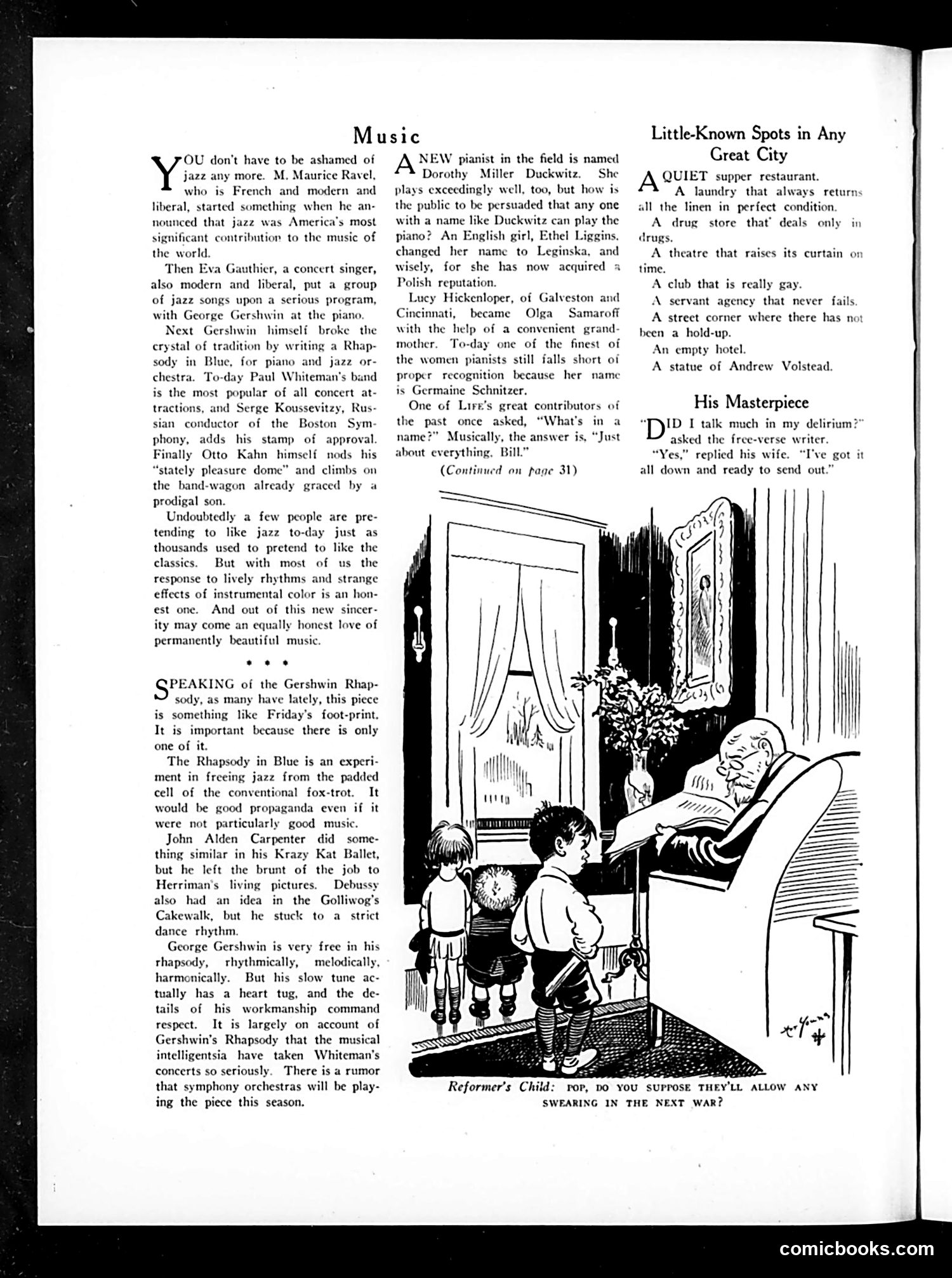
This page contains two distinct sections: a music essay and satirical commentary. **The Music Essay** discusses jazz's newfound respectability in American high culture. It celebrates that composers like George Gershwin and conductors like Serge Koussevitsky have legitimized jazz—once dismissed—as serious art. The essay notes the irony that some people pretend to like jazz just as others once pretended to like classical music. **The Cartoon** depicts a father figure (likely representing a Prohibitionist reformer, given the reference to "Andrew Volstead"—architect of Prohibition) reclining while his child asks whether swearing will be permitted in the next war. The humor is dark: it satirizes reformers obsessed with controlling morality while ignoring larger social catastrophes like war. The child's innocent question exposes the absurdity of prioritizing small moral issues over genuine human suffering. The page's sidebar lists satirical "little-known spots in any great city"—impossibilities like empty hotels and servant agencies that never fail—expressing cynicism about urban life and service industries.
📄 Transcribed text from this page (OCR, searchable)
Machine-transcribed from the original scan — historical spelling and the odd misread are preserved.
Music OU don't have to be ashamed of VY ius any more. M. Maurice Ravel, who is French and modern and liberal, started something when he an- nounced that jazz was America’s most significant contribution to the music of the world. Then Eva Gauthier, a concert singer, also modern and liberal, put a group of jazz songs upon a serious program, with George Gershwin at the piano. Next Gershwin himself broke the crystal of tradition by writing a Rhap- sody in Blue, for piano and jazz or- chestra. To-day Paul Whiteman’s band is the most popular of all concert a tractions, and Serge Koussevitzy, Rus- sian conductor of the Boston Sym- phony, adds his stamp of approval. Finally Otto Kahn himself nods his “stately pleasure dome” and climbs on the band-wagon already graced by a prodigal son. Undoubtedly a few people are pre- tending to like jazz to-day just as thousands used to pretend to like the classics. But with most of us the response to lively rhythms and strange effects of instrumental color is an hon- est one. And out of this new sincer- ity may come an equally honest love of permanently beautiful music. PEAKING of the Gershwin Rhap- sody, as many have lately, this piece is something like Friday's foot-print. It is important because there is only one of it. The Rhapsody in Blue is an experi- ment in freeing jazz from the padded cell of the conventional fox-trot. It would be good propaganda even if it were not particularly good music. John Alden Carpenter did some- thing similar in his Krazy Kat Ballet, but he left the brunt of the job to Herriman’s living pictures. Debussy also had an idea in the Golliwog’s Cakewalk, but he stuck to a_ strict dance rhythm. George Gershwin is very free in his rhapsody, rhythmically, — melodically, harmonically. But his slow tune ac- tually has a heart tug, and the de- tails of his workmanship command respect. It is largely on account of Gershwin’s Rhapsody that the musical intelligentsia have taken Whiteman's concerts so seriously. There is a rumor that symphony orchestras will be play- ing the piece this season. A ZW pianist in the field is named Dorothy Miller Duckwitz. She plays exceedingly well, too, but how is the public to be persuaded that any one with a name like Duckwitz can play the piano? An English girl, Ethel Liggins. changed her name to Leginska, and wisely, for she has now acquired a Polish reputation. Lucy Hickenloper, of Galveston and Cincinnati, became Olga Samaroff with the help of a convenient grand- mother. To-day one of the finest of the women pianists still falls short of proper recognition because her name is Germaine Schnitzer. One of Lire’s great contributors of the past once asked, “What's in a Musically, the answer is, “Just about everything, Bill.” (Continued on page 31) name?” Little-Known Spots in Any Great City A QUIET supper restaurant. A undry that always returns all the linen in perfect condition A drug store that’ deals only in drugs. A theatre that raises its curtain on time. A club that is really gay. A servant agency that never fails. A street corner where there has not been a hold-up. An empty hotel. A statue of Andrew Volstead His Masterpiece “PYID I talk much in my delirium?” ked the free-verse writer “Yes,” replied his wife. “I've got it all down and ready to send out.” | Reformer’s Child: ror, po YoU SUPPOSE THEY'LL ALLOW ANY SWEARING IN THE NEXT WAR? comicbooks.com