
Life, 1924-12-11 · page 16 of 36
Life — December 11, 1924 — page 16: what you’re looking at
What you’re looking at
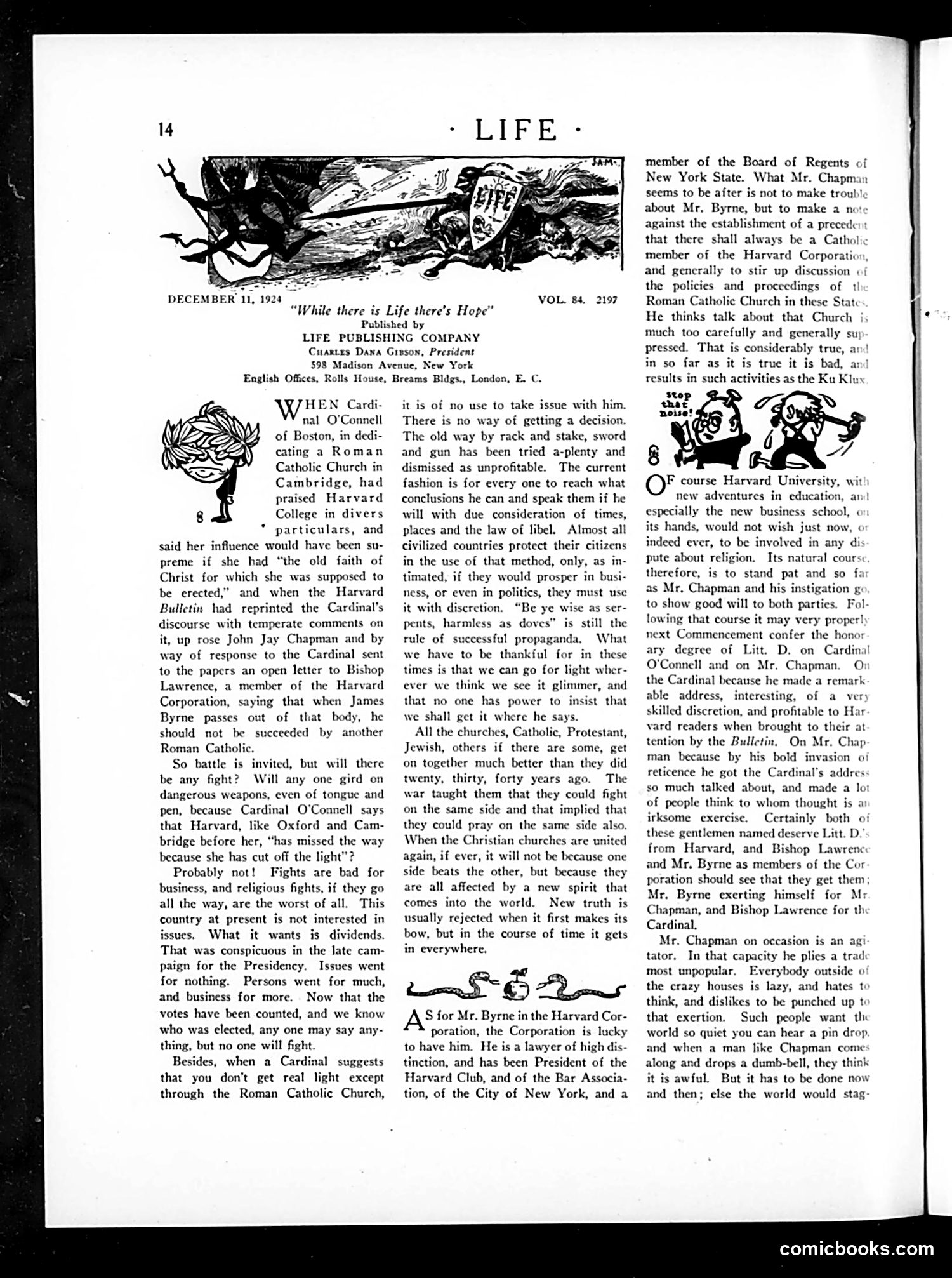
This page discusses a controversy involving Cardinal O'Connell of Boston, who publicly criticized Harvard University and James Byrne, a Harvard Corporation member. The small illustrated figures (labeled with numbers 8 and 9) appear to be caricatures of the disputants, though their specific identities aren't entirely clear from the image alone. The satire concerns O'Connell's attempt to influence Harvard's policies regarding Catholic Church representation. The text argues that while the Cardinal's concerns may have merit, his public attacks were counterproductive. The cartoon mocks the ecclesiastical interference in university governance—a recurring tension between Catholic leadership and secular academic institutions in 1920s America. The overall tone suggests the author finds the Cardinal's approach heavy-handed and self-defeating.
📄 Transcribed text from this page (OCR, searchable)
Machine-transcribed from the original scan — historical spelling and the odd misread are preserved.
DECEMBER 11, 1924 VOL, 84. 2197 “While there is Life there’s Hope” Published by LIFE PUBLISHING COMPANY Cuantes Dawa Ginson, President $98 Madison Avenue, New York English Offices, Rolls House, Breams Bldgs., London, E. C. HEN Cardi- nal O'Connell of Boston, in dedi- cating a Roman Catholic Church in Cambridge, had praised Harvard College in divers particulars, and said her influence would have been su- preme if she had “the old faith of Christ for which she was supposed to be erected,” and when the Harvard Bulletin had reprinted the Cardinal's discourse with temperate comments on it, up rose John Jay Chapman and by way of response to the Cardinal sent to the papers an open letter to Bishop Lawrence, a member of the Harvard Corporation, saying that when James Byrne passes out of that body, he should not be succeeded by another Roman Catholic. So battle is invited, but will there be any fight? Will any one gird on dangerous weapons, even of tongue and pen, because Cardinal O'Connell says that Harvard, like Oxford and Ca bridge before her, “has missed the way because she has cut off the light"? Probably not! Fights are bad for business, and religious fights, if they go all the way, are the worst of all. This country at present is not interested in issues. What it wants is dividends. That was conspicuous in the late cam- paign for the Presidency. Issues went for nothing. Persons went for much, and business for more. Now that the votes have been counted, and we know who was elected, any one may say any- thing, but no one will fight. Besides, when a Cardinal suggests that you don’t get real light except through the Roman Catholic Church, it is of no use to take issue with him. There is no way of getting a decision. The old way by rack and stake, sword and gun has been tried a-plenty and dismissed as unprofitable. The current fashion is for every one to reach what conclusions he can and speak them if he will with due consideration of times, places and the law of libel. Almost all civilized countries protect their citizens in the use of that method, only, as in- timated, if they would prosper in busi- ness, or even in politics, they must use it with discretion. “Be ye wise as ser- pents, harmless as doves” is still the rule of successful propaganda. What we have to be thankiul for in these times is that we can go for light wher- ever we think we sce it glimmer, and that no one has power to insist that we shall get it where he says. All the churches, Catholic, Protestant, Jewish, others if there are some, get on together much better than they did twenty, thirty, forty years ago. The war taught them that they could fight on the same side and that implied that they could pray on the same side also. When the Christian churches are united again, if ever, it will not be because one side beats the other, but because they are all affected by a new spirit that comes into the world. New truth is usually rejected when it first makes its bow, but in the course of time it gets in everywhere. CSO Dems S for Mr. Byrne in the Harvard Cor- poration, the Corporation is lucky to have him. He is a lawyer of high dis- tinction, and has been President of the Harvard Club, and of the Bar Associa- tion, of the City of New York, and a member of the Board of Regents of New York State. What Mr. Chapman seems to be after is not to make troul about Mr. Byrne, but to make a note against the establishment of a precede that there shall always be a Cathe member of the Harvard Corporatic and generally to stir up discussion «/ the policies and proceedings of 1! Roman Catholic Church in these Stat: He thinks talk about that Church much too carefully and generally su pressed. That is considerably true, ani! in so far as it is true it is bad, an! results in such activities as the Ku Klux OF course Harvard University, wit new adventures in education, ani! especially the new business school, « its hands, would not wish just now, « indeed ever, to be involved in any dis pute about religion. Its natural cours¢ therefore, is to stand pat and so fa as Mr. Chapman and his instigation g: to show good will to both parties. lowing that course it may very prope next Commencement confer the hon ary degree of Litt. D. on Cardinal O'Connell and on Mr. Chapman. 0: the Cardinal because he made a remark able address, interesting, of a ver) skilled discretion, and profitable to Har vard readers when brought to their at tention by the Bulletin. On Mr. Chap man because by his bold invasion oi reticence he got the Cardinal's addres so much talked about, and made a lo of people think to whom thought is a: irksome exercise. Certainly both o: these gentlemen named deserve Litt. D. from Harvard, and Bishop Lawrenc and Mr. Byrne as members of the Cor poration should see that they get them Mr. Byrne exerting himself for Mr Chapman, and Bishop Lawrence for th Cardinal. Mr. Chapman on occasion is an agi tator. In that capacity he plies a trad most unpopular. Everybody outside o the crazy houses is lazy, and hates to think, and dislikes to be punched up t that exertion. Such people want th world so quiet you can hear a pin drop. and when a man like Chapman comes along and drops a dumb-bell, they think it is awful. But it has to be done now and then; else the world would stag- comicbooks.com