
A complete issue · 37 pages · 1924
Life — September 25, 1924
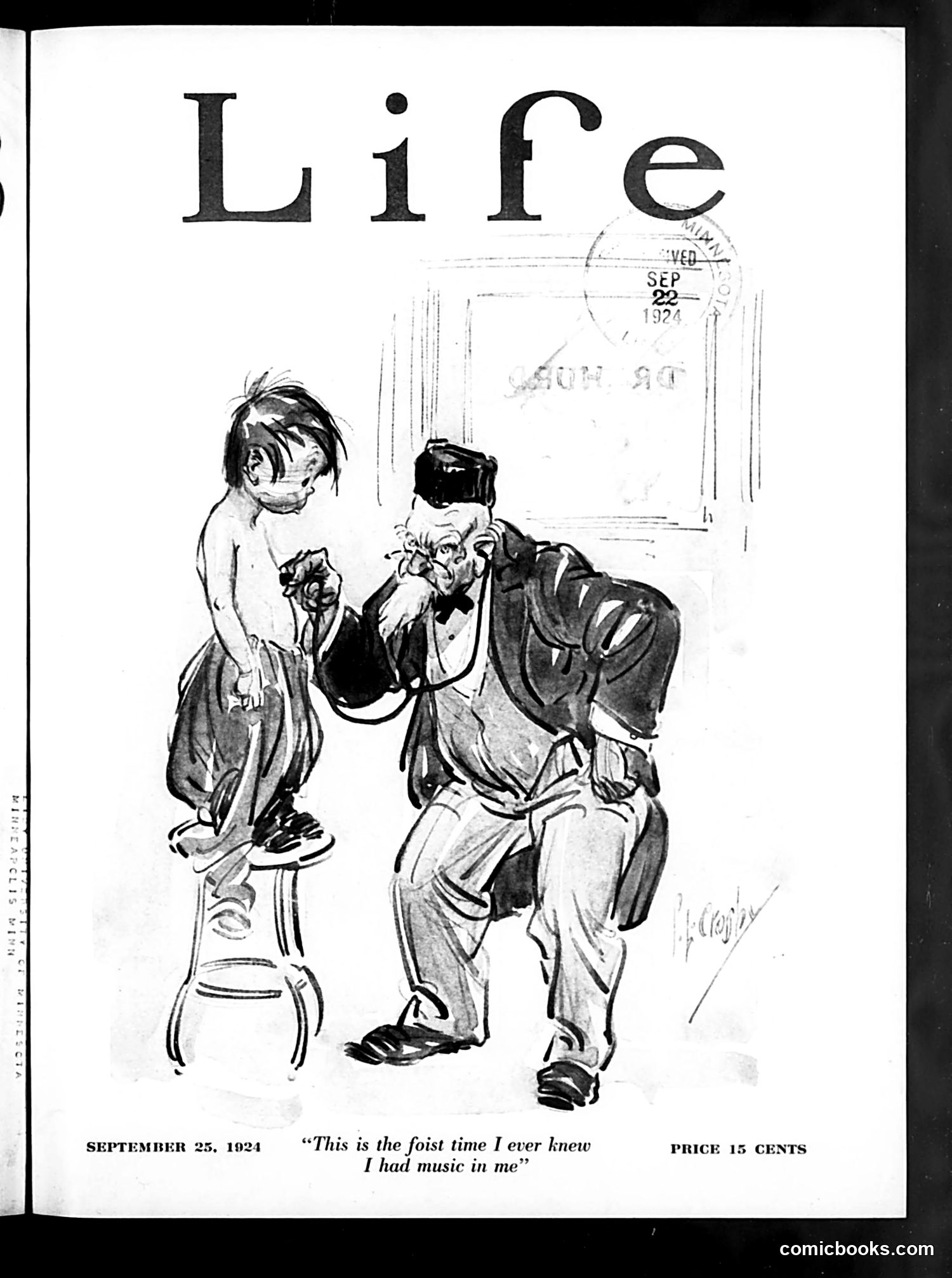
This cover illustration depicts a military or uniformed official (identifiable by his formal dress uniform and cap) examining a young child with a stethoscope. The child holds a flower, suggesting innocence or youth. The caption reads: "This is the foist time I ever knew I had music in me" — using deliberate dialect speech ("foist" for "first"), which was common comedic device in 1920s satire. The joke appears to satirize either: 1. Medical examinations of children, or 2. Military/institutional screening processes applied to the young The specific context—whether this references a particular 1924 policy, military draft, or public health initiative—remains unclear without additional period documentation. The humor relies on the incongruity of formal institutional authority examining childhood innocence.
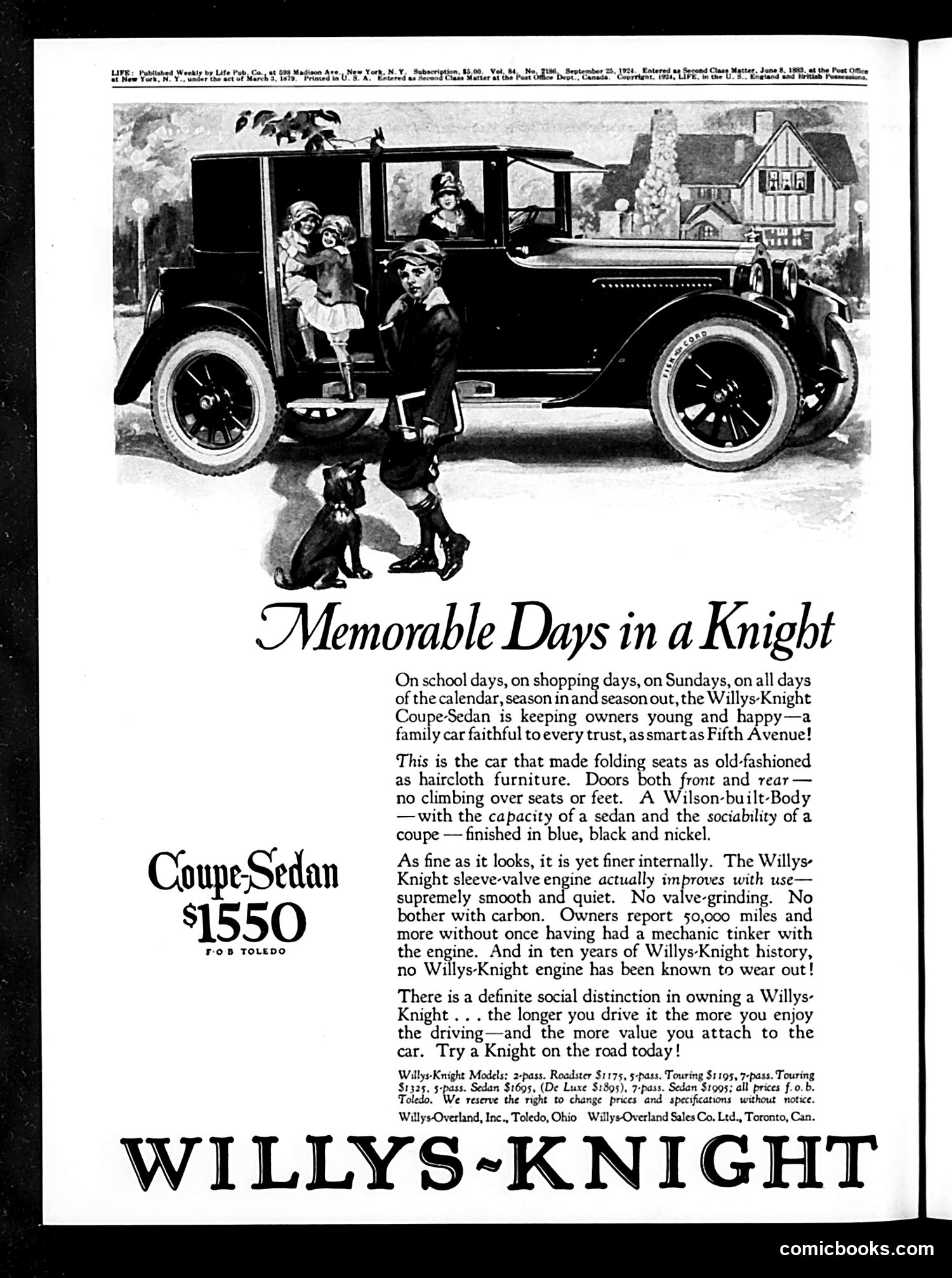
This is primarily a **Willys-Knight automobile advertisement**, not political satire. The ad promotes the Coupe-Sedan model at $1550, emphasizing its reliability for family outings ("school days, on shopping days, on Sundays"). The illustration shows a well-dressed family (parents and children) with their car and a small dog, representing aspirational middle-class domesticity. The headline "Memorable Days in a Knight" is a pun on the car's brand name. The text highlights technical features: folding seats, front and rear doors, a sleeve-valve engine that "improves with use," and exceptional durability (no engines known to wear out in ten years). It appeals to social status and the car's longevity as selling points. This reflects 1920s automotive marketing targeting prosperous families seeking reliable transportation.
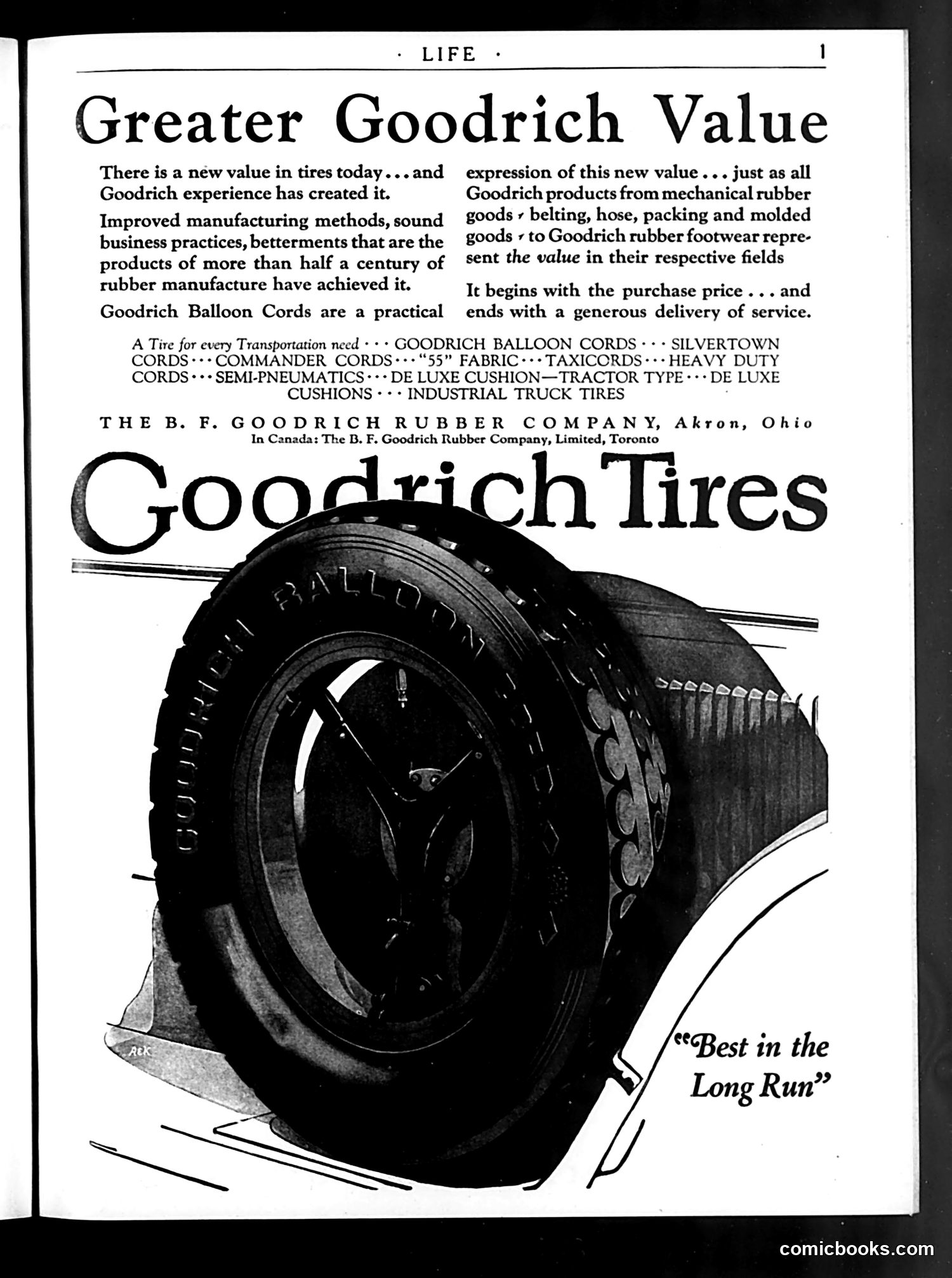
This is **not a political cartoon or satire**—it's a straightforward advertisement for Goodrich Tires, published in *Life* magazine (which contained both humor and ads). The page promotes "Greater Goodrich Value," emphasizing that improved manufacturing and business practices over fifty years have created superior tire products. The ad lists various Goodrich tire lines (Balloon Cords, Silvertown Cords, Commander Cords, etc.) for different vehicles. The central image shows a tire on a wheel, with the slogan **"Best in the Long Run"**—a pun on tire durability and distance performance. The company headquarters was in Akron, Ohio, a major rubber manufacturing center. This represents early 20th-century industrial advertising, emphasizing manufacturing innovation and product reliability rather than humor or political commentary.
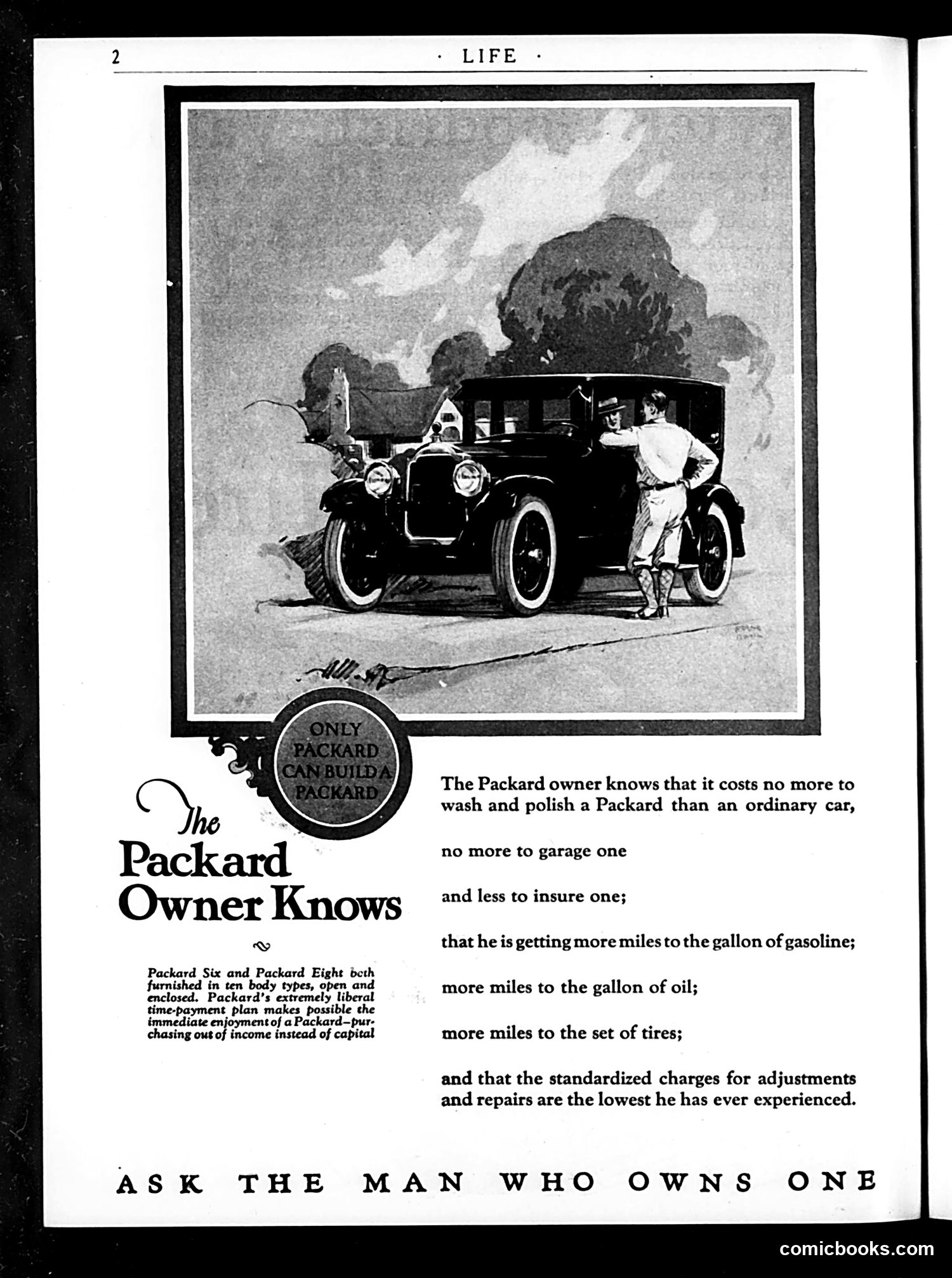
This is a **Packard automobile advertisement**, not satire or political commentary. The ad promotes the Packard Six and Packard Eight models by claiming ownership advantages: lower maintenance costs than ordinary cars, better fuel and oil efficiency, longer tire life, and cheaper repairs. The illustration shows a well-dressed man and woman with a Packard automobile, representing the aspirational lifestyle associated with the brand. The tagline "The Packard Owner Knows" positions the car as a choice for discerning, financially savvy buyers. The circular seal stating "Only Packard Can Build a Packard" emphasizes brand exclusivity. The final line "Ask the Man Who Owns One" was Packard's actual advertising slogan, appealing to word-of-mouth credibility and peer recommendation—a common marketing technique of this era (appears to be 1920s).
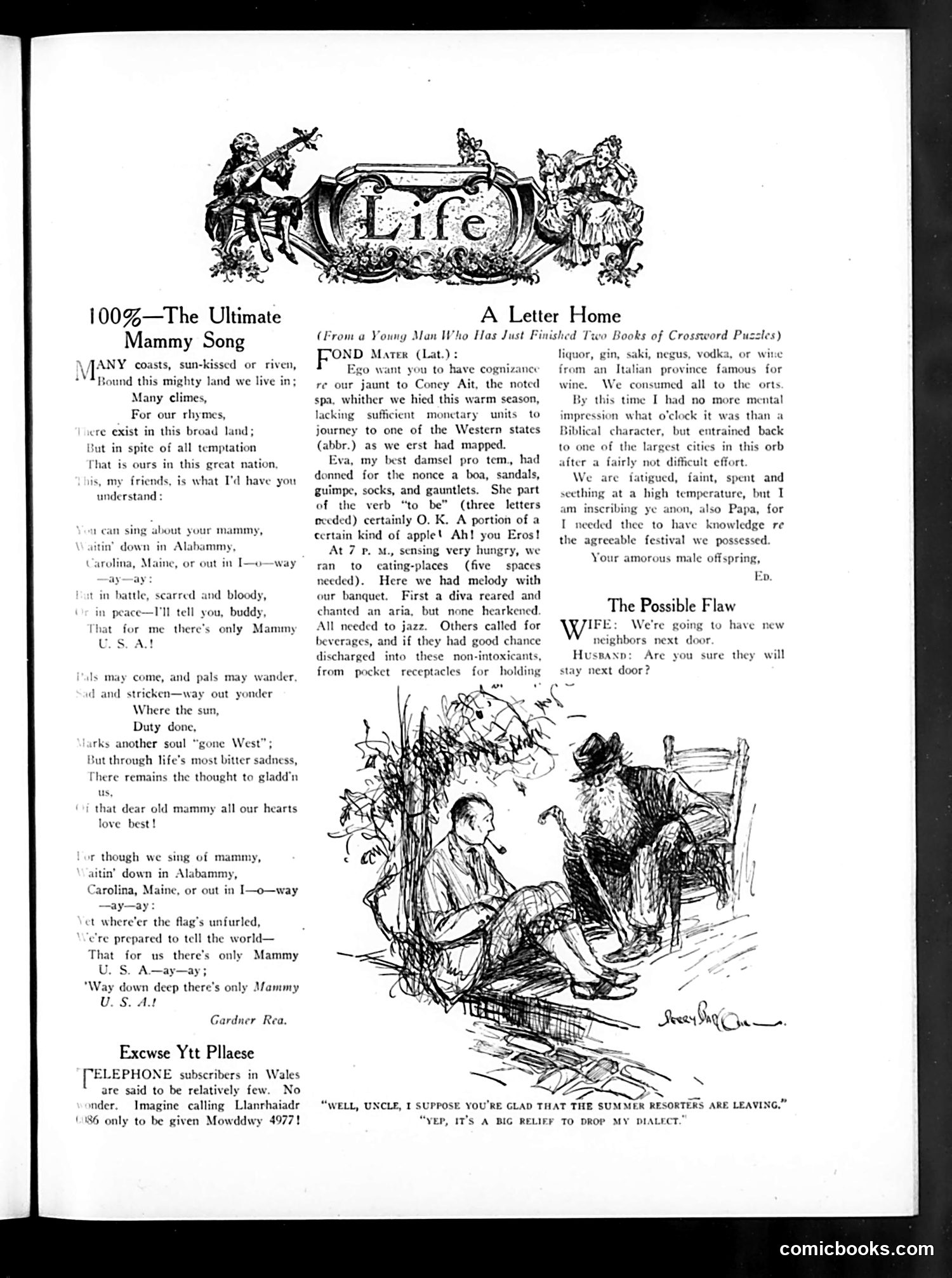
This page contains three distinct pieces: 1. **"100%—The Ultimate Mammy Song"**: A patriotic poem celebrating American motherhood, with references to regional pride ("Alabama," "Carolina, Maine"). 2. **"A Letter Home"**: A humorous account from a young man describing a vacation to a Western state, including dining experiences and socializing—likely satirizing the earnestness of travel correspondence. 3. **"The Possible Flaw"**: A cartoon showing a couple discussing new neighbors. The husband worries they won't stay, while the wife—sitting in a chair surrounded by potted plants—responds that losing them would be "a big relief to drop my dialect," suggesting she's been adopting an affected accent for social climbing. This satirizes class pretension and performative behavior among neighbors. The page combines patriotic sentiment with gentle social satire about American manners and aspirations.
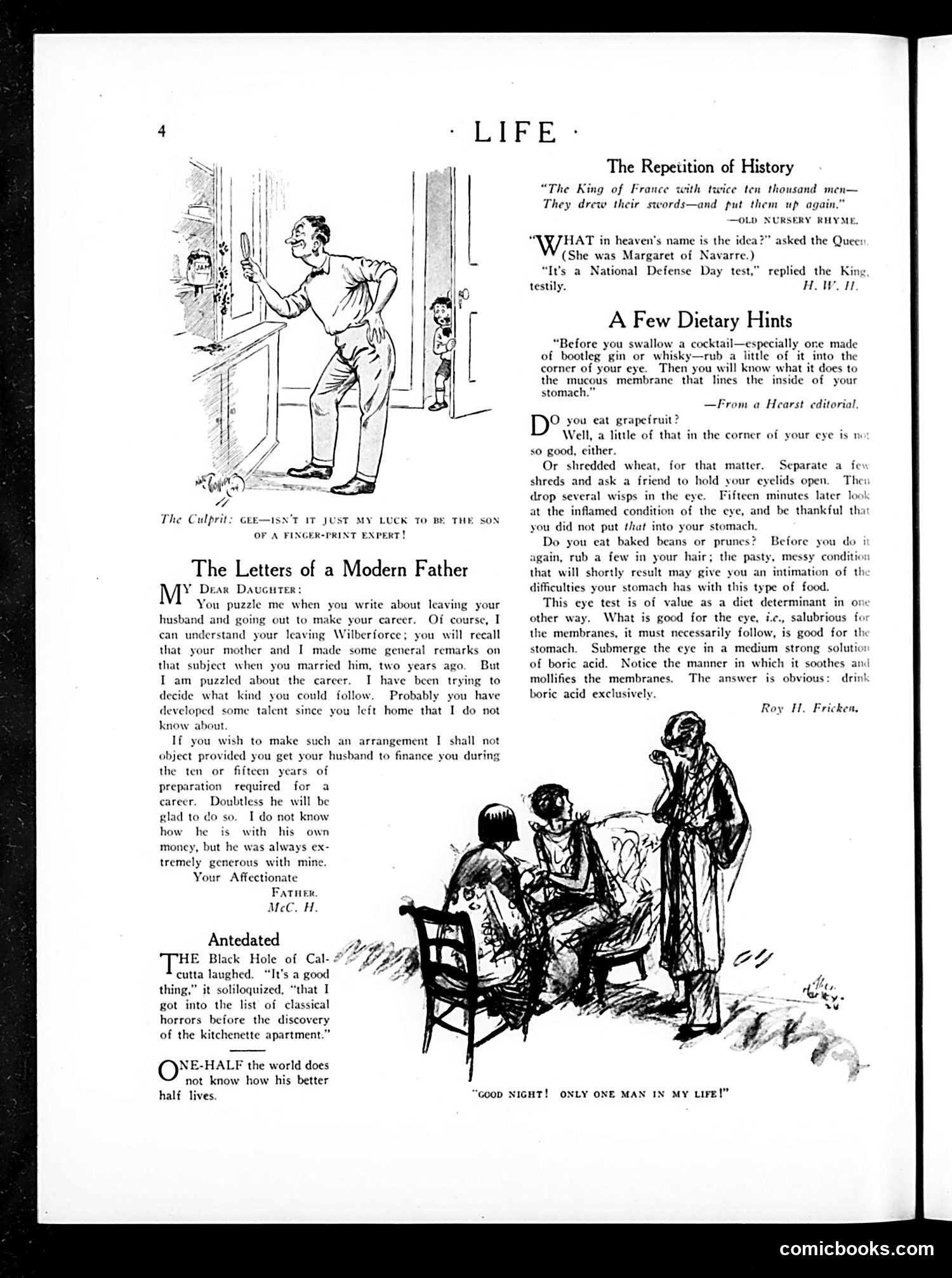
**Top Cartoon:** A man (appearing to be an expert or specialist) examines a door lock while a small child watches. The caption jokes that it's not "just my luck to be the son of a fingerprint expert"—suggesting the child is caught doing something wrong and fears his father's professional skills will expose him. **Main Content:** "The Letters of a Modern Father" presents a father's advice to his daughter about leaving her husband to pursue a career. He discusses financing her preparation period, displaying progressive (for the era) attitudes about women's independence and work. **Additional Sections:** Include "A Few Dietary Hints" offering humorous pseudo-scientific advice about consuming certain foods, and an "Antedated" anecdote about the Black Hole of Calcutta. The page reflects early-20th-century attitudes toward gender roles and family dynamics.
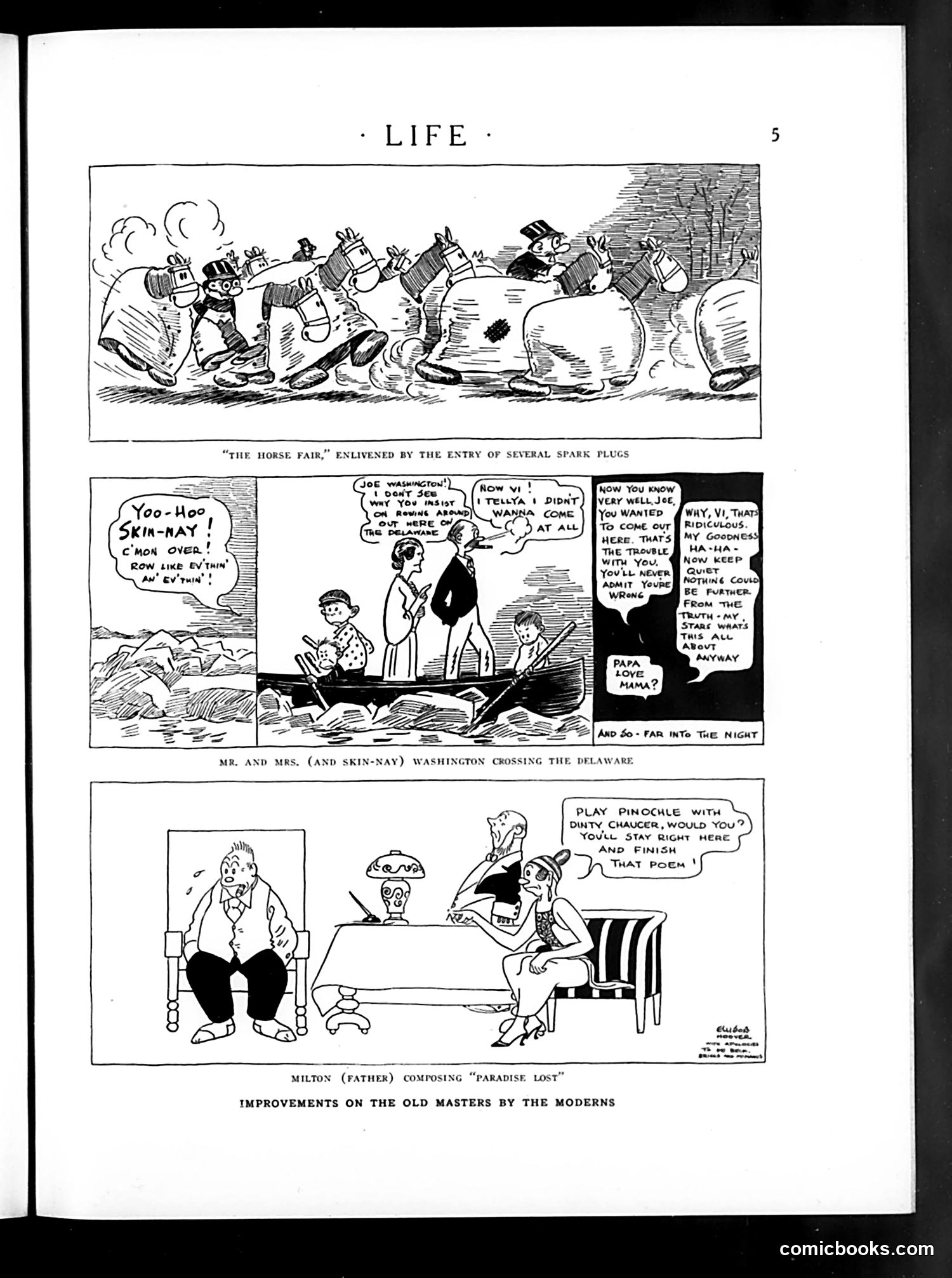
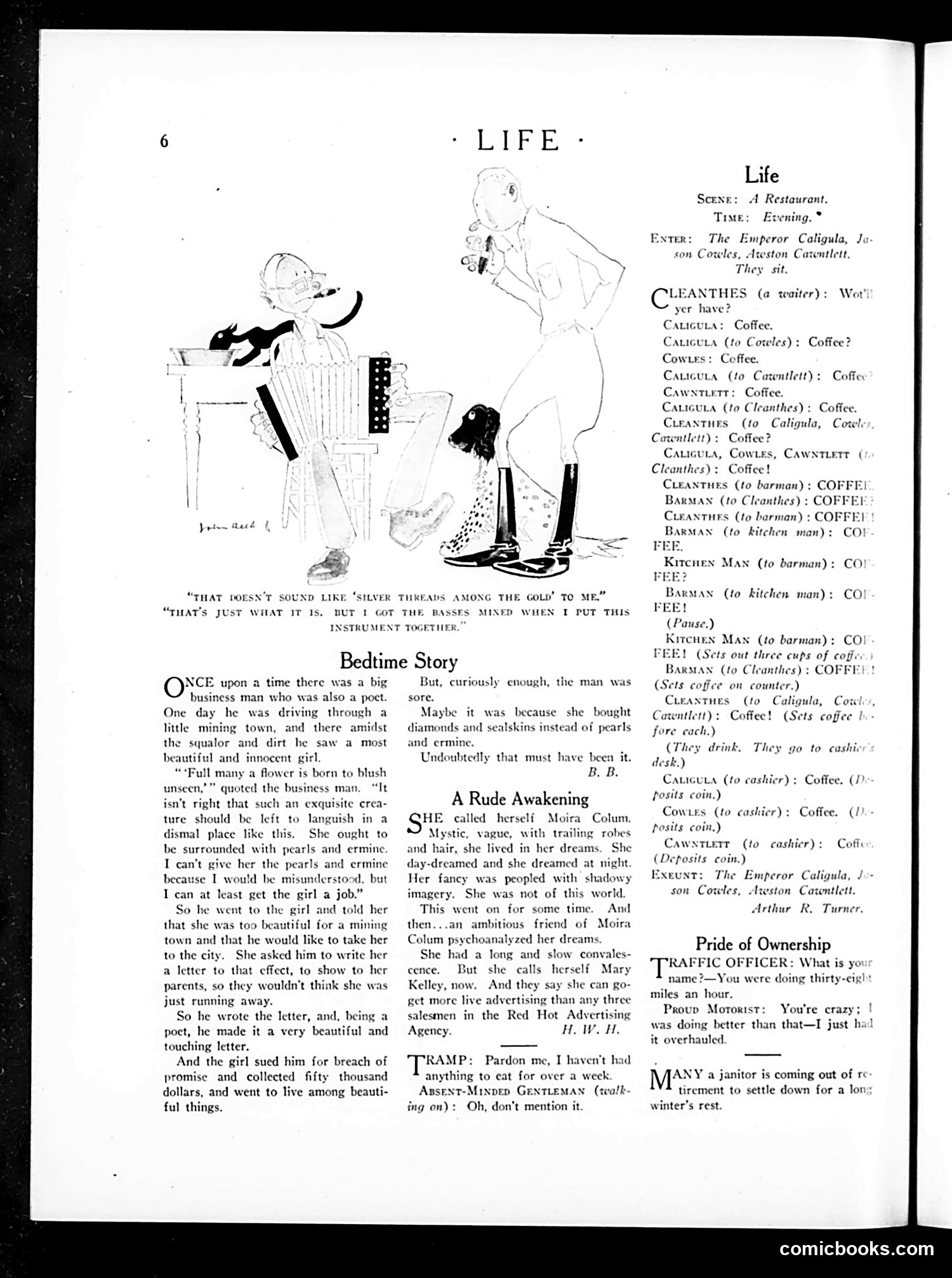
This page contains three separate satirical pieces: 1. **Top cartoon** ("That doesn't sound like 'silver threads among the gold' to me"): Shows a waiter serving coffee while a diner complains about the beverage's poor quality, satirizing restaurant service standards. 2. **"Bedtime Story"**: A narrative satire about a businessman-poet who writes a beautiful letter to secure a mining town girl's employment in the city. She sues him for breach of promise, collecting fifty thousand dollars. The joke mocks romantic deception and mercenary attitudes. 3. **"A Rude Awakening," "Pride of Ownership,"** and brief sketches: Short comedic vignettes about everyday social interactions and character types. The page exemplifies Life's satirical approach to American social pretensions, romance, and class dynamics of its era.
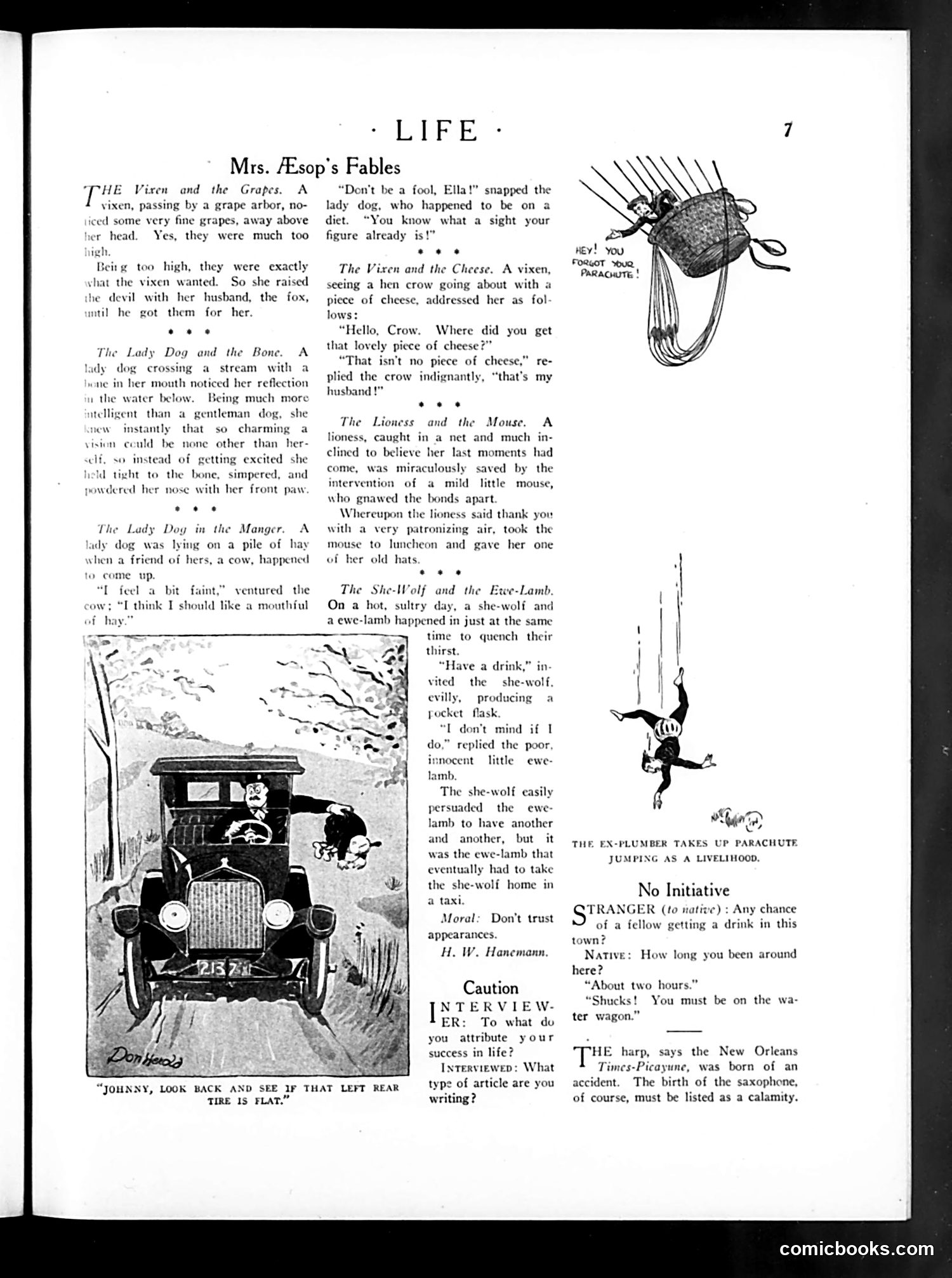
This page presents modernized adaptations of classic Aesop's fables with contemporary twists. The main illustration shows a car (appears to be 1920s-era) with the caption "JOHNNY, LOOK BACK AND SEE IF THAT REAR TIRE IS FLAT," satirizing careless automobile ownership. The fables use animals to mock modern behavior: a vixen manipulates her husband, a lady dog obsesses over appearance, and a she-wolf exploits an innocent ewe-lamb for drinks. The moral "Don't trust appearances" warns against deception. The "No Initiative" section presents a dialogue joke about someone newly arrived in town who must visit the water wagon—likely a Prohibition-era reference to temperance advocacy, contrasting with the she-wolf's pocket flask. The content satirizes urban 1920s manners, materialism, and moral hypocrisy.
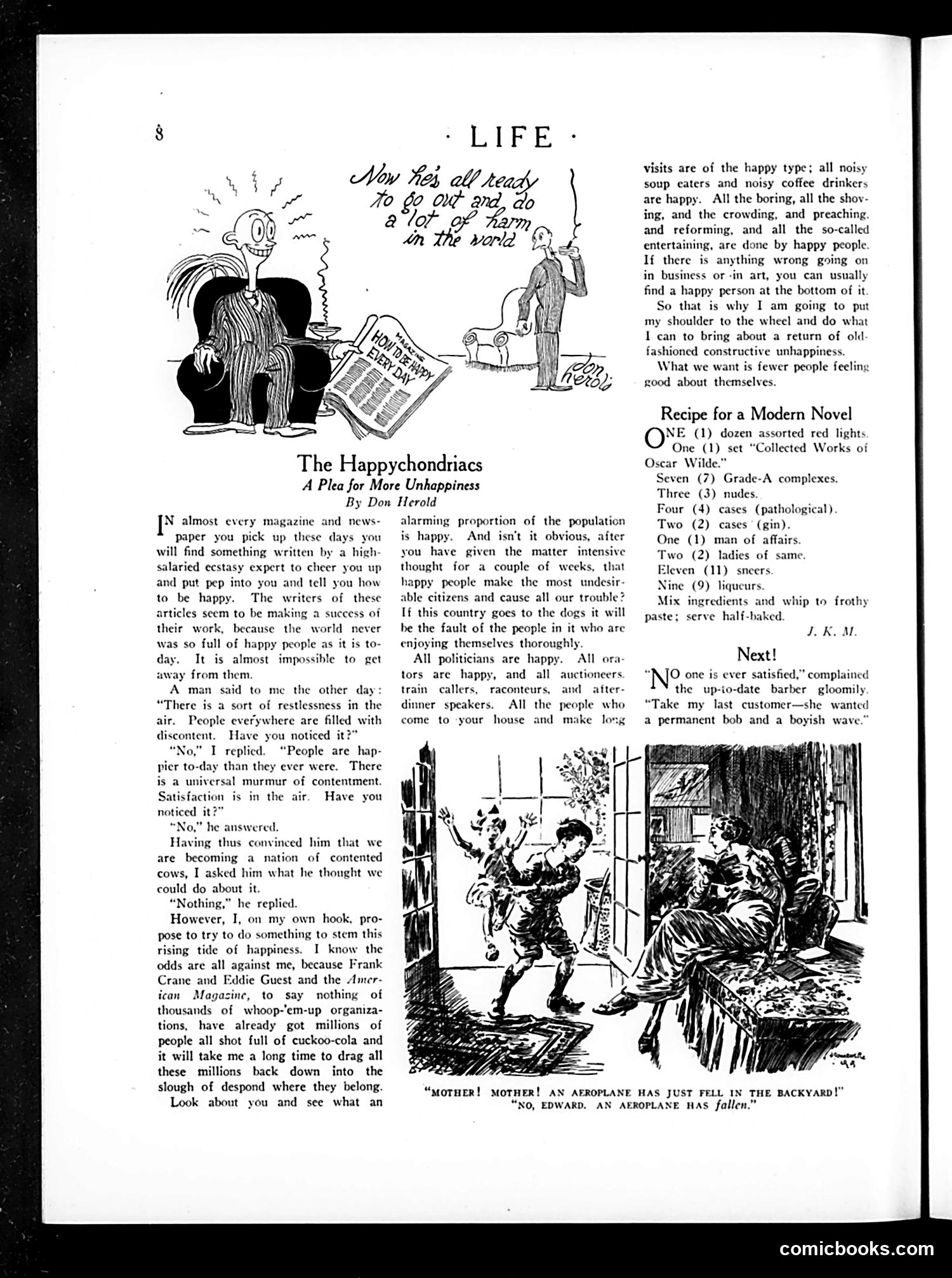
This satirical piece by Don Herald critiques what he calls "happiness" culture—the era's proliferation of magazine articles and expert advice claiming everyone *should* be happy. The cartoon's title, "The Happychondriacs," puns on "hypochondriacs" (people obsessed with illness). Herald argues that constant messaging about happiness actually makes people *miserable* by suggesting contentment is a problem requiring expert solutions. He notes politicians, auctioneers, and dinner speakers all peddle happiness advice, creating what he calls "cuckoo-cola" mass culture designed to distract from genuine discontent. The accompanying illustration shows domestic chaos—an airplane crash in the backyard—yet the caption suggests absurd optimism about such disasters, embodying Herald's point about forced cheerfulness despite real problems.
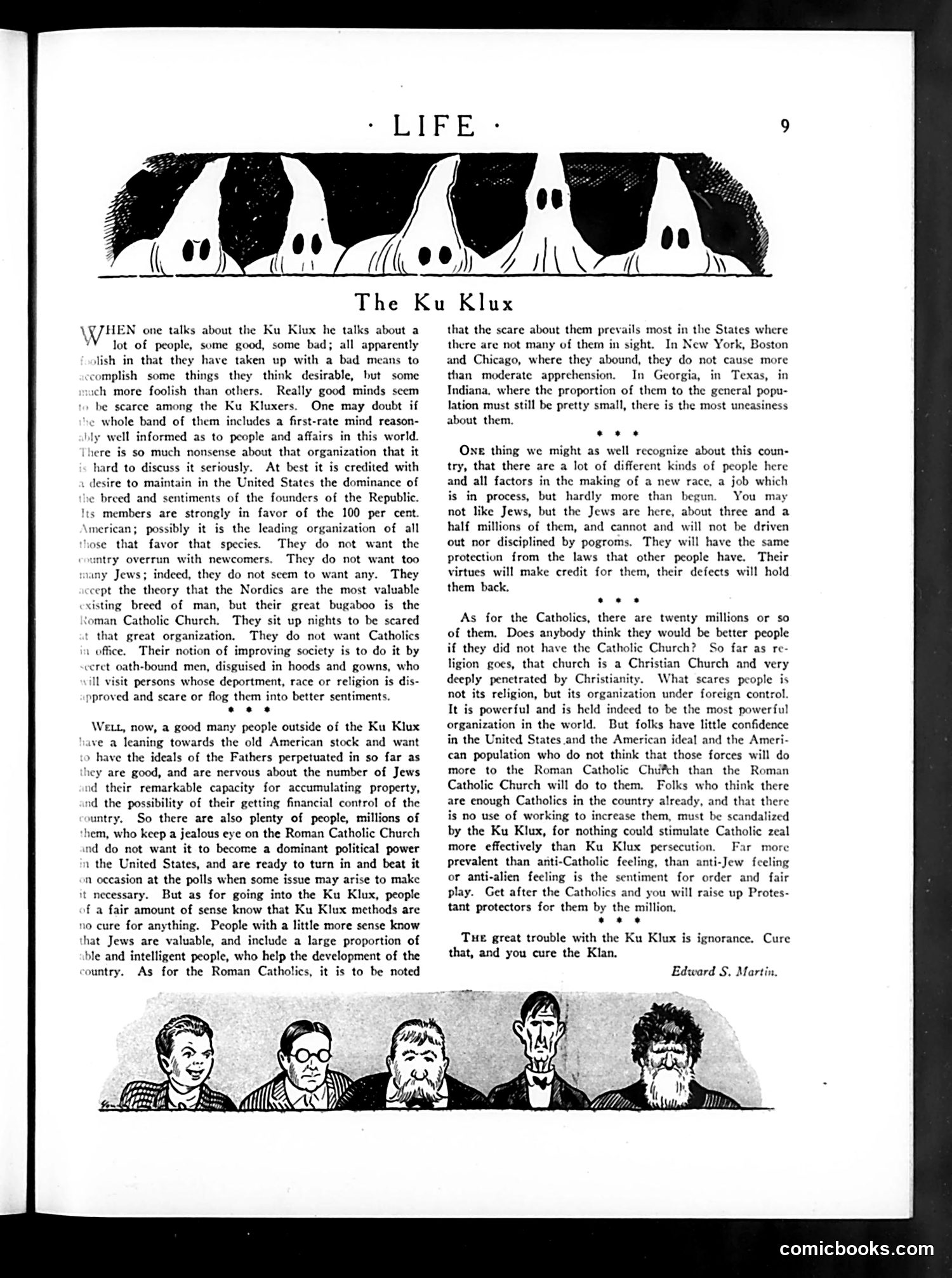
This page presents satirical editorial commentary on the Ku Klux Klan. The illustration at top shows KKK members in their characteristic robes and hoods. The text discusses how attitudes toward the Klan vary geographically—greater concern in northern cities (New York, Boston, Chicago) versus indifference in southern states. The author argues the real solution is education: "The great trouble with the Ku Klux is ignorance. Cure that, and you cure the Klan" (attributed to Edward S. Martin). The editorial also contrasts the KKK with other groups like Catholics and Jews, suggesting these communities pose no threat to American democracy. The bottom illustration depicts five diverse male faces—likely representing different ethnic or religious groups—countering the Klan's exclusionary ideology.
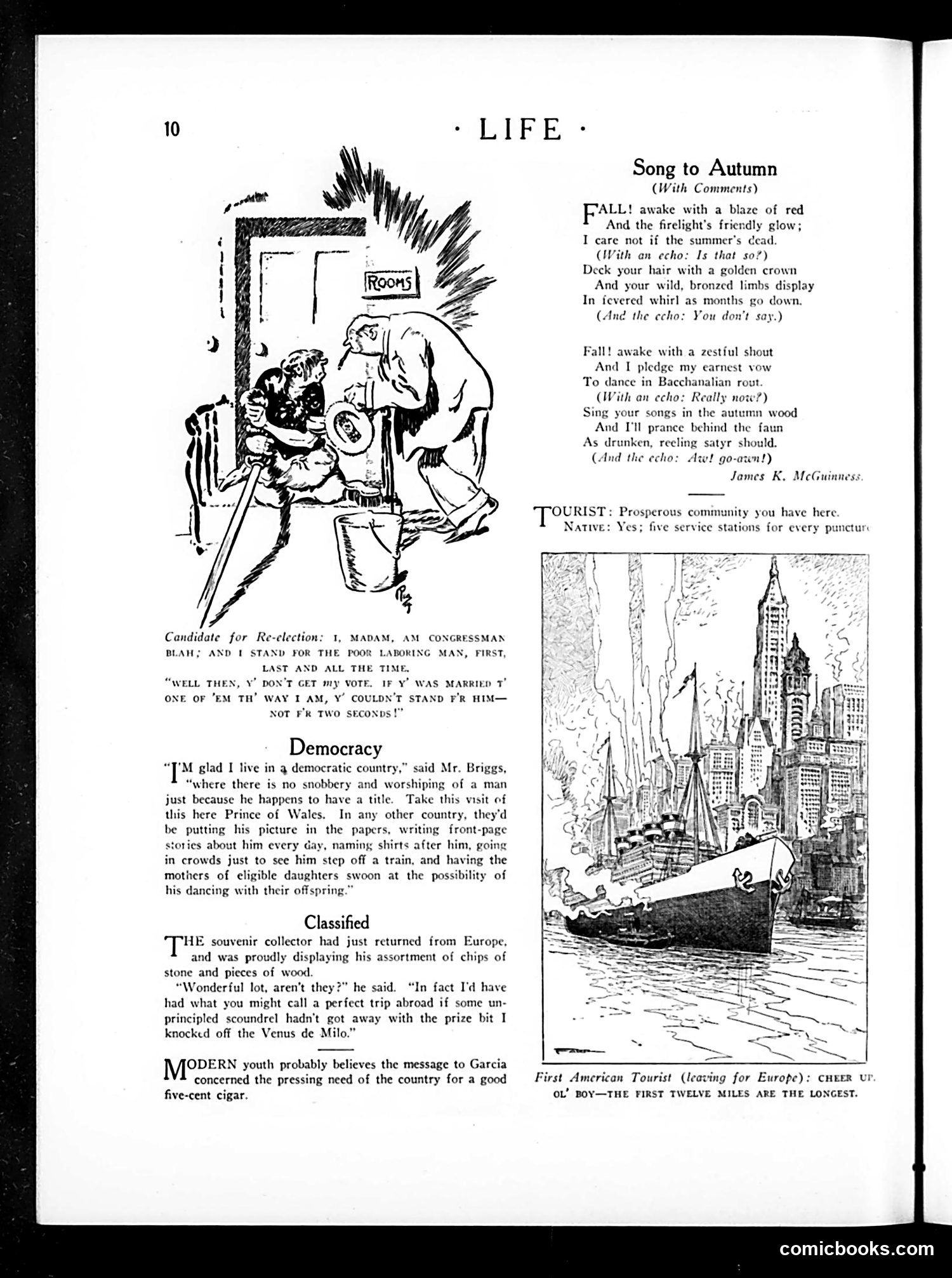
This page contains three satirical pieces on American life and politics: **Top cartoon**: A caricatured politician (labeled "Candidate for Re-election") appeals to voters by claiming to support "the poor laboring man first," yet admits he wouldn't help if one married into his family—exposing hypocrisy about class values. **"Democracy" section**: Mr. Briggs praises living in a democratic country where a prince's visit doesn't trigger excessive press coverage and social climbing, contrasting this favorably with monarchies. **"First American Tourist" sketch**: Shows a ship leaving New York with a tourist's comment about the journey being long—social commentary on American travel experiences. The page overall satirizes political dishonesty, class pretension, and American attitudes toward Europe and democracy during this period.
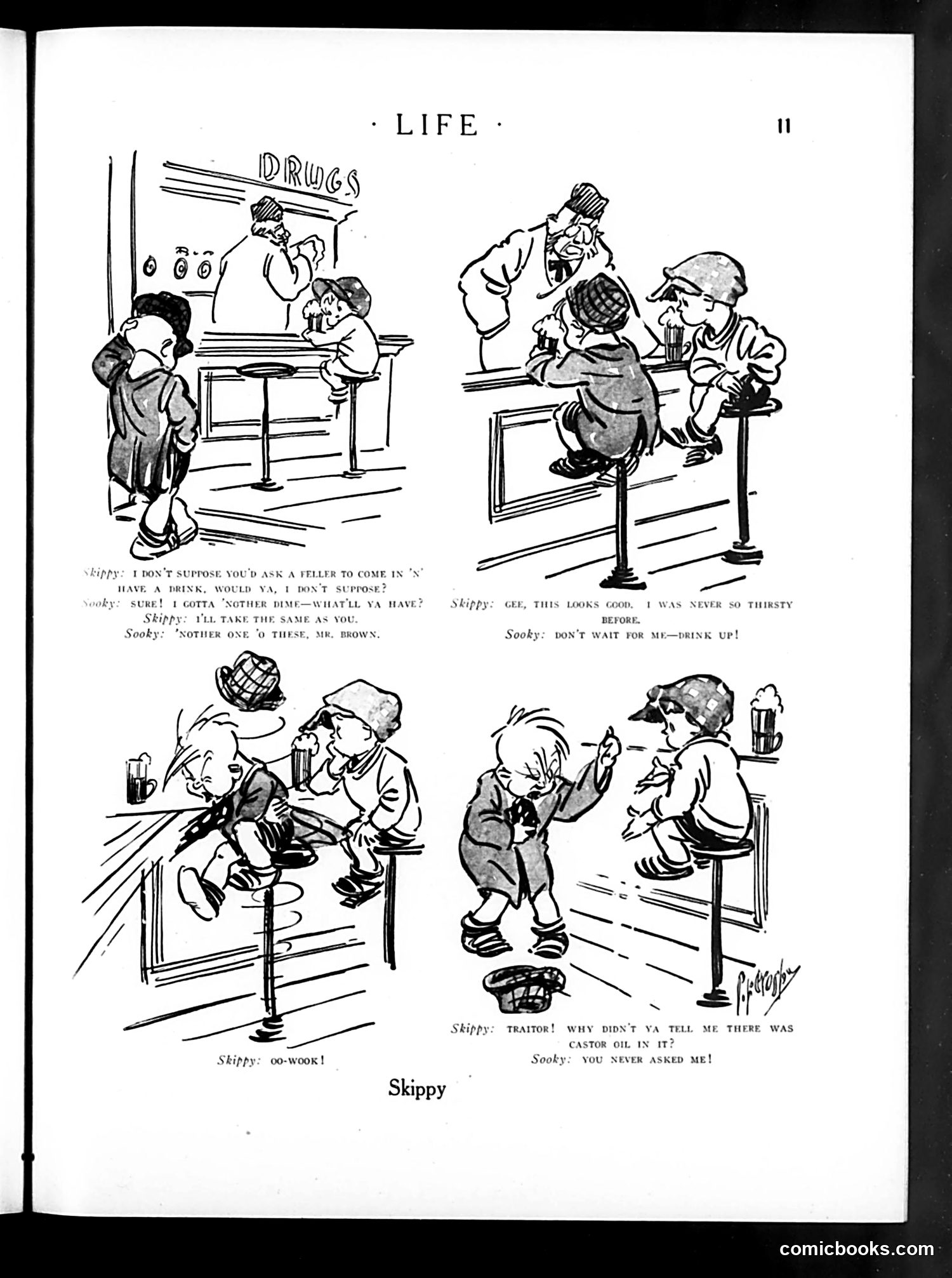
This is a multi-panel comic strip titled "Skippy" depicting a young boy and his friend "Sooky" attempting to buy alcohol at a drugstore during Prohibition (when alcohol sales were legally banned in the U.S.). The satire targets Prohibition's ineffectiveness: children easily circumvent the law by using transparent excuses ("have a drink," "take medicine"). The drugstore clerk sells them what appears to be beer despite their obvious youth and thin pretenses. The humor satirizes how Prohibition failed to prevent alcohol consumption—even children could access drinks. "Castor oil" reference suggests drugstores legally sold alcohol as "medicine," exploiting a loophole. The strip mocks both the law's naïveté and widespread public flouting of it during this era.
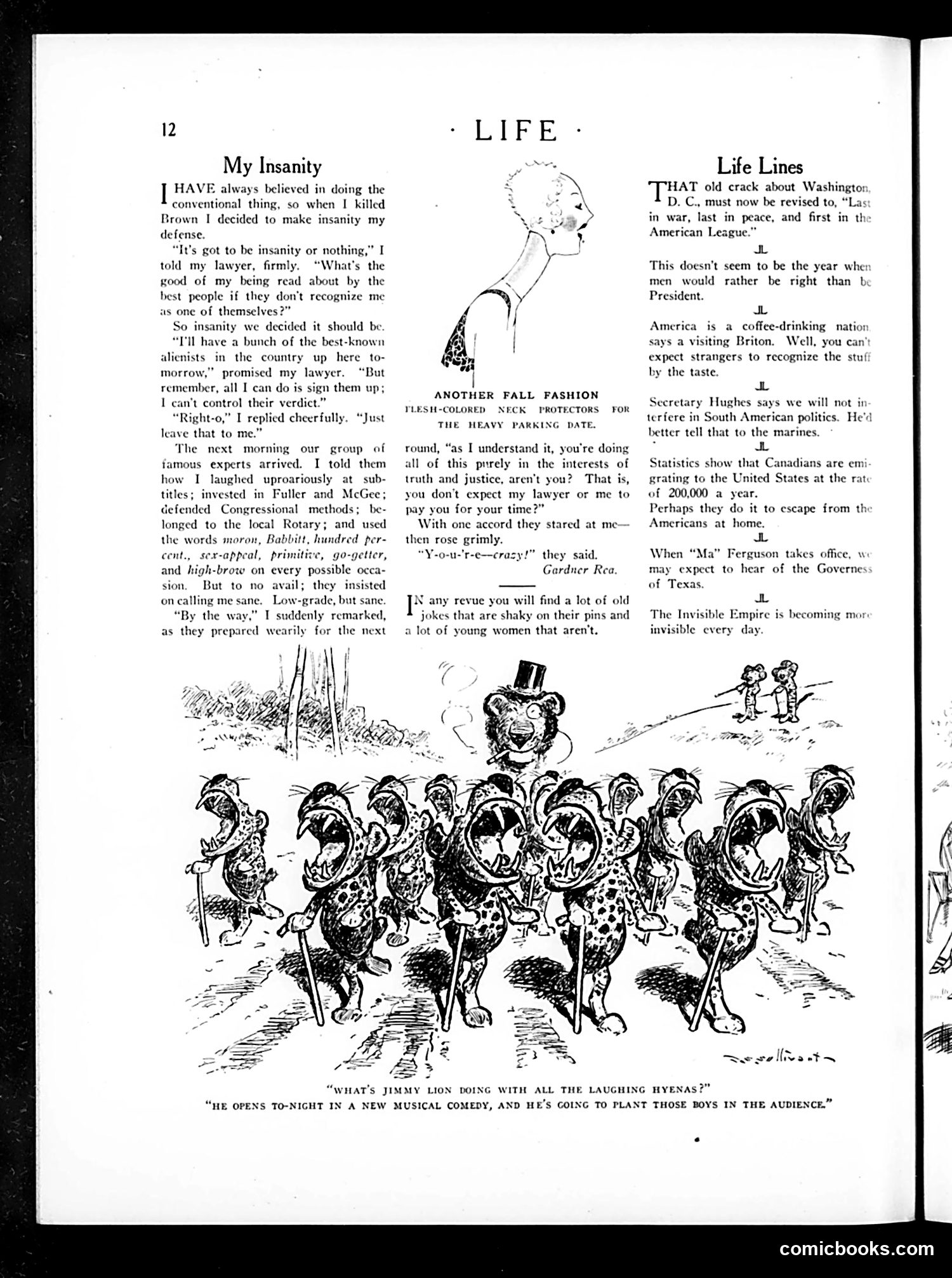
This page contains a satirical article "My Insanity" about using an insanity defense in court, alongside a large cartoon depicting a lion in a top hat conducting an orchestra of hyenas. The main cartoon satirizes a theatrical production, with the caption explaining: "What's Jimmy Lion doing with all the laughing hyenas? He opens tonight in a new musical comedy, and he's going to plant those boys in the audience." The joke references a common vaudeville/theater practice of planting shills (paid audience members) to generate fake laughter and enthusiasm. The hyenas—typically associated with mockery—represent these planted laugh-producers. The well-dressed lion conductor symbolizes the theatrical impresario orchestrating manufactured entertainment and artificial audience response, satirizing show-business deception and the artificiality of commercial entertainment.
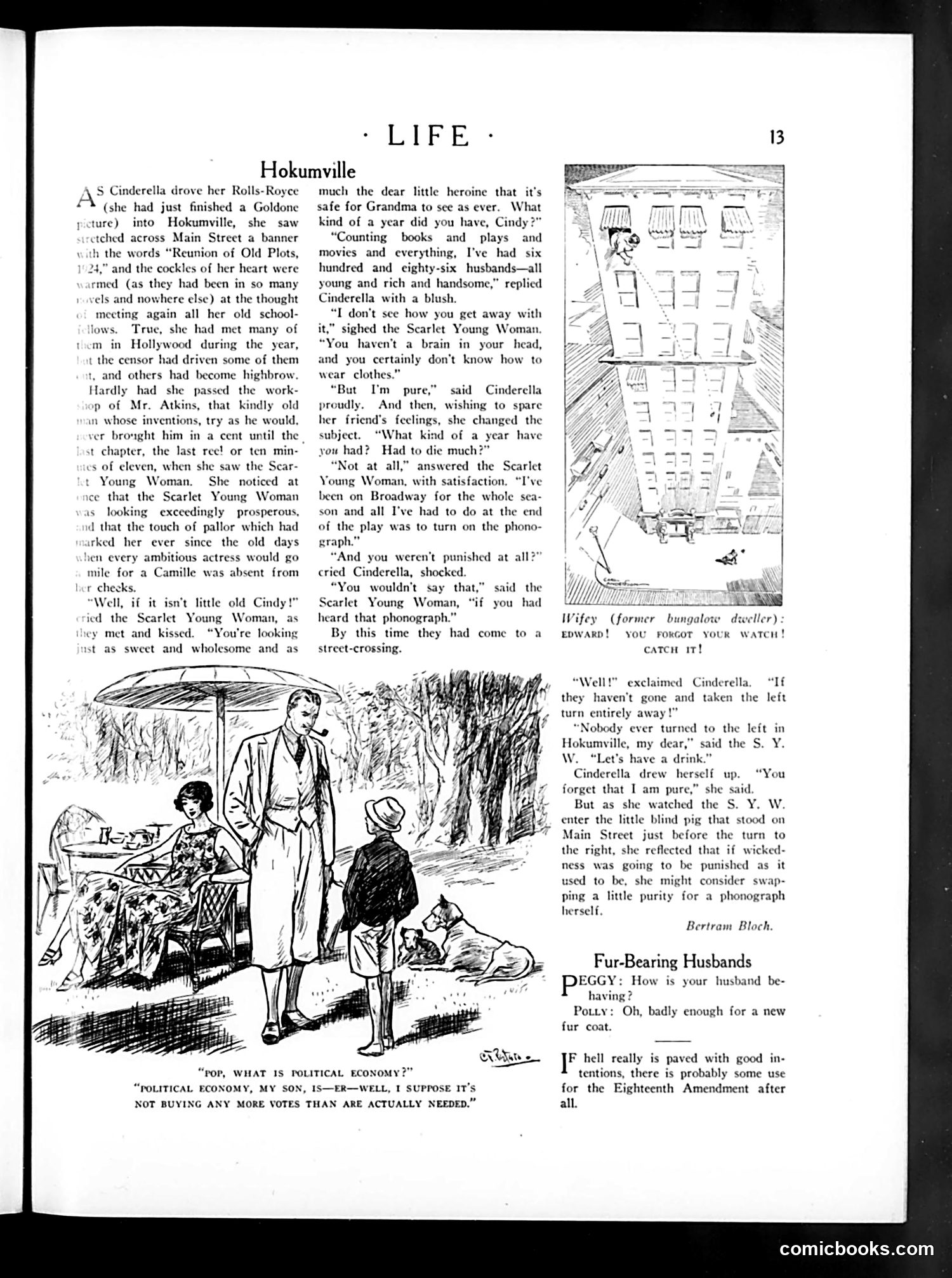
The cartoon depicts a father explaining "political economy" to his son while they observe people at what appears to be a public gathering or market. The father's caption reads: "Political economy, my son, is—er—well, I suppose it's not buying any more votes than are actually needed." This is a direct satirical jab at political corruption in early 20th-century America. The joke relies on the assumption that vote-buying was a common, accepted practice among politicians—so much so that a father casually explains it to his child as basic economics. The satire criticizes both the prevalence of electoral bribery and the cynical acceptance of such practices as normal business. The humor comes from the father's matter-of-fact explanation of an essentially criminal activity.
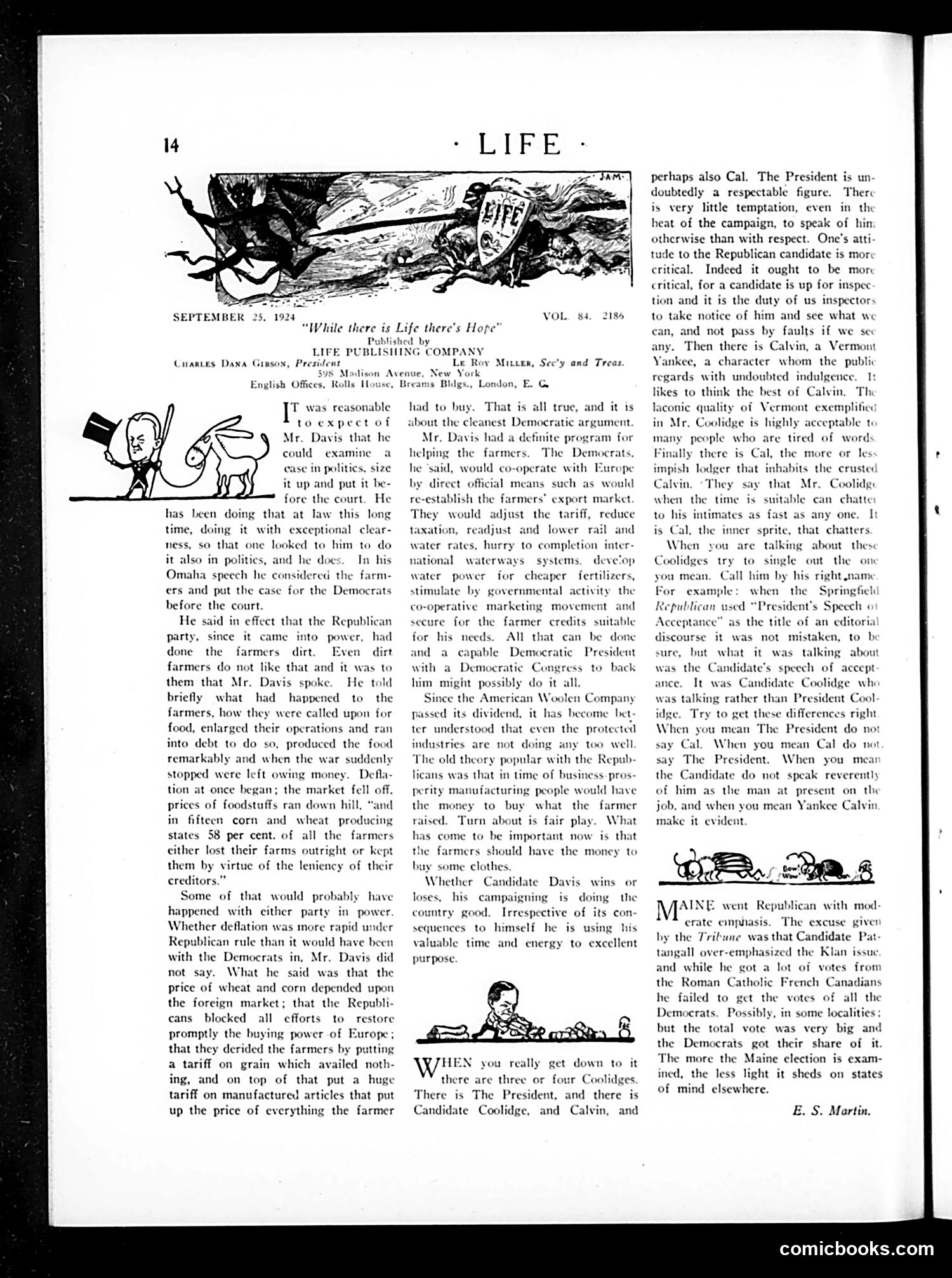
This page discusses the 1924 U.S. presidential campaign. The article critiques both major candidates and introduces three "Coolidges"—President Coolidge, Candidate Coolidge, and Calvin (apparently a Vermont character representing Coolidge's inner nature). The cartoons appear to satirize presidential politics of the era, with caricatured figures representing political figures or types. The text argues that inspecting candidates carefully is voters' duty, and suggests tension between Coolidge's public respectability and private character. The article by E.S. Martin analyzes campaign rhetoric about farming policy and tariffs, questioning whether either candidate genuinely serves farmers' interests versus manufacturing interests. It critiques both Democratic and Republican approaches to agricultural economics.
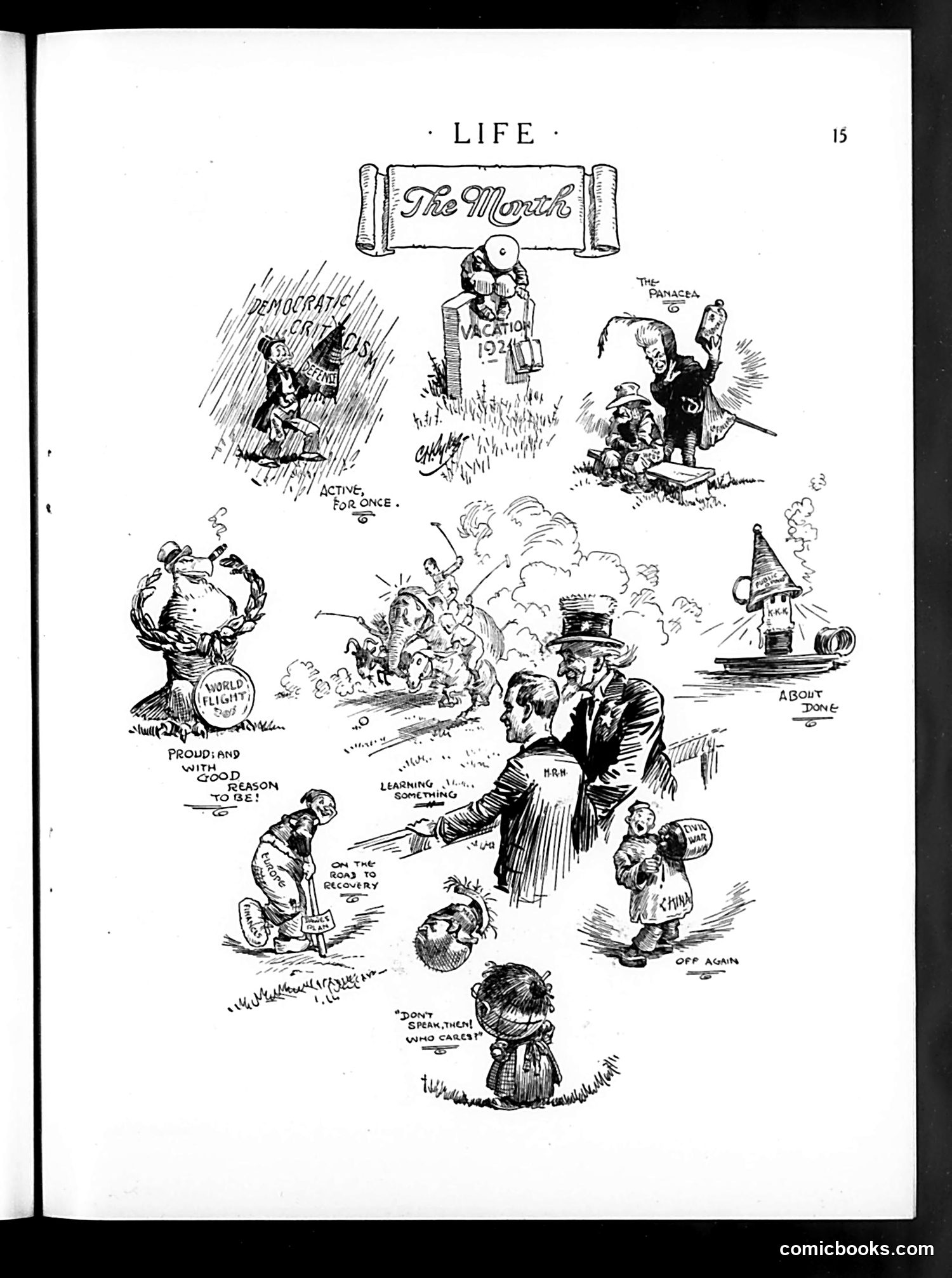
This page presents satirical sketches about 1920s American life and politics. The central figure appears to be a politician or public figure surrounded by various social commentary vignettes: - "Active, For Once" depicts Democratic action (likely referencing the 1924 election mentioned) - "Promised Land" with "Reason to be" suggests commentary on post-war recovery hopes - "Learning Something" and "On the Road to Recovery" reference economic or political lessons - "About Done" and "Off Again" suggest cyclical political or social patterns - Various small figures labeled with phrases like "World Flight" and "The Pamaces" [sic] satirize contemporary news events and public preoccupations The overall tone mocks politicians' inconsistency and the public's shifting concerns during the 1920s period.
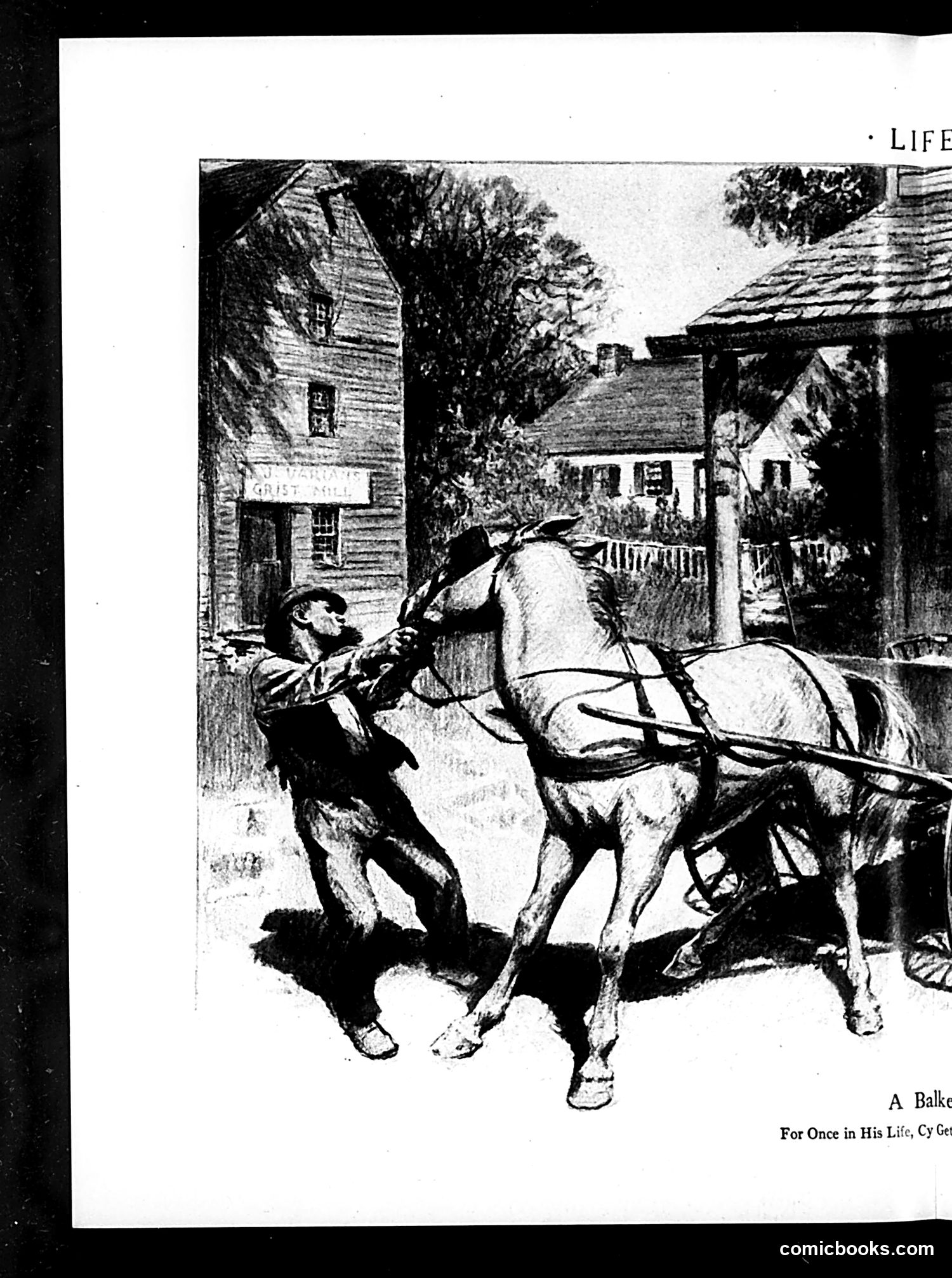
This appears to be a historical illustration from *Life* magazine showing a man struggling to control a horse-drawn cart or wagon in front of colonial-era buildings. The OCR text is fragmentary ("A Balke" and "For Once in His Life, Cy Ge"), making the specific reference unclear. The image likely depicts a comedic scenario about loss of control or an unexpected reversal—suggested by the caption's phrase "For Once in His Life," implying this is an unusual occurrence for the character. The man's physical struggle with the horse suggests slapstick humor common to early *Life* satire. Without complete text or clearer identification of the figures referenced, I cannot definitively explain the political or social satire intended.
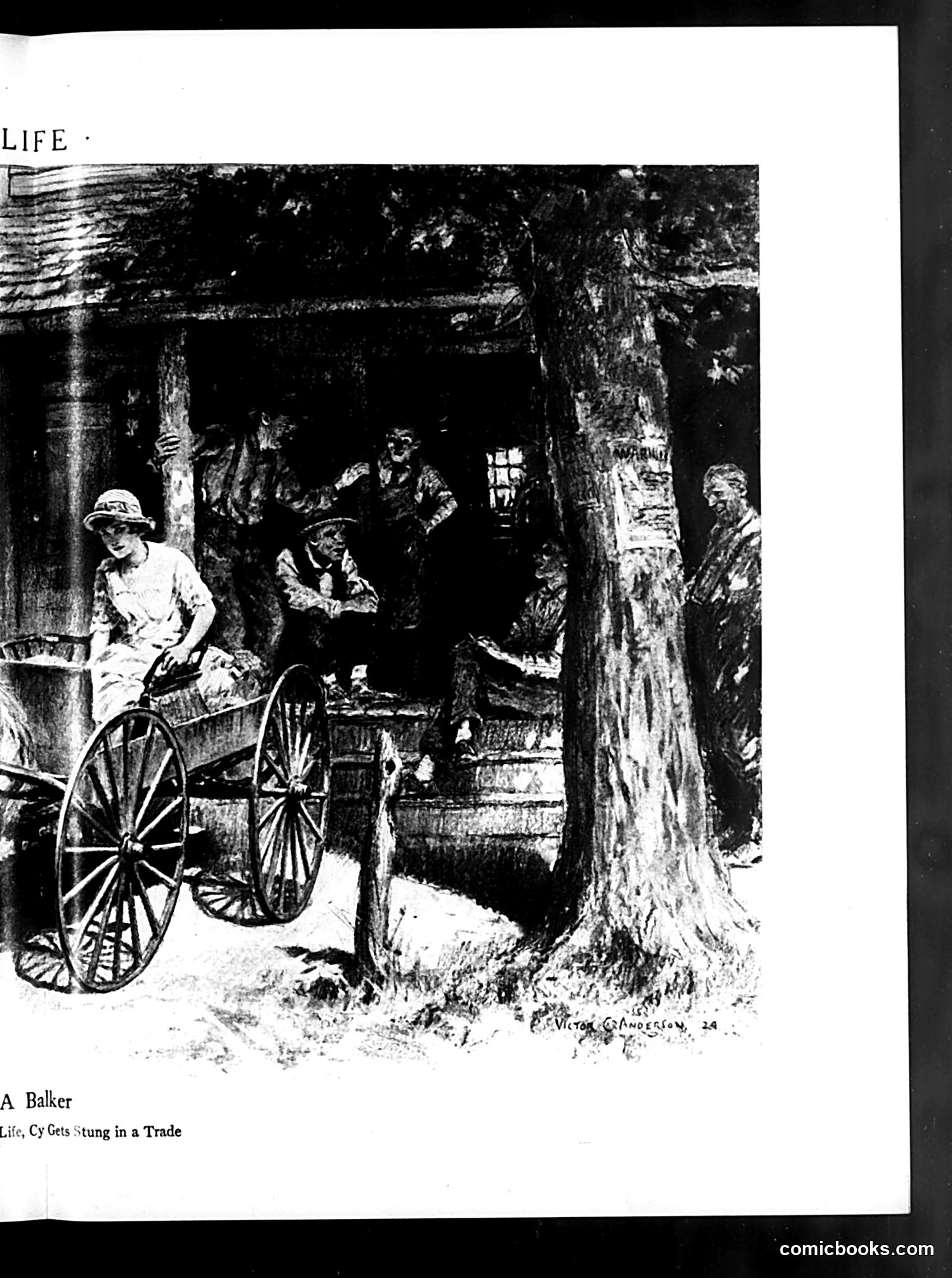
This appears to be a satirical illustration showing a transaction or negotiation scene. A woman in a hat operates a hand cart or small vehicle on the left, while several men gather around what looks like a shop or trading establishment. The title suggests "Cy" (likely a character name) has made a poor deal—he's been "stung" in a trade. The satire likely mocks either poor business acumen, unfair dealing practices, or perhaps the naive nature of rural or working-class commerce. The woman's prominent positioning and the gathering of observers suggest the humor centers on a public or embarrassing transaction. Without clearer context about the specific historical moment or "Cy" character's identity in Life magazine's regular lineup, the exact target of the satire remains unclear, though it appears to comment on everyday commercial practices or character types of the era.
This is a theater review comparing two recent Broadway plays about World War I: "Nerves" and "What Price Glory?" **The Satire:** The critic contrasts how each play depicts the war. "Nerves" romanticizes it through an elite lens—portraying pilots as Ivy League fraternity members ("Bones," "Deke"), making war seem like exclusive club membership. "What Price Glory?" shows the unglamorous reality: enlisted marines fighting over a French barmaid, speaking realistically (avoiding words like "democracy"), motivated by mud and survival rather than patriotic ideals. **Key Point:** The review defends both plays' right to exist, but argues "What Price Glory?" rings truer because it depicts ordinary soldiers' actual experience. The critic notes playwright Stallings earned credibility by losing a leg serving as a Marine in France—his authenticity counters idealized portrayals. **Context:** Written roughly 1924-25, this reflects post-WWI disillusionment with war glorification, and the era's emerging realism in American theater rejecting Victorian sentimentality.
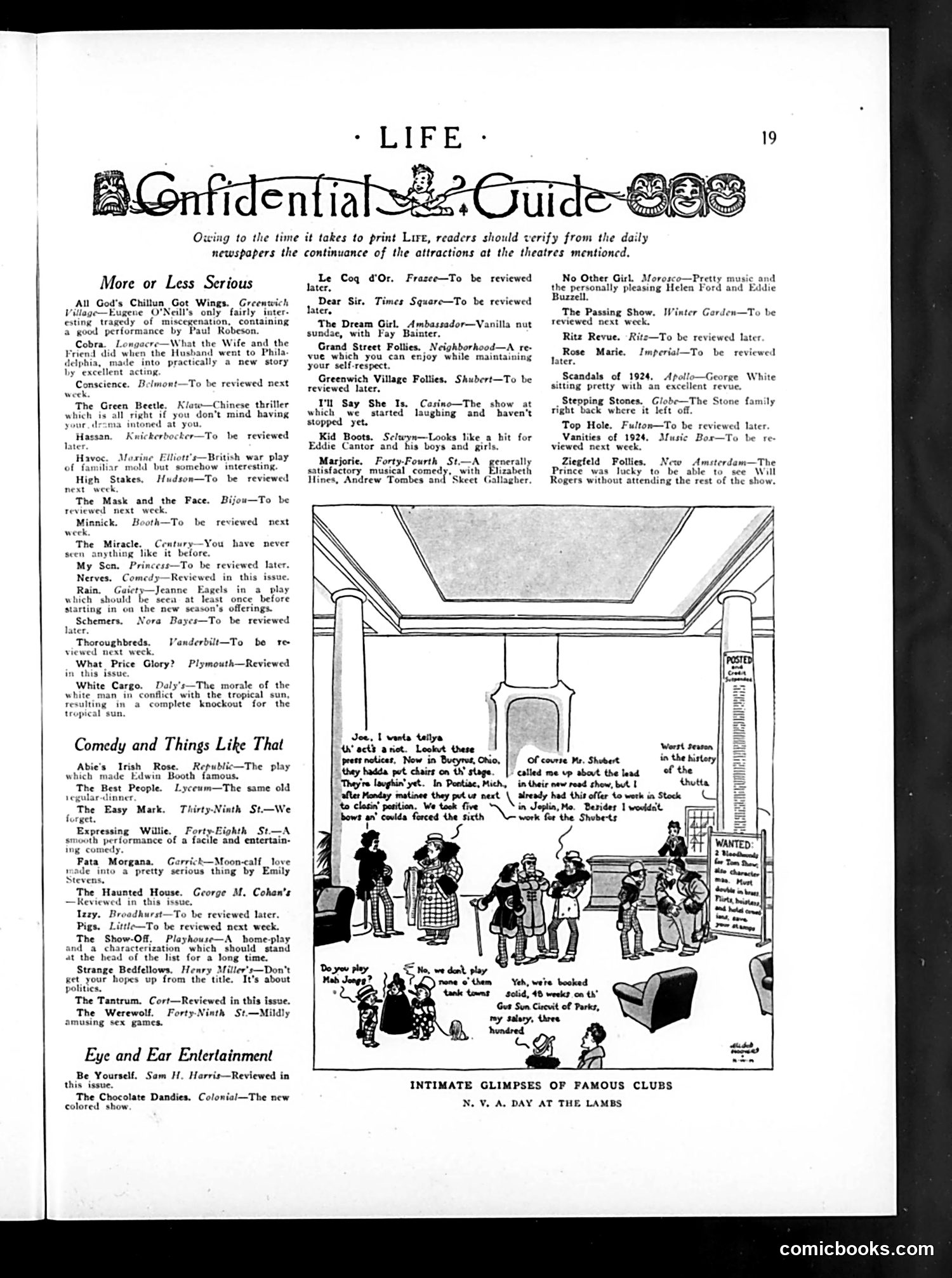
This cartoon depicts a scene at the Lambs Club, a prestigious theatrical actors' club in New York. The illustration shows various performers and theatrical figures in what appears to be a casual gathering or audition space. The dialogue bubbles reference theatrical business—mentions of working on shows, salary negotiations, and casting discussions. The humor appears gentle and insider-focused, capturing the everyday chatter of theater professionals networking and discussing their work. The cartoon serves as visual relief on a page otherwise dense with theater reviews and listings. It illustrates the social side of theater life rather than satirizing politics or current events. The "N.W.A. Day" likely refers to a specific club event or gathering of members. The overall tone is affectionate portrayal of theatrical culture rather than sharp satire, typical of Life magazine's entertainment coverage of the 1924 theater season.
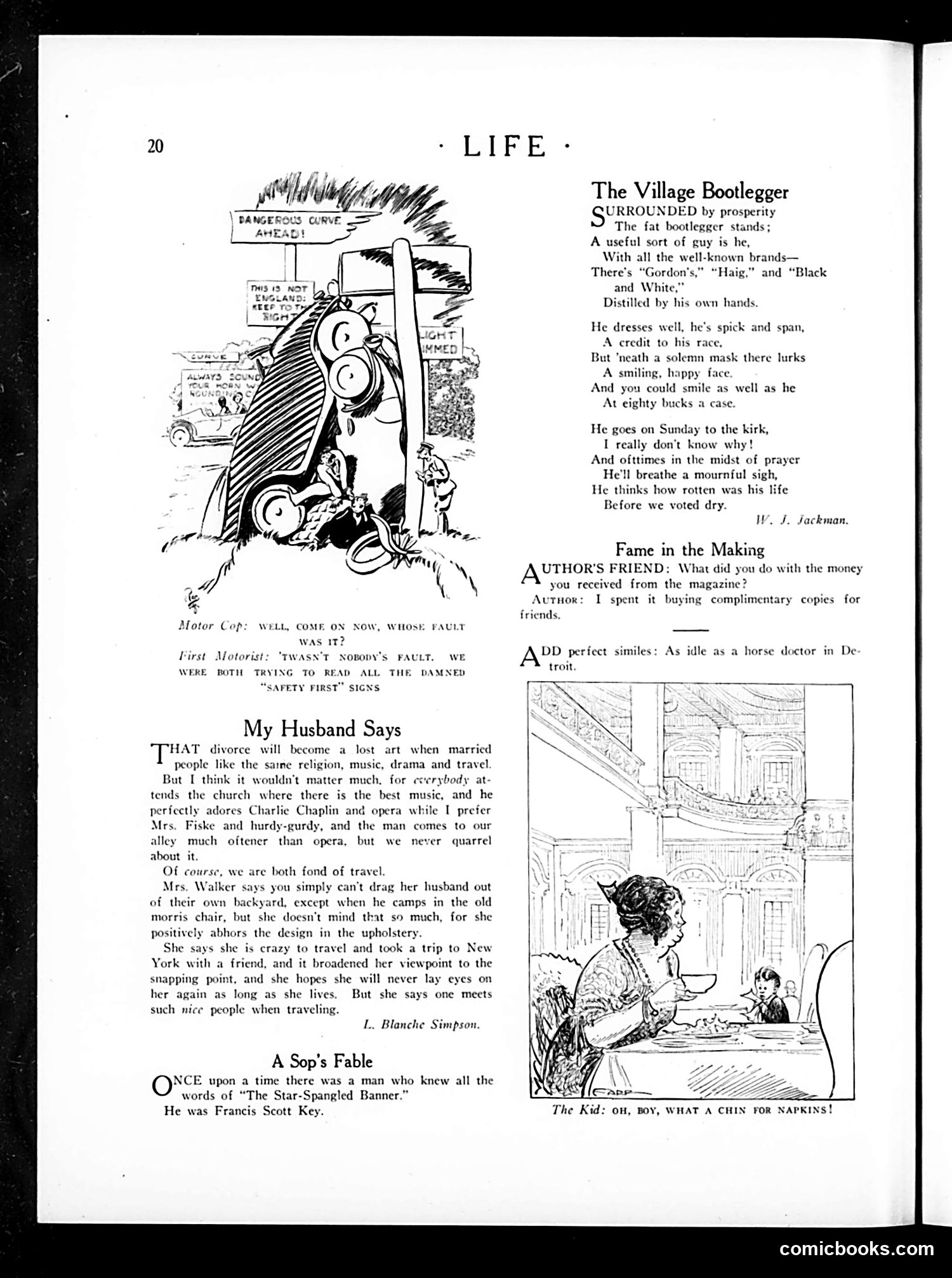
This page contains satirical commentary on Prohibition-era America (post-1920). **"The Village Bootlegger"** is a poem mocking the irony of Prohibition: the illegal liquor dealer has grown wealthy and respectable, dressing well and attending church, yet profits from selling banned alcohol brands like "Gordon's" and "Haig" at inflated prices ("eighty bucks a case"). The satire is that he's thriving precisely *because* America "voted dry"—Prohibition created his lucrative black market. **Other pieces** on the page include light humor: a Motor Cop cartoon about drivers distracted by safety signs; "My Husband Says," a domestic comedy about marital disagreements; and "A Sop's Fable," which appears to be a humorous reference to Francis Scott Key. The overall tone reflects Life's satirical stance toward Prohibition as economically absurd and culturally contradictory, enriching criminals while claiming moral purpose.
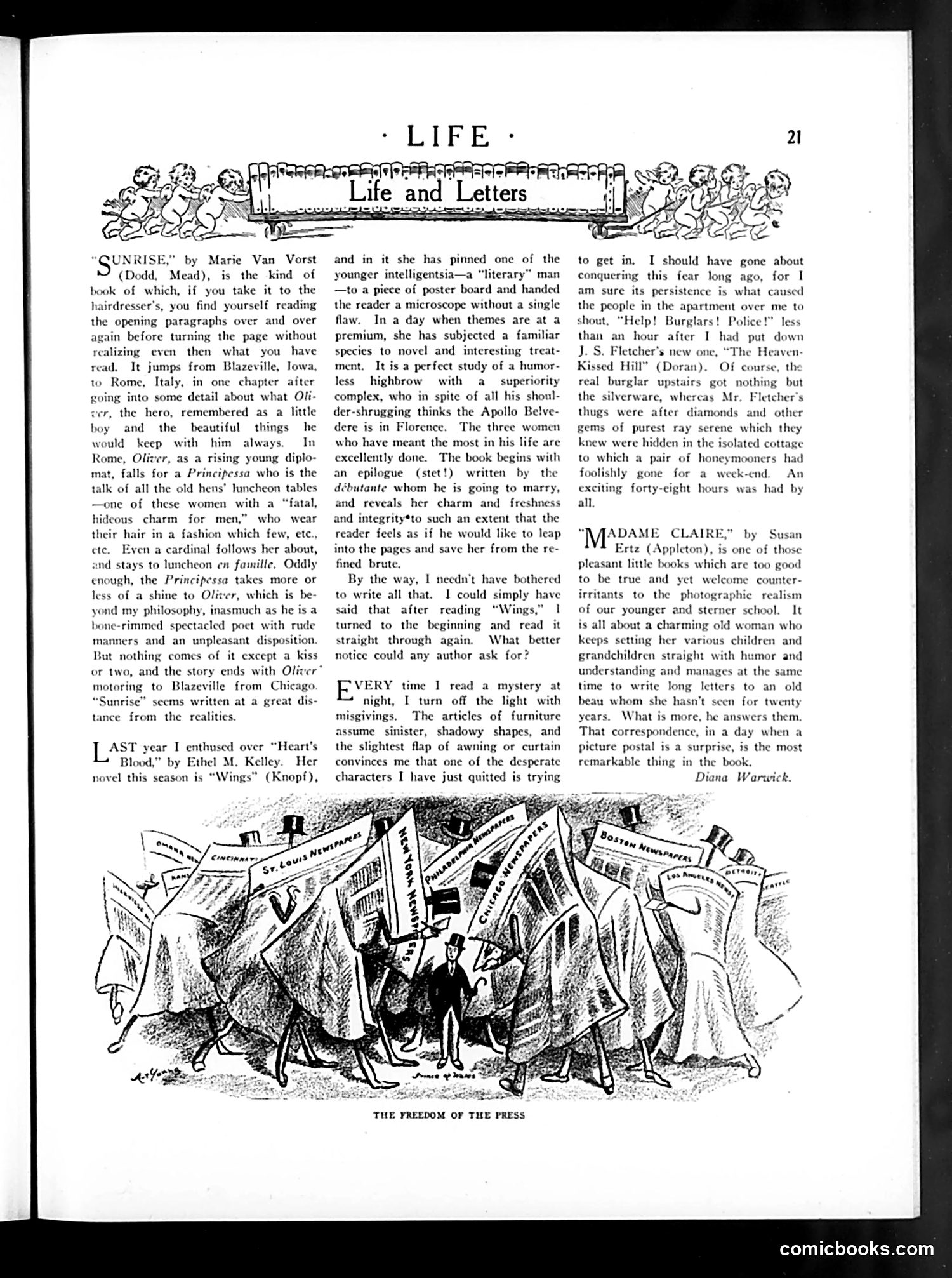
This cartoon depicts a man in formal dress standing amid billowing newspapers labeled with various publication names (St. Louis News, Western Newspapers, Los Angeles, etc.). The newspapers engulf him like a storm or fortress around a central figure. The satire comments on **press power and journalistic influence** in American society. The figure appears trapped or overwhelmed by the newspapers surrounding him—suggesting either that: 1. The press constrains or controls individuals, or 2. A single figure (possibly a politician or public person) is besieged by media scrutiny The caption "The Freedom of the Press" uses irony: while nominally celebrating this constitutional freedom, the image suggests the press's overwhelming power may paradoxically *limit* rather than expand freedom. This reflects early 20th-century anxieties about media monopolies, sensationalism, or the influence of newspaper empires on public opinion and individual liberty.
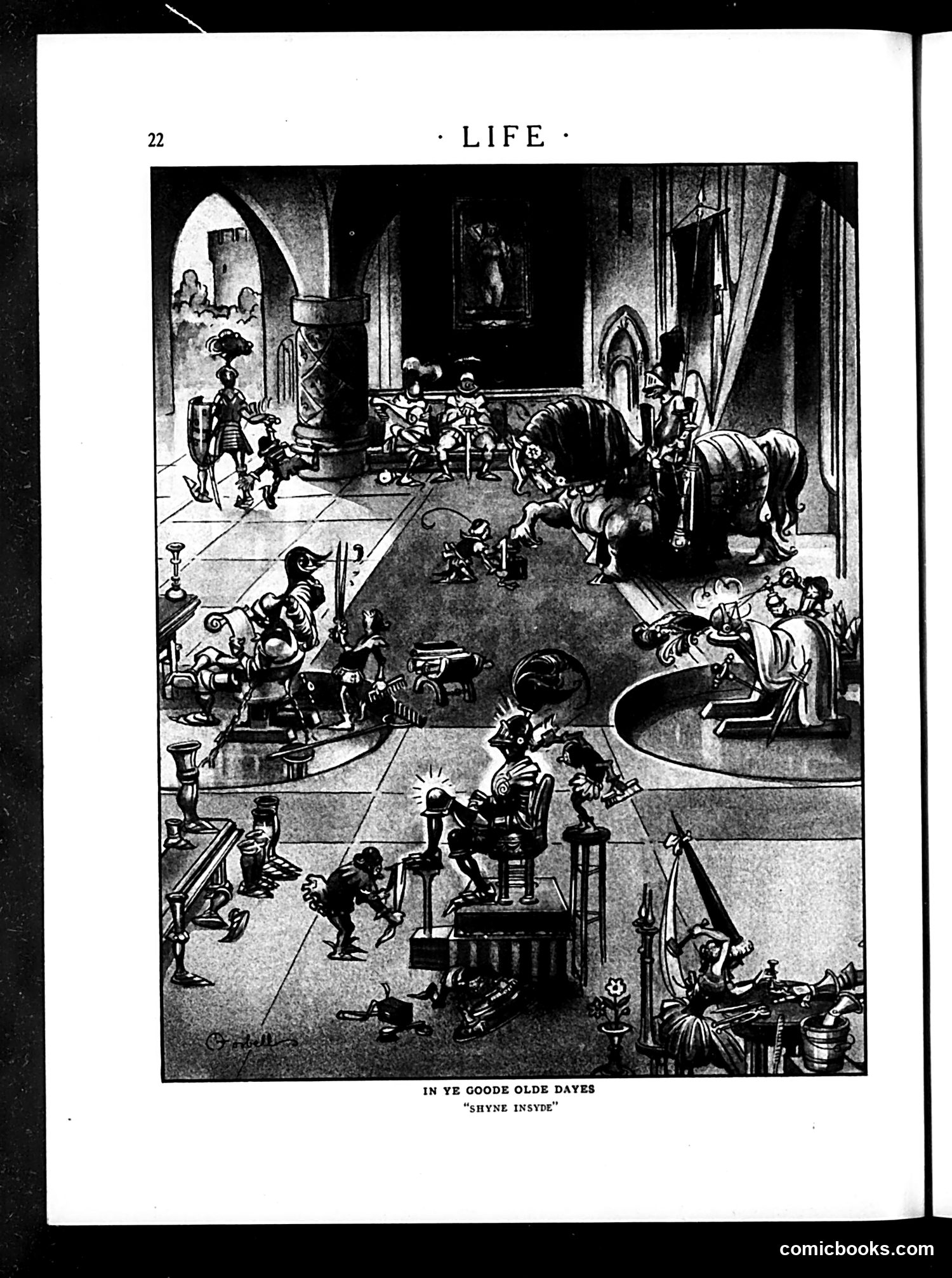
This is a satirical illustration titled "In Ye Goode Olde Dayes" with the subtitle "Shyne Insyde" (archaic spelling suggesting "Shine Inside"). The cartoon depicts a medieval or Renaissance-era interior court scene with numerous figures engaged in various activities—feasting, entertainment, commerce, and leisure. The satire appears to mock the romanticized notion of "the good old days" by showing that human nature—greed, excess, frivolity, and chaos—remains constant across centuries. The "shyne insyde" caption likely suggests that despite outward pretenses of civility or propriety ("olde dayes"), people's inner nature (vanity, selfishness) shines through unchanged. The work is social commentary on nostalgia and human behavior rather than political satire targeting specific figures.
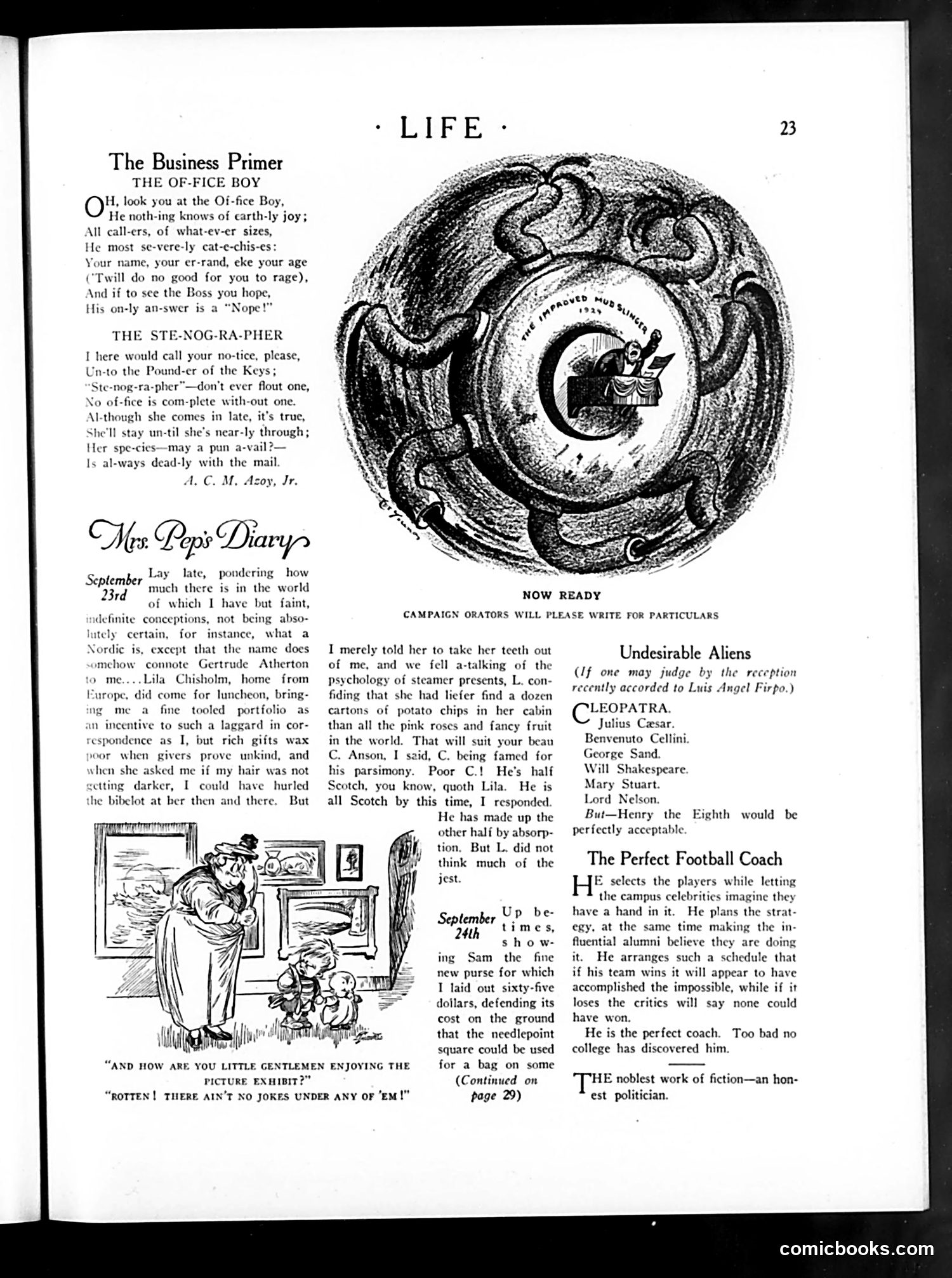
This page contains several satirical pieces typical of *Life* magazine's humor: **"The Business Primer"** humorously describes office archetypes in verse—the gatekeeping office boy and the indispensable stenographer (secretary). The stenographer section notes she arrives late but stays until work is done and is "deadly with the mail," a play on her typing skills. **"Miss Peps Diary"** is a gossipy society column mocking upper-class conversations. A notable reference: "Undesirable Aliens" lists historical figures (Cleopatra, Shakespeare, etc.) as apparently unwelcome, then notes "Henry the Eighth would be perfectly acceptable"—likely satirizing contemporary anti-immigrant sentiment by suggesting even famous figures wouldn't pass current standards. **"The Perfect Football Coach"** satirizes college athletics by describing a coach who manipulates perception: taking credit for wins while deflecting blame for losses, and orchestrating schedules to maximize his reputation. The cartoon below the diary shows an adult and children at an art exhibit; children complain there are "no jokes under any of 'em'"—mocking both modern art pretension and children's literal-minded humor expectations.
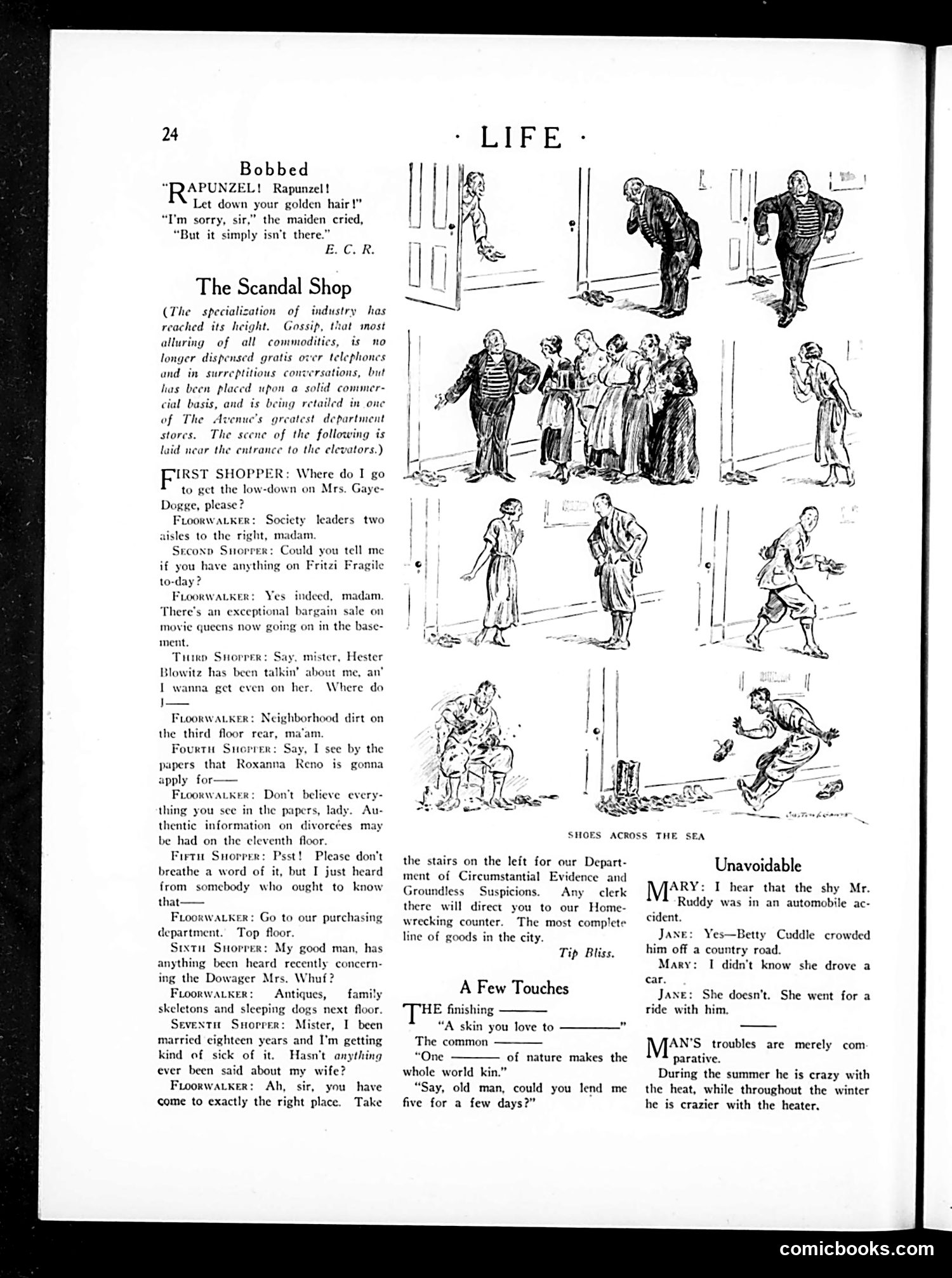
This 1920s satirical page mocks two social trends: **"The Scandal Shop"** is the main cartoon, lampooning gossip as a commercialized commodity. The joke: a department store now sells gossip like merchandise, with different "departments" organized by scandal type—society leaders' affairs, movie queens' drama, divorce details, and a "home-wrecking counter." This satirizes how 1920s consumer culture had monetized everything, including private scandal and rumor. The reference to "bobbed" hair in the opening poem relates to the "flapper" era's modern, independent women, whose personal lives fueled endless gossip. **"Shoes Across the Sea"** features a series of cartoon panels showing characters playing what appears to be a game or dance, likely satirizing some contemporary fad or fashion. The page's smaller items ("A Few Touches," "Unavoidable") are brief jokes about advertisement clichés and predictable romantic/marital situations. The overall tone mocks both emerging consumer culture and the era's obsession with celebrity scandal and gossip.
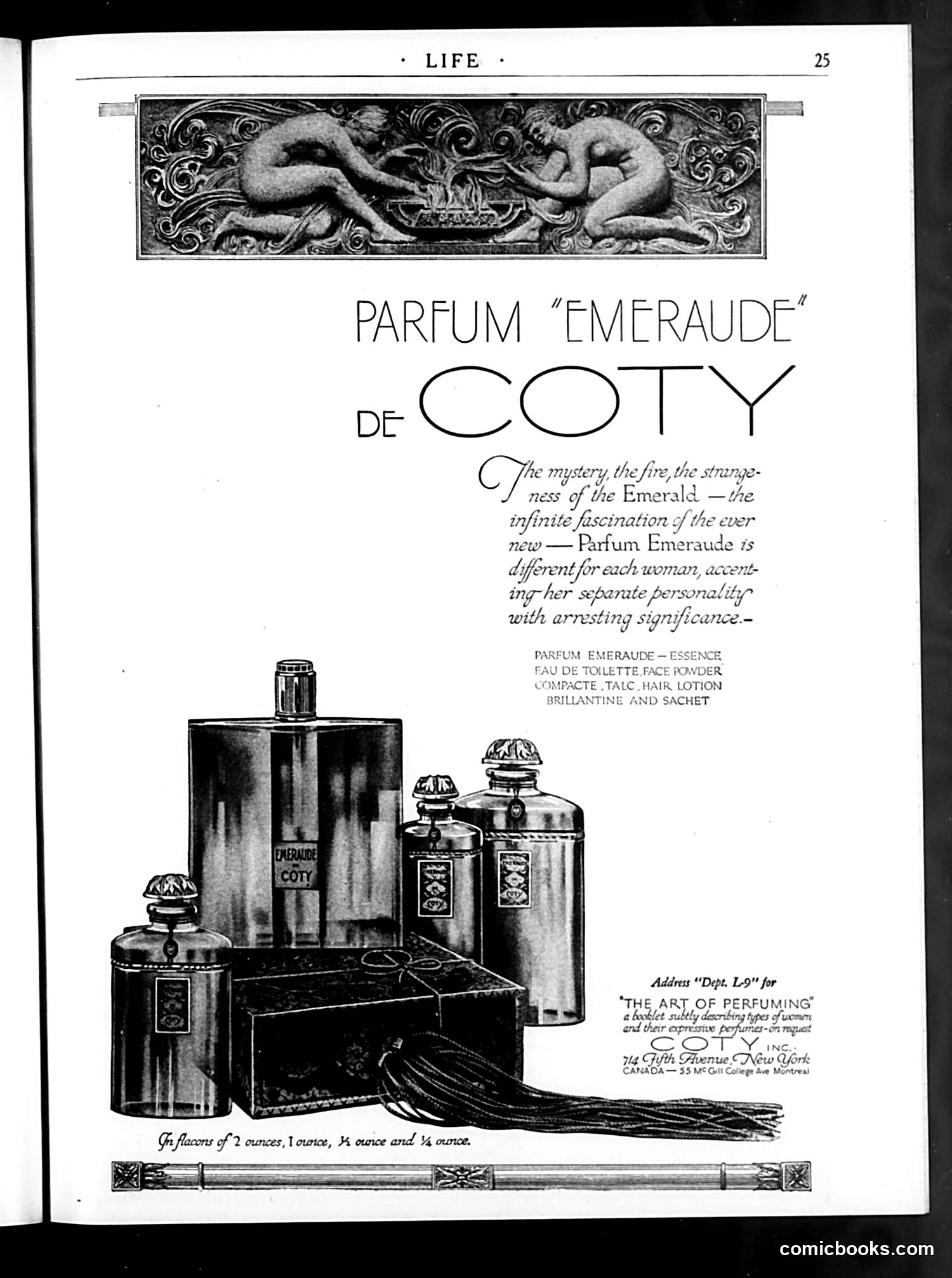
This is a **perfume advertisement**, not a political cartoon. It promotes "Parfum Emeraude" by Coty, a real cosmetics brand. The page features decorative cherub artwork at the top and displays multiple ornate perfume bottles arranged on a platform with a tassel. The advertising copy uses romantic, mystical language ("mystery, the fire, the strangeness of the Emerald") typical of early-to-mid 20th-century luxury marketing, claiming the fragrance expresses each woman's "separate personality." Notably, Coty advertises a companion booklet titled "The Art of Perfuming" that describes "types of women and their expressive perfumes"—suggesting different scents for different female personalities or social roles. This reflects period advertising conventions that marketed products through appeals to femininity, individuality, and aspiration rather than practical benefit.
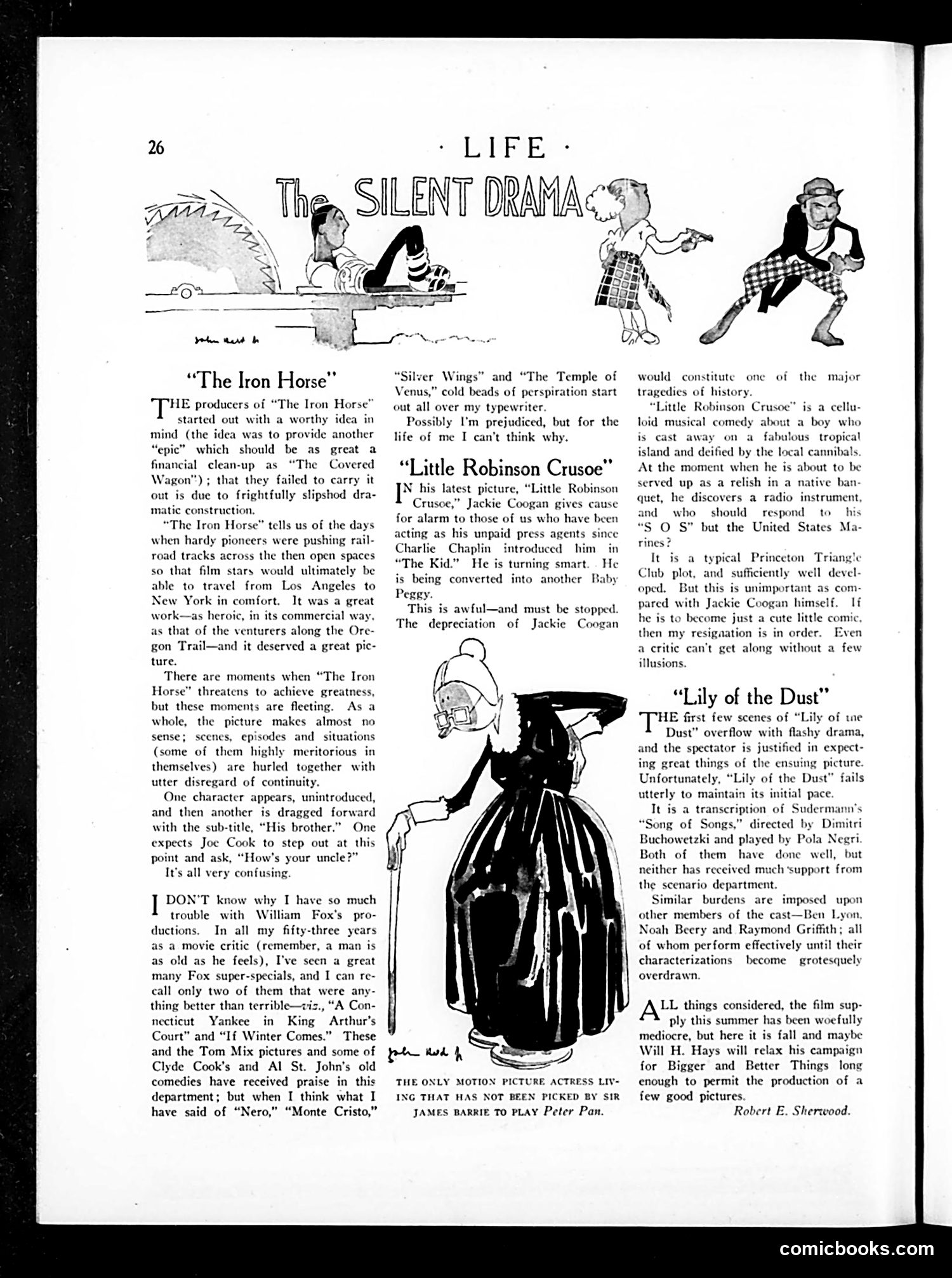
This page contains satirical film criticism reviewing three silent films. The critic attacks William Fox productions for poor dramatic construction, using "The Iron Horse"—an ambitious epic about railroad pioneers—as an example of expensive spectacle undermined by incoherent storytelling. The reviews mock Jackie Coogan's transition from serious child actor (discovered by Chaplin in "The Kid") to cute comedian in "Little Robinson Crusoe," warning this represents his professional decline. The critic jokes that Pola Negri remains "the only motion picture actress living that has not been picked by Sir James Barrie to play Peter Pan"—satirizing excessive casting of actresses in that role. The cartoons at top illustrate silent film comedic tropes: slapstick physical humor and exaggerated character types typical of 1920s cinema. The overall tone reflects Life's role as cultural arbiter, using sharp wit to critique Hollywood's commercial excess.
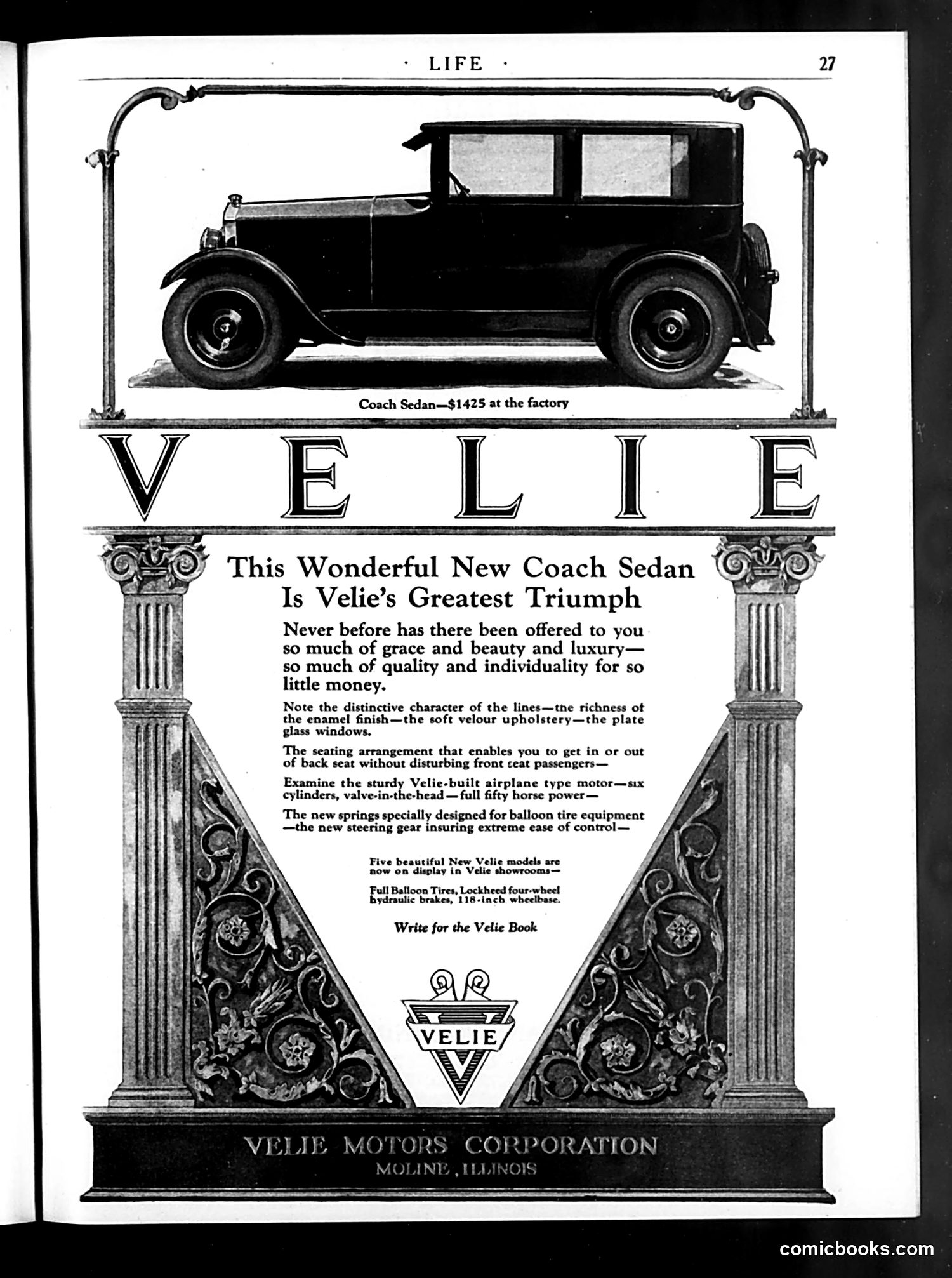
This is not a cartoon or satire—it's a straightforward automobile advertisement. The page features a photograph of a Velie Coach Sedan priced at $1,425 (factory price) displayed above classical columns and decorative architectural elements. The ad copy emphasizes luxury features: enamel finish, velour upholstery, plate glass windows, an airplane-type six-cylinder motor, balloon tires, and hydraulic brakes. The classical framing device suggests quality and prestige. Velie Motors Corporation, based in Moline, Illinois, is marketing this as an affordable luxury vehicle—combining "grace and beauty and luxury" with reasonable cost. There is no political or satirical content; this is purely commercial advertising from Life magazine's revenue stream.
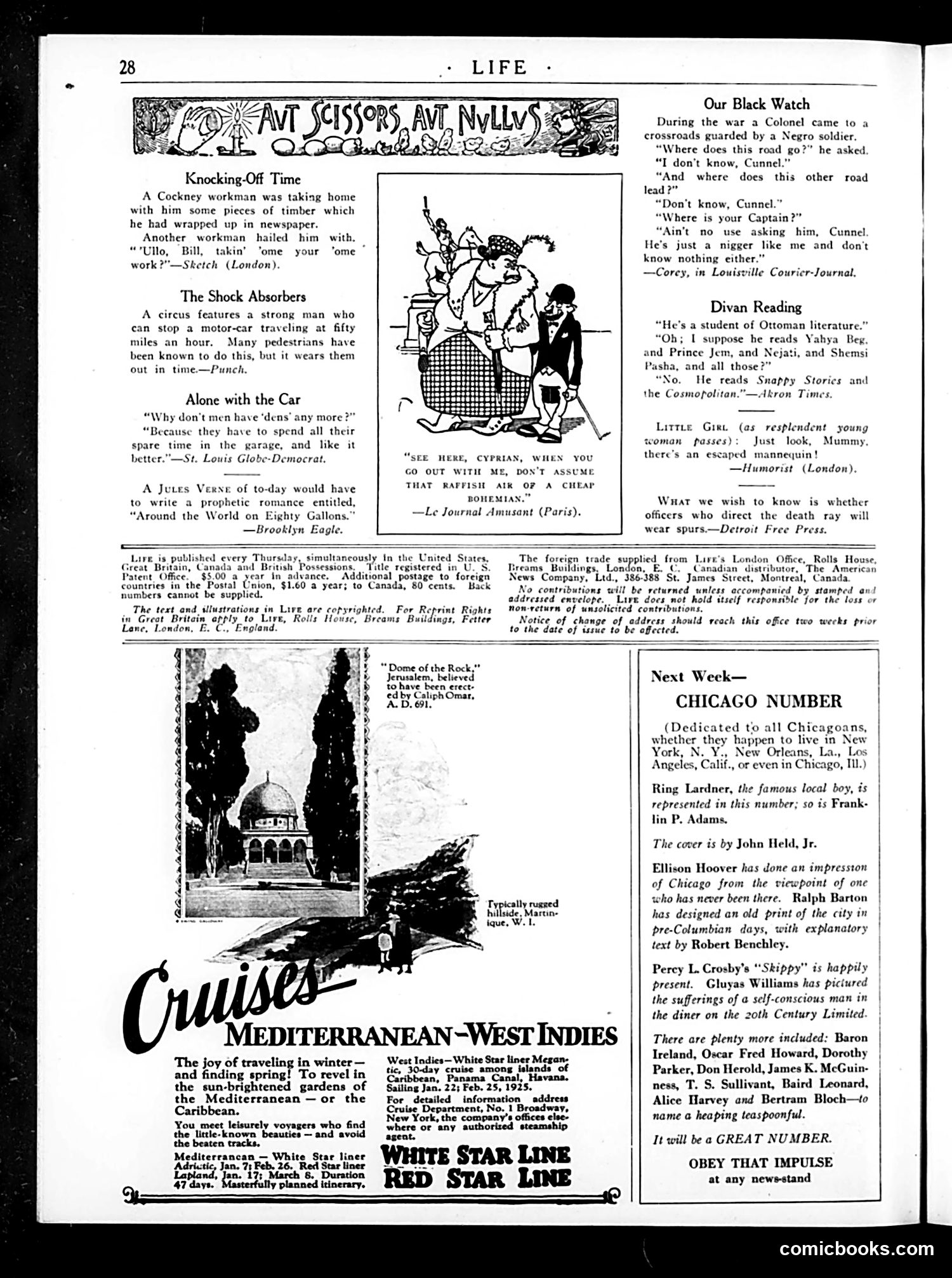
This page contains brief humorous anecdotes from various sources, plus advertisements. Key pieces: **"Knocking-Off Time"**: A Cockney worker carries stolen timber home wrapped in newspaper—a joke about petty workplace theft disguised as legitimate materials. **"The Shock Absorbers"**: Darkly jokes that pedestrians "stop" cars like circus strongmen, but "it wears them out"—meaning they get hit and injured. **"Our Black Watch"**: A racist military anecdote depicting a Negro soldier and captain as ignorant stereotypes unable to give directions. Reflects period prejudice in humor. **"Divan Reading"**: Mocks someone claiming Ottoman literary sophistication while actually reading pulp magazines (*Snappy Stories*, *Cosmopolitan*). **"Little Girl"**: A fashion joke about a fashionably dressed woman mistaken for an escaped department-store mannequin. The page mostly advertises cruise lines and upcoming Chicago-themed content. These brief jokes reflect 1920s satirical conventions, some containing now-offensive racial stereotypes typical of the era.
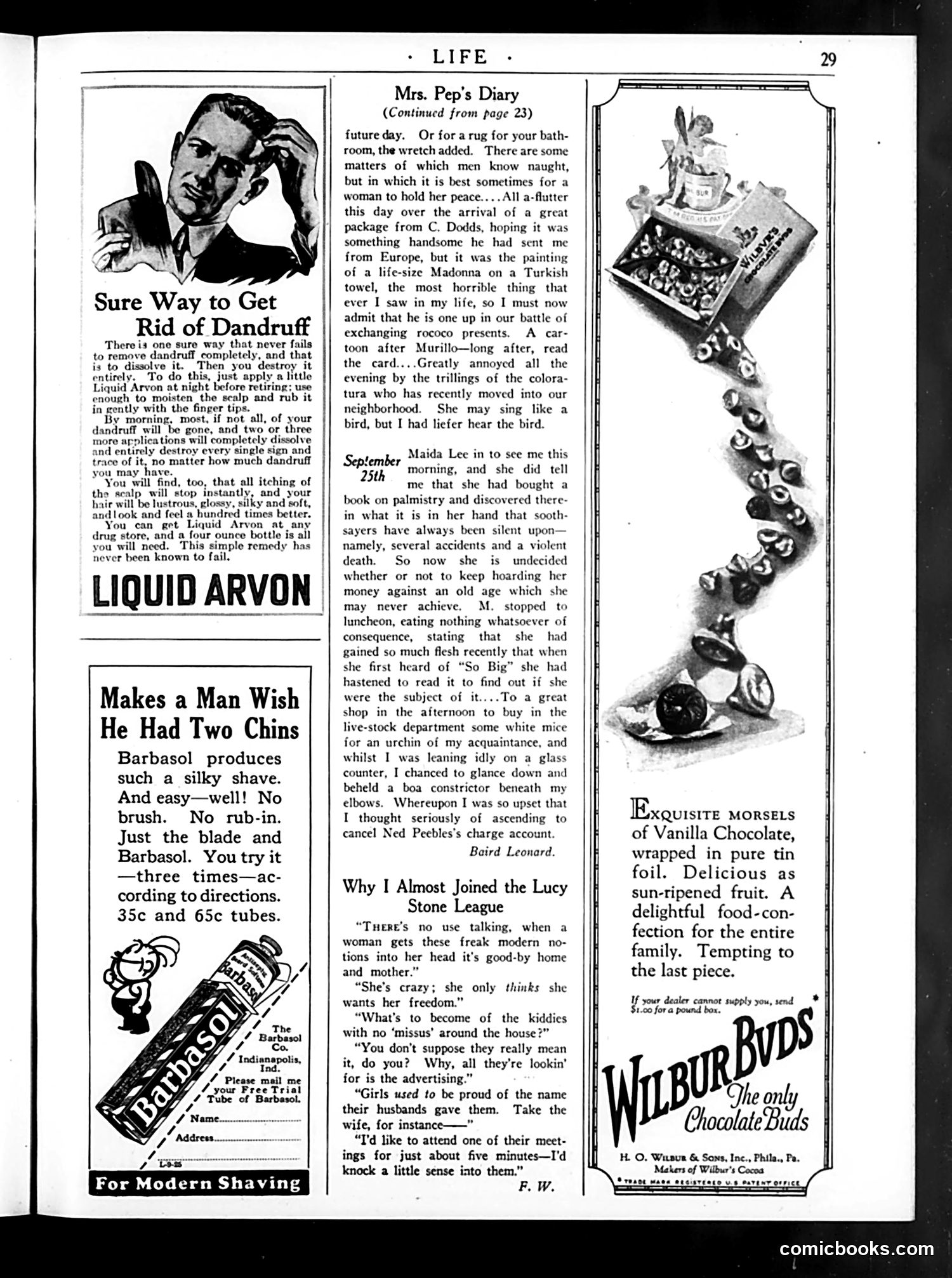
This page combines advertisements with satirical diary entries and social commentary typical of 1920s Life magazine. **The Advertisements** promote grooming products (Liquid Arvon for dandruff, Barbasol shaving cream) and Wilbur Buds chocolate—standard consumer goods marketing. **"Mrs. Pep's Diary"** is a humorous column mocking upper-class domestic life. It presents trivial complaints (an ugly Madonna painting, an opera singer's noise, finding a boa constrictor in a shop) with exaggerated drama, satirizing how wealthy women inflate minor inconveniences into major grievances. **"Why I Almost Joined the Lucy Stone League"** satirizes opposition to women's suffrage and independence. The quoted objections—dismissing women's freedom as "freak modern notions," suggesting activists only seek "advertising," questioning what happens to "kiddies"—represent actual anti-feminist arguments of the era. The satire exposes how opponents patronized and minimized women's legitimate demands for equality and autonomy. Together, these pieces mock both the self-absorbed privileged and the social conservatism resisting women's liberation.
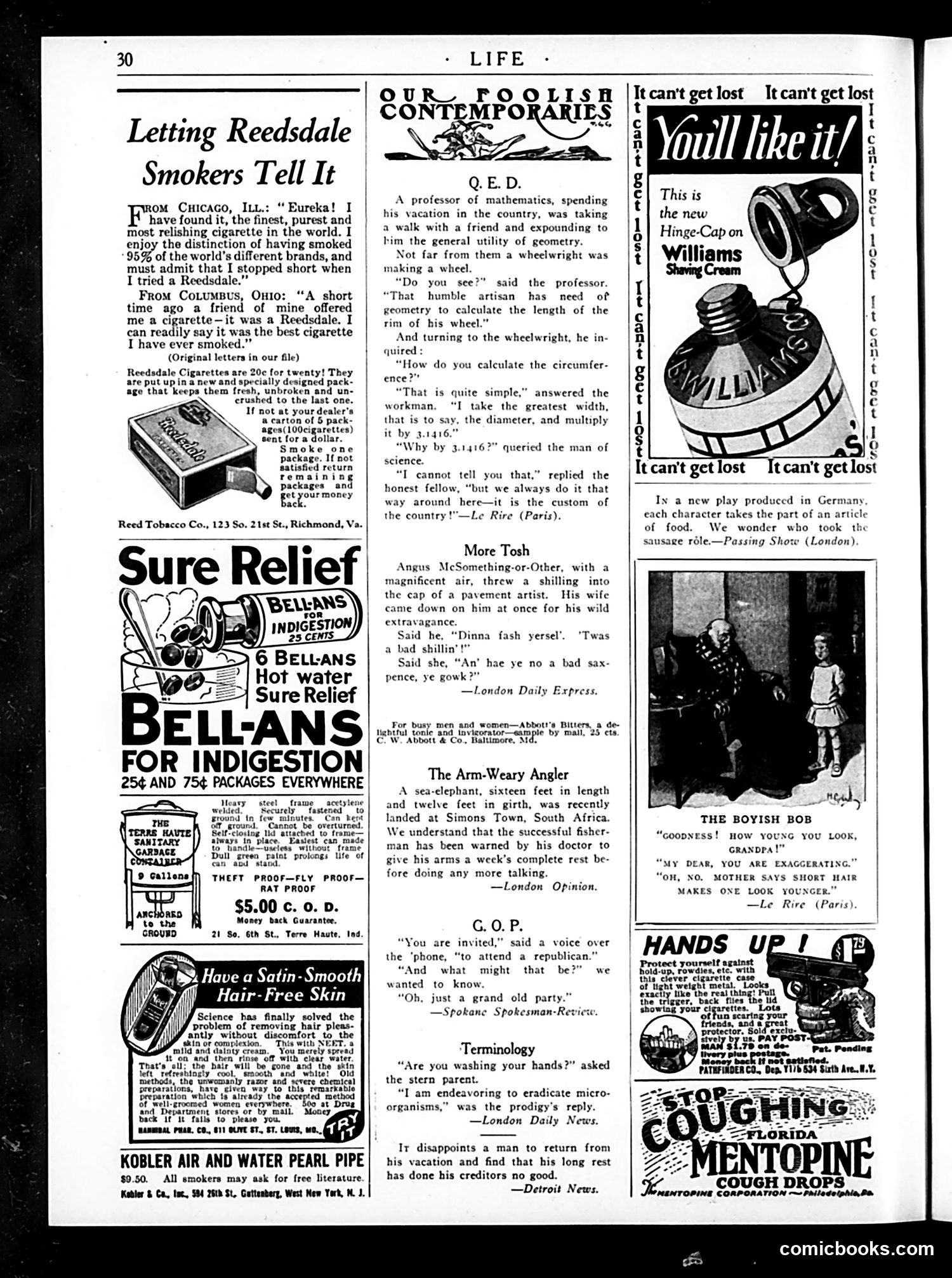
This is primarily an **advertising page** from Life magazine with several brief humorous anecdotes in the "Our Foolish Contemporaries" section (reprinted from European publications). **Main content:** - **Top left**: Testimonial ads for Reedsdale cigarettes using fake reader letters - **Center**: "Q.E.D." — a satire on academic pretension. A mathematics professor lectures a wheelwright about geometry, then asks how the man calculates a wheel's circumference. The wheelwright replies he simply multiplies the diameter by 3.1416 (pi) because "it's the custom"—missing the professor's point entirely. The joke: the professor expected to demonstrate geometry's necessity, but the practical worker already uses the correct formula without understanding *why*, deflating intellectual superiority. **Other anecdotes** mock Scottish frugality and verbose terminology in simple contexts. **Advertisements** dominate: Bellans antacid, hair removal cream (Neet), sanitary garbage cans, and pipes—typical early 20th-century patent medicine and consumer goods.
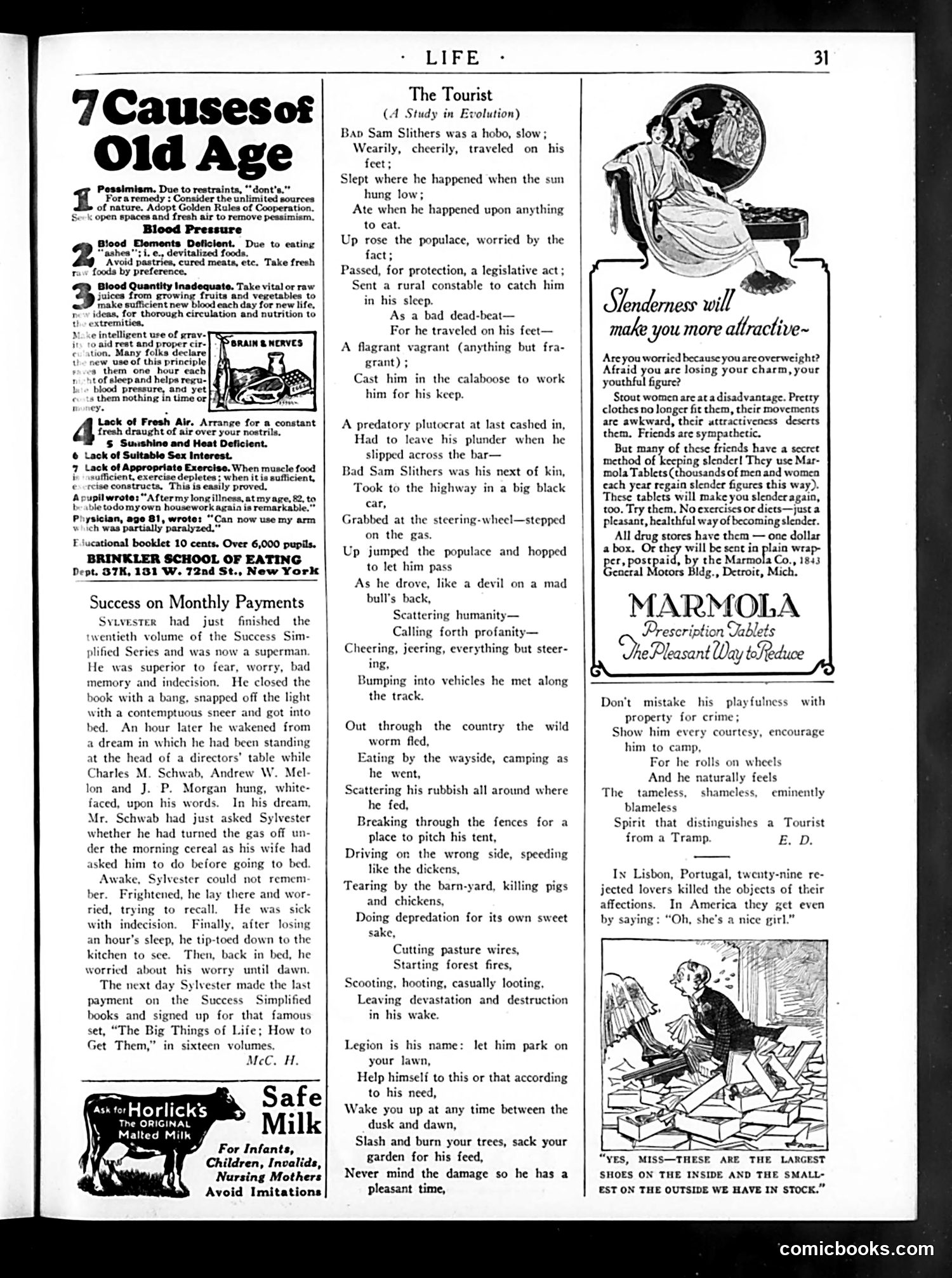
This page satirizes early 20th-century self-help culture and class hypocrisy through two pieces: **"7 Causes of Old Age"** is a health-advice advertisement promoting dubious wellness remedies (avoiding "devitalized foods," proper exercise ratios, sexual interest). It's typical period pseudoscience marketed as scientific rejuvenation. **"The Tourist (A Study in Evolution)"** is the main satire. It traces "Bad Sam Slithers" from poor vagrant (arrested and jailed) to wealthy heir who inherits a plutocrat's fortune. Suddenly respectable, he now recklessly drives a luxury car, endangering pedestrians—who now *cheer* him instead of arresting him. The poem mocks how society treats the identical behavior (recklessness, disregard for others) as criminal when poor, but charming or acceptable when wealthy. It's social commentary on class-based justice and the arbitrary standards applied to rich versus poor. The accompanying illustration shows a portly man in a car globe, emphasizing the satirical "tourist" as nouveau-riche leisure embodiment.
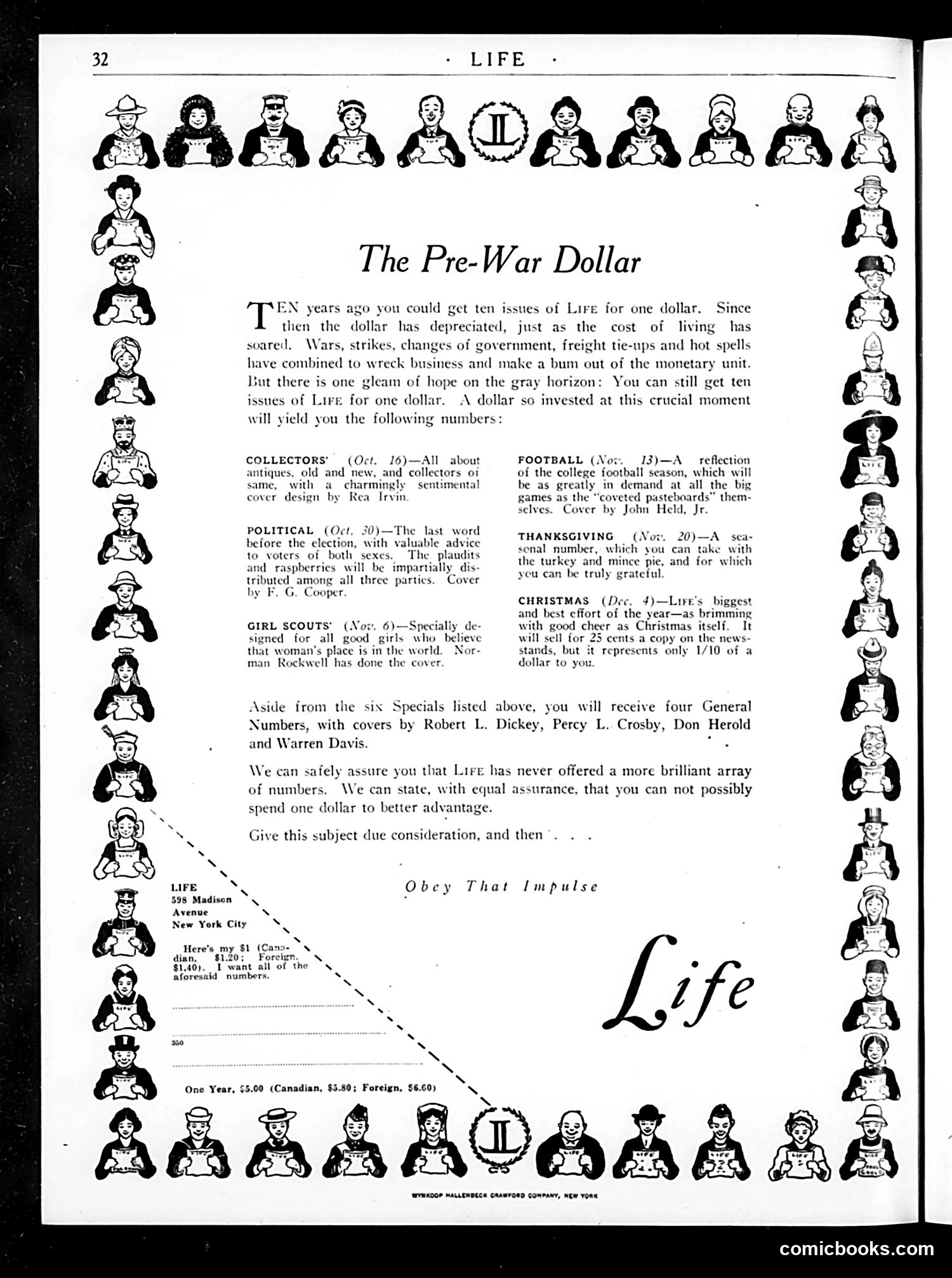
This is a subscription advertisement disguised as editorial commentary. Life magazine is selling annual subscriptions for one dollar by emphasizing value during economic hardship. The "Pre-War Dollar" headline references post-WWI inflation and economic decline—the dollar has depreciated significantly since before the war, yet Life still costs the same. The page lists six special themed issues (covering collectors, politics, football, Thanksgiving, Christmas, and Girl Scouts) plus four general numbers, all for one dollar. The border of illustrated faces appears decorative, showing various demographics Life reaches. The satire is subtle: Life positions itself as a shrewd investment during economic crisis ("A dollar so invested at this crucial moment"), implying readers should prioritize their satirical magazine subscription over other expenses. The phrase "Obey That Impulse" is the editorial push to subscribe despite financial uncertainty. This reflects 1920s economic anxiety and consumer magazine marketing tactics.
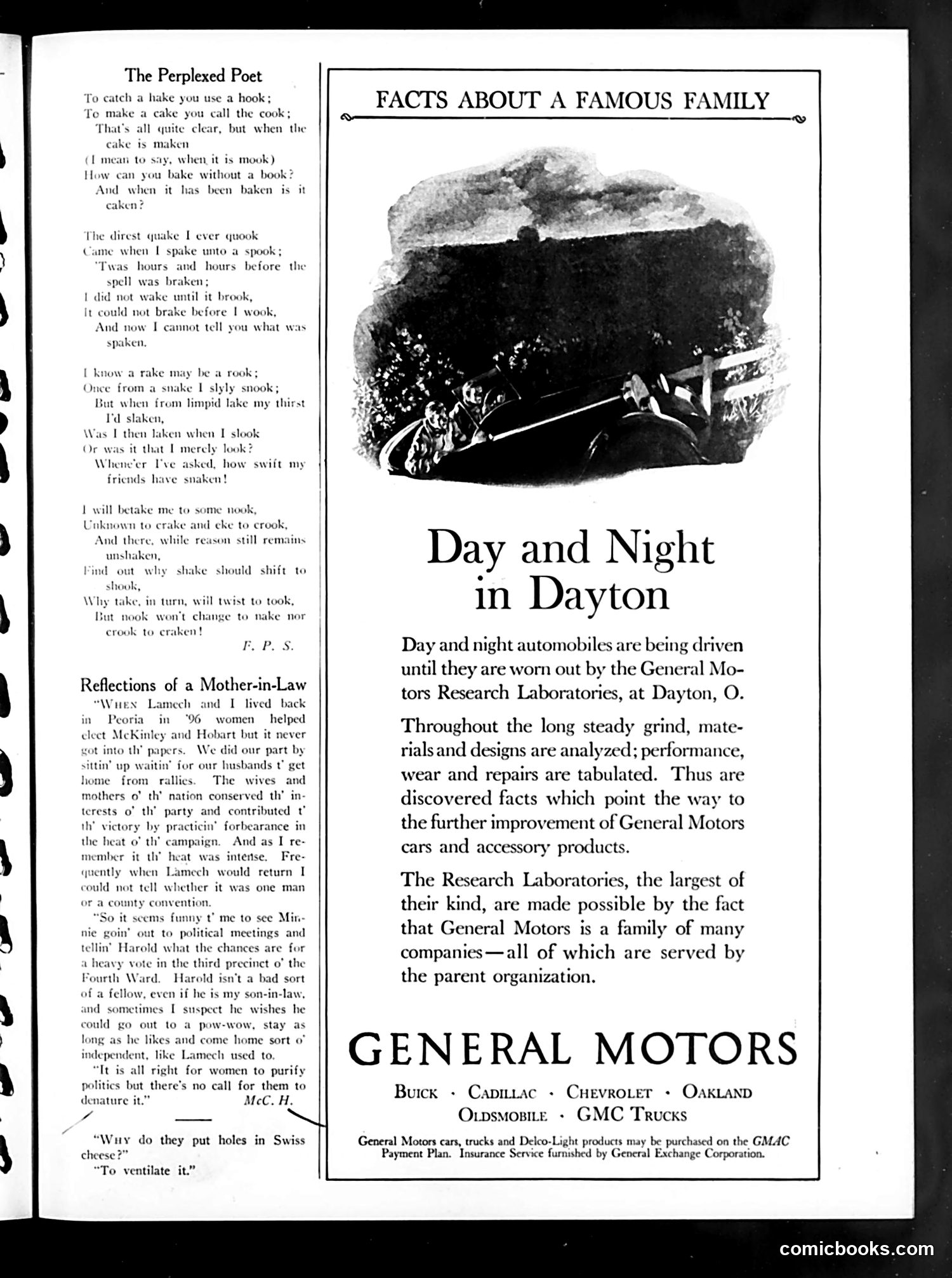
This page contains three distinct pieces: **"The Perplexed Poet"** is a humorous poem playing with English language irregularities—how verbs change unpredictably (bake/baken, shake/shook, take/took). The joke satirizes the illogical nature of English grammar itself. **"Reflections of a Mother-in-Law"** humorously contrasts women's political roles past and present. A woman recalls the 1896 McKinley election when wives silently supported husbands' political activities. She observes her daughter-in-law now attending political meetings herself, suggesting changing women's participation in politics—though the narrator suggests women should "purify" politics without "denaturing" it, reflecting ambivalent attitudes toward female political engagement in this era. **The remaining content is a General Motors advertisement** about their Dayton research laboratories testing automobiles continuously. It's not satirical—purely promotional, emphasizing GM's technical innovation and corporate structure. The page reflects early 20th-century American attitudes toward language, women's roles, and industrial progress.
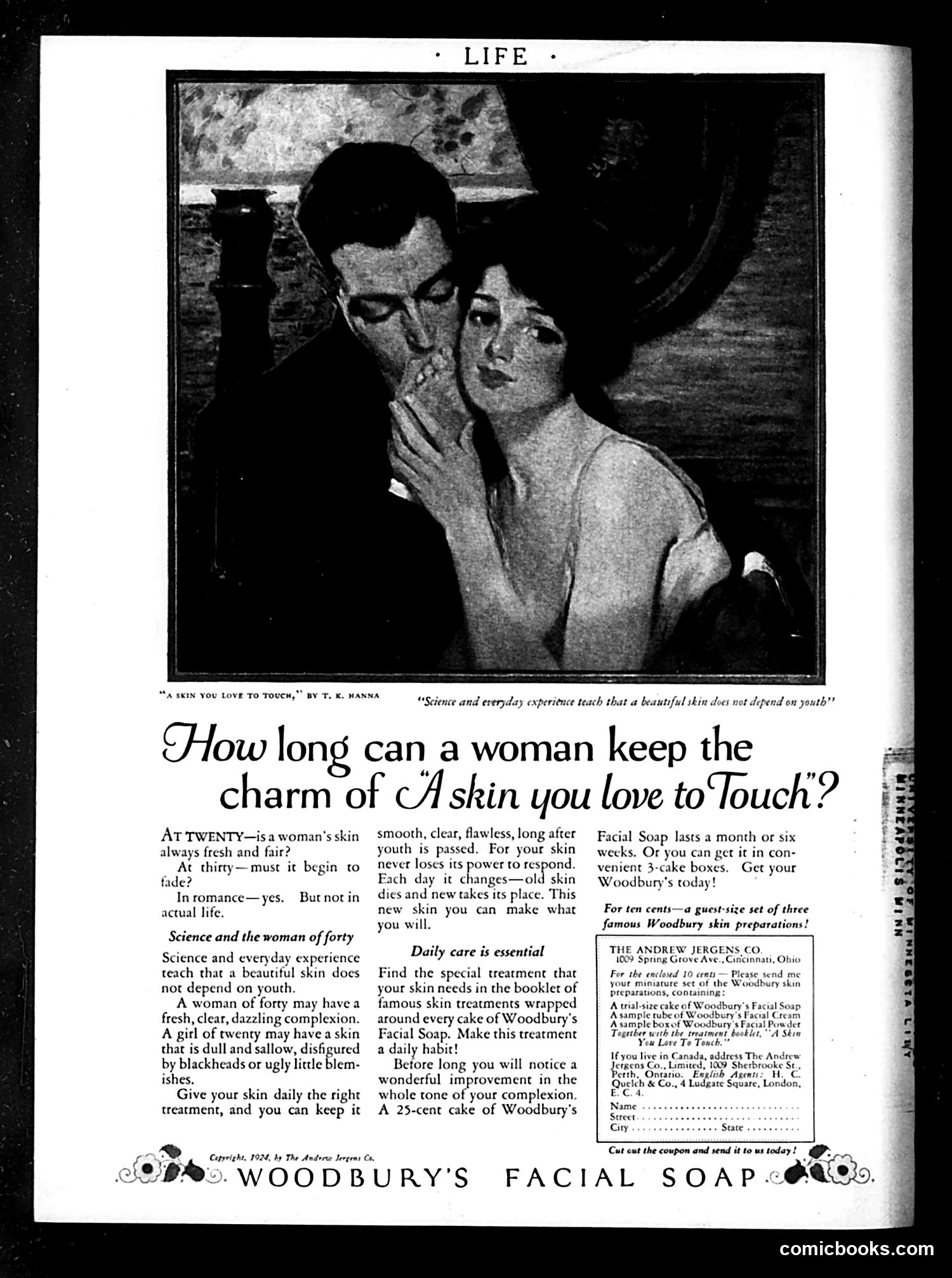
This is a **beauty product advertisement**, not political satire. The page promotes Woodbury's Facial Soap by addressing women's anxieties about aging skin. The image shows a romantic scene—a couple in an intimate moment—illustrating the ad's tagline "A Skin You Love to Touch." The advertisement's message challenges the era's assumption that beautiful skin is only for the young: it argues that a 40-year-old woman can maintain a "fresh, clear, dazzling complexion" through **daily skincare**, not youth alone. The copy emphasizes that skin constantly regenerates ("Each day it changes—old skin dies and new takes its place"), so proper treatment can maintain attractiveness across a woman's lifetime. This reflected 1920s messaging about science, self-care, and female appearance management—positioning skincare as an achievable, ongoing practice rather than a matter of natural aging. The coupon offer (ten cents for sample products) was typical 1920s direct-response advertising.

I can see this is a very dark/low-contrast image from what appears to be a historical Life magazine page. However, the image quality is too poor for me to reliably make out specific cartoon details, figures, or text content beyond the "comicbooks.com" watermark at the bottom. To provide an accurate historical analysis as requested, I would need a clearer version of this page. The current image is nearly entirely black with only faint outlines barely visible, making it impossible to identify specific caricatures, political references, or satirical content with confidence. If you could provide a higher-contrast or clearer scan of this page, I'd be happy to analyze the cartoon(s) and explain their historical and political context to a modern reader.