
Life, 1924-09-25 · page 28 of 37
Life — September 25, 1924 — page 28: what you’re looking at
What you’re looking at
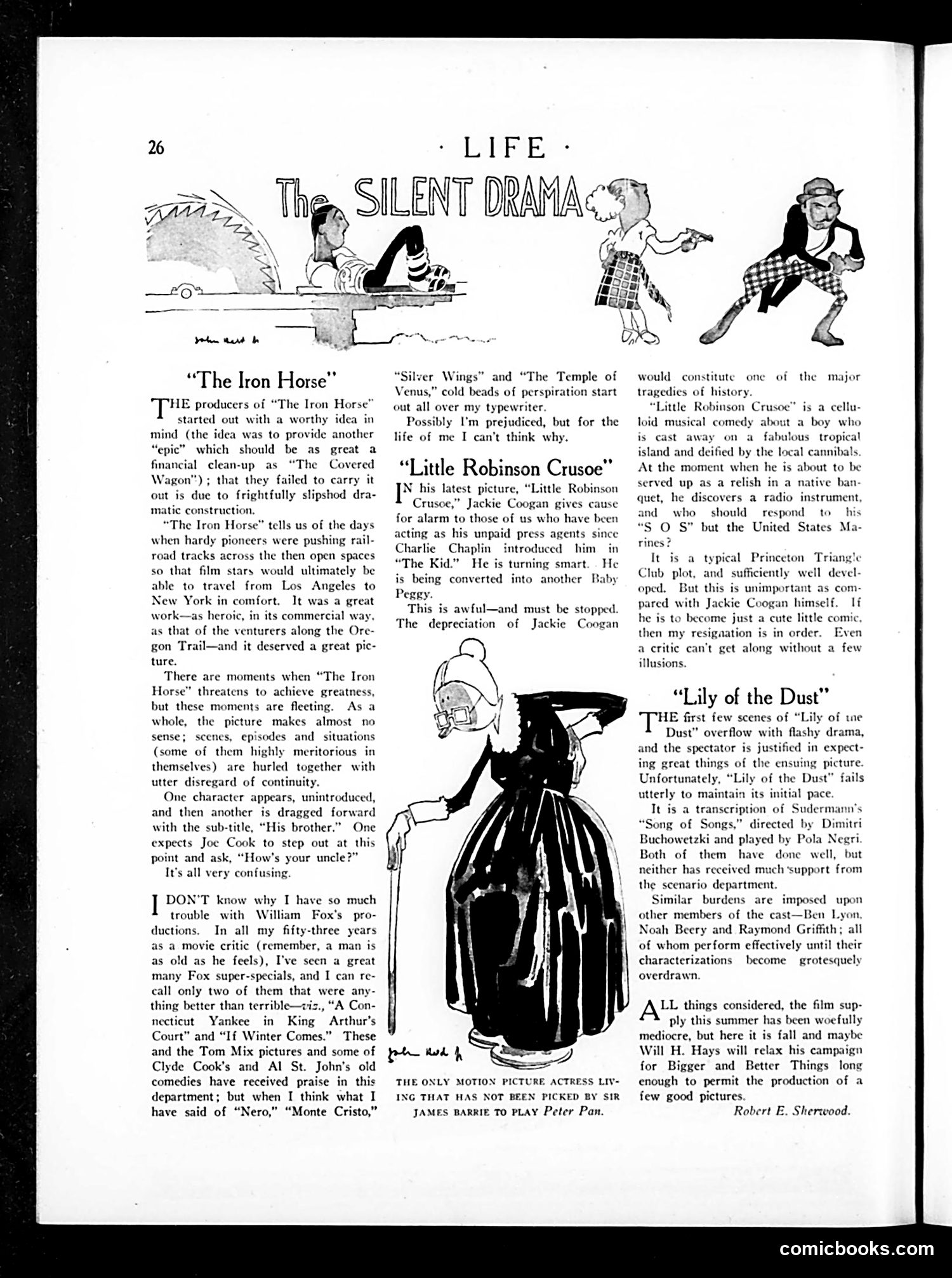
This page contains satirical film criticism reviewing three silent films. The critic attacks William Fox productions for poor dramatic construction, using "The Iron Horse"—an ambitious epic about railroad pioneers—as an example of expensive spectacle undermined by incoherent storytelling. The reviews mock Jackie Coogan's transition from serious child actor (discovered by Chaplin in "The Kid") to cute comedian in "Little Robinson Crusoe," warning this represents his professional decline. The critic jokes that Pola Negri remains "the only motion picture actress living that has not been picked by Sir James Barrie to play Peter Pan"—satirizing excessive casting of actresses in that role. The cartoons at top illustrate silent film comedic tropes: slapstick physical humor and exaggerated character types typical of 1920s cinema. The overall tone reflects Life's role as cultural arbiter, using sharp wit to critique Hollywood's commercial excess.
📄 Transcribed text from this page (OCR, searchable)
Machine-transcribed from the original scan — historical spelling and the odd misread are preserved.
Thgp SILENT DRAHACH Zt (ie } ~ EL “The Iron Horse” T! E of “The Iron Horse” started out with a worthy ic i mind (the idea was to provide another “epic” which should be as great a financial clean-up as “The Covered Wagon") ; that they failed to carry it out is due to frightfully slipshod dra- matic construction. “The Iron Horse” tells us of the days when hardy pioneers were pushing rail- road tracks across the then open spaces so that film stars would ultimately be able to travel from Los Angeles to New York in comfort. It was a great work—as heroic, in its commercial way, as that of the venturers along the Ore- gon Trai nd it deserved a great pic- ture. There are moments when “The Iron Horse” threatens to achieve greatness, but these moments are fleeting. As a whole, the picture makes almost no sense; scenes, episodes and. situations (some of them highly meritorious in themselves) are hurled together with utter disregard of continuity. One character appears, unintroduced, and then another is dragged forward with the sub-title, “His brother.” One expects Joe Cook to step out at this point and ask, “How's your uncle?” It's all very confusing. DON’T know why I have so much trouble with William Fox's pro- ductions. In all my fifty-three years as a movie critic (remember, a man is as old as he feels), I've seen a great many Fox super-specials, and I can re- call only two of them that were any- thing better than terrible—viz., “A Con- necticut. Yankee in King Arthur's Court” and “If Winter Comes.” These and the Tom Mix pictures and some of Clyde Cook's and Al St. John’s old comedies have received praise in this department; but when I think what I have said of “Nero,” “Monte Cristo,” LS ERIES ° “Silver Wings” and “The Temple of Venus,” cold beads of perspiration start out all over my typewriter. Possibly I'm prejudiced, but for the life of me I can’t think why, “Little Robinson Crusoe” N his latest picture, “Little Robinson Crusoe,” Jackie Coogan gives cause for m to those of us who have been acting as his unpaid press agents since Charlie Chaplin introduced him in “The Kid.” He is turning smart. He is being converted into another Baby Peg, This is awful—and must be stopped. The depreciation of Jackie Coogan THE ONLY MOTION PICTURE ACTRESS LIV- ING THAT HAS NOT BEEN PICKED BY SIR JAMES BARRIE TO PLAY Peter Pan. would constitute one of the tragedies of history. “Little Robinson Crusoe” is a cellu- loid musical comedy about a boy who away on major is cast island and deified by the local cannibals. At the moment when he is about to be served up as a relish in a native ban- quet, he discovers a radio instrument, and who should respond to his “S O S” but the United States Ma- rines? It is a typical Princeton Triang!¢ Club plot, and sufficiently well devel- oped, But this is unimportant as com- pared with kie Coogan himself. li he is to become just a cute little comic, then my resigaation is in order. Even a critic can't get along without a few illusions. “Lily of the Dust” HE first few scenes of “Lily of ie Dust” overflow with flashy drama, and the spectator is justified in expect- ing great things of the ensuing p Unfortunately, “Lily of the Dust utterly to maintain its initial pace, It is a transcription of Sudermann’s “Song of Songs,” directed by Dimitri Buchowetzki and played by Pola Negri Both of them done well, but neither has received much ‘support from the scenario department. Similar burdens are imposed upon other members of the cast—Ben Lyon. ah Beery and Raymond Griffith of whom perform effectively until their characterizations become grotesquely overdrawn. fabulous tropical have vALL things considered, the film sup- ply this summer has been woefully mediocre, but here it is fall and maybe Will H. Hays will relax his campaign for Bigger and Better Things long enough to permit the production of a few good pictures. Robert E. Sherwood. comicbooks.com