
Life, 1924-09-25 · page 16 of 37
Life — September 25, 1924 — page 16: what you’re looking at
What you’re looking at
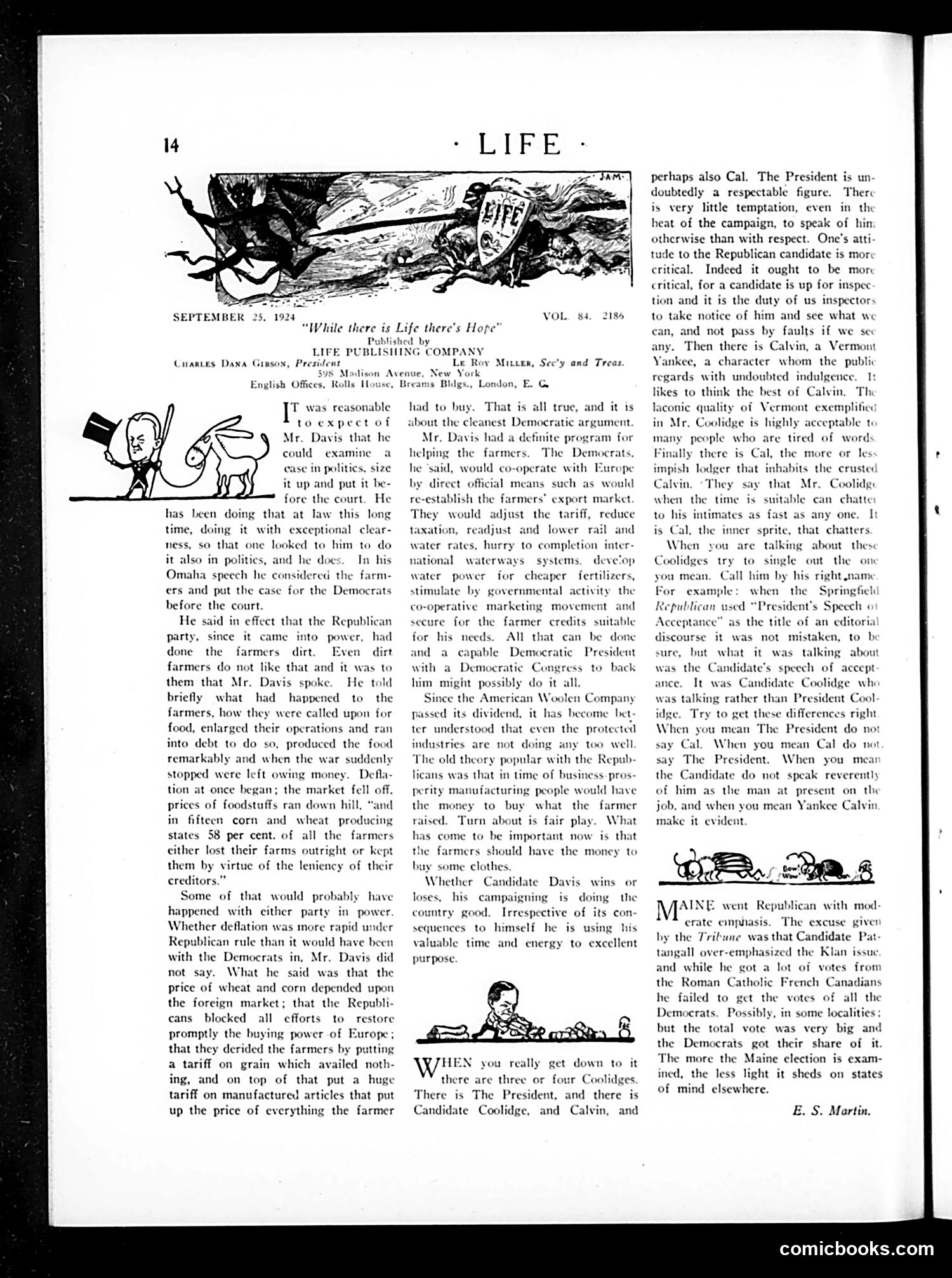
This page discusses the 1924 U.S. presidential campaign. The article critiques both major candidates and introduces three "Coolidges"—President Coolidge, Candidate Coolidge, and Calvin (apparently a Vermont character representing Coolidge's inner nature). The cartoons appear to satirize presidential politics of the era, with caricatured figures representing political figures or types. The text argues that inspecting candidates carefully is voters' duty, and suggests tension between Coolidge's public respectability and private character. The article by E.S. Martin analyzes campaign rhetoric about farming policy and tariffs, questioning whether either candidate genuinely serves farmers' interests versus manufacturing interests. It critiques both Democratic and Republican approaches to agricultural economics.
📄 Transcribed text from this page (OCR, searchable)
Machine-transcribed from the original scan — historical spelling and the odd misread are preserved.
Per: Pp LIFE PUBLISHING Curarces Dana Ganson, President d ny Miter, Sec’y and Treas. S Madison Avenue, New Y English Offices, Rolls I T was reasonable toexpectof Mr. Davis that he could examine a case in politics, size it up and put it be- fore the court. He has been doing that at law this time, doing it with exceptional clear- ness, so that one looked to him to do it also in politics, and he does. In his Omaha speech he considered the farm- ers and put the case for the Democrats before the court. He said in effect that the Republican party, since it power, had done the farmers dirt. Even dirt farmers do not like that and it was to them that Mr. Davis spoke. He told briefly what had happened to the farmers, how they were called upon for food, enlarged their operations and ran into debt to do so, produced the food remarkably and when the war suddenly stopped were left owing money. Defl. tion at once began; the market fell off, prices of foodstuffs ran down hill, “and in fifteen corn and wheat producing states 58 per cent. of all the farmers either lost their farms outright or kept them by virtue of the leniency of their creditors.” Some of that would probably have happened with either party in’ power. Whether deflation was more rapid under Republican rule than it would have been with the Democrats in, Mr. Davis did not say. What he said was that the price of wheat and corn depended upon the foreign market; that the Republi- cans blocked all cfforts to restore promptly the buying power of Europe; that they derided the farmers by putting a tariff on grain which availed noth- ing, and on top of that put a huge tariff on manufactured articles that put up the price of everything the farmer came into , Breams Bldg . London, EL G had to buy. That is all true, and it is about the cleanest Democratic argument. Mr. Davis had a definite program f helping the farmers. The Democrats, he ‘said, would co-operate with Europe by direct off re-establish the farmers’ export market They would adjust the tariff, reduce al means such as would taxation, readjust and lower rail and water rates, hurry to completion inter- national waterways power for systems. develop water cheaper fertilizers, stimulate by governmental activity the co-operative marketing movement and for the farmer credits suitable All that can and Democratic with a Democratic Congress to. him might possibly do it all. Since the American Woolen Company passed its dividend, it has become bet- ter understood that even the protected secure for his needs. be done President back a capable industries are not doing any too well The old theory popular with the Repub- licans was that in time of bus’ perity manufacturing people would have the money to buy what the farmer raised. Turn about is fair play. What has come to be important now is that the farmers should have the money to buy some clothes. Whether Candidate Davis loses, his campaigning is country good ress: pros- wins or doing the Irrespective of its con- sequences to himself he is using his valuable time and energy to excellent purpose. V EN 1 really get down to it there are three or four Coolidges. There is The President, Candidate Coolidge, and Calvin, and and there is perhaps also Cal. The President is un- doubtedly a respectable figure. Ther is very little temptation, even in the heat of the campaign, to speak of hin otherwise than with respect. One's atti- tude to the Republican candidate is more critical, Indeed it ought to be morc critical, for a candidate is up for inspec tion and it is the duty of us inspectors to take notice of him and sce what we can, and not pass by faults if we sec any. Then there is Calvin, a Vermont Yankee, a character whom the public regards with undoubted indulgence. I: likes to think the best of Calvin. The laconic quality of Vermont exemplitie: in Mr. Coolidge is highly acceptable t many people who are tired of words Finally there is Cal, the more or les impish lodger that inhabits the crusted Calvin, Mr. when the time is suitable can chatte to his intimates as fast as any one. It is Cal, the inner sprite, that chatters. When you are talking Coolidges try to They say t Coolidg: these single out the onc about mean. Call him by his right.n: example: when the Springfiel blican used “President's Speech « as the title of an editoria mistaken, to by what it was talking about was the Candidate's speech of ance. ptance”™ discourse it sure, but was not accept It was Candidate Coolidge wh« was talking rather than President Cool fi Try to get these differences right When you mean The President do m say Cal. When you mean Cal do no! say The President. When you meat the Candidate do not speak reverently of him as the man at present on the job, and when you mean Yankee Cal make Mant went Republican with mod- erate emphasis. The excuse given by the Trifune was that Can tangall over-emphasized the Klan issue. and while he got a lot of votes from the Roman Catholic French Canadians he failed to get the votes of all the Democrats. Possibly, in some localities ; but the total vote was very big and the Democrats got their share of it. The more the Maine election is exam- ined, the less light it sheds on states of mind elsewhere. E. S. Martin. comicbooks.com