
Life, 1924-09-25 · page 23 of 37
Life — September 25, 1924 — page 23: what you’re looking at
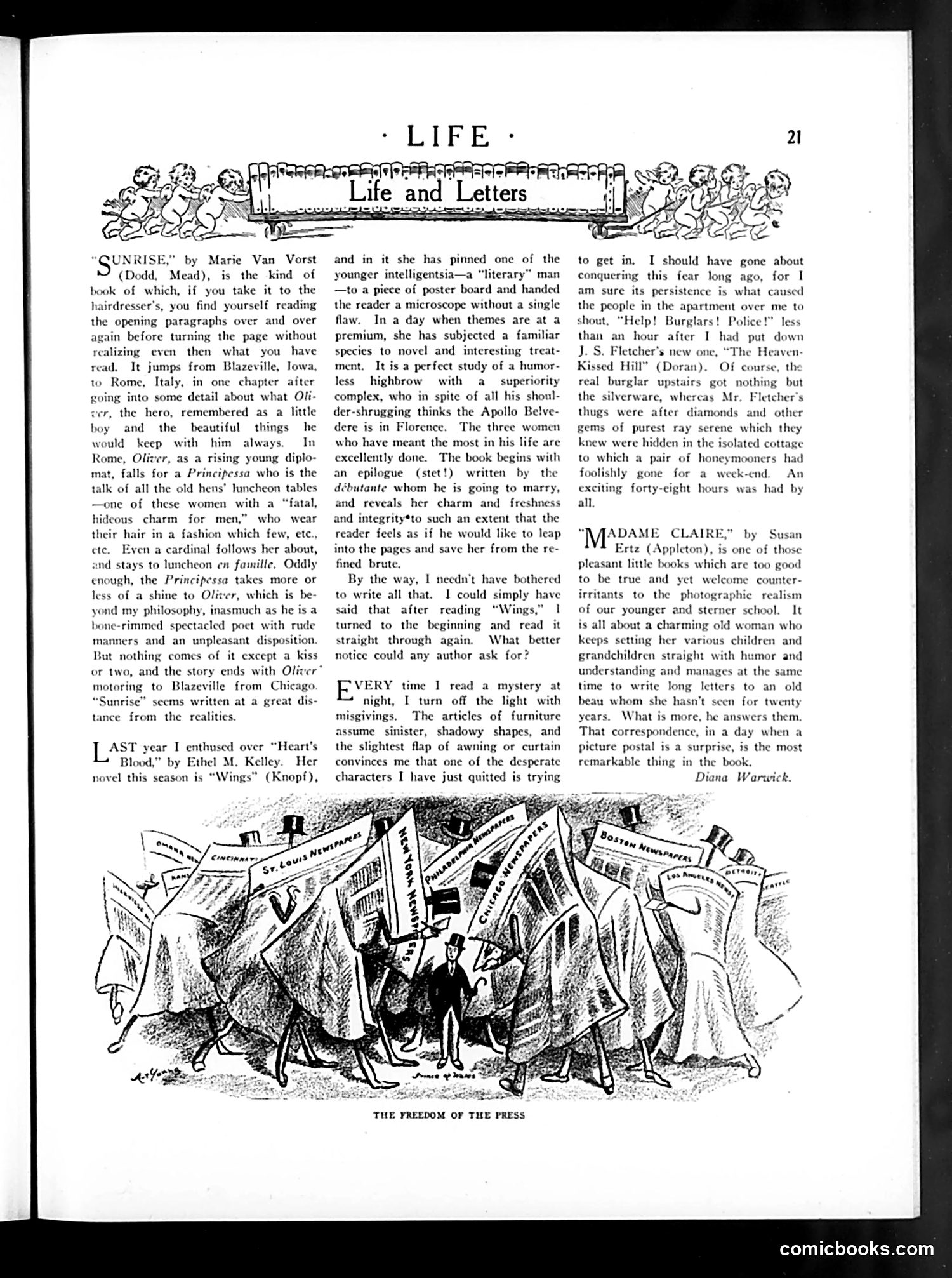
What you’re looking at
This cartoon depicts a man in formal dress standing amid billowing newspapers labeled with various publication names (St. Louis News, Western Newspapers, Los Angeles, etc.). The newspapers engulf him like a storm or fortress around a central figure. The satire comments on **press power and journalistic influence** in American society. The figure appears trapped or overwhelmed by the newspapers surrounding him—suggesting either that: 1. The press constrains or controls individuals, or 2. A single figure (possibly a politician or public person) is besieged by media scrutiny The caption "The Freedom of the Press" uses irony: while nominally celebrating this constitutional freedom, the image suggests the press's overwhelming power may paradoxically *limit* rather than expand freedom. This reflects early 20th-century anxieties about media monopolies, sensationalism, or the influence of newspaper empires on public opinion and individual liberty.
📄 Transcribed text from this page (OCR, searchable)
Machine-transcribed from the original scan — historical spelling and the odd misread are preserved.
by Marie Van Vorst (Dodd, Mead), is the kind of book of which, if you take it to the hairdresser's, you find yourself. reading the opening paragraphs over and over again before turning the page without realizing then what you have read, It jumps from Blazeville, lowa, Rome, Italy, in one chapter after going into some detail about what Oli- ver, the hero, remembered as a little boy and the beautiful things he would keep with him always. In Rome, Oliver, as a rising young diplo- mat, falls for a Principessa who is the alk of all the old hens’ luncheon tables one of these women with a “fatal, charm for men,” who wear their hair in a fashion which few, ete., na cardinal follows her about, and stays to luncheon en famille. Oddly enough, the Principessa takes more or less of a shine to Oliver, which is be- yond my philosophy, inasmuch as he is a hone-rimmed spectacled poet with rude manners and an unpleasant disposition. But nothing comes of it except a kiss even hideous ete, or two, and the story ends with Oliver” motoring to Blazeville from Chicago. “Sunrise” seems written at a great dis- tance from the realities. LAST year I enthused over “Heart's Blood,” by Ethel M. Kelley. Her novel this season is “Wings” (Knopf), Life an and in it she has pinned one of the younger intelligentsia—a “literary” man —to a piece of poster board and handed the reader a microscope without a single flaw. In a day when themes are at a premium, she has subjected a familiar species to novel and interesting treat- ment. It is a perfect study of a humor- less highbrow with a superiority complex, who in spite of all his shoul- der-shrugging thinks the Apollo Belve- dere is in Florence. The three women who have meant the most in his life are excellently done. The book begins with an epilogue (stet!) written by the débutante whom he is going to marry, and reveals her charm and freshness and integrity*to such an extent that the reader feels as if he would like to leap into the pages and save her from the re- fined brute, By the way, I necdn’t have bothered to write all that. I could simply have said that after reading “Wings,” 1 turned to the beginning and read it straight through again. What better notice could any author ask for? E Y time I read a mystery night, I turn off the light with misgivings. The articles of furniture assume sinister, shadowy shapes, and the slightest flap of awning or curtain convinces me that one of the desperate characters I have just quitted is trying THE FREEDOM OF THE PRESS to get in. I should have gone about conquering this fear long ago, for | am sure its persistence is what caused the people in the apartment over me to shout, “Help! Burglars! Police!” less than an hour after I had put down J. S. Fletcher's new one, “The Heaven Kissed Hill” (Doran). Of course, the real burglar upstairs got nothing but the silverware, whereas Mr. Fletcher's thugs were after diamonds and other gems of purest ray serene which they knew were hidden in the isolated cottage to which a pair of honeymooners had foolishly gone for a week-end. An exciting forty-eight hours was had by all ADAME CLAIRE,” by Susan Ertz (Appleton), is one of those pleasant little books which are too good to be true and yet welcome counter- irritants to the photographic realism of our younger and sterner school. It is all about a charming old woman who keeps setting her various children and grandchildren straight with humor and understanding and manages at the same time to write Jong letters to an old beau whom she hasn't seen for twenty years, What is more, he answers them. That correspondence, in a day when a picture postal is a surprise, is the most remarkable thing in the book. Diana Warwick. comicbooks.com