
Life, 1924-09-25 · page 20 of 37
Life — September 25, 1924 — page 20: what you’re looking at
What you’re looking at
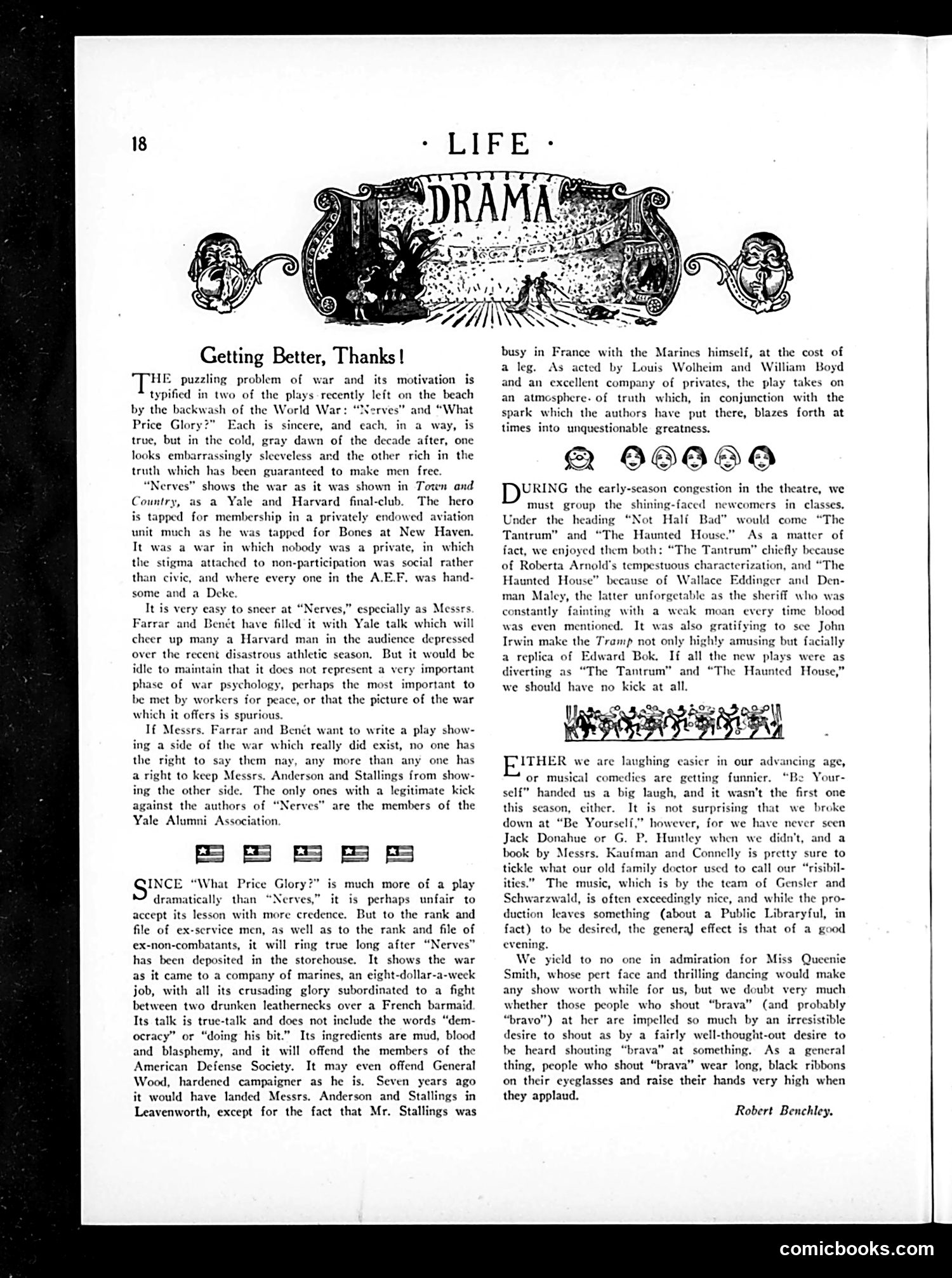
This is a theater review comparing two recent Broadway plays about World War I: "Nerves" and "What Price Glory?" **The Satire:** The critic contrasts how each play depicts the war. "Nerves" romanticizes it through an elite lens—portraying pilots as Ivy League fraternity members ("Bones," "Deke"), making war seem like exclusive club membership. "What Price Glory?" shows the unglamorous reality: enlisted marines fighting over a French barmaid, speaking realistically (avoiding words like "democracy"), motivated by mud and survival rather than patriotic ideals. **Key Point:** The review defends both plays' right to exist, but argues "What Price Glory?" rings truer because it depicts ordinary soldiers' actual experience. The critic notes playwright Stallings earned credibility by losing a leg serving as a Marine in France—his authenticity counters idealized portrayals. **Context:** Written roughly 1924-25, this reflects post-WWI disillusionment with war glorification, and the era's emerging realism in American theater rejecting Victorian sentimentality.
📄 Transcribed text from this page (OCR, searchable)
Machine-transcribed from the original scan — historical spelling and the odd misread are preserved.
Getting Better, Thanks! HE puzzling problem of war and its motivation is typified in two of the plays recently left on the beach by the kwash of the World War: “Nerves” and “What Price Glory?” Each is sincere, and each, in a way, is true, but in the cold, gray dawn of the decade after, one looks embarrassingly sleeveless and the other rich in the truth which has been guaranteed to make men free. “Nerves” shows the war as it was shown in Toten and Country, as a Yale and Harvard final-club. The hero is tapped for membership in a privately endowed aviation unit much as he was tapped for Bones at New Haven. It a war in which nobody was a private, in which the stigma attached to non-participation was social rather than and where every one in the A.E.F, was hand- some and a Deke. It is very easy to sneer at “Nerves,” especially as Messrs. Farrar and Benét have filled it with Yale talk which will cheer up many a Harvard man in the audience depressed over the recent disastrous athletic season, But it would be idle to maintain that it does not represent a very important phase of war psychology, perhaps the most important to be met by workers for peace, or that the picture of the war ich it offers is spurious. If Messrs. Farrar and Benét want to write a play show- ing a side of the war which really did exist, no one has the right to say them nay, any more than any one has a right to keep Messrs. Anderson and Stallings from show ing the other side. The only ones with a legitimate kick against the authors of “Nerves” are the members of the Yale Alumni Association > — INCE “What Price Glory?” is much more of a play dramatically than “Nerve it is perhaps unfair to accept its lesson with more credence. But to the rank and file of ex-service men, as well as to the rank and file of ex-non-combatants, it will ring true long after “Nerves” has been deposited in the storehouse. It shows the war as it came to a company of marines, an eight-dollar-a-week job, with all its crusading glory subordinated to a fight between two drunken leathernecks over a French barmaid Its talk is true-talk and does not include the words “dem- ocracy” or “doing his bit.” Its ingredients are mud, blood and blasphemy, and it will offend the members of the American Defense Society. It may even offend General Wood, hardened campaigner as he is. Seven years ago it would have landed Messrs. Anderson and Stallings in Leavenworth, except for the fact that Mr. Stallings was = busy in France with the Marines himself, at the cost of a leg. As acted by Louis Wolheim and William Boyd and an excellent company of privates, the play takes on an atmosphere. of truth which, in conjunction with the spark which the authors have put there, blazes forth at times into unquestionable greatness. Q 9888884 URING the early-season congestion in the theatre, we must group the shining-faced newcomers in classes. Under the heading ‘ot Half Bad” would come “The Tantrum” and “The Haunted House.” As a matter of fact, we enjoyed them both: “The Tantrum” chiefly because of Roberta Arnold's tempestuous characterization, and “The Haunted House” because of Wallace Eddinger and Den- man Maley, the latter unforge as the sheriff who was constantly fainting with a weak moan every time blood was even mentioned. It was also gratifying to sce John Irwin make the Tramp not only highly amusing but facially a replica of Edward Bok. If all the new plays were as diverting as “The Tantrum” and “The Haunted House,” we should have no kick at all. ITHER we are laughing easier in our advancing age, or musical comedies are getting funn’ “Be Your- self” handed us a big laugh, and it wasn't the first one this scason, cither. It is not surprising that we broke down at “Be Yourself,” however, for we have never scen Jack Donahue or G. P. Huntley when we didn't, and a book by Messrs. Kaufman and Connelly is pretty sure to tickle what our old family doctor used to call our “risibil- The music, which is by the team of Gensler and Schwarzwald, is often exceedingly nice, and while the pro- duction leaves something (about a Public Libraryful, in fact) to be desired, the genera) effect is that of a good evening. We yield to no one in admiration for Miss Queenie Smith, whose pert face and thrilling dancing would make any show worth while for us, but we doubt very much whether those people who shout “brava” (and probably “bravo") at her are impelled so much by an irresistible desire to shout as by a fairly well-thought-out desire to be heard shouting “brava” at something. As a general thing, people who shout “brava” wear long, black ribbons on their eyeglasses and raise their hands very high when they applaud. Robert Benchley. comicbooks.com