
A complete issue · 36 pages · 1924
Life — July 31, 1924
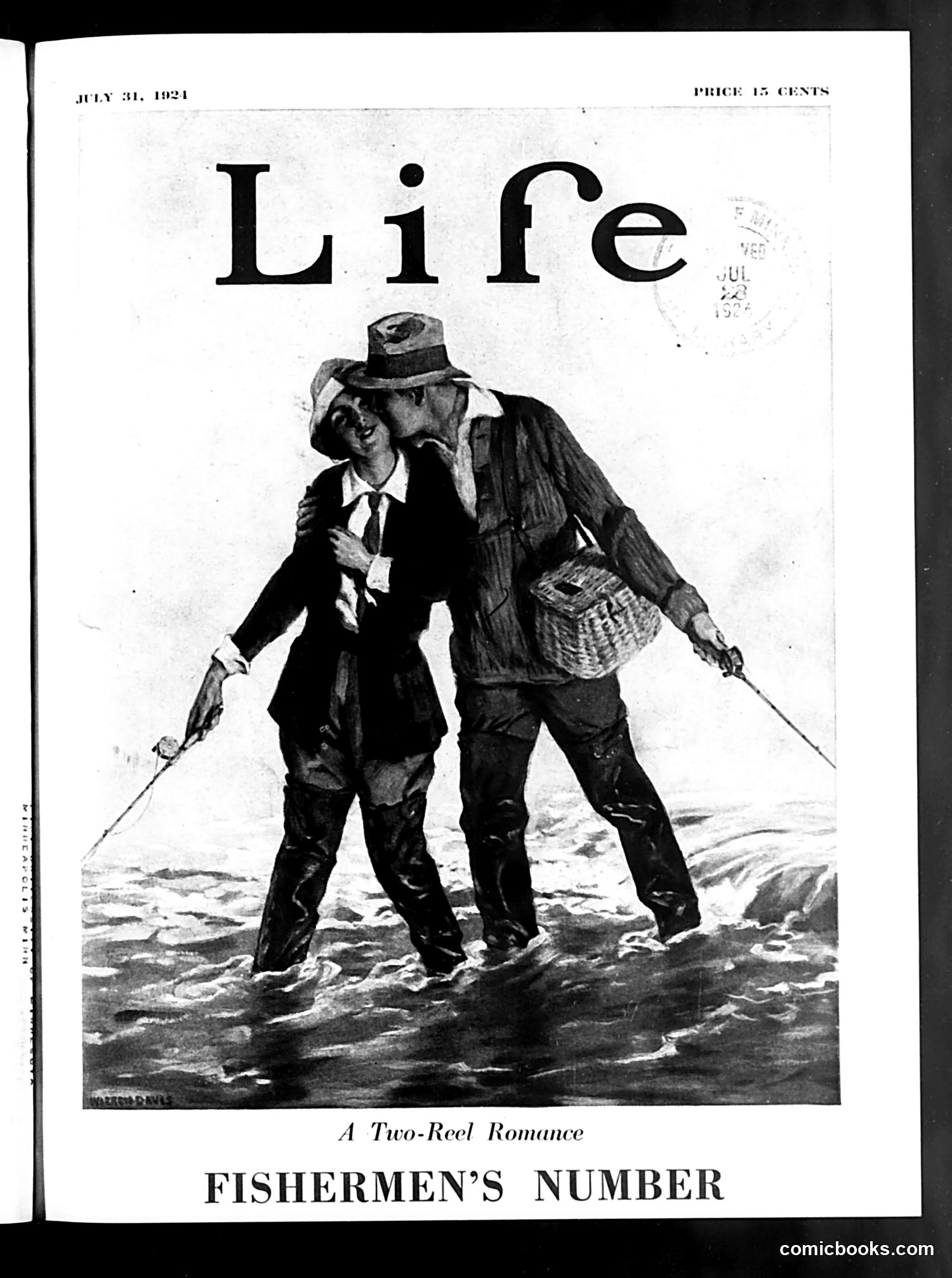
This is a Life magazine cover from July 31, 1924, featuring a two-reel film advertisement titled "Fishermen's Number." The image shows two men in formal business attire (suits and hats) wading in shallow water, apparently fishing with rods. One man appears to be kissing or whispering to the other. The satire likely plays on the contrast between refined, urban businessmen and the rustic activity of fishing—a working-class pursuit. The intimate physical contact between the two men may suggest comedic misunderstanding or parody of romantic conventions. The "Two-Reel Romance" subtitle indicates this is a comedy short film. Without identifying the specific actors or film production details, the basic joke appears to mock pretentious city-dwellers attempting outdoor recreation.
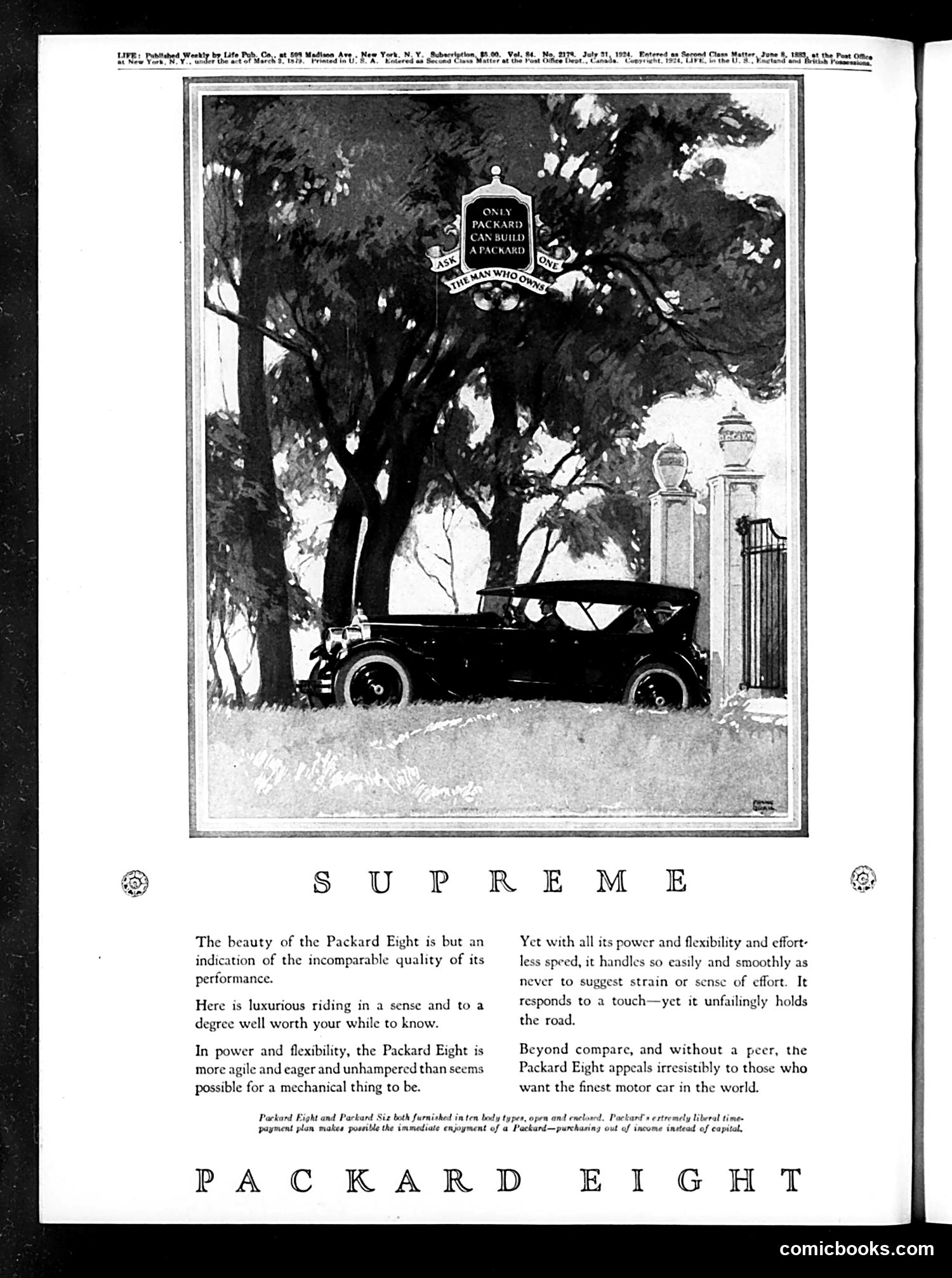
This page is **advertising, not satire or political commentary**. It's a full-page advertisement for the Packard Eight automobile, published in *Life* magazine. The image shows a luxury car positioned beneath dramatic trees, near an ornate gate—evoking wealth, elegance, and leisure. The Packard Eight logo appears at top center. The accompanying text emphasizes the car's superior qualities: power, flexibility, smooth handling, and effortless performance. The ad targets affluent readers, positioning the Packard Eight as "the finest motor car in the world" for those desiring luxury and mechanical excellence. This represents early automotive advertising strategy: associating cars with refined taste, beauty, and social status rather than practical transportation needs.
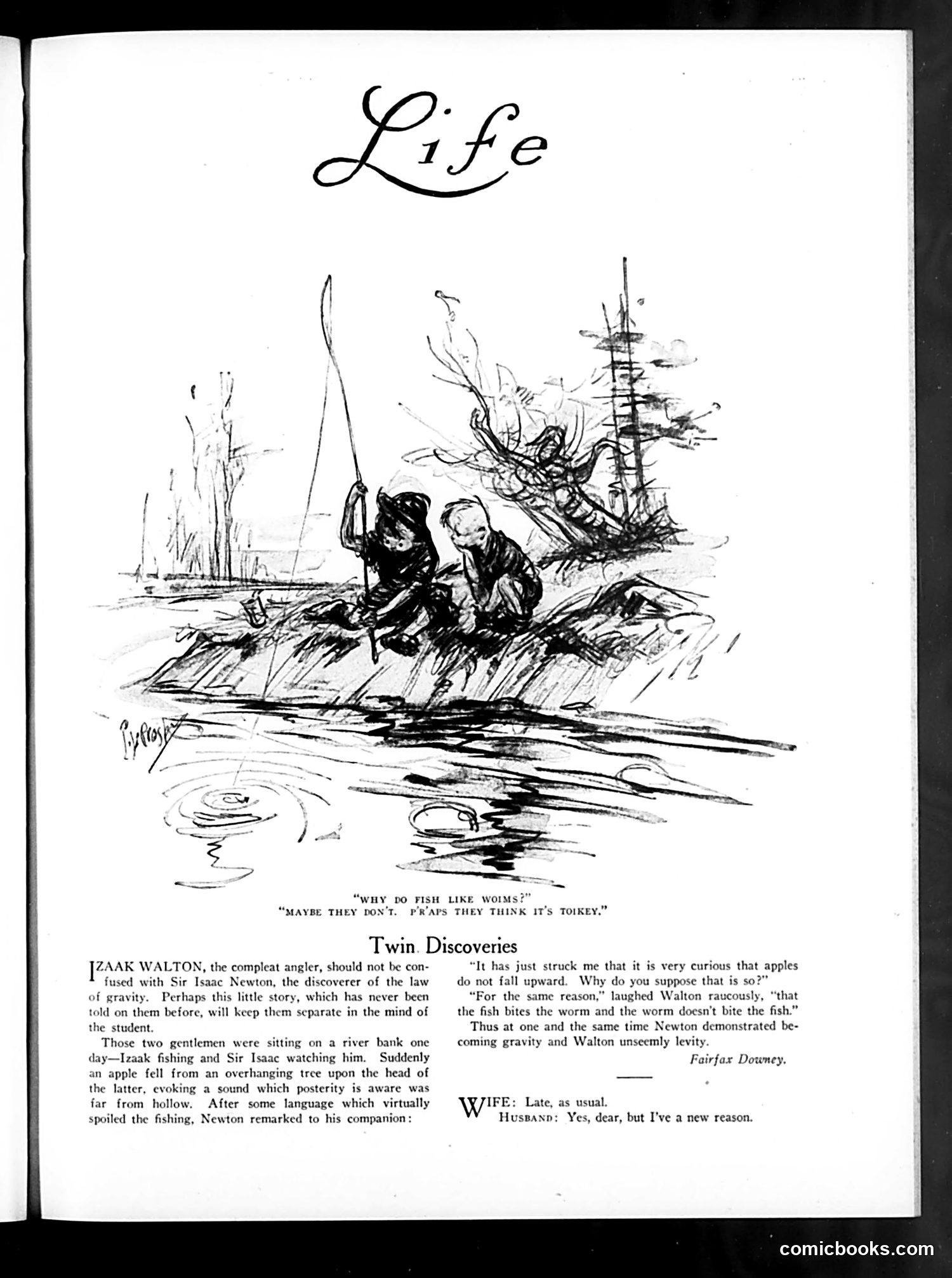
This page from *Life* magazine presents two separate pieces: **"Twin Discoveries"** is a humorous essay contrasting Isaac Newton and Izaak Walton. It opens with an anecdote: while fishing together, an apple falls on Walton's head (referencing Newton's famous apple and gravity discovery). Newton remarks that fish don't bite worms because worms fall upward, demonstrating gravity humorously. The accompanying sketch shows two figures by a river with sailing ships, illustrating the fishing scene. Below is a brief comedic dialogue titled "Fairfax Downery" about a husband arriving home late, offering a new excuse to his wife. The humor relies on wordplay and the juxtaposition of scientific discovery with everyday domestic situations—typical of *Life*'s satirical approach to American life and culture.
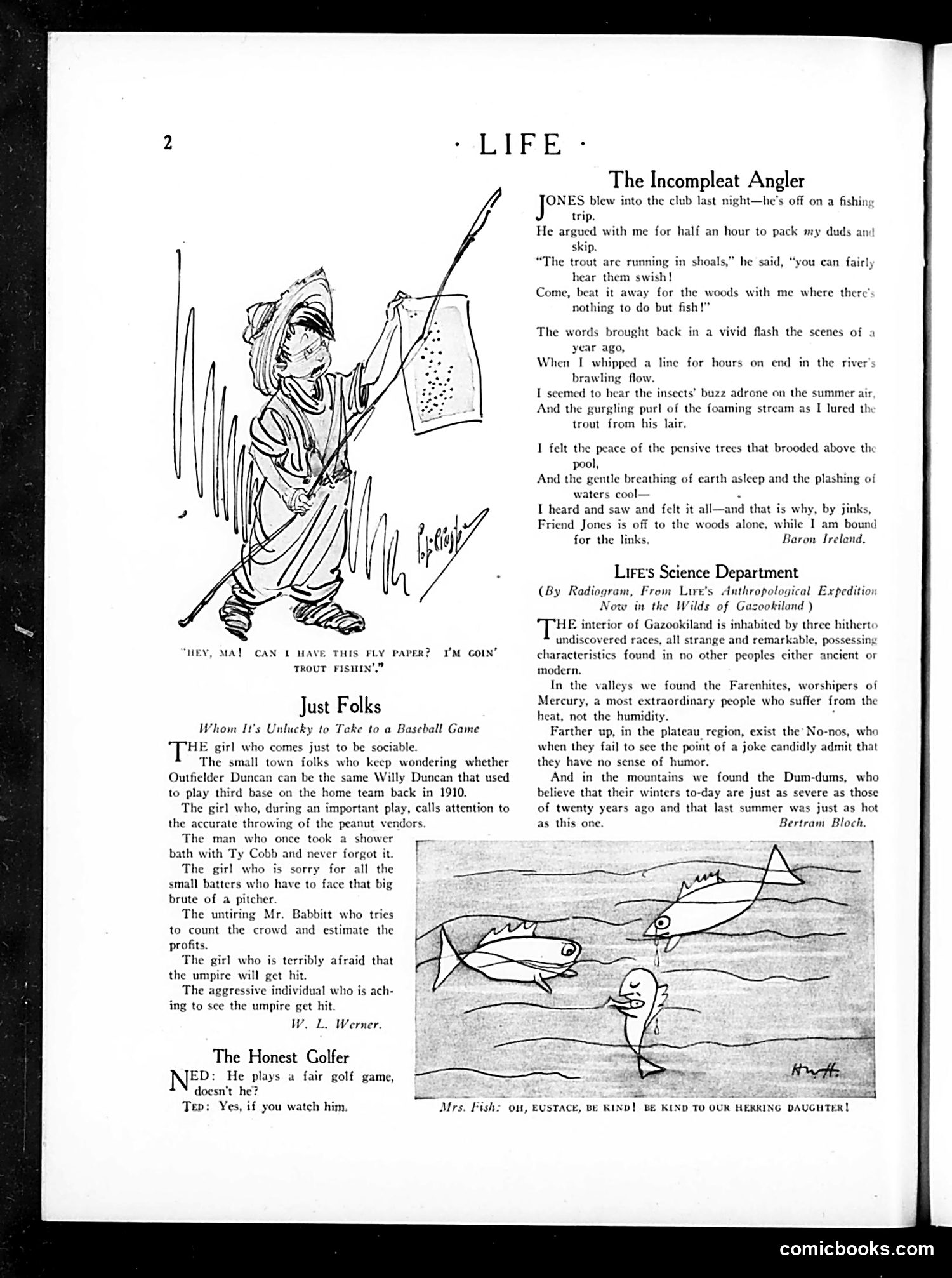
This page contains three humorous pieces: **"The Incompleat Angler"** presents a poem by Baron Ireland about fishing's peaceful pleasures, contrasting with **the cartoon above** showing a disheveled fisherman asking for fly paper—a joke about insects ruining outdoor relaxation. **"Just Folks"** by W.L. Werner offers brief satirical observations about baseball culture: the small-town obsession with the game, vendors' aggressive tactics, and specific character types (an umpire-hating girl, an aggressive fan). It references Willy Duncan using third base humor from 1910, suggesting this is early 20th-century content poking fun at baseball's social importance. **"The Honest Golfer"** is a two-line joke playing on the assumption that golfers cheat—implying fair play is so unusual it warrants surveillance.
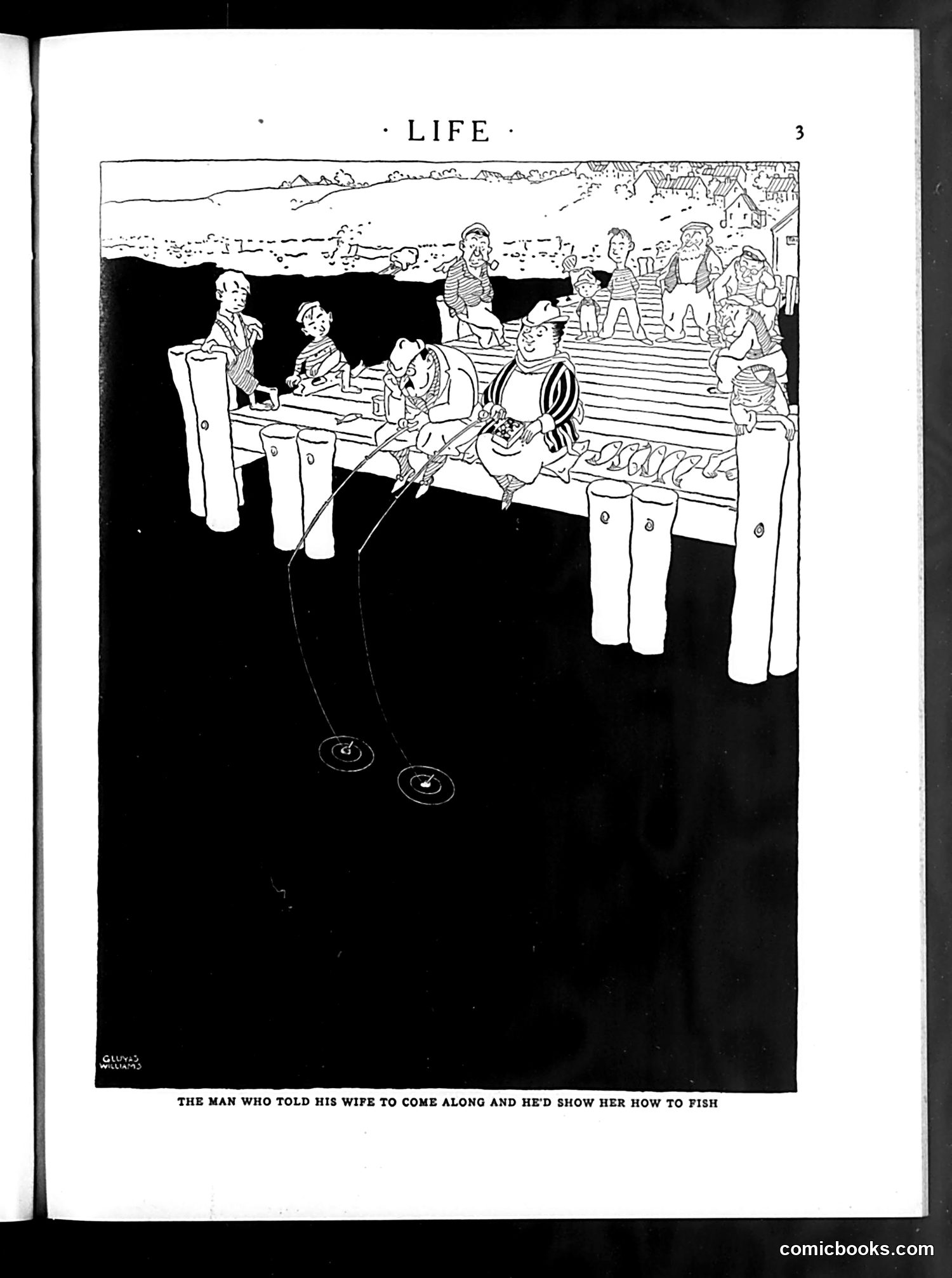
This is a humorous domestic satire from Life magazine. The caption reads: "THE MAN WHO TOLD HIS WIFE TO COME ALONG AND HE'D SHOW HER HOW TO FISH." The cartoon depicts a man fishing from a dock with his wife beside him. While the man appears relaxed, the scene shows a group of other people (adults and children) gathered on the dock and shoreline behind them, seemingly waiting or watching. The joke satirizes a common domestic scenario: the husband confidently invites his wife to join his hobby, implying he'll teach her, but the presence of the crowd suggests either his fishing expertise is questionable or the outing has become an awkward public spectacle rather than an intimate lesson. It's gentle social satire about masculine pride and domestic miscommunication.
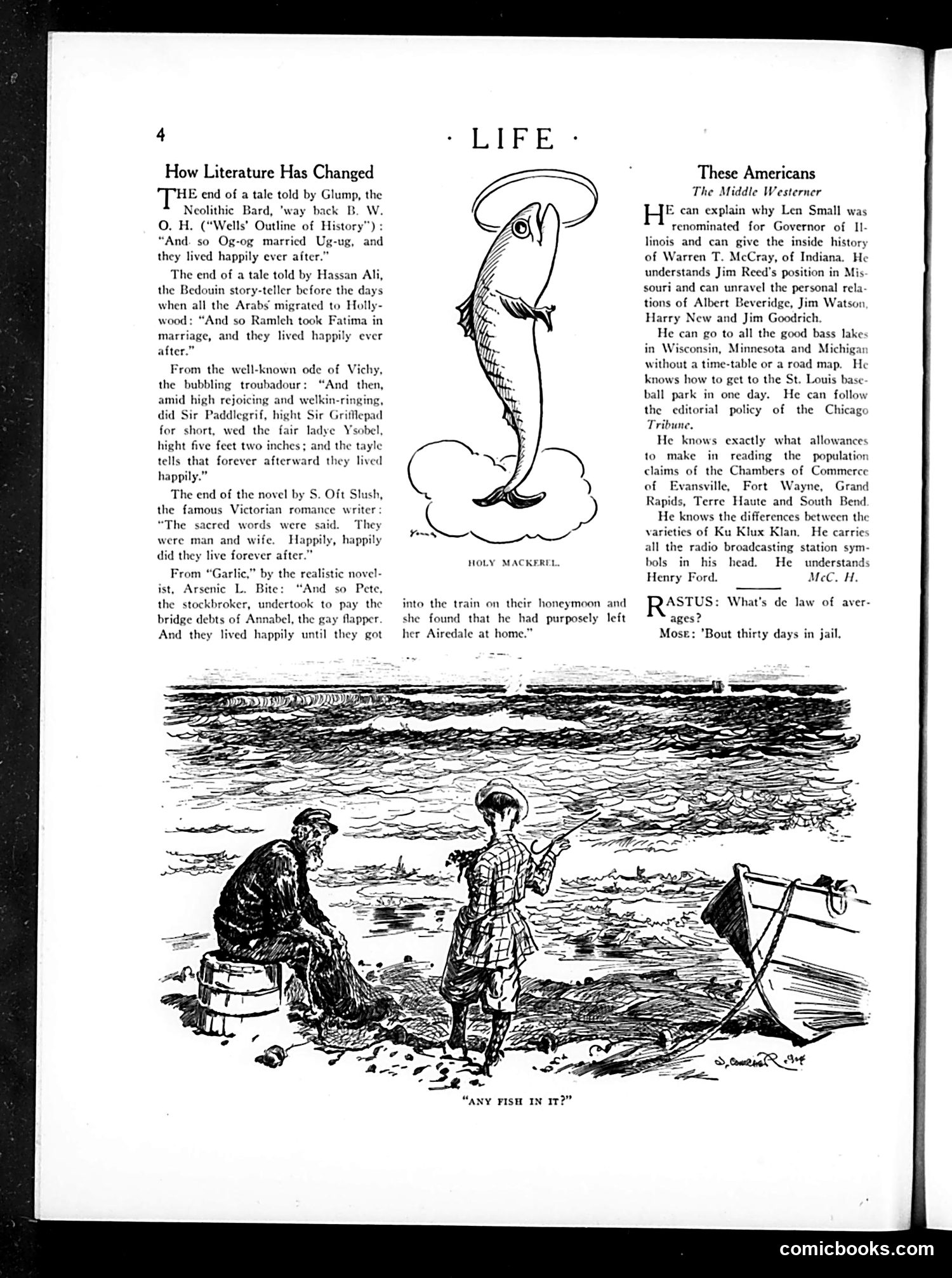
This page contains two distinct sections: **"How Literature Has Changed"** (left column) presents literary excerpts showing how story endings evolved—from classic tales with "happily ever after" conclusions to more realistic modern literature featuring unhappy endings and cynical outcomes. **"These Americans"** (right column) humorously profiles a Midwesterner with encyclopedic knowledge of regional politics, geography, sports figures, and radio stations—essentially a walking almanac of Americana. The two **cartoons** below depict: (1) a "Holy Mackerel" with wings on a cloud, and (2) a seaside scene captioned "Any Fish In It?" showing an adult and child fishing, likely making a crude joke about the child's question. The overall page satirizes changing American cultural attitudes and regional character types.
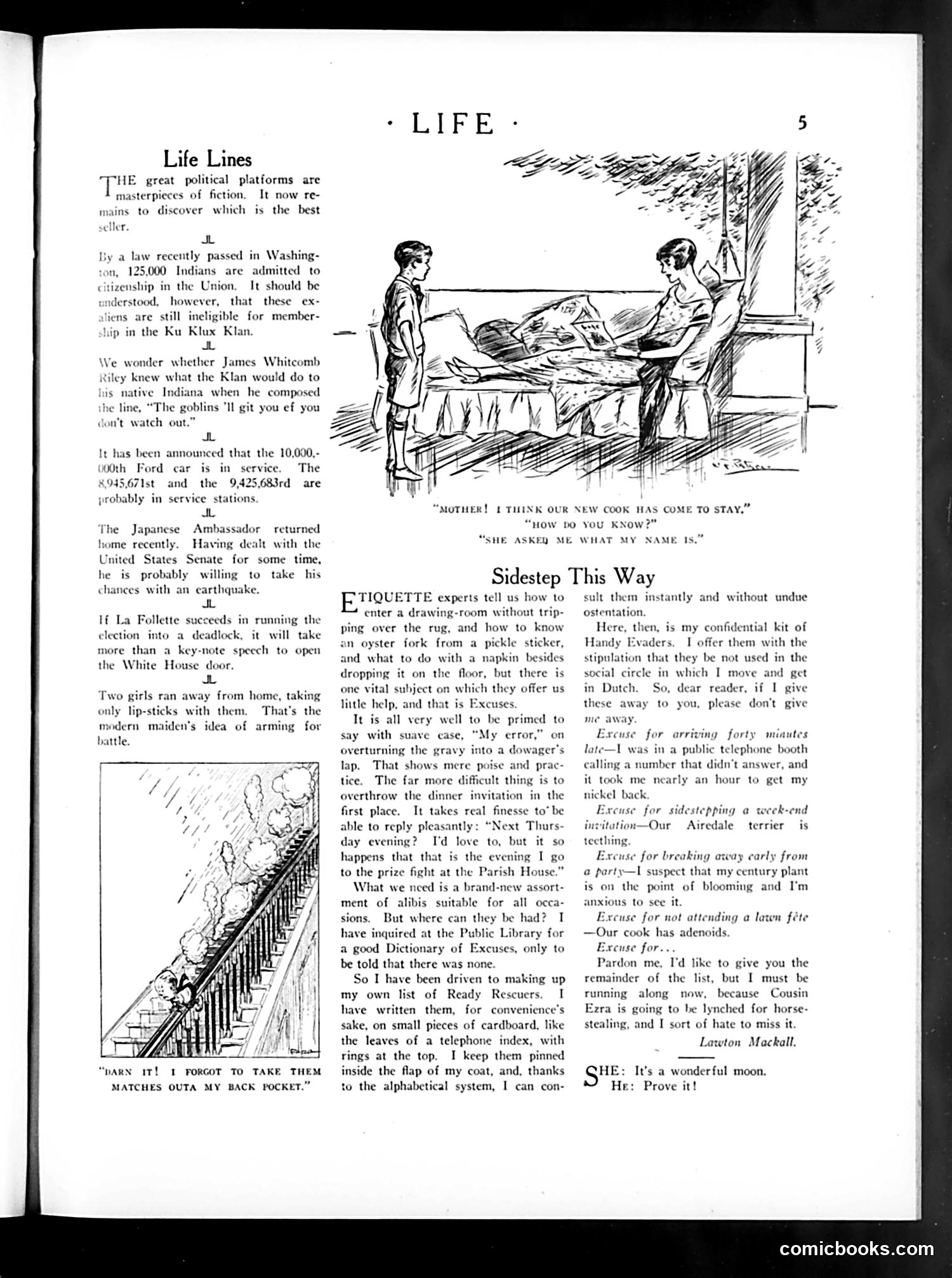
This page combines short satirical commentary with illustrations and humor pieces typical of early 20th-century Life magazine. **"Life Lines" section:** Brief political/social jabs, including references to a Washington law admitting 125,000 Native Americans to citizenship and mention of James Whitcomb Riley (likely the Indiana poet). References to Ford automobile production numbers and a Japanese ambassador dealing with earthquake concerns appear to be topical commentary. **"Sidestep This Way":** An etiquette advice column using humorous "excuses" for social embarrassments—arriving late, sidestepping invitations, breaking potted plants at parties. It's gentle satire on modern social anxiety. **Illustrations:** Two sketches accompany the text—one showing domestic servants, another depicting someone forgetting matches. The overall tone is lighthearted social observation rather than hard political satire.
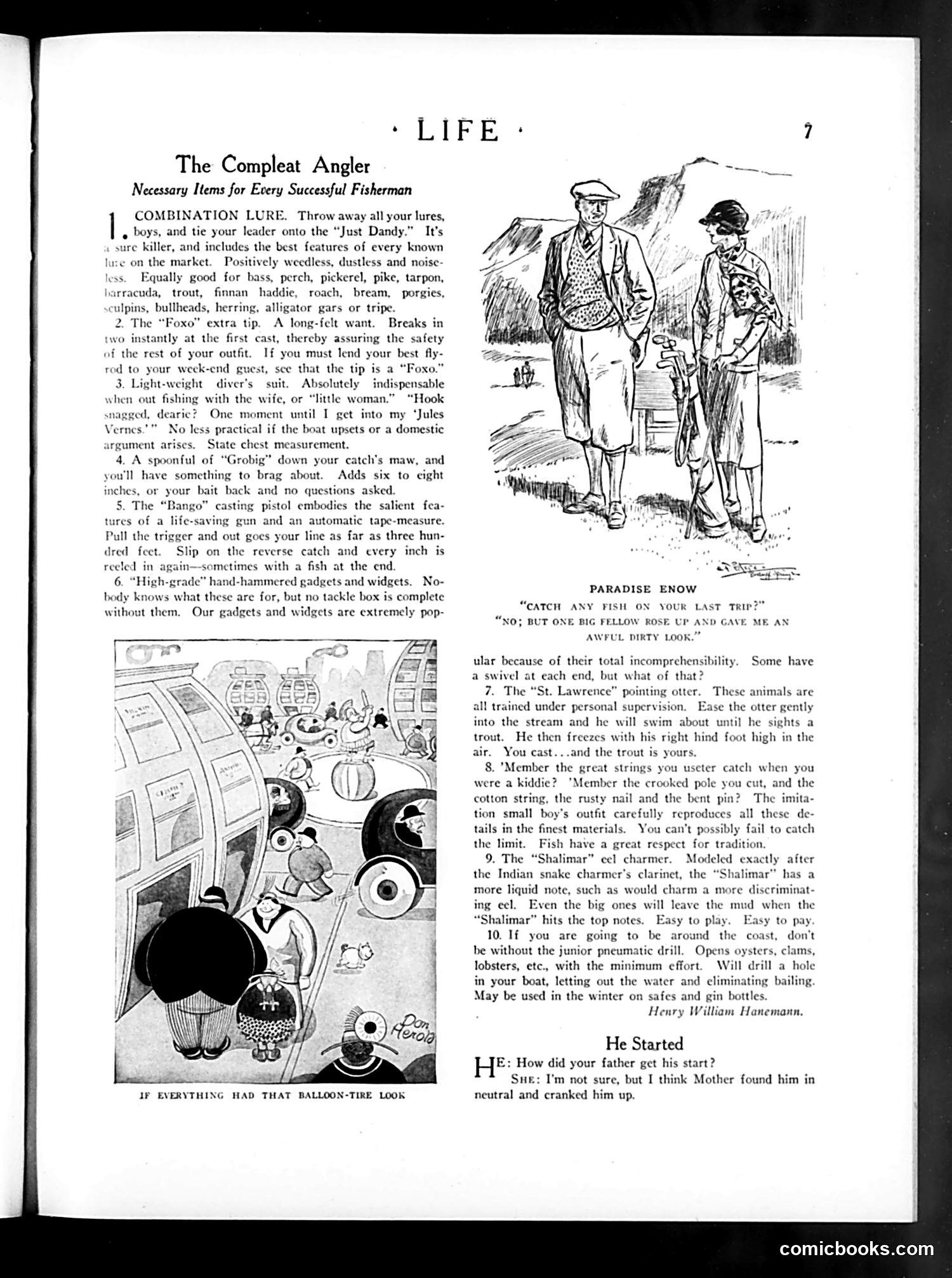
This page satirizes fishing enthusiasts through a humorous article listing absurdly specialized equipment for "every successful fisherman." The numbered items mock how fishermen accumulate excessive gadgets—combination lures, "Foxo" breaks, "Hook-snagged" darts, "Grobig" maw-grabbers, and "Bango" casting pistols—presented as though essential but clearly ridiculous. The left cartoon depicts a person so laden with balloon-like fishing gear they've become spherical and immobilized, captioned "IF EVERYTHING HAD THAT BALLOON-TIRE LOOK." This visual gag ridicules the obsessive accumulation of fishing paraphernalia. The right illustration shows two anglers, with dialogue mocking impractical catches ("Paradise Enow"), further emphasizing how fishing culture prioritizes gear over actual results. The satire targets middle-class consumerism and hobby obsessiveness.
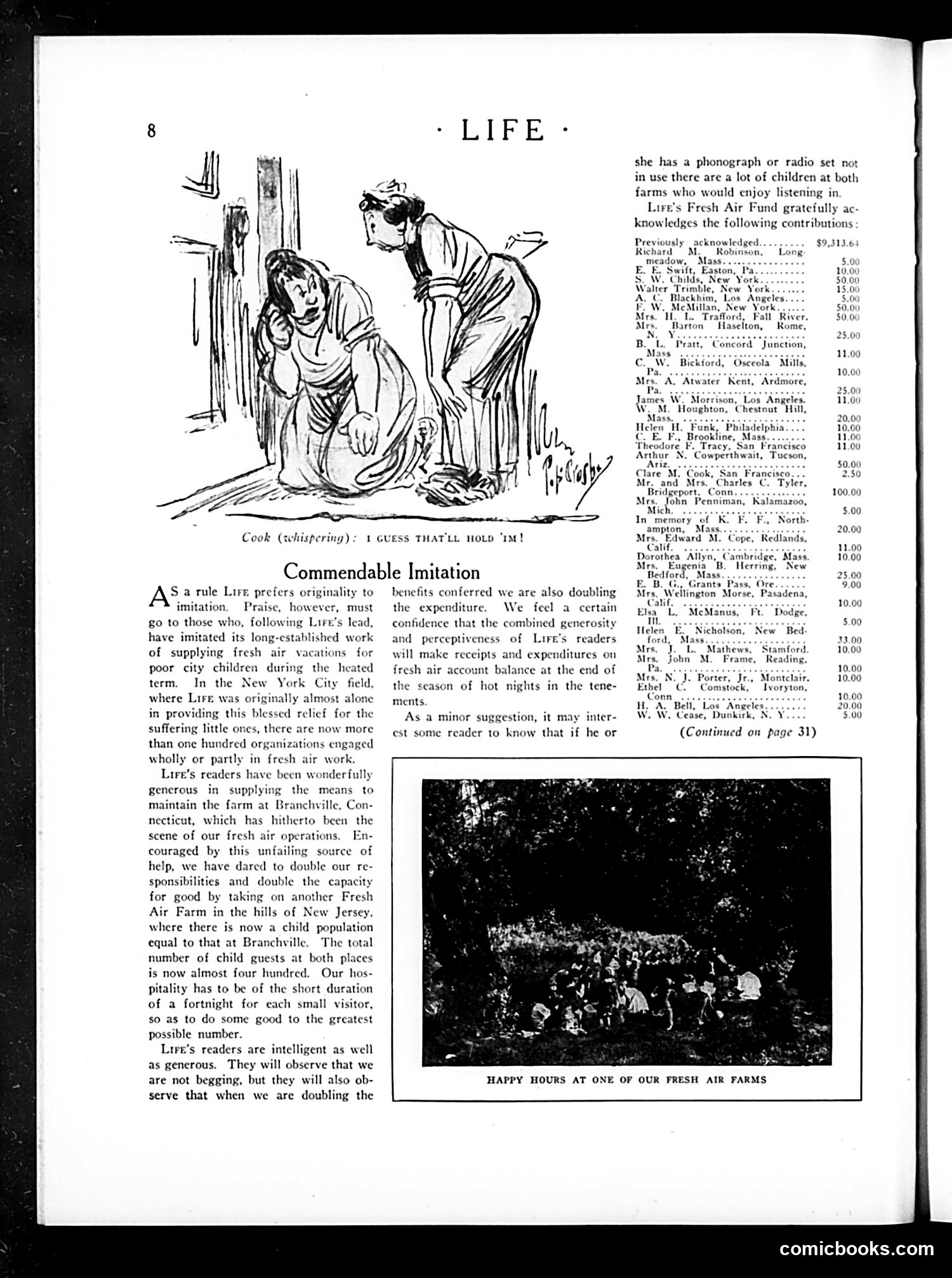
The main cartoon depicts a cook whispering to a thin, poorly-dressed child with the caption "I GUESS THAT'LL HOLD 'IM!" The image satirizes poverty and inadequate nutrition for children during what appears to be the early 20th century. The accompanying article, "Commendable Imitation," discusses LIFE magazine's Fresh Air Fund—a charitable initiative providing rural vacations for underprivileged city children. The piece acknowledges expanding operations to a second farm in New Jersey to accommodate more child guests. The cartoon's dark humor contrasts the meager meal being served against the charitable efforts described in the text, likely critiquing the gap between poor urban children's actual living conditions and the limited relief efforts available to them.
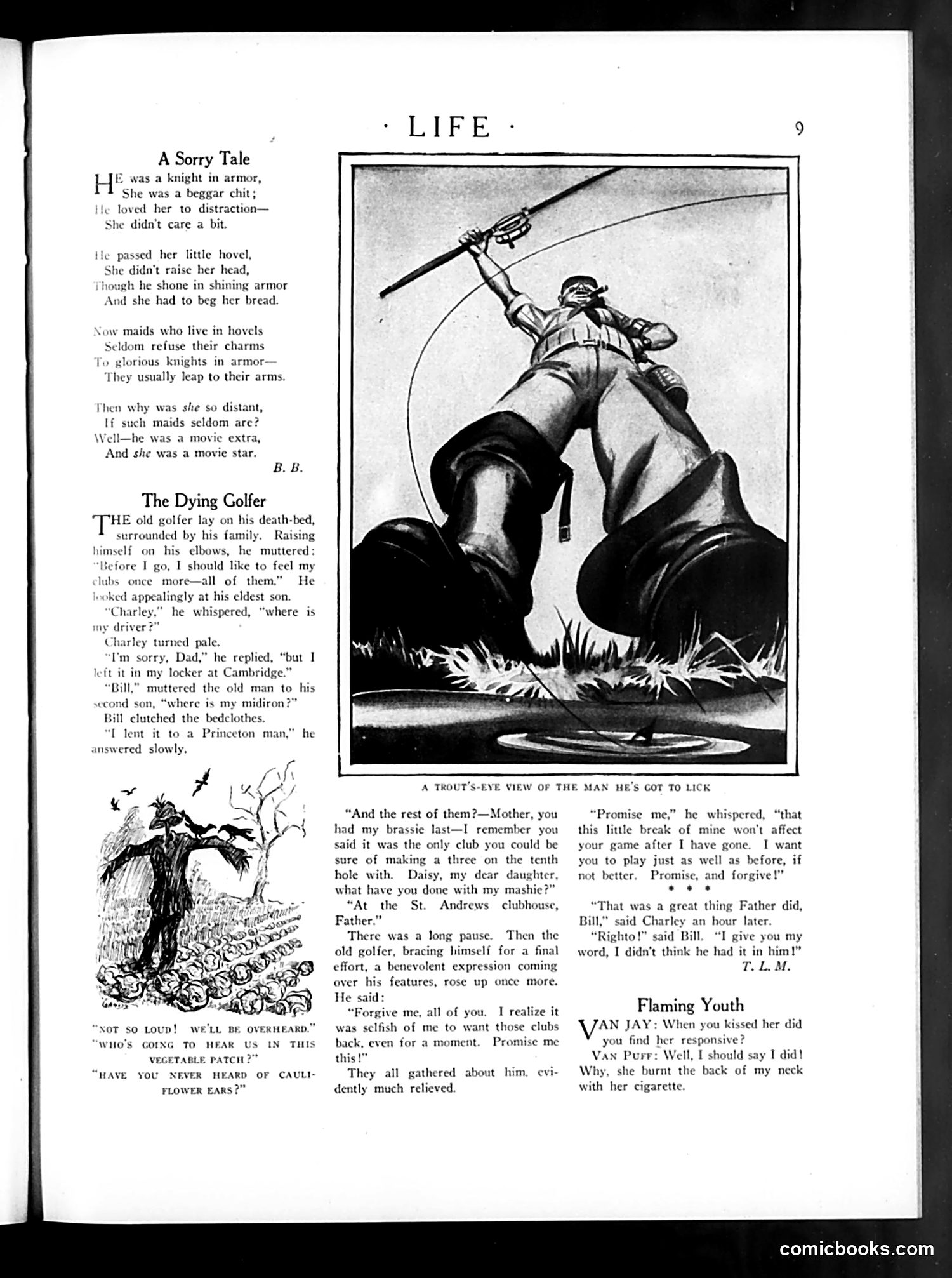
This page contains three separate pieces of satirical literature and one illustration: 1. **"A Sorry Tale"** (poem, unsigned): A witty commentary on class and celebrity. A knight in armor ignores a beggar girl despite his noble status, yet she later becomes a movie star. The satire targets both aristocratic indifference and Hollywood's elevating power—suggesting a "movie star" status paradoxically outranks actual nobility, reflecting 1920s cultural anxieties about cinema's influence. 2. **"The Dying Golfer"**: A humorous story about an elderly golfer's deathbed preoccupation with his golf clubs, satirizing upper-class priorities and the obsessive nature of sports enthusiasm among the wealthy. 3. **"Flaming Youth"**: A brief dialogue mocking modern dating behavior and female boldness, referencing the "flapper" generation's scandalous conduct by 1920s standards. The page reflects Jazz Age social commentary on class, modernity, and generational conflict.
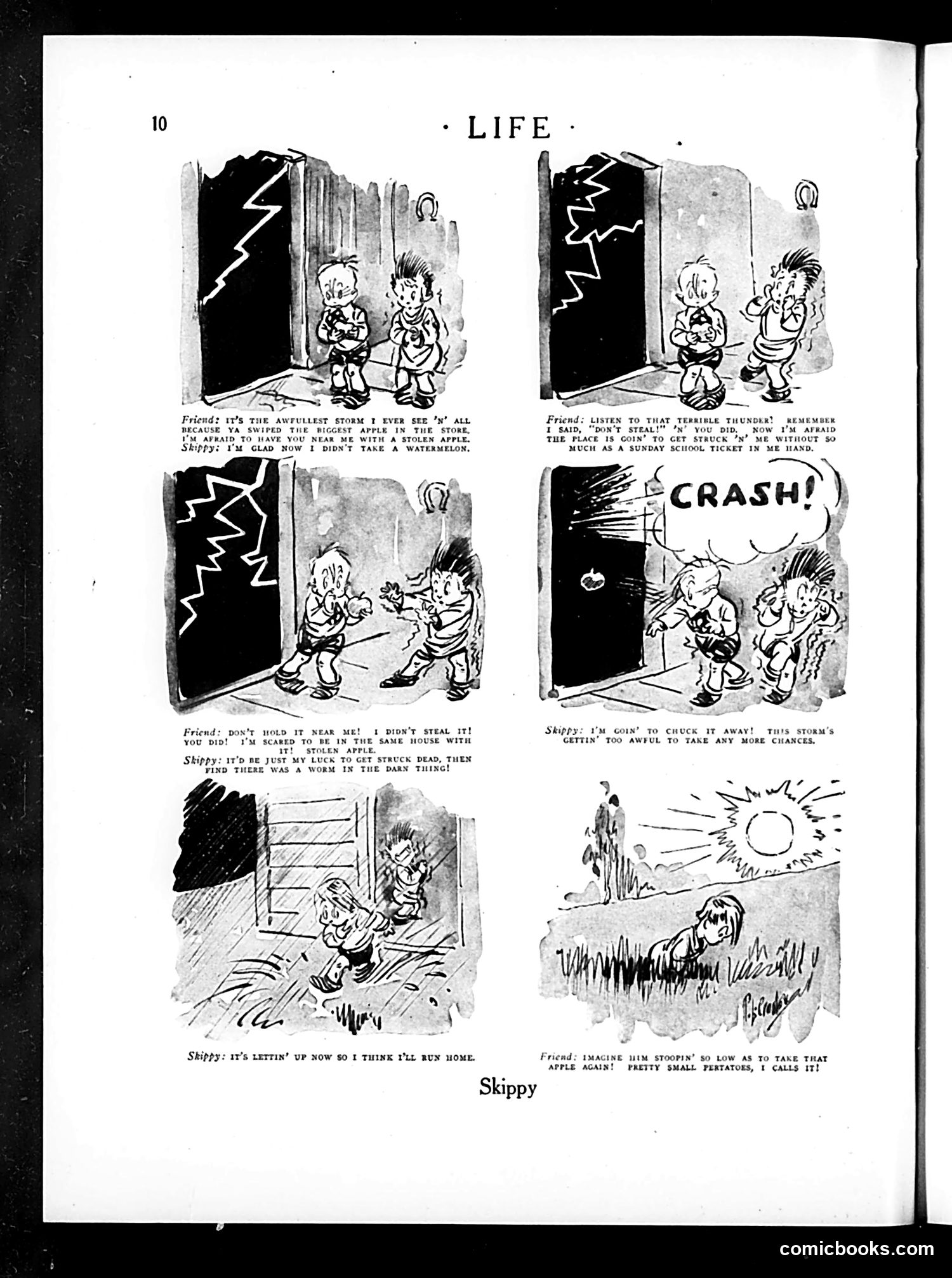
This is a six-panel comic strip titled "Skippy" depicting a child's mischievous encounter with a violent thunderstorm. The narrative follows a predictable trajectory: Skippy steals an apple from a store, his friend warns him about the lightning outside, Skippy dismisses the danger, then a crash of thunder frightens both boys. The comic plays on the moral lesson that wrongdoing invites punishment—here, divine retribution via the storm itself. The humor derives from the exaggeration and the child's fatalistic acceptance: "it'd be just my luck to get struck dead, then find there was a worm in the dark thing!" The final panel shows Skippy running home in daylight, his friend noting the irony that such a small creature causes such dramatic consequences. The strip reinforces period-appropriate moral instruction through slapstick comedy and providential consequences.
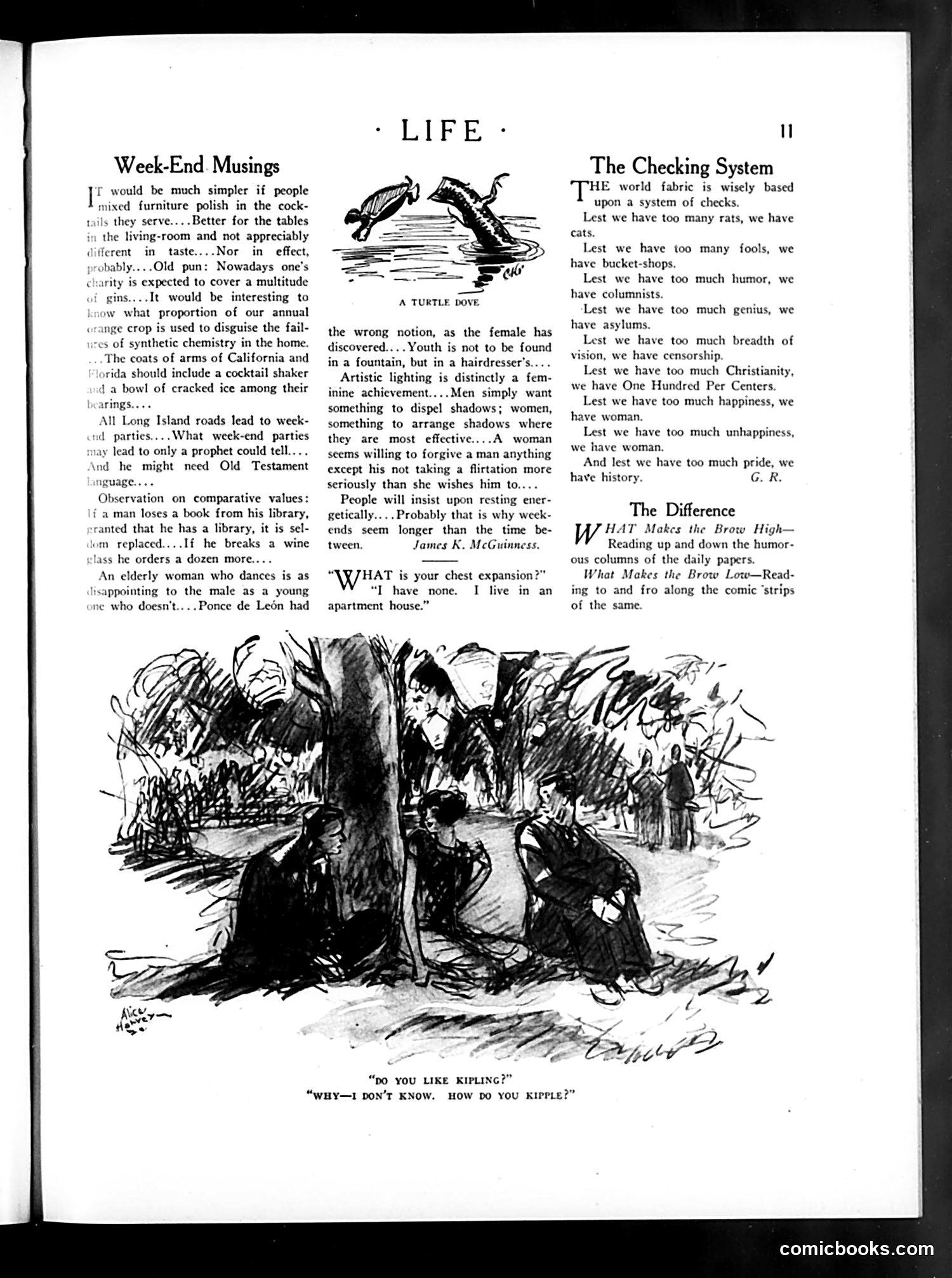
This page contains three separate satirical pieces. "Week-End Musings" offers social commentary on cocktail culture and Long Island society. "The Checking System" is a humorous list-poem criticizing various modern institutions—too many rats, tools, columnists, asylums, and ultimately blaming "woman" for society's excess of unhappiness. The main cartoon depicts three figures beneath a tree, with one asking "Do you like Kipling?" The response is "Why—I don't know. How do you kipple?" This is wordplay: "Kipling" refers to the famous author Rudyard Kipling, but the joke treats it as if it were a verb ("kipple"), creating absurdist humor by treating a proper name as an unfamiliar activity or action.
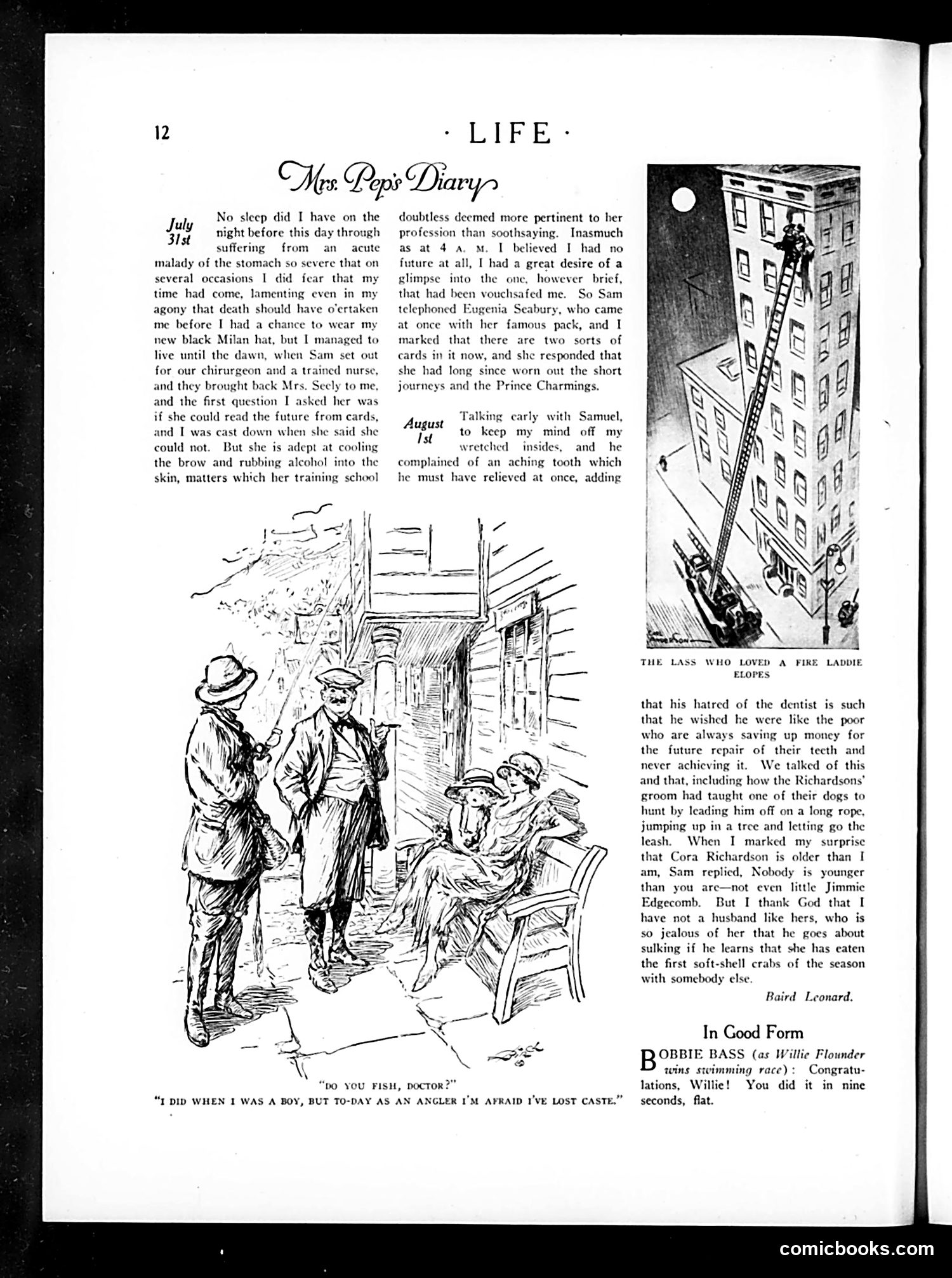
This page presents Mrs. Pops' Diary, a serialized humor column. The left illustration shows a street scene with three men in early 20th-century dress discussing fishing—one asking "Do you fish, doctor?" The doctor replies he fished as a boy but lost the habit as an angler. The right illustration, captioned "The Lass Who Loved a Fire Ladder Elopes," shows a woman on a fire escape ladder against a tall building. The diary entries humorously document daily domestic life and social observations. At bottom, a congratulatory note addresses "Bobbie Bass" on winning a swimming race ("nine seconds, flat"), appearing to be a humorous reader acknowledgment typical of Life magazine's interactive style with its audience.
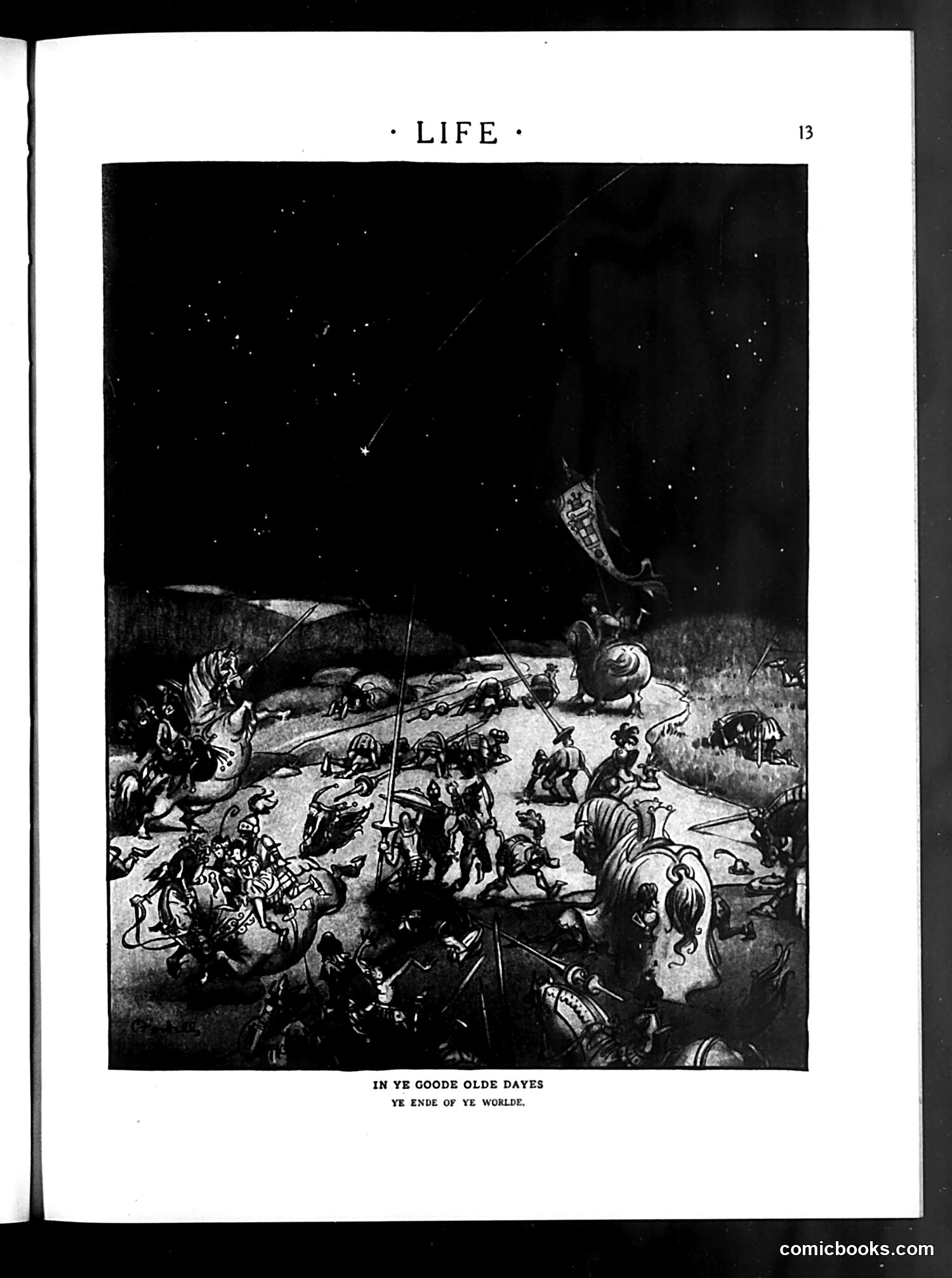
This is a satirical illustration depicting a fantastical, apocalyptic scene labeled "In Ye Goode Olde Dayes / Ye Ende of Ye Worlde" (the end of the world in good old days). The engraving shows a chaotic heavenly or supernatural landscape populated with numerous small figures, strange creatures, and celestial objects—including what appears to be a large spherical body and a vessel in the sky. The satire appears to mock nostalgia for "the good old days" by imagining them as equally chaotic and bizarre as contemporary times. This was likely a commentary on the human tendency to romanticize the past while dismissing present troubles. The detailed, crowded composition emphasizes absurdity rather than any specific political target.
This page contains editorial commentary by E.S. Martin about the 1924 presidential race, focusing on Calvin Coolidge's prospects. The article discusses Coolidge's strengths as a candidate—described as a "great lawyer" and effective speaker—while comparing him favorably to rival John W. Davis. The text analyzes European political movements and tensions between France, Germany, and the League of Nations as context for American politics. Martin argues that international instability (Russia, German recovery) makes Coolidge's steady leadership appealing, and that Democrats' divisions over Woodrow Wilson's legacy weaken their position against the Republican candidate. The small illustrations appear decorative rather than satirical commentary.
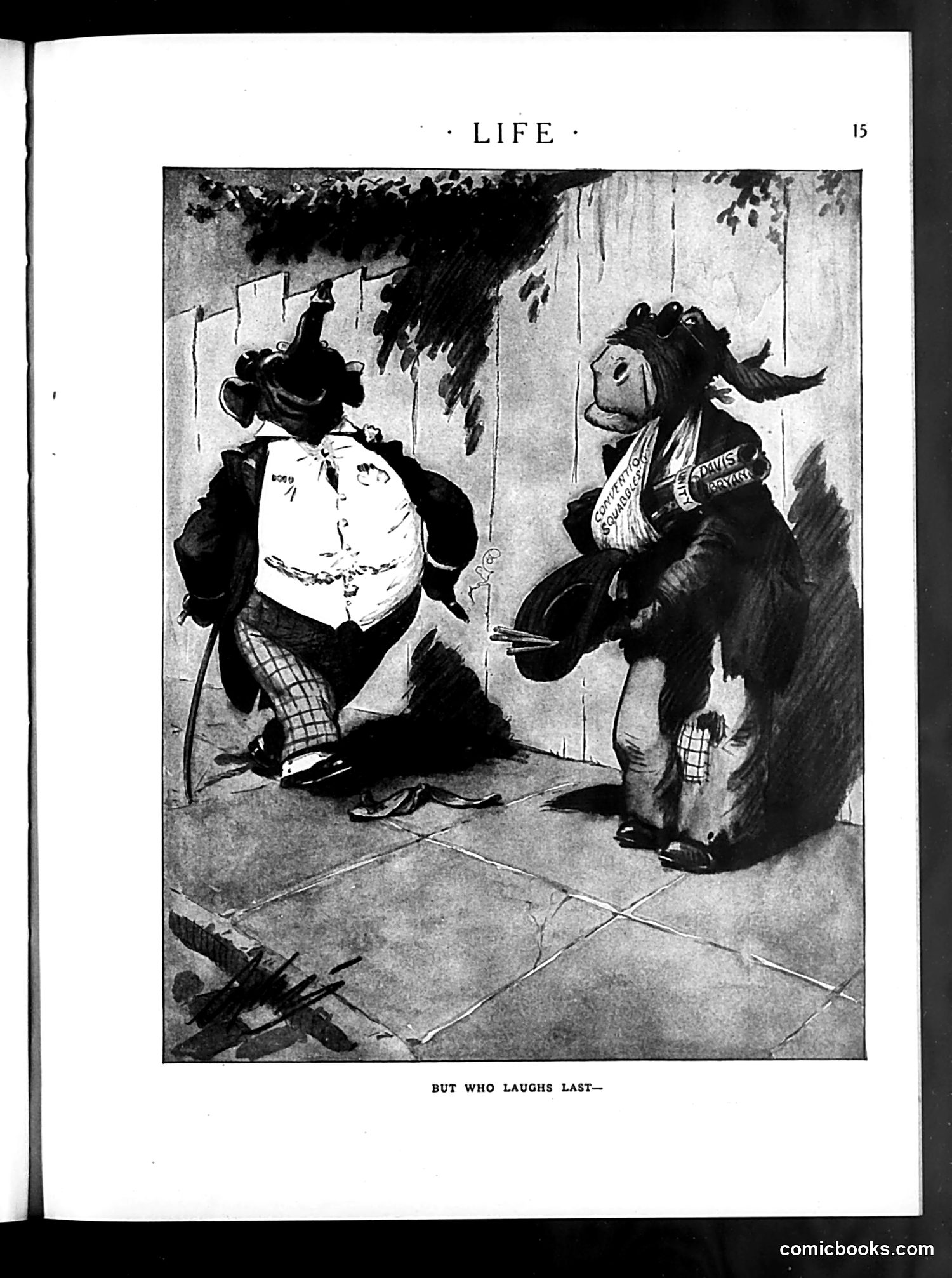
This cartoon depicts two exaggerated caricatured figures in what appears to be an alley or confined space. Both are drawn with grotesque features typical of early 20th-century satirical cartooning. The figure on the left wears a white vest or shirt front, while the right figure wears dark clothing with what appears to be a bandana or scarf. The caption "But Who Laughs Last—" suggests a commentary on comeuppance or ultimate victory. Without additional context identifying these specific figures, the precise political or social reference remains unclear. The artistic style and composition suggest this is satirizing some contemporaneous conflict, rivalry, or ironic twist of fortune, likely referencing recognizable public figures or events from Life magazine's period.
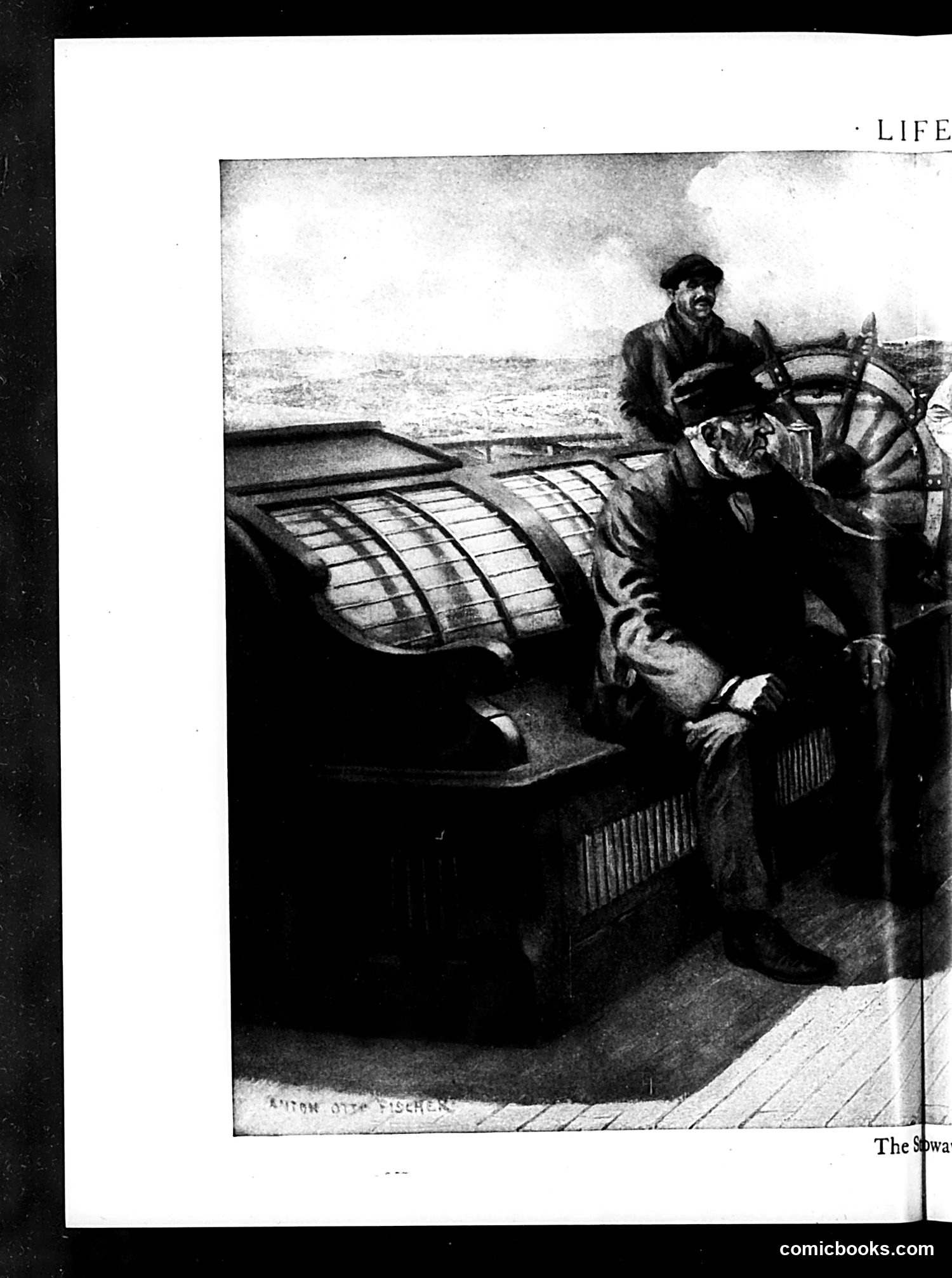
This appears to be a maritime scene rather than a political cartoon. The image shows two figures aboard what looks like a ship or boat—one at the wheel (steering) and another below deck or in the cabin area. The illustration style and black-and-white photography suggest early-to-mid 20th century. The credit line reads "CLIFTON OTT FISCHER," identifying the artist. The partial text visible includes "LIFE" (the magazine header) and what appears to be "The S[...]wa" at bottom right, likely a title cut off. Without the complete caption or article text, the specific satirical or narrative point remains unclear. The scene depicts maritime labor or activity, but the intended commentary—whether social, political, or humorous—cannot be reliably determined from the visible image alone.
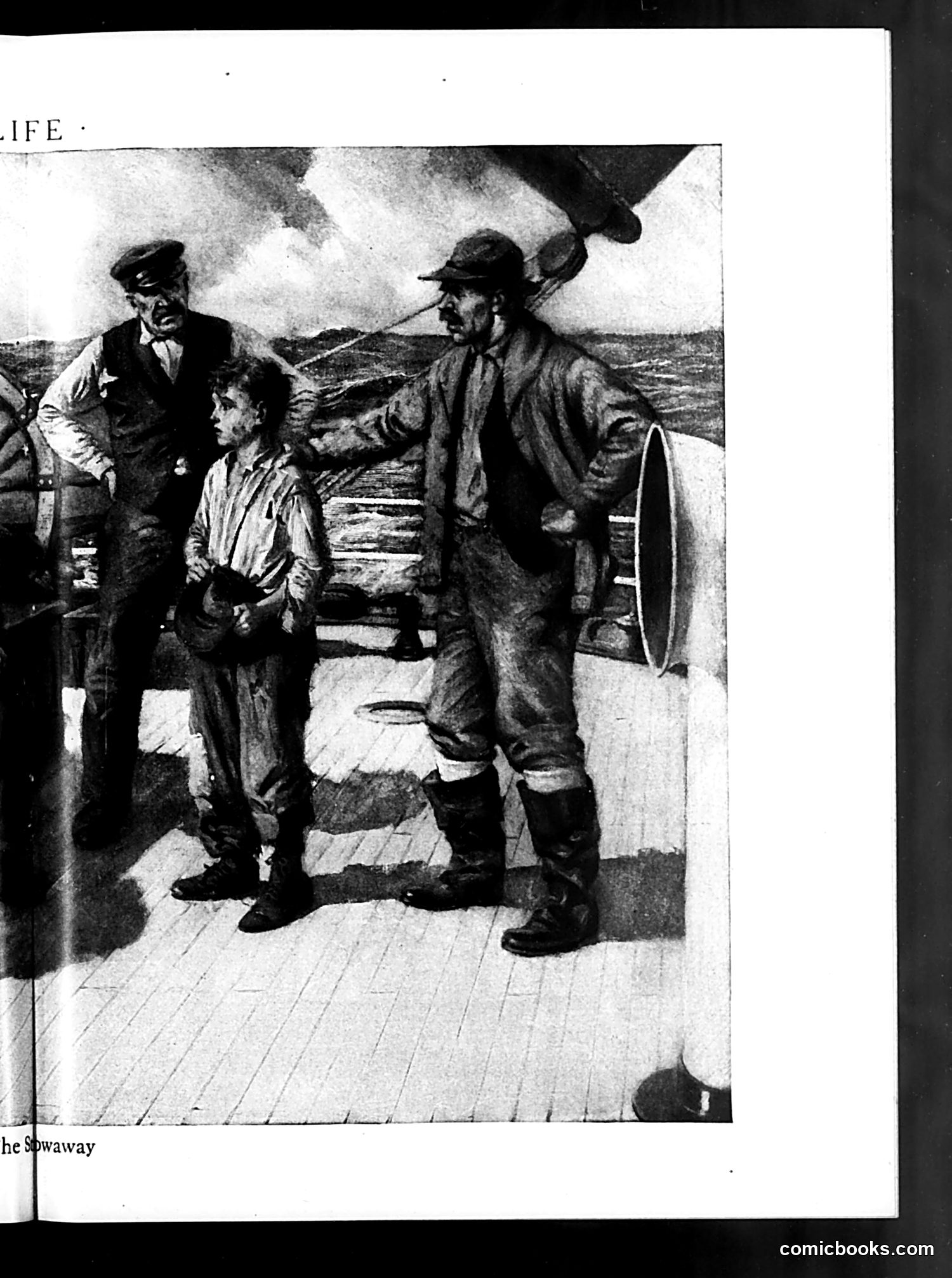
The OCR text is too corrupted to be useful. Based solely on the **image**, this appears to be a scene set on a ship's deck, showing three men in early 20th-century clothing engaged in conversation or confrontation. One wears a formal suit and cap (possibly an authority figure), while another in work clothes appears to be the subject of attention. The maritime setting and body language suggest this depicts some kind of shipboard incident or social interaction. Without legible text or caption identifying the specific figures, event, or satirical point, I cannot confidently explain what political or social commentary this cartoon makes. The page header reads "LIFE" (confirming the source), but the caption at bottom ("he 50waway" or similar) is illegible. **I cannot reliably identify the figures or satirical intent from this image alone.**
This is a theater review comparing two rival Broadway impresarios. **Florenz Ziegfeld** produced the famous *Ziegfeld Follies*, while **George White** created the competing *Scandals* revue. The critic argues White has finally surpassed Ziegfeld's once-dominant show. The review praises White's *Scandals* for emphasizing pure entertainment over heavy-handed political satire (referencing earlier editions that tackled Panama Canal tolls and appropriations bills). Key performers mentioned include **Lester Allen**, **Tom Patricola**, and the **Williams sisters**. Notably, the critic admires White's restraint in *not* taking himself too seriously—contrasting with the trend toward self-important revues. The review singles out a **Will Mahoney blackface mammy song parody**, framing it as good-natured burlesque in the tradition of **George M. Cohan**. The satire is theatrical rather than political—this is industry commentary on entertainment trends and competitive showmanship.
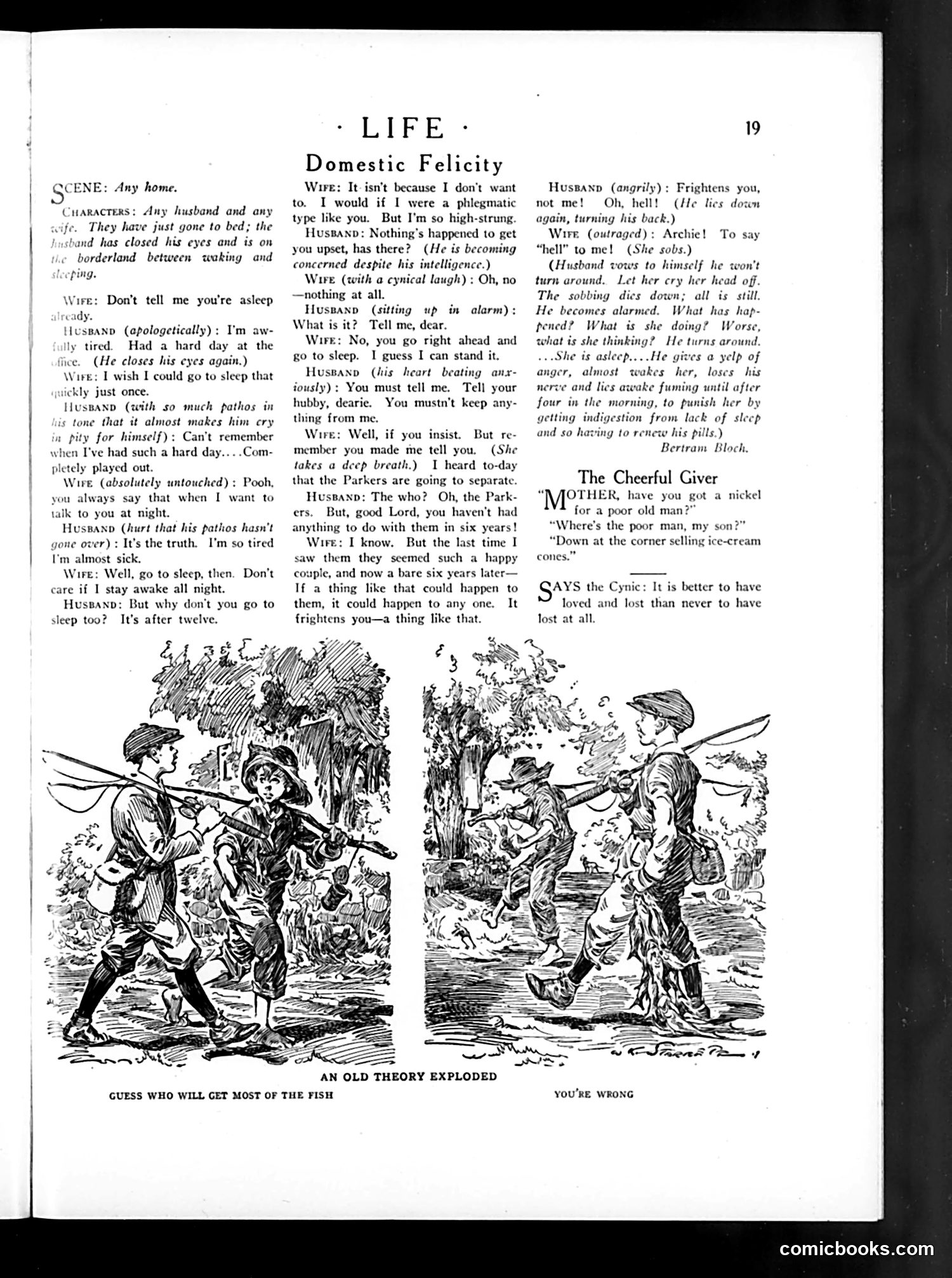
This page contains two satirical pieces mocking marriage dynamics and human nature. **"Domestic Felicity"** is a dramatic scene depicting a common marital manipulation: the wife manufactures emotional distress (worrying about the Parkers' divorce) to keep her tired husband awake, then punishes him further by falling asleep herself while he lies awake with indigestion from anxiety. The satire exposes how wives weaponize emotional crises to control husbands, and the husband's helpless frustration. **The two fishing cartoons** (captioned "An Old Theory Exploded" and "Guess Who Will Get Most of the Fish" / "You're Wrong") appear to subvert an old saying—likely about women being better at fishing or relationships. The images suggest the opposite outcome. **"The Cheerful Giver"** mocks false charity: a "poor man" begging actually sells ice cream for a living—exposing either beggar fraud or people's naive gullibility. All three pieces ridicule human self-deception and hypocrisy in domestic and social life.
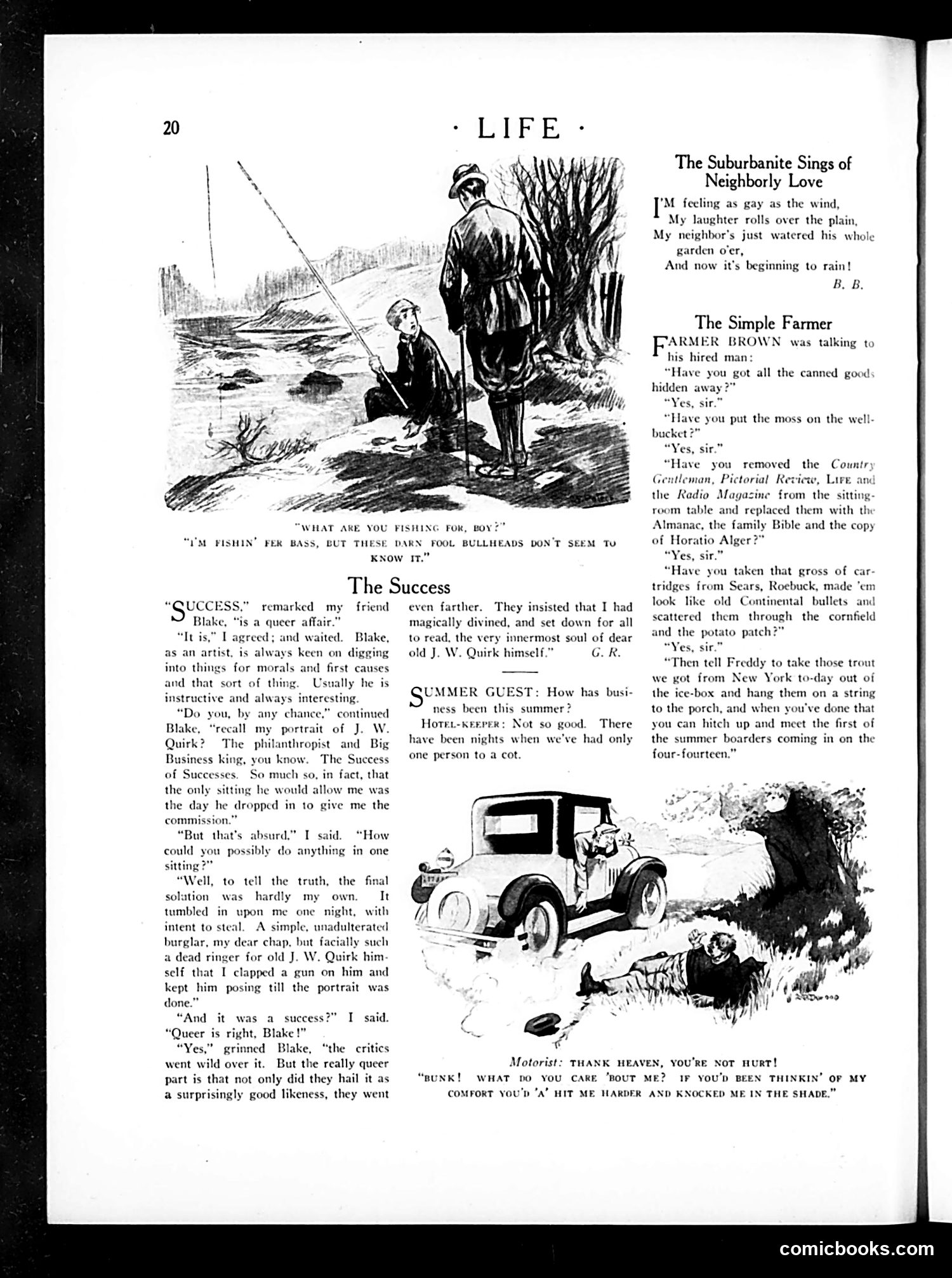
This page from *Life* contains three satirical pieces mocking American society: **"The Success"**: A story about artist Blake painting a wealthy businessman (J.W. Quirk). Blake admits he used a burglar who resembled Quirk as his model, yet critics praised it as capturing Quirk's "innermost soul." The satire targets both wealthy businessmen and art critics—suggesting the wealthy are morally indistinguishable from criminals, and critics are gullible frauds. **"The Simple Farmer"**: A farmer instructs his hired man to hide modern magazines (country lifestyle publications, *Life*, radio magazines) and replace them with old-fashioned materials (Almanac, Bible, Horatio Alger) before summer boarders arrive. The joke mocks rural Americans performing false rusticity for urban visitors seeking "authentic" farm experience. **"The Suburbanite Sings"**: Brief verse about a neighbor's watered garden causing rain on the speaker's property—satirizing suburban pettiness masked as cheerfulness. All three pieces target American pretense and shallow values.
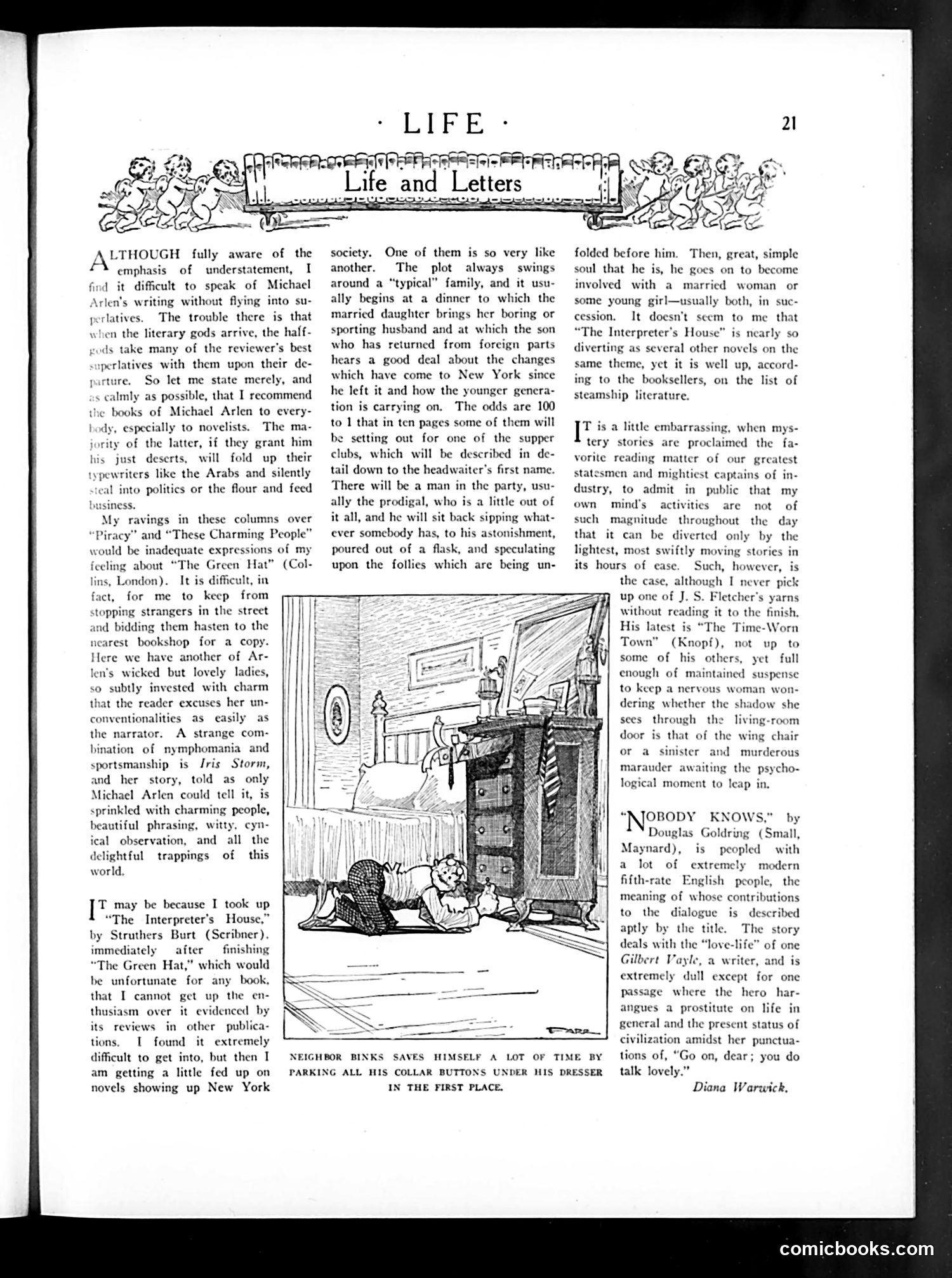
This is a book review column by Diana Warwick discussing contemporary 1920s fiction. The main cartoon shows a neighbor efficiently storing collar buttons under his dresser—a practical domestic humor joke about organization and time-saving. The text reviews three novels: Michael Arlen's *The Green Hat* (praised enthusiastically), Struthers Burt's *The Interpreter's House* (criticized as derivative), and J.S. Fletcher's mystery novels (enjoyed as light reading). The reviewer notes these books follow predictable patterns: dinner parties, returning expatriates commenting on New York's changes, nightclub scenes, and romantic entanglements. The satire targets both the formulaic nature of contemporary literature and readers' tastes—the reviewer admits enjoying "steamship literature" (light reading for travel) despite their intellectual pretensions. The column reflects 1920s literary culture's mix of serious criticism and popular entertainment.
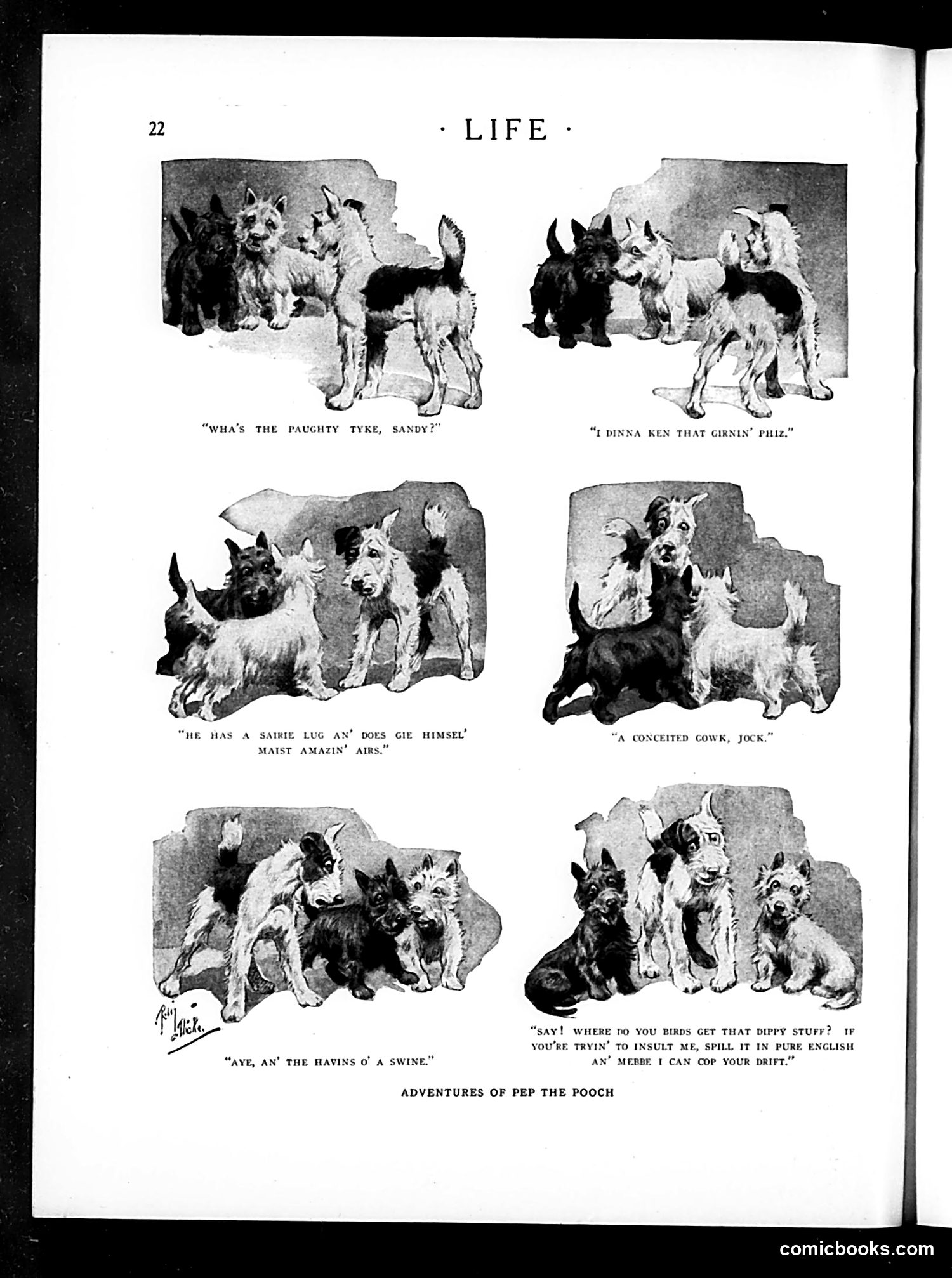
This page features a comic strip series about a dog character named Pep, presented through six illustrated panels with dialogue. The humor derives from dogs using exaggerated Scottish dialect and colloquialisms ("paughty tyke," "sairie lug," "havins o' a swine") to insult each other in what appears to be mock-serious confrontations. The satire targets affected speech patterns and pretentious behavior—dogs anthropomorphically adopting elaborate, regional dialect-heavy insults. One panel explicitly mocks this affectation, with a dog demanding insults be delivered "in pure English" rather than obscure slang, suggesting the original dialect-heavy insults are unintelligible posturing rather than genuine communication. The comic likely satirizes human social pretension and class-based speech affectations of the era through animal analogues.
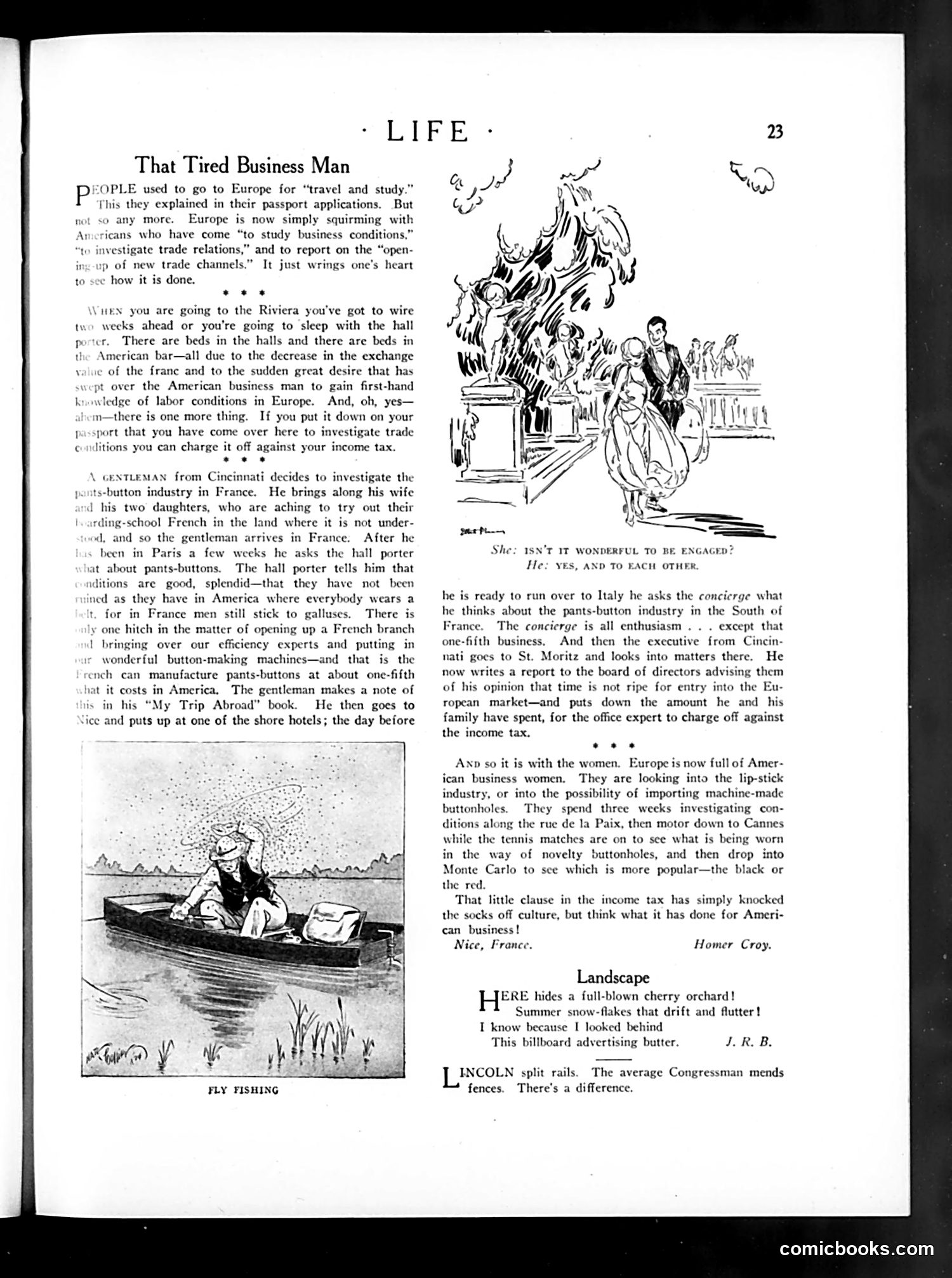
This article satirizes American businessmen using post-WWI tax law loopholes to disguise European vacations as business research. The piece mocks the transparent pretense: men claiming to "study business conditions" while their families vacation on the Riviera, then deducting all expenses as business costs. The specific example—a Cincinnati gentleman ostensibly investigating the French pants-button industry, who ultimately concludes entry is unviable but charges the entire family trip against taxes—exemplifies the absurdity. The satire extends to "American business women" similarly investigating lipstick and buttonholes while visiting fashionable resorts. The humor targets both the men's flimsy justifications and the income tax system's exploitability. The accompanying cartoons (fly fishing, an engaged couple) reinforce the theme: supposedly serious business purposes mask leisurely tourism. This reflects 1920s debates over tax fairness and the newly enacted income tax's enforcement challenges.
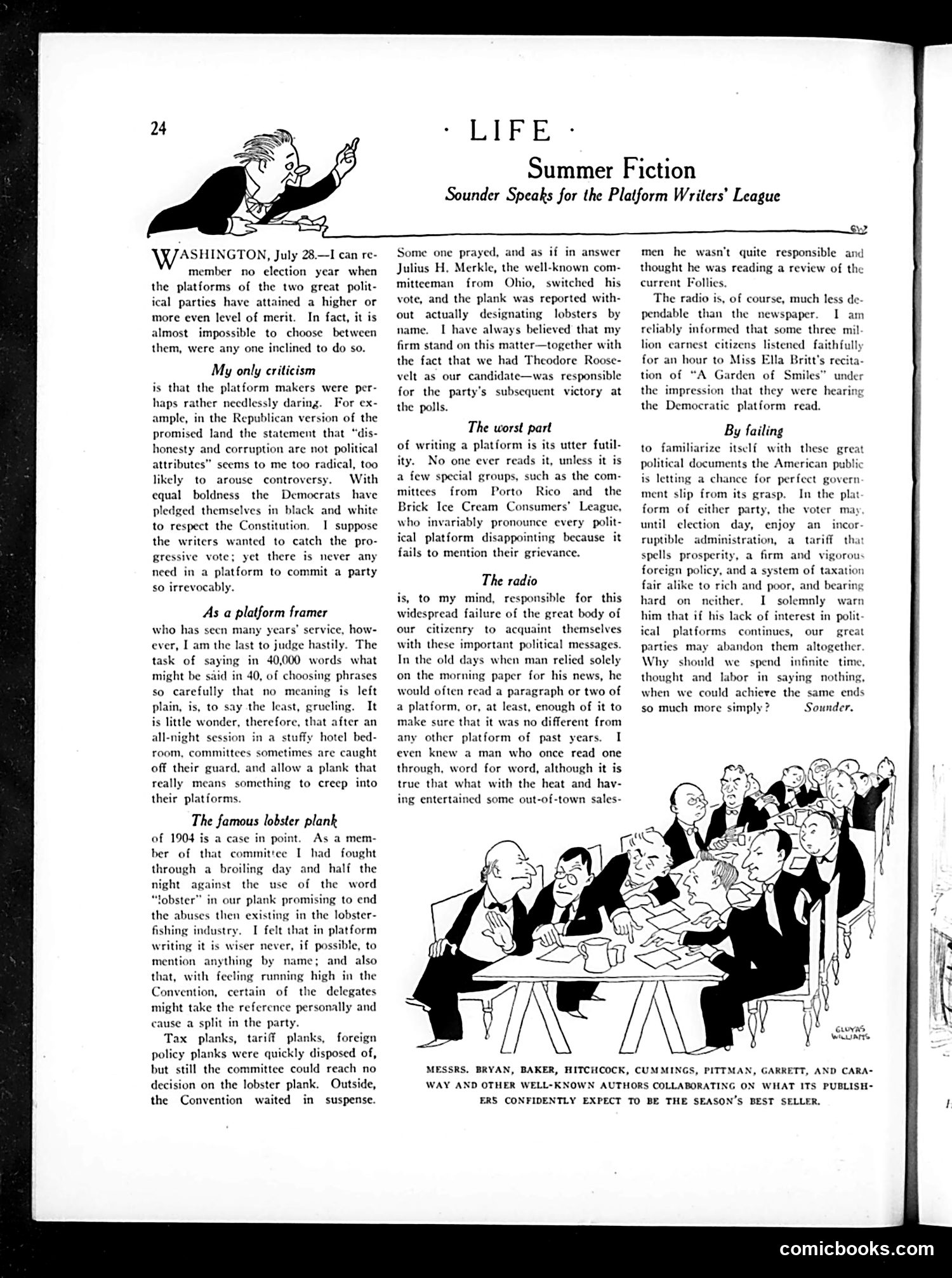
This is a humorous essay by "Sounder" mocking the futility of political party platforms. The piece satirizes platform-writers' obsessive vagueness—claiming they deliberately obscure meaning in 40,000 words what could be said in 40. The central joke involves an absurd anecdote about the "famous lobster plank of 1904," where committee members debated whether to name "lobster" directly when addressing fishing-industry abuses. The author claims this trivial dispute nearly split the party, and that winning the debate helped secure Roosevelt's victory. The satire peaks with the observation that **nobody reads platforms anyway**—except niche groups like the "Brick Ice Cream Consumers' League" who complain they weren't mentioned. He blames radio for making this worse, since fewer people now read newspapers where platforms appear. The cartoon shows well-dressed political figures collaborating on what publishers confidently claim will be "the season's best seller"—obviously ironic, since the essay just finished explaining nobody reads these documents.
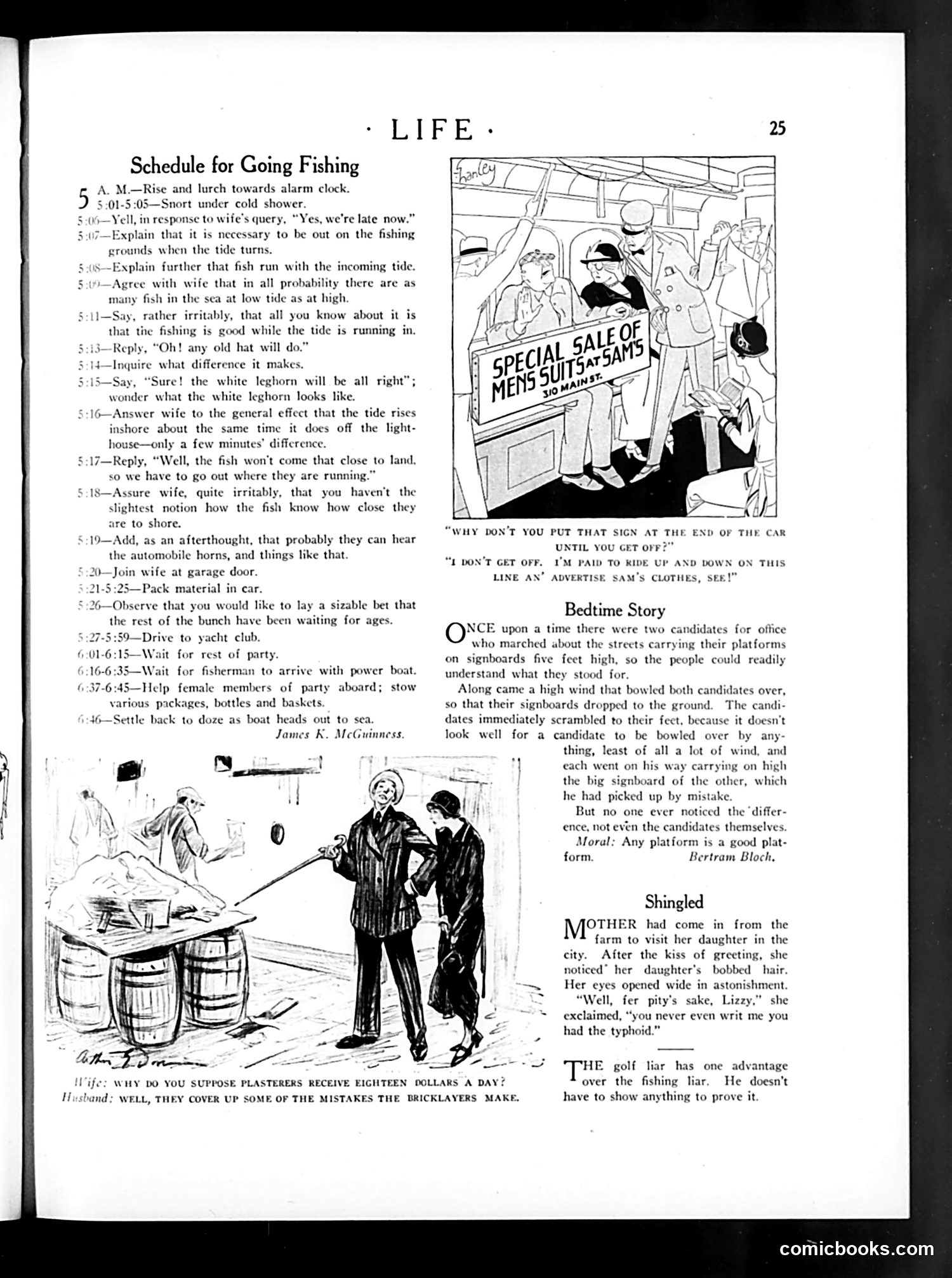
This page contains three satirical pieces typical of Life's humor: **"Schedule for Going Fishing"** mocks the stereotypical married man's fishing trip—his wife repeatedly questions the necessity of departing early, challenging his claims about tides and fish behavior. The joke is the husband's increasingly irritable, contradictory responses and admitted ignorance ("I haven't the slightest notion how the fish know how close they are to shore"), yet he persists in his outing. **The streetcar cartoon** depicts an advertising sign on a car. The conductor explains he's paid to ride the car advertising "Sam's Clothes"—satire on early 20th-century mobile advertising and its absurdity. **"Bedtime Story"** is political satire: two candidates literally swap platforms after being knocked over by wind. No one notices the difference, implying political platforms are interchangeable and meaningless—a cynical commentary on campaign rhetoric. **"Shingled"** jokes about the "bob" (short haircut), then fashionable. The rural mother mistakes her daughter's bobbed hair for typhoid—satirizing generational/urban-rural divide and older generations' shock at modern women's styles.
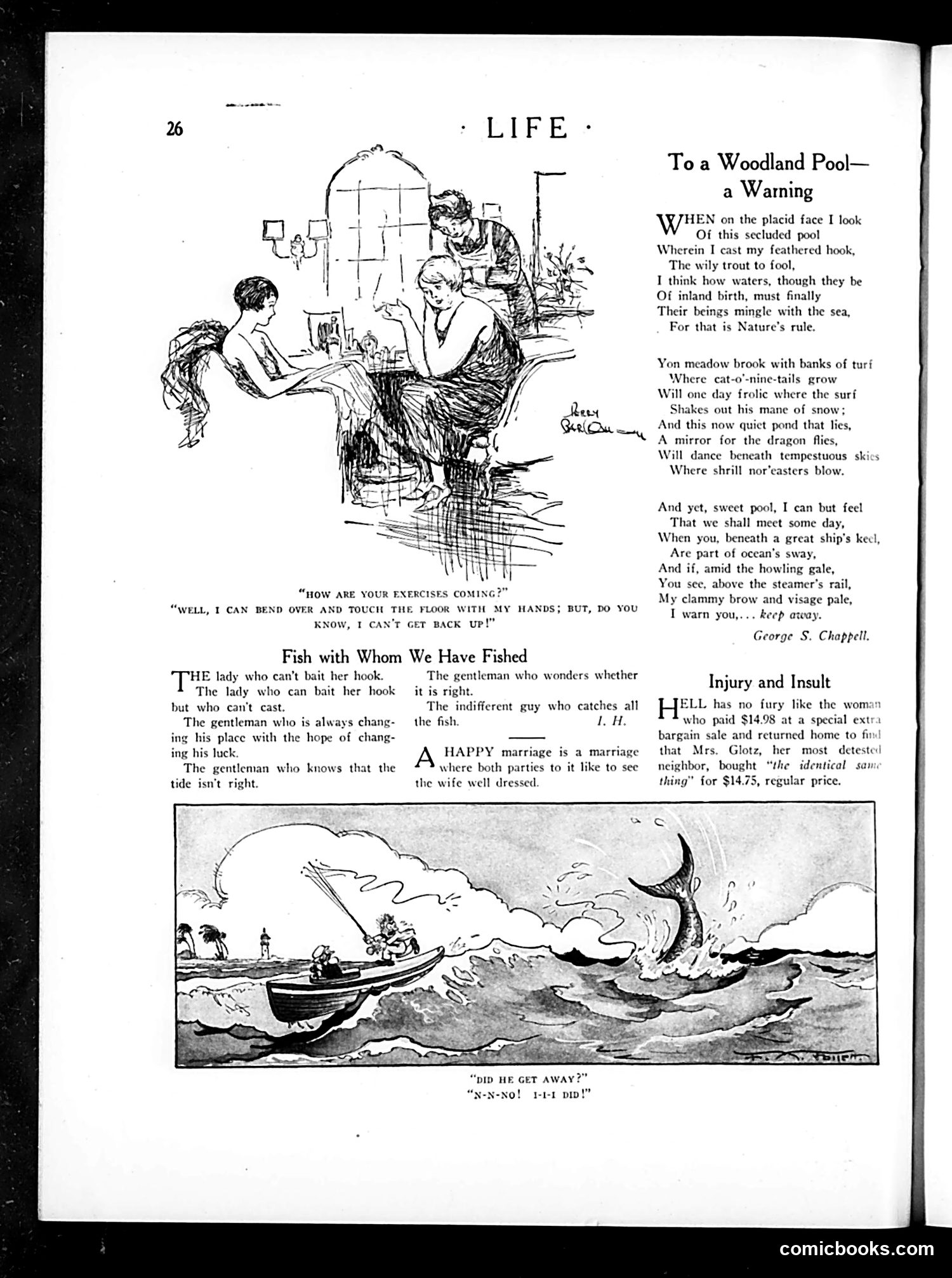
This page from *Life* magazine contains three distinct satirical pieces: **Top cartoon**: Shows an older person struggling with a fitness exercise—able to bend down and touch the floor but unable to stand back up. The joke satirizes the physical limitations of aging or the futility of exercise routines. **"Fish with Whom We Have Fished"**: A series of character types humorously observed at fishing spots—incompetent anglers, superstitious fishermen, and the annoyingly successful amateur. This is gentle social satire about human nature and fishing culture. **"To a Woodland Pool—a Warning"**: A poem by George S. Chappell using poetic language to describe inland waters eventually reaching the ocean, warning the pool they'll meet again when the speaker is at sea. It's whimsical and philosophical rather than overtly satirical. **"Injury and Insult"**: A brief joke mocking female competitiveness and status anxiety—a woman's rage upon discovering her detested neighbor bought the identical item cheaper. This reflects period attitudes about women and shopping. The page reflects early 20th-century *Life* magazine humor: gentle social observation, physical comedy, and period-specific gender stereotypes.
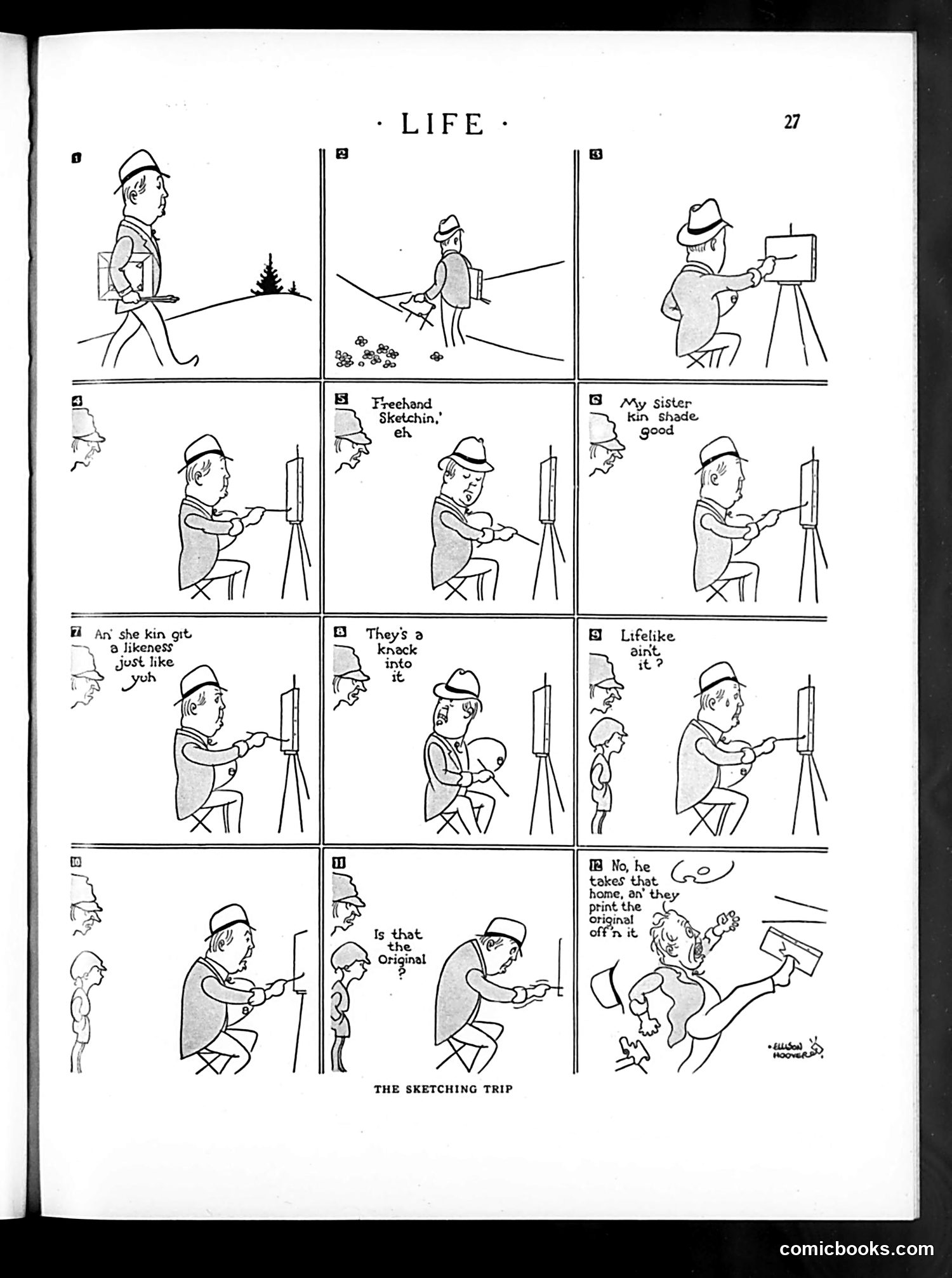
This is a humorous comic strip about an artist on a sketching expedition. The narrative follows a man attempting to sketch outdoors, but repeatedly interrupted by his young sister tagging along. The joke escalates through panels: he tries sketching a landscape, she appears wanting to help, he complains about her presence, she keeps interfering with his work, and eventually she damages or ruins his canvas/sketch entirely. The final panel reveals the punchline—when questioned whether his ruined work is "the original," he responds that she "takes that [the sketch] home to print the original off it," suggesting his sister has turned his artistic disaster into an even worse printed reproduction. It's gentle domestic satire mocking both artistic pretension and sibling rivalry, common themes in early-to-mid 20th century American humor magazines.
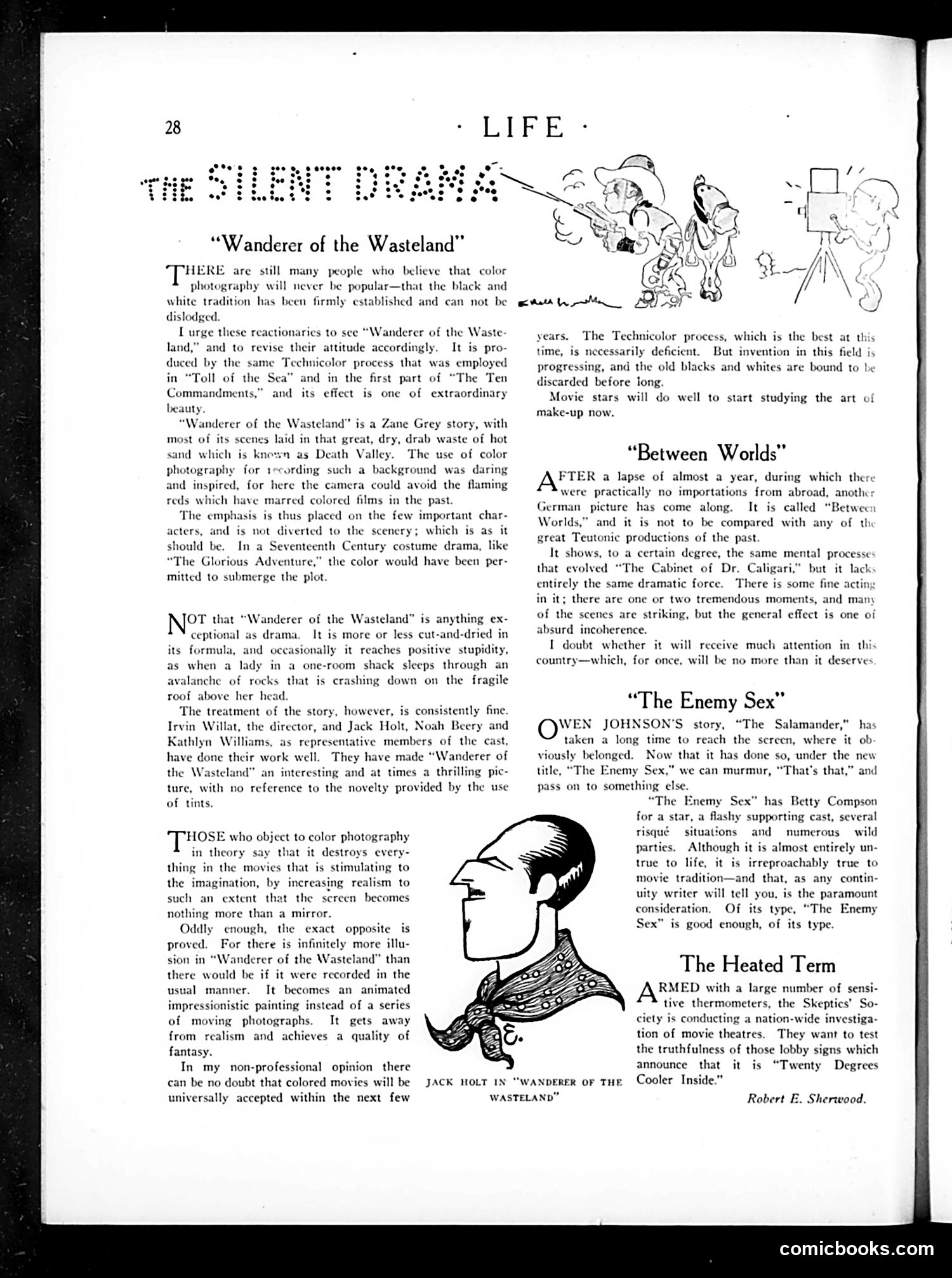
This page reviews three films from the early 1920s, with one prominent illustration: a profile sketch of actor **Jack Holt** in "Wanderer of the Wasteland." The main satire targets **skeptics of color photography**. The reviewer argues that Technicolor films will inevitably replace black-and-white cinema, calling doubters "reactionaries" who resist progress. The piece uses "Wanderer of the Wasteland"—a Zane Grey Western shot in Death Valley—as evidence that color enhances rather than diminishes artistic quality by adding impressionistic fantasy rather than crude realism. The page also briefly reviews "Between Worlds," a German import deemed inferior, and mentions Oren Johnson's "The Enemy Sex" (title cut off). The cartoon's purpose is decorative rather than satirical—simply identifying the actor and film discussed. The satire resides entirely in the *text's* rhetorical argument about technological progress displacing established tradition.
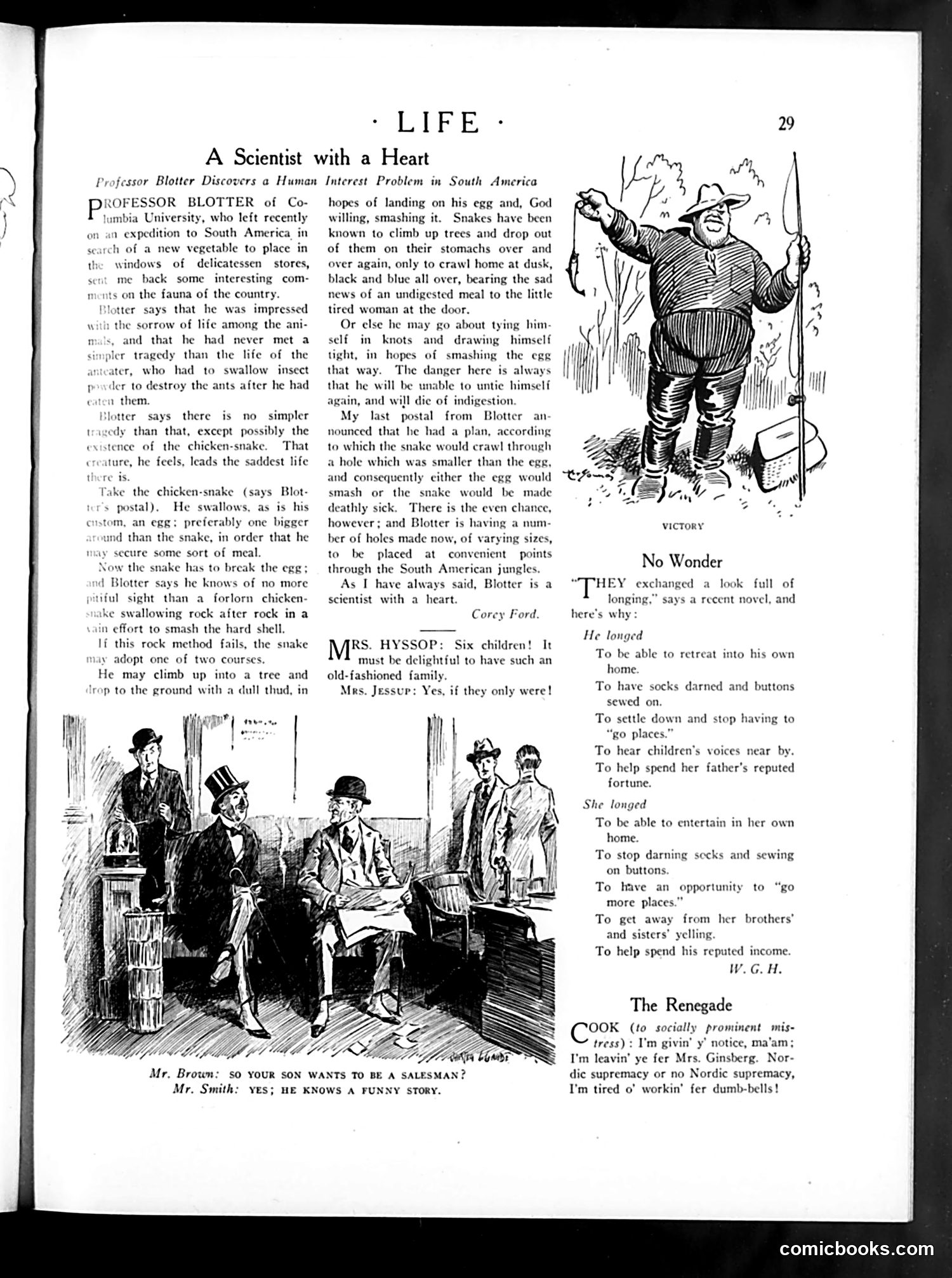
This Life magazine page contains three distinct satirical pieces: **"A Scientist with a Heart"** (main story): A humorous article by Corey Ford mocking Professor Blotter, a Columbia University scientist who observes animal suffering in South America with sentimental concern. The joke is absurdist: Blotter sympathizes with a chicken-snake's tragic struggle to digest eggs larger than itself, describing its attempts to break the shell by dropping from trees or tying itself in knots. The satire targets sentimentalizing animal behavior and academic pretension about "discovering human interest problems" abroad. **Lower cartoon**: Two businessmen discuss a son wanting to become a salesman—the joke being he only knows funny stories, suggesting salesmanship requires nothing but joke-telling ability. **"No Wonder"** and **"The Renegade"**: Brief comedic pieces about gender role expectations (couples longing for opposite domestic situations) and a servant quitting a "Nordic supremacy" employer to work for someone Jewish—mocking racial prejudice. The overall tone is lighthearted social commentary typical of 1920s-30s American humor magazines.
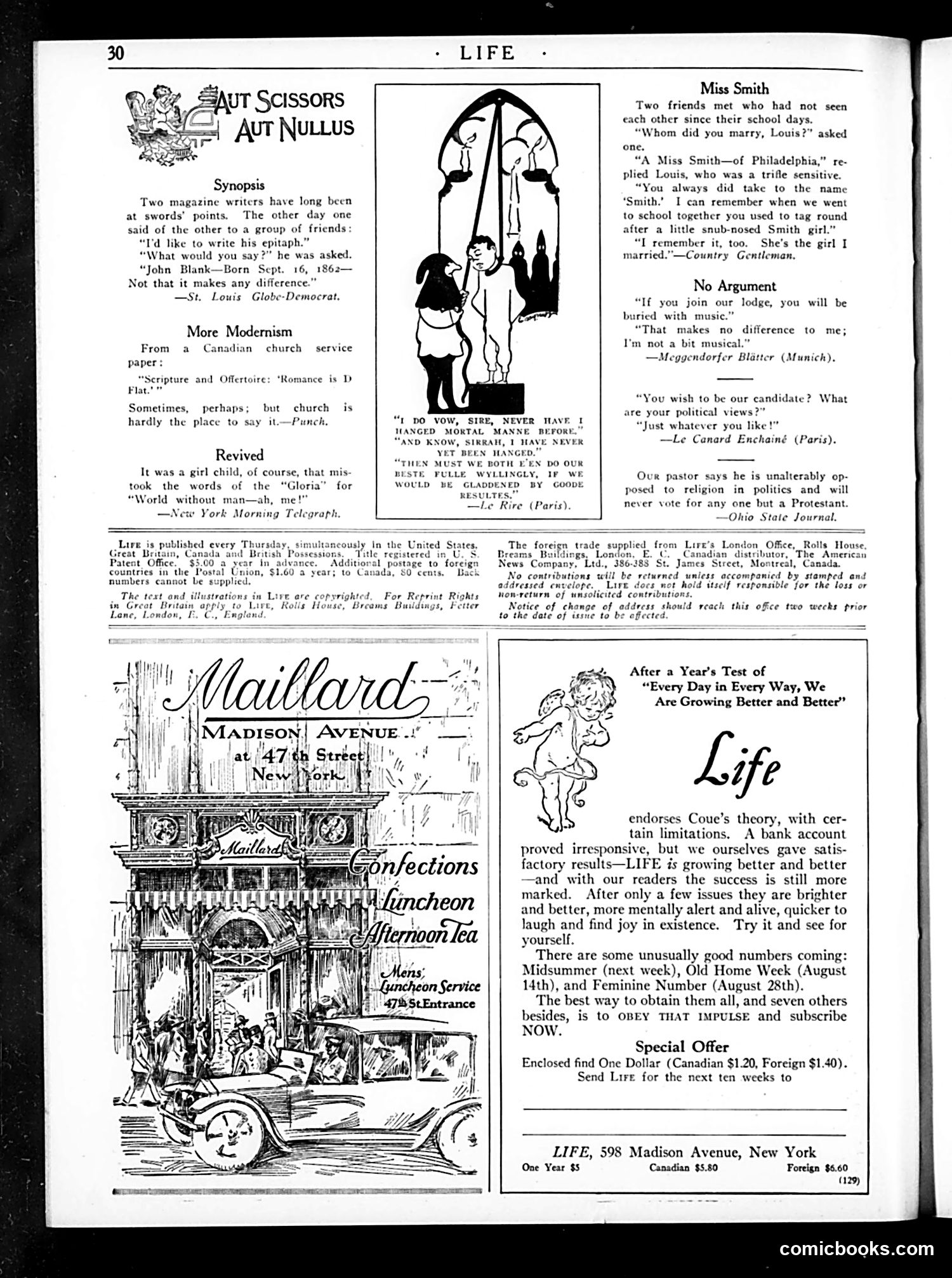
This page contains several satirical humor pieces typical of early 20th-century Life magazine: **Main Content:** A collection of short jokes and quips mocking contemporary social conventions. "Miss Smith" jokes about a man marrying the girl he pursued in school—the humor lies in his sensitivity about the common name. "No Argument" satirizes both lodge membership (burial "with music") and political candidates who claim to have no fixed views. Another piece mocks a child mishearing "Gloria" (a religious hymn) as "World without man." **The Political Cartoon (center):** Depicts what appears to be a historical scene of a hanged figure, with French text referencing "never been hanged" and discussion of "both of us" facing execution. The exact reference is unclear without additional context, but it likely references European political or historical events. **Advertisement:** A Maillard confectionery storefront ad occupies the lower left. The satire targets religion, politics, social pretension, and human foolishness—Life's consistent editorial voice.
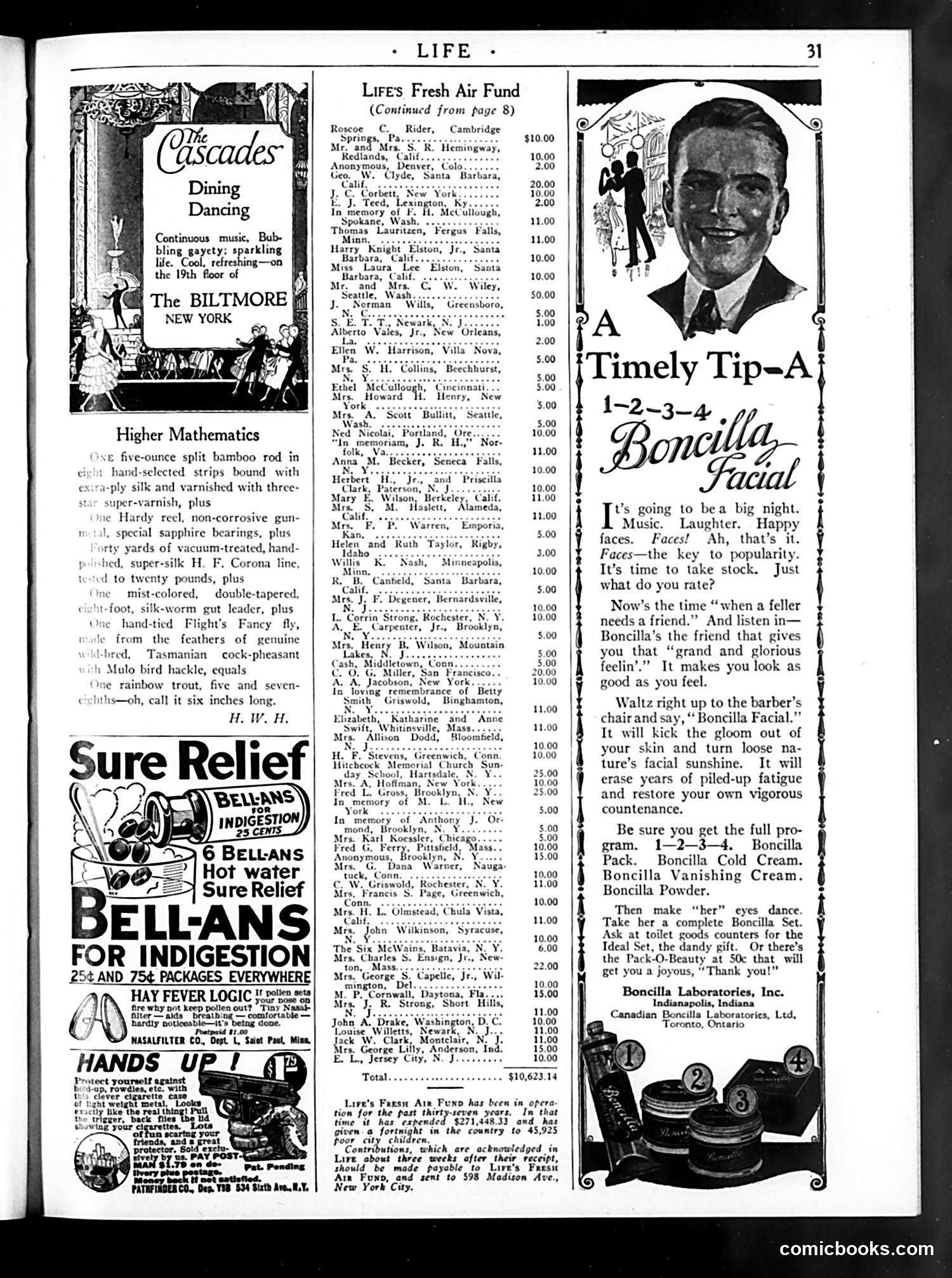
This page is primarily **advertising and fundraising**, not political satire. The main content includes: 1. **The Cascades restaurant ad** (top left) - promoting dining and dancing at the Biltmore in New York 2. **"Higher Mathematics"** - a humorous essay (by H.W.H.) using absurdly detailed fishing rod specifications as a joke about overcomplication 3. **Patent medicine ads** - Bell-Ans (indigestion relief) and a hay fever prevention device, typical of 1920s-30s advertising 4. **Life's Fresh Air Fund** - the magazine's charitable fundraiser listing donations to send poor city children to the countryside (continued from page 8). The running total shows $10,623.14 raised. 5. **Boncilla Facial advertisement** (right) - promoting a beauty product with a testimonial about improving appearance for social success The page reflects **1920s-30s consumer culture**: patent medicines, cosmetics, dining establishments, and charitable giving. No political cartoons appear here—it's a typical magazine revenue/community-service page.
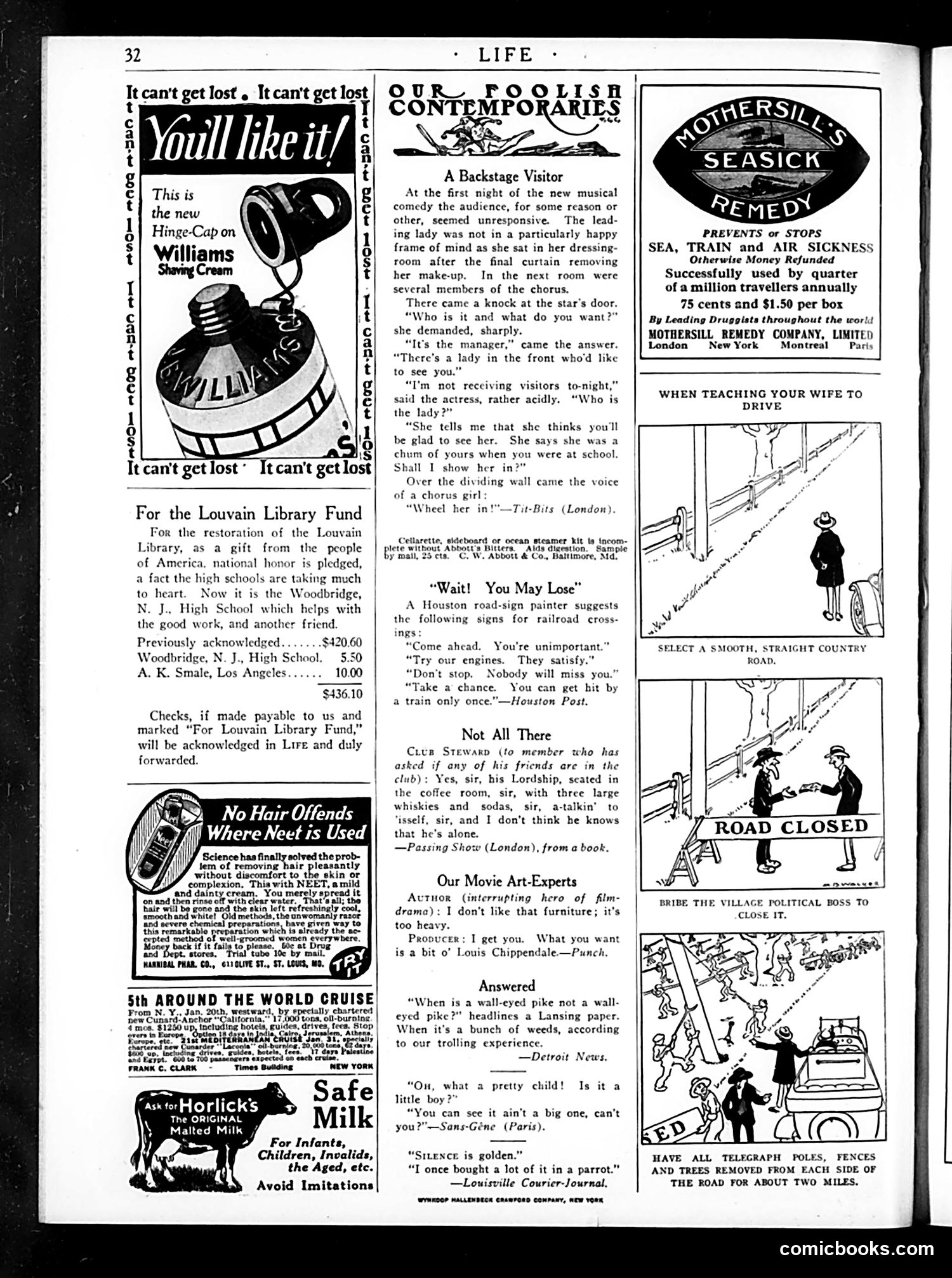
This page from *Life* magazine (likely 1920s based on style) contains satirical anecdotes and advertisements rather than political cartoons. The main humor pieces mock social pretension and absurdity: a backstage story where a famous actress is visited by an old schoolmate she'd rather avoid; railroad crossing signs sarcastically suggesting trains are unimportant; a club steward's observation that a member drinks alone while talking to himself. The "When Teaching Your Wife to Drive" cartoon illustrates practical driving instruction, showing proper road selection and safety awareness—likely satirizing either women drivers (then novel) or husbands' patience during instruction. A substantial portion supports the Louvain Library Fund, appealing to American patriotism by requesting donations to restore a Belgian library destroyed in World War I—a significant cultural cause of the era. Advertisements for patent medicines (Neet hair removal, Horlick's Malted Milk, Mothersill's seasickness remedy) dominate the lower half, typical of *Life*'s revenue model.
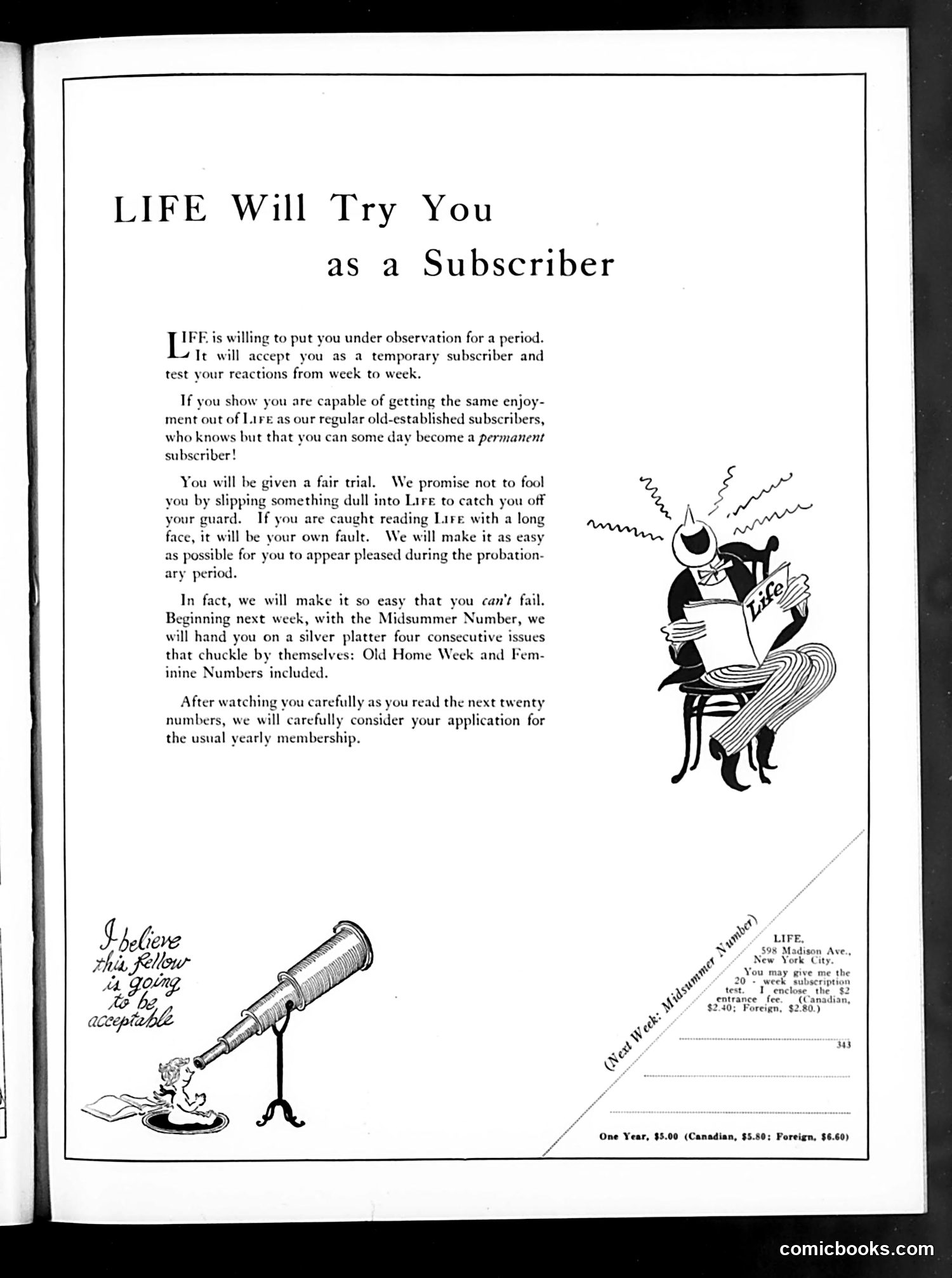
This is a subscription advertisement for *Life* magazine, a satirical weekly publication. The humor operates on a mock-serious tone: *Life* presents itself as rigorously testing whether potential subscribers are "worthy" of permanent membership, as though accepting readers were a selective club membership rather than a commercial transaction. The cartoon illustrations reinforce this tongue-in-cheek premise. A cheerful figure reads *Life* while lightning bolts suggest excitement, and another small figure peers through a telescope, literalizing the magazine's claim to "observe" and "watch" subscribers carefully during a probationary period. The satire mocks both magazine subscription practices and class-conscious social clubs of the era. *Life* promises the trial period will be "so easy that you can't fail"—simultaneously flattering potential readers while playfully suggesting the magazine's humor is accessible to everyone. The messaging frames purchasing a magazine subscription as obtaining entry into an exclusive community of people who appreciate intelligent satire.
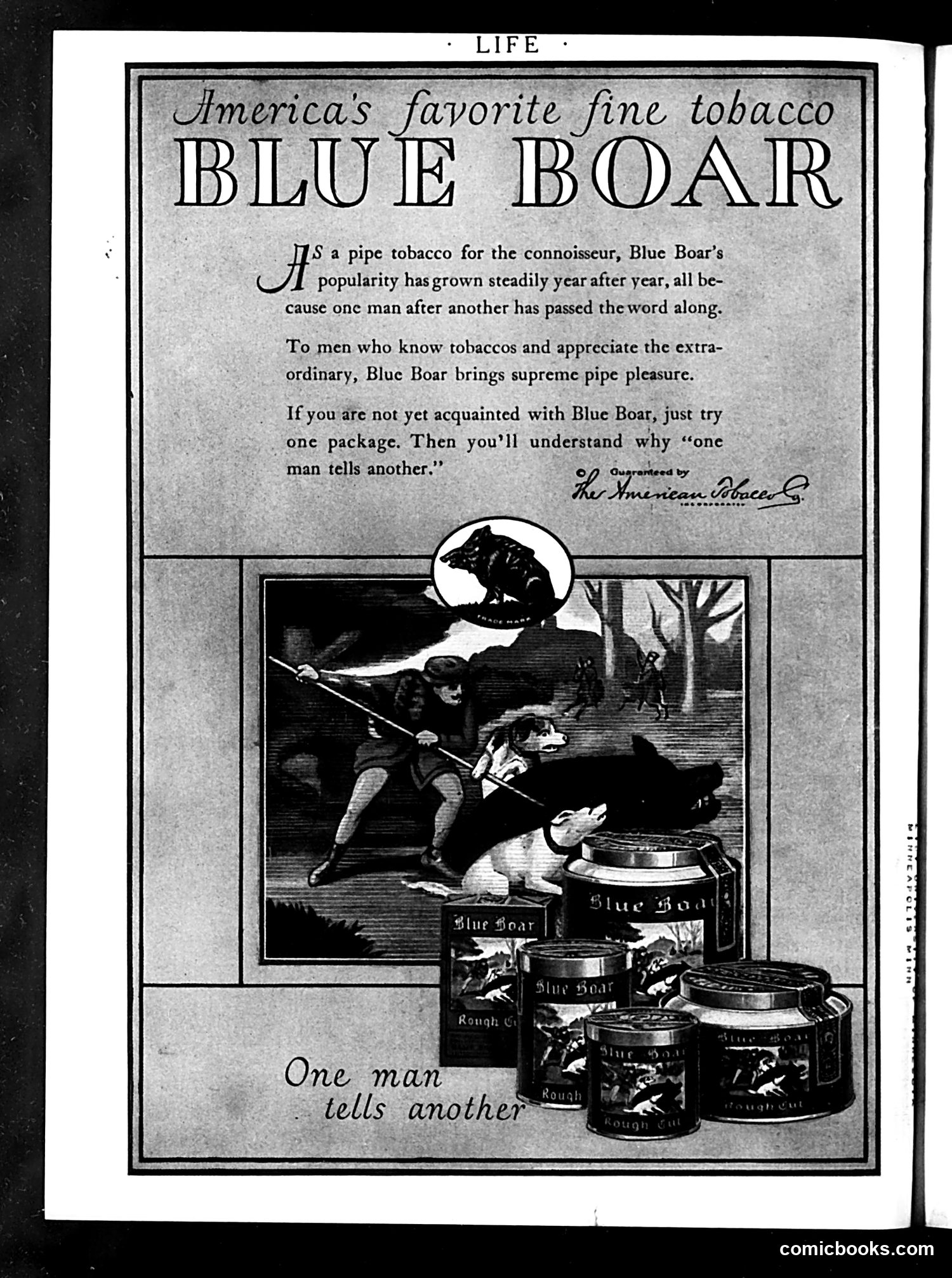
This is a **Blue Boar tobacco advertisement**, not political satire. The page promotes pipe tobacco to male consumers through word-of-mouth marketing ("one man tells another"). The illustration depicts cherubs or putti (classical winged figures) fishing, with a large boar's head appearing in the moon above—referencing the product's name. Below sits an arrangement of Blue Boar tobacco tins in various sizes. The ad's appeal is to masculinity and connoisseurship: it targets men who "know tobaccos" and positions Blue Boar as premium product spread through trusted recommendations rather than aggressive advertising. The tagline emphasizes organic social proof—satisfied customers naturally recommend it to peers. This represents early 20th-century advertising strategy before modern regulatory restrictions on tobacco promotion.