
Life, 1924-07-31 · page 20 of 36
Life — July 31, 1924 — page 20: what you’re looking at
What you’re looking at
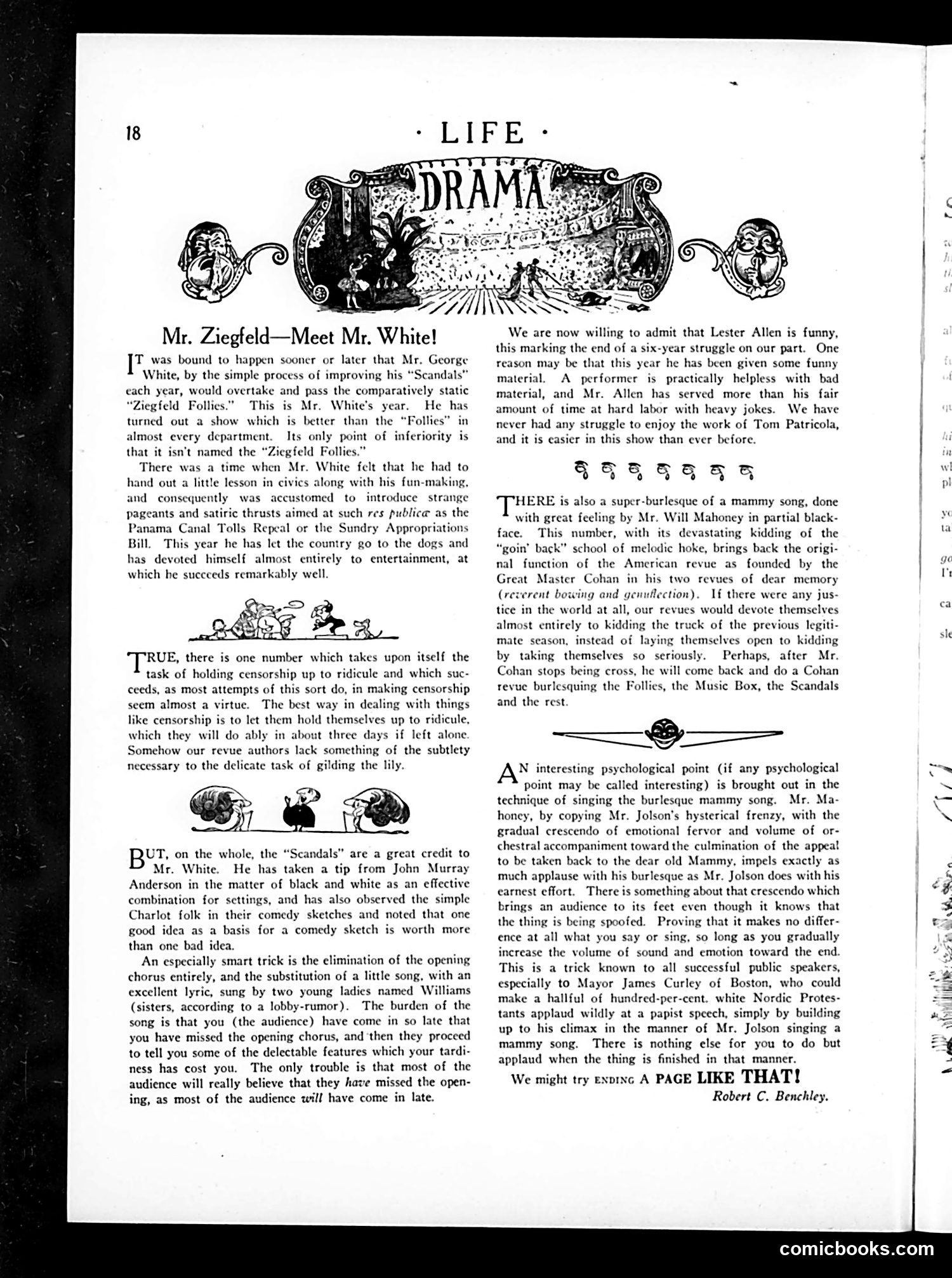
This is a theater review comparing two rival Broadway impresarios. **Florenz Ziegfeld** produced the famous *Ziegfeld Follies*, while **George White** created the competing *Scandals* revue. The critic argues White has finally surpassed Ziegfeld's once-dominant show. The review praises White's *Scandals* for emphasizing pure entertainment over heavy-handed political satire (referencing earlier editions that tackled Panama Canal tolls and appropriations bills). Key performers mentioned include **Lester Allen**, **Tom Patricola**, and the **Williams sisters**. Notably, the critic admires White's restraint in *not* taking himself too seriously—contrasting with the trend toward self-important revues. The review singles out a **Will Mahoney blackface mammy song parody**, framing it as good-natured burlesque in the tradition of **George M. Cohan**. The satire is theatrical rather than political—this is industry commentary on entertainment trends and competitive showmanship.
📄 Transcribed text from this page (OCR, searchable)
Machine-transcribed from the original scan — historical spelling and the odd misread are preserved.
Mr. Ziegfeld—Meet Mr. White! iG was bound to happen sooner or later that Mr. George White, by the simple process of improving his “Scandals” each year, would overtake and pass the comparatively static “Ziegfeld Follies." This is Mr. White's year. He has turned out a show which is better than the “Follies” in almost every department. Its only point of inferiority is that it isn’t named the gfeld Follies There was a time when Mr. White felt that he had to hand out a little lesson in civics along with his fun-making, and consequently was accustomed to introduce strange pageants and satiric thrusts aimed at such res publica as the Panama Canal Tolls Repeal or the Sundry Appropriations Bill. This year he has let the country go to the dogs and has devoted himself almost entirely to entertainment, at which he succeeds remarkably well. RUE, there is one number which takes upon itself the task of holding censorship up to ridicule and which suc- ceeds, as most attempts of this sort do, in making censorship seem almost a virtue. The best way in dealing with things like censorship is to let them hold themselves up to ridicule, which they will do ably in about three days if left alone. Somehow our revue authors lack something of the subtlety necessary to the delicate task of gilding the lily. Siw i UT, on the whole, the “Scandals” are a great credit to Mr. White. He has taken a tip from John Murray Anderson in the matter of black and white as an effective combination for settings, and has also observed the simple Charlot folk in their comedy sketches and noted that one good idea as a basis for a comedy sketch is worth more than one bad idea. An especially smart trick is the elimination of the opening chorus entirely, and the substitution of a little song, with an excellent lyric, sung by two young ladics named Williams (sisters, according to a lobby-rumor). The burden of the song is that you (the audience) have come in so late that you have missed the opening chorus, and ‘then they proceed to tell you some of the delectable features which your tardi- ness has cost you. The only trouble is that most of the audience will really believe that they have missed the open- ing, as most of the audience will have come in late. We are now willing to admit that Lester Allen is funny, this marking the end of a six-year struggle on our part. One reason may be that this year he has been given some funny material, A performer is practically helpless with bad material, and Mr. Allen has served more than his fair amount of time at hard labor with heavy jokes. We have never had any struggle to enjoy the work of Tom Patricola, and it is easier in this show than ever before. SSRSSRS HERE is also a super-burlesque of a mammy song, done with great feeling by Mr. Will Mahoney in partial black- face. This number, with its devastating kidding of the “goin’ back” school of melodic hoke, brings back the origi- nal function of the American revue as founded by the Great Master Cohan in his two revues of dear memory (reverent bowing and genuflection). If there were any jus- tice in the world at all, our revues would devote themselves almost entirely to kidding the truck of the previous le mate season, instead of laying themselves open to kidding by taking themselves so seriously. Perhaps, after Mr. Cohan stops being cross, he will come back and do a Cohan revue burlesquing the Follies, the Music Box, the Scandals and the rest —— & —— N interesting psychological point (if any psychological point may be called interesting) is brought out in the technique of singing the burlesque mammy song. Mr. Ma- honey, by copying Mr. Jolson’s hysterical frenzy, with the gradual crescendo of emotional fervor and volume of or- chestral accompaniment toward the culmination of the appeal to be taken back to the dear old Mammy, impels exactly as much applause with his burlesque as Mr. Jolson does with his earnest effort. There is something about that crescendo which brings an audience to its feet even though it knows that the thing is being spoofed. Proving that it makes no differ- ence at all what you say or sing, so long as you gradually increase the volume of sound and emotion toward the end. This is a trick known to all successful public speakers, especially to Mayor James Curley of Boston, who could make a hallful of hundred-per-cent. white Nordic Protes- tants applaud wildly at a papist speech, simply by building up to his climax in the manner of Mr. Jolson singing a mammy song. There is nothing else for you to do but applaud when the thing is finished in that manner. We might try expixc A PAGE LIKE THAT! Robert C. Benchley. < 3 comicbooks.com