
Life, 1924-07-31 · page 11 of 36
Life — July 31, 1924 — page 11: what you’re looking at
What you’re looking at
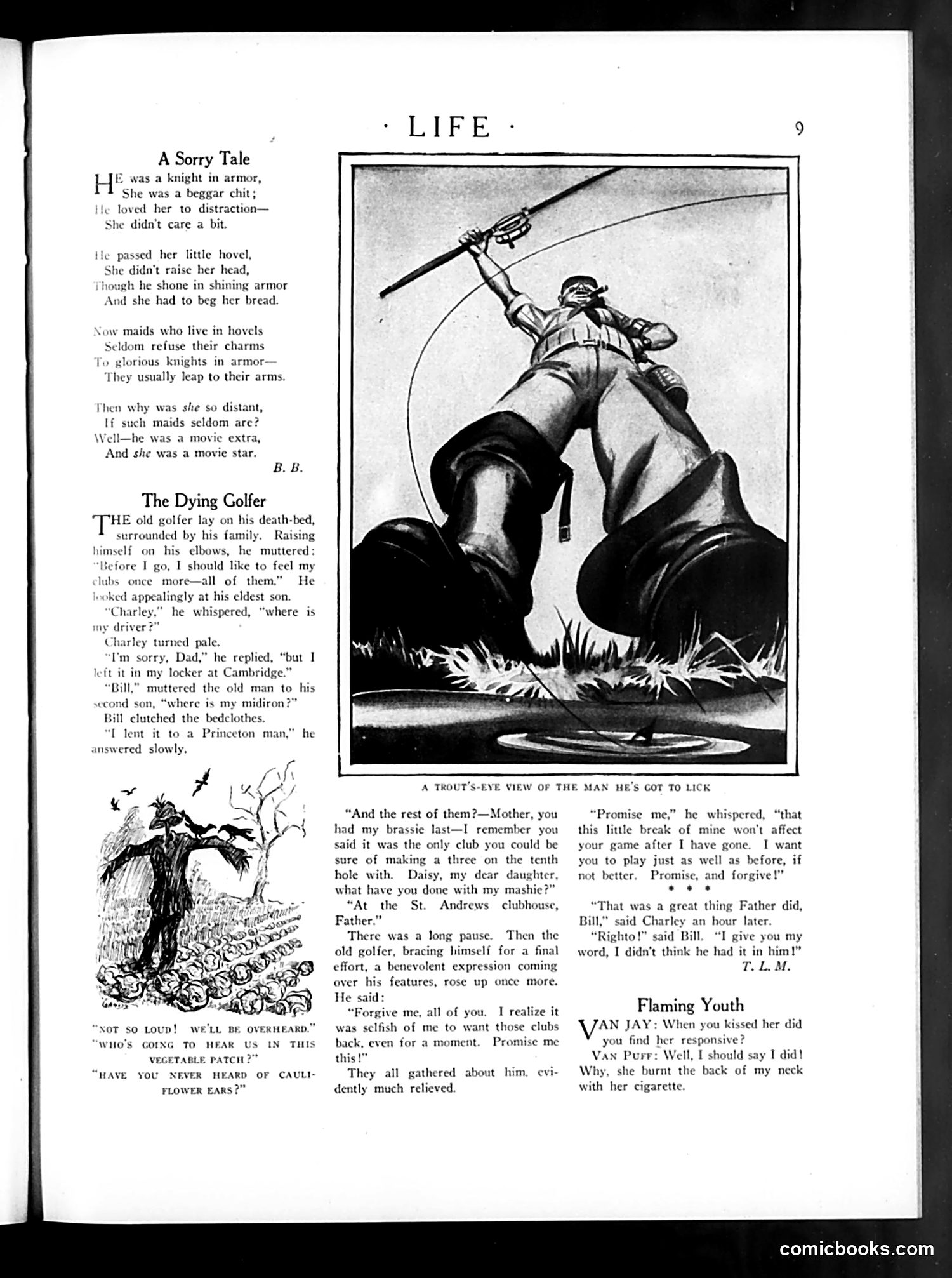
This page contains three separate pieces of satirical literature and one illustration: 1. **"A Sorry Tale"** (poem, unsigned): A witty commentary on class and celebrity. A knight in armor ignores a beggar girl despite his noble status, yet she later becomes a movie star. The satire targets both aristocratic indifference and Hollywood's elevating power—suggesting a "movie star" status paradoxically outranks actual nobility, reflecting 1920s cultural anxieties about cinema's influence. 2. **"The Dying Golfer"**: A humorous story about an elderly golfer's deathbed preoccupation with his golf clubs, satirizing upper-class priorities and the obsessive nature of sports enthusiasm among the wealthy. 3. **"Flaming Youth"**: A brief dialogue mocking modern dating behavior and female boldness, referencing the "flapper" generation's scandalous conduct by 1920s standards. The page reflects Jazz Age social commentary on class, modernity, and generational conflict.
📄 Transcribed text from this page (OCR, searchable)
Machine-transcribed from the original scan — historical spelling and the odd misread are preserved.
A Sorry Tale H was a knight in armor, She was a beggar chit; i1e loved her to distraction— She didn’t care a bit. tle passed her little hovel, he didn’t raise her head, hough he shone in shining armor And she had to beg her bread. Sow maids who live in hovels Seldom refuse their charms © glorious knights in armor- They usually leap to their arms. Then why was she so distant, If such maids seldom are? Well—he was a movie extra, And she was a movie star. B. B. The Dying Golfer HE old golfer lay on his death-bed, surrounded by his family. Raising himself on his elbows, he muttered: Uefore I go, I should like to feel my more—all of them.” He oked appealingly at his eldest son. "Charl he whispered, “where is iy driver Charley turned pale. “I'm sorry, Dad,” he replied, “but I it in my locker at Cambridge.” Bill,” muttered the old man to his econd son, “where is my midiron?” Bill clutched the bedclothes. “LT lent it to a Princeton man,” he answered slowly. lubs once “NOT so Loup! WE'LL BE OVERHEARD.” GOING TO HEAR US IN THIS VEGETABLE PATCH ? YOU NEVER HEARD OF FLOWER EARS?” “wuo's “HAVE CAULI- A TROUT'S-EVE VIEW OF THE MAN HE'S GOT TO LICK “And the rest of them?—Mother, you had my brassie last—I remember you said it was the only club you could be sure of making a three on the tenth hole with. Daisy, my dear daughter, what have you done with my mashie?” “At the St. Andrews clubhouse, Father. There was a long pause. Then the old golfer, bracing himself for a final effort, a benevolent expression coming over his features, rose up once more. He said: Forgive me, all of you. I realize it was selfish of me to want those clubs back, even for a moment. Promise me this!” They all gathered about him, evi- dently much relieved. “Promise me,” he whispered, “that this little break of mine won't affect your game after I have gone. I want you to play just as well as before, if not better. Promise, and forgive!" ee hat was a great thing Father did, Bill id Charley an hour later. Righto!” said Bill. “I give you my word, I didn’t think he had it in him!” T. LM. Flaming Youth ‘AN JAY: When you kissed her did you find her responsive? Van Purr: Well, I should say I did! Why, she burnt the back of my neck with her cigarette. comicbooks.com