
Life, 1924-07-31 · page 6 of 36
Life — July 31, 1924 — page 6: what you’re looking at
What you’re looking at
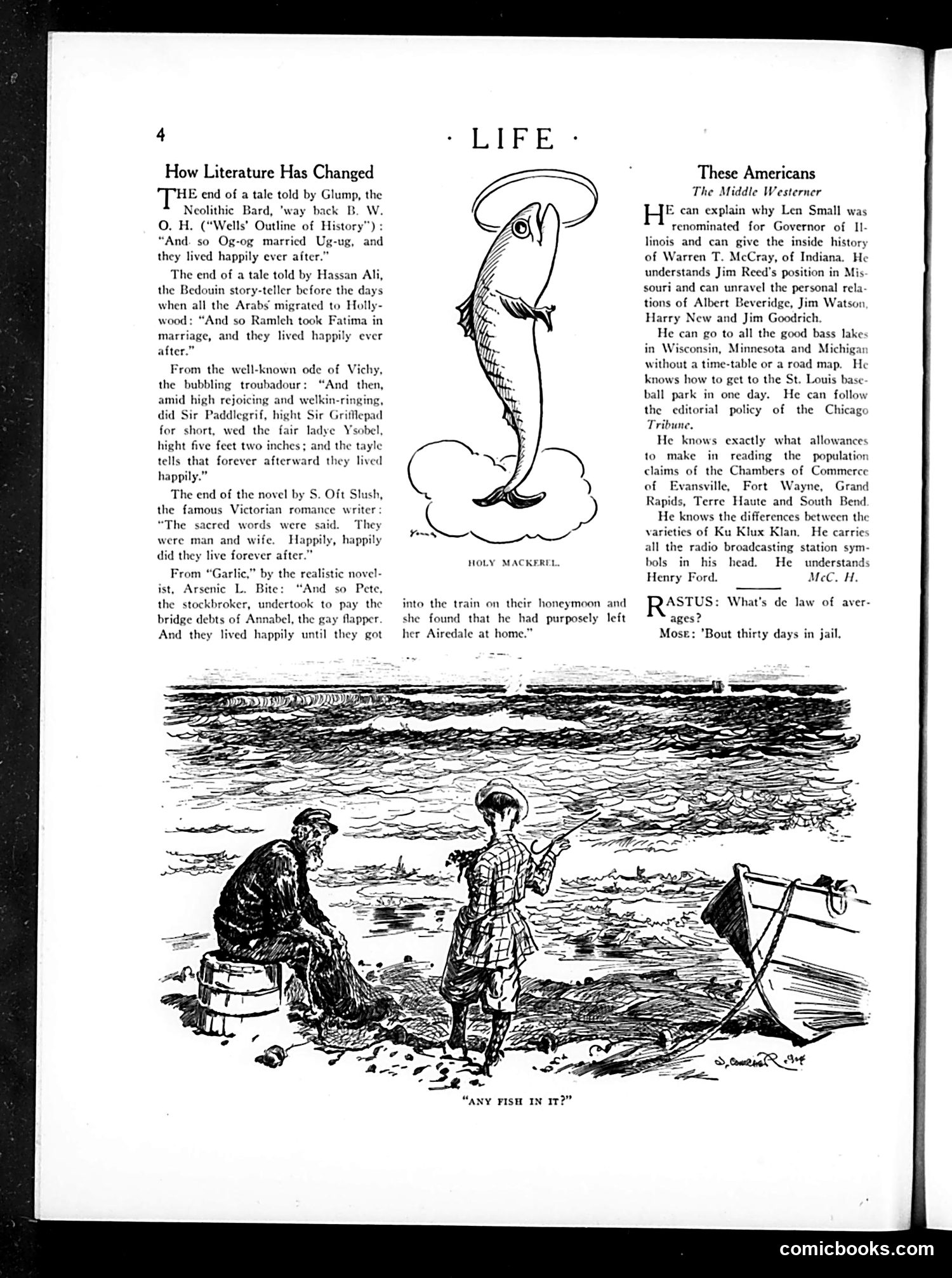
This page contains two distinct sections: **"How Literature Has Changed"** (left column) presents literary excerpts showing how story endings evolved—from classic tales with "happily ever after" conclusions to more realistic modern literature featuring unhappy endings and cynical outcomes. **"These Americans"** (right column) humorously profiles a Midwesterner with encyclopedic knowledge of regional politics, geography, sports figures, and radio stations—essentially a walking almanac of Americana. The two **cartoons** below depict: (1) a "Holy Mackerel" with wings on a cloud, and (2) a seaside scene captioned "Any Fish In It?" showing an adult and child fishing, likely making a crude joke about the child's question. The overall page satirizes changing American cultural attitudes and regional character types.
📄 Transcribed text from this page (OCR, searchable)
Machine-transcribed from the original scan — historical spelling and the odd misread are preserved.
4 How Literature Has Changed "TRE end of a tale told by Glump, the Neolithic Bard, ‘way back B. W. O. H. (“Wells’ Outline of History”) : “And. so Og-og married Ug-ug, and they lived happily ever after.” The end of a tale told by Hassan Ali, the Bedouin story-teller before the days when all the Arabs migrated to Holly- wood: “And so Ramlch took Fatima in marriage, and they lived happily ever after.” From the well-known ode of Vichy, the bubbling troubadour: “And then, amid high rejoicing and w -ringing, did Sir Paddlegrif, hight Sir Gritllepad for short, wed the fair ladye Ysobel, hight five feet two inches; and the tayle tells that forever afterward they lived happily.” The end of the novel by S. Oft Slush, the famous Victorian romance writer : “The sacred words were said. They Happily, happily did they live forever after.” were man and wife. From “Garlic,” by the realistic novel- ist, Arsenic L. Bite: “And so Pete, the stockbroker, undertook to pay the bridge debts of Annabel, the gay flapper. And they lived happily until they got HOLY MACKEREL. into the train on their honeymoon and she found that he had purposely left her Airedale at home.” These Americans The Middle Westerner E can explain why Len Small was renominated for Governor of Il- linois and can give the inside history of Warren T. McCray, of Indiana. He understands Jim Reed's position in Mis. souri and can unravel the personal rela- tions of Albert Beveridge, Jim Watson Harry New and Jim Goodrich. He can go to all the good bass lakes in Wisconsin, Minnesota and Michigar without a time-table or a road map. He knows how to get to the St. Louis base. ball park in one day. He can follow the editorial policy of the Chicago Tribune, He knows exactly what allowances to make in reading the population claims of the Chambers of Commerce of Evansville, Fort Wayne, Grand Rapids, Terre Haute and South Bend He knows the differences between the varieties of Ku Klux Klan, He carries all the radio broadcasting station sym- bols in his head. He understands Henry Ford. McC. H. RaAstus: What's de law of aver- ages? Mose: "Bout thirty days in jail. comicbooks.com