
Life, 1924-07-31 · page 31 of 36
Life — July 31, 1924 — page 31: what you’re looking at
What you’re looking at
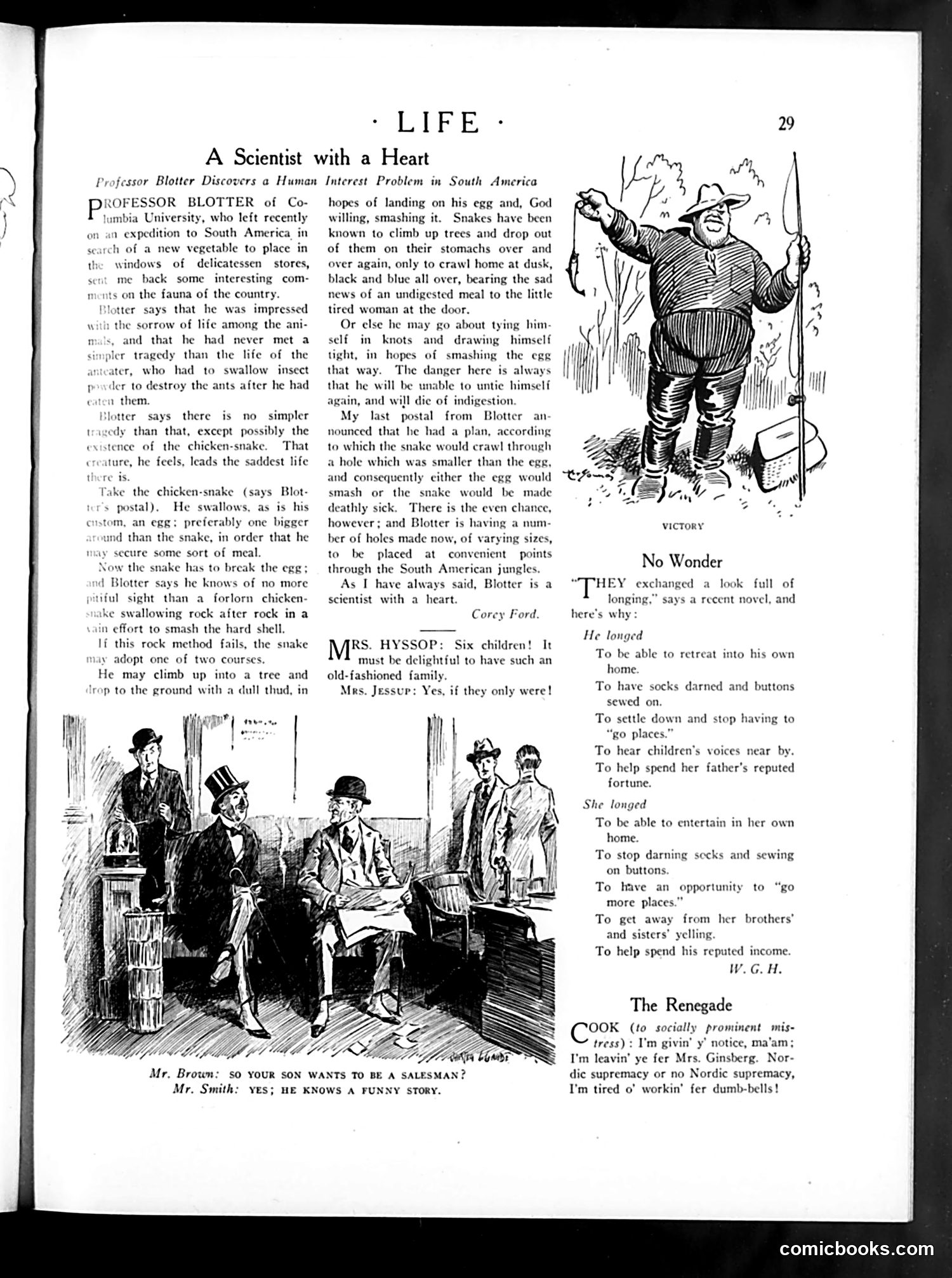
This Life magazine page contains three distinct satirical pieces: **"A Scientist with a Heart"** (main story): A humorous article by Corey Ford mocking Professor Blotter, a Columbia University scientist who observes animal suffering in South America with sentimental concern. The joke is absurdist: Blotter sympathizes with a chicken-snake's tragic struggle to digest eggs larger than itself, describing its attempts to break the shell by dropping from trees or tying itself in knots. The satire targets sentimentalizing animal behavior and academic pretension about "discovering human interest problems" abroad. **Lower cartoon**: Two businessmen discuss a son wanting to become a salesman—the joke being he only knows funny stories, suggesting salesmanship requires nothing but joke-telling ability. **"No Wonder"** and **"The Renegade"**: Brief comedic pieces about gender role expectations (couples longing for opposite domestic situations) and a servant quitting a "Nordic supremacy" employer to work for someone Jewish—mocking racial prejudice. The overall tone is lighthearted social commentary typical of 1920s-30s American humor magazines.
📄 Transcribed text from this page (OCR, searchable)
Machine-transcribed from the original scan — historical spelling and the odd misread are preserved.
« LIFE * A Scientist with a Heart Professor Blotter Discovers a Human Interest Problem in South America RC SSOR BLOTTER of Co- lumbia University, who left recently 1 expedition to South America, in rch of a new vegetable to place in windows of delicatessen stores, me back some interesting com- ts on the fauna of the country. [lotter says that he was impressed the sorrow of life among the ani- s, and that he had never met a pler tragedy than the life of the ater, who had to swallow insect ler to destroy the ants after he had 1 them. Blotter says there is no simpler igedy than that, except possibly the stence of the chicken-snake. That uture, he feels, leads the saddest life re is. Take the chicken-snake (says Blot- > postal). He swallows, as is his custom, an egg: preferably one bigger { than the snake, in order that he ney secure some sort of meal. Now the snake has to break the egg; 1 Blotter says he knows of no more pitiful sight than a forlorn chicken- ke swallowing rock after rock in a n effort to smash the hard shell. li this rock method fails, the snake y adopt one of two courses. He may climb up into a tree and lrop to the ground with a dull thud, in | , Abe ote Mr, Brown: Mr. Smith: hopes of landing on his egg and, God willing, smashing it. Snakes have been known to climb up trees and drop out of them on their stomachs over and over again, only to crawl home at dusk, black and blue all over, bearing the sad news of an undigested meal to the little tired woman at the door. Or else he may go about tying him- self in knots and drawing himself tight, in hopes of smashing the egg that way. The danger here is always that he will be unable to untic himself and will dic of indigestion. My last postal from Blotter an nounced that he had a plan, according to which the snake would crawl through a hole which was smaller than the egg, and consequently cither the egg would smash or the snake would be made deathly sick. There is the even chance, however; and Blotter is having a num- ber of holes made now, of varying sizes, to be placed at convenient points through the South American jungles. As I have always said, Blotter is a scientist with a heart. Corey Ford. RS. HYSSOP: Six children! It must be delightful to have such an old-fashioned family. Mrs. Jessup: Yes, if they only were! YG, DA lle Bdihed od SO YOUR SON WANTS TO BE A SALESMAN? YES; HE KNOWS A FUNNY STORY. vicTORY No Wonder “THEY exchanged a look full of longing,” says a recent novel, and here's why He longed To be able to retreat into his own home. To have socks darned and buttons sewed on. To settle down and stop having to “go places.” To hear children’s voices near by. To help spend her father's reputed fortune. She longed To be able to entertain in her own home. To stop darning socks and sewing on buttons. To have an opportunity to “go more places.” To get away from her brothers’ and sisters’ yelling. To help spend his reputed income. W.G.H. The Renegade OOK (to socially prominent mis- tress) : I'm givin’ y’ notice, ma'am; I'm leavin’ ye fer Mrs. Ginsberg. Nor- dic supremacy or no Nordic supremacy, I'm tired o’ workin’ fer dumb-bells! comicbooks.com