
Life, 1924-07-31 · page 26 of 36
Life — July 31, 1924 — page 26: what you’re looking at
What you’re looking at
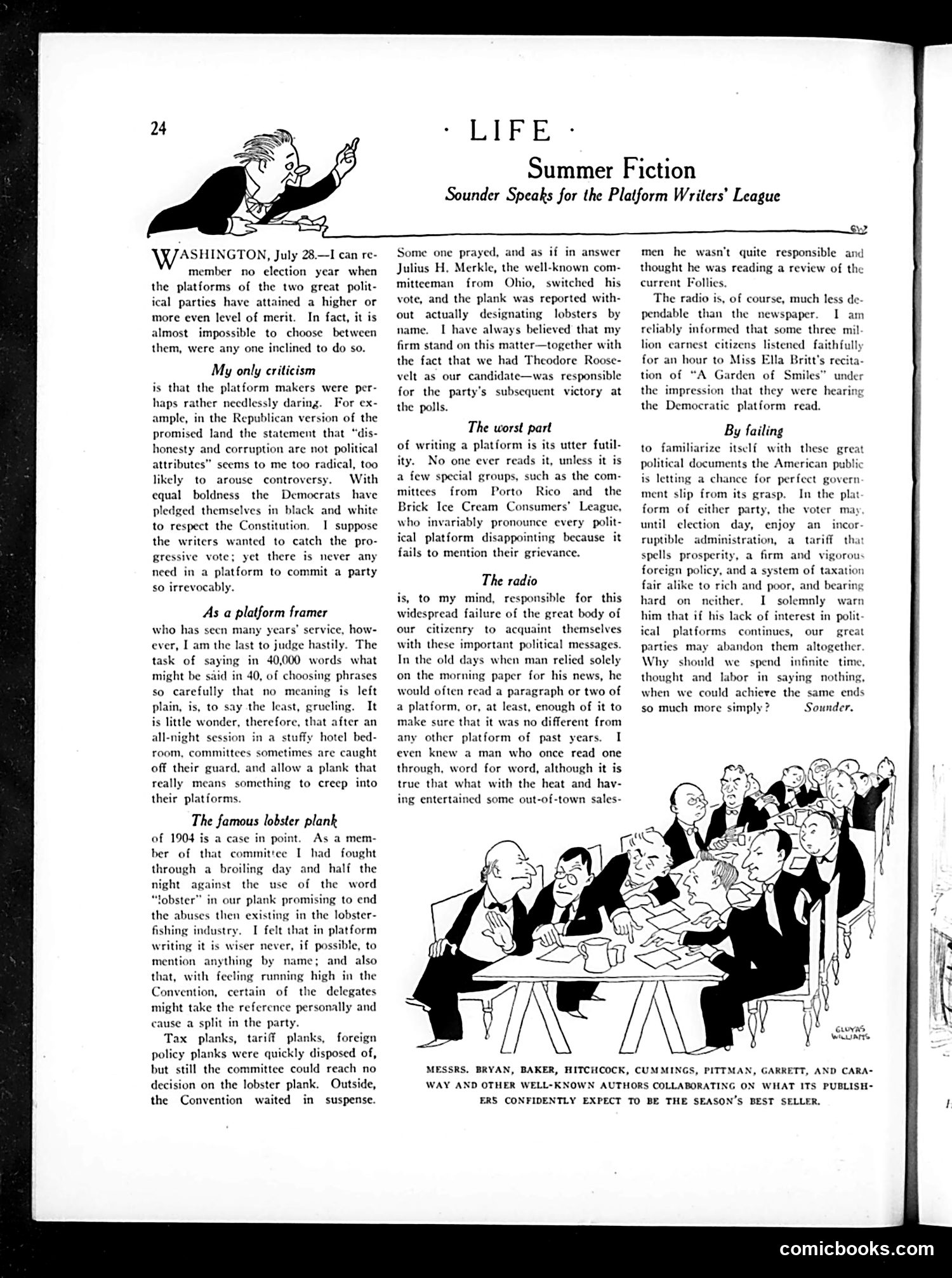
This is a humorous essay by "Sounder" mocking the futility of political party platforms. The piece satirizes platform-writers' obsessive vagueness—claiming they deliberately obscure meaning in 40,000 words what could be said in 40. The central joke involves an absurd anecdote about the "famous lobster plank of 1904," where committee members debated whether to name "lobster" directly when addressing fishing-industry abuses. The author claims this trivial dispute nearly split the party, and that winning the debate helped secure Roosevelt's victory. The satire peaks with the observation that **nobody reads platforms anyway**—except niche groups like the "Brick Ice Cream Consumers' League" who complain they weren't mentioned. He blames radio for making this worse, since fewer people now read newspapers where platforms appear. The cartoon shows well-dressed political figures collaborating on what publishers confidently claim will be "the season's best seller"—obviously ironic, since the essay just finished explaining nobody reads these documents.
📄 Transcribed text from this page (OCR, searchable)
Machine-transcribed from the original scan — historical spelling and the odd misread are preserved.
ASHINGTON, July 28.—I can re- member no election year when the platforms of the two great polit- ical parties have attained a higher or more even level of merit. In fact, it is almost impossible to choose between them, were any one inclined to do so. My only criticism is that the platform makers were per- haps rather needlessly daring. For ex- ample, in the Republican version of the promised land the statement that “dis- honesty and corruption are not political attributes” seems to me too radical, too likely to arouse controversy. With equal boldness the Democrats have pledged themselves in black and white to respect the Constitution. I suppose the writers wanted to catch the pro- gressive vote; yet there is never any need in a platform to commit a party so irrevocably. As a platform framer who has seen many years’ service, how- ever, I am the last to judge hastily. The task of saying in 40,000 words what might be said in 40, of choosing phrases so carefully that no meaning is left plain, is, to say the least, grucling. It is little wonder, therefore, that after an all-night session in a stuffy hotel bed- room, committces sometimes are caught off their guard, and allow a plank that really means something to creep into their platforms. The famous lobster plank of 1904 is a case in point. As a mem- ber of that committee I had fought through a broiling day and half the night against the use of the word “lobster” in our plank promising to end the abuses then existing in the lobster- fishing industry. I felt that in platform writing it is wiser never, if possible, to mention anything by name; and also that, with feeling running high in the Convention, certain of the delegates might take the reference personally and cause a split in the party. Tax planks, tariff planks, foreign policy planks were quickly disposed of, but still the committee could reach no decision on the lobster plank. Outside, the Convention waited in suspense. LIFE, - Summer Fiction Sounder Speaks for the Platform Writers’ League Some one prayed, and a in answer Julius H. Merkle, the well-known com- mitteeman from Ohio, switched his vote, and the plank was reported with- out actually designating lobsters by name. I have always believed that my firm stand on this matter—together with the fact that we had Theodore Roose- velt as our candidate—was responsible for the party's subsequent victory at the polls. The worst part of writing a platform is its utter futil- ity. No one ever reads it, unless it is a few special groups, such as the com- mittees from Porto Rico and the Brick Ice Cream Consumers’ League, who invariably pronounce every polit- ical platform disappointing because it fails to mention their grievance. The radio to my mind, responsible for this widespread failure of the great body of our citizenry to acquaint themselves with these important political messages In the old days when man relied solely on the morning paper for his news, he would often read a paragraph or two of a platform, or, at least, enough of it to make sure that it was no different from any other platform of past ars. I even knew a man who once read one through, word for word, although it is true that what with the heat and hav- ing entertained some out-of-town men he wasn't quite responsible and thought he was reading a review of the current The radio is, of course, much less de- pendable than the newspaper. I am reliably informed that some three mil lion earnest citizens listened faithful for an hour to Miss Ella Britt a tion of “A Garden of Smil under the impression that they were hearing the Democratic platform read. ollies, By failing to familiarize itself with these great political documents the American public is letting a chance for perfect govern ment slip from its grasp. In the plat form of either party, the voter may until election day, enjoy an incor ruptible administration, a tariff tha: spells prosperity, a firm and vigorous foreign policy, and a system of taxation fair alike to rich and poor, and bearing hard on neither. I solemnly warn him that if his lack of interest in polit ical platforms continues, our great parties may abandon them altogether Why should we spend infinite time, thought and labor in saying nothing, when we could achieve the same ends so much more simply? Sounder. MESSRS. BRYAN, BAKER, HITCHCOCK, CUMMINGS, PITTMAD OWN AUTHORS COLLABORATING ON WHAT ITS PUBLISH- WAY AND OTHER WEL! Gwwvas, GARRETT, AND CARA- ERS CONFIDENTLY EXPECT TO BE THE SEASON’S BEST SELLER. comicbooks.com