
Life, 1924-07-31 · page 16 of 36
Life — July 31, 1924 — page 16: what you’re looking at
What you’re looking at
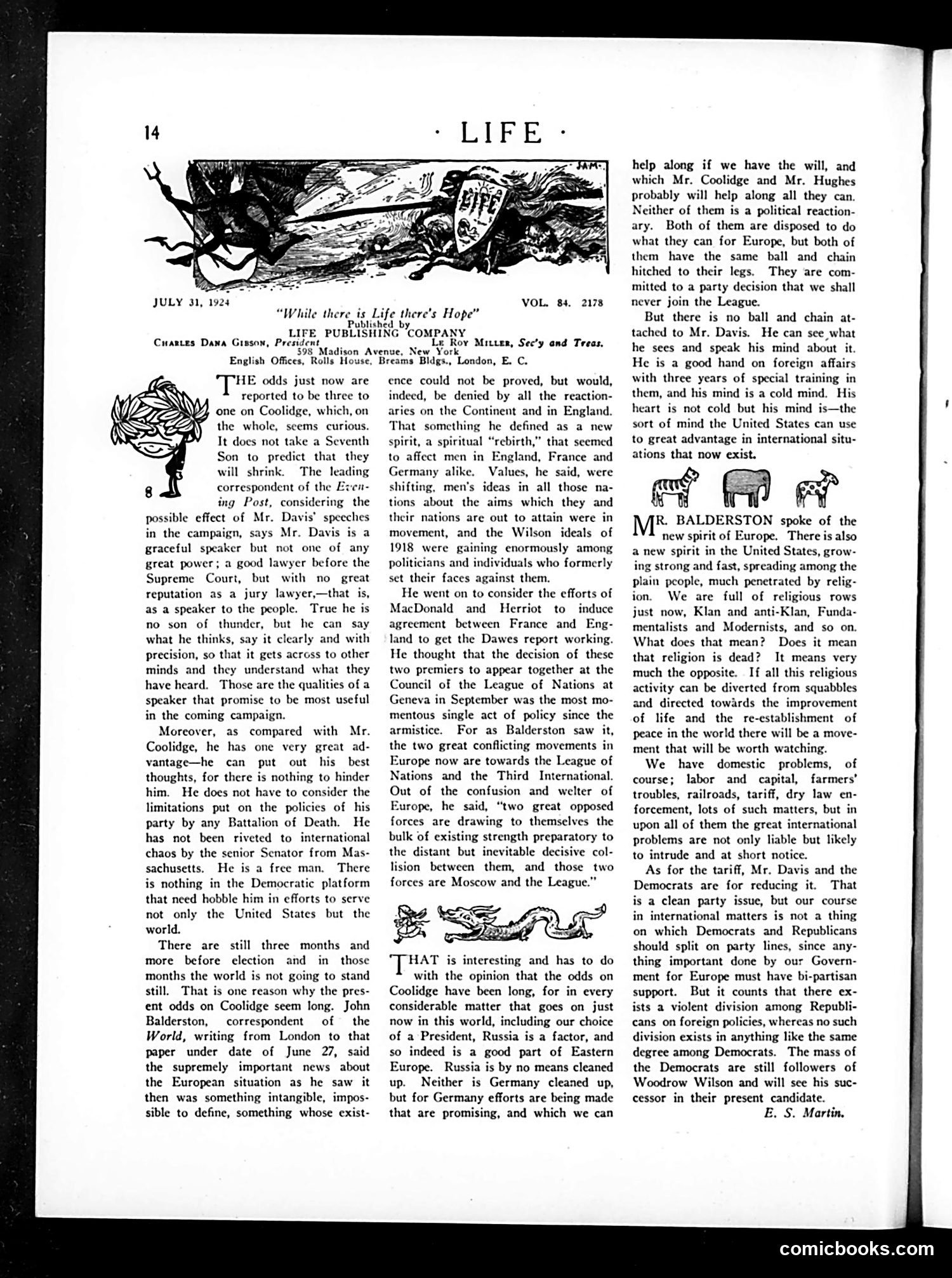
This page contains editorial commentary by E.S. Martin about the 1924 presidential race, focusing on Calvin Coolidge's prospects. The article discusses Coolidge's strengths as a candidate—described as a "great lawyer" and effective speaker—while comparing him favorably to rival John W. Davis. The text analyzes European political movements and tensions between France, Germany, and the League of Nations as context for American politics. Martin argues that international instability (Russia, German recovery) makes Coolidge's steady leadership appealing, and that Democrats' divisions over Woodrow Wilson's legacy weaken their position against the Republican candidate. The small illustrations appear decorative rather than satirical commentary.
📄 Transcribed text from this page (OCR, searchable)
Machine-transcribed from the original scan — historical spelling and the odd misread are preserved.
JULY 31, 1924 VOL, 84. 2178 “While there, is Life there's Hope” LIFE PUBLISHING” Cuantes Dana Gisson, Evesideat COMPANY Le Roy Mitter, Sec’y and Treas, 598 Madison Avenue, New York English Offices, HE odds just now are reported to be three to BR Ya Sy one on Coolidge, which, on SF the whole, seems curious. It does not take a Seventh Son to predict that they will shrink. The leading correspondent of the Even- ing Post, considering the possible effect of Mr. Davis’ speeches in the campaign, says Mr. Davis is a graceful speaker but not one of any great power; a good lawyer before the Supreme Court, but with no great reputation as a jury lawyer,—that is, as a speaker to the people. True he is no son of thunder, but he can say what he thinks, say it clearly and with precision, so that it gets across to other minds and they understand what they have heard. Those are the qualities of a speaker that promise to be most useful in the coming campaign. Moreover, as compared with Mr. Coolidge, he has one very great ad- vantage—he can put out his best thoughts, for there is nothing to hinder him. He does not have to consider the limitations put on the policies of his party by any Battalion of Death. He has not been riveted to international chaos by the senior Senator from Mas- sachusetts. He is a free man. There is nothing in the Democratic platform that need hobble him in efforts to serve not only the United States but the world. There are still three months and more before election and in those months the world is not going to stand still. That is one reason why the pres- ent odds on Coolidge seem long. John Balderston, correspondent of the World, writing from London to that paper under date of June 27, said the supremely important news about the European situation as he saw it then was something intangible, impos- sible to define, something whose exist- Rolls House, Breams Bldgs., London, E. C. ence could not be proved, but would, indeed, be denied by all the reaction- aries on the Continent and in England. That something he defined as a new spirit, a spiritual “rebirth,” that seemed to affect men in England, France and Germany alike. Values, he said, were shifting, men’s ideas in all those na- tions about the aims which they and their nations are out to attain were in movement, and the Wilson ideals of 1918 were gaining enormously among politicians and individuals who formerly set their faces against them. He went on to consider the efforts of MacDonald and Herriot to induce agreement between France and Eng- land to get the Dawes report working. He thought that the decision of these two premiers to appear together at the Council of the League of Nations at Geneva in September was the most mo- mentous single act of policy since the armistice. For as Balderston saw it, the two great conflicting movements in rope now are towards the League of Nations and the Third International. Out of the confusion and welter of Europe, he said, “two great opposed forces are drawing to themselves the bulk of existing strength preparatory to the distant but inevitable decisive col- lision between them, and those two forces are Moscow and the League.” HAT is interesting and has to do with the opinion that the odds on Coolidge have been long, for in every considerable matter that goes on just now in this world, including our choice of a President, Russia is a factor, and so indeed is a good part of Eastern Europe. Russia is by no means cleaned up. Neither is Germany cleaned up, but for Germany efforts are being made that are promising, and which we can help along if we have the will, and which Mr. Coolidge and Mr. Hughes probably will help along all they can. Neither of them is a political reaction- ary. Both of them are disposed to do what they can for Europe, but both of them have the same ball and chain hitched to their legs. They are com- mitted to a party decision that we shall never join the League. But there is no ball and chain at- tached to Mr. Davis. He can see what he sees and speak his mind about it. He is a good hand on foreign affairs with three years of special training in them, and his mind is a cold mind. His heart is not cold but his mind is—the sort of mind the United States can use to great advantage in international situ- ations that now exist. ee fo & M® BALDERSTON spoke of the new spirit of Europe. There is also a new spirit in the United States, grow- ing strong and fast, spreading among the plain people, much penetrated by relig- ion. We are full of religious rows just now, Klan and anti-Klan, Funda- mentalists and Modernists, and so on. What does that mean? Does it mean that religion is dead? It means very much the opposite. If all this religious activity can be diverted from squabbles and directed towards the improvement of life and the re-establishment of peace in the world there will be a move- ment that will be worth watching. We have domestic problems, of course; labor and capital, farmers’ troubles, railroads, tariff, dry law en- forcement, lots of such matters, but in upon all of them the great international problems are not only liable but likely to intrude and at short notice. As for the tariff, Mr. Davis and the Democrats are for reducing it. That is a clean party issue, but our course in international matters is not a thing on which Democrats and Republicans should split on party lines, since any- thing important done by our Govern- ment for Europe must have bi-partisan support. But it counts that there ex- ists a violent division among Republi- cans on foreign policies, whereas no such division exists in anything like the same degree among Democrats. The mass of the Democrats are still followers of Woodrow Wilson and will see his suc- cessor in their present candidate. E, S. Martin. comicbooks.com