
Life, 1924-07-31 · page 23 of 36
Life — July 31, 1924 — page 23: what you’re looking at
What you’re looking at
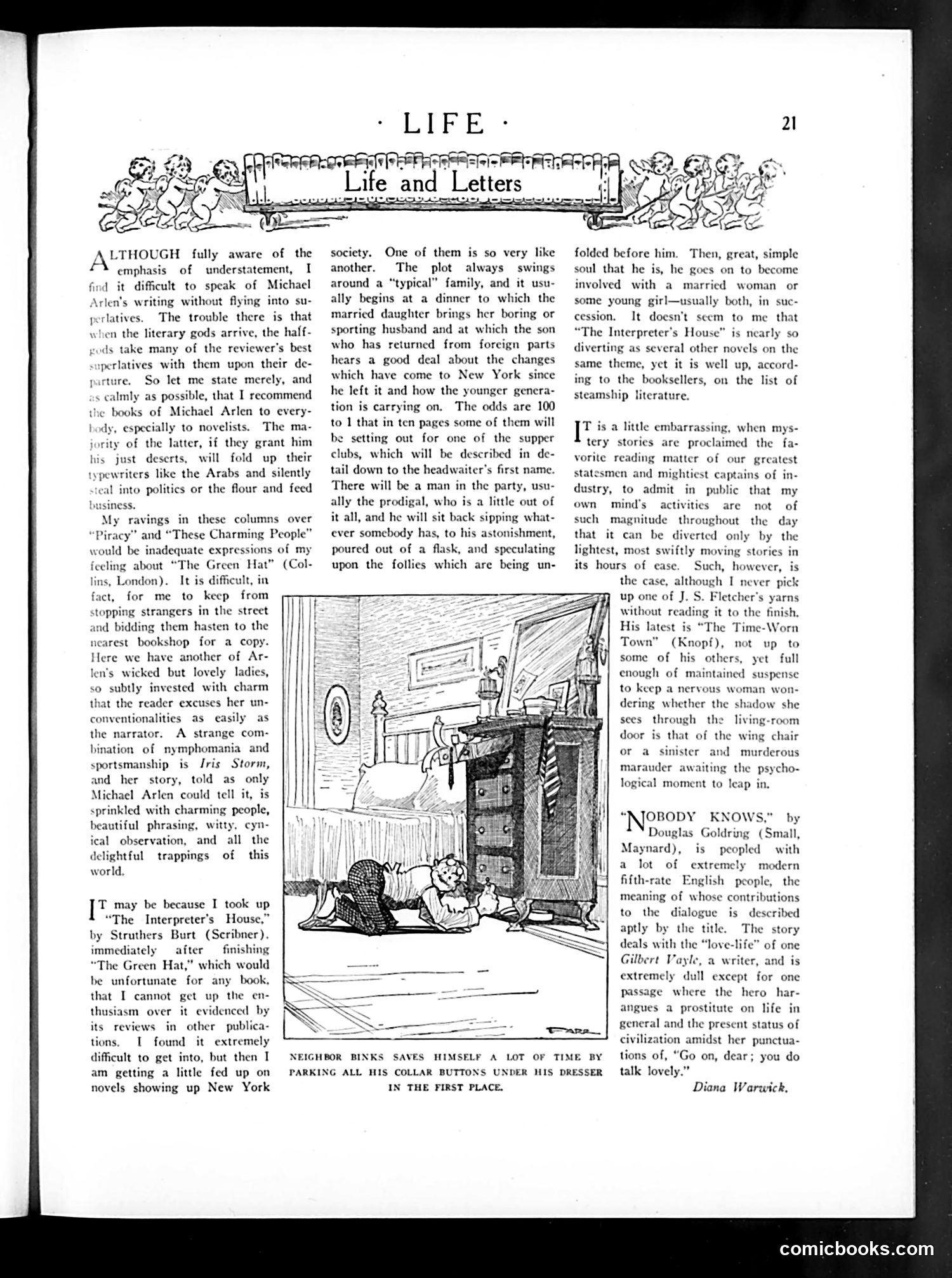
This is a book review column by Diana Warwick discussing contemporary 1920s fiction. The main cartoon shows a neighbor efficiently storing collar buttons under his dresser—a practical domestic humor joke about organization and time-saving. The text reviews three novels: Michael Arlen's *The Green Hat* (praised enthusiastically), Struthers Burt's *The Interpreter's House* (criticized as derivative), and J.S. Fletcher's mystery novels (enjoyed as light reading). The reviewer notes these books follow predictable patterns: dinner parties, returning expatriates commenting on New York's changes, nightclub scenes, and romantic entanglements. The satire targets both the formulaic nature of contemporary literature and readers' tastes—the reviewer admits enjoying "steamship literature" (light reading for travel) despite their intellectual pretensions. The column reflects 1920s literary culture's mix of serious criticism and popular entertainment.
📄 Transcribed text from this page (OCR, searchable)
Machine-transcribed from the original scan — historical spelling and the odd misread are preserved.
LTHOUGH fully aware of the emphasis of understatement, I find it difficult to speak of Michael Arlen's writing without flying into su- perlatives. The trouble there is that when the literary gods arrive, the half- gods take many of the reviewer's best superlatives with them upon their de- parture. So let me state merely, and s calmly as possible, that I recommend the books of Michael Arlen to every- dy, especially to novelists. The ma- jority of the latter, if they grant him his just deserts, will fold up their typewriters like the Arabs and silently eal into politics or the flour and feed iness. My ravings in these columns over “Piracy” and “These Charming People” would be inadequate expressions of my feeling about “The Green Hat” (Col- lins, London). It is difficult, in LIFE nd Letters society. One of them is so very like another. The plot always swings around a “typical” family, and it usu- ally begins at a dinner to which the married daughter brings her boring or sporting husband and at which the son who has returned from foreign parts hears a good deal about the changes which have come to New York since he left it and how the younger genera- tion is carrying on. The odds are 100 to 1 that in ten pages some of them will be setting out for one of the supper clubs, which will be described in de- tail down to the headwaiter's first name. There will be a man in the party, usu- ally the prodigal, who is a little out of it all, and he will sit back sipping what- ever somebody has, to his astonishment, poured out of a flask, and speculating upon the follies which are being un- fact, for me to keep from pping strangers in the street and bidding them hasten to the nearest bookshop for a copy. Here we have another of Ar- len’s wicked but lovely ladies, so subtly invested with charm at the reader excuses her un- conventionalities as easily as the narrator. A strange com- bination of nymphomania and sportsmanship is Iris Storm, and her story, told as only Michael Arlen could tell it, is sprinkled with charming people, beautiful phrasing, witty, cyn- ical observation, and all the delightful trappings of this world, T may be because I took up “The Interpreter’s House,” by Struthers Burt (Scribner). immediately after finishing “The Green Hat,” which would be unfortunate for any book, that I cannot get up the en- thusiasm over it evidenced by its reviews in other publica- tions. [ found it extremely difficult to get into, but then I am getting a little fed up on novels showing up New York NEIGHBOR BINKS SAVES PARKING ALL HIS COLLAR BUTTONS UNDER HIS DRESSER HIMSELF A LOT OF IN THE FIRST PLACE, TIME BY folded before him. Then, great, soul that he is, he goes on to become involved with a married woman or some young girl—usually both, in suc- cession, It doesn’t seem to me that “The Interpreter’s House” is nearly so diverting as several other novels on the same theme, yet it is well up, accord- ing to the booksellers, on the list of steamship literature. T is a little embarrassing, when mys- tery stories are proclaimed the fa- vorite reading matter of our greatest statesmen and mightiest captains of in- dustry, to admit in public that my own mind's activities are not of such magnitude throughout the day that it can be diverted only by the lightest, most swiftly moving stories in its hours of ease. Such, however, is the case, although I never pick up one of J. S. Fletcher's yarns without reading it to the finish, His latest is “The Time-Worn Town” (Knopf), not up to some of his others, yet full enough of maintained suspense to keep a nervous woman won- dering whether the shadow she living-room door is that of the wing chair sees through the or a sinister and murderous marauder awaiting the psycho- logical moment to leap in. IOBODY KNOWS,” by Douglas Goldring (Small, Maynard), is peopled with a lot of extremely modern fifth-rate English people, the meaning of whose contributions to the dialogue is aptly by the title. The story deals with the “ of one Gilbert Vayle, a writer, and is extremely dull except for one passage hero har- angues a prostitute on life in and the present status of civilization amidst her punctua- 3 you do described where the general tions of, “Go on, dea talk lovely.” Diana Warwick, comicbooks.com