
Life, 1924-07-31 · page 30 of 36
Life — July 31, 1924 — page 30: what you’re looking at
What you’re looking at
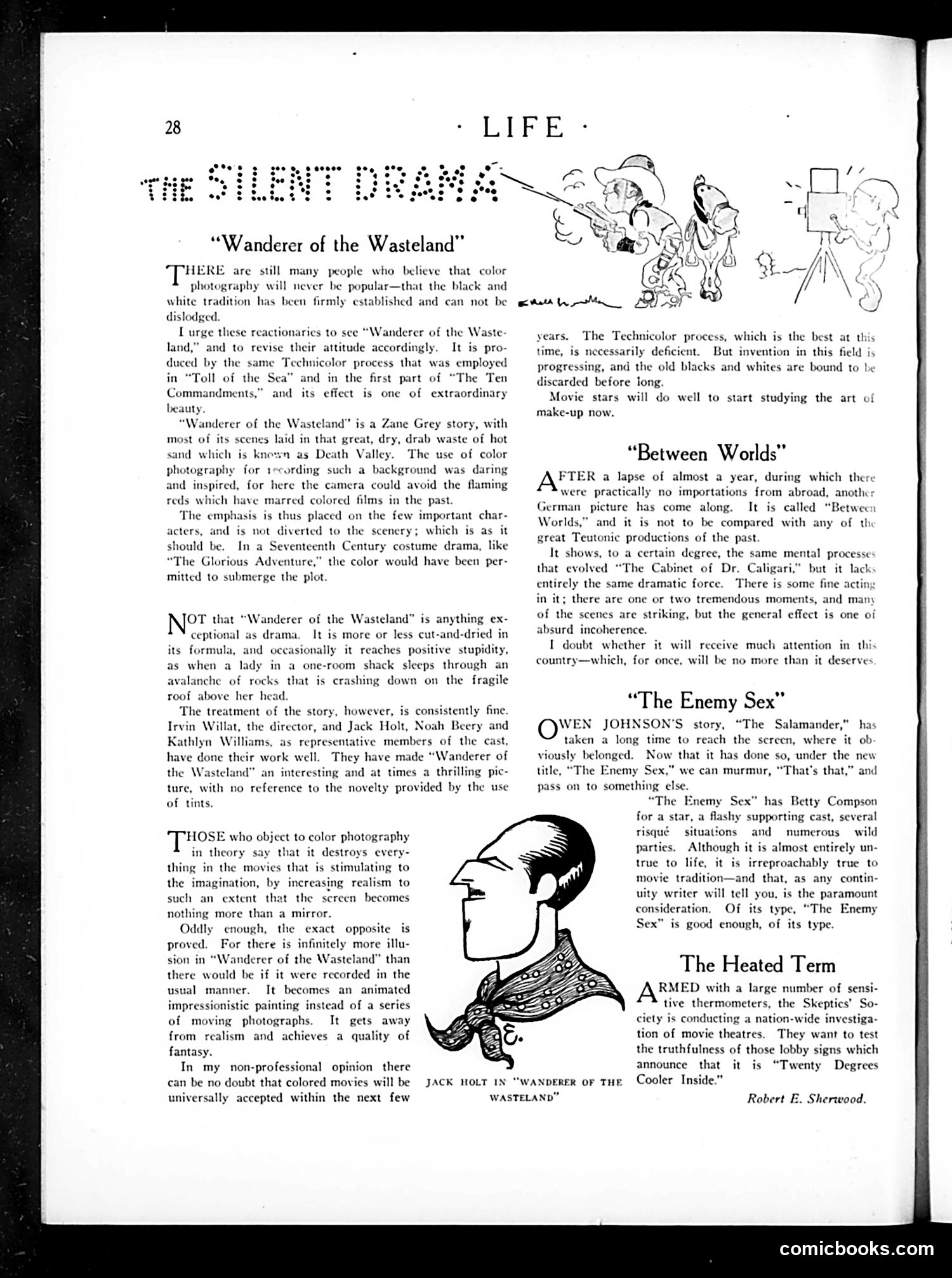
This page reviews three films from the early 1920s, with one prominent illustration: a profile sketch of actor **Jack Holt** in "Wanderer of the Wasteland." The main satire targets **skeptics of color photography**. The reviewer argues that Technicolor films will inevitably replace black-and-white cinema, calling doubters "reactionaries" who resist progress. The piece uses "Wanderer of the Wasteland"—a Zane Grey Western shot in Death Valley—as evidence that color enhances rather than diminishes artistic quality by adding impressionistic fantasy rather than crude realism. The page also briefly reviews "Between Worlds," a German import deemed inferior, and mentions Oren Johnson's "The Enemy Sex" (title cut off). The cartoon's purpose is decorative rather than satirical—simply identifying the actor and film discussed. The satire resides entirely in the *text's* rhetorical argument about technological progress displacing established tradition.
📄 Transcribed text from this page (OCR, searchable)
Machine-transcribed from the original scan — historical spelling and the odd misread are preserved.
“Wanderer of the Wasteland” HERE are still many people who believe that color photography will never be popular—that the black and white tradition has been firmly established and can not be dislodged. L urge these reactionaries to see “Wanderer of the Waste- land,” and to revise their attitude accordingly. It is pro- duced by the same Technicolor process that was employed in “Toll of the Sea nd in the first part of “The Ten Commandments,” and its effect is one of extraordinary beauty “Wanderer of the Wasteland” is a Zane Grey story, with most of its scenes laid in that great, dry, drab waste of hot sand which is known as Death Valley. The use of color photography for recording such a background was daring and inspired, for here the camera could avoid the flaming reds which have marred colored films in the past. The emphasis is thus placed on the few important char- acters, and is not diverted to the scenery; which is as it should be. In a Seventeenth Century costume drama, like fhe Glorious Adventure,” the color would have been per- mitted to submerge the plot. OT that “Wanderer of the Wasteland” is anything ex- ceptional as drama. It is more or less cut-and-dried in its formula, and occasionally it reaches positive stupidity, as when a lady in a one-room shack sleeps through an avalanche of rocks that is crashing down on the fragile roof above her head. The treatment of the story, however, is consistently fine. Irvin Willat, the director, and Jack Holt, Noah Beery and Kathlyn Williams, as representative members of the cast, have done their work well. They have made “Wanderer of the Wasteland” an interesting and at times a thrilling pic- ture, with no reference to the novelty provided by the use of tints. HOSE who object to color photography in theory say that it destroys every- thing in the movies that is stimulating to the imagination, by increasing realism to such an extent that the sereen becomes nothing more than a mirror. Oddly enough, the exact opposite is proved. For there is infinitely more illu- sion in “Wanderer of the Wasteland” than there would be if it were recorded in the usual manne It becomes an animated impressionistic painting instead of a series of moving photographs. It gets away from realism and achieves a quality of fantasy. In my non-professional opinion there can be no doubt that colored movies will be universally accepted within the next few JACK HOLT IN “WANDERER OF THE WASTELAND” years. The Technicolor process, which is the best at this time, is necessarily deficient. But invention in this field is progressing, and the old blacks and whites are bound to be discarded before long. Movie stars will do well to start studying the art of make-up now. “Between Worlds” FTER a lapse of almost a year, during which there were practically no importations from abroad, anothcr German picture has come along. It is called “Between Worlds,” and it is not to be compared with any of th great Teutonic productions of the past. It shows, to a certain degree, the same mental processes that evolved “The Cabinet of Dr. Caligari,” but it 1 entirely the same dramatic force. There is some fine acting in it; there are one or two tremendous moments, and many of the scenes are striking, but the general effect is one of absurd incoherence. [ doubt whether it will receive much attention in this country—which, for once, will be no more than it deserves “The Enemy Sex” WEN JOHNSON’S story, “The Salamander,” has taken a long time to reach the sereen, where it ob viously belonged. Now that it has done so, under the new title, “The Enemy Sex,” we can murmur, “That's that,” and pass on to something els “The Enemy Sex” has Betty Compson for a star, a flashy supporting cast, several risqué situations and numerous wild parties. Although it is almost entirely un- true to life, it is irreproachably true to movie tradition—and that, as any contin- uity writer will tell you, is the paramount consideration, Of its type, “The Enemy Sex” is good enough, of its type. The Heated Term RMED with a large number of sensi- tive thermometers, the Skeptics’ So- ciety is conducting a nation-wide investiga- tion of movie theatres. They want to test the truthfulness of those lobby signs which announce that it is “Twenty Degrees Cooler Inside.” Robert E. Sherwood. comicbooks.com