
A complete issue · 44 pages · 1924
Life — June 12, 1924
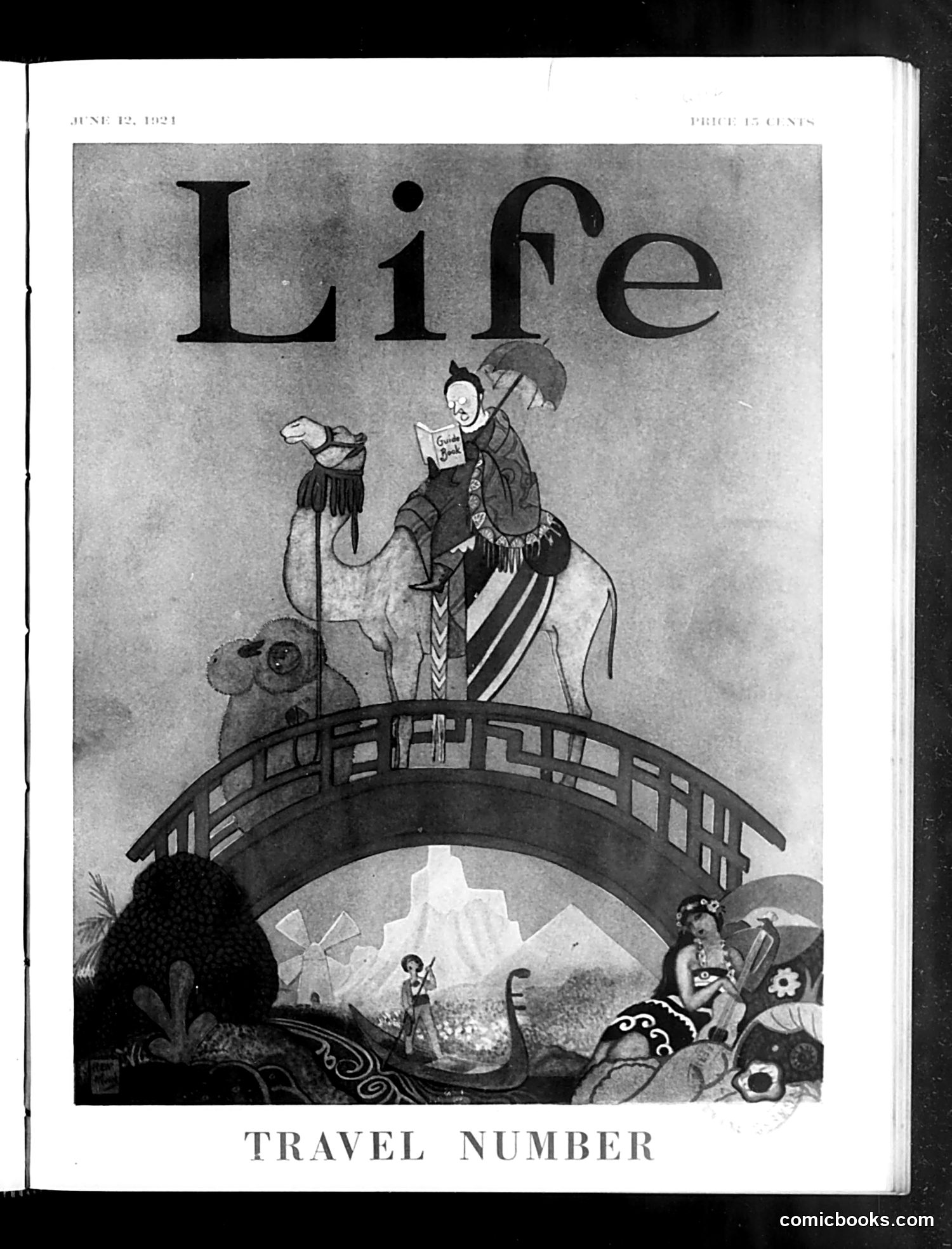
This is a "Travel Number" issue featuring an Art Deco-style illustration of exotic tourism. The central figure appears to be a wealthy Western traveler (possibly a woman, given the umbrella and fashionable dress) riding a camel across a stylized Asian landscape. The bridge and architectural elements suggest East Asian or Middle Eastern settings. Below, local figures and merchants are depicted in a romanticized, somewhat stereotypical manner typical of 1920s Western attitudes toward non-Western cultures. The composition celebrates leisure travel to distant lands—a luxury activity associated with wealth and cosmopolitan sophistication. The satire likely mocks both the pretensions of wealthy tourists and exoticized Western fantasies of "the Orient," though specific political references remain unclear from the image alone.
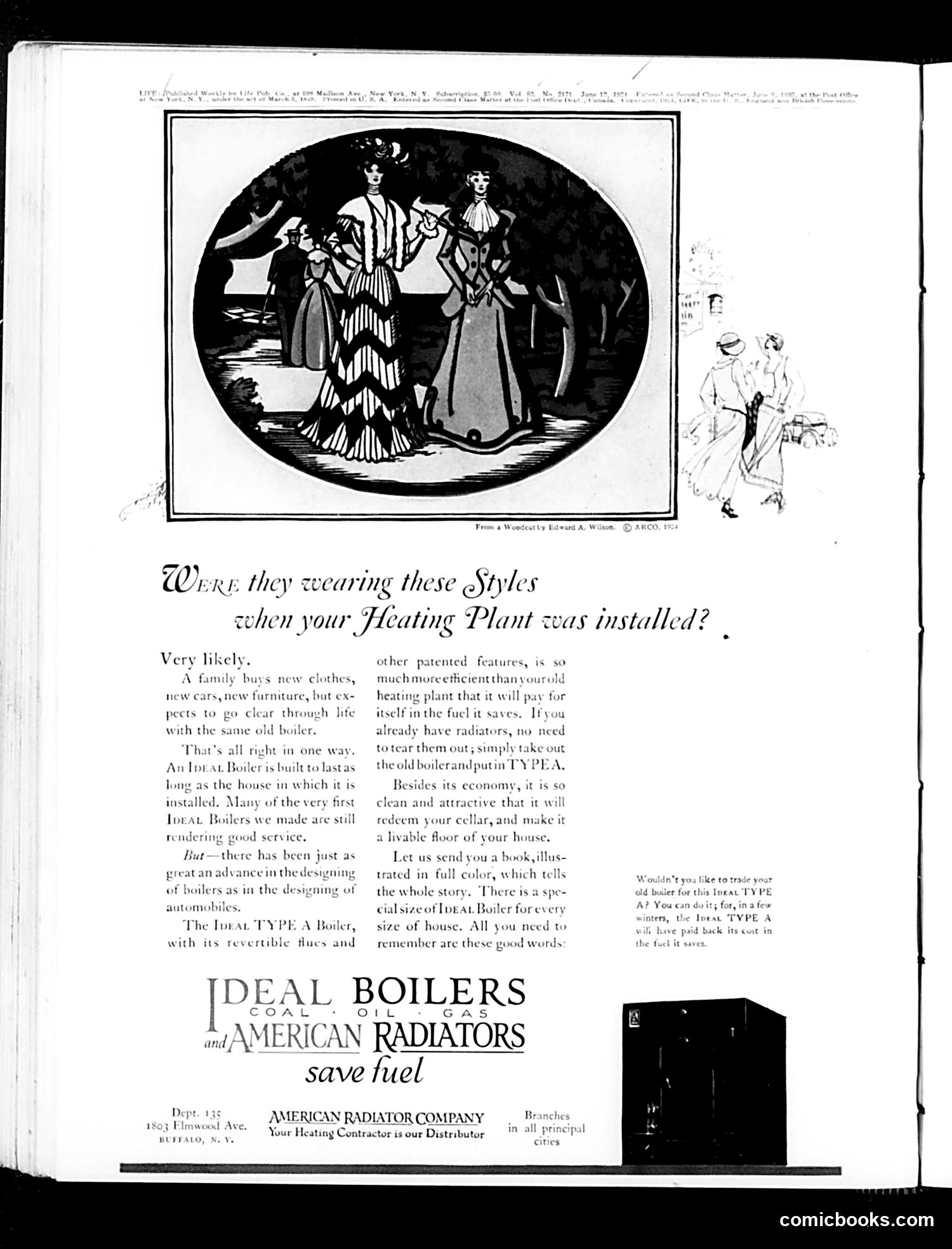
This page is primarily an advertisement for Ideal Boilers and American Radiators, with minimal satirical content. The large oval illustration at top appears to show elegantly dressed figures in historical costume, likely meant to evoke an earlier era of fashion and lifestyle. The advertisement's central joke contrasts past and present: the headline asks whether people wore such stylish clothes "when your Heating Plant was installed?" The implication is that just as fashion has modernized, so too should home heating systems. The ad argues that an old boiler is outdated, whereas an Ideal boiler represents current technology and efficiency. The satire, such as it is, gently mocks homeowners clinging to obsolete heating systems rather than modernizing. This is fundamentally a product advertisement using gentle humor rather than political commentary.
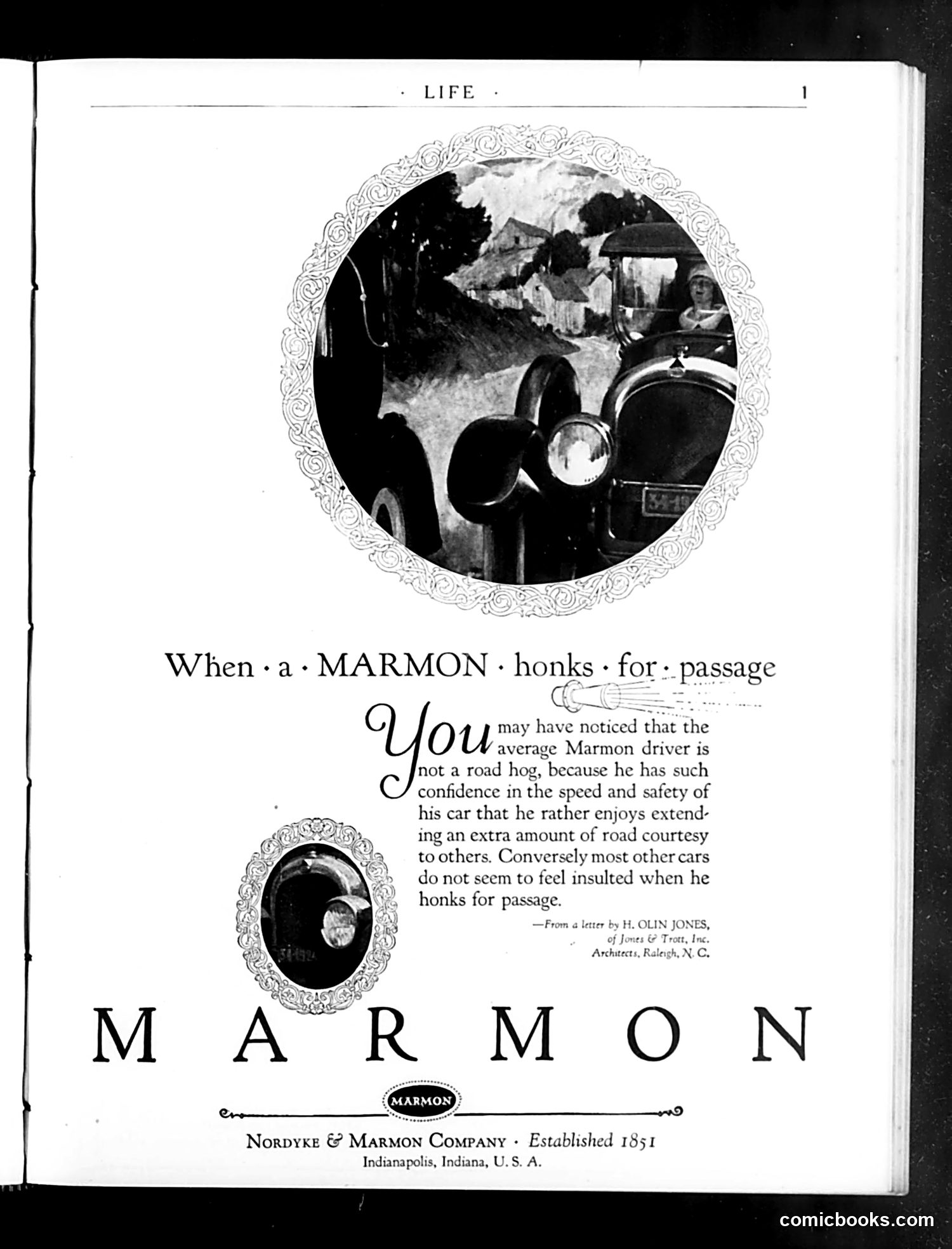
This page is primarily **advertising copy**, not satire or political commentary. It promotes Marmon automobiles through a testimonial format. The ad features two photographs of a Marmon car's headlight and horn, framed in ornamental borders. The text cites a letter from H. Olin Jones, an architect from Raleigh, North Carolina, praising Marmon drivers' courtesy on the road. Jones claims Marmon drivers honk politely for passage rather than aggressively, and that other drivers don't take offense—suggesting the cars inspire respect and trust. The "joke" is gentle brand humor: Marmon drivers are so refined and confident in their vehicles' quality that even demanding right-of-way seems courteous rather than rude. It's lifestyle marketing positioning Marmon as the car for sophisticated, well-mannered drivers.
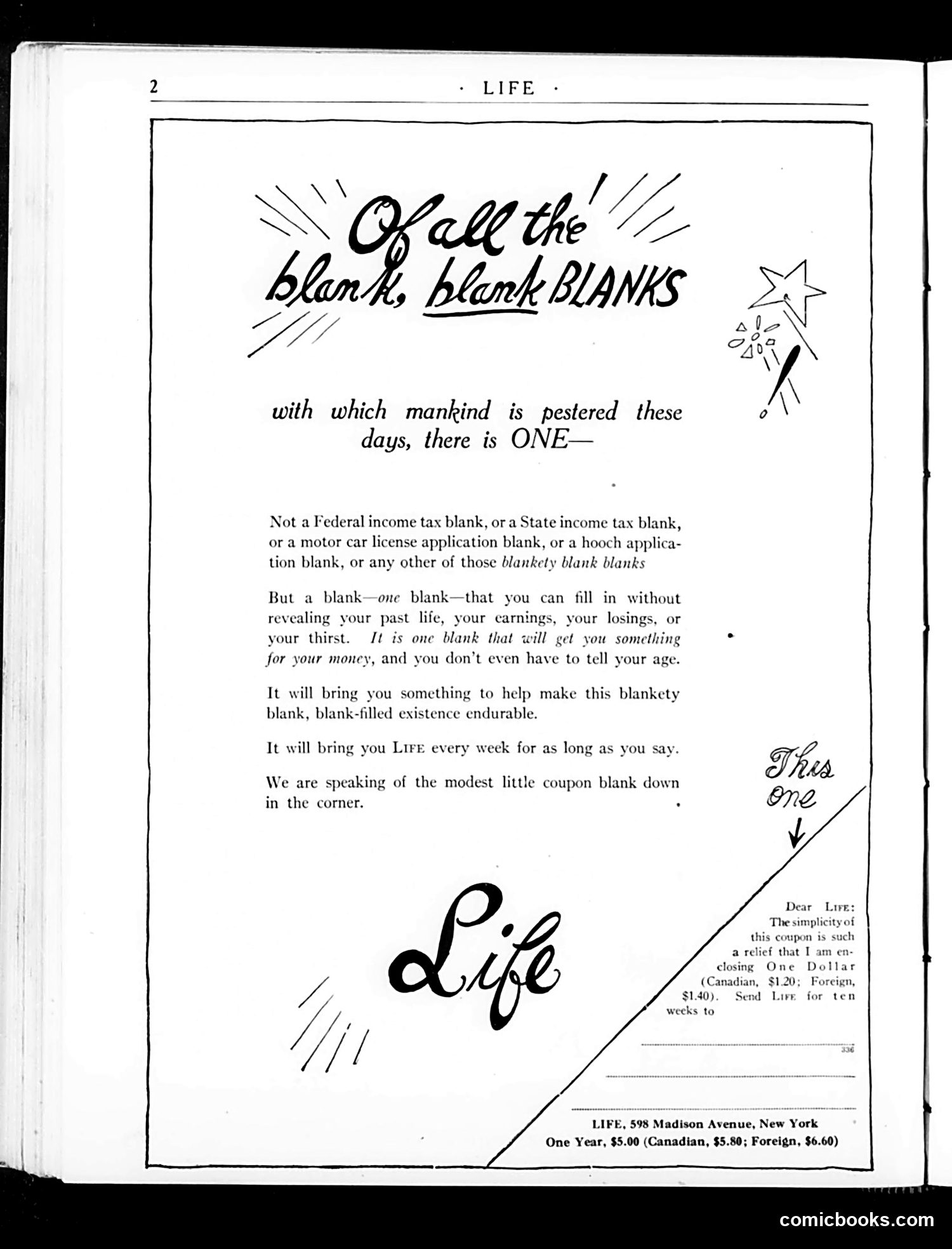
This is primarily a **subscription advertisement** for *Life* magazine, not a political cartoon. The ad uses humor to promote *Life's* coupon subscription blank—the one form readers can fill without disclosing personal information (unlike tax forms or license applications). The satirical setup contrasts "blank blanks" (government forms) with *Life's* simple coupon. The joke appeals to mid-20th century frustrations with bureaucratic red tape and invasive paperwork. By offering anonymity ("you don't even have to tell your age"), the ad positions *Life* as relief from governmental intrusion. The star-waving figure is decorative; no specific political figures are caricatured. This is straightforward magazine marketing using satire about bureaucracy as its selling point.
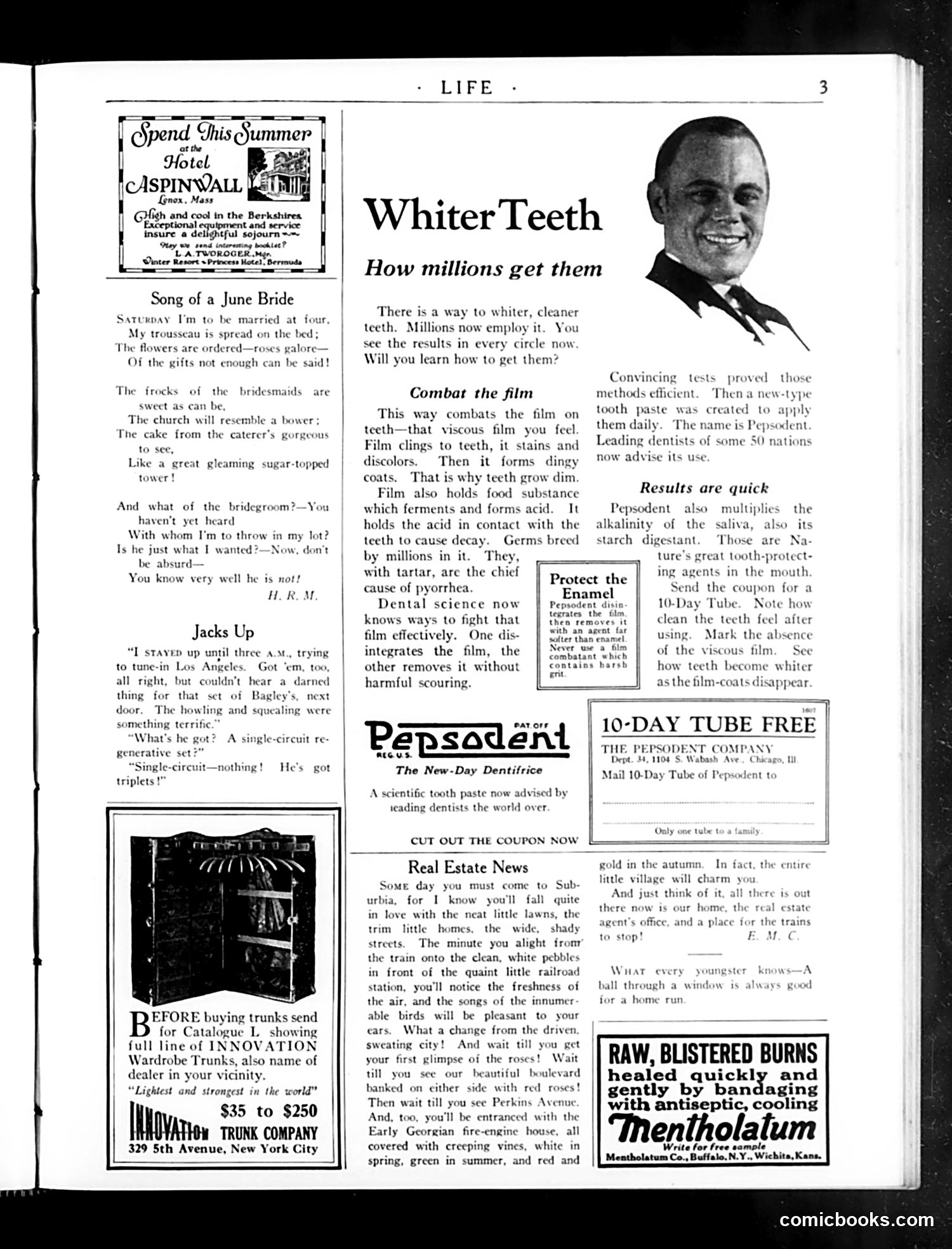
This page is primarily **advertising and light entertainment content**, not political satire. It contains: 1. **"Song of a June Bride"** — humorous poetry about wedding preparations, a common magazine feature of the era. 2. **"Jacks Up"** — a brief anecdote about someone staying up late in Los Angeles, illustrating a pun about "single-circuit" (electrical wiring). 3. **Multiple advertisements** for consumer products: Hotel Aspinwall, Innovation Trunk Company, Pepsodent toothpaste, Mentholatum, and real estate in Suburbia. The **Pepsodent ad features a smiling man** and touts the toothpaste as "The New-Day Dentifrice" — representing early 20th-century marketing of modern dental hygiene products to middle-class consumers. No political cartoons or satire appear on this page.
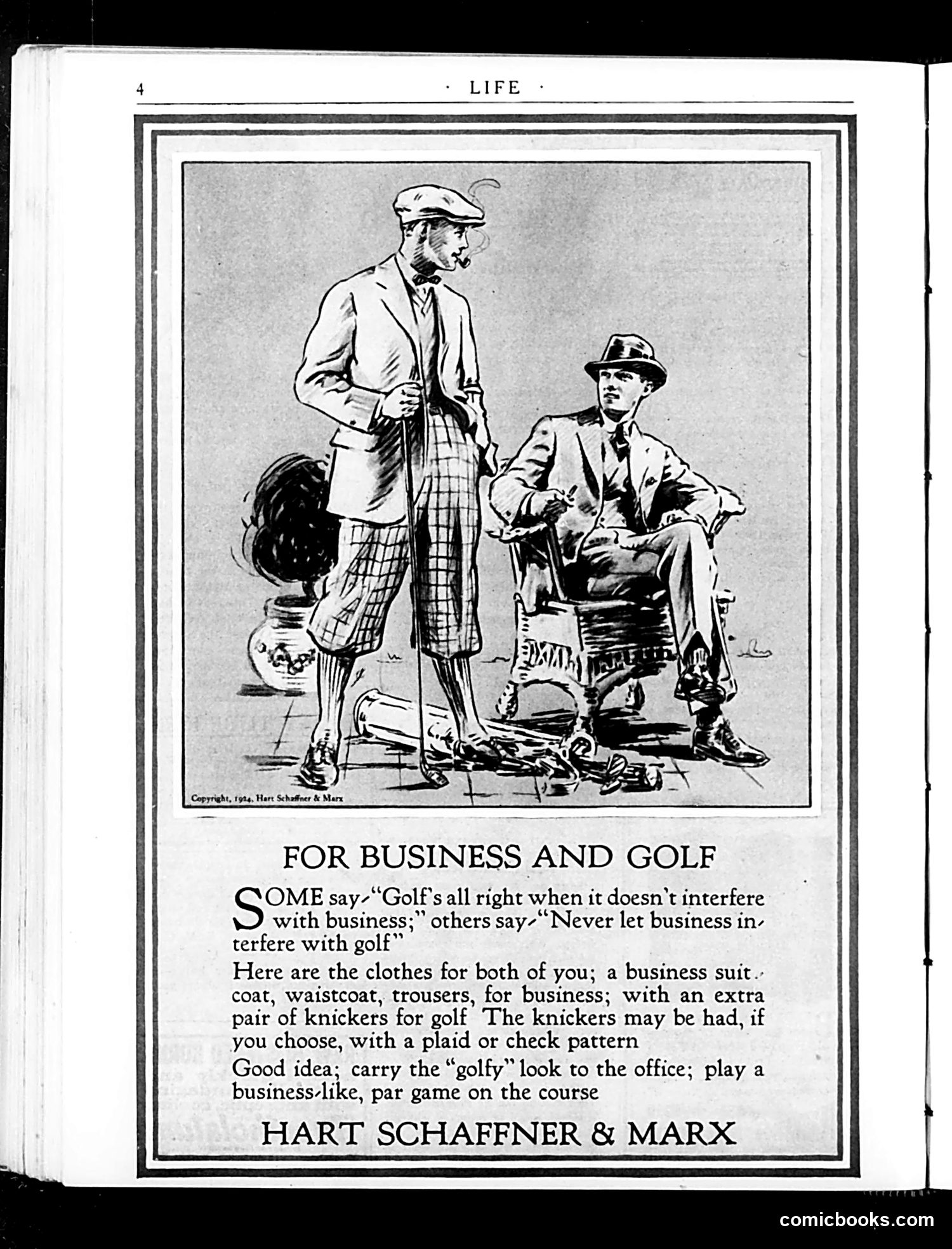
This page is primarily a **clothing advertisement** rather than political satire. It depicts two well-dressed men—one standing tall in golf attire (knickers, flat cap), the other seated in business clothes (suit, fedora)—illustrating Hart Schaffner & Marx's solution for men who balance professional and recreational pursuits. The ad humorously addresses a contemporary tension: whether golf should take precedence over business or vice versa. The company's pitch is practical—offering a business suit *plus* extra golf knickers, allowing men to maintain a "golfy look" while conducting office work. This reflects early 20th-century attitudes about leisure, masculinity, and the emerging importance of golf among businessmen. The satire is gentle: the ad acknowledges the conflict between work and play while offering a consumerist solution.
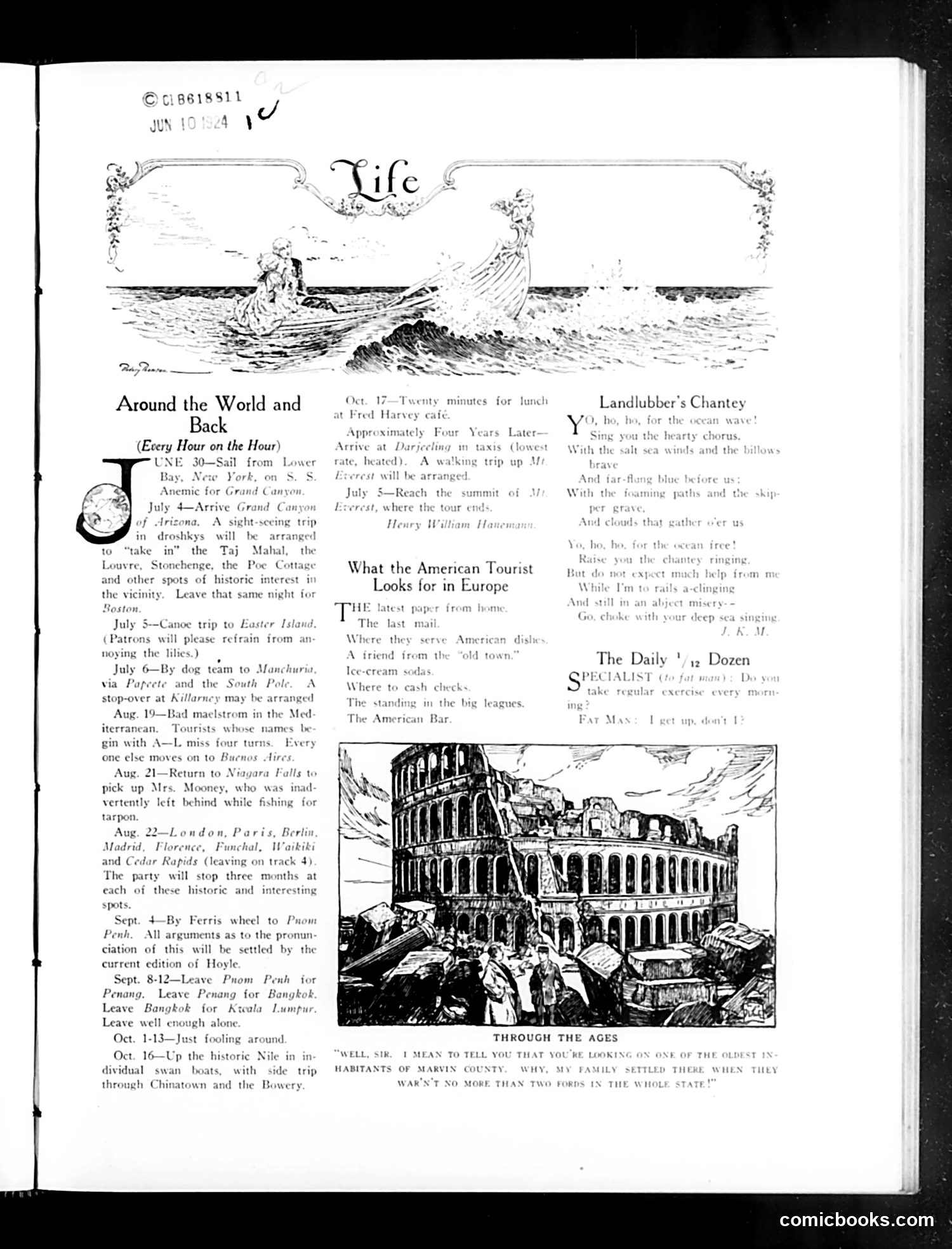
This page contains travel and lifestyle content rather than political satire. The main sections include: **"Around the World and Back"** — a travel itinerary listing destinations from July through October, including the Grand Canyon, Easter Island, Buenos Aires, and European cities (London, Paris, Berlin, Madrid, Florence). **"What the American Tourist Looks for in Europe"** — a humorous list of American expectations abroad: American dishes, ice-cream sodas, cash checks, and "The American Bar." **"Landlubber's Chantey"** — a poem about ocean travel. **"The Daily Dozen"** — exercise advice by "Pat Max." The large illustration shows the Colosseum in Rome, labeled "THROUGH THE AGES," with a caption about Marvin County settlers, presenting the monument as an ancient historical landmark. This appears to be entertainment and travel content typical of Life magazine's lifestyle coverage.
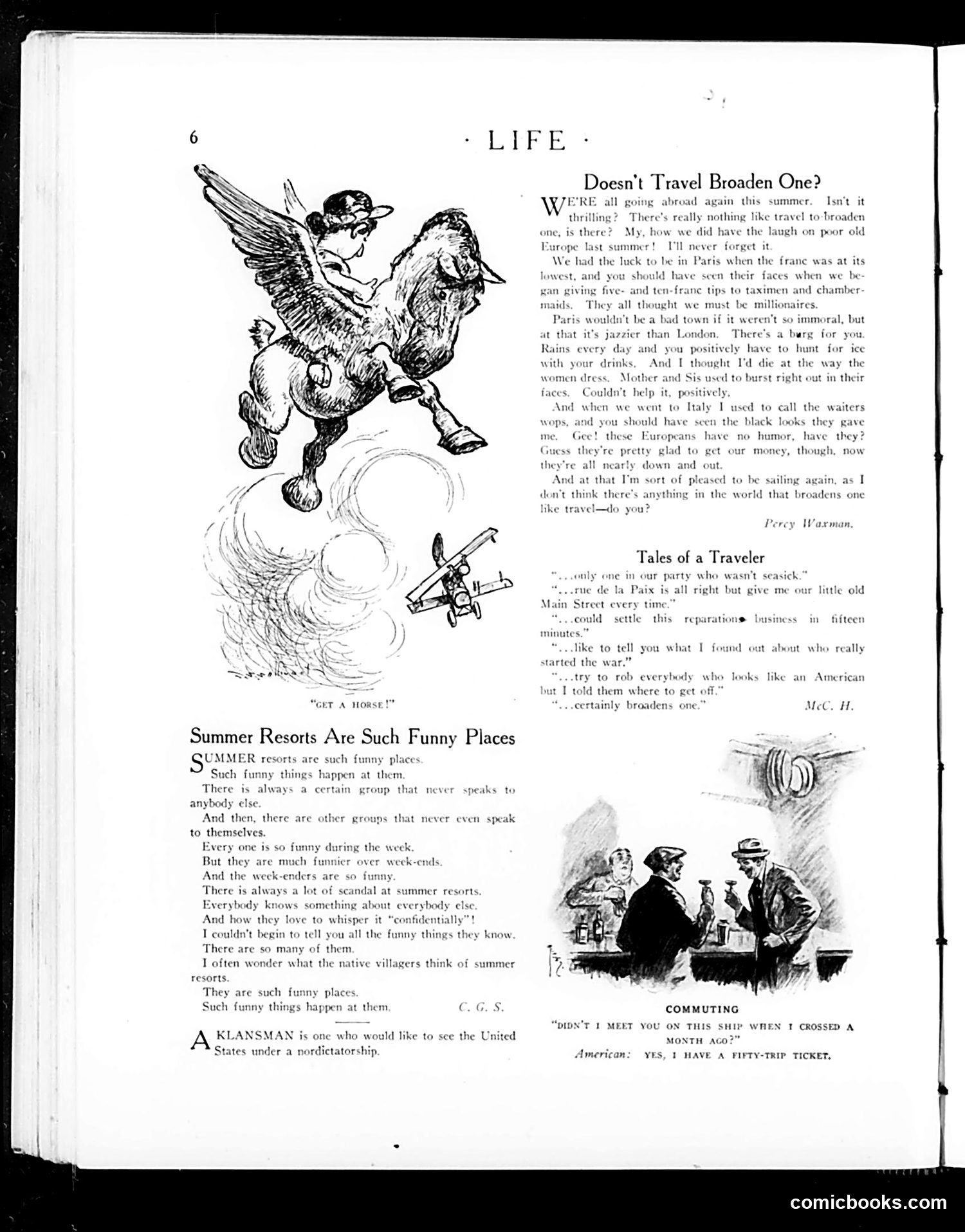
This page contains three humorous pieces about travel and social observation, typical of Life's satirical format. The top cartoon "Get a Horse!" depicts a cherub riding a bucking horse while holding an airplane, satirizing the contrast between old and new transportation methods—likely mocking either early aviation's unreliability or the transition from horses to planes. "Doesn't Travel Broaden One?" by Percy Waxman humorously catalogs American tourists' experiences abroad, particularly in Paris and Italy, emphasizing their cultural insensitivity and tendency to complain rather than appreciate differences. "Summer Resorts Are Such Funny Places" by C.G.S. satirizes the gossipy, cliquish nature of resort society, where everyone knows scandalous secrets about each other while maintaining social pretense. The bottom cartoon about "commuting" with a fifty-trip ticket appears to comment on frequent transatlantic travel among the wealthy.
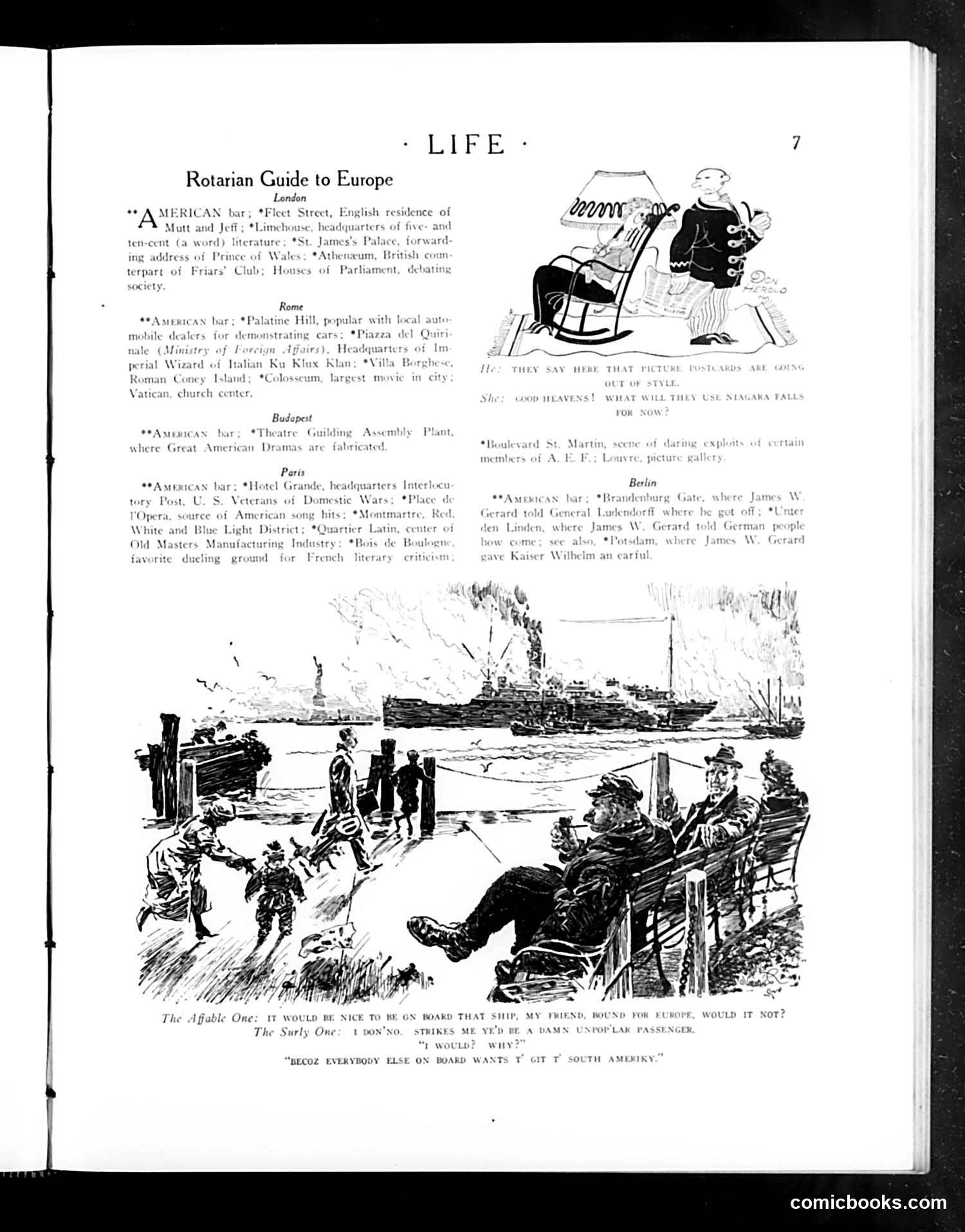
This page contains a "Rotarian Guide to Europe"—a satirical travel guide listing American bars in major European cities (London, Rome, Budapest, Berlin). The humor mocks American tourists who travel abroad but seek only American establishments and entertainment, avoiding authentic local culture. The cartoon below depicts two travelers at a European dock. The "Affable One" suggests boarding a ship to Europe, while the "Surly One" rejects the idea, sarcastically noting that everyone wants "t' git t' South America" instead. The final caption reveals the joke: tourists flee Europe because they can't find American-style passage (likely referring to liquor availability during Prohibition). The satire targets American provincialism and the absurdity of traveling internationally while seeking only familiar American comforts.
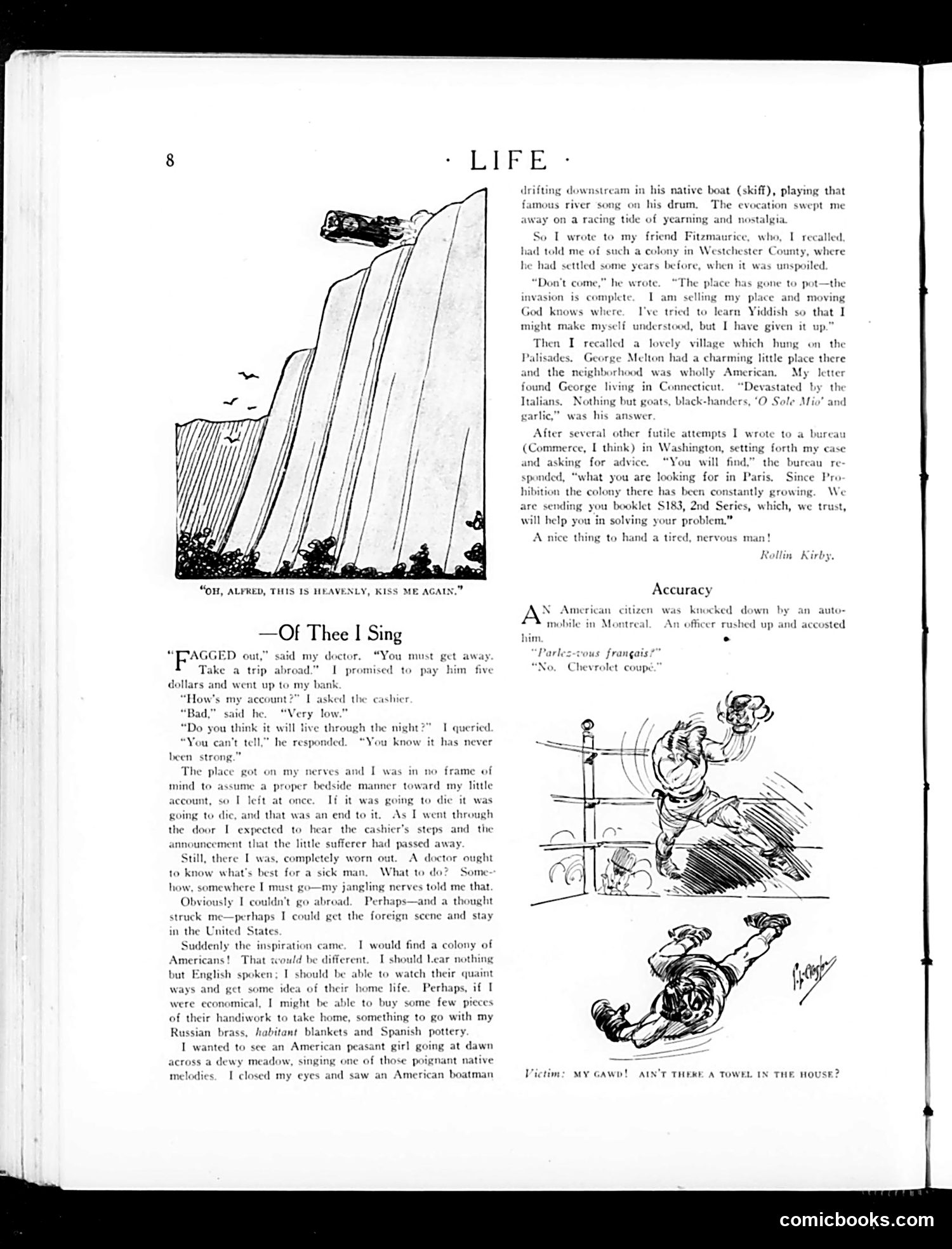
This page contains two distinct pieces. The upper section features an illustration titled "Oh, Alfred, This Is Heavenly, Kiss Me Again"—showing a couple in a small boat on water—accompanying a narrative essay "Of Thee I Sing" by Rollin Kirby about travel abroad and American identity. Below that is a brief satirical item called "Accuracy," depicting an auto accident in Montreal. An American driver in a Chevrolet coupe is confronted by an officer who addresses him in French ("Parlez-vous français?"), to which the American replies "No. Chevrolet coupe"—a joke mocking American automobiles' dominance and Americans' monolingual attitudes abroad. The cartoon's humor targets both American cultural insularity and the era's automobile industry dominance.
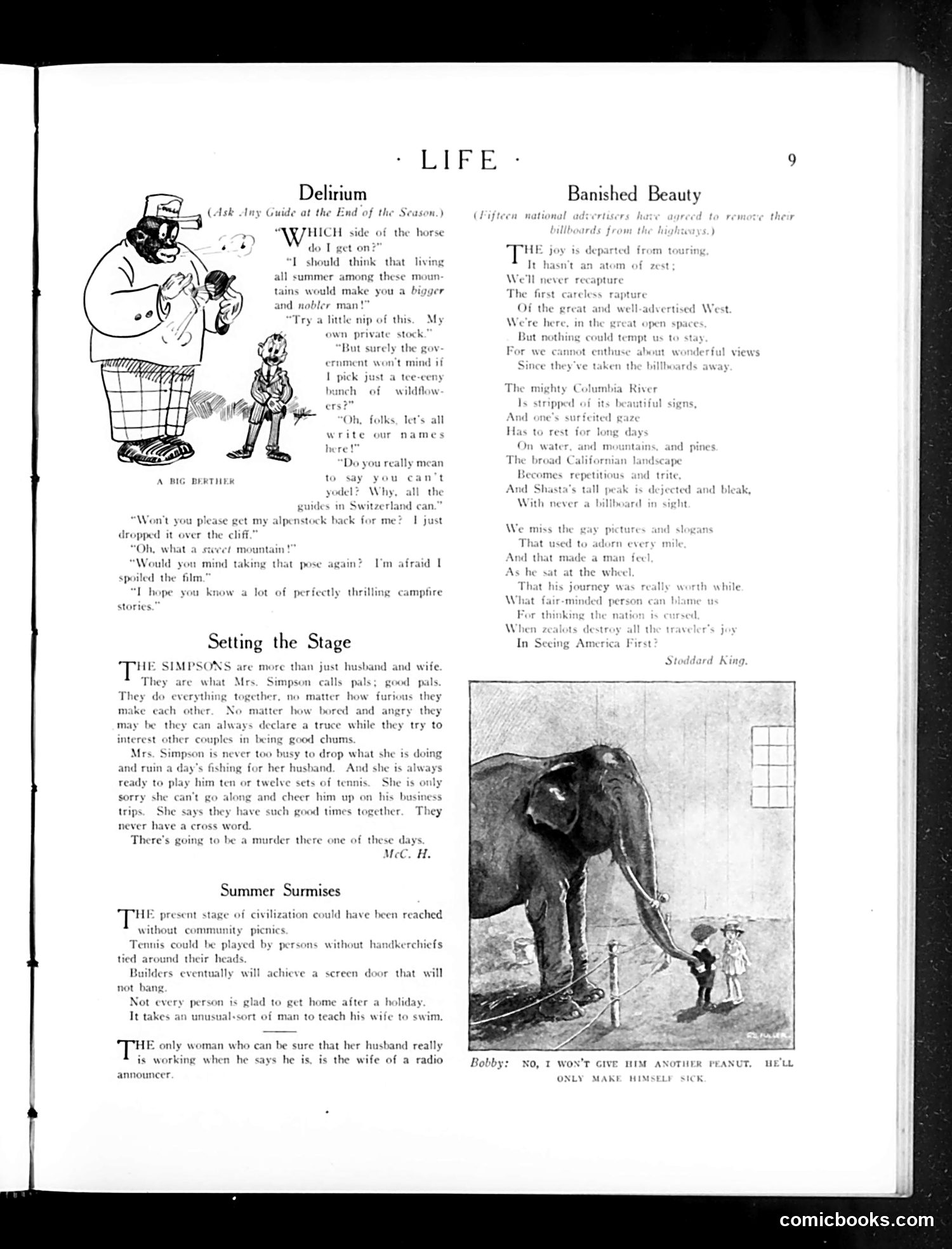
This cartoon depicts a large man (labeled "A Big Brother") holding a small child, discussing investment advice. The man promotes a "tee-eeny bunch of wildflowers" as a superior investment to government stocks, claiming it would make one a "bigger and nobler man." The satire targets **get-rich-quick schemes and dubious investment advice** popular during this era. The absurdity of comparing wildflowers to legitimate securities mocks both the naive optimism of small investors and the charlatan advisors who exploit them. The "big brother" figure represents a smooth-talking promoter using paternalistic language to convince the gullible child-like investor to abandon safe, conventional investments for speculative ventures—a common target of *Life* magazine's social criticism.
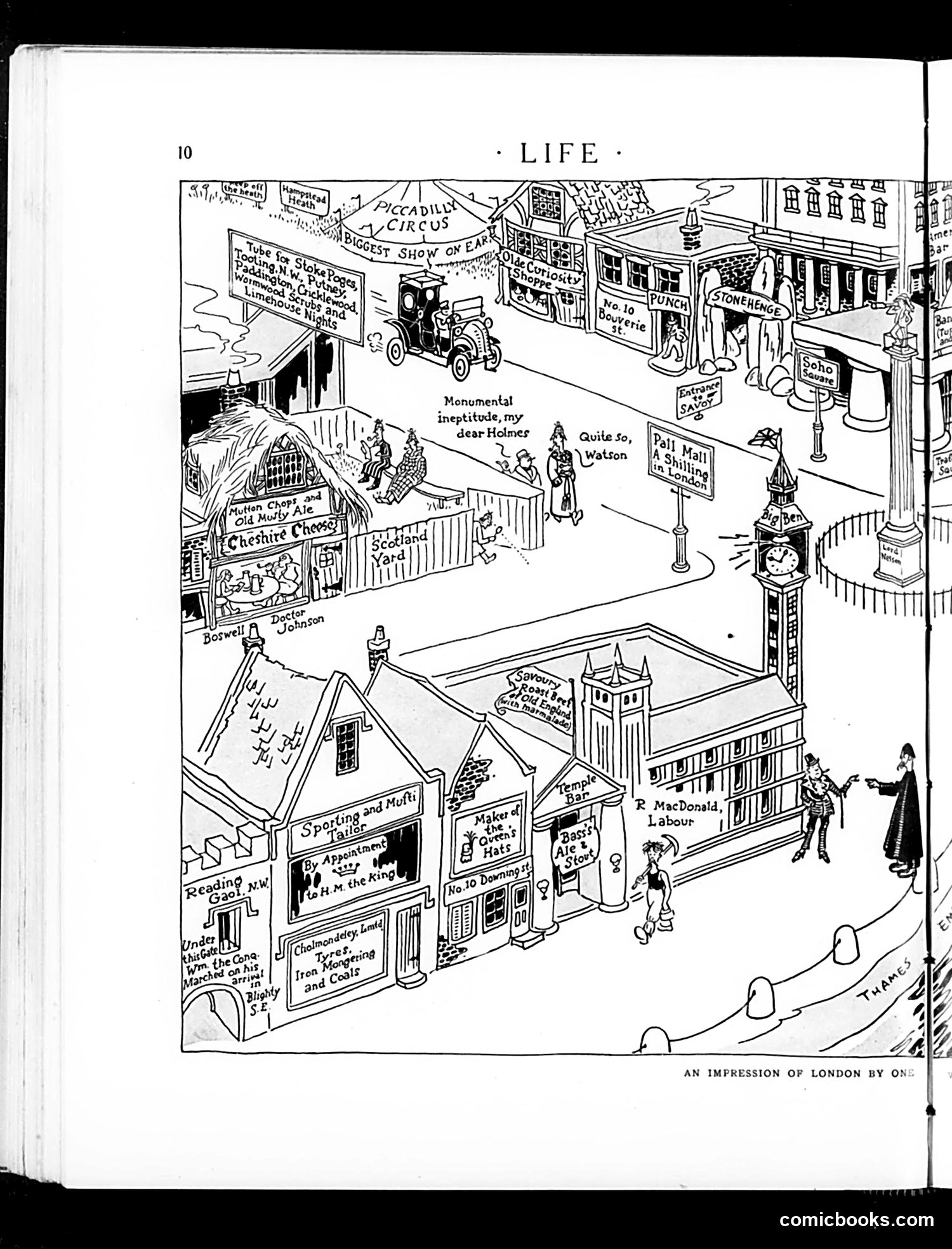
This is a satirical map of London landmarks and establishments, drawn as a bird's-eye view. The cartoon labels various famous locations with humorous commentary: **Key identifiable elements:** - Piccadilly Circus (upper left) - The Thames and Strand Theatre (lower right) - References to "R. MacDonald" and "Labour" party - Various shop signs and establishments including "Cheshire Cheese" pub, "Pall Mall," and betting/sporting venues **The satire appears to mock:** London's commercial districts, tourist attractions, and political figures (likely R. MacDonald, a Labour politician). The cramped, overlapping labeling suggests satirizing London's density and commercialism. The overall tone treats London as a chaotic marketplace of attractions, institutions, and politics rather than a dignified capital—typical early 20th-century American commentary on British society.
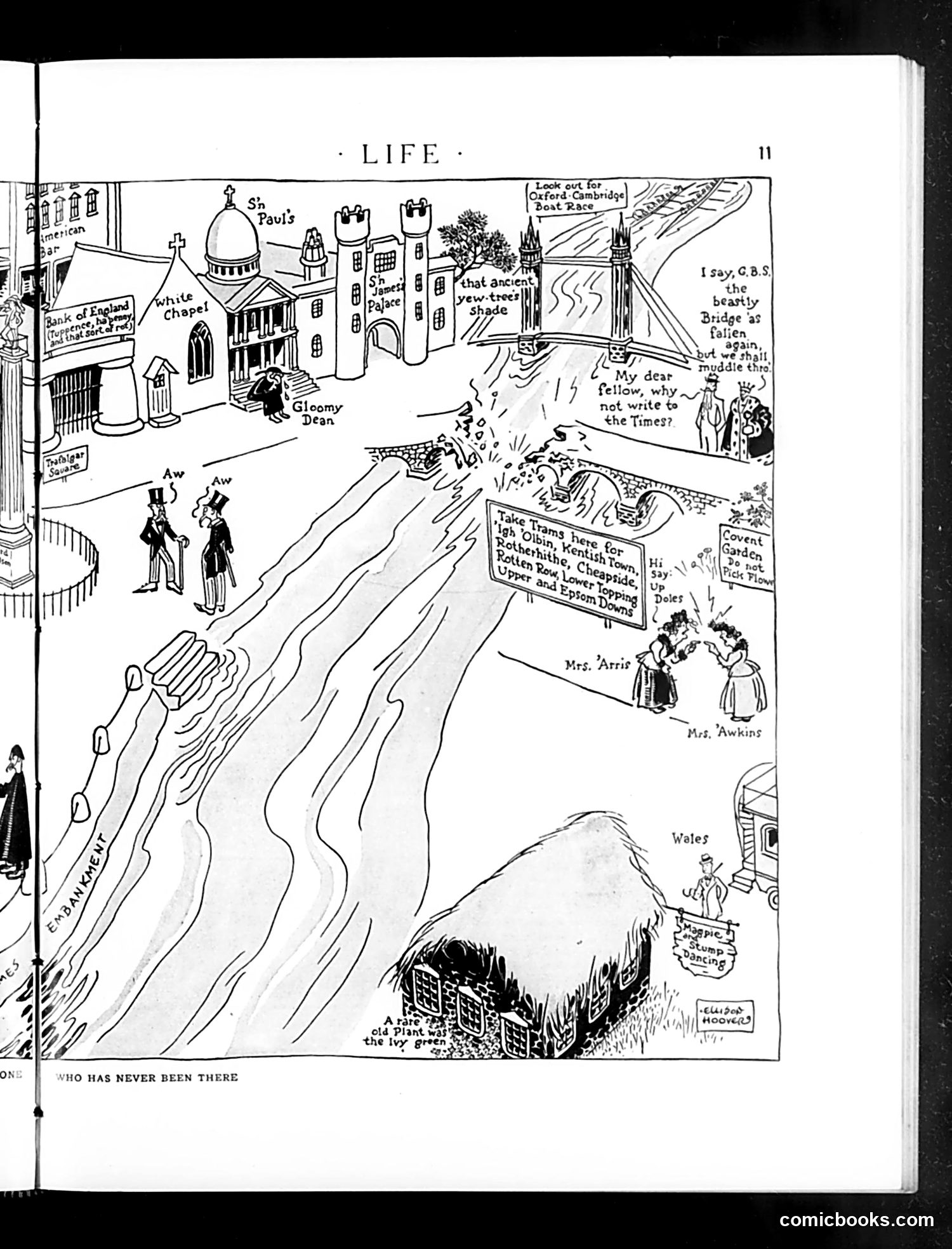
This is a satirical map of London landmarks and tourist sites, likely from the early 20th century. The cartoon humorously labels famous locations: St. Paul's Cathedral, Westminster Abbey, Tower Bridge, and the Thames River feature prominently. Characters labeled "Gloomy Dean," "Mrs. Arris," and "Mrs. Awkins" appear to be typical London figures—the Dean likely representing clergy, while the women seem to be working-class Londoners (suggested by their names and dress). The jokes reference recognizable London institutions: "Bank of England," "Covent Garden," and a tour guide's list offering "High Oxford Street, Kensington, Piccadilly, Leicester Square, Cheapside, Tower Hill, Lower and Epsom Downing." The satire mocks both the commercialization of tourism and stereotypical British characters, presenting London as a collection of clichéd attractions for visitors unfamiliar with the city.
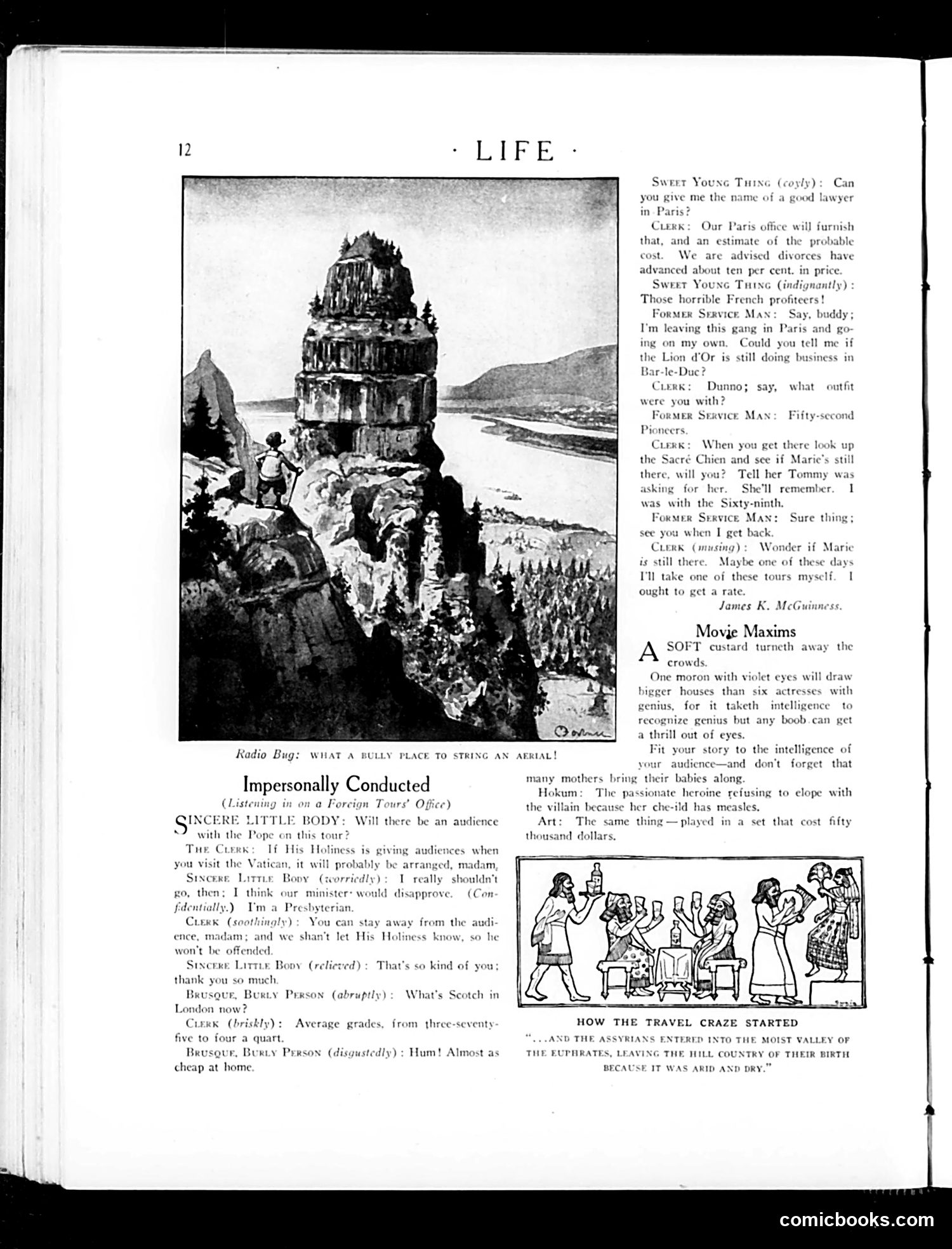
This page contains two separate satirical pieces: **"Impersonally Conducted"** mocks Vatican tours by depicting a clerk mechanically processing tourists visiting the Pope ("His Holiness"). The humor lies in the bureaucratic, transactional tone applied to a supposedly sacred religious experience—tourists are treated like customers at a travel agency rather than pilgrims. **"Movie Maxims"** offers cynical observations about film industry storytelling, noting that soft-focus cinematography and pretty actresses can distract audiences from recognizing shallow narratives as lacking intelligence. The bottom cartoon, "How the Travel Craze Started," satirizes the sudden popularity of European tourism among Americans, suggesting this fad originated somewhat arbitrarily—Assyrians supposedly started it simply because their birthplace was "arid and dry." Together, these pieces critique commercialization of culture and the superficiality of modern tourism and entertainment.
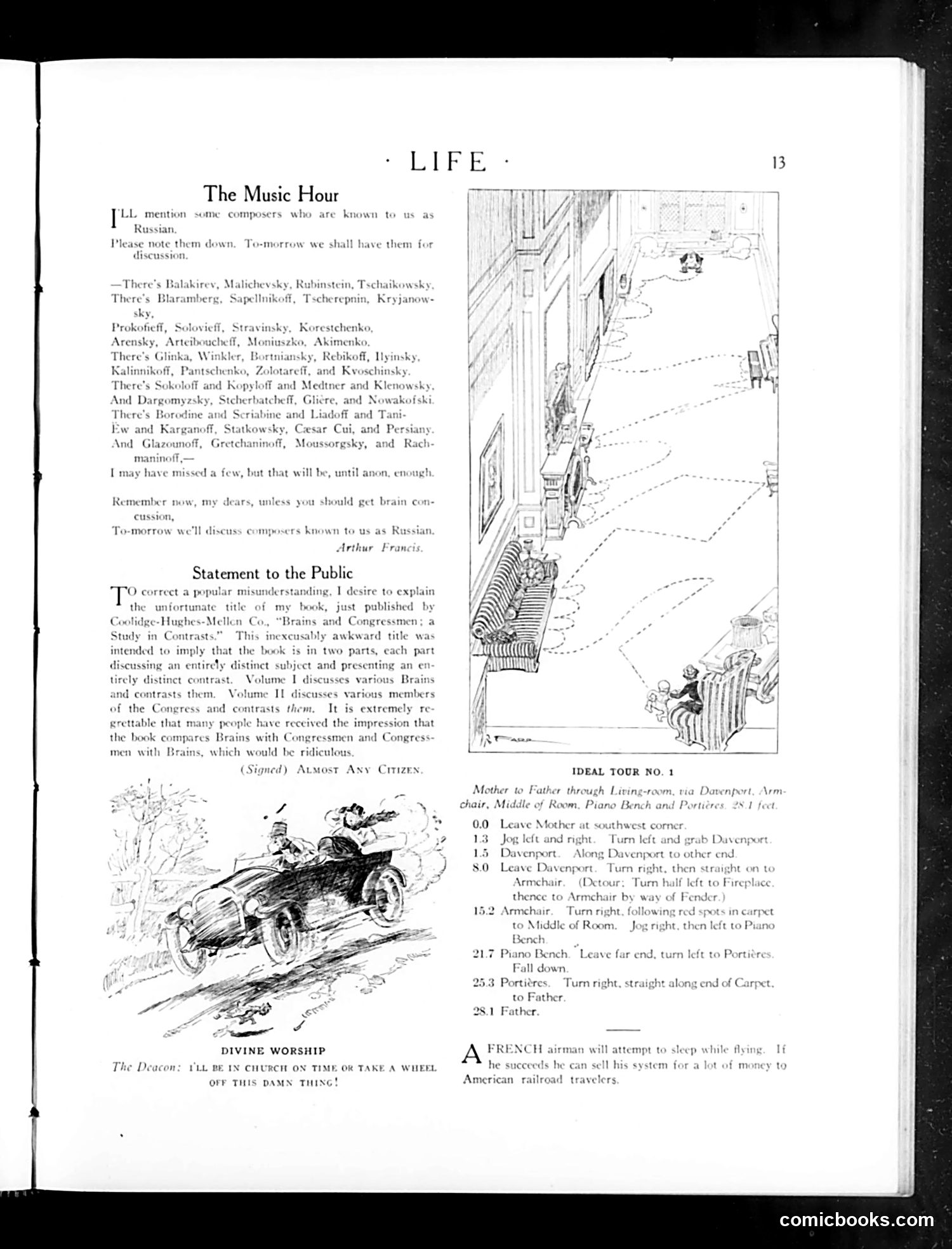
This page contains three distinct items: 1. **"The Music Hour"** — A humorous list of Russian composers (Balakirev, Mussorgsky, Stravinsky, etc.), apparently satirizing the difficulty non-Russian speakers have pronouncing these names. The joke is that reciting them requires "brain confusion." 2. **"Statement to the Public"** — A clarification regarding a book titled "Brains and Congressmen," explaining the volumes aren't comparing congressmen *to* brains, but rather discussing both separately. This is clearly satirical—the disclaimer itself becomes the joke, implying people naturally assumed congressmen lack brains. 3. **"Divine Worship"** — A small cartoon showing a deacon in a speeding car, captioned with a pun about being "in church on time or take a wheel off this damn thing." It's a joke about reckless driving. All three items use humor to mock intellectual pretension, political incompetence, and modern behavior.
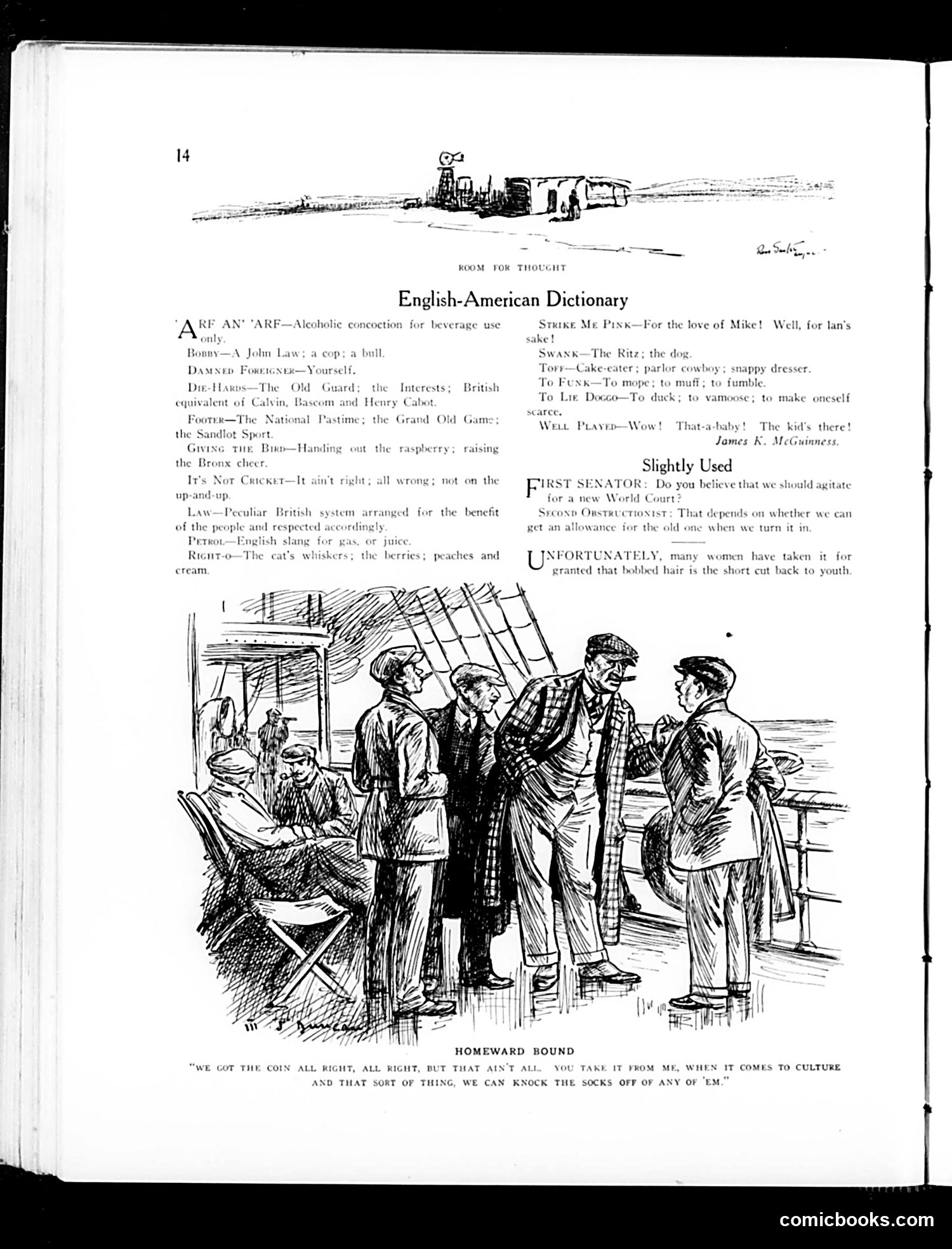
This cartoon depicts working-class men on what appears to be a ship, discussing issues of fair wages and labor practices. The central figure speaks about getting "the coin all right" but argues that money alone doesn't guarantee cultural refinement—suggesting employers can't simply "knock the socks off" workers through wages while ignoring other aspects of their treatment or dignity. The satire targets early 20th-century industrial capitalism: the critique that factory owners believed paying workers adequately discharged all their responsibilities, while ignoring broader social welfare, working conditions, or workers' intellectual development. The "Room for Thought" header emphasizes the cartoon's point about workers' intellectual and social dignity beyond mere wage compensation.
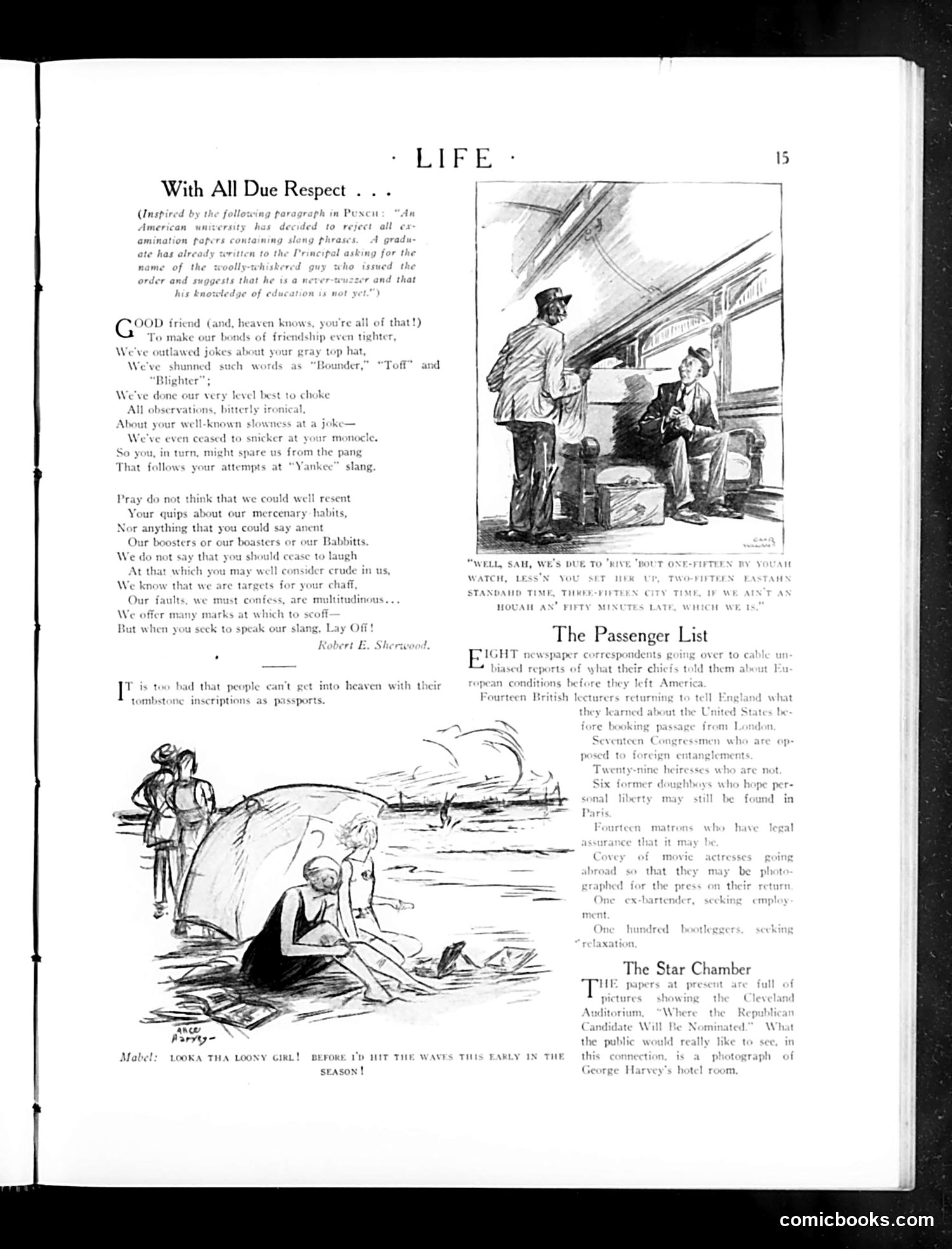
This page contains two separate cartoons and accompanying text pieces. **Top cartoon**: Shows a porter or conductor speaking to a well-dressed passenger about train scheduling, with the caption about giving "bout one-glitter by your watch" and referencing "standard time" versus "city time." This satirizes the confusion of multiple time zones in early 20th-century American rail travel before standardized scheduling. **Bottom cartoon**: Depicts someone at a beach with the caption "Mabel! Look tha loony girl! Before I'd hit the waves this early in the season!" This mocks early-season swimmers and the social judgment around unconventional bathing practices. The page also includes brief news items ("The Passenger List," "The Star Chamber") noting various arrivals and departures of notable figures, typical of Life's gossip-column style content.
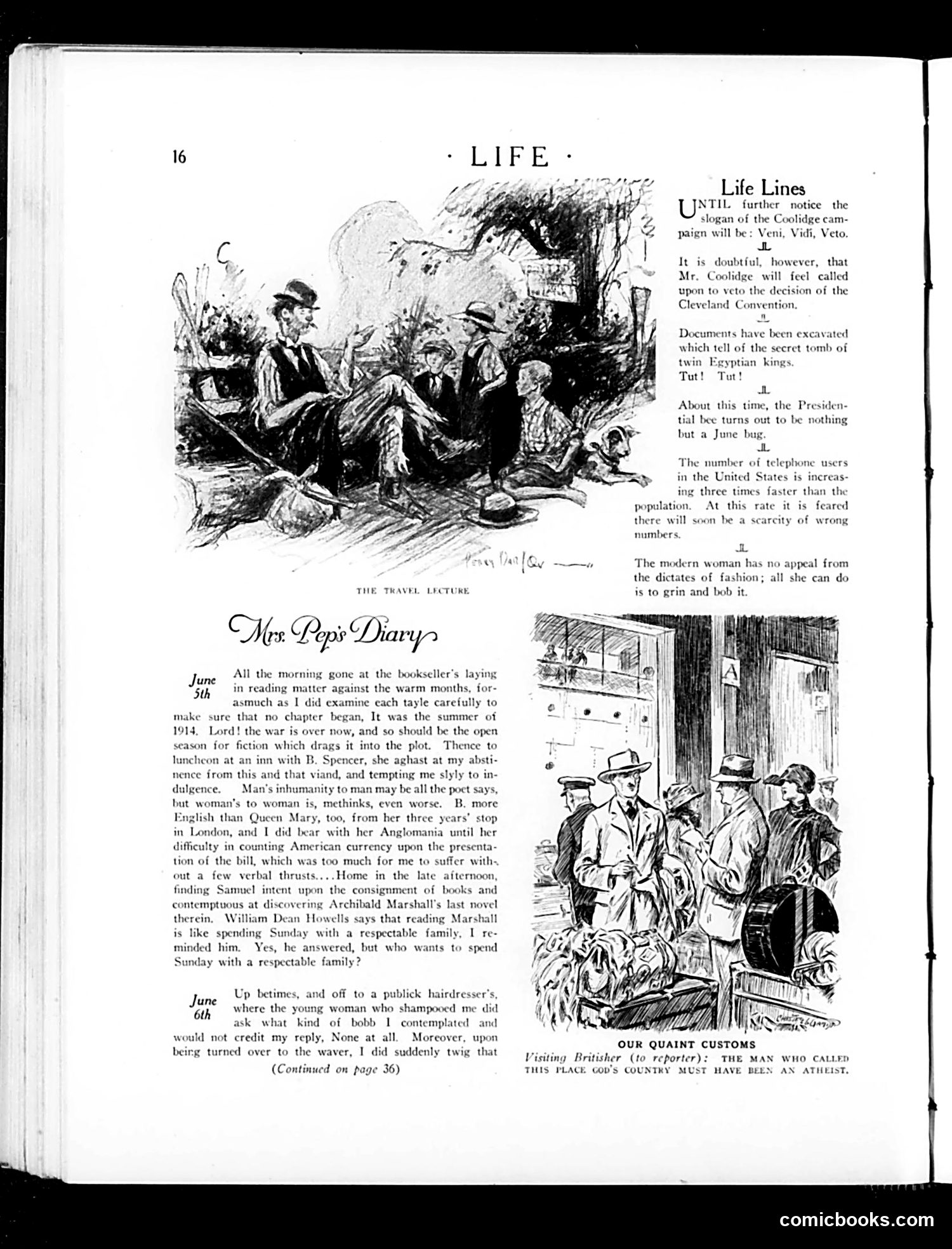
This page from *Life* magazine contains several short satirical commentary pieces mocking 1920s American politics and culture. **"Life Lines"** (top right) includes political jabs: a joke about President Coolidge's campaign slogan "Veni, Vidi, Veto" (Latin: "I came, I saw, I vetoed"), suggesting his passivity; and mockery of the 1924 Cleveland Convention. Other items mock telephone overuse, women's fashion obsession with bobbed hair, and the scarcity of wrong numbers. **"The Travel Lecture"** cartoon (top left) depicts a group gathered around what appears to be a travel speaker or entertainer. **"Mrs. Peps Diary"** (middle) is a prose diary entry satirizing British affectation and class consciousness, featuring a narrator's observations about a pretentious English woman's Anglophilia and inability to count American currency. **"Our Quaint Customs"** (bottom right) shows a cartoon mocking American patriotism—a visiting Brit suggests only an atheist would call America "God's country," satirizing American self-righteousness about national virtue.
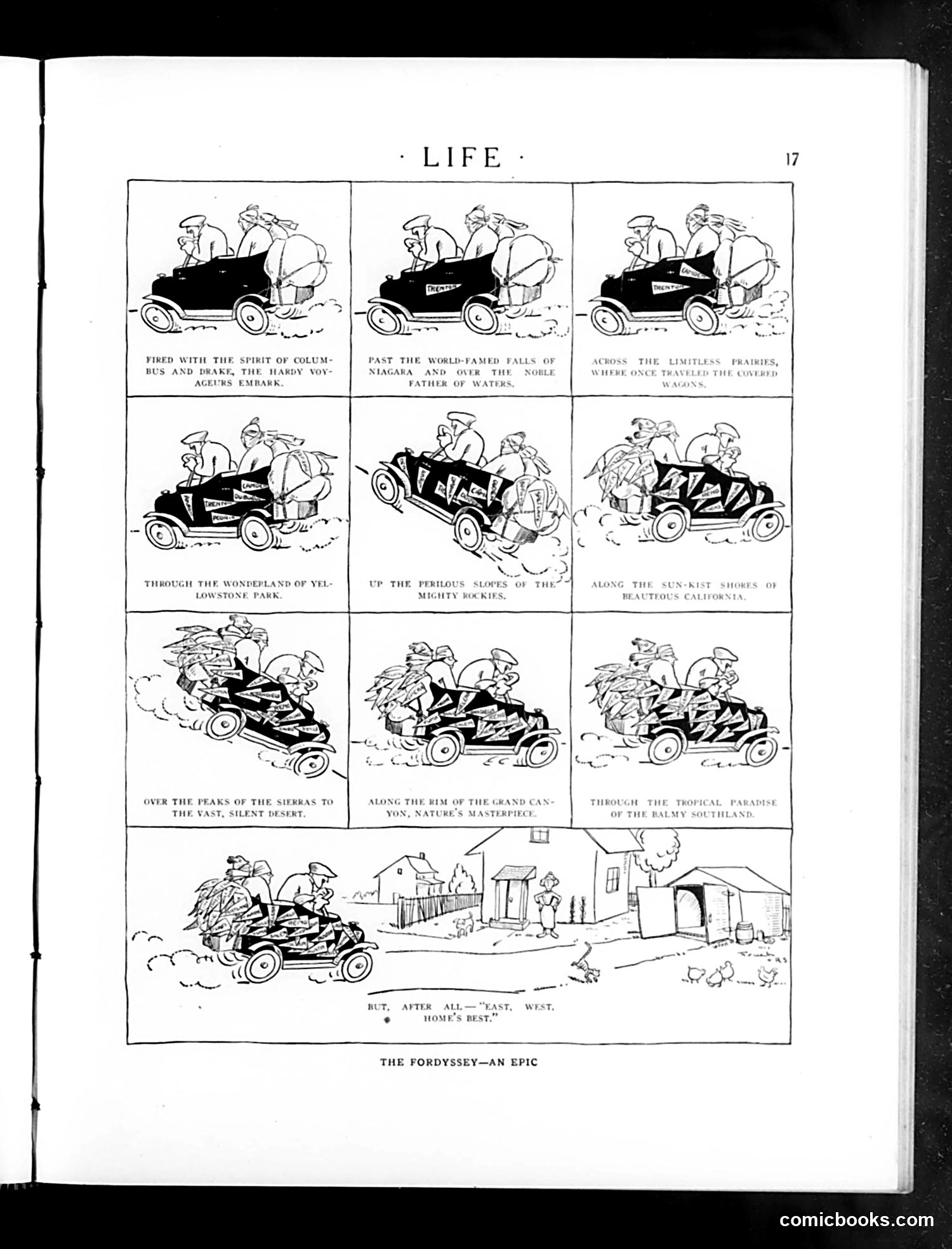
This is a satirical comic strip about a cross-country automobile journey in a Ford Model T. The title parodies Homer's *Odyssey*, treating a humble Ford road trip as mock-heroic adventure. Each panel shows the car traveling through famous American landscapes—Yellowstone, Niagara Falls, the Rocky Mountains, the Grand Canyon, California coast, and the Sierra Nevada mountains—with passengers constantly bouncing around comically. The satire celebrates the Model T's accessibility and the early-20th-century American road-trip phenomenon, while poking fun at both the vehicle's rough ride and the grandiose way people romanticized auto travel. The final panel's "East, West, Home's Best" ending jokes that after such an exhausting journey, returning home is preferable. This reflects contemporary fascination with automobile democratization and American adventure tourism.
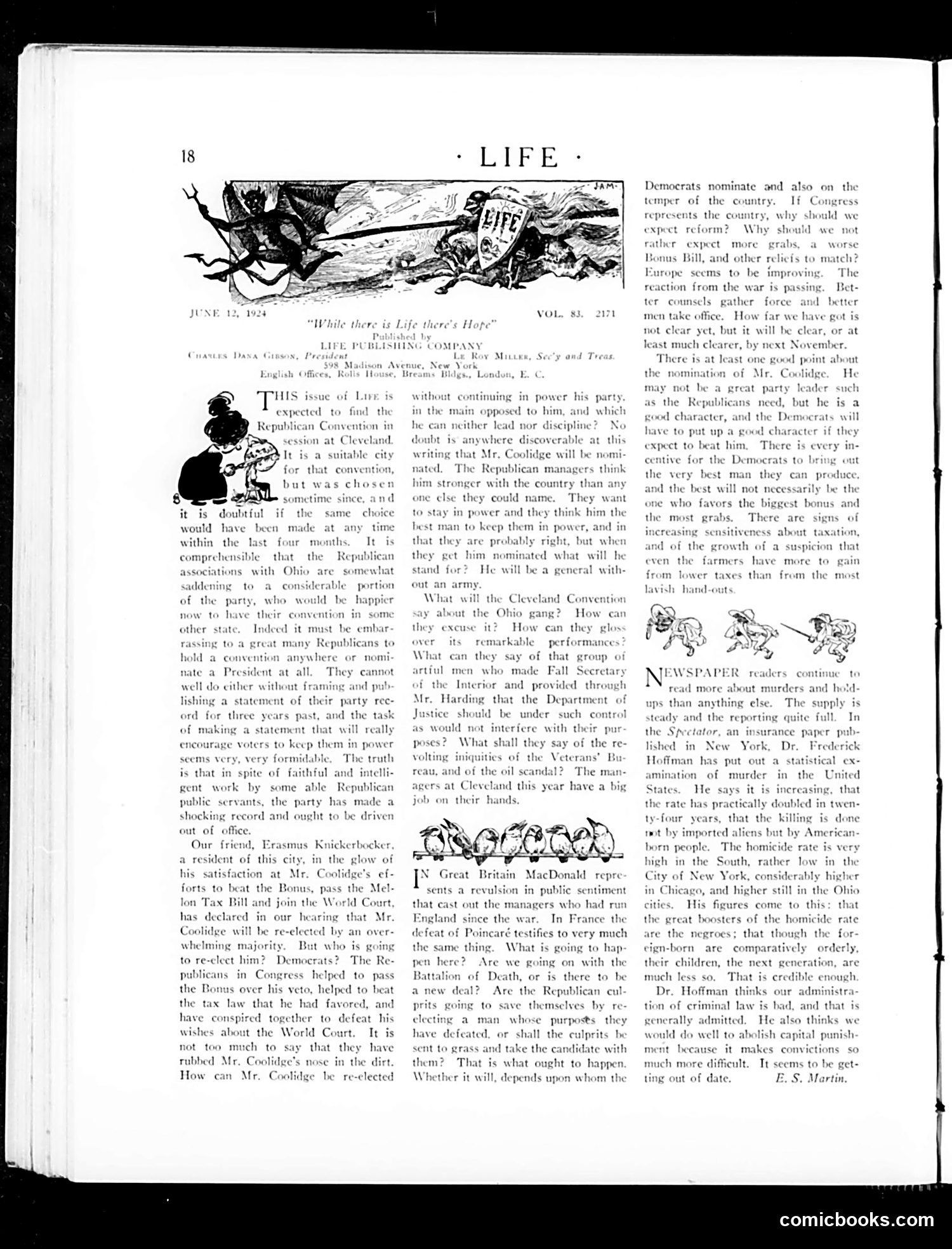
This editorial page discusses the upcoming Republican National Convention in Cleveland. The main political argument concerns whether the GOP should re-nominate President Calvin Coolidge, and whether the party should address recent scandals—specifically referencing the "oil scandal" (the Teapot Dome affair) and Fall's appointment as Secretary of the Interior under Harding. The author argues Republicans face a dilemma: nominating Coolidge keeps the party in power, but he may be too weak to discipline the party or restore public confidence after corruption. The piece questions whether Republicans can credibly run on reform while protecting implicated figures. A secondary article by "Newspaper readers" discusses rising homicide rates in America, attributing increases partly to immigration and questioning whether capital punishment effectively deters crime. The cartoons (now illegible in detail) appear to illustrate these political tensions, though specific figures cannot be identified from this reproduction.
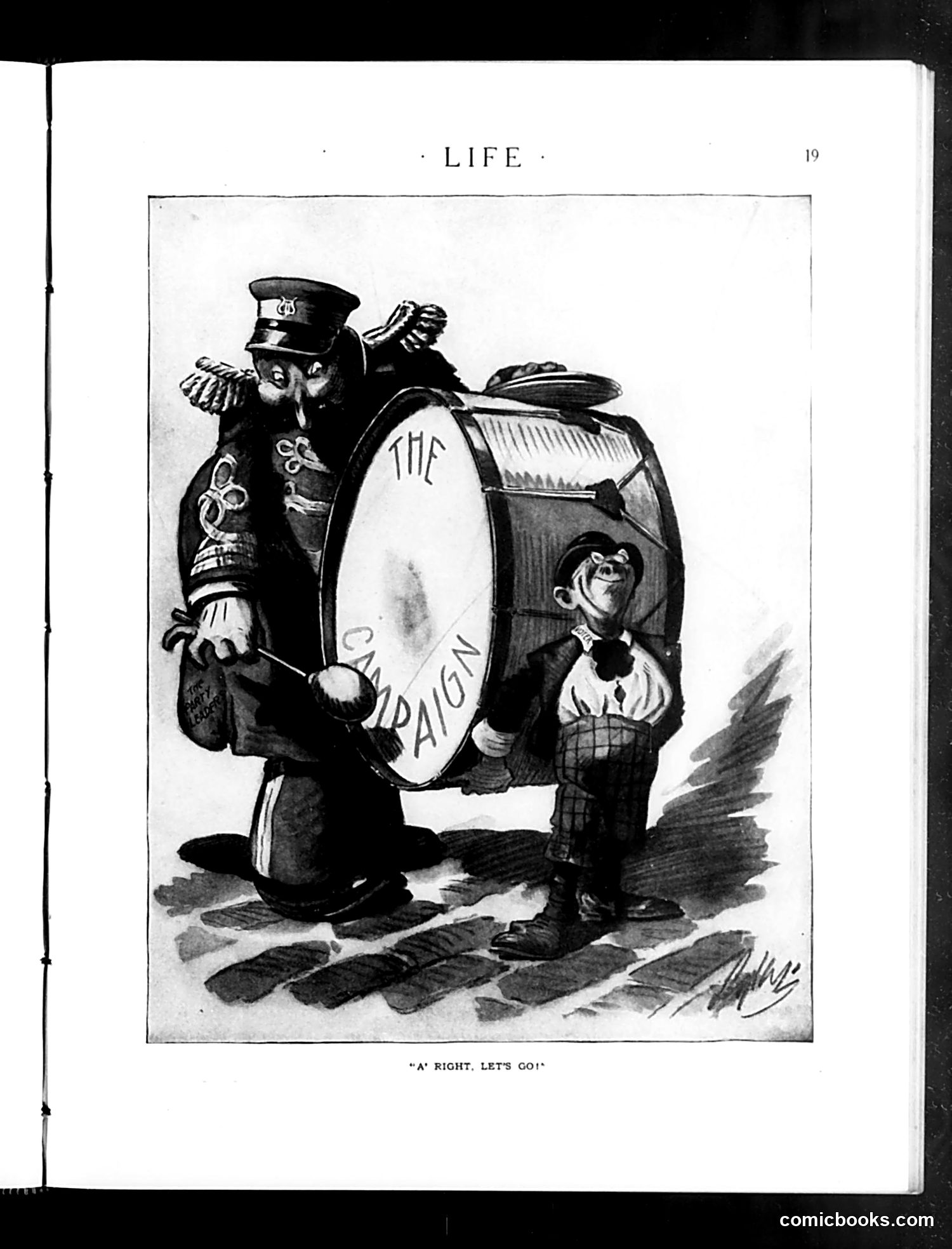
This political cartoon depicts an anthropomorphic military officer (appearing to be a high-ranking general based on uniform details and epaulettes) drumming what appears to be a large bass drum labeled "THE UNION" while a smaller monkey-like figure stands beside him. The caption reads "A! Right, Let's Go!" The satire likely critiques military leadership or governmental authority figures using the drum as a metaphor for propaganda or rousing public support. The subordinate figure may represent the general populace being led into action. Without knowing the specific publication date, the exact historical context remains unclear, though this appears to be commentary on militarism, leadership manipulation, or wartime mobilization from early-to-mid 20th century America.
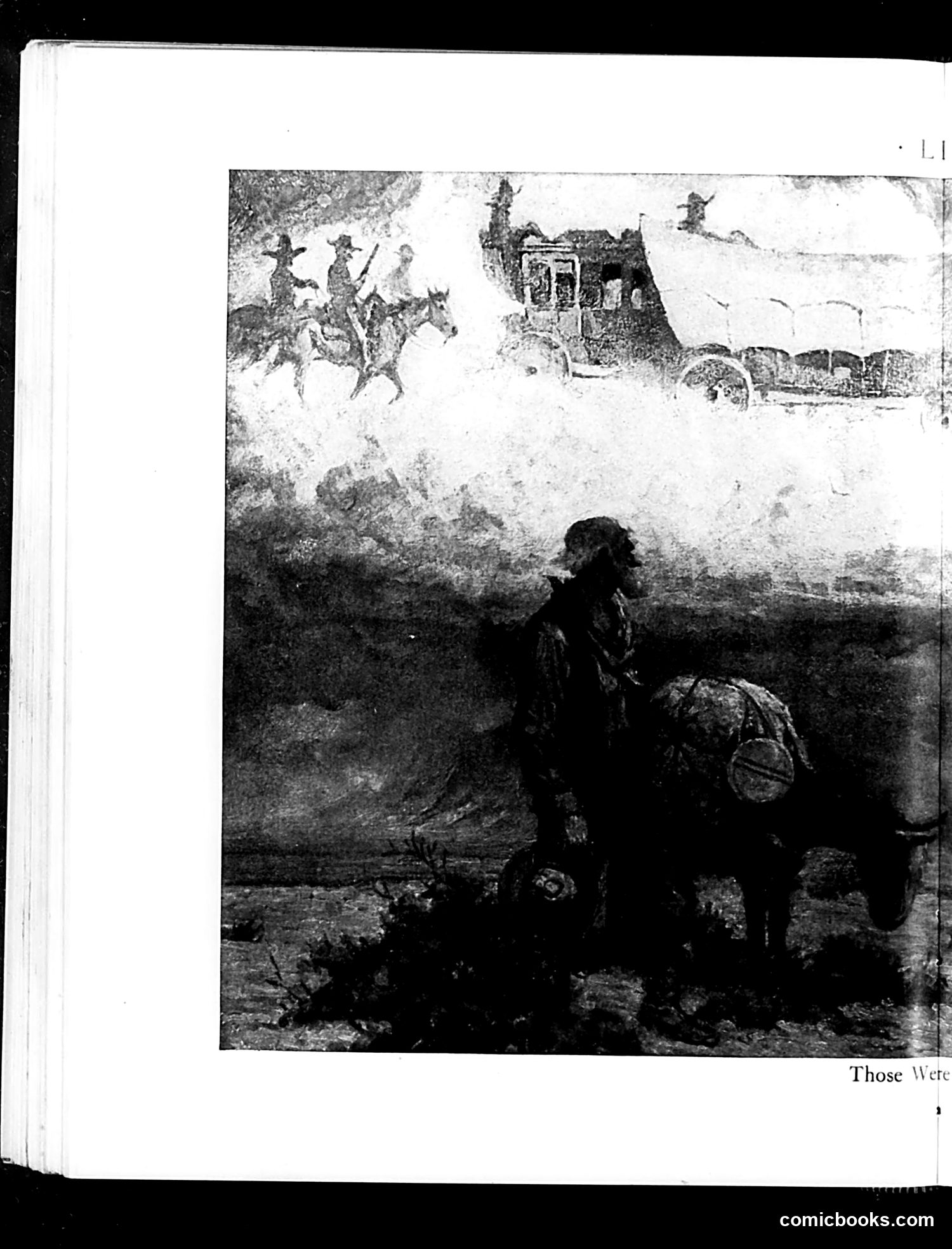
This appears to be a page from *Life* magazine featuring a dramatic illustration depicting a figure in silhouette in the foreground observing a desert or battlefield scene. In the background, there are mounted soldiers on horseback and what appears to be military equipment or a fortified structure. The partially visible caption reads "Those Were," suggesting this is likely commentary on historical military events or warfare. Without the complete text, the specific political or social satire is unclear. The stark contrast between the dark foreground figure and the lighter background scene suggests this may be reflecting on past conflicts or military history, but the exact target of satire cannot be determined from the visible portions alone.
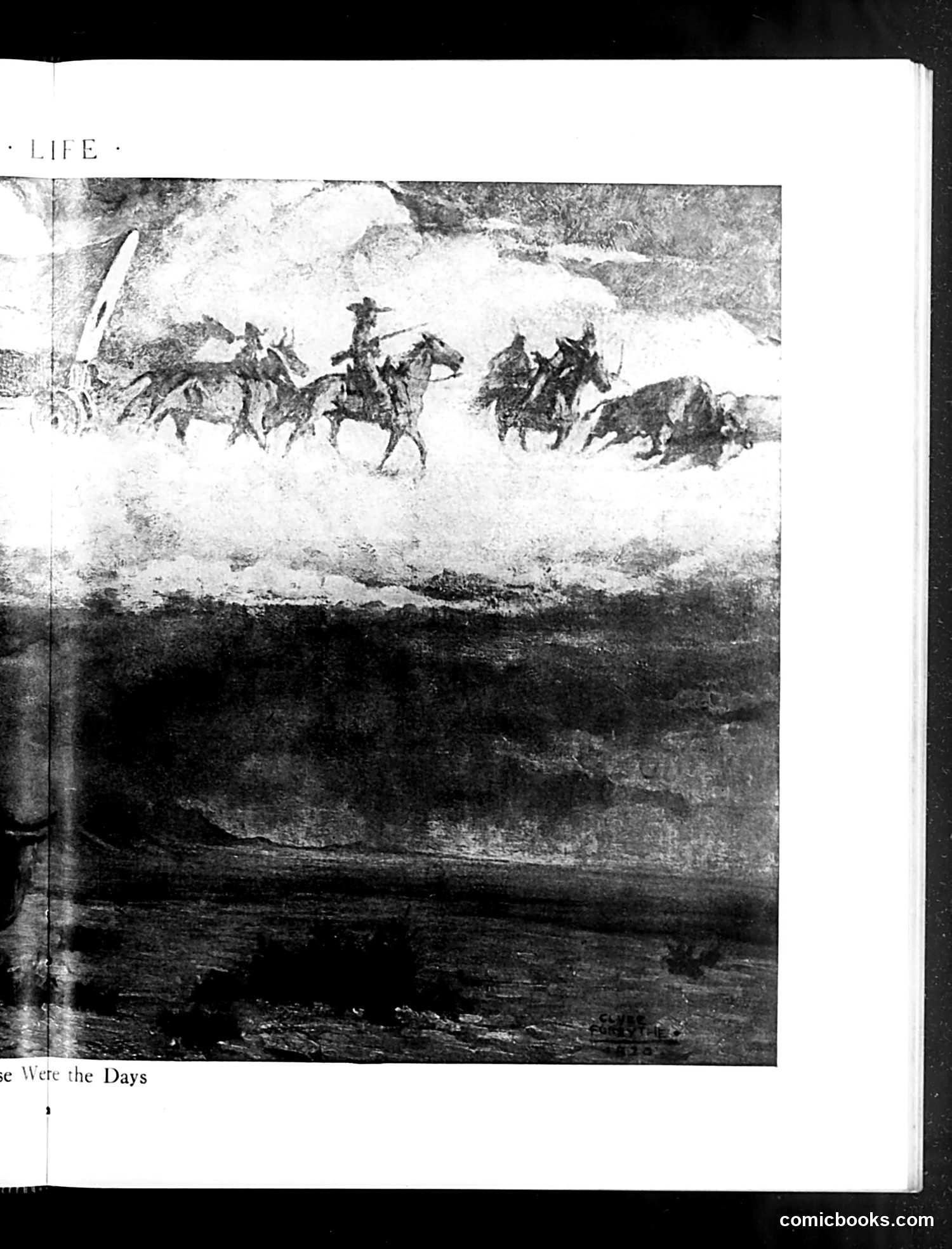
This page from *Life* magazine shows a dramatic illustration titled "se Were the Days" (likely "Those Were the Days"). The image depicts mounted figures on horseback moving through snowy terrain, appearing to be from a historical or frontier scene. Without additional context or visible captions identifying the specific figures, I cannot definitively state who is being caricatured or what political/social event is referenced. The romanticized depiction of horsemen in a winter landscape suggests nostalgia for an earlier historical period—possibly the American frontier or Civil War era. The satirical point appears to involve contrasting past romantic ideals with present circumstances, but the specific target of the satire remains unclear without seeing complete accompanying text or captions.
This page analyzes three Broadway revues from the 1920s era. The author reviews "Round the Town," "Keep Kool," and an unnamed Winter Garden production, explaining what makes revues succeed or fail. **"Round the Town"** is criticized as an intellectual failure despite featuring respected performers (Julius Tannen, Harry Fox) and smart writing. It "lacked authority"—the gap between clever ideas and actual entertainment was too wide. **"Keep Kool"** succeeds where "Round the Town" failed by balancing sophistication with accessible entertainment. Though spelled unconventionally ("kool"), it delivers on audience expectations with fast pacing, good satire, and memorable performers like Hazel Dawn and Johnny Dooley. **The Winter Garden show** receives harsh dismissal as wasteful spectacle—expensive but intellectually empty, money literally wasted on gilt ceilings rather than substance. The satire targets the tension between artistic ambition and commercial entertainment in 1920s Broadway theater.
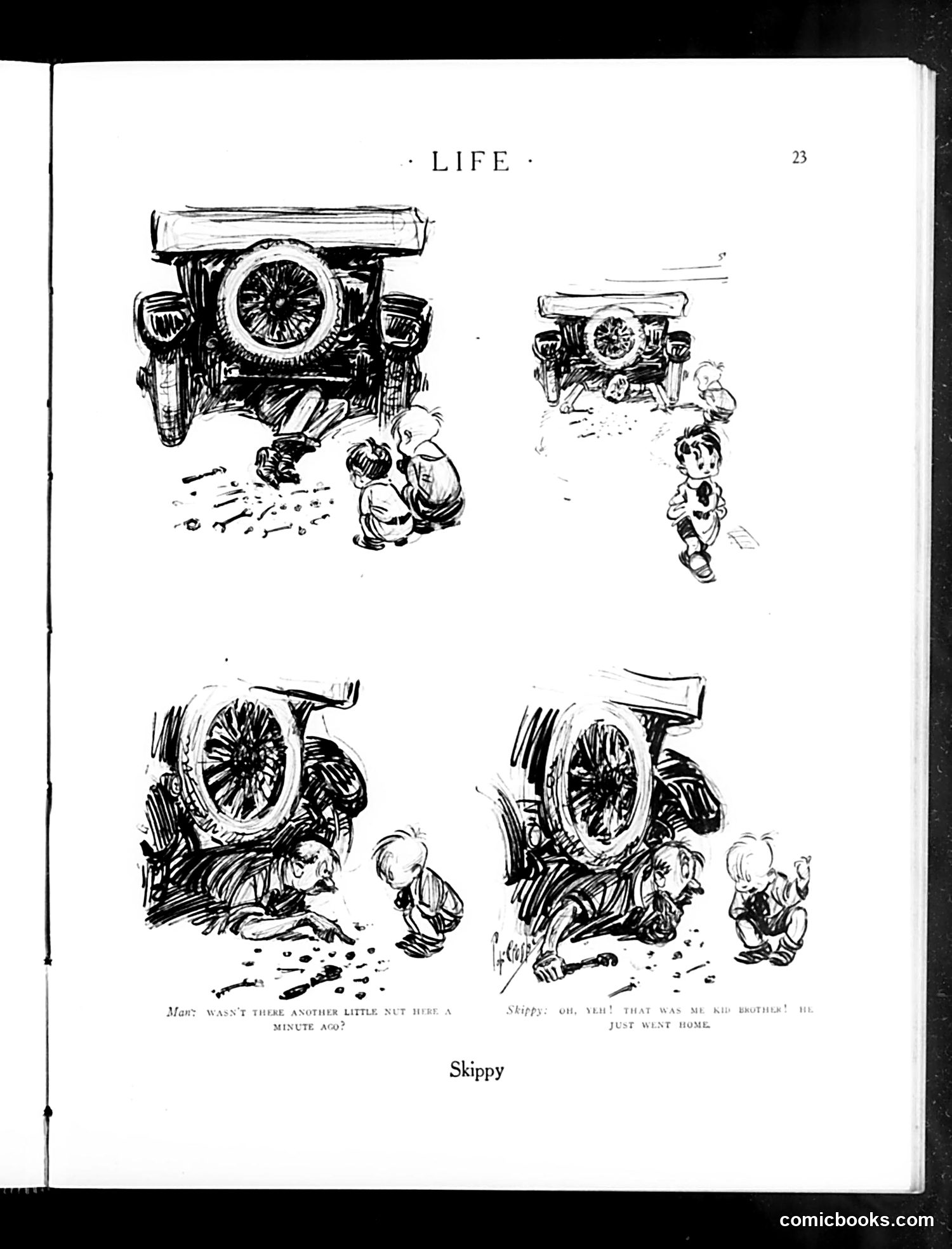
This page features a four-panel comic strip titled "Skippy" depicting children playing with an automobile. The narrative shows two children discovering a "little nut" (likely a bolt or mechanical part) that fell from a car "a minute ago," then one child (identified as "Skippy") returning home after the other child's older brother ("me kid brother") went home. The humor relies on visual slapstick rather than political satire—children removing parts from or playing dangerously around automobiles was a common source of comedy in early 20th-century humor magazines. The strip satirizes childhood mischief and the nascent car culture of the era, where vehicles were still novel enough that children's interactions with them could be treated as humorous material.
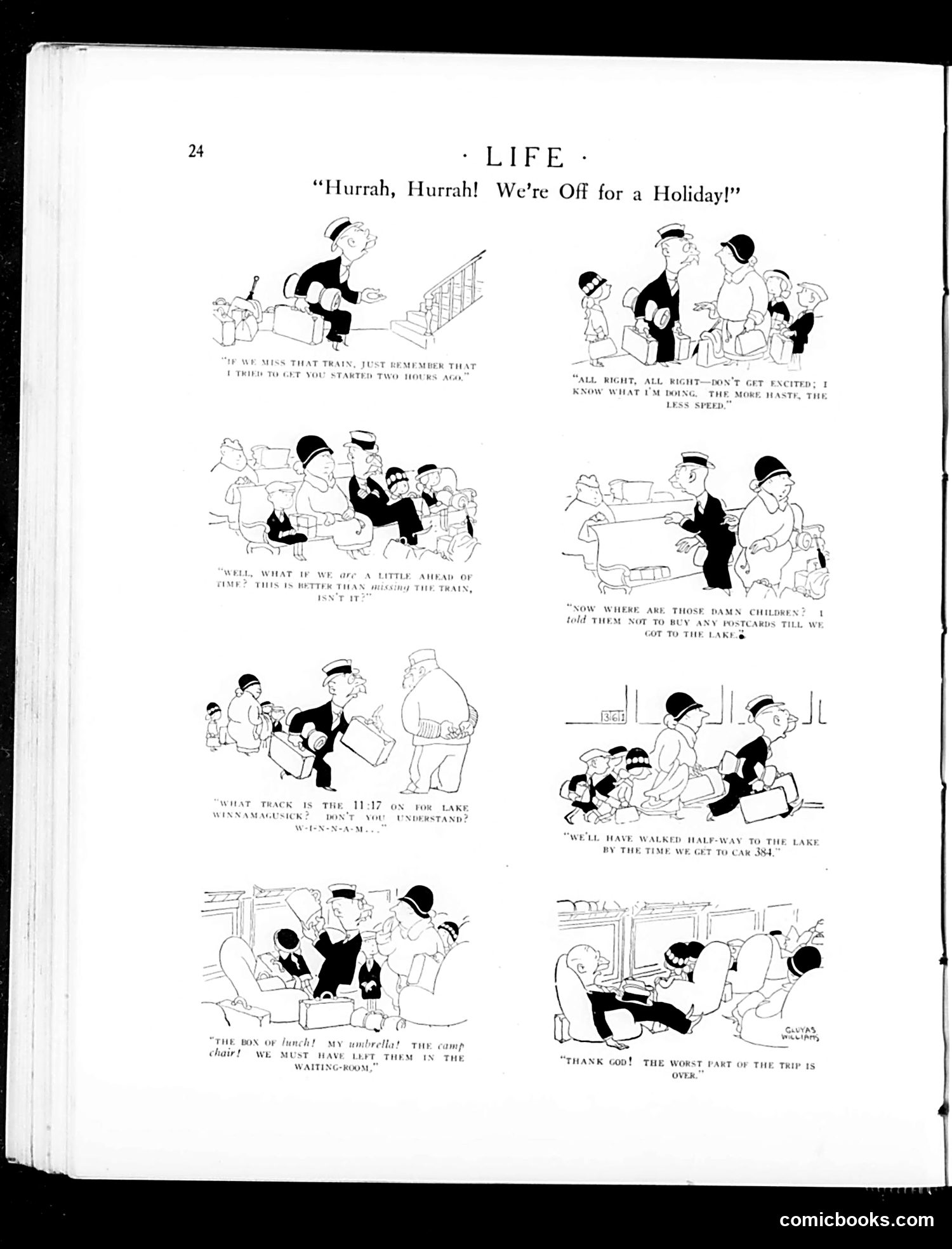
This multi-panel comic depicts the chaotic reality of a family vacation departure versus its cheerful promise. The satirical point: holiday trips are exhausting nightmares disguised as fun. The panels show escalating complications—a father frantically chasing children, confusion about train schedules and platform numbers, forgotten luggage left in the station waiting room, children buying postcards against orders, and excessive walking. Each character complains or panics while claiming things are under control ("Don't get excited; I know what I'm doing"). The final panel's relief—"Thank God! The worst part of the trip is over"—arrives only when they're finally aboard, emphasizing that the *journey itself*, not the destination, is the ordeal. The cartoon mocks middle-class family travel culture, capturing the gap between vacation advertising's promise and domestic reality: harried parents, disobedient children, and logistical chaos.
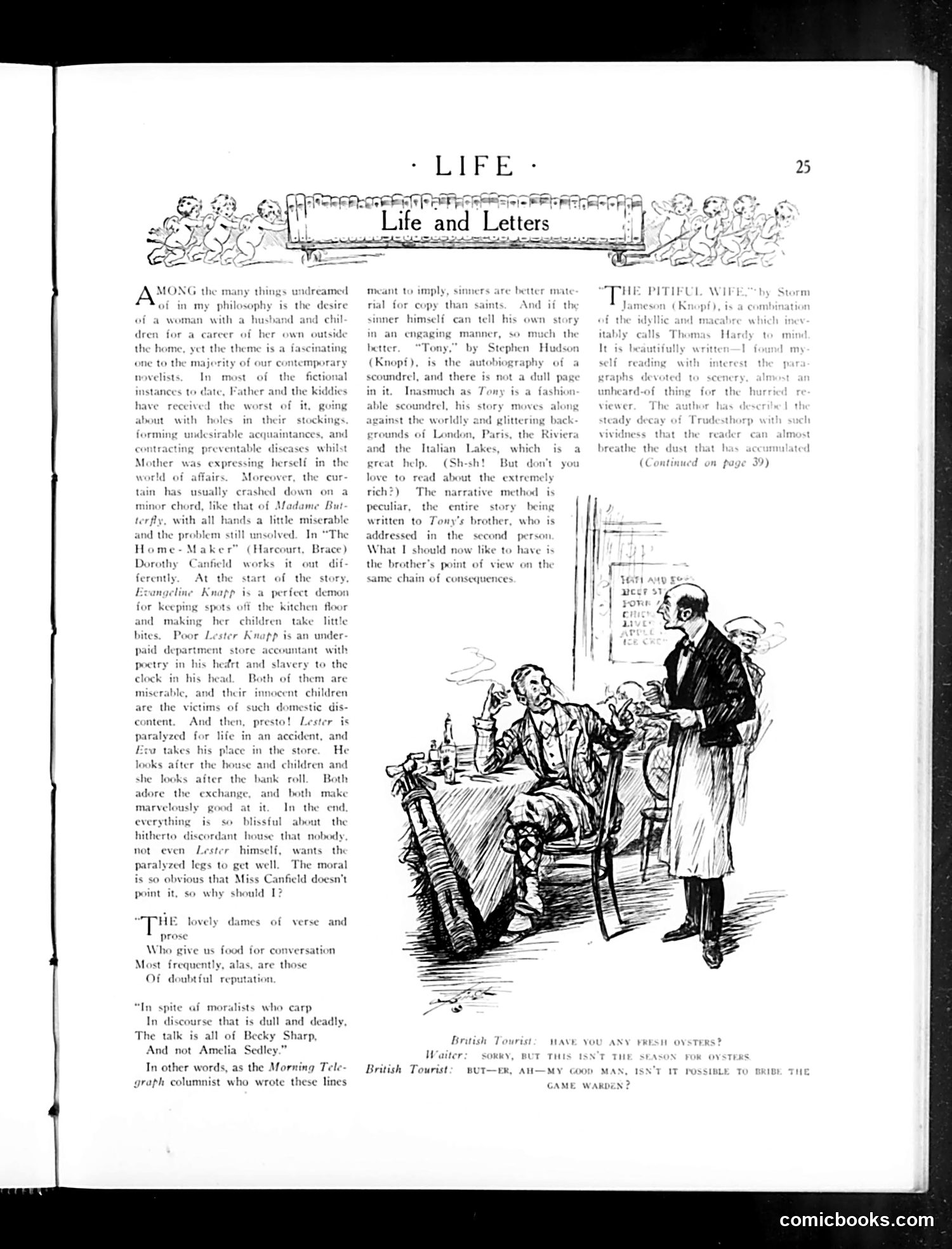
This page from *Life* magazine features a literary review column alongside a cartoon joke. The main cartoon depicts a British tourist asking a waiter about "fresh oysters," apparently unaware of seasonal restrictions. The waiter explains it's not oyster season and suggests bribing "the game warden" instead—a satirical jab at British attitudes toward rules and aristocratic privilege. The humor relies on the stereotype of wealthy British tourists expecting to circumvent regulations through money or connections. The literary review discusses contemporary novels, including Stephen Hudson's *Tony* and Dorothy Canfield's *The Home-Maker*, critiquing their moral messaging and narrative choices. A quoted poem mocks the public's fascination with morally questionable literary figures like Becky Sharp (from *Vanity Fair*) over virtuous heroines like Amelia Sedley.
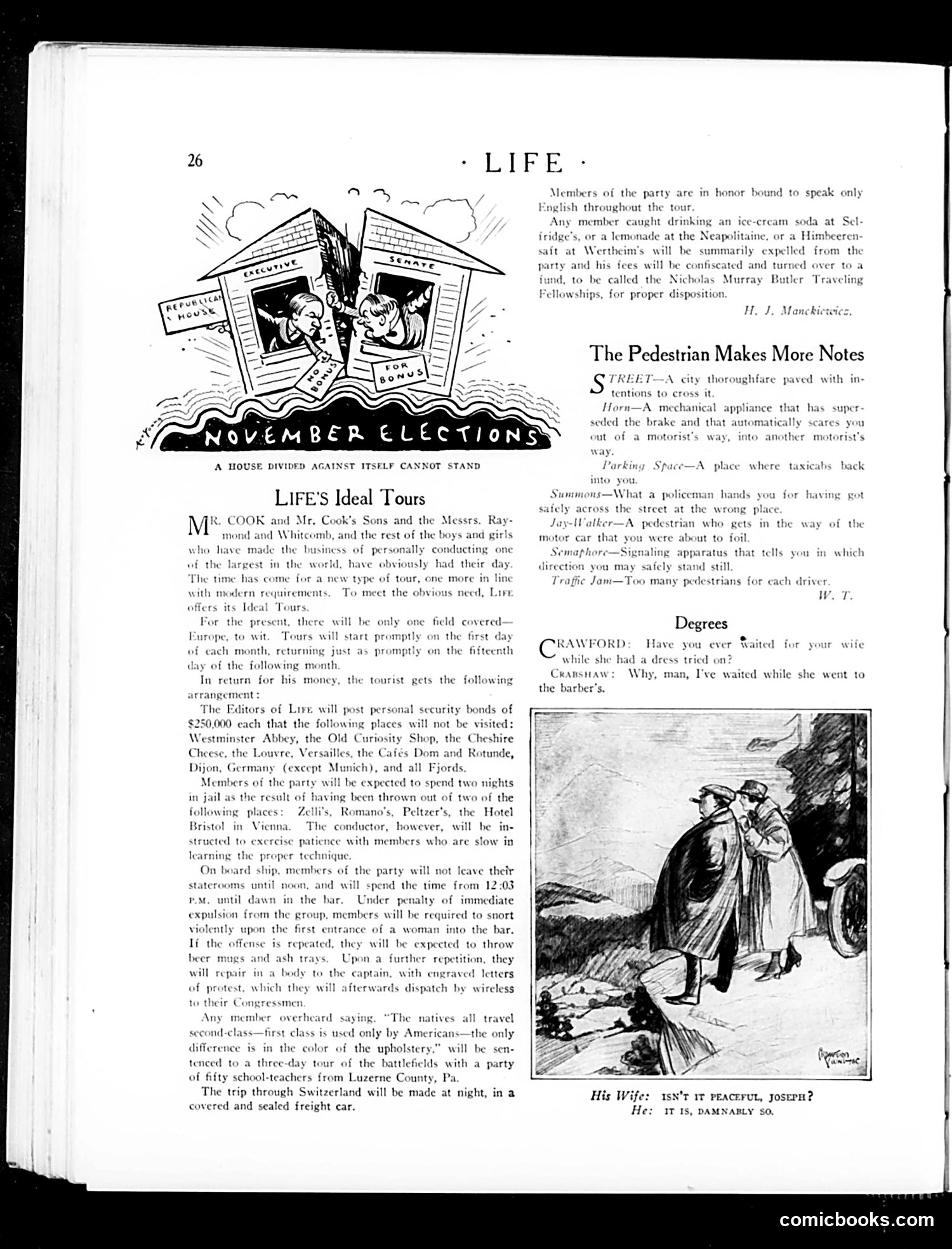
## Main Cartoon: "November Elections" The top illustration depicts a house split down the middle, with "Executive" and "Senate" labeled on opposing sides. This references the political gridlock following the 1918 midterm elections, when Republicans gained control of Congress, creating divided government under President Wilson. The caption "A house divided against itself cannot stand" invokes Lincoln's famous phrase to satirize partisan conflict. ## "LIFE's Ideal Tours" This satirical travel article mocks the pretensions of European tourism and stuffy tour companies. It proposes an absurdist alternative tour featuring intentional exclusions (Westminster Abbey, the Louvre) and mandatory jail time, ridiculing both overcrowded tourist attractions and sanctimonious travelers who affect superiority. ## Lower Cartoon & "Degrees" The small cartoon and "Degrees" dialogue joke about marital patience—husbands waiting for wives at shops. It's gentle domestic humor typical of the era. The entire page combines political satire with social commentary on contemporary American life and leisure.
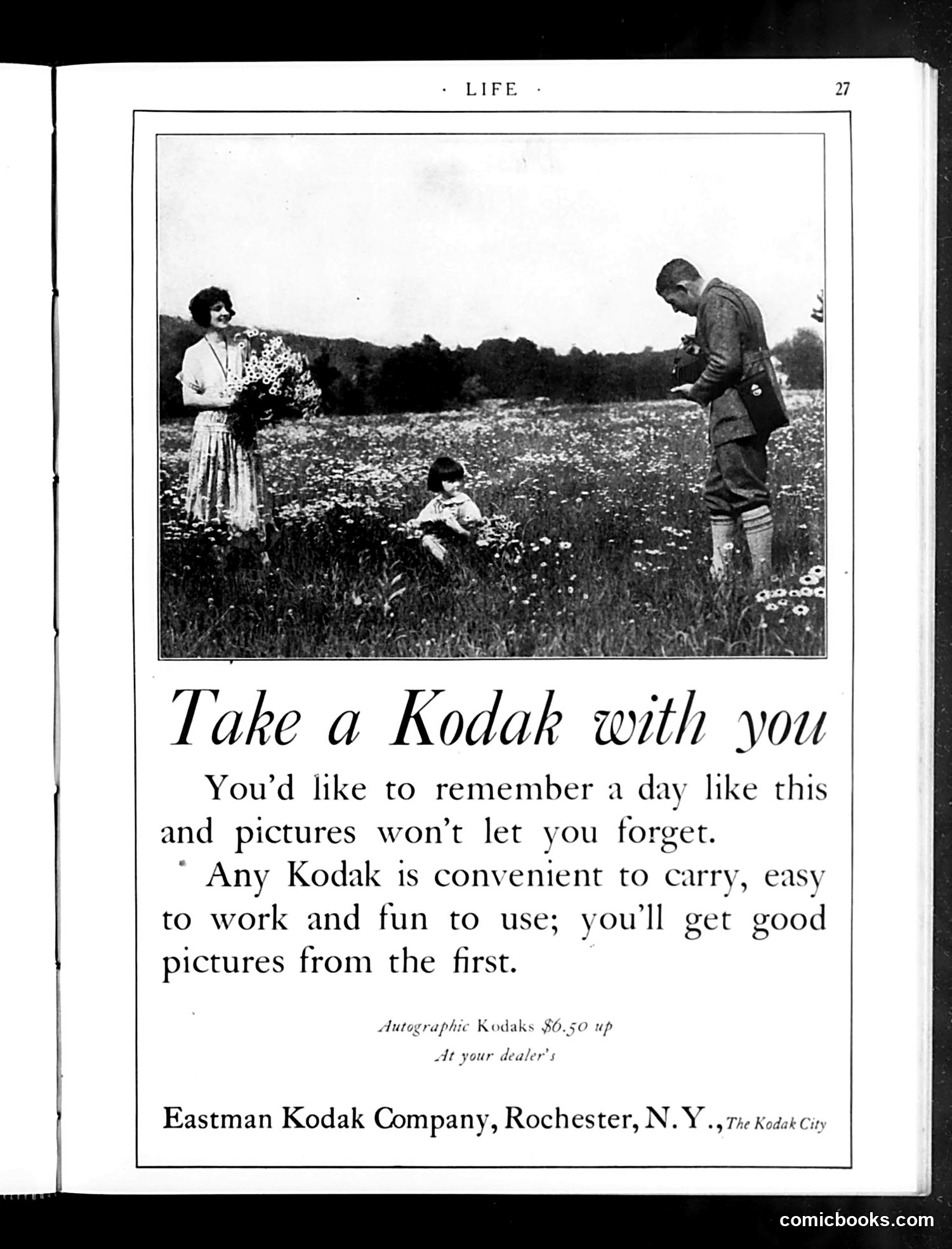
This is a Kodak camera advertisement, not political satire. The page shows a family in a wildflower field—a woman holding flowers, a small child, and a man in a suit looking at his camera. The ad's message is straightforward: take photographs to preserve happy family memories. The text emphasizes that Kodak cameras are portable, easy to use, and produce good results immediately. "Autographic Kodaks $6.50 up" indicates the price point. There is no cartoon, political commentary, or satirical content on this page—it's purely a commercial advertisement positioned in *Life* magazine to promote consumer photography during an era when camera ownership was becoming more accessible to middle-class families.
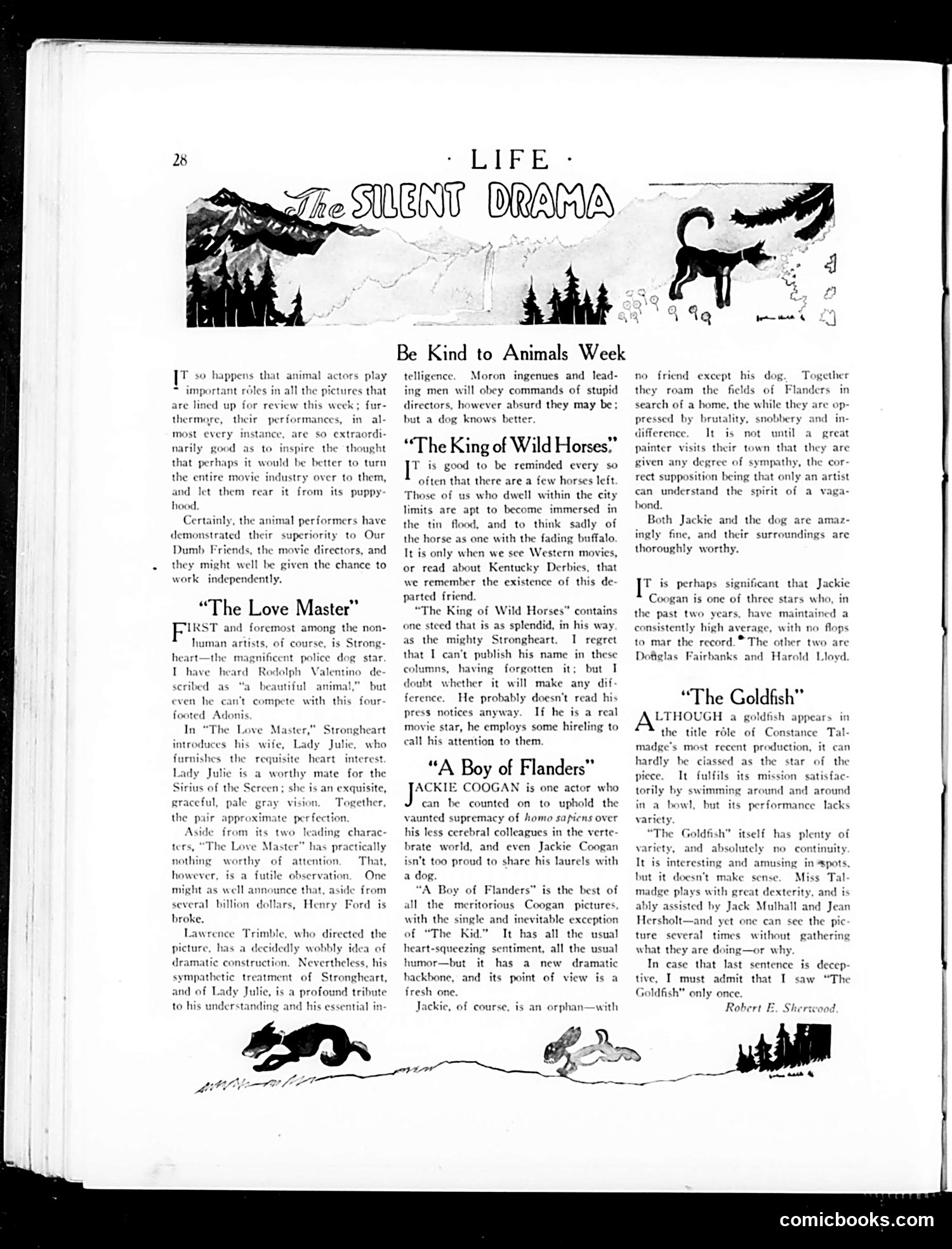
This Life magazine page reviews recent films starring animal actors—particularly the dog Strongheart in "The Love Master" and Jackie Coogan with a dog in "A Boy of Flanders." The satire's central joke: animals are better actors than human performers and directors. The author argues that dogs "know better" than human actors who mindlessly obey stupid directors' commands. He suggests the film industry should be handed over to animal performers entirely. The piece mocks human vanity while genuinely praising animal performances. It's framed as "Be Kind to Animals Week" commentary—playfully suggesting animals deserve respect not just morally but professionally. The implicit critique targets Hollywood's bloated egos: even famous dog star Strongheart (compared to Valentino) is more dignified than the human talent surrounding him. The humor relies on readers' awareness that animals were genuinely major silent-film stars during this era.
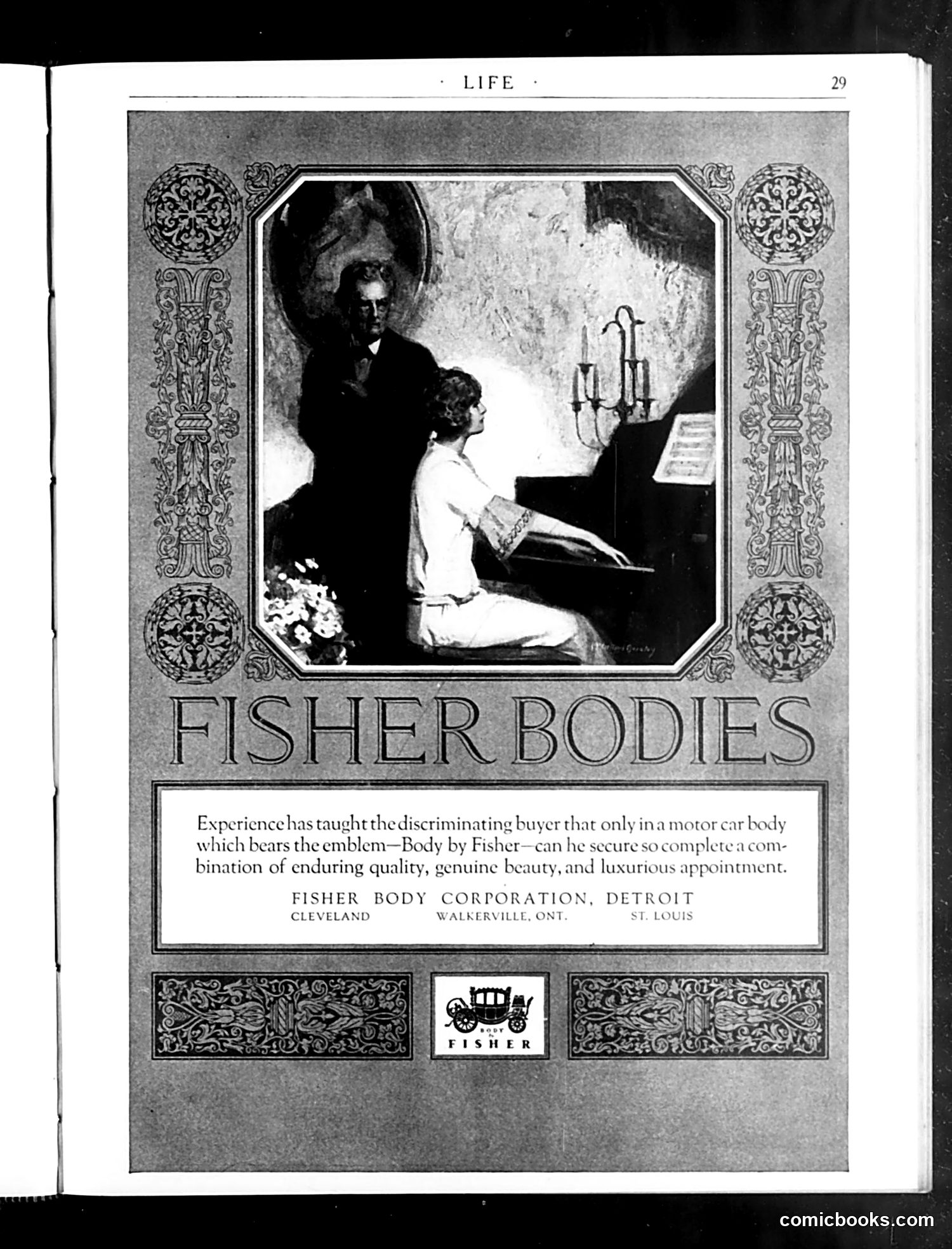
This is primarily a **Fisher Body Corporation advertisement**, not a political cartoon. The page shows a elegant interior scene: a woman seated at a piano while a man stands beside her in what appears to be a luxurious room with a candelabra. The ad emphasizes that only Fisher-branded automobile bodies offer the combination of quality, beauty, and luxury that "discriminating buyers" demand. Fisher Body Corporation, headquartered in Detroit with branches in Cleveland, Walkerville (Ontario), and St. Louis, manufactured car bodies for various automobile manufacturers. This represents early 20th-century automotive advertising that associates car ownership with refined taste, sophistication, and cultural refinement—specifically, the ability to enjoy classical music in elegant surroundings. The ornate decorative borders and artistic presentation reflect the period's marketing strategy of positioning automobiles as status symbols for the affluent.
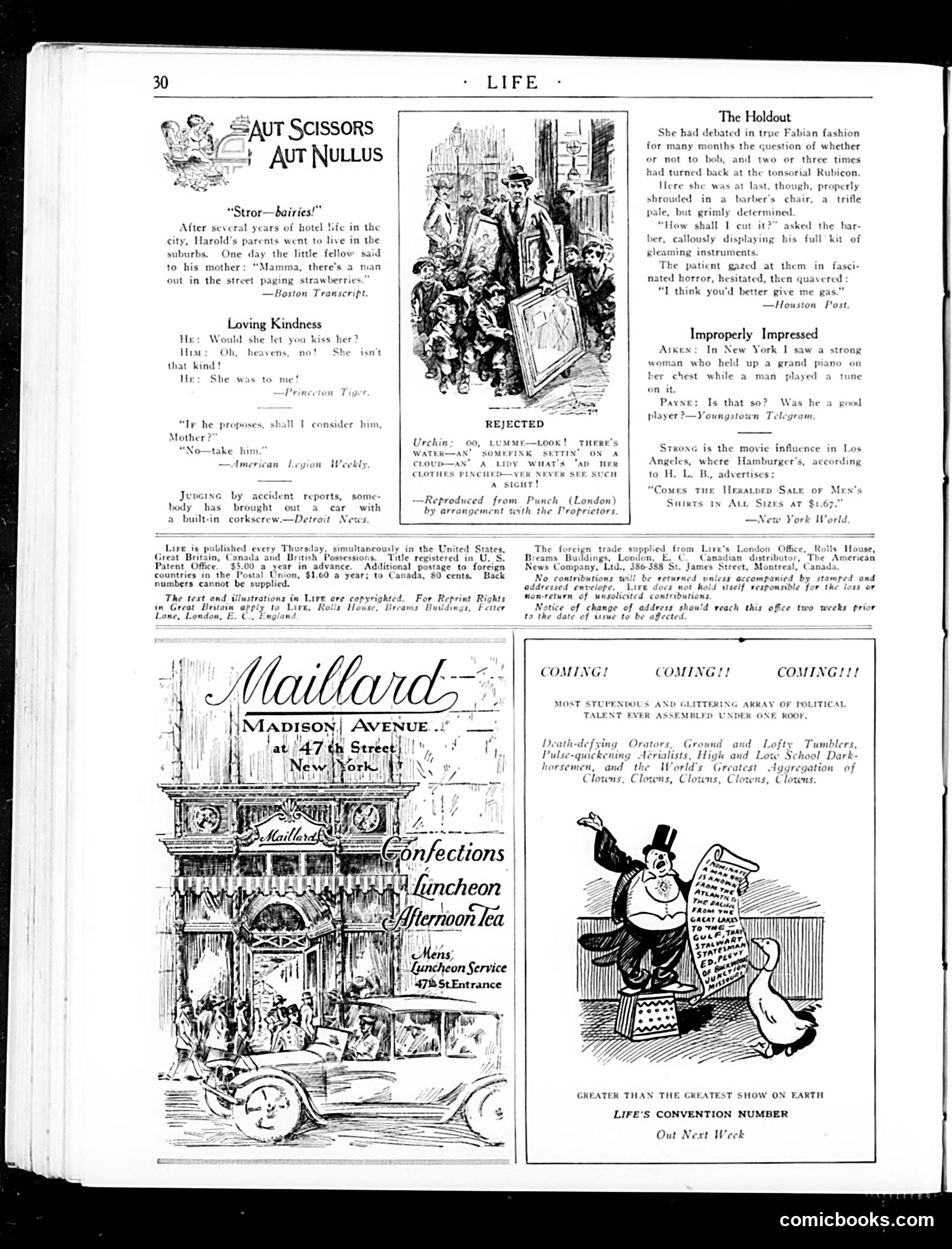
This page from *Life* magazine contains satirical humor and advertisements typical of early 20th-century American magazines. **Main Cartoons:** The "Aut Scissors/Aut Nullus" section presents brief humorous anecdotes and jokes, including one about a child observing strawberry vendors ("Stror—bairies!") and romantic exchanges about kissing. **"The Holdout"** cartoon satirizes the 1920s "bob" hairstyle debate—a genuinely controversial social issue at the time. A woman sits in a barber's chair, hesitating about cutting her hair short, finally requesting anesthesia gas rather than face the decision. **"Improperly Impressed"** jokes about cinema's influence on New York society—a woman supposedly holds a piano on her chest while a man plays it, absurdly mimicking movie spectacle. **Advertisement:** The Maillard confectionery storefront advertisement dominates the left side. **Teaser:** The page concludes with promotional text for "Life's Convention Number," promising political satire "Greater than the Greatest Show on Earth"—likely referencing an upcoming political convention (1920s era). The page reflects 1920s American concerns: changing social norms, cinema culture, and political theater.
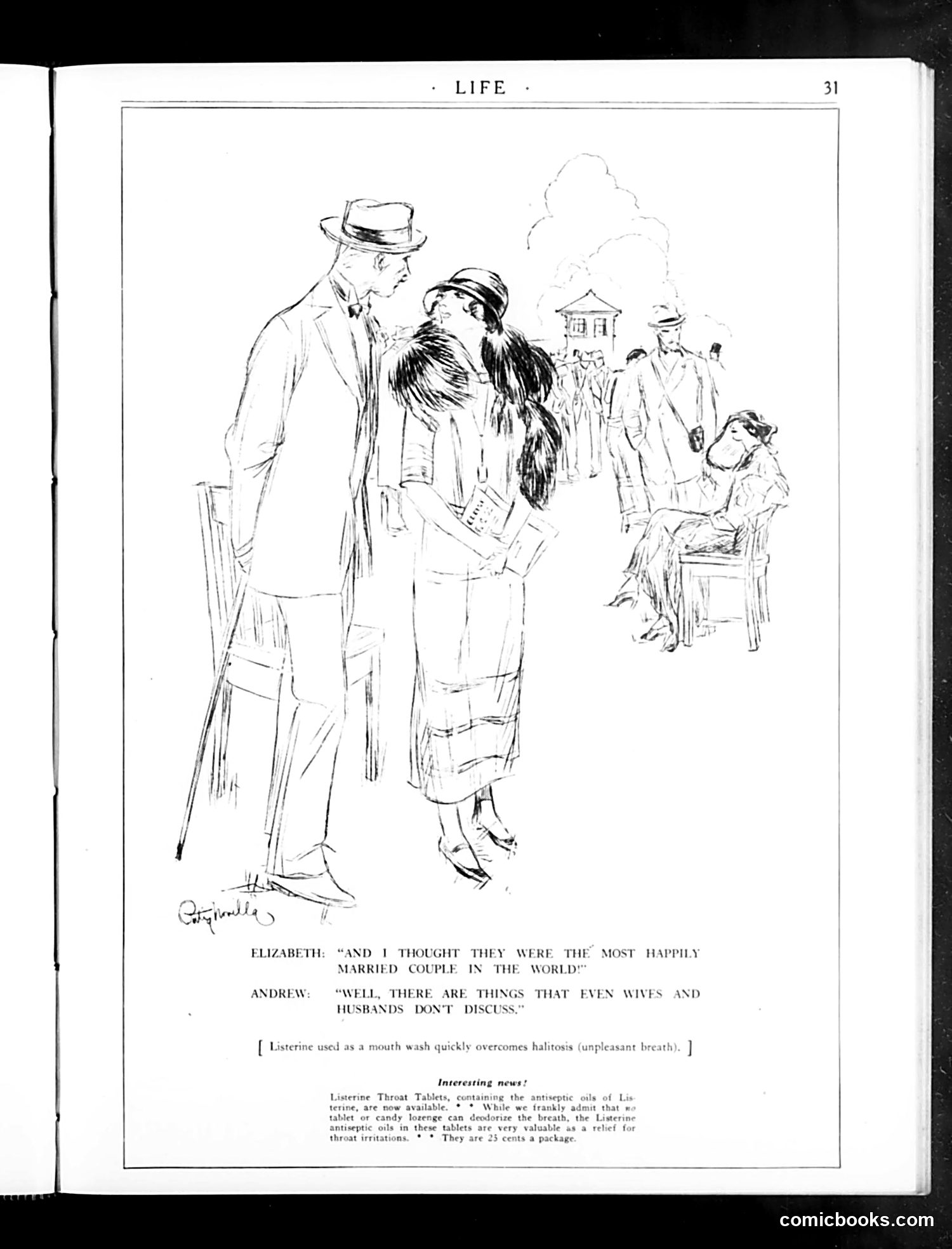
This cartoon satirizes marital secrets and social taboos in early 20th-century America. Elizabeth expresses shock at discovering something troubling about a seemingly perfect marriage, while Andrew deflects with the observation that even spouses keep things private from each other. The joke appears to hinge on the implication that bad breath (halitosis) is so embarrassing that married couples wouldn't discuss it—a social awkwardness the adjacent advertisement promises to solve with Listerine mouthwash. The cartoon uses marital discord as a setup to promote the product, suggesting that even intimate relationships have unspoken discomforts. The humor relies on the period's prudishness about bodily functions and personal hygiene matters.
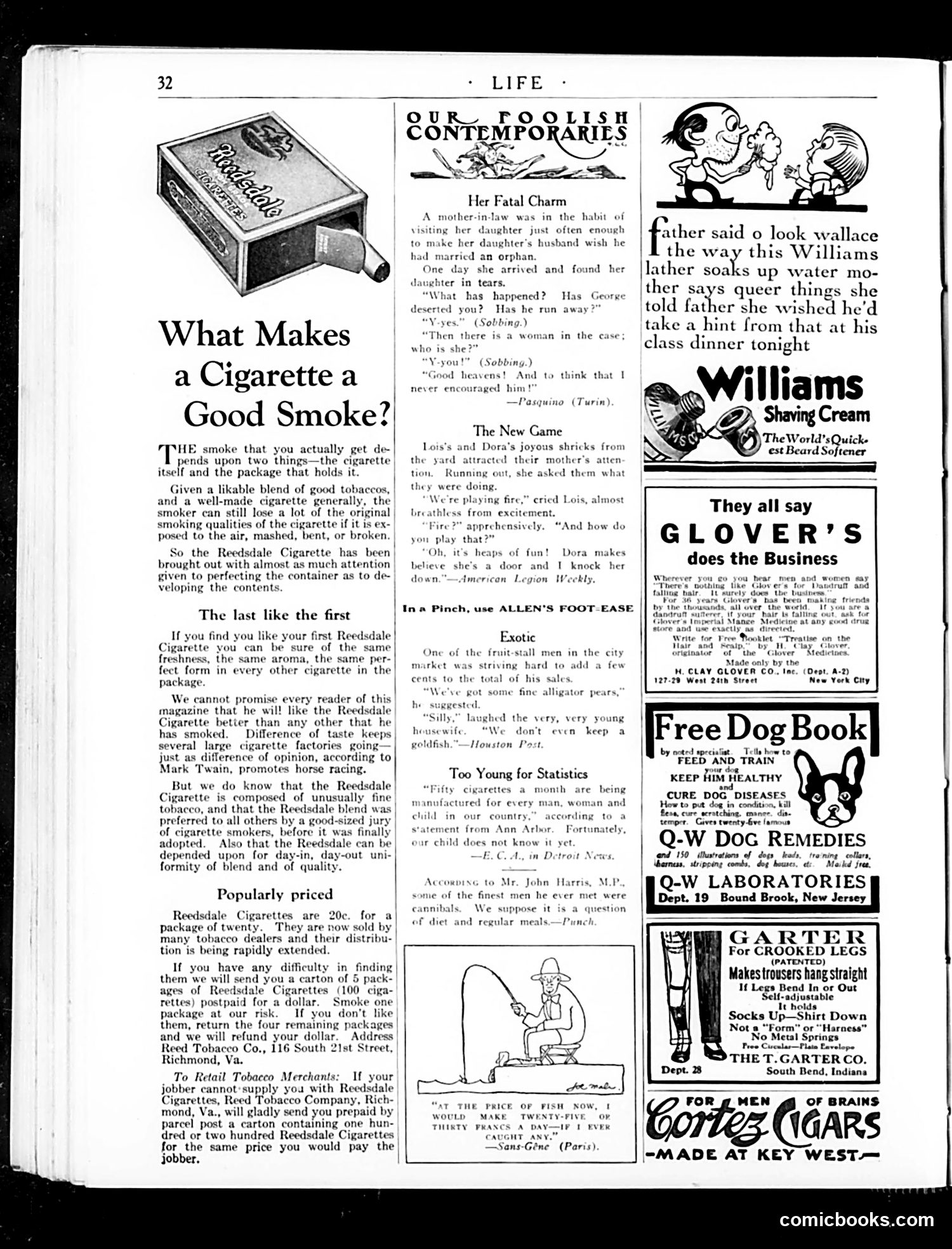
This page is primarily **cigarette advertising** (Reedsdale brand dominates the left column), with small humorous vignettes in the center—typical for the satirical magazine. ## The Small Cartoons The sketches titled "Our Foolish Contemporaries" mock domestic absurdities: a mother-in-law's visits ruin marriages; children playing "fire" by pretending one is a door to knock down; awkward market vendors. These aren't political satire but rather gentle mockery of ordinary social conventions and family life. The italicized quotes are foreign ("Pasquino [Turin]," "Sans-Géne [Paris])," suggesting Life presented international humor as evidence of universal human foolishness—a common early-20th-century editorial approach. ## Supporting Ads The right column features period products: Williams shaving cream, Glover's hair product, dog remedies, leg braces, and Cortez cigars—all standard consumer goods without satirical content. The page reflects Life's mixed model: serious advertising revenue funding space for satirical domestic comedy rather than hard political commentary.
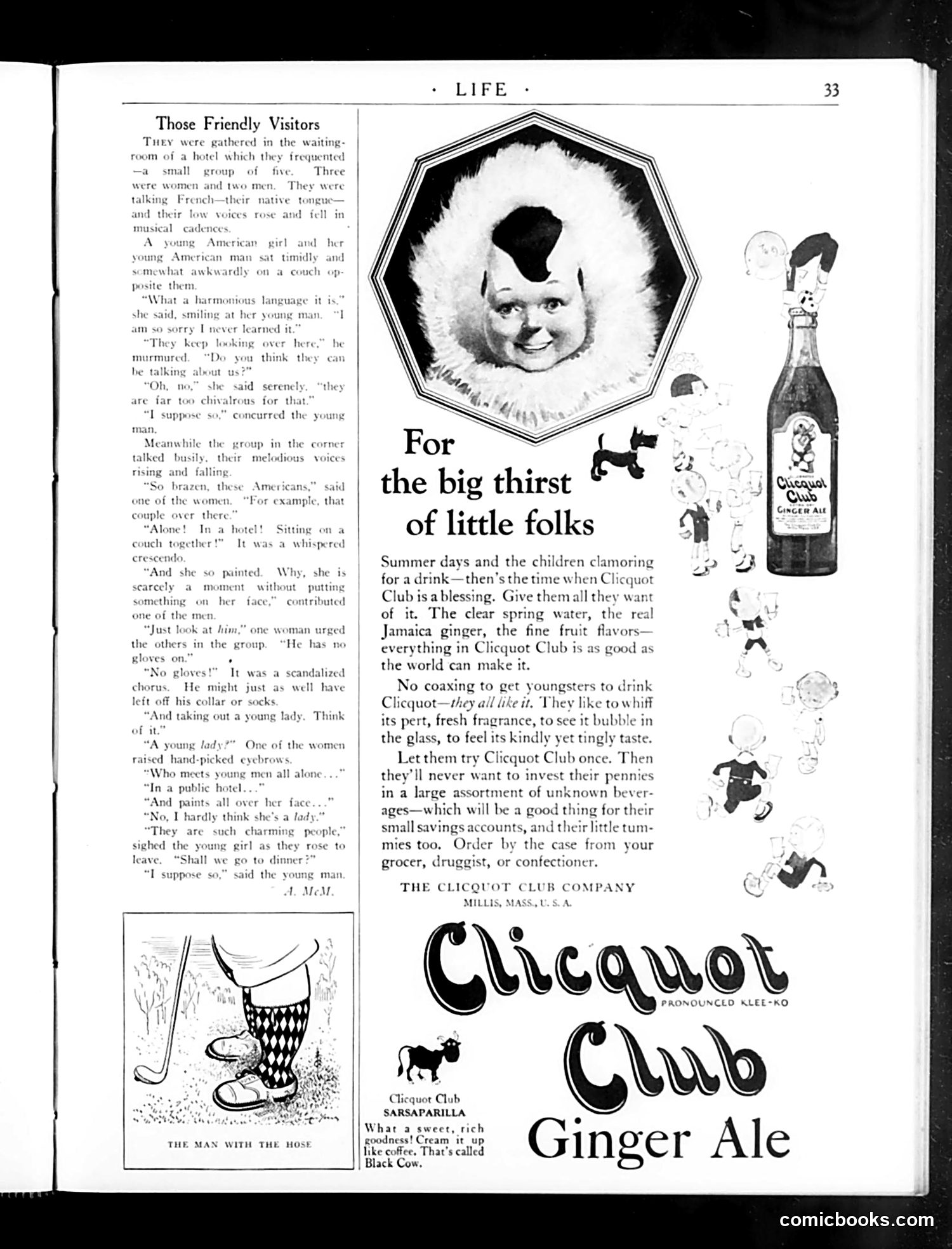
This page contains two distinct elements: a short satirical story and an advertisement. **"Those Friendly Visitors"** (left side) satirizes European attitudes toward Americans, specifically American courtship customs. French hotel guests express shock at American social practices—particularly that an unmarried young man and woman socialize openly together, and that the man removes his gloves in public. The satire targets European stuffiness and strict social conventions by presenting American informality as scandalized through foreign eyes. The punchline relies on the contrast between rigid European propriety and casual American behavior. **"For the Big Thirst of Little Folks"** (right) is a Clicquot Club ginger ale advertisement, not satire. It markets the beverage to children as wholesome and preferable to other "unknown beverages," appealing to parents' concerns about their children's consumption habits and savings accounts. The accompanying illustration "The Man with the Hose" (bottom left) appears decorative rather than satirical.
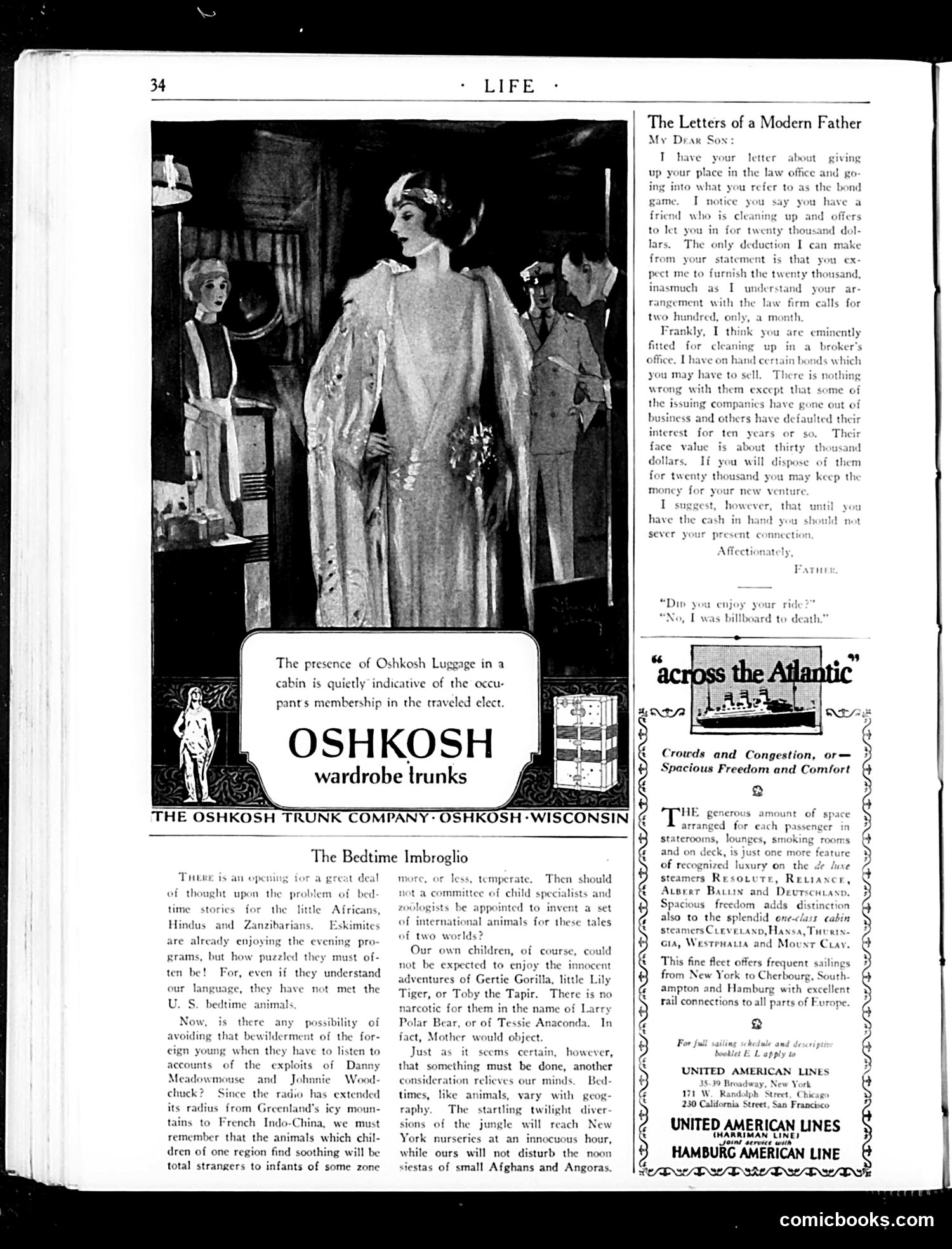
This page contains two distinct pieces of satirical content: **"The Letters of a Modern Father"** (top right): A humorous advice column where a father responds skeptically to his son's proposal to enter the bond/stock market. The satire targets get-rich-quick schemes and naive young men—the father suspects his son expects him to fund a $20,000 investment while the son's "friend" does the actual work. The joke hinges on generational tension and the father's worldly skepticism about financial ventures. **"The Bedtime Imbroglio"** (lower half): This satirizes the challenges of children's bedtime stories in an increasingly globalized world. The author notes that traditional American animal characters (Larry Polar Bear, Tessie Anaconda) confuse children unfamiliar with those creatures, while children in other regions (African, Indian, Eskimo) have equally obscure local animals. The radio's expansion means stories now reach international audiences unprepared for their references—a joke about cultural disconnection and the complications of mass media expansion. Both pieces use gentle humor about modernity's disruptions.
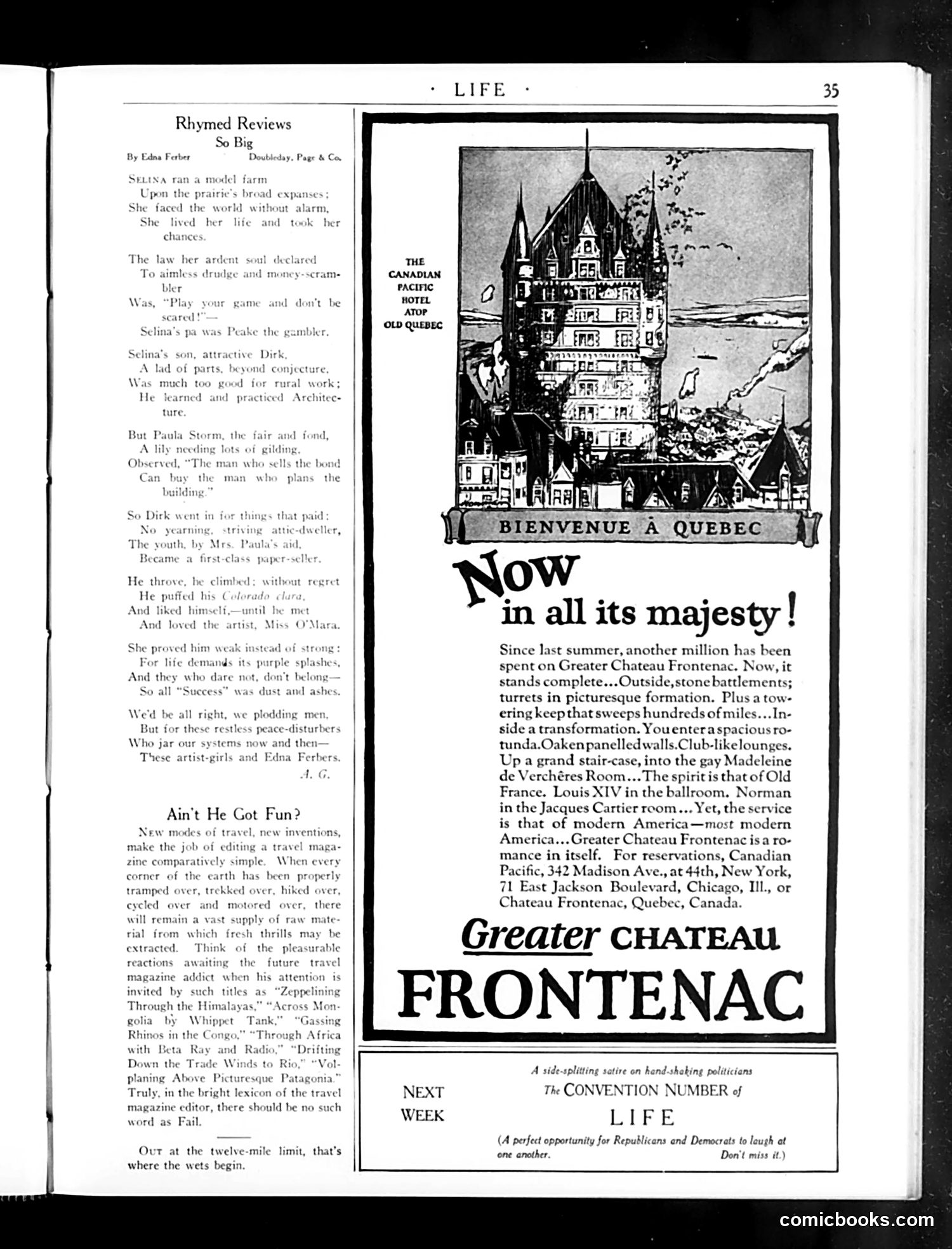
This page contains two distinct elements: **Left side:** A book review of Edna Ferber's novel *So Big* (published by Doubleday, Page & Co.), presented in rhymed verse. The review follows the protagonist Selina through her life managing a farm, facing hardship, and finding love with an architect named Dirk. The satire appears gentle—poking fun at the novel's romantic plot rather than political content. **Right side:** A full-page advertisement for the Greater Chateau Frontenac hotel in Quebec City, emphasizing its recent million-dollar expansion and French-inspired grandeur combined with modern American service. **Bottom note:** An announcement that next week's issue will feature "The Convention Number of LIFE"—a satirical political issue inviting "Republicans and Democrats to laugh at one another." This suggests the magazine's upcoming focus on election-year politics. The page itself contains no political cartoon—the "satire" mentioned refers to the literary review and upcoming convention coverage.
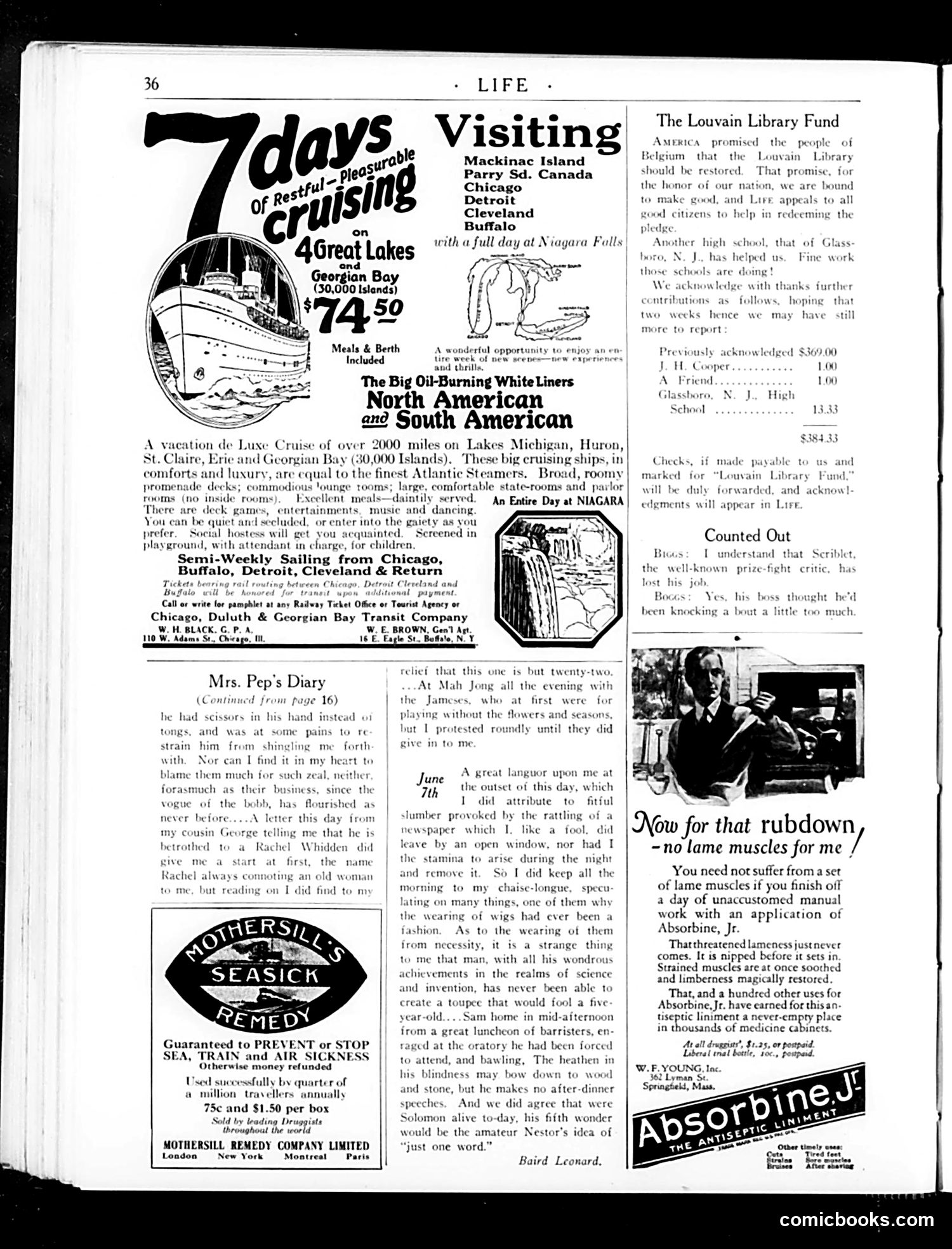
This page is primarily **advertising and miscellaneous content** rather than political satire. The main features include: 1. **Great Lakes cruise advertisements** for "North American and South American" oil-burning White Liners—luxury vacation promotions offering multi-day ship tours among the Great Lakes with meals and entertainment included. 2. **"The Louvain Library Fund"** section—an appeal for donations to rebuild the University of Louvain's library in Belgium, damaged during World War I. This references America's post-WWI commitment to restore Belgian cultural institutions. 3. **"Mrs. Pep's Diary"** (continued from previous page)—a domestic humor column describing mundane social situations like Mah Jong games and fashion observations about wearing wigs. 4. **Product advertisements** including Mothersill's Seasick Remedy and Absorbine Jr. liniment. The page reflects early 20th-century American concerns: post-war charitable obligations, luxury leisure travel marketing, and domestic social commentary aimed at middle-class readers.
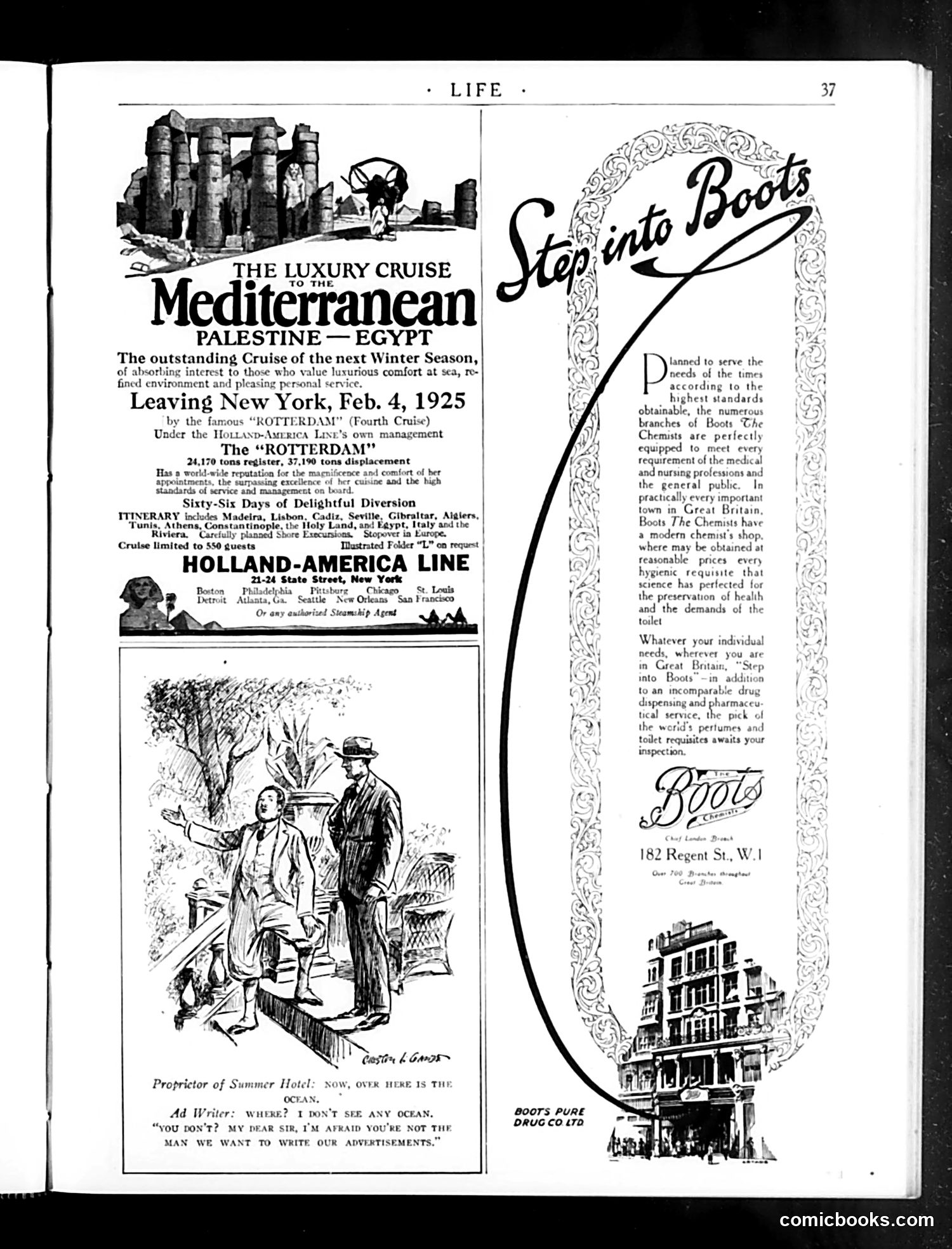
This page contains primarily **advertisements** rather than editorial cartoons. The main visual joke appears in the **lower left cartoon**: an ad writer pitches a luxury cruise to Palestine-Egypt, but the hotel proprietor complains he can't see the ocean from the hotel. The ad writer responds that this is precisely why they need advertising—to sell what isn't actually there. It's a self-aware joke about advertising's role in selling aspirational experiences. The top left advertises the Holland-America Line's "Rotterdam" cruise ship, departing February 4, 1925, for a 66-day Mediterranean voyage to Palestine and Egypt. The right side features a large advertisement for **Boots The Chemists**, a British pharmacy chain, emphasizing their widespread availability and comprehensive pharmaceutical services throughout Great Britain. The satire is gentle: advertising can obscure reality by marketing the intangible (luxury, prestige) rather than the tangible (an actual ocean view).
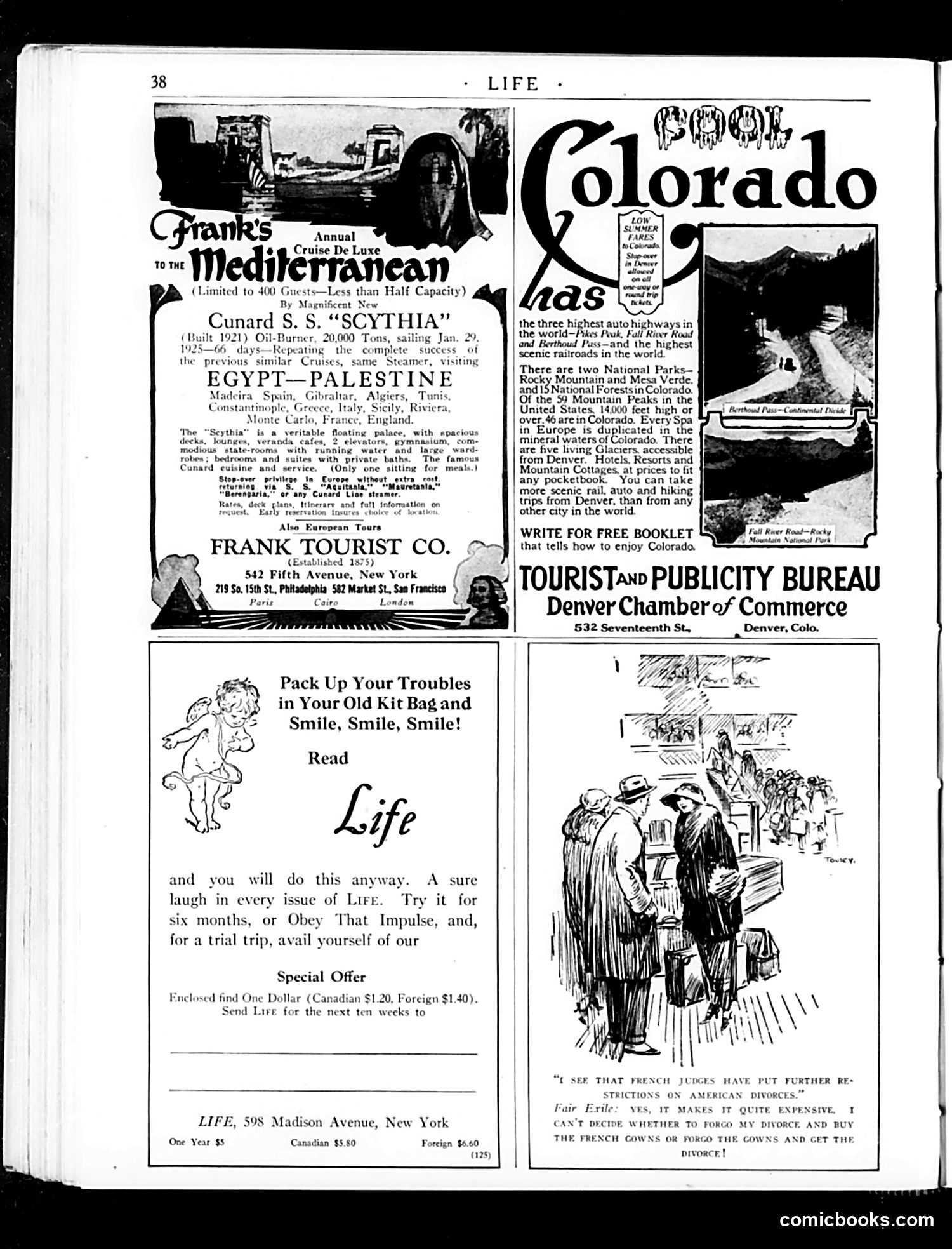
This page is primarily **advertisements and promotional material** rather than editorial content. The notable cartoon (lower right) depicts a wealthy woman facing a satirical dilemma about French divorce restrictions. She's torn between purchasing expensive French fashions or affording a divorce, joking that new French legal restrictions have made American divorces prohibitively costly. This references 1920s concerns about **marital dissolution among the wealthy elite** and appears to mock both the expense of divorce proceedings and the frivolity of upper-class concerns about luxury goods versus personal freedom. The page's other content advertises luxury travel (Cunard cruise line to Egypt and Palestine), Colorado tourism, and Life magazine subscriptions—all targeting affluent readers. The soldier illustration referencing "Pack Up Your Troubles" (a WWI song) dates this to the 1920s post-war era. The overall message positions Life as entertainment for the prosperous classes navigating modern marriage, consumption, and leisure.
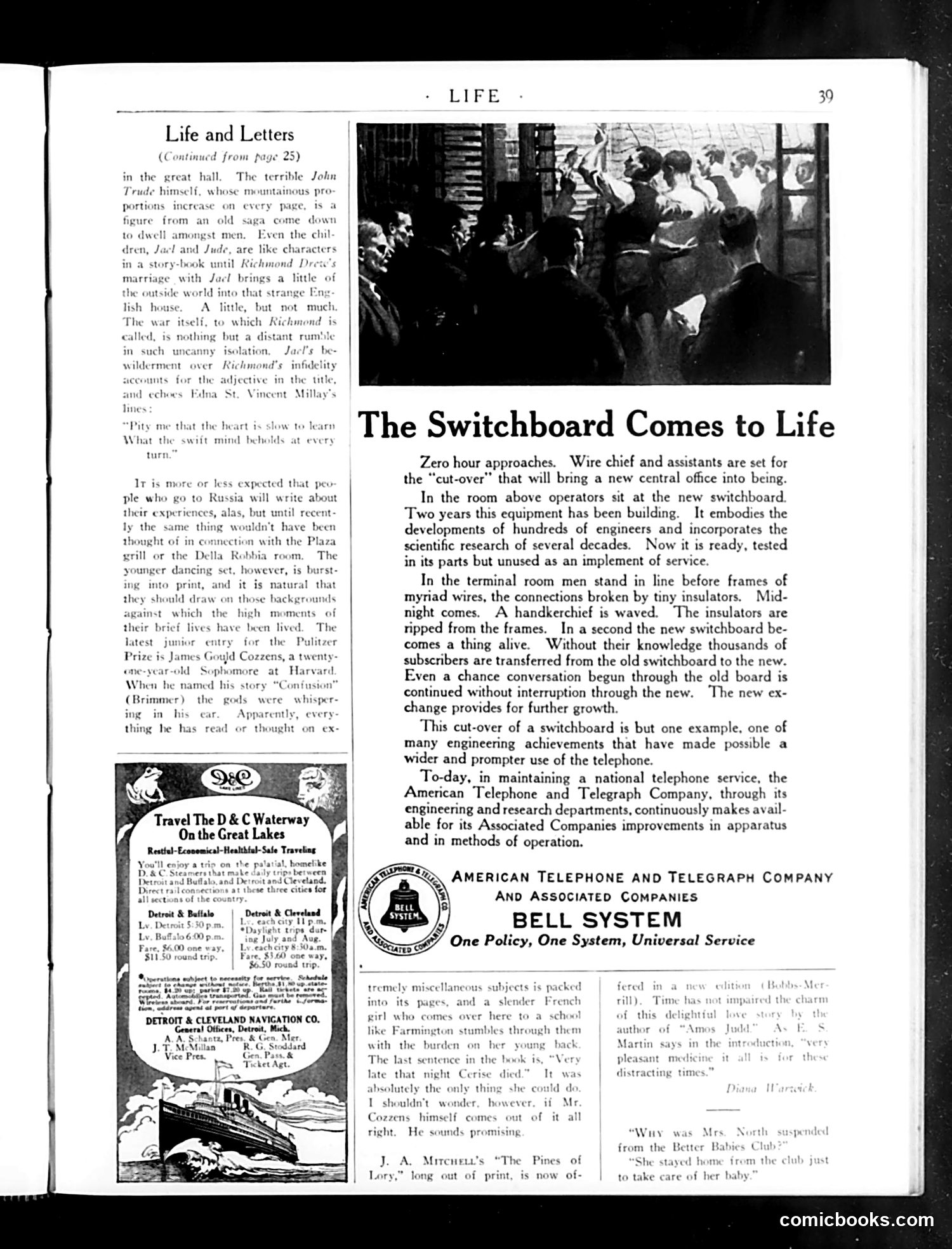
This page mixes literary criticism with corporate advertising. The upper text discusses contemporary authors—particularly James Gould Cozzens, a young Harvard sophomore whose novel "Confusion" (humorously called "Brimmer") has been nominated for the Pulitzer Prize. The passage is satirical, suggesting the gods whispered in his ear, implying his success came from luck rather than merit. The main feature is **"The Switchboard Comes to Life,"** a Bell System advertisement celebrating a telephone switchboard upgrade. The dramatic photograph shows technicians performing a live "cut-over"—transferring thousands of subscribers from an old to new switchboard without interruption. This is presented as modern engineering marvel, illustrating how AT&T maintains national telephone service. The left sidebar advertises D&C Waterway travel on the Great Lakes—period leisure marketing. The page reflects 1920s American culture: celebration of technological progress, corporate public relations through "Life" magazine advertising, and literary commentary on emerging American authors.
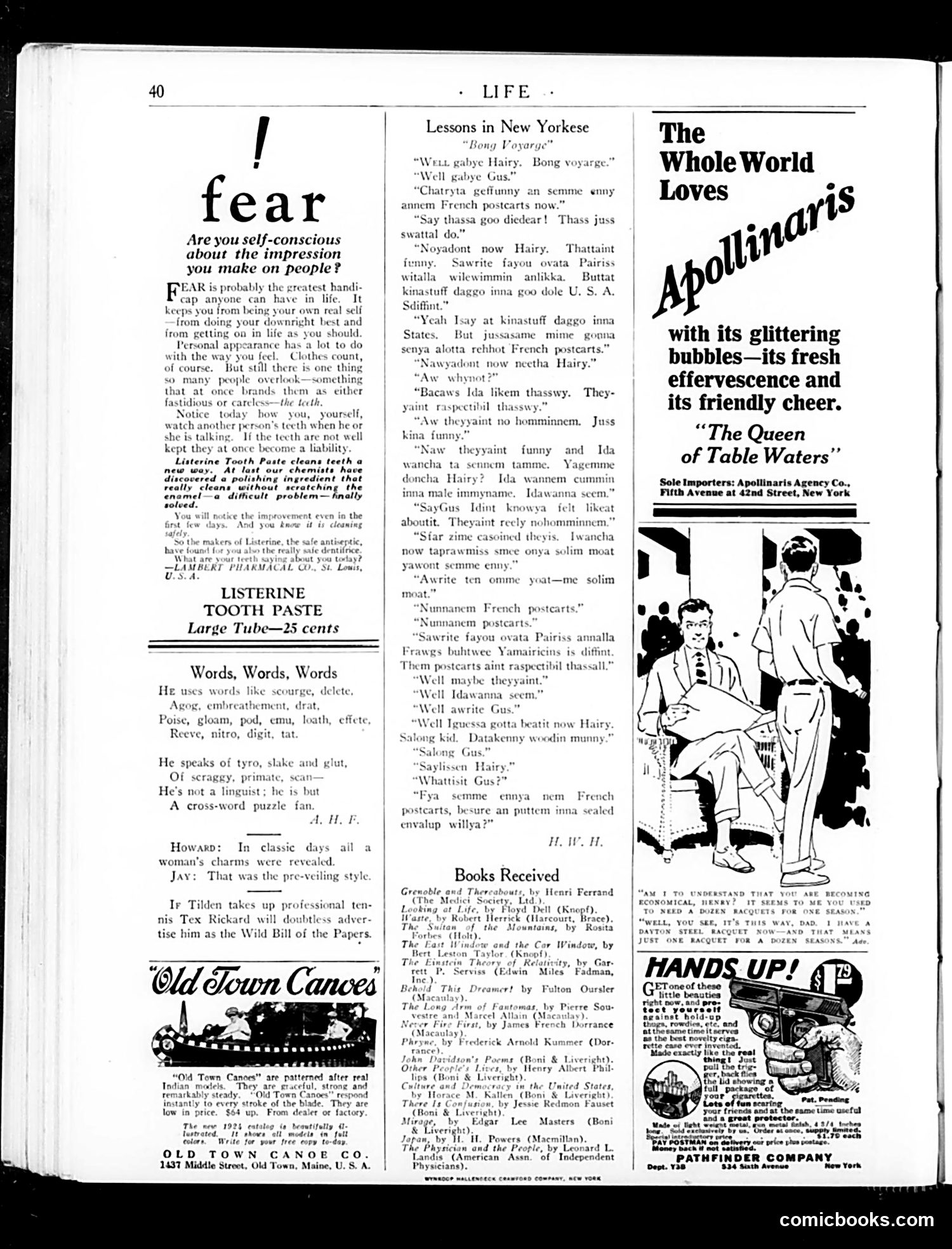
This page features a humorous dialect piece mocking working-class New York immigrant speech patterns—likely Italian and Eastern European immigrants. The dialogue depicts two men ("Hairy" and "Gus") using exaggerated phonetic misspellings and malapropisms ("bong voyage," "thassa goo diecar," "raspectibil") while discussing French postcards. The satire targets both the immigrants' accented English and American attitudes toward European culture. The joke relies on stereotyping: the characters butcher language while obsessing over "French postcards" (a period euphemism for risqué images), suggesting crude materialism and sexual preoccupation. This reflects 1920s attitudes viewing working-class immigrants as objects of ridicule—their speech patterns inherently amusing to educated readers. The piece is representative of Life magazine's satirical approach to immigration and assimilation during this era, though modern readers would recognize it primarily as ethnic caricature.
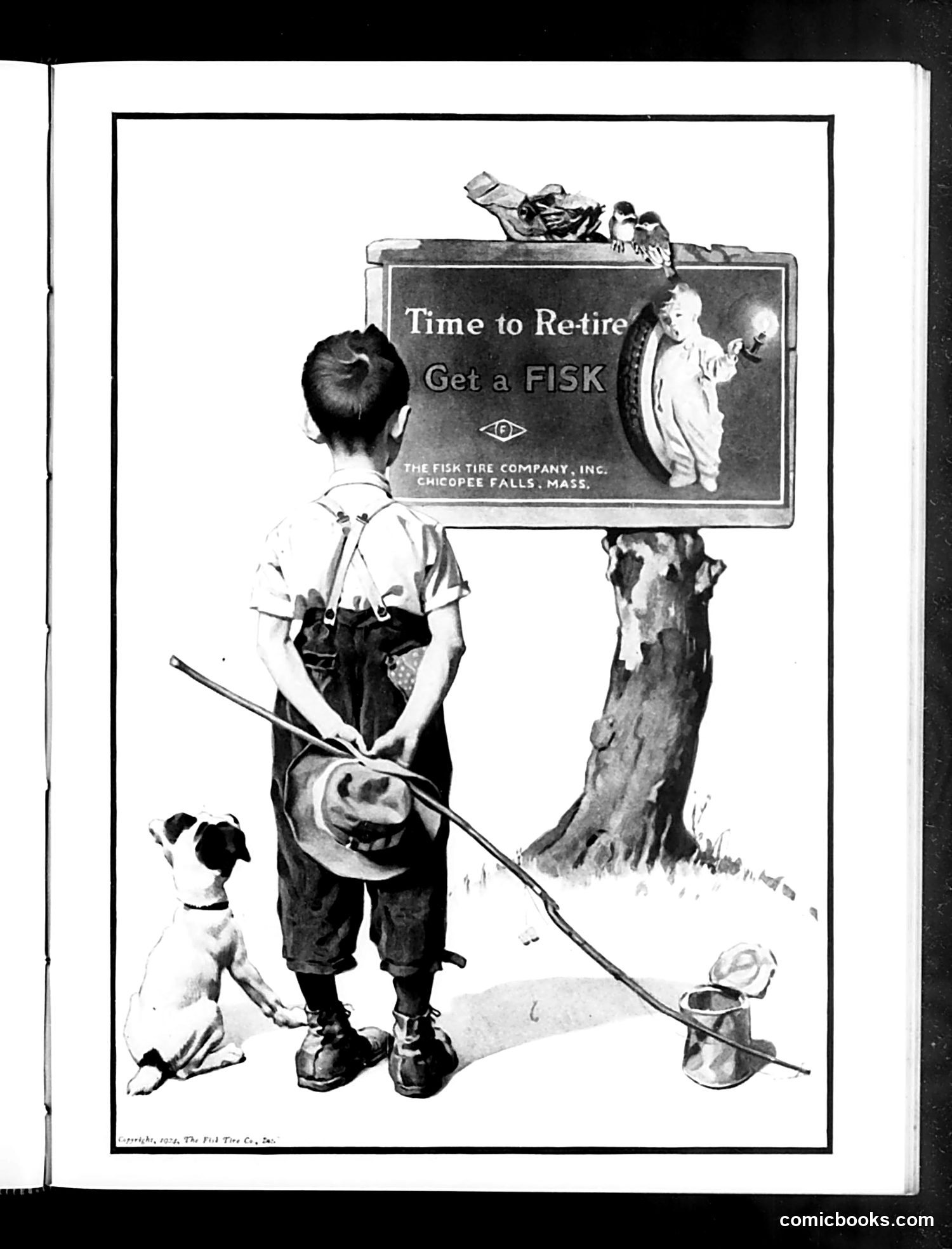
This is a **Fisk Tire Company advertisement** disguised as satirical editorial content. The image shows a young boy looking at a billboard advertisement that reads "Time to Re-tire / Get a FISK" (a pun on tire replacement and retirement). The boy is depicted as a farm worker—holding a hoe, with a small dog beside him, standing before a gnarled tree. The advertisement's imagery of elderly figures suggests the "retire" wordplay targets both tired workers and worn-out tires. This represents **early 20th-century advertising satire**, where commercial messages were presented as humorous editorial cartoons in magazines like *Life*. The joke relies on the double meaning of "tire" (vehicle part/exhaustion) and plays on viewers recognizing the Fisk brand. Modern readers would recognize this as branded content masquerading as humor.
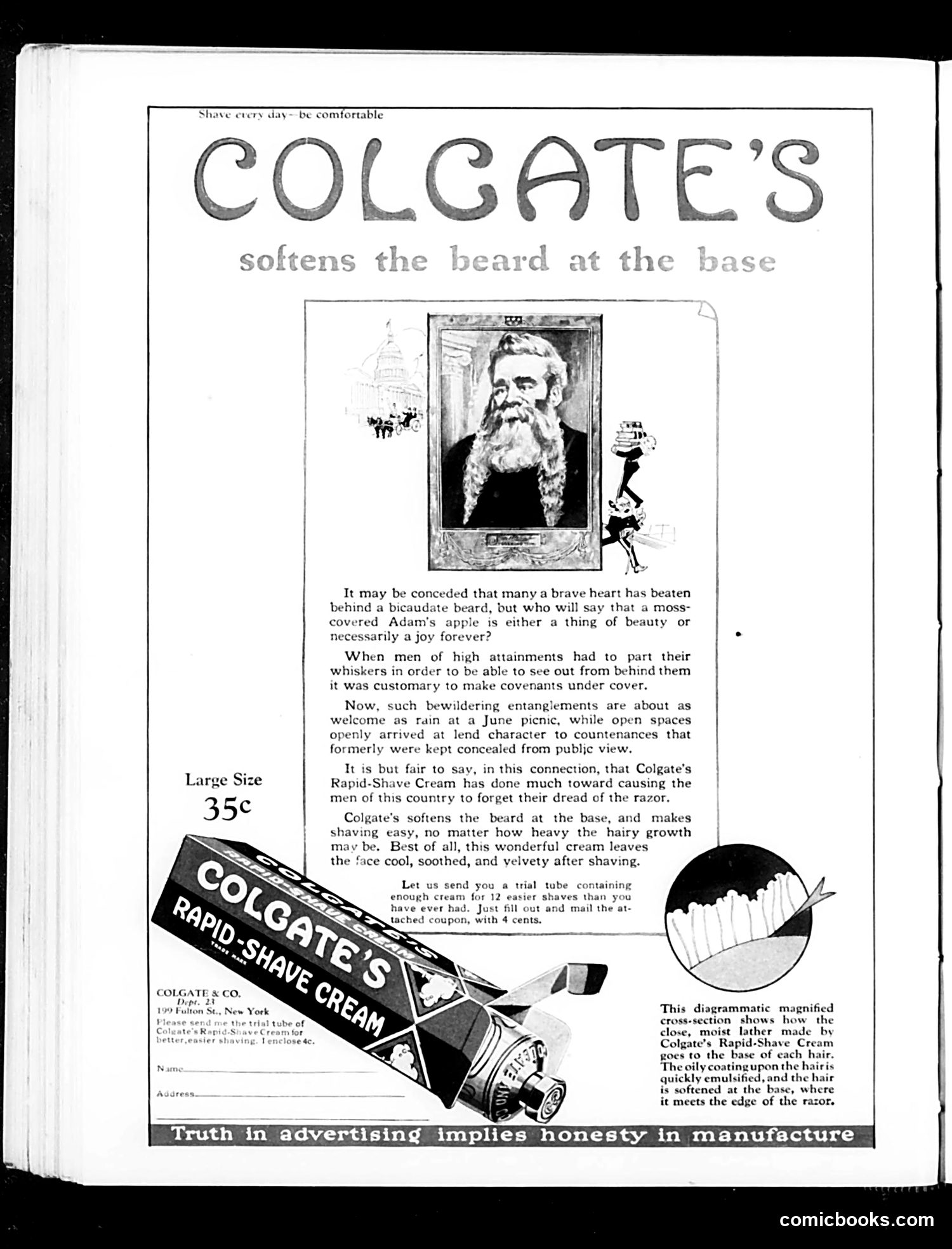
This is primarily a **product advertisement**, not political satire. However, it contains social commentary disguised as marketing copy. The bearded gentleman in the portrait represents the outdated fashion of heavy beards. The ad's text mocks this style—referencing how men once had to part their whiskers to see, and how beards were used to conceal or hide things ("make covenants under cover"). The satire targets **changing masculinity norms**: the ad celebrates the modern, clean-shaven man as more honest and transparent ("open spaces openly arrived at"), contrasting him with the secretive, hidden nature of the bearded past. The phrase "forget their dread of the razor" suggests previous resistance to shaving. The product pitch emphasizes comfort and ease, positioning Colgate's cream as enabling this cultural shift toward clean-shaven modernity. The technical diagram explains the product's mechanics—softening beard hair at the base for easier removal. The tagline "Truth in advertising implies honesty in manufacture" reinforces the broader message: modernity, visibility, and honesty go together.