
Life, 1924-06-12 · page 30 of 44
Life — June 12, 1924 — page 30: what you’re looking at
What you’re looking at
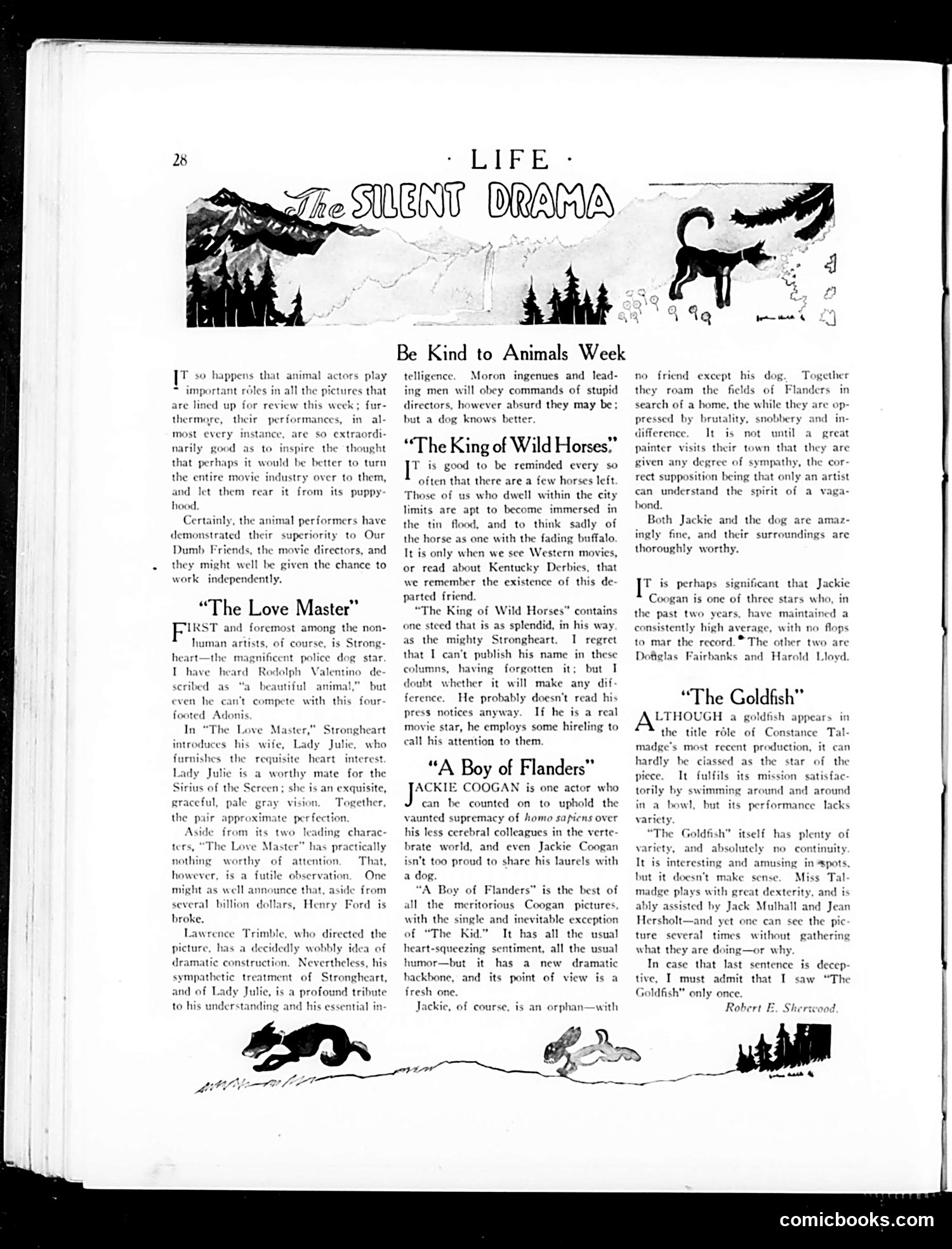
This Life magazine page reviews recent films starring animal actors—particularly the dog Strongheart in "The Love Master" and Jackie Coogan with a dog in "A Boy of Flanders." The satire's central joke: animals are better actors than human performers and directors. The author argues that dogs "know better" than human actors who mindlessly obey stupid directors' commands. He suggests the film industry should be handed over to animal performers entirely. The piece mocks human vanity while genuinely praising animal performances. It's framed as "Be Kind to Animals Week" commentary—playfully suggesting animals deserve respect not just morally but professionally. The implicit critique targets Hollywood's bloated egos: even famous dog star Strongheart (compared to Valentino) is more dignified than the human talent surrounding him. The humor relies on readers' awareness that animals were genuinely major silent-film stars during this era.
📄 Transcribed text from this page (OCR, searchable)
Machine-transcribed from the original scan — historical spelling and the odd misread are preserved.
LIFE The WRAMA [7 s0 happens that animal actors play important roles in all the pictures that are lined up for review this week; fur- thermore, their performances, in al- so extraordi narily good as to the thought that perhaps it would be better to turn the entire movie and let them most every instance, are inspire industry over to them, rear it from its puppy. hood Certainly, the animal performers have demonstrated their superiority to Our Dumb Friends, the movie directors, and they might well be given the chance to work independently. “The Love Master” IRST and foremost among the non- human artists, of heart—the magnificent I have heard scribed as “a nurse, is Strong police dog star Valentino de but four Rodolph beautiful animal,” can't with this footed Adonis In “The introduces even he compete Love Master,” Strongheart Lady Julie, heart mate his wife, who interest for the she is an ¢: exquisite, wether, furnishes the requisite Lady Julie is a worthy Sirius of the Sereen; graceful the pair approxi Aside from its two ters, “The Love Master nothing attention. That observation. Or ce that pale gray vision mate perfection. ding. charac has practically worthy of futile might as well annout billion however, is a aside from several dollars, Henry Ford is broke. Lawrence Trimble, who directed the picture, has a decidedly wobbly idea of dramatic construction. Nevertheless, his treatment of Strongheart, Julie, is a ps and his essential in sympathetic and of Lady to his understanding ofound tribute at's Be Kind to Animals Week telligence. Moron ingenues and lead- ing men will obey commands of stupid directors, however absurd they may be: but a dog knows better. ‘The King of Wild Horses’ T I often that there are a few horses left Those of us who dwell within the city limits are apt to become immersed i the tin flood, and to think sadly of the horse as one with the fading buffalo. is good to be reminded every so It is only when we see Western movies, or read about Kentucky Derbies, that we remember the existence of this de- parted friend. “The King of Wild Horses” contains one steed that is as splendid, in his way as the mighty Strongheart that I can’t publish his name in these columns, having forgotten it; but I doubt whether it will make any dif ference. He probably doesn't read his press notices If he is a real movie star, he employs some hireling to call his attention to them. om “A Boy of Flanders ACKIE COOGAN is one actor who counted on to uphold the vaunted supremacy of homo sapiens over his less cerebral colleagues in the verte- brate world, and even Jackie Coogan isn’t too proud to share his laurels with a dog. “A Boy of the meritorious anyway can be anders” is the best of Coogan pictures with the single and inevitable exception of “The Kid.” It has all the usual heart-squeezing sentiment, all the usual humor—but it has a new backbone, and its point of fresh one. Jack dramatic view is a of course, is an orphan—with br friend am no except his dog, Together they the fields of search of a home, the while they are op- Flanders in pressed by brutality, snobbery and in- not town th difference. It is until a great t they iven any de hy, the rect supposition being that only understand the spirit of painter visits the are ce of symp: cor artist can a vaga- bond. Both Jackie and the dog are amaz- ingly fine, and their surroundings thoroughly worthy. I" the past two years. is perhaps significant that Jackie Coogan is one of three stars who, in have maintained a consistently high average, with no flops * The other two are Harold Lloyd to mar the record Dotiglas Fairbanks and “The Goldfish” LTHOUGH a g dfish appears in the title Tal madge’s most recent production, it can hardly be as the the ce. Tt satisfac torily réle of Constance ciassed star of fulfils by swimming bowl, b variety “The variety, its mission and around lacks ‘ound ina its performar Goldfish” itself has lutely and amusing in spots. make Miss Tal madge plays with great dexterity, and is Jack Mulhall and Jean Hersholt—and yet one can see the pic ture times. gathering what they are doing—or why. In case that last sentence is decep tive, T must admit that I “The Goldfish” only once. Robert E. plenty of no. continuity It is interesting but it doesn't sense ably assisted by several without saw comicbooks.com