
Life, 1924-06-12 · page 24 of 44
Life — June 12, 1924 — page 24: what you’re looking at
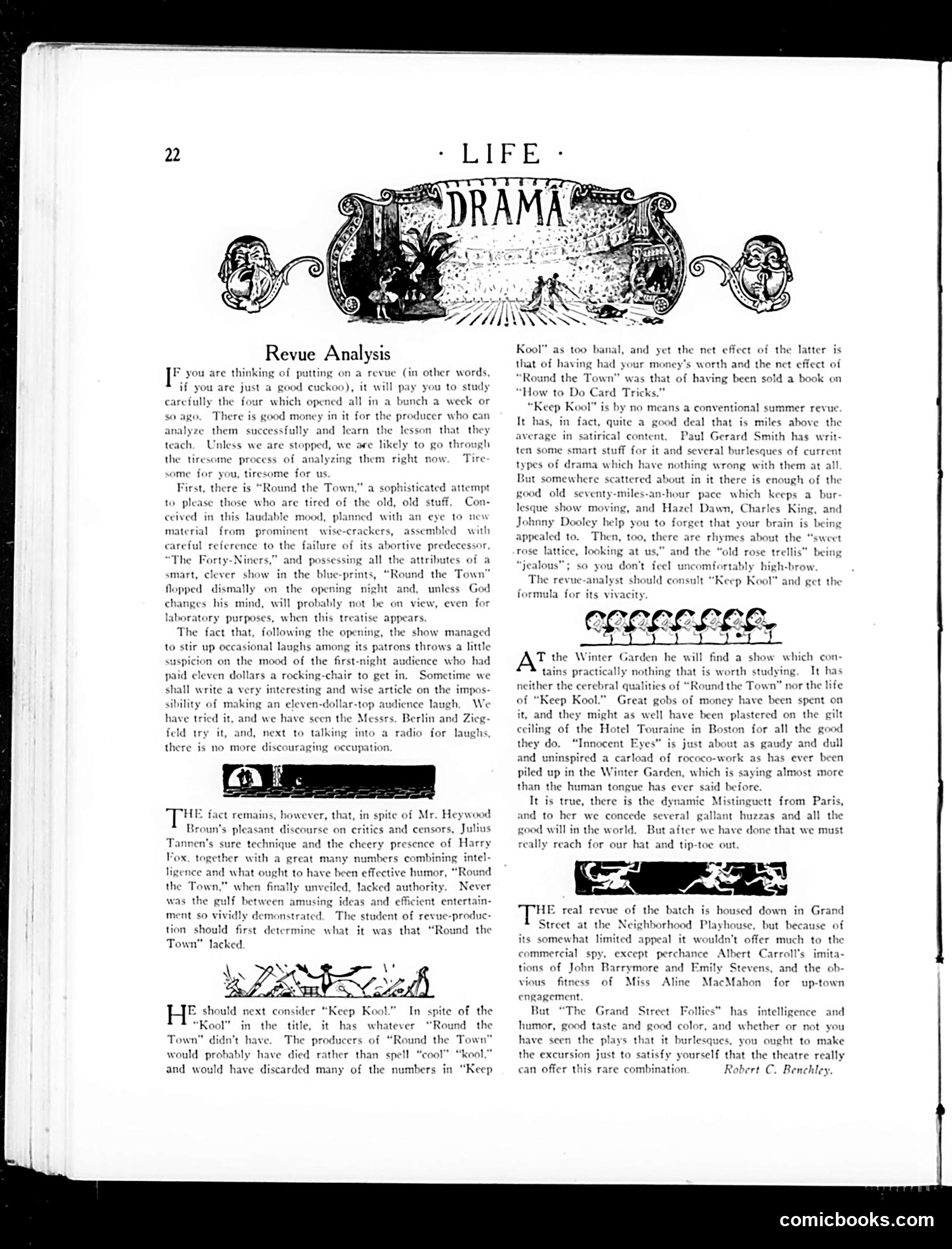
What you’re looking at
This page analyzes three Broadway revues from the 1920s era. The author reviews "Round the Town," "Keep Kool," and an unnamed Winter Garden production, explaining what makes revues succeed or fail. **"Round the Town"** is criticized as an intellectual failure despite featuring respected performers (Julius Tannen, Harry Fox) and smart writing. It "lacked authority"—the gap between clever ideas and actual entertainment was too wide. **"Keep Kool"** succeeds where "Round the Town" failed by balancing sophistication with accessible entertainment. Though spelled unconventionally ("kool"), it delivers on audience expectations with fast pacing, good satire, and memorable performers like Hazel Dawn and Johnny Dooley. **The Winter Garden show** receives harsh dismissal as wasteful spectacle—expensive but intellectually empty, money literally wasted on gilt ceilings rather than substance. The satire targets the tension between artistic ambition and commercial entertainment in 1920s Broadway theater.
📄 Transcribed text from this page (OCR, searchable)
Machine-transcribed from the original scan — historical spelling and the odd misread are preserved.
Revue Analysis you are thinking of putting on a revue (in other words if you are just a good cuckoo), it will pay you to study ich a week or There is good money in it for the producer who can careiully the four which opened all in a analyze them successfully and learn the lesson that they teach. Unless we are stopped, we are likely to go through the tiresome process of analyzing them right now some for you, tiresome for us. ticated to please those who are tired of the old, old s First, there is “Round the Town,” a sophi: ceived in this laudable mood, planned with an eye to 1 material from prominent wise-crackers, assembled with careful reference to the failure of its abortive predecessor “The Fi smart, clever show in the bli rty-Niners,” and possessing all the attributes of a prints, “Round the Tow flopped dismally on the opening night and, unless God changes his mind, will probably not be on view, even for laboratory purposes, when this treatise appears The fact that, following the opening, the show managed to stir up occasional laughs among its patrons throws a little suspicion on the mood of the first-night audience who had paid cleven dollars a rocking-chair to get in. shall write a very interesting and wise Sometime we ticle on the impos- lience laugh. We nd Zic for lau sibility of making an eleven-dollar have tried it, and we have seen the Messrs. Berlin feld try it, and, next to talking into a radio there is no more discouraging occu HE fact remains, however, that, in spite of Mr, Heywood Broun’s pleasant discourse on critics and censors, Julius Tannen's sure technique and the cheery presence of Harry Fox, together with a great many numbers combining intel- ligence and what ought to have been effective humor, “Round when fi Never ient entertain- the Town, ly unveiled, lacked authority. was the gulf between amusing ideas and ef ment so vividly demonstrated. The student of revue-produc- tion should first determine what it was that “Round the Town” lacked. E should next consider “Keep Kool In spite of the “Kool” in the title, it has whatever “Round the Town” didn’t have. The producers of “Round the Town would ably have died rather than spell “cool” “kool,” and would have discarded many of the numbers in “Keep Kool” as too banal, and yet the net effect of the latter is that of having had your money's worth and the net effect of “Round the Town" was that of having been sold a book on “How to Do Card Tricks.” “Keep Kool” is by no means a conventional summer revue It has, in fact, quite a good deal that is miles above the average in satirical content. Paul Gerard Smith has writ- ten some smart stuff for it and several burlesques of current types of drama which have nothing wrong with them at But somewhere scattered about in it there is enough of the good old seventy-miles-an-hour pace which keeps a bur g, and Hazel Dawn, Charles Ki: and Johnny Dooley help you to f lesque show mov et that your brain is being appealed to. Then, too, there are rhymes about the “sweet rose lattice, looking at us,” and the d rose trellis” being “jealous”; so you don't feel uncomfortably high-brow alyst should e« ula for its vivacity The revue cep Kool” and get the ROG is Sais eS aie T the Winter Garden he will find a show which con- tains practically nothing that is worth studyi Tt has neither the cerebral qu: Round the Town” nor the life of “Keep Kool.” Great gobs of money have been spent on it, and they might as well have been plastered on the gilt ceiling of the Hotel Touraine in Boston for all the good they do. “Innocent Eyes” is just about as gaudy and dull and uninspired a carload of rococo-work as has ever been piled up in the Winter Garden, which is saying almost more than the human tongue has ever said before. It is true, there is the dynamic Mistinguett from Paris, and to her we concede several gallant huzzas a all the good will in the world. But after we have done that we must really reach for our hat and tip-toe out. ee HE real revue of the batch is housed down in Grand Street at th its somewhat Neighborhood Playhouse, but because of mited appeal it wouldn't offer much to the except perchance Albert Carroll's imita- tions of John Barrymore and Emily Stevens, and the ob- vious fitness of Miss commercial sf acMahon for up-town ement “The Grand Street Follies” has intelligence and humor, good taste and good color, and whether or not you <, you ought to make the excursion just to satisfy yourself that the theatre really can offer this rare combination Robert C. Benchley have seen the plays that it burles¢ comicbooks.com