
Life, 1924-06-12 · page 18 of 44
Life — June 12, 1924 — page 18: what you’re looking at
What you’re looking at
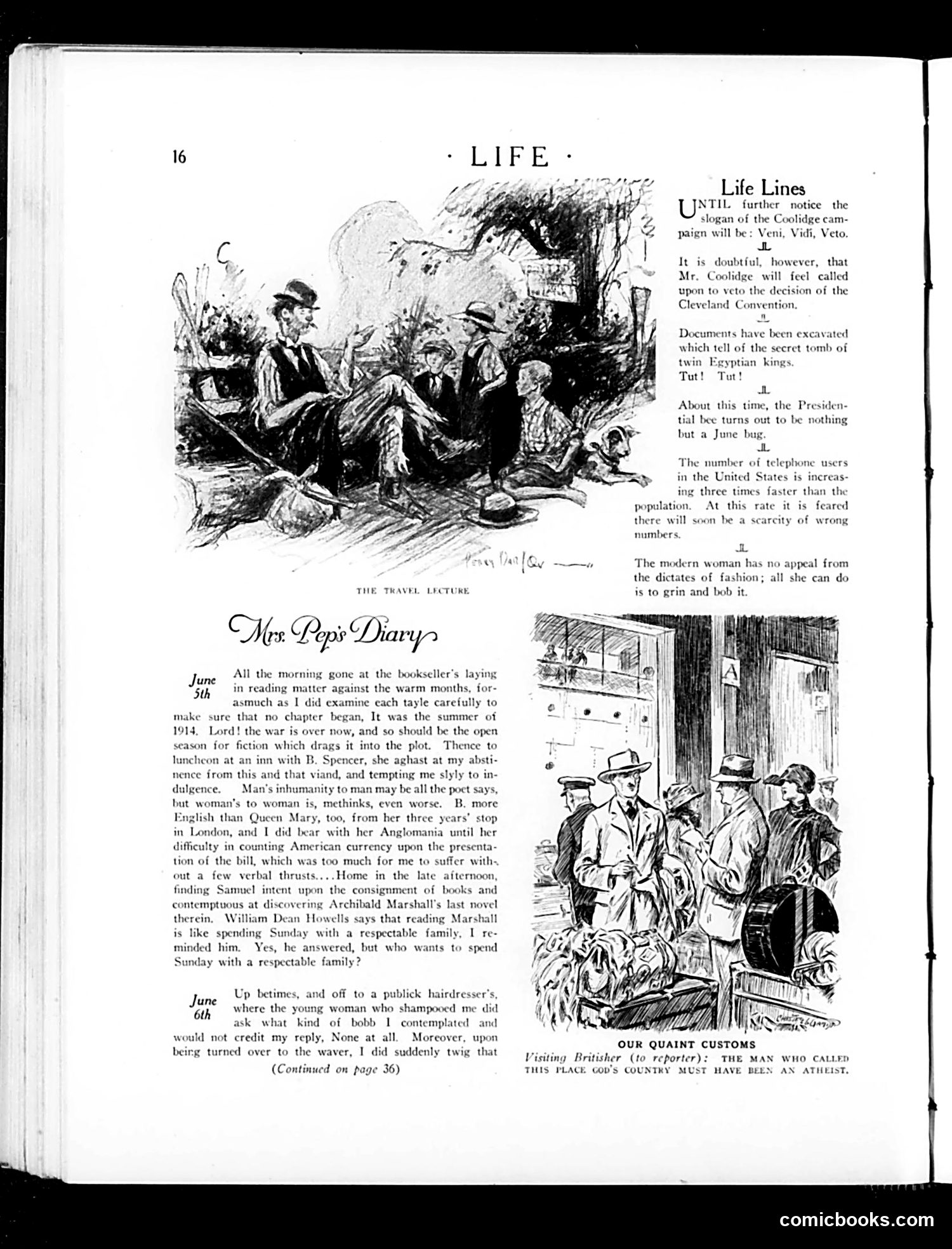
This page from *Life* magazine contains several short satirical commentary pieces mocking 1920s American politics and culture. **"Life Lines"** (top right) includes political jabs: a joke about President Coolidge's campaign slogan "Veni, Vidi, Veto" (Latin: "I came, I saw, I vetoed"), suggesting his passivity; and mockery of the 1924 Cleveland Convention. Other items mock telephone overuse, women's fashion obsession with bobbed hair, and the scarcity of wrong numbers. **"The Travel Lecture"** cartoon (top left) depicts a group gathered around what appears to be a travel speaker or entertainer. **"Mrs. Peps Diary"** (middle) is a prose diary entry satirizing British affectation and class consciousness, featuring a narrator's observations about a pretentious English woman's Anglophilia and inability to count American currency. **"Our Quaint Customs"** (bottom right) shows a cartoon mocking American patriotism—a visiting Brit suggests only an atheist would call America "God's country," satirizing American self-righteousness about national virtue.
📄 Transcribed text from this page (OCR, searchable)
Machine-transcribed from the original scan — historical spelling and the odd misread are preserved.
Life Lines NTIL further notice the slogan of the Coolidge cam- paign will be: Veni, Vidi, Veto. L It is doubtful, however, that Mr. Coolidge will feel called upon to veto the decision of the Cleveland Convention. Documents have been excavated which tell of the secret tomb of twin ki Tut! aL About this time, the Presiden- tial bee turns out to be nothing but a June bug aL The number of telephone users in the United States is increas- ing three times faster than the population. At this rate it is feared there will soon be a scarcity of wrong numbers. AL The modern woman has no appeal from the dictates of fashion; all she can do THE TRAVEL LECTURE is to grin and bob it. Ju All the morning gone at the bookseller’s laying 5th in reading matter against the warm months, ~ asmuch as I did examine cach tayle carefully to make sure that no chapter began, It was the summer of 1914, Lord! the war is over now, and so should be the open season for fiction which drags it into the . Thence to luncheon at an inn with B. Spencer, she aghast at my absti- nence from this and that viand, and tempting me slyly to in- dulgence. Man's inhumanity to man may be all the poct says, but woman's to woman is, methinks, even worse. B, more English than Queen Mary, too, from her three years’ stop in London, and I did bear with her Anglomania until her difficulty in counting American currency upon the presenta- tion of the bill, which was too much for me to suffer with. out a few verbal thrusts....Home in the late afternoon, finding Samuel intent upon the consignment of books and ce mptuous at discovering Archibald Marshall's last novel therein. William Dean Howells says that reading Marshall is like spending Sunday with a respectable family, I re- minded him. Yes, he answered, but who wants to spend ay with a respectable family? Up betimes, and off to a publick hairdresser’s, where the young woman who shampooed me did ask what kind of bobb 1 contemplated and ’ i would not credit my reply, None at all. Moreover, upon being turned over to the waver, I did suddenly twig that OUR QUAINT CUSTOMS . Visiting Britisher (to reporter): THE MAN WHO CALLED (Continued on page 36) THIS PLACE Cop's COUNTRY M HAVE BEEN AN ATHEIST. comicbooks.com